Solidarity economy and beekeeping in Colombia: characterization of associative organizations
Abstract
This article analyzes the relationship between the social and solidarity economy and beekeeping in Colombia. The general objective is to identify and characterize associative organizations linked to beekeeping in different departments of the country. A qualitative-descriptive design with documentary support was employed, based on the review of academic literature, institutional reports, and sectoral registries, which enabled the selection of twenty solidarity-based beekeeping organizations in departments such as Huila, Boyacá, Tolima, Meta, Santander, Cauca, Antioquia, Nariño, Magdalena, Atlántico, and Cundinamarca. The collected information was systematized in a comparative matrix that integrated territorial location and product portfolio, highlighting territorial diversity and the incorporation of honey-derived products such as pollen, propolis, and mead. The results suggest that solidarity-based forms of organization can contribute to the productive and social sustainability of the beekeeping sector, although the study is explicitly exploratory and descriptive and relies exclusively on secondary information, which limits the analytical and interpretative depth of the findings. Accordingly, the article does not formulate causal claims but identifies descriptive patterns that may orient future research and policy debates on solidarity-based beekeeping.
Keywords:
beekeeping; social and solidarity economy; rural associativity; territorial development; meliponiculture; exploratory study
Resumen
Este artículo analiza la relación entre la economía social y solidaria y la apicultura en Colombia. El objetivo general es identificar y caracterizar las organizaciones asociativas vinculadas a la apicultura en diferentes departamentos del país. Se empleó un diseño cualitativo-descriptivo con soporte documental, basado en la revisión de literatura académica, informes institucionales y registros sectoriales, lo que permitió la selección de veinte organizaciones apícolas solidarias en departamentos como Huila, Boyacá, Tolima, Meta, Santander, Cauca, Antioquia, Nariño, Magdalena, Atlántico y Cundinamarca. La información recopilada se sistematizó en una matriz comparativa que integró la ubicación territorial y el portafolio de productos, destacando la diversidad territorial y la incorporación de productos derivados de la miel como el polen, el propóleo y el aguamiel. Los resultados sugieren que las formas de organización solidarias pueden contribuir a la sostenibilidad productiva y social del sector apícola, aunque el estudio es explícitamente exploratorio y descriptivo y se basa exclusivamente en información secundaria, lo que limita la profundidad analítica e interpretativa de los hallazgos. En consecuencia, el artículo no formula afirmaciones causales, sino que identifica patrones descriptivos que pueden orientar futuras investigaciones y debates políticos sobre la apicultura solidaria.
Palabras clave:
Apicultura; Economía social y solidaria; Asociatividad rural; Desarrollo territorial; Meliponicultura; Estudio exploratorio
Resumo
Este artigo analisa a relação entre a economia social e solidária e a apicultura na Colômbia. O objetivo geral é identificar e caracterizar organizações associativas vinculadas à apicultura em diferentes departamentos do país. Foi utilizado um desenho qualitativo-descritivo com suporte documental, baseado na revisão de literatura acadêmica, relatórios institucionais e registros setoriais, o que permitiu a seleção de vinte organizações apícolas de base solidária em departamentos como Huila, Boyacá, Tolima, Meta, Santander, Cauca, Antioquia, Nariño, Magdalena, Atlántico e Cundinamarca. As informações coletadas foram sistematizadas em uma matriz comparativa que integrou localização territorial e portfólio de produtos, destacando a diversidade territorial e a incorporação de produtos derivados do mel, como pólen, própolis e hidromel. Os resultados sugerem que as formas solidárias de organização podem contribuir para a sustentabilidade produtiva e social do setor apícola, embora o estudo seja explicitamente exploratório e descritivo e se baseie exclusivamente em informações secundárias, o que limita a profundidade analítica e interpretativa dos achados. Nesse sentido, o artigo não formula afirmações de causalidade, mas identifica padrões descritivos que podem orientar futuras pesquisas e debates de políticas públicas sobre a apicultura solidária.
Palavras-chave:
apicultura; economia social e solidária; associativismo rural; desenvolvimento territorial; meliponicultura; estudo exploratório
Introduction
Beekeeping in Colombia is a strategic productive activity that contributes not only to the generation of honey and other products derived from bees, but also plays an important ecological role through pollination. Pollination services provided by bees are essential for the functioning of agricultural systems and for the maintenance of biodiversity in different ecosystems (Corpoica, 2012). These functions position beekeeping as a key component of sustainable rural development agendas (Carballido,2013).
In recent years, Colombian beekeepers have explored alternative productive strategies, such as associativity, cooperative work, and territorial networks, as mechanisms to overcome structural challenges including limited production scale, barriers to accessing markets, price volatility, and technological gaps in management and transformation processes (González & Jaramillo, 2022; Medina & García, 2020). These constraints reveal the importance of collective organizational forms capable of aggregating production, reducing transaction costs, facilitating access to support programs, and strengthening negotiation capacity with actors in the value chain (Gómez, 2025a).
Within this context, the social and solidarity economy (SSE) offers a fertile analytical framework for understanding how collective action can contribute to territorial development. Laville (2013), characterize the SSE as a set of initiatives that articulate cooperation, mutual aid, and democratic governance, while Coraggio (2020) emphasizes its ability to generate social value beyond capital accumulation. From this perspective, solidarity-based organizations are not only economic units but also social and political actors that mobilize values of reciprocity, participation, and redistribution (Cueto et al., 2018).
In rural Colombia, cooperatives, associations, pre-cooperatives, and other forms of solidarity-based organization have become relevant instruments for structuring productive initiatives that articulate agricultural activities, environmental management, and community processes (Sánchez & Herrera, 2017). In the beekeeping sector, these organizational forms have contributed to the consolidation of local honey markets, the diversification of products, and the promotion of training and technical assistance processes among producers (Dávila et., 2018).
Despite the relevance of these experiences, institutional and academic information on solidarity-based beekeeping organizations in Colombia remains fragmented and only partially systematized. Available data are dispersed in regional reports, guild registries, or isolated case studies that use heterogeneous methodologies and coverage criteria (Muñoz, 2020; Neira, 2021). This fragmentation produces analytical gaps with respect to the territorial distribution, organizational characteristics, and productive diversification of such entities, limiting the capacity to understand their scope and potential contributions (Andrieu et al.,2023).
Based on this problematization, the general objective of this article is to identify and descriptively characterize solidarity-based beekeeping organizations in Colombia, documenting their territorial distribution, organizational traits, and product portfolios. The study is not designed to measure impacts or establish causal relationships between solidarity-based organization and productive outcomes, but rather to build an initial mapping and systematization that can serve as a baseline for subsequent research using primary data and more complex analytical strategies. The research is guided by the following question: What territorial and organizational patterns emerge from the descriptive characterization of solidarity-based beekeeping organizations in Colombia, and how might these patterns inform future analyses of their potential productive, social, and environmental contributions?
The article is structured into five sections. Following this introduction, the methodological design and the selection and systematization procedures are presented. The third section describes the main results obtained from the comparative matrix. The fourth section discusses these findings in light of the specialized literature on beekeeping, rural associativity, and SSE. The final section offers conclusions, identifies limitations, and outlines possible lines of future research and policy implications.
Methodology
Research design
The study adopts a qualitative-descriptive design with documentary support. This design is appropriate when available information consists primarily of secondary sources that are heterogeneous in format and coverage, and when the aim is to systematize such information in order to identify patterns rather than to test causal hypotheses (Page et al., 2021; Liberati et al., 2009). The research strategy focuses on constructing a structured description of solidarity-based beekeeping organizations and on mapping their territorial presence, organizational attributes, and productive features (Gómez, 2025b; Bunge,1969).
The methodological approach combines elements of documentary review, comparative analysis, and territorial characterization. The study does not incorporate the collection of primary data through interviews, surveys, or direct observation, which implies that all empirical material is mediated by previous records and publications. This restriction is acknowledged as a central limitation and defines the scope of the analysis as exploratory (Aguilera et al., 2020; Bunge,1980).
Sources of information
The main sources consulted include: Academic literature on beekeeping, SSE, rural development, and territorial economy (e.g. Laville, 2013; Coraggio, 2020; Craviotti & Soleno, 2016); Institutional reports from the Ministry of Agriculture and Rural Development, and other public agencies linked to the agricultural and rural sectors; Data from the Apicultural Chain Information System (SIOC), which provides information on production, commercialization, and actors in the chain; Registries from Chambers of Commerce and other business or cooperative registries in different departments; Documents and directories produced by guilds and federations such as FEDEABEJAS and regional beekeeping associations; Technical manuals and sectoral diagnoses elaborated by research centers and universities (Corpoica, 2012; Maldonado, 2018).
The combination of these sources makes it possible to identify organizations, verify their existence, reconstruct basic organizational and productive characteristics, and contextualize the observed patterns within broader debates on rural development and the SSE (Gómez, 2025c; Barbosa et al., 2020).
Selection of organizations
The unit of analysis is the solidarity-based beekeeping organization. For the purposes of this study, an organization is considered “solidarity-based” when it meets at least one of the following criteria: A. it is formally registered as an association, cooperative, pre-cooperative, mutual, or similar entity; or B it is recognized in institutional or guild documents as a collective initiative guided by principles of cooperation, mutual aid, and democratic participation (Tenny & Brice, 2022; Bunge,1980).
The selection of cases followed a purposive sampling strategy, oriented toward identifying organizations that could provide relevant information for the research objective. The inclusion criteria were:
-
1. Formal or de facto solidarity-based organizational form (association, cooperative, pre-cooperative, etc.);
-
2. Documented beekeeping activity within the last five years, evidenced in at least one institutional, academic, or guild source;
-
3. Availability of basic verifiable information on location (department and, when possible, municipality) and on the main products and services generated (Mukherjee et al., 2022).
Organizations were excluded if: their existence or activity could not be confirmed in institutional or guild sources; they corresponded to private companies with no solidarity-based organizational structure; the information available was insufficient to complete the minimum variables of the matrix.
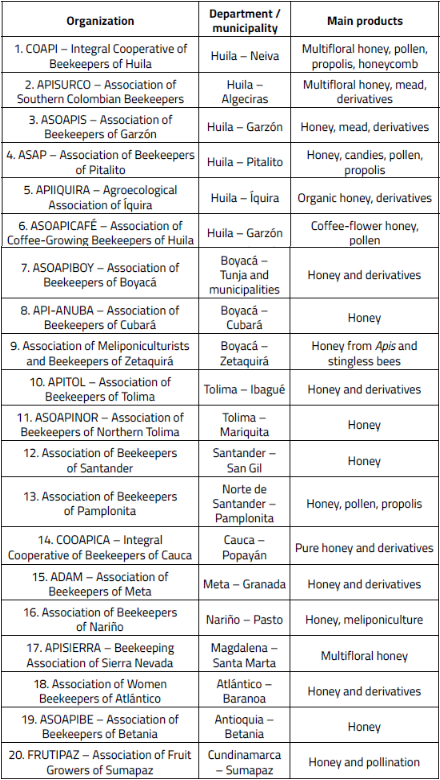
Applying these criteria resulted in a set of twenty organizations located in eleven departments: Huila, Boyacá, Tolima, Meta, Santander, Cauca, Antioquia, Nariño, Magdalena, Atlántico, and Cundinamarca. This set of cases does not seek statistical representativeness; instead, it is configured as an analytically diverse sample that reflects different beekeeping trajectories and territorial configurations (López et al., 2025; Castro et al., 2017).
Variables and comparative matrix
The information collected for each organization was organized in a comparative matrix. The initial core variables were: name of the organization; department and municipality; main beekeeping products and derivatives.
In order to enrich the characterization and respond to analytical needs identified in the literature, additional variables were incorporated whenever information was available, including: year of establishment; approximate number of members; participation of women in the membership or leadership; main commercialization channels (local markets, intermediaries, institutional purchases, fairs, etc.; type of production conventional, organic, agroecological or mixed; observations on missing information or special features, clearly coded using the label “N/D” (no data) when information could not be verified (Neugen & Suh, 2023).
This structure allows not only organizing dispersed information but also identifying convergences and differences among organizations, which is fundamental for building a descriptive typology and for observing territorial and organizational patterns. (Table 1).
Data processing and analytical strategy
The documentary information was processed through the following steps:
-
1. Compilation and systematization of sources, classifying them by type (academic, institutional, guild, technical) and by territorial scope (national, regional, local).
-
2. Identification and extraction of relevant data for each organization, according to the variables defined in the matrix.
-
3. Cross-checking (triangulation) of information among different sources to verify consistency and correct possible errors or discrepancies in names, locations, activities (Rodríguez,2025).
-
4. Coding of missing or uncertain information as “N/D” to ensure transparency and avoid inferring undocumented attributes.
-
5. Descriptive analysis of the matrix, oriented toward identifying patterns of territorial distribution, organizational forms, diversification of product portfolios, and observed tendencies in terms of membership and participation (Lim, 2025; Tenny & Brice, 2022).
The analytical strategy is exclusively descriptive. No statistical tests are performed, and no models are estimated to infer relationships between variables. Instead, the focus is on articulating the empirical description with theoretical and conceptual contributions from the literature on SSE, rural associativity, and beekeeping (Gómez, 2025d; Ali et al., 2024).
Limitations
The study presents several limitations that condition the scope of the results:
-Dependence on secondary data, which may contain omissions, inconsistencies, or biases related to the interests of the entities that produced them;
-Absence of standardized indicators on production volumes, economic performance, social capital, and environmental practices for most organizations;
-Limited information on internal governance, decision-making mechanisms, and membership composition, including gender and age;
-Heterogeneity in the temporal coverage of sources, which may mix information generated at different moments without allowing a precise reconstruction of trajectories (Khoa, 2023).
These limitations mean that the findings should be interpreted as an exploratory and descriptive mapping, rather than as a comprehensive diagnosis of solidarity-based beekeeping in Colombia (Arias & Maldonado, 2025).
Results
Territorial distribution of organizations
The twenty solidarity-based beekeeping organizations identified are located in eleven departments, with a marked concentration in Huila, Tolima, Antioquia, Boyacá, and Meta. In Huila, several associations and cooperatives have emerged in recent years, which link beekeeping with other agricultural activities and rural development projects. In Tolima, organizations such as APITOL represent historical experiences with more than five decades of trajectory, which have contributed to structuring the local beekeeping chain and to positioning the department as a relevant producer (Maluf, 2021; Barbosa et al., 2021).
In Antioquia, the presence of associations such as ASOAPIBE and other collective initiatives reflects a process of organizational densification that has accompanied the expansion of beekeeping activity and its integration into regional markets. In Meta, the consolidation of associations that articulate beekeeping with other production systems (livestock, crops, agroforestry) suggests a growing insertion into broader value chains and potential articulation with territorial development policies
Departments such as Magdalena, Atlántico, Nariño, and Norte de Santander present a smaller number of documented organizations, but their inclusion in the matrix is important because it evidences the existence of solidarity-based beekeeping initiatives in coastal, Andean, and border territories with distinct socio-environmental conditions. The territorial mapping derived from the matrix thus offers a first approximation to the geographic spread of solidarity-based beekeeping in Colombia, without implying statistical representativeness or exhaustive coverage (Gómez y Barbosa, 2024).
Productive activities and diversification
In all cases, the production of multifloral honey is reported as the central activity of the organizations. However, the matrix also records processes of diversification toward a variety of products and services, including: pollen; propolis and propolis-based preparations; beeswax, comb honey, and wax-based products; flavored, creamed, or monofloral honeys; candies, sweets, and other processed goods; mead and other fermented beverages; pollination services associated with certain crops (Prodanović et al., 2024).
Two organizations, located in Boyacá and Nariño, explicitly report the practice of meliponiculture, that is, the management of stingless bees and the production of differentiated honey with cultural and medicinal value (Mora, 2012; García, 2022). These experiences are consistent with literature that associates meliponiculture with the conservation of native species, the valorization of local knowledge, and the diversification of rural livelihoods (Rendón & Gómez, 2020).
The information available does not permit quantifying production volumes or determining the relative contribution of each product to total organizational income. Therefore, the presence of diversified product portfolios is interpreted strictly as a descriptive indicator of the range of activities developed, rather than as evidence of increased competitiveness or income (Martínez et al., 2024; Huerta et al., 2022).
Organizational forms and membership characteristics
Most of the organizations in the sample are legally constituted associations, followed by cooperatives and, in a smaller proportion, pre-cooperatives or other solidarity figures. In several cases, the year of establishment is documented, which allows distinguishing between organizations with long trajectories (such as APITOL in Tolima or certain associations in Antioquia and Meta) and newer organizations created in the last decade under the stimulus of public policies and development programs that promote productive alliances and associative strategies (Ministry of Agriculture, 2021; 2020).
In those cases, where membership information is available, the organizations range from small groups of a dozen beekeepers to entities with several dozen associated members. Some cases highlight the participation of women as beekeepers, leaders, or members of the boards of directors, particularly in Atlántico and Magdalena, where beekeeping has been incorporated into broader strategies of women’s economic empowerment. However, such information is not generalized across all cases and is often presented in qualitative rather than quantitative terms (Gómez et al., 2025; Barrientos et al., 2021).
Due to the absence of standardized and systematic records, the analysis cannot establish comparative indicators regarding membership size, gender composition, or degree of participation. Even so, the available data suggest that solidarity-based beekeeping organizations constitute relevant spaces for building social capital and for experimenting with forms of collective management of productive activities (Maldonado, 2024).
Information gaps and constraints
One of the main results of the characterization is the identification of significant information gaps. In most organizations, there are no public data on: production volumes disaggregated by product; economic performance (income, costs, profitability; internal governance structures (assembly functioning, board of directors, mechanisms of accountability); formal and informal networks established with other organizations, institutions, and markets; environmental management practices related to the use of inputs, adaptation to climate variability, or protection of pollinator habitats.
These gaps confirm the diagnosis made by various authors regarding the weaknesses of information systems in the beekeeping sector in Latin America (Muñoz, 2020). The lack of standardized and accessible data not only limits academic analysis but also hampers the design, implementation, and evaluation of public policies aimed at promoting the sector and at recognizing the contributions of solidarity-based organizations (Gómez, 2024a; Da Silva et al., 2018).
Discussion
The descriptive patterns identified in the matrix allow articulating the empirical characterization with several key debates in the literature on SSE, rural associativity, and beekeeping.
First, the territorial distribution of organizations, with a concentration in departments such as Huila, Tolima, Antioquia, and Meta, is consistent with the thesis that solidarity-based organizations tend to emerge and consolidate in territories where there is a productive trajectory, institutional support, and networks of organizations that provide a favorable environment for cooperation (González & Jaramillo, 2022). Although the available data do not allow determining the exact weight of these territories in the national panorama, they do show that solidarity-based beekeeping is not confined to a single region but is embedded in diverse territorial dynamics (Barbiéri & Francoy, 2020; Maldonado, 2025).
Second, product diversification-expressed in the production of pollen, propolis, wax derivatives, candies, and mead-echoes analyses that link solidarity-based organizations with processes of value addition, construction of short commercialization circuits, and exploration of niche markets for differentiated products (Craviotti & Soleno, 2016; Medina & García, 2020; Martinez et al., 2024). In the present study, diversification is interpreted as a descriptive tendency that reveals the capacity of organizations to experiment with new products and services; however, in the absence of economic indicators, it is not possible to infer its impact on income, profitability, or market positioning (Alcívar, 2024 Gómez, 2024b).
Third, the presence of meliponiculture in some organizations connects the empirical findings with discussions on the multiple values of beekeeping, which go beyond conventional production and include ecological, cultural, and symbolic dimensions (Mora, 2012; García, 2022; Rendón & Gómez, 2020). These cases suggest that solidarity-based organizations can serve as platforms for incorporating practices that integrate biodiversity conservation, valorization of local knowledge, and economic diversification. Nevertheless, the small number of documented cases and the limitations of the available information prevent generalizing this pattern or attributing it exclusively to the solidarity nature of the organizations (Herab et al., 2023)
Fourth, the identification of experiences in which women play a leading role in beekeeping production and organizational management is coherent with contributions that associate the SSE with processes of inclusion, empowerment, and recognition of historically marginalized actors (Coraggio, 2020; Osorio & Rojas, 2023; Martinez, 2023; Malagón et al., 2022). The cases recorded in Atlántico and Magdalena illustrate how beekeeping can become a space for diversifying women’s income and strengthening their participation in local economies; however, due to the limitations of the data, these observations must be understood as indicative rather than conclusive (Virlanuta, 2014).
Taken together, these elements support the idea that solidarity-based beekeeping organizations constitute relevant actors for strategies of sustainable rural development, as they integrate productive, social, and environmental dimensions in their practices (Sánchez & Herrera, 2017; Meyer, 2020; Coraggio, 2020; Altschuler et al., 2025). Even so, the findings of this study do not allow quantifying or evaluating the magnitude of these contributions, nor do they make it possible to determine under what specific conditions they materialize in terms of economic performance, social inclusion, or environmental impact (Garzón et al., 2023; 2022).
The main contribution of the article lies, therefore, in offering an initial descriptive mapping and in highlighting the need to strengthen information systems and analytical frameworks that adequately capture the complexity of solidarity-based beekeeping (ILO, 2024) Future studies could incorporate mixed methodologies that combine documentary review, quantitative data, and qualitative fieldwork to deepen the analysis of organizational dynamics, governance, commercialization strategies, and socio-environmental effects (Rendón & Gómez, 2022).
Conclusions
This article provides an exploratory and descriptive characterization of twenty solidarity-based beekeeping organizations in Colombia, based on the systematization of secondary information. The analysis reveals that these organizations are present in multiple departments and that they develop a variety of productive activities that go beyond the production of multifloral honey, including honey derivatives and, in some cases, meliponiculture.
From the perspective of the social and solidarity economy, the findings suggest that these organizations constitute spaces where cooperation, collective management, and community-oriented values are articulated with productive practices. However, given the limitations of the information used, the study does not make it possible to evaluate the scale or distribution of the productive, social, or environmental effects associated with these organizations.
The main contributions of the study can be summarized as follows:
-
1. It systematizes dispersed and heterogeneous information on solidarity-based beekeeping organizations, producing a comparative matrix that can serve as a reference for future research.
-
2. It identifies descriptive patterns related to territorial distribution, product portfolio, and organizational forms, revealing the diversity and heterogeneity of solidarity-based beekeeping in the country.
-
3. It documents structural information gaps that affect both academic analysis and public policy design, especially in relation to production volumes, economic performance, governance, and gender participation.
At the same time, the research presents important limitations:
-It is based exclusively on secondary sources, which constrain the precision and depth of the analysis.
-It does not include standardized indicators for evaluating the economic, social, or environmental impact of organizations.
-It lacks systematic information on internal governance, networks, and membership composition.
Consequently, the conclusions of this article should be interpreted as descriptive and non-causal. The study offers a baseline rather than a comprehensive evaluation of the contribution of beekeeping to the social and solidarity economy in Colombia.
Future research could address these limitations by:
-Combining documentary review with fieldwork through interviews, surveys, and participatory observation;
-Designing and applying indicators aligned with the dimensions of the SSE (economic, social, environmental, and political-cultural);
-Conducting comparative case studies that explore in depth the internal governance, commercialization strategies, and socio-environmental practices of selected organizations;
-Incorporating a more robust gender and generational perspective, with disaggregated data and specific analytical tools.
In addition, strengthening official and guild information systems, and promoting coordination among beekeeping organizations, federations, and public institutions, will be fundamental to generate reliable and accessible data that support evidence-based decision-making and the recognition of the role of solidarity-based beekeeping in territorial development.
References
-
Aguilera, M., Rincón, H., & Gómez, D. (2020). Bioeconomía, una alternativa de investigación en administración y afines. En M. Aguilera , H. Rincón , & D. Gómez , Temas y métodos de investigación en negocios, administración, mercadeo y contaduría, 193-225. Editorial Uniagustiniana. https://editorial.uniagustiniana.edu.co/index.php/editorial/catalog/view/50/71/866
» https://editorial.uniagustiniana.edu.co/index.php/editorial/catalog/view/50/71/866 -
Alcívar, I. (2024).La apicultura y su aporte al desarrollo comunitario en Manabí, Ecuador. Agroecología Global, 6(10), 58-74. https://doi.org/10.35381/a.g.v6i10.3237
» https://doi.org/10.35381/a.g.v6i10.3237 -
Ali, M. D., Al-Hatef, E. J., & Alamri, H. S. (2024). A concise review of qualitative research methods in healthcare research. Journal of Young Pharmacists, 16(3), 374-384. https://doi.org/10.5530/jyp.2024.16.49
» https://doi.org/10.5530/jyp.2024.16.49 -
Altschuler, B., Isola, F., Sciarretta, V., & Monzón, A. L. M. (2025). Circuitos socioeconómicos alimentarios de la economía popular, social y solidaria: Avances y desafíos desde Argentina.Revista de Ciencias Sociales
,
38(57), e218. https://doi.org/10.26489/rvs.v38i57.5
» https://doi.org/10.26489/rvs.v38i57.5 -
Andrieu, J., Bernal, E. Mozas, A. & Fernández, D.(2023). Sustainable Development Goals in the beekeeping sector and its cooperative network. CIRIEC-España, Revista de Economía Pública, Social y Cooperativa, 109, 185-212. https://doi.org/10.7203/CIRIEC-E.109.27026
» https://doi.org/10.7203/CIRIEC-E.109.27026 -
Arias, W., & Maldonado, C. (2025). Diseño metodológico: más allá de una verdad a toda costa. Revista Perspectivas, 10(2). https://doi.org/10.22463/25909215.5277
» https://doi.org/10.22463/25909215.5277 -
Asociación Nacional de Industriales (ANDI). (2017). Línea base de la población de apicultores en Colombia ANDI. https://abejasenagricultura.org/wp-con- tent/uploads/2018/07/Linea-de-Base-Poblacion-Apicultores.pdf
» https://abejasenagricultura.org/wp-con- tent/uploads/2018/07/Linea-de-Base-Poblacion-Apicultores.pdf -
Barbiéri, C., & Francoy, T. (2020). Theoretical model for interdisciplinary analysis of human activities: Meliponiculture as an activity that promotes sustainability. Ambiente & Sociedade, 23, e0202. https://doi.org/10.1590/1809-4422asoc20190020r2vu2020l4ao
» https://doi.org/10.1590/1809-4422asoc20190020r2vu2020l4ao -
Barbosa, E., Rojas, J., & Gómez, D. (2021). Prueba piloto del Plan Nacional de Fomento de la Economía Solidaria y Cooperativa Rural - PLANFES. Estudio del caso del municipio de San Antero, Córdoba, Colombia. Otra economía: revista latinoamericana de economía social y solidaria, 14(25), 77- 94. https:// revistaotraeconomia.org/index.php/otraeconomia/article/view/14924
» https:// revistaotraeconomia.org/index.php/otraeconomia/article/view/14924 -
Barbosa, E., Vargas, H., & Gómez, D. (2020). Breve estudio bibliométrico sobre economía solidaria. Cooperativismo & Desarrollo, 28(118), 1-20. https://doi.org/10.16925/2382-4220.2020.03.05B
» https://doi.org/10.16925/2382-4220.2020.03.05B -
Barrientos, A. H., Saldaña, M., & Vera, A. (2021). Sustainable beekeeping cooperative societies: The case of Mexico City. International Journal of Food Science and Agriculture, 5(1), 76-84. https://www.hillpublisher.com/UpFile/202102/20210205183041.pdf
» https://www.hillpublisher.com/UpFile/202102/20210205183041.pdf - Bunge, M. (1969). La investigación científica: Su estrategia y su filosofía Ariel.
- Bunge, M. (1980). Epistemología Ariel.
- Bunge, M. (1997). Ciencia y desarrollo Siglo XXI.
- Carballido, D. (2013). Concepto de territorio: ¿arma de distracción masiva? Didáctica y Prácticas docentes. Quehacer educativo (121) 43-47.
-
Coraggio, J. (2020). La economía social y solidaria en América Latina: conceptos y prácticas Clacso. https://libreria.clacso.org/publicacion.php?p=2322&c=1
» https://libreria.clacso.org/publicacion.php?p=2322&c=1 -
Corporación Colombiana de Investigación Agropecuaria (Corpoica). (2012). Manual técnico de apicultura abeja (Apis mellifera) Corpoica. https://repository.agrosavia.co/bitstream/handle/20.500.12324/32817/Ver_documento_32817.pdf?sequence=1&isAllowed=y
» https://repository.agrosavia.co/bitstream/handle/20.500.12324/32817/Ver_documento_32817.pdf?sequence=1&isAllowed=y -
Craviotti, C., & Soleno, R. (2016). Circuitos cortos de comercialización agroalimentaria: un acercamiento desde la agricultura familiar diversificada en Argentina. Mundo Agrario, 16(33). https://www.mundoagrario.unlp.edu.ar/arti-cle/view/mAv16n33a01
» https://www.mundoagrario.unlp.edu.ar/arti-cle/view/mAv16n33a01 -
Cueto, E., Arboleda, O., Zabala , & Echeverry, F. (2018). Una década de economía social y solidaria en Colombia: análisis de la producción investigativa y académica 2005-2015 Corporación Universitaria Minuto de Dios-Uniminuto y Universidad Católica Luis Amigó. https://repository.uniminuto.edu/server/ api/core/bitstreams/32bf15b4-cfdd-4a43-a05f-5853a7b9e9b9/content
» https://repository.uniminuto.edu/server/ api/core/bitstreams/32bf15b4-cfdd-4a43-a05f-5853a7b9e9b9/content -
Da Silva, M. G., Gonçalves, A. F., & Furtado, G. D. (2018). A beekeeping and rotary solidary funds: Are there possibilities for sustainable territorial development? Environmental Smoke, 1(2), 184-204 https://doi.org/10.32435/envsmoke.201812184
» https://doi.org/10.32435/envsmoke.201812184 - Dávila, R., Vargas, A., Blanco, L, Roa, E, Cáceres, L., & Vargas, L. (2018). Características de la economía solidaria colombiana. Aproximaciones a las corrientes influyentes en Colombia, CIRIEC España. Revista de Economía Pública, Social y Cooperativa, (93), 85-113.
-
Federación Colombiana de Apicultores y Criadores de Abejas (Fedeabejas). (2025) Asociaciones. Fenapicol. https://www.fenapicol.com
» https://www.fenapicol.com -
García, M. (2022). Meliponicultura como estrategia de conservación y desarrollo rural en Boyacá, Colombia. Revista Colombiana de Ciencias Pecuarias, 35(2), 101-110. https://doi.org/10.17533/udea.rccp.v35n2a05
» https://doi.org/10.17533/udea.rccp.v35n2a05 -
Garzón, B., Barbosa, E., & Gómez, D. (2022). Política pública en la pandemia desde la economía solidaria: circuitos cortos de comercialización-C.C.C. en Colombia (2020- 2021). Apuntes de Economía y Sociedad, 3(1), 25-36. https://doi.org/10.5377/aes.v3i1.14287
» https://doi.org/10.5377/aes.v3i1.14287 -
Garzón, B., Barbosa, E., & Gómez, D. (2023). Las organizaciones comunales como gestoras de reactivación económica: mercados campesinos solidarios en el municipio el Playón, Santander. CIRIEC Colombia, (1), 245-257. https://doi. org/10.58415/revciriec.v1n1a17
» https://doi.org/10.58415/revciriec.v1n1a17 -
Gómez, D. (2024a). Diálogos entre Agrociencias y Economía Solidaria: perspectivas para un desarrollo rural sostenible. Gizaekoa- Revista Vasca de Economía Social, (21). https://doi.org/10.1387/gizaekoa.26249
» https://doi.org/10.1387/gizaekoa.26249 - Gómez, D. (2024b). La producción de alimentos para autoconsumo. Revista Multidisciplina Voces de América y el Caribe, 1(1), 52-79.
-
Gómez, D. (2025a). De la colmena al tejido social: abejas como modelo de economía solidaria. Ciencias Económicas 6 (12),17-32. https://revistascientificas.una.py/index.php/reco/article/view/6041
» https://revistascientificas.una.py/index.php/reco/article/view/6041 - Gómez, D. (2025b). Conversaciones sobre economías, territorio y sostenibilidad según enseñanzas papales. Revista De Educación Religiosa, 3(4), 42-53. https://doi.org/10.38123/rer.v3i4.678
-
Gómez, D. (2025c). Sostenibilidad agrícola: integrando Agrociencias y Economía Ecológica. Revista Internacional De Desarrollo Humano Y Sostenibilidad, 2(2), 37- 64. 10.51660/ridhs22304
» https://doi.org/10.51660/ridhs22304 -
Gómez, D. (2025d). Social metabolism and oil palm territories in Colombia (2020-2024): material flows, water, biodiversity, and socio-ecological conflicts. Perspectiva XXI, 3(4), 238-263. https://doi.org/10.70577/h59afv74
» https://doi.org/10.70577/h59afv74 -
Gómez, D., & Barbosa, E. (2024). Diálogos entre la economía solidaria y las nuevas ruralidades: estrategias para el desarrollo sostenible. Cultura Científica, (21).https://revista.jdc.edu.co/Cult_cient/article/view/835
» https://revista.jdc.edu.co/Cult_cient/article/view/835 -
Gómez, D., Martínez, C., & Barreto, J. (2024). From the Field to the Consumer: The Role of Agro sciences in the Optimization of Short Food Supply Chains. Prisma ODS: Revista Multidisciplinaria Sobre Desarrollo Sostenible, 3(1), 119-136.https://prismaods.latindes.org/index.php/pods/article/view/55
» https://prismaods.latindes.org/index.php/pods/article/view/55 -
Gómez, D., Martínez, C., & Lily, J. (2025). Gestión pública y circuitos cortos de comercialización de alimentos: estrategias para el desarrollo económico local y la sostenibilidad territorial.Región Científica
,4(2), 2025490. 10.58763/rc2025490
» https://doi.org/10.58763/rc2025490 -
Gómez, D., Martínez, Carlos D., & Barbosa, E. (2024). Solidarity economy and community economy Approaches that energize the new ruralities. Revista Economía, 76(123), 31-50. https://doi.org/10.29166/economa.v76i123.
» https://doi.org/10.29166/economa.v76i123 -
Herab, A., Al-Ghamdi, A., Alzahrani, K., Elhindi, K. M., Muddassir, M., & Kassem, H. S. (2023). A Framework for Quantifying the Strength of Partnerships between Agricultural Cooperatives and Development Actors: A Case Study in Saudi Arabia. International Journal of Environmental Research and Public Health, 20(1), 364. https://doi.org/10.3390/ijerph20010364
» https://doi.org/10.3390/ijerph20010364 -
Huerta, A., Saldaña, M. Ángel, Ávila, L., & Vera, A. (2022). Cadena de valor sustentable de la apicultura en la Ciudad de México apoyada en la innovación sociocultural.RDP Revista Digital De Posgrado, (4), 8-21. https://doi.org/10.22201/fesa.rdp.2022.4.02
» https://doi.org/10.22201/fesa.rdp.2022.4.02 -
International Labour Organization (ILO). (2024). Empowering beekeeping in Tunisia: ILO’s support for sustainable livelihoods through the Social and Solidarity Economy ILO. https://www.ilo.org/resource/news/empowering-beekeeping-tunisia-ilos-support-sustainable-livelihoods-through?utm_source=chatgpt.com
» https://www.ilo.org/resource/news/empowering-beekeeping-tunisia-ilos-support-sustainable-livelihoods-through?utm_source=chatgpt.com -
Laville, JL (2013). The social and solidarity Economy: A Theoretical and Plural Framework United Nations Research Institute for Social Development (UNRISD). https://knowledgehub.unsse.org/wp-content/uploads/2023/08/The-Social-and-Solidarity-Economy.pdf
» https://knowledgehub.unsse.org/wp-content/uploads/2023/08/The-Social-and-Solidarity-Economy.pdf -
Liberati, A., Altman, D. G., Tetzlaff, J., Mulrow, C., Gøtzsche, P. C., Ioannidis, J. P., Clarke, M., Devereaux, P. J., Kleijn, J., & Moher, D. (2009). The PRISMA statement for reporting systematic reviews and meta-analyses of studies that evaluate health care interventions: explanation and elaboration. Journal of clinical epidemiology, 62(10), e1-e34. https://doi.org/10.1016/j.jcli-nepi.2009.06.006
» https://doi.org/10.1016/j.jcli-nepi.2009.06.006 -
Lim, W. M. (2025). What is qualitative research? An overview and guidelines. Qualitative Research Journal, 33(2). https://doi.org/10.1177/14413582241264619
» https://doi.org/10.1177/14413582241264619 -
López, C., Gómez, D., & Santana, L. (2025). Evolución de la administración de empresas: Un análisis bibliométrico desde la perspectiva de la dinámica empresarial global. Revista Academia & Negocios, 11(1), 1-14. https://doi.org/10.29393/RAN11-10EALR30010
» https://doi.org/10.29393/RAN11-10EALR30010 -
Malagón, R., et al. (2022). Cocina raizal colombiana del archipiélago de San Andrés, Providencia y Santa Catalina Sena. https://repositorio.sena.edu.co/handle/11404/7837
» https://repositorio.sena.edu.co/handle/11404/7837 - Maldonado, C. (2018). Bioeconomía, Biodesarrollo y civilización. Un mapa de problemas y soluciones. En Epistemologías del Sur para germinar alternativas de desarrollo. Debate entre Enrique Leff, Carlos Maldonado y Horacio Machado (pp. 57-81). Universidad del Rosario.
-
Maldonado, C. (2024). Hacia una epistemología de los sistemas complejos: Crítica a la racionalidad lineal. Foundations of Science, 29(1), 1-18. https://doi.org/10.1007/s10699-023-09930-1
» https://doi.org/10.1007/s10699-023-09930-1 -
Maldonado, C. (2025). Aprendizaje de los saberes originarios en Abya-Yala como clave para una nueva civilización.Inter Disciplina,13(36), 19-37. https://doi.org/10.22201/ceiich.24485705e.2025.36.91338.
» https://doi.org/10.22201/ceiich.24485705e.2025.36.91338 -
Martínez, C., Gómez, D., Barbosa, E. & Avellaneda, Z. (2024). Tendencias emergentes: diálogos entre la sostenibilidad ambiental en la gestión de proyectos de innovación social para un futuro sostenible. Ciencia y Sociedad, 49(2), 77-87.https://revistas.intec.edu.do/index.php/ciso/article/view/3034/3679
» https://revistas.intec.edu.do/index.php/ciso/article/view/3034/3679 -
Medina, N., & García, I. (2020). Formación de los circuitos económicos solidarios interculturales en el cantón Cayambe. Estudio de caso Biovida. Revista Economía, 72(11) 63-79. https://doi.org/10.29166/economia.v72i116.2621
» https://doi.org/10.29166/economia.v72i116.2621 -
Ministerio de Agricultura y Desarrollo Rural (Minagricultura). (2021). Informe sectorial de la cadena de las abejas y la apicultura en Colombia MinAgricultura. https://sioc.minagricultura.gov.co/Apicola/Documentos/2020-03-31%20Cifras%20Sectoriales.pdf
» https://sioc.minagricultura.gov.co/Apicola/Documentos/2020-03-31%20Cifras%20Sectoriales.pdf -
Ministerio de Agricultura y Desarrollo Rural (Minagricultura). (2020). Cadena de las Abejas y la Apicultura Dirección de Cadenas Pecuarias, Pesqueras y Acuícolas. https://sioc.minagricultura.gov.co/Apicola/Documentos/2020-03-31%20Cifras%20Sectoriales.pdf
» https://sioc.minagricultura.gov.co/Apicola/Documentos/2020-03-31%20Cifras%20Sectoriales.pdf -
Mora, S. (2012). Las empresas del sector agropecuario: racionalidad económica y gestión. AD-minister, (21), 87-99.http://www.scielo.org.co/scielo.php?script=sci_arttext&pid=S1692-02792012000200006&lng=en&tlng=es
» http://www.scielo.org.co/scielo.php?script=sci_arttext&pid=S1692-02792012000200006&lng=en&tlng=es -
Mukherjee, D., Lim, W., Kumar, S., & Donthu, N. (2022). Guidelines for advancing theory and practice through bibliometric research. Journal of Business Research, 148, 101-115. https://doi.org/10.1016/j.jbusres.2022.04.042
» https://doi.org/10.1016/j.jbusres.2022.04.042 -
Muñoz, E. (2020).Sistemas de producción convencionales y agroecológicos asociados al conocimiento tradicional de la apicultura en tres municipios del departamento del Cauca, Colombia (Tesis doctoral). Universidad Nacional de Colombia. https://repositorio.unal.edu.co/handle/unal/76739
» https://repositorio.unal.edu.co/handle/unal/76739 -
Neira, J. (2021). Estudio documental sobre la aplicación del Internet de las cosas en procesos agrícolas enfocado a la apicultura colombiana. Revista Sinapsis, 1(19), 2-16. https://dialnet.unirioja.es/servlet/articulo?codigo=8474736
» https://dialnet.unirioja.es/servlet/articulo?codigo=8474736 -
Neugen, E., & Suh, J. (2023). Qualitative Research Methodology in Social Sciences. International Journal of Scientific Research and Management (IJSRM), 11(9), 1431-1445. https://doi.org/10.18535/ijsrm/v11i09.sh01
» https://doi.org/10.18535/ijsrm/v11i09.sh01 -
Page, M., Moer, D., Bossuyt, P., Boutron, I., Hoffmann, T., Mulrow, C., Shamseer, L., Tetzlaff, J. M., Akl, E. A., Brennan, S. E., Chou, R., Glanville, J., Grimshaw, J. M., Hróbjartsson, A., Lalu, M. M., Li, T., Loder, E. W., mayo-Wilson, E., McDonald, S., McKenzie, J. E. (2021). PRISMA 2020 explanation and elaboration: Updated guidance and exemplars for reporting systematic reviews. BMJ, 160. https://doi.org/10.1136/bmj.n160
» https://doi.org/10.1136/bmj.n160 -
Prodanović, R., Brkić, I., Soleša, K., Ljubojević Pelić, D., Pelić, M., Bursić, V., & Vapa Tankosić, J. (2024). Beekeeping as a tool for sustainable rural development. Journal of Agronomy, Technology and Engineering Management, 7(2), 1054-1066. https://doi.org/10.55817/IXVM2800
» https://doi.org/10.55817/IXVM2800 -
Rendón, J., & Gómez, D. (2020). Circuitos cortos y verdes. Alimentos si hay. Revista Surhttps://www.sur.org.co/circuitos-cortos-y-verdes-alimentos-si-hay/
» https://www.sur.org.co/circuitos-cortos-y-verdes-alimentos-si-hay/ -
Rendón, J., & Gómez, D. (2022). Paisaje, territorio y agroindustria. El caso de la palma de aceite en Aracataca Magdalena Colombia. En Cuadernos de Seminario: Las Agrociencias en la dimensión de paisajes sostenibles, 13. Ediciones Unisalles. https://ciencia.lasalle.edu.co/items/7af7d39d-05fc-4fda-8fb6-018b95cea374/full
» https://ciencia.lasalle.edu.co/items/7af7d39d-05fc-4fda-8fb6-018b95cea374/full -
Rodríguez, D. (2025). Rescuing and socializing ancestral knowledge: the “Guineo Paso” in Aracataca and Ciénaga, Magdalena, Colombia.Revista De Gestão - RGSA
,
19(4), e011965. https://doi.org/10.24857/rgsa.v19n4-073
» https://doi.org/10.24857/rgsa.v19n4-073 -
Sánchez, A., & Herrera, E. (2017). Desarrollo rural local: un enfoque de desarrollo para el reconocimiento de la diversidad rural y los actores locales (Tesis de maestría). Universidad de la Salle. https://ciencia.lasalle.edu.co/items/41823067-6640-4689-a163-35c83edb2893/full
» https://ciencia.lasalle.edu.co/items/41823067-6640-4689-a163-35c83edb2893/full -
Tenny, S. & Brice, J. (2022). Qualitative Study. In StatPearls NCBI Bookshelf. https://www.ncbi.nlm.nih.gov/books/NBK470395/
» https://www.ncbi.nlm.nih.gov/books/NBK470395/ -
Virlanuta, F. O. (2014). Social cooperative - an important entity of the social economy. Annals of “Dunarea de Jos” University of Galati, Fascicle I: Economics and Applied Informatics, 20(2), 57-60. http://www.eia.feaa.ugal.ro/images/eia/2014_2/FlorinaVirlanuta.pdf
» http://www.eia.feaa.ugal.ro/images/eia/2014_2/FlorinaVirlanuta.pdf