Gingivitis in 12-year-old schoolchildren in Montevideo: prevalence and associated factors
Abstract
Gingivitis is more common in children and adolescents and is influenced by factors shared with non-communicable diseases (NCDs).
Objective. To study gingival inflammation and its relationship with risk indicators in 12-year-old schoolchildren from Montevideo.
Method. Secondary data from a population-based cross-sectional study conducted between 2011 and 2012 were used. Questionnaires, anthropometric measurements, and oral examinations were carried out.
Results. A total of 1,154 schoolchildren were examined, with a 66.6% response rate. Gingivitis was present in 70.2% (95% CI: 64.9-75.5) of participants, and was severe in 33.0% (95% CI: 27.7-38.2). Schoolchildren who reported brushing their teeth ≥3 times per day and those who were overweight/obese had an OR of 0.66 (95% CI: 0.46-0.95) and 1.57 (95% CI: 1.12-2.20), respectively, adjusted for school type and dental care.
Conclusions. A high prevalence of gingivitis was found, associated with tooth brushing habits and overweight/obesity, confirming the importance of incorporating dentistry into the common risk factor strategy for NCDs
Keywords:
Gingivitis; children 12 years old; prevalence; risk indicators
Resumen
La gingivitis es más frecuente en niños y adolescentes, influenciada por factores compartidos con enfermedades no transmisibles (ENTs).
Objetivo: Estudiar la inflamación gingival y su relación con indicadores de riesgo en escolares montevideanos de 12 años.
Método: Fueron utilizados datos secundarios de un estudio transversal poblacional realizado entre 2011-2012. Se emplearon cuestionarios, mediciones antropométricas y examen bucal.
Resultados: Fueron examinados 1.154 escolares con un 66,6% de respuesta. El 70,2% (IC 95%: 64,9-75,5) presentó gingivitis, siendo el 33,0% (IC 95%: 27,7-38,2) severa. Los escolares que declararon cepillarse ≥3 veces al día y tenían sobrepeso/obesidad presentaron OR: 0,66 (IC 95%: 0,46-0,95) y OR: 1,57 (IC 95%: 1,12-2,20) respectivamente, ajustado por tipo de escuela y atención odontológica
Conclusiones: Se halló una alta prevalencia de gingivitis, estando asociada al hábito de cepillado dental y a la condición de sobrepeso/obesidad, confirmando la importancia de incorporar la odontología en la estrategia de factores de riesgo común de las ENTs.
Palabras clave
Gingivitis; niños 12 años; prevalencia; indicadores de riesgo
Resumo
A gengivite é mais comum em crianças e adolescentes, influenciada por fatores compartilhados com as doenças crônicas não transmissíveis (DCNTs).
Objetivo: Estudar a inflamação gengival e sua relação com indicadores de risco em escolares de 12 anos de Montevidéu.
Método: Foram utilizados dados secundários de um estudo populacional transversal realizado entre 2011 e 2012. Foram utilizados questionários, medidas antropométricas e exame bucal.
Resultados: Foram examinados 1.154 escolares, com uma taxa de resposta de 66,6%. 70,2% (IC 95%: 64,9-75,5) apresentaram gengivite, sendo 33,0% (IC 95%: 27,7-38,2) grave. Os escolares que relataram escovar os dentes ≥3 vezes ao dia e estavam acima do sobrepeso/obesidade tiveram OR: 0,66 (IC 95%: 0,46-0,95) e OR: 1,57 (IC 95%:1,12-2,20), respectivamente, ajustados para tipo de escola e atendimento odontológico
Conclusões: Foi encontrada uma alta prevalência de gengivite, associada aos hábitos de escovação dentária e sobrepeso/obesidade. Confirmando a importância da incorporação da odontologia na estratégia de fatores de risco comuns para DCNTs.
Keyword
Gengivite; crianças 12 anos; prevalência; indicadores de risco
Introduction
According to the World Health Organization (WHO), periodontal disease (PD) is the second most prevalent oral disease. PD is a chronic condition that is prevalent worldwide 1) and has a negative impact on the quality of life of children and adolescents (2. Gingivitis is the most common periodontal disease in children (3, affecting more than 70% of children between the ages of 6 and 11. A review of the global literature showed that the prevalence of gingivitis increases considerably during puberty, with prevalence figures ranging from 50% to 99% 4.
Gingivitis is an inflammatory condition specific to the supra- and intra-crevicular site, initiated by the accumulation of dental biofilm. It is reversible and a precursor to periodontitis. It is characterized by bleeding during brushing, erythema, edema, sensitivity, and bad breath (5. However, its expression is influenced by other factors such as sociodemographic and behavioral factors that influence biological factors, and it can be said that the expression of gingivitis is socially modeled (6. In addition, it shares these risk factors with other NCDs such as obesity and hypertension 7. Its main risk indicators are age, sex, access to health services, place of residence, parents' educational level, and socioeconomic status, among others (6,8-13.
A recent study in Uruguay reported a high prevalence of gingivitis at age 12 8, and the average number of bleeding sites showed an association with some risk indicators (place of residence in departments bordering Brazil and low socioeconomic status). However, these associations were not adjusted for other variables present in the study, and analyses that take into account the complexity of this oral condition are necessary. Therefore, this study is the first nationwide study that aims to determine the prevalence and extent of gingivitis and analyze its adjusted relationship with different risk indicators in 12-year-old schoolchildren in Montevideo, Uruguay.
Methodology
Study design
Secondary data from a population-based analytical observational study were used for this work. This study was approved by the Ethics Committee of the Faculty of Dentistry of the Udelar, resolution No. 1 dated 12/11/12 14. A total of 1,154 12-year-old schoolchildren (934 from public schools and 220 from private schools) in Montevideo were examined. For more details, see the article by Fabruccini et al., 2016 14.
Data collection
Two questionnaires were administered. The first was aimed at parents or guardians and asked about sociodemographic indicators, such as the mother's educational level and access to health services for the child. The second questionnaire was aimed at schoolchildren and asked about behavioral factors such as oral hygiene and dietary habits.
Schoolchildren who submitted both completed questionnaires underwent a clinical examination. First, anthropometric measurements were taken, recording the height of the schoolchildren barefoot and wearing light clothing, using a tape measure placed perpendicular to the floor on a wall without a baseboard. Each child's weight was recorded twice on a digital scale, and after obtaining the two measurements, an average of both was calculated.
Second, the oral examination was performed by four previously trained examiners, using specially equipped furniture, portable lamps, cotton rolls to control humidity, mirrors, forceps, and sterile WHO standardized probes. The schoolchildren were examined in the supine position, and different oral conditions were recorded on a specific form.
For the gingivitis examination, the gingival bleeding index (GBI) of Ainamo et al. 16 was used, using the reference teeth of Ramfjord 17,18. The following teeth were examined in the upper jaw: 16, 21, 24, and in the lower jaw: 36, 41, and 44 18,19. Each tooth was examined by probing at different sites: distal, mesial, vestibular, and palatal or lingual. If any of the teeth were missing, the immediate proximal tooth was examined. Therefore, a total of 24 sites were studied.
The examination began on the buccal side of tooth 16, moving clockwise from distal to mesial, by sliding a blunt periodontal probe along the gingival sulcus at a 60-degree angle to the tooth axis, on the soft tissue wall, applying light pressure. The same maneuver was repeated on the buccal side of teeth 21 and 24, this time from mesial to distal. After 20-30 seconds, the presence or absence of bleeding was observed and recorded in the mesial, central, and distal areas. The examination continued on the palatal side, from distal to mesial for teeth 24 and 21, and from mesial to distal for tooth 16. After waiting 20-30 seconds, bleeding presence or absence was again recorded. The absence of marginal bleeding on probing was coded as 0, and its presence as 1. The same protocol was applied to the lower teeth 36, 41, and 44.
Training
Theoretical instruction was provided to standardize gingival examination, probe angulation, and pressure. Practical training was also conducted with four examiners in a school that was not part of the study sample. Calibration of gingival bleeding was not performed due to its non-reproducible nature.
Studied variables
The outcome variable “gingivitis” was defined using the GBI 15. A schoolchild was considered to have gingivitis if 10% or more of the sites showed gingival bleeding.
Those with ≥10% to ≤30% bleeding sites were classified as having localized gingivitis, and those with >30% as having generalized gingivitis 20. In addition, gingivitis extent was calculated based on the number of bleeding sites per individual.
The explanatory indicators included: Sociodemographic: sex (female or male), mother's educational level (primary, secondary, or university), type of school (state or private), and dental care (public sector, mutual/cooperative system, or private sector); behavioral: frequency of toothbrushing (once a day or less, twice a day, or three or more times a day). Last, the child’s nutritional status. Body mass index (BMI) was calculated using recorded anthropometric data by dividing weight in kg by height squared in cm. According to WHO 2007 child growth standards (21, children were classified by sex as follows: normal weight with a z score ˂1; overweight with a z score between 1 and 2; obese with a z score ≥2; and severely obese with a z score ≥3 (22.
Data analysis
Sample weights from the survey were calibrated using weighting adjustments to account for discrepancies between the 2010 school enrollment sampling frame and the 2011-2012 enrollment data collection. This weighting variable was based on the probability of school selection and the population distribution by gender, type of school (public and private), and each school's participation rate 14. Gingivitis was reported as a percentage (prevalence) and average number of affected sites (extent), with 95% confidence intervals (CI). Association analyses were conducted using different risk indicators (sociodemographic, behavioral, and biological). Wald Chi-square tests were applied to prevalence, and Student’s t-tests to gingivitis extent. Indicators with a p-value < 0.20 were included in logistic regression and Poisson models, adjusted for gingivitis prevalence and extent, respectively. Variables with a p-value ≤ 0.05 were considered significant.
Results
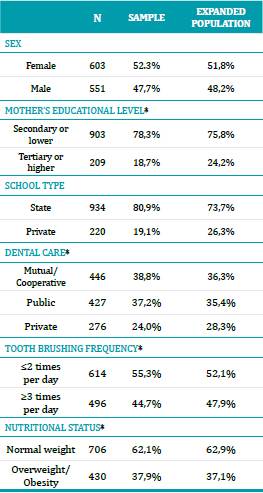
Of the 1,733 schoolchildren invited to participate, 1,154 were examined, yielding a response rate of 66.6%. In this group, 47.7% were male and 52.3% female. Seventy-eight point three percent had mothers with a secondary education or less, while the remainder had mothers with tertiary or higher education. In terms of dental care, 76% of the children used public or mutual/cooperative dental services, and 24% used the private sector. A total of 44.7% of schoolchildren reported brushing their teeth three or more times per day. Finally, 62.1% of children had a normal weight, and 37.9% were overweight or obese (Table 1).
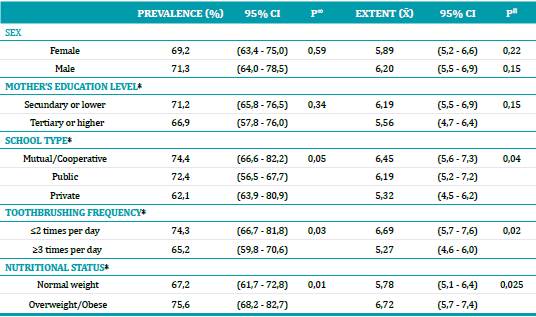
The overall prevalence of gingivitis was 70.2% (95% CI: 64.9-75.5), with 7 out of 10 schoolchildren presenting 10% or more sites with gingival bleeding. The mean number of bleeding sites was 6.04 (95% CI: 5.42-6.45). The prevalence of localized gingivitis was 37.2% (95% CI: 32.7-41.8), while generalized gingivitis accounted for 33.0% (95% CI: 27.7-38.2), meaning that 3 out of 10 schoolchildren had 30% or more bleeding sites. When analyzing the prevalence of gingivitis in relation to sociodemographic and behavioral variables, schoolchildren who reported brushing ≤2 times per day had a prevalence of 74.3% (95% CI: 66.7-81.8), which was significantly higher than among those who reported brushing three or more times per day. In addition, the average number of bleeding sites was significantly lower among schoolchildren who had access to private dental care and among those who reported brushing three or more times per day, with p-values of 0.04 and 0.02, respectively.
Similarly, overweight or obese schoolchildren had a gingivitis prevalence of 75.6% and an average of 6.72 bleeding sites, both significantly higher than those observed among schoolchildren with normal weight, with p = 0.01 and p = 0.02, respectively (Table 2).
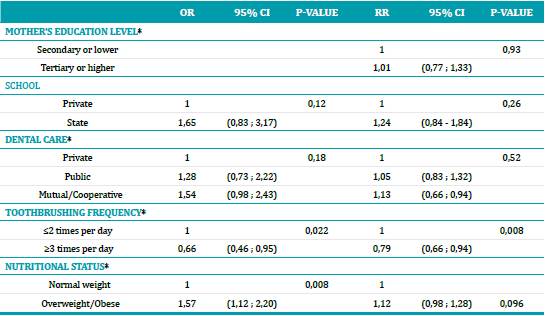
Finally, schoolchildren who reported brushing three or more times per day were less likely to present gingivitis than those who brushed two or fewer times per day (OR = 0.66, 95% CI: 0.46-0.95), while overweight/obese schoolchildren were more likely to present gingivitis (OR = 1.57, 95% CI: 1.12-2.20), in the analysis adjusted for school type and type of dental care. Furthermore, schoolchildren who reported brushing three or more times per day had fewer bleeding sites than those who brushed two or fewer times per day (RR = 0.79, 95% CI: 0.66-0.94), adjusted for sociodemographic variables and nutritional status (Table 3).
Discussion
This was the first cross-sectional study to evaluate the prevalence and extent of gingival bleeding and its adjusted association with different risk indicators in 12-year-old Uruguayan schoolchildren. A high prevalence of gingivitis was found: 7 out of 10 children presented gingivitis (70.2%, 95% CI: 64.9-75.5), suggesting that this oral disease represents a public health problem.
A preliminary report from the national study conducted in 2010-2011, which applied the gingival bleeding index to the same reference teeth, found a prevalence of gingivitis of 93% among 12-year-old Uruguayan schoolchildren. The nearly 23% difference in prevalence compared to this study can be explained by the definition of a gingivitis case. Angulo et al. (8 defined a case as an individual with at least one site with bleeding on probing, whereas in this study, a case was defined as having 10% or more sites with bleeding. Similar findings were reported in studies conducted in China at age 12 using the Community Periodontal Index to assess gingival bleeding. Studies by Chen et al. (11 and Du et al. (12, which defined a case as having at least one bleeding site, found a prevalence of 46.6% and 48.9%, respectively. In contrast, studies by Liu et al. (23 and Fan et al. (10, which defined a case as having 10% or more bleeding sites, reported prevalence rates of 28.6% and 29.6%, respectively. These differences underscore the importance of case definition for making comparisons both globally and nationally (24. For this reason, this study followed the case definition recommended by the 2017 Global Workshop (20, allowing for improved surveillance.
Furthermore, the mean number of bleeding sites was 6.04 (95% CI: 5.42-6.45). Schoolchildren who reported brushing their teeth three or more times a day had a 21% reduction in the number of bleeding sites compared to those who brushed twice or less per day, with a relative risk (RR) of 0.79 (95% CI: 0.66-0.94), adjusted for sociodemographic and behavioral variables.
One limitation of this study is the potential bias introduced by assessing gingival bleeding using index teeth instead of examining all present teeth. However, a study that compared the plaque index, gingival index (GI), and papillary bleeding index found no significant differences between assessments based on index teeth and full dentitions. Moreover, both methods achieved high concordance (ICC > 0.9) across all indices 25. Another study 26) that compared periodontal health indicators-such as gingival bleeding, dental calculus, and periodontal pockets-using the CPI in partial versus full-mouth examinations, found some significant differences by sex and age. The authors concluded that partial-mouth exams underestimated the presence of periodontal pockets and overestimated calculus and bleeding. Nonetheless, a high level of agreement was found between partial and full-mouth examinations, supporting the continued use of partial assessments in population-based surveys due to their faster implementation, lower cost, and greater patient acceptability. This aligns with a review indicating that certain partial-mouth protocols yield estimates close to those from full-mouth assessments for periodontitis prevalence (27.
Periodontal disease is considered a complex multifactorial condition, and its major risk factors are shared with non-communicable diseases (NCDs). This is why the WHO advocates for policies focused on social determinants and shared risk factors with NCDs to prevent both conditions (7. In this study, schoolchildren who reported brushing three or more times a day were 34% less likely to present gingivitis compared to those with lower brushing frequency (OR = 0.66, 95% CI: 0.46-0.95), while overweight or obese schoolchildren were 57% more likely to have gingivitis than those of normal weight (OR = 1.57, 95% CI: 1.12-2.20), after adjusting for school type and dental care.
Gingivitis is an inflammatory response of the gingival tissues resulting from the accumulation of supra- and subgingival bacterial plaque 23. Therefore, behaviors that promote oral hygiene may lead to a reduction in the prevalence of gingivitis. This has also been demonstrated in a regional study, which found that schoolchildren who reported brushing their teeth three or more times a day had an adjusted OR of 0.73 (95% CI: 0.41-0.83). Additionally, two Asian studies 11,23 reported similar associations in adjusted models, reinforcing the notion that the higher the frequency of daily brushing, the lower the amount of dental biofilm and the risk of developing gingivitis.
According to Lock et al. 9, obese children showed a 13% higher prevalence of gingivitis compared to their normal-weight peers-a finding consistent with that of the present study. Several systematic reviews have found a significant association between obesity and multiple periodontal parameters, including dental plaque, bleeding on probing, and probing depth in children and adolescents 28,29. Furthermore, studies have shown that the prevalence of gingivitis during puberty correlates with increased levels of sex hormones such as testosterone, estradiol, and progesterone, which are positively associated with higher levels of Prevotella intermedia and P. nigrescens (28. Gingivitis and obesity, both inflammatory conditions, therefore share a significant interrelationship 30.
Although this study is based on data from 2011-2012, over the past decade, average household income in Montevideo has shown minimal change (a difference of USD 33.5 between the first quarter of 2011 and the first quarter of 2023) 31. This variation is unlikely to have had a substantial impact on current socioeconomic indicators related to the reported prevalence. Moreover, the study found that 37.1% of schoolchildren were overweight or obese, which is comparable to the findings by Estragó et al. (32, who, four years later, reported a prevalence of 39.9%.
Conclusions
The high prevalence of gingivitis in 12-year-old schoolchildren in Montevideo underscores the importance and urgency of developing interdisciplinary programs aimed at adolescents to control shared risk factors for NCDs. Within this approach, the dental sector could play a key role in supporting health teams in the prevention and management of these conditions.
References
- 1 Jin L, Lamster I, Greenspan J, Pitts N, Scully C, Warnakulasuriya S. Global burden of oral diseases: emerging concepts, management and interplay with systemic health. Oral Dis. octubre de 2016;22(7):609-19.
- 2 Thomson WM, Broder HL. Oral-Health-Related Quality of Life in Children and Adolescents. Pediatric Clinics of North America. octubre de 2018;65(5):1073-84.
- 3 Oh TJ, Eber R, Wang HL. Periodontal diseases in the child and adolescent. J Clin Periodontol. mayo de 2002;29(5):400-10.
- 4 Pari A, Ilango P, Subbareddy V, Katamreddy V, Parthasarthy H. Gingival Diseases in Childhood - A Review. J Clin Diagn Res. octubre de 2014;8(10):ZE01-4.
- 5 Bueno DL. Facultad de Odontología Universidad de la República Oriental del Uruguay. :160.
- 6 Andrade E, Lorenzo S, Álvarez L, Fabruccini A, García MV, Mayol M, et al. Epidemiología de las Enfermedades Periodontales en el Uruguay. Pasado y presente. Odontoestomatología. 30 de noviembre de 2017;19(30):14-28.
- 7 Morales A, Bravo J, Baeza M, Werlinger F, Gamonal J. Las enfermedades periodontales como enfermedades crónicas no transmisibles: Cambios en los paradigmas. Revista Clínica de Periodoncia, Implantología y Rehabilitación Oral. agosto de 2016;9(2):203-7.
- 8 Angulo M, Bianco P, Cuitiño E, Silveira A. Relevamiento y análisis de caries dental, fluorosis y gingivitis en adolescentes escolarizados de 12 años de la República Oriental del Uruguay. En: Relevamiento y análisis de caries dental, fluorosis y gingivitis en adolescentes escolarizados de 12 años de la República Oriental del Uruguay. Montevideo: UdelaR, Ministerio de Salud Pública; 2010.
- 9 Lock NC, Susin C, Damé-Teixeira N, Maltz M, Alves LS. Sex differences in the association between obesity and gingivitis among 12-year-old South Brazilian schoolchildren. J of Periodontal Research. agosto de 2020;55(4):559-66.
- 10 Fan W, Liu C, Zhang Y, Yang Z, Li J, Huang S. Epidemiology and associated factors of gingivitis in adolescents in Guangdong Province, Southern China: a cross-sectional study. BMC Oral Health. 16 de junio de 2021;21:311.
- 11 Chen H, Zhang R, Cheng R, Xu T, Zhang T, Hong X, et al. Gingival bleeding and calculus among 12-year-old Chinese adolescents: a multilevel analysis. BMC Oral Health. diciembre de 2020;20(1):147.
- 12 Du A, Zhang H, Chen C, Zhang F, Liu X, Zhang Z, et al. Oral health of 12-year-old children in Jilin province, China: A population-based epidemiological survey. Medicine. diciembre de 2019;98(51):e18463.
- 13 Carvajal P. Enfermedades periodontales como un problema de salud pública: el desafío del nivel primario de atención en salud. Revista Clínica de Periodoncia, Implantología y Rehabilitación Oral. agosto de 2016;9(2):177-83.
- 14 Fabruccini A, Alves L s., Alvarez L, Alvarez R, Susin C, Maltz M. Comparative effectiveness of water and salt community-based fluoridation methods in preventing dental caries among schoolchildren. Community Dentistry and Oral Epidemiology. 2016;44(6):577-85.
- 15 Lorenzo DS, Alvarez LR. Prevalencia de caries en escolares de 12 años de diferente nivel socioeconómico, Montevideo, Uruguay, 2003. 2003;10.
- 16 Ainamo J, Bay I. Problems and proposals for recording gingivitis and plaque. Int Dent J. diciembre de 1975;25(4):229-35.
- 17 Van der Weijden GA, Timmerman MF, Nijboer A, Reijerse E, Van der Velden U. Comparison of different approaches to assess bleeding on probing as indicators of gingivitis. Journal of Clinical Periodontology. 1994;21(9):589-94.
- 18 Ramfjord SP. Indices for Prevalence and Incidence of Periodontal Disease. The Journal of Periodontology. 1959;30(1):51-9.
- 19 Beltrán-Aguilar ED, Eke PI, Thornton-Evans G, Petersen PE. Recording and surveillance systems for periodontal diseases. Periodontology 2000. 2012;60(1):40-53.
- 20 Trombelli L, Farina R, Silva CO, Tatakis DN. Plaque-induced gingivitis: Case definition and diagnostic considerations. J Clin Periodontol. junio de 2018;45:S44-67.
-
21 Growth reference data for 5-19 years (Internet). (citado 13 de abril de 2024). Disponible en: https://www.who.int/tools/growth-reference-data-for-5to19-years
» https://www.who.int/tools/growth-reference-data-for-5to19-years - 22 Fernández JR, Redden DT, Pietrobelli A, Allison DB. Waist circumference percentiles in nationally representative samples of African-American, European-American, and Mexican-American children and adolescents. J Pediatr. octubre de 2004;145(4):439-44.
- 23 Liu X, Xu J, Li S, Wang X, Liu J, Li X. The prevalence of gingivitis and related risk factors in schoolchildren aged 6-12 years old. BMC Oral Health. 21 de diciembre de 2022;22(1):623.
- 24 Page RC, Eke PI. Case Definitions for Use in Population-Based Surveillance of Periodontitis. J Periodontol. 2007;78(7).
- 25 ShariatmadarAhmadi R, Fard K, Mousavi V. Comparison of Partial and Full-Mouth Examination in Periodontal Assessment Among Untreated Patients. Journal of Dentistry of Tehran University of Medical Sciences. 1 de septiembre de 2009;6.
-
26 Coelho RS, Gusmao ES, Siqueira RACD, Donos N, Vajgel BCF, Cimões R. Are there differences between partial and total periodontal examination of the mouth? int arch med (Internet). 15 de septiembre de 2017 (citado 27 de mayo de 2024);10. Disponible en: http://imedicalpublisher.com/ojs/index.php/iam/article/view/2728
» http://imedicalpublisher.com/ojs/index.php/iam/article/view/2728 - 27 Tran DT, Gay I, Du XL, Fu Y, Bebermeyer RD, Neumann AS, et al. Assessing periodontitis in populations: a systematic review of the validity of partial-mouth examination protocols. J Clin Periodontol. diciembre de 2013;40(12):1064-71.
- 28 Li LW, Wong HM, Sun L, Wen YF, McGrath CP. Anthropometric measurements and periodontal diseases in children and adolescents: a systematic review and metaanalysis. Adv Nutr. noviembre de 2015;6(6):828-41.
- 29 Martens L, De Smet S, Yusof MYPM, Rajasekharan S. Association between overweight/obesity and periodontal disease in children and adolescents: a systematic review and meta-analysis. Eur Arch Paediatr Dent. abril de 2017;18(2):69-82.
- 30 Goodson JM. Disease reciprocity between gingivitis and obesity. J Periodontol. octubre de 2020;91 Suppl 1(Suppl 1):S26-34.
-
31 Estimación de la pobreza por el método del ingreso (Internet). Uruguay: Instituto Nacional de Estadística, 2023 (citado 27 de mayo de 2024). Disponible en: https://www5.ine.gub.uy/documents/Demograf%C3%ADayEESS/HTML/ECH/Pobreza/2023/Estimaci%C3%B3n%20se%20la%20pobreza%20por%20el%20m%C3%A9todo%20del%20ingreso%20primer%20semestre%202023.html
» https://www5.ine.gub.uy/documents/Demograf%C3%ADayEESS/HTML/ECH/Pobreza/2023/Estimaci%C3%B3n%20se%20la%20pobreza%20por%20el%20m%C3%A9todo%20del%20ingreso%20primer%20semestre%202023.html - 32 Estragó V, Tabárez A, Muñoz M, González G, Bulla D, Díaz J, et al. Sobrepeso, obesidad e hipertensión arterial en niños, una aproximación al problema. Archivos de Pediatría del Uruguay. octubre de 2018;89(5):301-10.