Dilemmas and ethical decision-making in Knowledge OrganizationDilemas y toma de decisiones éticas en las organizaciones del conocimiento
Abstract
Librarians assign classification numbers and indexing terms to documents through knowledge representation and knowledge organization systems, such as classification schemes, indexing languages, etc. When representation is not carried out in a reliable way, censorship, omission, or misrepresentation of information may occur. Librarians will have to deal with ethical values as well as cultural and linguistic boundaries, and they will face dilemmas that require ethical decision-making. Once librarians realize that unresolved ethical problems can be harmful to their community users, they should be respectful. Based on reports from specialized international literature, this paper proposes a discussion about the ways in which knowledge organization tools may present ethical dilemmas for librarians. By approaching the issue from an exploratory, bibliographic, and qualitative perspective, this study aims to provide elements for discussion both in courses related to knowledge organization and other areas concerned with ethical issues though an interdisciplinary approach.
Keywords:
KNOWLEDGE REPRESENTATION; KNOWLEDGE ORGANIZATION SYSTEMS; ETHICS IN KNOWLEDGE ORGANIZATION; ETHICAL DILEMMAS; ETHICAL DECISION-MAKING
Resumen
Los bibliotecarios atribuyen números de clasificación y términos de indización a los documentos a través de la representación del conocimiento y los sistemas de organización del conocimiento, tales como esquemas de clasificación y lenguajes de indización. Cuando la representación no se realiza de manera confiable, pueden ocurrir censura, omisión o mala representación de la información. Los bibliotecarios deben lidiar con valores éticos, así como con fronteras culturales y lingüísticas, y enfrentarán dilemas que requieren una toma de decisiones éticas. Una vez que los bibliotecarios se dan cuenta de que los problemas éticos no resueltos pueden ser perjudiciales para su comunidad de usuarios, deben actuar con respeto. Basado en informes de literatura internacional especializada, este artículo propone una discusión sobre las formas en que las herramientas de organización del conocimiento pueden presentar dilemas éticos para los bibliotecarios. Al abordar el tema desde una perspectiva exploratoria, bibliográfica y cualitativa, este estudio tiene como objetivo proporcionar elementos para la discusión tanto en cursos relacionados con la organización del conocimiento como en otras áreas preocupadas por cuestiones éticas a través de un enfoque interdisciplinario.
Keywords:
REPRESENTACIÓN DEL CONOCIMIENTO; SISTEMAS DE ORGANIZACIÓN DEL CONOCIMIENTO; ÉTICA EN LA ORGANIZACIÓN DEL CONOCIMIENTO; DILEMAS ÉTICOS; TOMA DE DECISIONES ÉTICAS
Resumo
Bibliotecários atribuem números de classificação e termos de indexação a documentos por meio de sistemas de representação e organização do conhecimento, como esquemas de classificação, linguagens de indexação, etc. Quando a representação não é realizada de forma confiável, pode ocorrer censura, omissão ou deturpação da informação. Bibliotecários terão que lidar com valores éticos, bem como com fronteiras culturais e linguísticas, e enfrentarão dilemas que exigem tomada de decisões éticas. Uma vez que os bibliotecários percebam que problemas éticos não resolvidos podem ser prejudiciais aos usuários de sua comunidade, eles devem ser respeitosos. Com base em relatos da literatura internacional especializada, este artigo propõe uma discussão sobre as maneiras pelas quais ferramentas de organização do conhecimento podem apresentar dilemas éticos para bibliotecários. Ao abordar a questão de uma perspectiva exploratória, bibliográfica e qualitativa, este estudo visa fornecer elementos para discussão tanto em cursos relacionados à organização do conhecimento quanto em outras áreas que se preocupam com questões éticas, por meio de uma abordagem interdisciplinar.
Palavras-chave:
REPRESENTAÇÃO DO CONHECIMENTO; SISTEMAS DE ORGANIZAÇÃO DO CONHECIMENTO; ÉTICA NA ORGANIZAÇÃO DO CONHECIMENTO; DILEMAS ÉTICOS; TOMADA DE DECISÃO ÉTICA
1. Introduction
Hope Olson’s doctoral dissertation “The power to name: locating the limits of subject representation in libraries” was published later (2002) as a book, and since then it has been widely recognized as a fundamental work in Knowledge Organization (KO).
In the first chapter of her book, Hope Olson gives an example that precisely illustrates the scope of this reflection. She refers to Marielena Fina (1993) and her experience in 1972 as a Spanish-speaking user trying to locate information on Latinos in the catalogue cards of a library in the Boston area. Marielena Fina found that materials on this subject were recorded under the heading libraries and the socially handicapped. As a chicana, a Mexican girl raised in the United States, at that moment she felt the catalogue was insulting her, since it referred to her own ethnicity in a derogatory manner. In Olson’s words, “(...) miraculously, or perhaps courageously, Fina still chose to become a librarian and wrote about her experience from that professional perspective” (Olson 2002, 2). Marielena Fina realized that the library catalogue was not neutral, but it was constructed according to the dominant values of society. Feeling marginalized, the library as a social institution was therefore an unfriendly space for her.
In this example, the card with the subject access point libraries and the socially handicapped linked Marielena Fina to the books on Latin women that she was searching. In KO, this access point is called a surrogate of knowledge, that is, a record that will provide the user with the address where the books on that subject will be in the library’s collection. These documentary alternatives are determined by librarians and serve as true labels for the books in the collection.
These labels are assigned by librarians, who rely on the subject representation process. When subject representation is not performed in a defensible way, praise, censorship, omission and distortion of information may occur. We can deprive someone of being heard (in the case of our example, the author of a book on Latin women) or receiving information (the term chicana, in the case of Marielena Fina). There is a hidden power underlying the subject representation process, which Olson (2002) referred to as the power to name. A name or label is assigned to the contents of a book by subject representation. Librarians can control this representation and, therefore, access books in the collection.
On naming things, efforts are made to place authority under language (Olson 2002). This control imposed under language is not based on the characteristics and needs of each individual, but on a pattern that supports a community. However, it may happen that on creating a document surrogate, a librarian does so in a biased manner following his own beliefs and ethical values or even prejudices, as in the case of Marielena Fina’s search in that particular library catalogue. When document surrogates convey prejudice, slanting and inclinations through cataloging, classification or indexing, we say that they convey biases.
Biases can be harmful to users’ communities when they reflect the beliefs and principles of the professional responsible for classification and indexing or one in charge of building a knowledge organization system. These tendencies may reinforce prejudices or promote detours in subject representation, causing detrimental effects on library users, especially those who do not belong to the dominant communities.
While performing knowledge representation, a librarian envisions that someone will go across the information bridge that he/she had built or else he/she will reformulate it in order to locate the desired information and then make use of it. In this sense, access to information is the goal of KO and information retrieval is its great ally. It is important to note that this objective will only be achieved once it occurs in an equitable way. For representation of knowledge, equity would mean making efforts to give voice to the various communities that use the library.
Knowledge representation is discussed within the context of KO1, which is a theoretical-conceptual framework for Library Science, Information Science and other fields, a domain committed to studying theories and methodologies for the creation of document surrogates and the practices and social activities related to knowledge access.
When librarians are questioned about neutrality of knowledge representation, they may say that they do not believe they are impartial, after all they have their own beliefs, standpoints about various issues and that their views of the world may sometimes be different from their peers’. Anyhow, both librarians and future ones should be aware that ethical values, honesty, responsibility, professional
commitment and skills are essential in providing services to users.
In epistemic terms, when librarians carry out the task of knowledge representation, they are exercising their subjectivity, “(t)he quality or condition of viewing things chiefly or exclusively through the medium of one’s own mind or individuality; (…)” (Oxford English Dictionary 2014). Librarians are knowing subjects who come to understand the known objects that they study. In addition, information users and those who develop the standards for representation (i.e.: classificationists) also see known objects through individual subjective lenses producing layers of subjectivity (Milani, Guimarães & Olson 2014).
Librarians deal not only with information but also with users’ communities who need to have a voice and want to know more about themselves and/or certain subject topics (‘validate a proposition’, as Budd 2006 says). To this end, librarians are expected to help users retrieve both physical and digital documents, promote interviews, educational and cultural programs to familiarize readers with the library resources and services, etc. Most importantly, librarians must be aware of avoiding subjectivity, that is, be committed to neutrality in their practices.
Nowadays, as there are a great number of user communities, librarians are concerned about mapping and describing them. It is necessary to reflect on the communities’ informational behaviors as well as to offer them the means to develop their informational skills, which would be a valuable contribution to ethical studies in KO. However, due to the situational character of this discussion, few concrete examples are provided by the literature on how to deal with cases that involve censorship, prejudice, carelessness or may cause any damage to a users’ community through KO. While these ethical concerns are relevant, librarians end up basing their decisions mostly on common sense and personal values, not on philosophical aspects.
The same occurs in knowledge organization studies on ethics that have often used concepts of right and wrong that are not clearly stated. Thus, “(i)f a reasonable set of ethical standards can be sketched out, then the only moral task remaining will be mainly interpretive, that is, applying the standards to the work to be done by systems-level vendors and classifiers as well as practitioners in the field” (Fox & Reece 2012, 378).
By approaching these topics from an exploratory, bibliographic, and qualitative perspective, this reflection may be useful in academic discussions, classification and indexing teaching courses as well as in improving librarians’ performance.
2. Dilemmas and ethical decision-making in knowledge organization
The epistemic goal of libraries and information systems is to promote access and appropriation of recorded and socialized information by users’ communities. According to Budd (2004, 367), libraries could “(...) support the critical evaluation of knowledge claims, both individual and collective knowledge growth, and the space where people can engage in the social connections that make knowledge, as defined (...) above (and also in Budd 2001), possible”.
The ways in which libraries and information systems are built and used play an important role in knowledge production. Based on this assumption, we believe that the manner documents represented and organized in libraries’ catalogues can have an impact on users and their knowledge constructions, i.e., KO is an intermediate process between a documentary production context and an informational use context.
In KO, “(...) we make implicit epistemic statements about knowledge of concepts, acts (such as representation), entities and systems. In so doing, we create knowledge, and our epistemic stance dictates what kind of knowledge that is” (Tennis 2008, 103). In this way, there are many issues with ethical implications that can be promoted and reinforced by the bridges built by library catalogues and information systems, ranging from poor representation and non-representation to censorship, manipulation and biased or derogatory representation.
Fox, Martínez-Ávila and Milani (2017, 248) state that “(...) while inanimate objects, such as carpets or sea sponges, do not care how or where they are classified, groups of people do”, so when a topic is treated as an exception, ghettoization, omission, inadequate structures and biased terminology (Olson, 2002), users’ communities will be harmed.
No alternative negotiating spaces for the other in library catalogues or solutions of ethical dilemmas will have a universal character. Since each ethical stance
contains values with moral implications, we can say that we should not rely on common sense. After all,
(e)ach of us has our own world view. We tend to forget about this and to act as if the people we interact with share our perspectives, even if not our opinions. When we index, however, we need to be conscious that the way we perceive the world may well be very different from the way a particular author does, and indeed from the way particular users may. The only real solution is to be as conscious as possible of our own assumptions when we meet those in the document (Jacobs 2007, 163).
Budd (2006) reminds us that it is the role of Library Science as well as of any profession to decide what is good2, what may be independent of us and what has value, that is, what can be used to understand some of the ethical goals and objectives that we establish. Some of these assumptions may have a global, not a universal character, but a local or contextualized reflection is the key to avoiding oppression.
Discussions on interdisciplinary and intercultural ethics are a traditional research topic relating to the most varied epistemic positions. Ethics as a concept is polysemic, but it is mainly understood as a reflection of the norms and principles that are entitled to a human being, that is, a citizen that belongs to a certain space, time and society. These principles, which are deeply rooted in a society’s culture, are referred to as ethical values. These values are judged morally and are accepted and respected by the members of society.
Ethical values are not mutually exclusive, but ethical dilemmas can arise when values come into conflict. For example, when
-
a)An action does not match the ethical values of the professional who is performing it.
-
b)An action is not supported by an ethical value that is considered essential to fulfil an intended purpose.
-
c)An action differs from the one proposed by the knowledge organization system adopted by the library.
-
d)An action involves two or more ethical values.
Regarding the last dilemma, it is important to highlight that this is not a problem itself. When two or more ethical values contradict themselves, they must be hierarchized to be evaluated and, then, the person can make the decision.
-
In any of these situations, the librarian will make an ethical decision and, even if it means ignoring the dilemma, his decision will have consequences, such as
-
-Library users may suffer impacts on their self-esteem, which is a difficult aspect to assess or comment on. Literature tends not to address this topic in order to avoid judgments, but there are some ongoing studies on this issue.
-
-Library users’ interaction with knowledge and their knowledge constructions may be affected by the classification number or subject headings assigned to the documents they are looking for. This situation may occur when the historical record of the changes regarding the classification numbers or subject headings is not available to the users, when there are not reliable definitions or scope notes explaining the meanings of the subject headings, etc.
-
-Library induction of false or biased beliefs, including the stigmatization of groups of people, especially those not belonging to the dominant groups.
-
-The reinforcement of some presumptions, such as belief in neutrality, objectivity and universality as the only possible perspectives in KO.
-
-The reinforcement of the presumption that the purpose of all knowledge organization systems (KOS) is to provide support only for universal information retrieval systems.
How will we ascertain if the users’ communities of our library are being insulted? It is well known that the theoretical and conceptual identification of the most consulted knowledge domains in a library and the attention to discussions related to groups that do not belong to the dominant culture, since it is already supported by the library, are reliable resources.
Budd (2006, 252) believes that
(p)ractical ethics can be conceived of in several ways (including consideration of what is right and wrong, how action affects others, and how we look at ourselves), but even in the face of criticism, there is a need to understand what we should do in certain circumstances.
We argue that librarians’ contact with theoretical structures for ethical decision- making would also help in this context.
Library is a space where multiple voices are confronted, so we must think of forms of dialogue between KO, which is non-neutral, and the ethical commitment
of librarians to meet the explicit and implicit demands of the different communities of library users. Ethical decision-making involves epistemic goals, and, for this reason, any possibility of neutrality is excluded from this discourse.
In knowledge representation, we impose control on the information and, while this facilitates standardization, preservation and subsequent access, it also limits it. In KOS, “(...) the ethical implications of control can be easily overlooked in the enthusiasm for making information accessible” (McQueen 2015, 336).
However, one may ask “Can librarians not be impartial?” No, they cannot. Once they choose not to assume a position, they are favoring the values and interests of large, dominant institutions that make the major decisions that involve Library Science and Information Science practices. Still intrigued, one may wonder why the position taken by one library professional could make a difference before renowned institutions and large databases (e.g., LISA, Scopus), major publishers (e.g., Elsevier), Library of Congress, the Online Computer Library Center, ProQuest (Ex Libris), the UDC Consortium, etc. 3
We argue that this librarian would be able to promote negotiation spaces within the KOS he uses by inserting scope notes, valuing possible related terms and by highlighting explanatory notes in library catalogues. However, the form he/she will use to include the other in the reality of his library can make a difference by satisfying his users or even attracting new ones to that library. Probably most librarians have been adopting this ethical position even without realizing it.
According to Fox and Reece (2012), catalogers apply ethics based on their own moral judgment and through feedback methods, such as requesting changes to KOS, even if such changes involve bureaucratic and often long processes.
The authors argue that these reflections should be based on appropriate ethical standards to protect both the individuals acting in the domain of corporate power and the corporate individuals as well. After all, librarians “(...) do not directly produce the information to which they provide access. Other parties - publishers, media producers, and individuals - form a system of production and dissemination of information” (Budd 2006, p. 253). All decisions made in any of these areas will affect KO.
3. Frameworks and guidelines for ethical decision-making in knowledge organization
Discussions about the ethical values, dilemmas and decisions involved in KO can favor users’ and librarians’ access to information and avoid damages to library users. In this context,
(h)arm is apparent to us when we deviate from agreed upon set of precepts that dictate what is ethical. If we agree that there are particular precepts in the field of knowledge organization, we can then decide as a community what is ethical and what can be interpreted as causing harm (Adler & Tennis 2013, 268).
In this sense and based on observations and analysis of the literature, we pointed out some structures and guidelines that might help librarians make decisions when they face ethical dilemmas that may cause damage to users’ communities.
3.1 Critical theories applied
In the context of KO domain, critical theories can be applied from an ethical- theoretical perspective that, according to Martínez-Ávila, Semidão & Ferreira (2016, 122), would challenge a supposed neutrality of knowledge representation that affects groups in universal classification systems. The authors present a framework of methodological dynamics composed of three steps:
-
Aporetic stage of finding an inadequacy in the representation of knowledge in the context of a given social group in a classification system.
-
Consciously theoretical stage which actively seeks input on schools of thought that consider this social group from different points of view (philosophical,
-
historical and sociological).
-
Propositive stage that presents an antithetical response to the ethical aporia
-
found at the first stage of the process.
In the context of feminist epistemologies, the aporetic stage would correspond to the perception of the misrepresentation of issues related to women in classification systems. The conscientiously theoretical stage involves the
explanation of epistemological positions and literature research on specific theories on the representation of the community. The propositive stage would be present in those cases that propose a solution for the problem that is different from the problem itself, for example, if the librarians acknowledge that the presumption of universality/neutrality is the problem, they cannot propose a “universal” solution (Martínez-Ávila, Semidão & Ferreira 2016).
3.2 Deconstruction
The deconstruction method can be adapted and used as a metacognitive strategy. By identifying the one and the other in a problem situation, they can be reversed in order to identify the limits of each one, and then to promote a negotiation at the indexing evaluation stage.
Deconstruction reveals the other and deflates the hierarchy. The other is often textually hidden in footnotes or asides, or implied by the definition of the one. The opacity of the boundary between the one and the other conceals the existence of the other and, therefore, the intimate relationship between the two (Olson 2001, 3).
Deconstruction aims to build an understanding of why things are built the way they are, and then offer a possibility of response, not a singular answer. To that end, three dynamic steps are involved in the deconstruction process: 1) identifying the binary opposition, 2) decentering the binary, and 3) transcending the binary.
Deconstruction “(...) does not simply reverse the binaries or replace the old structure with a new structure. Rather, it shows the old structure, the dominant one, the mainstream, to be a constructed reality” (Olson 2001, 5).
3.3Taxonomy of harm
In situations that could be harmful to a users’ community, three main issues should be considered: What happened? Who participated? Who is affected and how? Adler and Tennis (2015) believe that it would be impossible to examine each instance of damage or each group that would suffer damage in the library,
but the recognition of possible consequences that this damage might cause could provide a space for reflection. Table 1
Observe the following example. The book “Part-time Perverts: Sex, Pop Culture, and Kink Management”, written by Lauren Rosewarne, in 2011, does not deal with perversion from a traditional psychological and psychiatric perspective, but from a feminist perspective. Even so, the subject headings “Paraphilias” and “Sex customs” were assigned to it. This demonstrates bias by medicalizing a social debate, erasure of the author’s perspective, and pathologization of sexualities. The example illustrates how knowledge representation can reproduce dominant discourses and limit access to information.
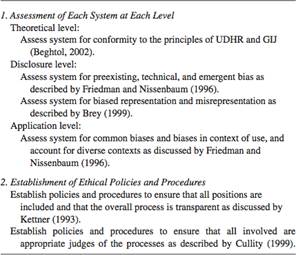
3.4 Framework for establishing policies for disclosive ethical analysis of knowledge representation and organization systems for
global use
The ethical assessment of a knowledge representation and organization system for global use is presented in table 2. As Beghtol (2005, 910) explains,
(t)he provision of a theoretical foundation as a referent for decision-making and for specific examination and analyses at the disclosure and application levels has also made it possible to develop policies and procedures that would be incorporated in ethically acceptable knowledge representation and organization systems.
This framework should be used more than once under the supervision of indexers/classifiers appropriately committed to the process in order to check whether identified problems have been solved or other problems have appeared.
3.5 Queer perspective
Considering that knowledge organization systems are inherently biased, contextual, and influenced by discourses of power, the Queer perspective sheds light to their structure and contingency. This perspective may support pedagogical and technical strategies to involve users in a critical analysis of the catalog, instead of simply looking for an objective correction (Drabinski, 2013).
In this way, the issue “(…) becomes less about correction and more about locating the ruptures in the structure, developing what Olson has called ‘techniques for making the limits of our existing information systems permeable’ (2001, 20)” (Drabinski 2013, 101).
For instance, “(…) efforts to fix gay sexuality under the category of Sexual life rather than Sexual deviance do not secure truth, but simply reveal the process through which these categories and knowledge about them are produced”
(Drabinski 2013, 102), so the catalog may be used as a pedagogical tool to the users’ reflection about this topic
It is the responsibility of librarians to offer functional solutions that highlight that catalogs are complex and a biased text and that users may be engaged in this understanding.
3.6 Conceptual framework for ethical decision-making
Classification systems are powerful tools because they have significant political and ethical implications. No classification can be considered the best one, so culture and context are some of the fundamental variables to be considered. To represent the world in a justifiable way, we need to use ethics to embrace plurality and diversity even if it is based on a particular point of view.
Ethical sensitivities of a given classification can be objectively assessed and it “(...) must be based in a practice (aka a domain) and not bound to particular institutions. The classification must actively seek engagement and justification in the activities and judgment of the practice” (Mai 2013, 251).
Not all the structures were presented as methods to be applied. For example, the structure proposed by Beghtol (2005) does not convey an explicit epistemological position.
4.Final considerations
It is imperative that librarians expand their ethical awareness to deal with the processes, tools and products throughout KO. Thomas Froehlich’s authority is evoked here to alert that librarians should “(…) expect to enhance their ethical awareness - particularly in terms of understanding the ethical dimensions of a specific context or activity - and appreciate the diversity of viewpoints and values that come to bear in ethical deliberation” (Froehlich, 2011).
When harmful effects, such as prejudice, exclusion, and misrepresentation occur and impose an attitude on the librarian, ethical decision-making or even the absence of a position has ethical implications.
The use of generic concepts or common-sense statements will no longer be accepted by the users’ communities committed to the empowerment of their specificities. Inevitably, we will be slanted in classifying and indexing, because there are many perspectives within the same knowledge domain. It will be necessary to choose which of these perspectives will be represented, but we can do so in a defensible way, that is, by explaining to users why certain choices have been made that way and what epistemological positions have been taken.
KO requires an understanding of how knowledge production takes place in a knowledge domain and how this domain interacts with society and is affected by it through historical and philosophical analysis. In this context of the domain- analytic view, “(...) criteria of relevance are implicated by the theories in a given domain, and explanations of information behavior relate to the information seekers epistemological beliefs” (Hjørland 2017).
A simultaneous analysis of multiple cultures would be feasible only when their differences are considered. By identifying which voices are excluded in the context of a library and by trying to invite them to be present, we will be opening spaces for negotiation to make users feel comfortable while interacting with the library. The catalogue can be an alternative, a pedagogical tool, as attested Drabinski (2013) and we can go further by showing users not only the items they requested but also some other options that are useful according to the knowledge domain(s) that they approached through search strategies.
These actions will only be possible when epistemological decisions are made in the context of the KO as a field and in the library as a local application of those decisions. Mai (2013, 249) explains that “(l)ibraries and librarians should free themselves from senseless notions of neutrality and objectivity and instead seek epistemological and ethical guidance in the practice of the domains”.
Many authors as well as the International Society for Knowledge Organization itself have emphasized the need for an ethical reflection within the own domain of KO. In other words, assumptions that have been taken for granted in the context
of KO should be contemplated, for the ethical values involved in the librarians’ performance in KO will influence their decision-making process. As information researchers, we need to have some ideas and approaches on how to represent, how to evaluate existing KOS and how to teach students through interdisciplinary dialogues.
Acknowledgment
Postdoctoral National Program Grant - Coordination for the Improvement of Higher Level - or Education - Personnel (2016-2017).
References
- Adler, M. and Tennis, J. T. (2013). Toward a taxonomy of harm in knowledge organization systems. Knowledge Organization (40), pp. 266-72.
- Barité, M. (2001). Organización del conocimiento: un nuevo marco teórico-conceptual en Bibliotecología y Documentación. In Carrara, K. (Ed), Educação, universidade e pesquisa (pp. 35-60). Marília: UNESP.
- Beghtol, C. (2005). Ethical decision-making for knowledge representation and organization systems for global use. Journal of the American Society for Information Science and Technology (56), pp. 903-12.
- Budd, J. (2001). Knowledge and knowing in Library and Information Science: A philosophical framework Lanham: The Scarecrow Press.
- Budd, J. (2004). Academic libraries and knowledge: a social epistemology network. The Journal of Academic Librarianship (30), pp. 361-67.
- Budd, J. (2006). Toward a practical and normative ethics for librarianship. The Library Quarterly (76), pp. 251-69.
- Drabinski, E. (2013). Queering the catalog: queer theory and the politics of correction. Library Quarterly (83), pp. 94-111.
- Fina, M. (1993). The role of subject headings in access to information: the experience of one speaking-patron. Cataloging & Classification Quarterly (17), pp. 267-74.
- Fox, M. J. and Reece, A. (2012). Which ethics? Whose morality?: An analysis of ethical standards for information organization. Knowledge Organization (39), pp. 377-83.
- Fox, M. J., Martínez-Ávila, D., and Milani, S. O. (2017). A Interseccionalidade e o Respeito às Pessoas na Organização do Conhecimento. In Alves, Marcos A., Gracio, Maria Cláudia C., and Martínez-Ávila, Daniel. Informação, conhecimento e modelos (pp. 289-53). Campinas: UNICAMP.
- Froehlich, T. (2011). 10 Questions: Tom Froehlich. Information Outlook (15). Interview granted to Stuart Hales.
-
Hjørland, B. (2017). Domain Analysis.Knowledge Organization(44), pp. 436-64. Also available in ISKO Encyclopedia of Knowledge Organization, Retrieved from www.isko.org/cyclo/domain_analysis#2.0
» www.isko.org/cyclo/domain_analysis#2.0 - Jacobs, C. (2007). Ethical places, ethical spaces: stopping to listen. The indexer (25), pp. 161-66.
- Mai, J.-E. (2010). Classification in a social world: bias and trust. Journal of Documentation (66), pp. 627-42.
- Mai, J.-E. (2013). Ethics, values and morality in contemporary library classifications. Knowledge Organization (40), pp. 242-53.
- Martínez-Ávila, D., Semidão, R., and Ferreira, M. (2016). Methodological aspects of critical theories in knowledge organization. Knowledge Organization (43), pp. 118-25.
- McQueen, K. (2015). Ethical issues of knowledge organization in designing a metadata schema for the Leo Kottke Archives. Knowledge Organization (42), pp. 332-38.
- Milani, S. O., Guimarães, J. A. C., and Olson, H. A. (2014). Bias in subject representation: convergences and divergences in the international literature. In Babik, Wiesław (Ed), Knowledge Organization in the 21st Century: Between Historical Patterns and Future Prospects (pp. 335-42). Knowledge Organization 14. Würzburg: Ergon.
- Oxford English Dictionary Online (2014). Oxford English Dictionary Online Oxford: Oxford University Press.
- Olson, H. A. (2001). Patriarchal structures of subject access and subversive techniques for change. Canadian Journal for Information and Library Science (26), pp. 1-29.
- Olson, H. A. (2002). The power to name: locating the limits of subject representation in libraries Dordrecht: Kluwer Academic Publisher.
- Tennis, J. T. (2008). Epistemology, theory, and methodology in knowledge organization: toward a classification, metatheory, and research framework. Knowledge Organization (35), pp. 102-12.