Patient Experience and Satisfaction regarding Nursing Care in the Emergency Service
Abstract:
Introduction: Patient satisfaction with nursing care is an important predictor for assessing the quality of hospital care. However, in Peru, patient satisfaction and experience with nursing care in the emergency department remains unknown
Objective: To analyze the experience and satisfaction with nursing care perceived by patients hospitalized in the emergency department at a level III hospital in Peru
Methodology: The Newcastle Questionnaire Satisfaction with Nursing Scales was applied, which is classified into two dimensions: experience and satisfaction. The independent variables were sociodemographic and clinical factors. The Chi-square test and Poisson regression were used to calculate the prevalence ratio (PR) with a p-value of less than 0.05
Results: Of 130 patients surveyed, 52.08 % perceived a bad experience and 54.62 % were dissatisfied with nursing care. Age was associated with the dimensions experience (PRa: 1.01) and nursing care satisfaction (PRa: 1.02). In addition, medium-high socioeconomic level (PRa: 0.52) and days of hospital stay (PRa: 0.65) were associated with poor satisfaction
Conclusions: More than half of the patients reported a bad experience and dissatisfaction with the care received. This implies the necessity to take into account the needs of hospitalized patients in emergencies and to manage human and material resources
Keywords:
quality of health care; emergency nursing; inpatients; socioeconomic factors
Resumen:
Introducción: La satisfacción del paciente con el cuidado de enfermería es un predictor importante para evaluar la calidad de la atención hospitalaria. Sin embargo, en Perú, la satisfacción y la experiencia del paciente sobre el cuidado de enfermería en el servicio de Emergencias sigue siendo desconocida
Objetivo: Analizar la experiencia y la satisfacción con los cuidados de enfermería percibidas por pacientes hospitalizados en el servicio de emergencia en un hospital de nivel III de Perú
Metodología: Se aplicó el Cuestionario de Calidad del Cuidado de Enfermería que se clasifica en dos dimensiones: experiencia y satisfacción. Las variables independientes fueron factores sociodemográficos y clínicos. Se utilizó la prueba de Chi-cuadrado y la regresión de Poisson para calcular la razón de prevalencia (RP) con un p-valor menor a 0.05
Resultados: De 130 pacientes relevados, el 52,08 % percibió una mala experiencia y el 54,62 % estuvo insatisfecho con los cuidados de enfermería. La edad se asoció con las dimensiones experiencia (RPa: 1.01) y la satisfacción de cuidados de enfermería (RPa: 1.02). Además, el nivel socioeconómico medio-alto (RPa: 0.52) y los días de estancia hospitalaria (RPa: 0.65) se asociaron a una mala satisfacción
Conclusiones: Más de la mitad de los pacientes manifestaron una mala experiencia e insatisfacción con los cuidados recibidos. Esto implica la necesidad de tomar en cuenta las necesidades del paciente hospitalizado en emergencias y gestionar recursos humanos y materiales
Palabras clave:
calidad de la atención de salud; enfermería de urgencia; pacientes internos; factores socioeconómicos
Resumo:
Introdução: A satisfação do paciente com o cuidado de enfermagem é um importante preditor para avaliar a qualidade do atendimento hospitalar. No entanto, no Peru, a satisfação e a experiência do paciente com o cuidado de enfermagem no serviço de emergência ainda são desconhecidas
Objetivo: Analisar a experiência e a satisfação com os cuidados de enfermagem percebida por pacientes internados no serviço de emergência em um hospital de nível III no Peru
Metodologia: Foi aplicado o Questionário de Qualidade do Cuidado de Enfermagem, classificado em duas dimensões: experiência e satisfação. As variáveis independentes foram fatores sociodemográficos e clínicos. O teste do qui-quadrado e a regressão de Poisson foram usados para calcular a razão de prevalência (RP), com um valor de p inferior a 0,05
Resultados: De 130 pacientes pesquisados, 52,08% perceberam uma experiência ruim e 54,62% estavam insatisfeitos com os cuidados de enfermagem. A idade foi associada às dimensões experiência (RPa: 1,01) e satisfação com os cuidados de enfermagem (RPa: 1,02). Além disso, o nível socioeconômico médio-alto (RPa: 0,52) e os dias de internação hospitalar (RPa: 0,65) foram associados à baixa satisfação
Conclusões: Mais da metade dos pacientes manifestaram uma experiência ruim e insatisfação com os cuidados recebidos. Isso implica a necessidade de levar em conta as necessidades do paciente internado em emergências e gerenciar os recursos humanos e materiais
Palavras-chave:
qualidade da atenção à saúde; enfermagem de emergência; pacientes internados; fatores socioeconômicos
Introduction
In recent decades, it has been observed that, in many cases, patients in emergency services are treated as a “set of symptoms” rather than as human beings with diverse needs.1,2 Possible causes include excessive workload, a shortage of professionals, and inadequate structural and organizational conditions of the service.3 During the COVID-19 pandemic, emergency nurses worked under pressure to provide adequate care and had to avoid the risk of infection, sometimes with insufficient protective measures. They also had to adapt to new care protocols and witnessed a high number of deaths that affected their mental health. 4
Various studies 5,6,7 show that patients perceived poor experiences when nurses cared for them. For example, a study conducted in the emergency department of a hospital in Saudi Arabia revealed that 57 % of patients reported a lack of courtesy, respect, active listening, time to attend to them, and patience in explaining instructions. 6 Another study, conducted in 2022 in the emergency department of a hospital in Ecuador, indicated that 43% of patients perceived only moderate personalized care from nurses, 74 % never received support from nurses to strengthen their faith in their religious preferences, 27 % felt that they did not receive dignified treatment during care, such as when nurses did not provide respectful and considerate care, and 34 % reported that nurses never considered patients’ social needs. 7
Currently, the prevalence of nursing care quality varies across countries. 6,7,8 Possible explanations for these differences could be variations in sample size, the instruments used to measure nursing care quality, which include patient experiences and satisfaction with the care they received, methodological differences, and, above all, potential sociodemographic and clinical factors related to the patients themselves. 9,10
Patient satisfaction is an indicator of the quality of care, whether good or bad. 11) Satisfaction with nursing services is even more important, as the nature of nursing allows patients to judge the overall quality of hospital services based on their perceptions of the care they receive. 12 However, only one study on this topic has been conducted in the emergency services of public hospitals in Lima, Peru. 13 In the Sergio E. Bernales National Hospital, no scientific research has been carried out during the COVID-19 pandemic, despite the high demand from patients coming from three densely populated neighboring districts and referrals from two provinces of Lima. 14 Given this reality, the present study aims to analyze the experience and satisfaction with nursing care perceived by hospitalized patients and its associated factors in the emergency service of a level III hospital in the Comas district, Lima, Peru.
Materials and Methods
A cross-sectional study was conducted. The population consisted of 1,704 adult users who were hospitalized in the non-COVID-19 area of the emergency department at the Sergio E. Bernales National Hospital throughout 2020. Patients of both sexes were included, excluding those who had been hospitalized for two days or less. The sample was calculated with a variance of 277, 15,16) a 95 % confidence level, and a 5 % margin of error. Additionally, the sample size was adjusted for potential losses, resulting in an effective sample of 130 users. A non-probability sampling method was used by calling patients when they were discharged.
In data collection, the 130 patients who were hospitalized and registered in 2020 were first contacted, and then telephone surveys were conducted in 2024. The instrument used was the Quality of Nursing Care Questionnaire (CUCACE), a Spanish version of the Newcastle Satisfaction with Nursing Scales (NSNS), developed by Thomas et al. 17 CUCACE consists of two dimensions: the first is the experience with nursing care which measures patients’ perceptions of their experiences with nursing care during hospitalization. The instrument has 26 items, each with seven Likert-type response options. The variable was categorized by mean calculation into two categories: good (112-156 points), poor (0-111 points). The second dimension is satisfaction with nursing care, which measures patients’ perceptions of whether their expectations for nursing care during hospitalization were met. It consists of 19 items, all positively worded, and is scored on a five-point Likert scale: completely satisfied (5), very satisfied (4), quite satisfied (3), slightly satisfied (2), and not satisfied (1). The variable was categorized by mean calculation into two categories: satisfied (49-85 points), dissatisfied (0-48 points). The CUCACE is an instrument with comprehensible language, regardless of the respondent’s language and cultural level, and it is widely accepted by the scientific community. Furthermore, it stands out as a valid and reliable instrument both internationally and nationally. 18,19
Sociodemographic factors such as age, education level, and socioeconomic status were considered. Regarding the latter, the Graffar classification was used as an instrument.20,21 This international scale presents five indicators: head of household’s occupation, education level, family income sources, housing comfort, and the appearance of the area where the family lives. It is categorized into five social strata: upper, upper middle, middle, relative poverty, and critical poverty. This instrument has been modified for adult patients and has undergone various validation processes. 20,21) Clinical factors, defined as the patient’s health characteristics and medical history, included admission diagnosis, previous admissions to the emergency department, and length of stay in the emergency department.
STATA version 17 was used for data processing. In the univariate analysis, mean and standard deviation were calculated for quantitative variables, while frequencies and percentages were calculated for categorical variables, such as Experience and Satisfaction with care. Chi-square and Poisson regression were used for bivariate analysis, and for multivariate analysis, p-values less than 0.20 were considered, with a Hosmer-Lemeshow test p-value greater than 0.05. Statistical significance was considered with a p-value less than 0.05 and 95 % confidence intervals.
The study received approval from the Institutional Research Ethics Committee No. 00028-2024. Due to the characteristics of the CUCACE instrument, patients had to be surveyed after discharge. However, due to COVID-19-related activity restrictions, telephone surveys were conducted with each patient after obtaining their phone numbers and providing further information about the study and informed consent. Additionally, the surveyors explained to the patients that their responses would remain anonymous.
Results
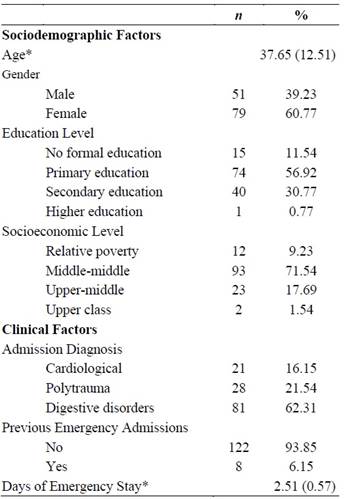
The arithmetic mean age was 37.65 years, and the mean length of hospital stay was 2.51 days. Additionally, the majority of the patients were female (60.77 %), had a primary education level (56.92 %), belonged to the middle-middle socioeconomic level (71.54 %), were hospitalized for a digestive disorder (62.31 %), and had no previous admissions to the emergency department (93.85 %) (Table 1).
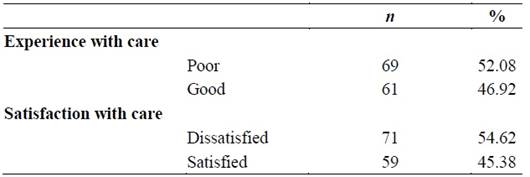
In Table 2, it is observed that more than half of all patients had a poor experience (52.08 %) and were dissatisfied (54.62 %) with the care provided by the nursing professional.
Characterization of patients’ experience and satisfaction with the care provided by the nursing professional
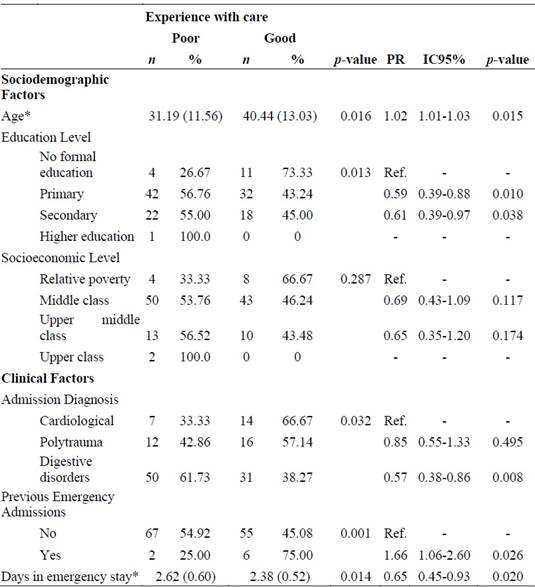
In the dimension of experience with care, based on bivariate analyses, including chi-square and Poisson regression, it is shown that for each additional year of patient age, the prevalence of having a good care experience was 2 % higher (PR: 1.02), and for more previous emergency admissions, the prevalence was 66 % higher (PR: 1.66). However, the prevalence of having a good care experience at the primary care level was 41 % lower (PR: 0.59), and for each additional day of hospital stay, the prevalence was 35 % lower (PR: 0.65) (Table 3).
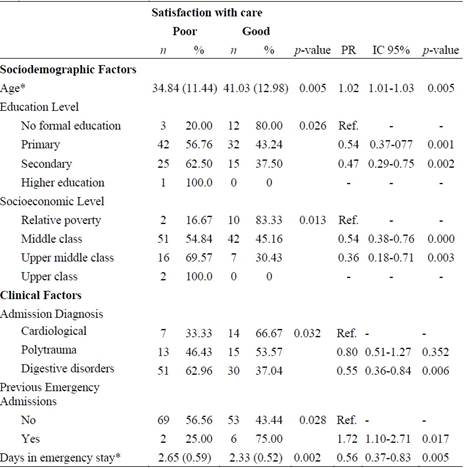
In the dimension of satisfaction with care, Poisson regression shows that for each additional year of patient age, the prevalence of having good satisfaction with the care received was 2 % higher (PR: 1.02), and for those with more previous emergency admissions, the prevalence was 72 % higher (PR: 1.72). However, for those with a secondary education level, the prevalence of having good satisfaction with their care was 53 % lower (PR: 0.47), and for those with an upper-middle socioeconomic level, the prevalence was 64 % lower (PR: 0.36). Additionally, for each additional day of hospital stay, satisfaction was 44 % lower (PR: 0.56) (Table 4).
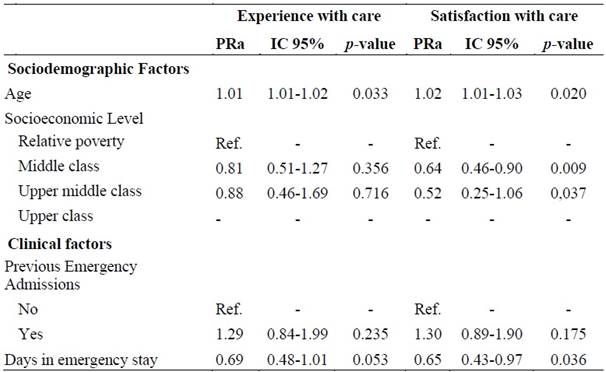
Regarding the multivariate analysis, the Hosmer-Lemeshow test for the dimension of care experience was 0.21, and for satisfaction with care, it was 0.30. Additionally, for each additional year of patient age, the prevalence of having a good experience with their care was 1 % higher (PRa: 1.01), and the prevalence of having good satisfaction with their care was 2 % higher (PRa: 1.02). However, for each additional day of hospital stay, the prevalence of having good satisfaction with their care was 35 % lower (PRa: 0.65), as well as for those with an upper-middle socioeconomic level, where the prevalence of having good satisfaction with their care was 48 % lower compared to those living in poverty (PRa: 0.64) (Table 5).
Factors associated with patients’ experience and satisfaction with the care received from nursing professionals, using multivariate analysis
52.08 % of all patients had a poor experience with nursing care. Likewise, 54.62 % were satisfied with the care received from nursing professionals. On the other hand, regarding the multivariate analysis, age was associated with the experience dimension (PRa: 1.01, p = 0.033) and the satisfaction dimension of nursing care (PRa: 1.02, p = 0.020). Additionally, the factors of upper-middle socioeconomic level (PRa: 0.52, p = 0.037) and days of hospital stay (PRa: 0.65, p = 0.036) were associated with a lower prevalence of satisfaction with nursing care.
Discussion
In the descriptive results, it is shown that more than half of all patients perceive a poor quality of humanized care regarding their care experience (53.08 %). A possible explanation for the poor experience perceived by patients could be attributed to mental health issues among the nurses, which affected their care. Some of them were stressed and anxious because it was something new; they were unprepared and even witnessed recurrent deaths.22 However, this result was different from a study conducted in Sub-Saharan Africa, where the majority (62.6 %) perceived a high quality of nursing care 23 In a study conducted in Brazil, it was evidenced that the perception of care provided by nursing professionals in the emergency service was good. 24 Similarly, in a study conducted in Peru, it was demonstrated that 53.3 % of all patients hospitalized in the Emergency Department of a public hospital in Lima reported a high level of nursing care quality. 9 The discrepancy in the different results could be attributed to the varying health management of each hospital and service, as well as the different measurement instruments that consider the domains of structure, process, and outcome.
Furthermore, more than half of all patients were dissatisfied with nursing care (54.08 %). However, a study conducted in Iraq showed that 83.3 % of patients were satisfied with nursing care. 25 Meanwhile, the only research conducted in a public hospital in Lima, Peru, shows that 86.7 % of all hospitalized patients were satisfied with the care received from nurses. 9 This discrepancy may be attributed to the number of patients, the availability of hospital resources, and the competencies of nurses to implement all aspects of nursing care. Similarly, in various public hospitals in Peru, there is a high patient flow where the nurse-to-patient ratio is insufficient to meet their needs. 26,27
In the multivariate analysis, one of the sociodemographic factors associated with the experience and satisfaction of nursing care was age. Older patients reported better experiences when nurses provided their care. This result was similar to a single study conducted in China, where age was significantly related to satisfaction with humanistic care (p < 0.05), but through bivariate analysis. 28 A possible explanation for this result is that older individuals may have lower expectations than younger patients and understand the role of the nurse better because they are more aware of their vulnerability to illness and recognize that their recovery requires more complex care. 29
Another sociodemographic factor associated with the satisfaction dimension of nursing care was the socioeconomic level. The prevalence of having good satisfaction with care was lower among those with an upper-middle socioeconomic level compared to those living in poverty. There are no similar results reported in an emergency service. This could be because patients who have the means to pay for hospitalization expect to receive care from highly qualified staff and feel dissatisfied if their expectations are not met. 30 However, during the pandemic, nursing staff without experience and without specialization in Emergencies were hired, which negatively impacted their care. Additionally, they lacked the capacity to resolve problems that could arise during their shifts.
Regarding clinical factors, only the length of hospital stay was associated with the satisfaction dimension of nursing care, meaning that for each day of hospitalization, the prevalence of having good satisfaction with care was lower. According to Martínez 10 reported that older adults with longer hospital stays had an unfavorable perception of the humanized care provided by nurses. This may be due to the fact that, during the pandemic, patients who were hospitalized for several days noticed the absence of nurses in the Emergency Services 31 because they rotated through different areas to fill vacant positions due to staff absence or to cover services with a high patient demand. Additionally, care provided with personal protective equipment (masks, gowns, etc.) may also have been more distant and less humanized by the nurses present. Consequently, patients perceive a lack of humanitarian sensitivity from the nursing staff, with rare instances of nurses approaching patients to greet them and ask: ‘How are you?’ ‘How can I help you?’ ‘What are you feeling at this moment?’, etc.
Limitations of the Study
The main limitations of the study were related to the type of sampling and the instruments used, as patients may not have been accurate in their responses when evaluated, either out of fear of causing conflicts or, conversely, they may have expressed excessive dissatisfaction. However, this is one of the first studies conducted in the emergency service during the COVID-19 pandemic.
Conclusions
More than half of all patients had a poor experience and were dissatisfied with the care received from nursing professionals. Furthermore, according to the multivariate analysis, for each year of the patient’s age, the prevalence of having a good experience and satisfaction with the care received was higher. Additionally, the factors associated with a lower prevalence of satisfaction with nursing care are socioeconomic level and length of hospital stay.
In light of these findings, hospital authorities should identify the needs of patients in Emergencies through the evaluation of nursing staff performance and provide training. Additionally, they must adequately distribute staff across services and ensure a sufficient supply of biomedical equipment and medications to improve the experience of hospitalized patients, and, above all, their safety and quality of life. Another important recommendation is to consider future research that delves into the relationship between sociodemographic factors and the quality of care, to help improve emergency care and its implications for the training and management of healthcare personnel. Furthermore, more research on this topic should be conducted in other hospitals.
References
-
1. Rôlo B, Santos B, Duarte I, Pires L, Castro C. Humanization of nursing care in the emergency service: a systematic review. Annals of Medicine. 2019;51(1):204-205. doi: 10.1080/07853890.2018.1560164
» 10.1080/07853890.2018.1560164 -
2. Busch IM, Moretti F, Travaini G, Wu AW, Rimondini M. Humanization of care: key elements identified by patients, caregivers, and healthcare providers. A systematic review. The Patient-Patient-Centered Outcomes Research. 2019;12(5):461-474. doi: 10.1007/s40271-019-00370-1
» 10.1007/s40271-019-00370-1 -
3. Sousa KHJF, Damasceno CKCS, Almeida CAPL, Magalhães JM, Ferreira MA. Humanização nos serviços de urgência e emergência: contribuições para o cuidado de enfermagem. Rev Gaúcha Enferm. 2019;40:1-10. doi: 10.1590/1983-1447.2019.20180263
» https://doi.org/10.1590/1983-1447.2019.20180263 -
4. Gonzáles-Gil MT, Gonzáles-Blázquez C, Parro-Morena AI et al. Nurses’ perceptions and demands regarding COVID-19 care delivery in critical care units and hospital emergency services. Intensive Crit Care Nurs. 2020;62:1-9. doi: 10.1016/j.iccn.2020.102966
» https://doi.org/10.1016/j.iccn.2020.102966 -
5. Amritzer M, Goransson K, Berg L, Nymark C. A New Perspective on Missed Nursing Care in the Emergency Department: A Descriptive Cross-Sectional Study. Journal of Emergency Nursing. 2024;50(3):392-402. doi: 10.1016/j.jen.2023.12.006
» https://doi.org/10.1016/j.jen.2023.12.006 -
6. Abass G, Asery A, Al Badr A, AlMaghlouth A, AlOtaiby S, Heena H. Patient satisfaction with the emergency department services at an academic teaching hospital. J Family Med Prim Care. 2021;10(4):1718-1725. doi: 10.4103/jfmpc.jfmpc_8_20
» https://doi.org/10.4103/jfmpc.jfmpc_8_20 -
7. Cortez CJ. Percepción del Cuidado de Enfermería Humanizado en Pacientes del Área de Emergencias del Hospital Juan Carlos Guasti del Cantón Atacames. Revista Científica Hallazgos21. 2022;7(2):176-188. Disponible en: https://revistas.pucese.edu.ec/hallazgos21/article/view/575/537
» https://revistas.pucese.edu.ec/hallazgos21/article/view/575/537 -
8. Deji-Dada O, Dada SA, Ogunlusi JD, Solomon OA. Patients’ satisfaction with emergency care services in a University Teaching Hospital in South-West, Nigeria. Afr J Emerg Med. 2021;11:321-324. doi: 10.1016/j.afjem.2021.03.015
» https://doi.org/10.1016/j.afjem.2021.03.015 -
9. Karaca A, Durna Z. Patient satisfaction with the quality of nursing care. Nursing Open. 2019;6:535-545. doi: 10.1002/nop2.237
» 10.1002/nop2.237 -
10. Martínez-Carbajal N. Tipo de hospital y percepción del adulto mayor acerca del cuidado humanizado del enfermero. CASUS. 2013;3(2):64-71. doi: 10.35626/casus.2.2018.79
» https://doi.org/10.35626/casus.2.2018.79 -
11. Johansson P, Oléni M, Fridlund B. Patient satisfaction with nursing care in the context of health care: a literature study. Scand J Caring Sci. 2002;16:337-344. doi: 10.1046/j.1471-6712.2002.00094.x
» https://doi.org/10.1046/j.1471-6712.2002.00094.x -
12. Merkouris A, Papathanassoglou ED, Lemonidou C. Evaluation of patient satisfaction with nursing care: quantitative or qualitative approach? Int J Nurs Stud. 2004;41:355-367. doi: 10.1016/j.ijnurstu.2003.10.006
» https://doi.org/10.1016/j.ijnurstu.2003.10.006 -
13. Rodríguez-López RM, Arevalo Marcos RA. Calidad de atención de enfermería y satisfacción del paciente en el servicio de emergencia de un hospital nacional de Lima-Perú. Ciencia Latina Revista Científica Multidisciplinar. 2023;7(1):5045-5059. doi: 10.37811/cl_rcm.v7i1.4815
» https://doi.org/10.37811/cl_rcm.v7i1.4815 -
14. Hospital Nacional Sergio E. Bernales (Internet). Comas, Perú: Ministerio de Salud; 2022 (citado 2024 may 02). Plan Operativo Institucional 2023. Disponible en: Disponible en: https://hnseb.gob.pe/repositorio-principal/resoluciones-directorales/2022/RD2022-295.pdf
» https://hnseb.gob.pe/repositorio-principal/resoluciones-directorales/2022/RD2022-295.pdf -
15. Torres-Contreras CC. Percepción de la calidad del cuidado de enfermería en pacientes hospitalizados. Av. Enferm. 2010;28(2):98-110. Disponible en: https://revistas.unal.edu.co/index.php/avenferm/article/view/21385
» https://revistas.unal.edu.co/index.php/avenferm/article/view/21385 -
16. Lenis-Victoria CA, Manrique-Abril FG. Calidad del cuidado de enfermería percibida por pacientes hospitalizados. Aquichan. 2015;15(3):415-425. doi: 10.5294/aqui.2015.15.3.9.
» https://doi.org/10.5294/aqui.2015.15.3.9. -
17. Thomas LH, McColl E, Priest J, Bond S, Boys RJ. Newcastle satisfaction with nursing scales: an instrument for quality assessments of nursing care. Quality in Health Care. 1996;5:67-72. Disponible en: https://www.ncbi.nlm.nih.gov/pmc/articles/PMC1055368/pdf/qualhc00020-0003.pdf
» https://www.ncbi.nlm.nih.gov/pmc/articles/PMC1055368/pdf/qualhc00020-0003.pdf -
18. Matta-Zamudio LS. Calidad de Cuidado de enfermería en pacientes de una sala de hospitalización ubicada en Lima Centro. Rev. Cient. Cuidado y Salud Pública. 2022;2(1):30-35. doi: 10.53684/csp.v2i1.39
» https://doi.org/10.53684/csp.v2i1.39 -
19. Manrique FG, Marciá ML, Herrera GM, Cifuentes JE, González VM. Cuestionario de calidad del cuidado de enfermería (CUCACE): Validez y fiabilidad en Colombia. Rev. Salud Pública. 2021;23(4):1-6. doi: 10.15446/rsap.v23n4.94715
» https://doi.org/10.15446/rsap.v23n4.94715 -
20. Rubio R, Sánchez N, Jiménez M, Kanahan D, Oria C. Comparación de los niveles de depresión, ansiedad y estrés en pacientes nefrópatas sometidos a diálisis peritoneal y hemodiálisis y su relación con el Nivel Socioeconómico. Ciudad Hospitalaria Dr. Enrique Tejera (CHET) y unidades de diálisis extrahospitalarias. Valencia, Estado Carabobo 2010-2011. Avances en Ciencias de la Salud. 2012;1(2):14-21. Disponible en: http://servicio.bc.uc.edu.ve/fcs/avances/vol1n2/art3.pdf
» http://servicio.bc.uc.edu.ve/fcs/avances/vol1n2/art3.pdf -
21. Ortuni M, Guevara H, Cardozo R. Calidad de Vida en pacientes con Hipertensión Arterial. Academia.edu. 2014. Disponible en: https://www.academia.edu/113825710/Calidad_de_Vida_en_Pacientes_con_Hipertensi%C3%B3n_Arterial
» https://www.academia.edu/113825710/Calidad_de_Vida_en_Pacientes_con_Hipertensi%C3%B3n_Arterial -
22. Obando-Zegarra R, Arévalo-Ipanaqué JM, Aliaga-Sánchez RA, Obando-Zegarra M. Ansiedad, estrés y depresión en enfermeros de emergencia Covid-19. Index Enferm. 2020;29(4):225-229. Disponible en: https://ciberindex.com/index.php/ie/article/view/e13056
» https://ciberindex.com/index.php/ie/article/view/e13056 -
23. Ogunlade AA, Ayandiran EO, Oyediran OO, Oyelade OO, Olaogun AAE. Quality of emergency nursing care in two tertiary healthcare settings in a developing Sub-Saharan African Country. Afr J Emerg Med. 2020;10(1):73-77. doi: 10.1016/j.afjem.2020.05.008
» https://doi.org/10.1016/j.afjem.2020.05.008 -
24. Silva NM, Ribeiro MS, Moura L, Leite MT, Biasuz S, Both CT. Cuidados de enfermagem em uma unidade de pronto socorro: percepção de pessoas idosas longevas. Revista de Enfermagem e Atenção à Saúde. 2024;13(1): e202415. doi: 10.18554/reas.v13i1.7423
» 10.18554/reas.v13i1.7423 -
25. Al-Khafaji ZAA, Al-Hussein IQK. Patient’s Satisfaction with Nursing Care in Emergency Department at Public Hospital in Alnajaf Al-Ashraf Governorate. GSJ. 2018;6(11):208-214. Disponible en: https://www.globalscientificjournal.com/researchpaper/Patient_s_Satisfaction_with_Nursing_Care_in_Emergency_Department_at_Public_Hospital _in_Al_Najaf_Al_Ashraf_Governorate.pdf
» https://www.globalscientificjournal.com/researchpaper/Patient_s_Satisfaction_with_Nursing_Care_in_Emergency_Department_at_Public_Hospital _in_Al_Najaf_Al_Ashraf_Governorate.pdf -
26. Vásquez R, Amado J, Ramírez F, Velásquez R, Huari R. Sobredemanda de atención médica en el servicio de emergencia de adultos de un hospital terciario, Lima, Perú. An Fac med. 2016;77(4):379-385. doi: 10.15381/anales.v77i4.12654
» https://doi.org/10.15381/anales.v77i4.12654 -
27. Alamo IJ, Matzumura JP, Gutiérrez HF. Patient complaints in the adult emergency department of a tertiary referral hospital. Rev. Fac. Med. Hum. 2020;20(2):246-253. doi: 10.25176/rfmh.v20i2.2916
» https://doi.org/10.25176/rfmh.v20i2.2916 -
28. Wang W, Liu X, Shen X, Zhang J, Zhang F, Liao L, et al. Emergency patients’ satisfaction with humanistic caring and its associated factors in Chinese hospitals: a multi-center cross-sectional study. Front. Public Health. 2024;12:1-10. doi: 10.3389/fpubh.2024.1414032
» https://doi.org/10.3389/fpubh.2024.1414032 -
29. Guo S, Chang Y, Chang H, He X, Zhang Q, Song B, et al. Patient satisfaction with nurses care is positively related to the nurse-patient relationship in Chinese hospitals: a multicentre study. Front Public Health. 2022;10:1109313. doi: 10.3389/fpubh.2022.1109313
» https://doi.org/10.3389/fpubh.2022.1109313 -
30. Hoxha R, Kosevska E, Berisha M, Ramadani N, Jerliu N, Zhjeqi V, et al. Predictive factors for patient satisfaction in public and private hospitals in Kosovo. SEEJPH. 2023;12(1):1-9. doi: 10.70135/seejph.vi.144
» https://doi.org/10.70135/seejph.vi.144 -
31. Farías ME. Calidad de atención y cuidado de enfermería en servicio de emergencia visto desde la perspectiva del paciente. Salud, Ciencia y Tecnología. 2021;1:39. doi: 10.56294/saludcyt202139
» https://doi.org/10.56294/saludcyt202139