Prevalence of Intimate Partner Violence Against Women in the Americas Region: Systematic Review
Abstract:
Introduction: Intimate partner violence (IPV) against women represents a global public health problem whose formal recognition was established in the 1990s. Since then, systematic research has enabled a better understanding of its impact across different world regions
Objective: To analyze the available scientific evidence on the prevalence of this phenomenon in the Americas
Methods: Systematic review following PRISMA guidelines. The search was carried out in 2023 across PubMed, BioMed, EBSCO, LILACS, and SciELO databases. Original cross-sectional studies published between 1995 and 2023 reporting prevalence rates of physical and/or sexual intimate partner violence against women were included
Results: A total of 25 articles from six countries, published in English, Spanish, and Portuguese, were analyzed. The most frequently used measurement tool was the WHO Violence against Women Questionnaire. Lifetime prevalence of IPV ranged from 7.6 % to 59.1 %, with the highest figures reported in Brazil. One-year prevalence was highest in Brazil (36.7 %) and the United States (33 %)
Conclusions: IPV against women persists as a high-prevalence phenomenon throughout the Americas. The increase in publications since 2018 reflects growing scientific attention to this issue, but sustained public health and nursing interventions remain essential for its prevention and comprehensive management
Keywords:
systematic review; women; violence against women; intimate partner violence; nursing
Resumen:
Introducción: La violencia de pareja (VP) contra las mujeres constituye un problema de salud pública global, cuyo reconocimiento formal se consolidó en la década de 1990. Desde entonces, su estudio ha permitido dimensionar su impacto en distintas regiones del mundo
Objetivo: Analizar la evidencia científica disponible sobre la prevalencia de este fenómeno en la región de las Américas
Metodología: Revisión sistemática conforme a las directrices PRISMA, efectuada en 2023 en las bases de datos PubMed, BioMed, EBSCO, LILACS y SciELO. Se incluyeron artículos originales de corte transversal publicados entre 1995 y 2023, que reportaran prevalencias de violencia física y/o sexual de pareja contra mujeres
Resultados: Se analizaron 25 artículos de seis países, publicados en inglés, español y portugués. El instrumento de medición más frecuente fue el Cuestionario sobre Violencia contra la Mujer de la OMS. La prevalencia de VP a lo largo de la vida osciló entre 7.6 % y 59.1 %, con valores más elevados en Brasil. En el período de un año, la prevalencia fue mayor en Brasil (36.7 %) y Estados Unidos (33 %)
Conclusiones: La VP contra las mujeres persiste como un fenómeno de alta prevalencia en las Américas. El incremento de publicaciones desde 2018 refleja una creciente atención científica hacia el problema, pero se requieren intervenciones sostenidas desde la salud pública y la enfermería para su prevención y atención integral
Palabras clave:
revisión sistemática; mujeres; violencia contra la mujer; violencia de pareja; enfermería
Resumo:
Introdução: A violência por parceiro íntimo (VPI) contra as mulheres constitui um problema de saúde pública global, cujo reconhecimento formal se consolidou na década de 1990. Desde então, seu estudo tem permitido dimensionar seu impacto em distintas regiões do mundo.
Objetivo: Analisar a evidência científica disponível sobre a prevalência desse fenômeno na região das Américas
Metodologia: Revisão sistemática conforme às diretrizes PRISMA, realizada em 2023 nas bases de dados PubMed, BioMed, EBSCO, LILACS e SciELO. Foram incluídos artigos originais de corte transversal publicados entre 1995 e 2023, que reportassem prevalências de violência física e/ou sexual por parceiro íntimo contra mulheres
Resultados: Foram analisados 25 artigos de seis países, publicados em inglês, espanhol e português. O instrumento de medição mais utilizado foi o Questionário sobre Violência contra a Mulher da OMS. A prevalência de VPI ao longo da vida variou entre 7,6% e 59,1%, com valores mais elevados no Brasil. No período de um ano, a prevalência foi maior no Brasil (36,7%) e nos Estados Unidos (33%)
Conclusões: A VPI contra as mulheres persiste como fenômeno de elevada prevalência nas Américas. O incremento de publicações desde 2018 reflete uma atenção científica crescente ao problema, porém são necessárias intervenções contínuas por parte da saúde pública e da enfermagem para sua prevenção e atenção integral
Palavras-chave:
revisão sistemática; mulheres; violência contra a mulher; violência por parceiro íntimo; enfermagem
Introduction
Violence against women, especially by their partners, is a serious public health problem and a violation of women’s human rights. Intimate Partner Violence (IPV) is considered to be the most common form of violence against women, referred to as the behaviors of the partner or ex-partner that cause physical, sexual or psychological harm, including physical aggression, sexual coercion, psychological abuse and controlling behaviors. 1
Throughout history, violence has manifested itself in all dimensions, focused mainly on women as victims of violence and men as their victimizers. 2 This phenomenon has been widely documented; however, this was not possible until the 1990s, when it began to be recognized as a public health problem. 3
IPV against women is usually generated due to the management of power relationships and specific roles, where, if these are altered or reversed, conflicts arise. 2 This type of violence is a complex phenomenon that varies according to conditions such as age, educational level, ethnicity and marital status, and is considered a form of exclusion. It is also considered a private matter, which instills fear and generates a permanent environment of risk and uncertainty, becoming normalized in some sociocultural contexts. 4-6)
In the Americas, 25% of women and girls have reported physical and/or sexual IPV at some point in their lives. Last year, it was estimated that 7% of women aged 15 to 49 who have ever been married or in a relationship have experienced physical or sexual violence. 7,8
In this regard, the UN states that climate change and environmental degradation aggravate the risks of violence due to displacement, scarcity of resources and food insecurity. 9 In the same way, research mentions that the COVID-19 pandemic accentuated IPV, as a result of confinement measures, referring to an increase in requests for help and refuge. 4,10
In 2021, a Systematic Review and Reanalysis of National Estimates of Intimate Partner Violence prevalence in the Americas was published, with studies from 1998 to 2017. Among the findings, women reported having suffered physical and/or sexual violence by an intimate partner from 14 % to 17 % in Brazil, Panama and Uruguay. The prevalence in the last year ranged from 1.1 % in Canada to 27.1 % in Bolivia. (11) It is worth mentioning that IPV has been addressed by other similar studies and systematic reviews. However, the study by Bott et al. 11 conducted in 2017 covered the population aged 15 years and older. Therefore, the temporality with which this research was carried out and the population studied, provide the basis for conducting a similar study of the behavior of IPV against women in countries of the Americas, involving women 18 years of age or older because they may find themselves with greater autonomy and independence to be in a relationship, which allows showing the most current behavior of this problem, which can affect women’s health.
Within this context, the nursing professional has a relevant role in the detection of cases of IPV against women, particularly in health settings, since they can be the first contact of the abused woman when she seeks care in institutional services, in such a way that the humanized care they provide, as well as the accompaniment or referrals they make in collaboration with the health team, will allow timely and comprehensive assistance to this health problem in women. In the same way, they can design strategies for the prevention of abuse and the promotion of healthy relationships. Against this overview, this systematic review of the literature was carried out with the aim of analyzing the available scientific evidence on the prevalence of IPV in the Americas region.
Methodology
A systematic review of prevalence studies of IPV against women was carried out, following the guidelines of the Preferred Reporting Items for Systematic Reviews and Meta-Analyses (PRISMA). The protocol was registered in the International Prospective Registry of Systematic Reviews (PROSPERO), with number CRD42024506826. The review covered studies conducted between January 1995 and September 2023.
The question was formulated using the PICOT strategy (population, intervention, comparison, outcome, time), which in this study involves: P- Women of the Americas region; I- Prevalence of intimate partner violence; C- There is no comparator; O- To investigate and synthesize the literature on the phenomenon of intimate partner violence against women; T- Studies from 1995 to 2023. The following question was obtained: What does the existing scientific evidence show about the prevalence of intimate partner violence against women in the Americas region?
Original articles of scientific research with a quantitative, cross-sectional approach, descriptive, correlational, associative and/or predictive scope that included prevalences of intimate partner violence against women of the Americas region were included; who have published their results in Spanish, English, Portuguese or French; explicitly mentioning “partners” in preambles and questionnaire questions used to measure violence; and that they addressed prevalences in women aged between 18 and 59 years.
The prevalence of IPV included in the review was that reported globally at some time in life or during the last year; where the perpetrator could be any lifetime partner, current or most recent partner: “current” for women with a partner in the last year and “most recent” for women who were separated, divorced, or widowed. Regarding the type of violence, only physical, sexual, or physical and sexual violence was considered, the results of emotional or psychological violence were not considered for the review; to which the Pan American Health Organization (PAHO) points out that there is an enormous diversity of measurement methods in surveys and there is a lack of international consensus on definitions. 11
The search was conducted by two review authors in the four languages established in the inclusion criteria, using the Boolean operators “OR” and “AND” in the open access databases: PubMed, BioMed, EBSCO, LILACS and SciELO. The keywords used for the search strategy were: “women”, “intimate partner violence”, “Americas” and the 35 Member States of the PAHO. 12
As a search strategy in the databases, the following was used: (“mujeres” OR “chicas” OR “women” OR “mulheres” OR “femmes” OR “Américas” OR “Amériques” OR “América” OR “America” OR “continente americano” OR “Antigua y Barbuda” OR “Argentina” OR “Bahamas” OR “Barbados” OR “Belice” OR “Bolivia” OR “Brasil” OR “Canadá” OR “Canada” OR “Chile” OR “Colombia” OR “Costa Rica” OR “Cuba” OR “Dominica” OR “Ecuador” OR “Estados Unidos de América” OR “Estados Unidos de America” OR “El Salvador” OR “Granada” OR “Guatemala” OR “Guyana” OR “Haití” OR “Haiti” OR “Honduras” OR “Jamaica” OR “México” OR “Mexico” OR “Nicaragua” OR “Panamá” OR “Panama” OR “Paraguay” OR “Perú” OR “Peru” OR “República Dominicana” OR “Republica Dominicana” OR “Santa Lucía” OR “Santa Lucia” OR “San Vicente y las Granadinas” OR “Saint Kitts y Nevis” OR “Suriname” OR “Trinidad y Tabago” OR “Uruguay” OR “Venezuela”) AND (“violencia de pareja” OR “violencia contra la pareja” OR “violencia de pareja íntima” OR “intimate partner violence” OR “violência por parceiro íntimo” OR “violence envers le partenaire intime”).
Compliance with the inclusion criteria of the studies was evaluated jointly by the two reviewers, where the screening was carried out by examining the titles and abstracts of the identified studies, and then reading the studies in full text. Differences of opinion were resolved by consensus between both review authors and another author of the present study.
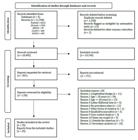
During the search for studies and management of references, the Zotero program was used as an extension to collect and manage the research found in each database, following the PRISMA guidelines, through the phases: Identification, Screening and Inclusion.
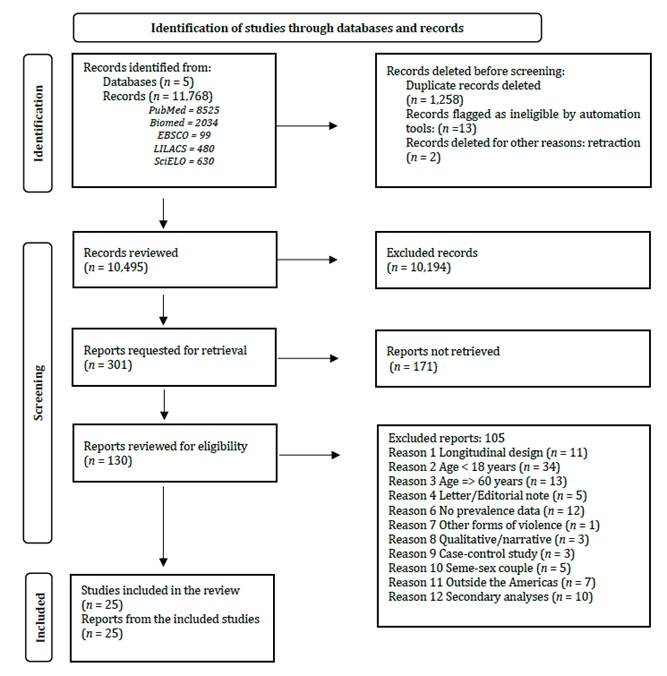
The initial search allowed us to identify 11,768 eligible articles on the different types of violence in men and women, from fifteen years of age to older adults, with different characteristics such as pregnancy, puerperium, mental disorders, substance addiction, HIV, prison situation, gynecological-obstetric care and homosexual couples. In screening, 10,495 records were initially examined, of which 301 were requested for recovery, 130 reports were evaluated to determine eligibility, and finally 105 were excluded (Figure 1).
Risk of bias was assessed using the Statement on Strengthening Reporting of Observational Studies in Epidemiology (STROBE) for cross-sectional studies, 13 which allowed analysis of each recommended element that this type of work should include, from the title/abstract to funding information, allowing the studies to be classified as A (studies that met a value equal to or greater than 80 % of the criteria); B (studies with 50 to 80 % of the criteria) and C (less than 50 % of the criteria).
For the analysis of the data, first began with reading and rereading of the studies and and then created tables and graphs of percentages of the results of the research, carried out in the Excel program version 2311 of Microsoft 365.
Results. . .
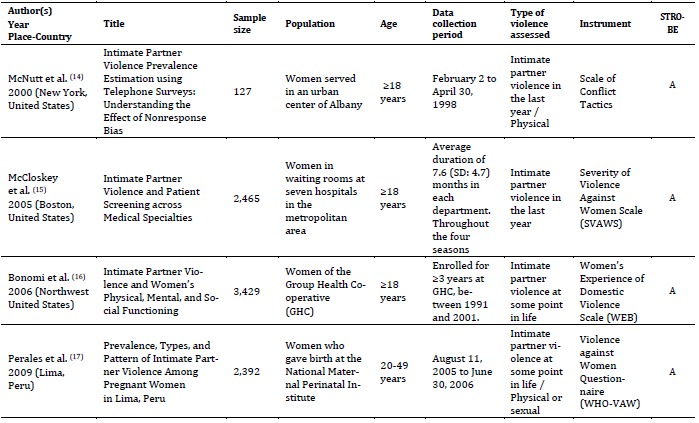
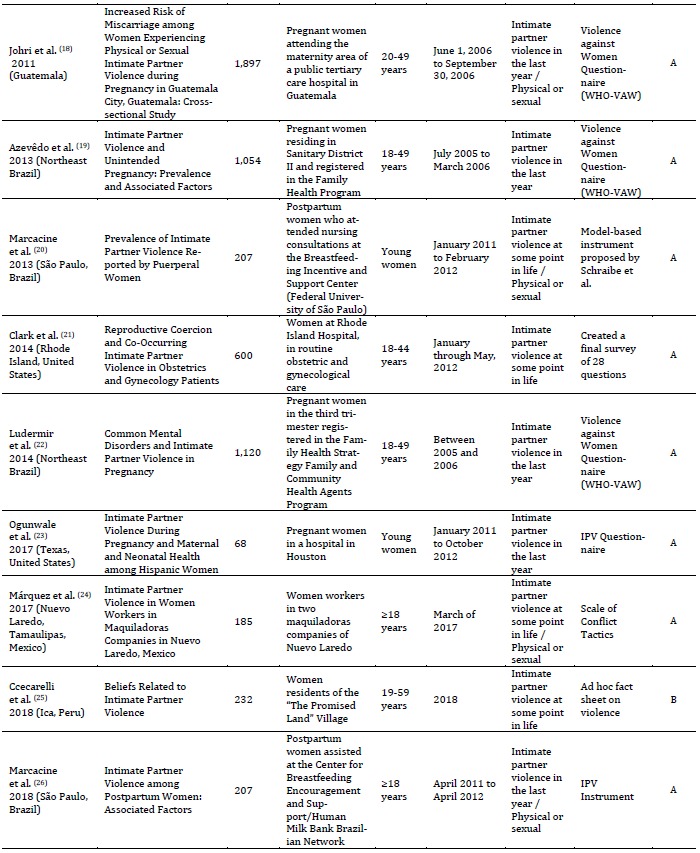
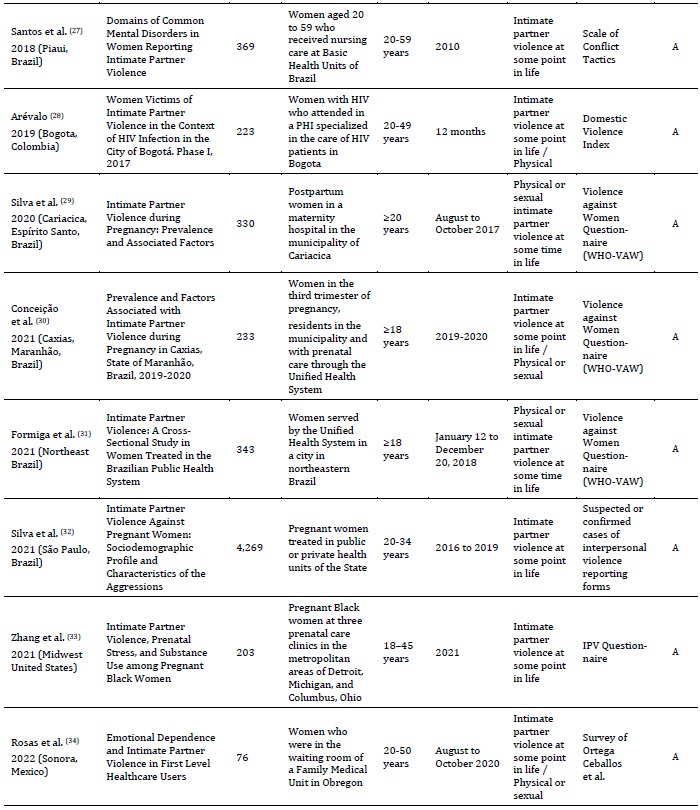
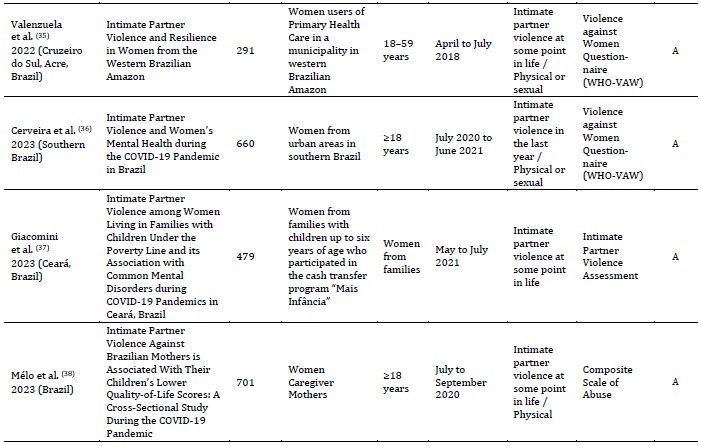
The final sample was made up of 25 articles (Table 1), which were fully analyzed 14,15,16,17,18,19,20,21,22,23,24,25,26,27,28,29,30,31,32,33,34,35,36,37,38.The selected articles were in three languages, 18 in English, 4 in Spanish and 3 in Portuguese, from six countries in the Region of the Americas, 6 from the United States published between 2000 and 2021; 1 from Guatemala in 2011; 2 from Peru (2009 and 2018); 13 from Brazil between 2013 and 2023; 2 from Mexico in 2017 and 2022; and 1 from Colombia in 2019.
The most widely used instrument to measure violence was the World Health Organization Violence against Women Questionnaire (WHO-VAW), which was applied in nine studies, six studies developed their own questionnaires or questions to inquire about the phenomenon, while three studies used the Scale of Conflict Tactics.
Regarding the assessment of risk of bias, only one of the studies was found to have a moderate risk, while the rest were rated as having a low risk, suggesting that the studies included in this review are sufficiently rigorous and of high quality.
Discussion
This systematic review synthesizes the available evidence on the prevalence of intimate partner violence against women in countries of the Americas. The studies analyzed were mainly developed in urban areas and document temporal and geographical variations throughout the period reviewed.
Regarding the lifetime prevalence of IPV, values ranged from 7.6 % to 59.1 %. The highest estimates corresponded to four studies conducted in Brazil between 2013 and 2022: Piauí (59.1 %), western Amazon (53.3 %), and São Paulo (51.2 %, reported in two independent studies). These figures exceed the regional estimates of the Pan American Health Organization (PAHO), which place the proportion of women who have experienced physical or sexual IPV at some point in their lives at 25 %,7 as well as the global average of 27 % documented by the World Health Organization (WHO). 1
The prevalence in the last year was between 11 % and 36.7 %. The highest values were recorded in São Paulo, Brazil (36.7 %), in the south of that country (33.3 %) and in New York, United States (33.3 %). These findings are consistent with the literature that identifies the Americas region as one of the areas of greatest risk for IPV on a global scale, with documented consequences on the physical and mental health of affected women, including injuries, depression, anxiety, unwanted pregnancies, and sexually transmitted infections, in addition to considerable economic and social costs. 39
Regarding the types of violence, physical violence throughout life presented prevalences between 2.6 % and 72.8 %, with the highest values in Ica, Peru (72.8 %) and Brazil (57.3 %). In the last year, the highest prevalence was reported in New York, United States (40.2 %), a figure notably higher than the 7 % estimated for the Americas by PAHO. 8 This finding is especially relevant given that physical violence is the main risk factor for femicide and is associated with a significant deterioration in the health status of exposed women, who have a greater burden of physical morbidity than those who are not affected. 40
Sexual violence throughout life registered prevalences between 0.9 % and 16.1 %, with the highest data in the western Amazon of Brazil (16.1 %) and Nuevo Laredo, Tamaulipas, Mexico (13.5 %). In the last year, only two studies reported this indicator: southern Brazil (5.6 %) and Guatemala (16 %). The lower frequency of reporting of this form of violence compared to physical violence can be attributed to structural and sociocultural barriers, including stigma, shame, and hierarchies of power, which make it difficult to report. These results underscore the need to strengthen timely access to post-exposure care and to deepen the study of the patterns of gender inequality that condition its underreporting. (41, 42)
From a public health perspective, the findings of this review reinforce the need for preventive and care interventions aimed at women in urban and rural contexts, which promote equitable access to physical, mental, and social health services, and which strengthen the autonomy and decision-making capacity of women in a situation of IPV. On the political level, the increase in publications in the region since 2018 is consistent with the greater institutional emphasis on women’s health and rights, as well as with the creation of specific protection agencies. However, the heterogeneity in the geographical distribution of the studies shows the need to extend epidemiological surveillance of this phenomenon to a greater number of countries in the Americas.
Conclusions
The analysis of intimate partner violence against women in countries in the Americas region identified scientific evidence in six countries, predominantly in English and with the highest concentration of publications starting from 2018. The most widely used instrument was the World Health Organization’s Violence against Women Questionnaire. The results show that IPV is a persistent phenomenon, with high prevalences in Brazil, Peru, and Mexico. Physical violence registered higher prevalences than sexual violence, which underlines the need to prioritize its prevention and care, given its link with femicide, suicide, and serious illnesses.
It is recommended to expand the age ranges in future studies to include adolescent and older women, as well as to extend the analysis to school and prison contexts. Strengthening comprehensive care for women who have experienced IPV, with an emphasis on their physical and mental health, is a strategic priority. It is also suggested that health workers be sensitized to this problem, considering the persistence of the associated stigma. Nursing professionals, in particular, play a key role in early detection, accompaniment, and the design of interventions based on humanized care, which incorporate active listening, empathy, mental health care, gender perspective, and timely referral.
The present review has limitations that should be considered when interpreting its findings. First, the search was restricted to five open-access databases, which excludes evidence available in subscription databases. Secondly, women aged 15 to 17 years were excluded, which limits the understanding of the phenomenon at a stage of initiation of relationships and greater vulnerability. Thirdly, some included studies limit IPV to a single relationship, without considering previous experiences. Finally, the exclusion of emotional or psychological violence, motivated by the lack of international consensus in its definitions and measurement methods, restricts the ability to generalize the results and limits the empirical basis for the design of comprehensive preventive actions in the region.
References
-
1. World Health Organization. Violence against women (Internet). Geneva: WHO; 2021 (citado 2025 nov 01). Disponible en: Disponible en: https://www.who.int/es/news-room/fact-sheets/detail/violence-against-women
» https://www.who.int/es/news-room/fact-sheets/detail/violence-against-women -
2. Muñoz-Díaz SR, Rodríguez-Alfonso TV. Narrativas de la violencia bidireccional de parejas heterosexuales en el contexto doméstico. Integr Acad Psicol (Internet). 2020 (citado 2025 nov 01); 8(24):83-89. Disponible en: Disponible en: https://integracion-academica.org/anteriores/37-volumen-8-numero-24-2020/287-narrativas-de-la-violencia-bidireccional-de-parejas-heterosexuales-en-el-contexto-domestico
» https://integracion-academica.org/anteriores/37-volumen-8-numero-24-2020/287-narrativas-de-la-violencia-bidireccional-de-parejas-heterosexuales-en-el-contexto-domestico -
3. Cienfuegos-Martínez YI. Medición de la violencia en las relaciones de pareja en psicología. Culturales (Internet). 2021 (citado 2025 nov 01);9(1):1-37. doi: 10.22234/recu.20210901.e544
» https://doi.org/10.22234/recu.20210901.e544 -
4. Ascensio-Martínez C. Terrorismo íntimo: violencia de pareja, feminicidio y confinamiento. Acta Sociol (Internet). 2023 (citado 2025 nov 01);(90):83-114. doi: 10.22201/fcpys.24484938e.2023.90.86273
» https://doi.org/10.22201/fcpys.24484938e.2023.90.86273 -
5. Rodríguez-Hernández R, Esquivel-Santoveña EE. Prevalencia y factores asociados con la violencia de pareja en las adultas mayores mexicanas. Salud Colect (Internet). 2020 (citado 2025 nov 01);16:e2600. doi: 10.18294/sc.2020.2600
» https://doi.org/10.18294/sc.2020.2600 -
6. Arguello N, Sepúlveda A, Duarte L, Orrego M, Redondo J. Violencia en pareja: factores sociodemográficos y socioeconómicos que influyen en el maltrato contra la mujer del área metropolitana de Bucaramanga, Colombia. Rev Estud Psicol (Internet). 2023 (citado 2025 nov 01);3(1):49-62. doi: 10.35622/j.rep.2023.01.004
» https://doi.org/10.35622/j.rep.2023.01.004 -
7. Organización Panamericana de la Salud. Violencia contra la mujer (Internet). Washington: OPS; 2023 (citado 2025 nov 01). Disponible en: Disponible en: https://www.paho.org/es/temas/violencia-contra-mujer
» https://www.paho.org/es/temas/violencia-contra-mujer -
8. Organización Panamericana de la Salud. Documentación de casos de violencia contra mujeres y niñas y registro de la respuesta del sector de la salud: cómo fortalecer los datos administrativos de salud sobre violencia de pareja y violencia sexual en la Región de las Américas (Internet). Washington: OPS; 2024 (citado 2025 nov 01). Disponible en: https://iris.paho.org/handle/10665.2/62791
» https://doi.org/https://iris.paho.org/handle/10665.2/62791 -
9. ONU Mujeres. Hechos y cifras: poner fin a la violencia contra las mujeres (Internet). Panamá: ONU Mujeres; 2023 (citado 2025 nov 01). Disponible en: Disponible en: https://lac.unwomen.org/es/stories/noticia/2023/11/hechos-y-cifras-poner-fin-a-la-violencia-contra-las-mujeres
» https://lac.unwomen.org/es/stories/noticia/2023/11/hechos-y-cifras-poner-fin-a-la-violencia-contra-las-mujeres -
10. Ibero-American General Secretariat. Ibero-American Initiative to Prevent and Eliminate Violence against Women (Internet). United States: SGI; 2022 (citado 2025 nov 01). Disponible en: Disponible en: https://mujereslibresdeviolenciaeniberoamerica.org/en/
» https://mujereslibresdeviolenciaeniberoamerica.org/en/ -
11. Bott S, Guedes A, Ruiz AP, Adams J. La violencia por parte de la pareja íntima en las Américas: una revisión sistemática y reanálisis de las estimaciones nacionales de prevalencia. Rev Panam Salud Publica (Internet). 2021 (citado 2025 nov 01);45:e34. doi: 10.26633/RPSP.2021.34
» https://doi.org/10.26633/RPSP.2021.34 -
12. Organización Panamericana de la Salud. Estados Miembros de la Organización Panamericana de la Salud (Internet). Washington: OPS ; 2023 (citado 2025 nov 01). Disponible en: Disponible en: https://www.paho.org/es/quienes-somos/planificacion-finanzas-rendicion-cuentas/estados-miembros-organizacion-panamericana
» https://www.paho.org/es/quienes-somos/planificacion-finanzas-rendicion-cuentas/estados-miembros-organizacion-panamericana -
13. Von Elm E, Altman DG, Egger M, Pocock SJ, Gøtzsche PC, Vandenbroucke JP. The Strengthening the Reporting of Observational Studies in Epidemiology (STROBE) statement: guidelines for reporting observational studies. J Clin Epidemiol (Internet). 2008 (citado 2025 nov 01);61(4):344-349. doi: 10.1016/j.jclinepi.2007.11.008
» https://doi.org/10.1016/j.jclinepi.2007.11.008 -
14. McNutt LA, Lee R. Intimate partner violence prevalence estimation using telephone surveys: understanding the effect of nonresponse bias. Am J Epidemiol (Internet). 2000 (citado 2025 nov 01); 152(5):438-441. doi: 10.1093/aje/152.5.438
» https://doi.org/10.1093/aje/152.5.438 -
15. McCloskey LA, Lichter E, Ganz ML, Williams CM, Gerber MR, Sege R, et al. Intimate partner violence and patient screening across medical specialties. Acad Emerg Med (Internet). 2005 (citado 2025 nov 01);12(8):712-722. doi: 10.1197/j.aem.2005.03.529
» https://doi.org/10.1197/j.aem.2005.03.529 -
16. Bonomi AE, Thompson RS, Anderson M, Reid RJ, Carrell D, Dimer JA, et al. Intimate partner violence and women's physical, mental, and social functioning. Am J Prev Med (Internet). 2006 (citado 2025 nov 01);30(6):458-466. doi: 10.1016/j.amepre.2006.01.015
» https://doi.org/10.1016/j.amepre.2006.01.015 -
17. Perales MT, Cripe SM, Lam N, Sanchez SE, Sanchez E, Williams MA. Prevalence, types, and pattern of intimate partner violence among pregnant women in Lima, Peru. Violence Against Women (Internet). 2009 (citado 2025 nov 01);15(2):224-250. doi: 10.1177/1077801208329387
» https://doi.org/10.1177/1077801208329387 -
18. Johri M, Morales RE, Boivin JF, Samayoa BE, Hoch JS, Grazioso CF, et al. Increased risk of miscarriage among women experiencing physical or sexual intimate partner violence during pregnancy in Guatemala City, Guatemala: cross-sectional study. BMC Pregnancy Childbirth (Internet). 2011 (citado 2025 nov 01);11:49. doi: 10.1186/1471-2393-11-49
» https://doi.org/10.1186/1471-2393-11-49 -
19. Azevêdo AC, Barreto-De Araújo TV, Valongueiro S, Ludermir AB. Intimate partner violence and unintended pregnancy: prevalence and associated factors. Cad Saúde Pública (Internet). 2013 (citado 2025 nov 01);29(12):2394-2404. doi: 10.1590/0102-311X00161111
» https://doi.org/10.1590/0102-311X00161111 -
20. Marcacine KO, Abuchaim ESV, Abrahão AR, Michelone CSL, Abrão ACFV. Prevalência de violência por parceiro íntimo relatada por puérperas. Acta Paul Enferm (Internet). 2013 (citado 2025 nov 01);26(4):395-400. doi: 10.1590/S0103-21002013000400015
» https://doi.org/10.1590/S0103-21002013000400015 -
21. Clark LE, Allen RH, Goyal V, Raker C, Gottlieb AS. Reproductive coercion and co-occurring intimate partner violence in obstetrics and gynecology patients. Am J Obstet Gynecol (Internet). 2014 (citado 2025 nov 01);210(1):42.e1-42.e8. doi: 10.1016/j.ajog.2013.09.019
» https://doi.org/10.1016/j.ajog.2013.09.019 -
22. Ludermir AB, Valongueiro S, Barreto-De Araújo TV. Common mental disorders and intimate partner violence in pregnancy. Rev Saúde Pública (Internet). 2014 (citado 2025 nov 01);48(1):29-35. doi: 10.1590/S0034-8910.2014048004538
» https://doi.org/10.1590/S0034-8910.2014048004538 -
23. Ogunwale A, Anderson ML, Sangi-Haghpeykar H. Intimate partner violence during pregnancy and maternal and neonatal health among Hispanic women. J Reprod Med (Internet). 2017 (citado 2025 nov 01);62(1-2):65-71. Disponible en: Disponible en: https://pubmed.ncbi.nlm.nih.gov/29999293/
» https://pubmed.ncbi.nlm.nih.gov/29999293/ -
24. Márquez-Vargas PM, Méndez-Ruiz MD, Villegas-Pantoja MA, Cadena-Santos F, Juárez-De Llano AL. Intimate partner violence in women workers in maquiladora companies in Nuevo Laredo, Mexico. Horiz Enferm (Internet). 2017 (citado 2025 nov 01);28(2):25-37. doi: 10.7764/Horiz_Enferm.28.2.25
» https://doi.org/10.7764/Horiz_Enferm.28.2.25 -
25. Ccecarelli-Flores J, Quijandria-Ángulo JE, Quintanilla-Bernaola PN, Requejo-Torres JE. Creencias relacionadas con la violencia de pareja. Rev Méd Panacea (Internet). 2018 (citado 2025 nov 01);7(2):56-62. doi: 10.35563/rmp.v7i2.24
» https://doi.org/10.35563/rmp.v7i2.24 -
26. Marcacine KO, De Sá Vieira-Abuchaim E, Jardini L, Pereira-Coca K, De Vilhena-Abrão ACFV. Intimate partner violence among postpartum women: associated factors. Rev Bras Enferm (Internet). 2018 (citado 2025 nov 01);71(3):1306-1312. doi: 10.1590/0034-7167-2016-0643
» https://doi.org/10.1590/0034-7167-2016-0643 -
27. Santos AGD, Monteiro CFS. Domains of common mental disorders in women reporting intimate partner violence. Rev Latino-Am Enfermagem (Internet). 2018 (citado 2025 nov 01);26:e3099. doi: 10.1590/1518-8345.2740.3099
» https://doi.org/10.1590/1518-8345.2740.3099 -
28. Arévalo-Mora L. Mujeres víctimas de violencia de pareja en el contexto de la infección por VIH en la ciudad de Bogotá. Fase I, 2017. Rev Salud Pública (Internet). 2019 (citado 2025 nov 01);21(1):34-41. doi: 10.15446/rsap.V21n1.74119
» https://doi.org/10.15446/rsap.V21n1.74119 -
29. Silva RP, Leite FMC. Intimate partner violence during pregnancy: prevalence and associated factors. Rev Saude Publica (Internet). 2020 (citado 2025 nov 01);54:97. doi: 10.11606/s1518-8787.2020054002103
» https://doi.org/10.11606/s1518-8787.2020054002103 -
30. Conceição HN, Coelho SF, Madeiro AP. Prevalence and factors associated with intimate partner violence during pregnancy in Caxias, Maranhão, 2019-2020. Epidemiol Serv Saúde (Internet). 2021 (citado 2025 nov 01);30(2):e2020612. doi: 10.1590/S1679-49742021000200012
» https://doi.org/10.1590/S1679-49742021000200012 -
31. Formiga K, Zaia V, Vertamatti M, Barbosa CP. Intimate partner violence: a cross-sectional study in women treated in the Brazilian Public Health System. Einstein (São Paulo) (Internet). 2021 (citado 2025 nov 01);19:eAO6584. doi: 10.31744/einstein_journal/2021AO6584
» https://doi.org/10.31744/einstein_journal/2021AO6584 -
32. Silva NB, Goldman RE, Fernandes H. Intimate partner violence against pregnant women: sociodemographic profile and characteristics of the aggressions. Rev Gaúcha Enferm (Internet). 2021 (citado 2025 nov 01);42:e20200394. doi: 10.1590/1983-1447.2021.20200394
» https://doi.org/10.1590/1983-1447.2021.20200394 -
33. Zhang L, Dailey RK, Price M, Misra DP, Giurgescu C. Intimate partner violence, prenatal stress, and substance use among pregnant Black women. Public Health Nurs (Internet). 2021 (citado 2025 nov 01);38(4):555-563. doi: 10.1111/phn.12878
» https://doi.org/10.1111/phn.12878 -
34. Rosas-Muñoz OA, Arrambí-Díaz C, Luna-Bernal IJ, Lugo-Valenzuela R. Emotional dependence and intimate partner violence in primary care users. Rev Mex Med Familiar (Internet). 2022 (citado 2025 nov 01);9(1):5-11. doi: 10.24875/rmf.21000034
» https://doi.org/10.24875/rmf.21000034 -
35. Valenzuela VVV, Vitorino LM, Valenzuela EV, Vianna LAC. Intimate partner violence and resilience in women in the western Brazilian Amazon. Acta Paul Enferm (Internet). 2022 (citado 2025 nov 01);35:eAPE01993459. doi: 10.37689/acta-ape/2022AO01993459
» https://doi.org/10.37689/acta-ape/2022AO01993459 -
36. Cerveira-De Baumont A, Sá-Oliveira G, Bastos-De Figueiredo J, Foschiera-Dos Santos J, Pasqualini-Genro B, Habigzang LF, et al. Intimate partner violence and women's mental health during the COVID-19 pandemic in Brazil. Trends Psychiatry Psychother (Internet). 2023 (citado 2025 nov 01);46:e20220594. doi: 10.47626/2237-6089-2022-0594
» https://doi.org/10.47626/2237-6089-2022-0594 -
37. Giacomini S, Machado M, De Santana O, Rocha S, De Aquino C, Gomes L, et al. Intimate partner violence among women living in families with children under the poverty line and its association with common mental disorders during COVID-19 pandemics in Ceará, Brazil. BMC Public Health (Internet). 2023 (citado 2025 nov 01);23:1299. doi: 10.1186/s12889-023-16233-2
» https://doi.org/10.1186/s12889-023-16233-2 -
38. Mélo TR, De Araujo LB, Rosa JC, Arantes M, Israel VL, Signorelli MC. Intimate partner violence against Brazilian mothers is associated with their children's lower quality-of-life scores: a cross-sectional study during the COVID-19 pandemic. Health Serv Insights (Internet). 2023 (citado 2025 nov 01);16:11786329231157550. doi: 10.1177/11786329231157550
» https://doi.org/10.1177/11786329231157550 -
39. Naciones Unidas. Una de cada tres mujeres en el mundo sufre violencia física o sexual desde que es muy joven (Internet). New York: NU; 2021 (citado 2025 nov 01). Disponible en: Disponible en: https://news.un.org/es/story/2021/03/1489292
» https://news.un.org/es/story/2021/03/1489292 -
40. Tourné-García M, Herrero-Velázquez S, Garriga-Puerto A. Consecuencias para la salud de la Violencia contra la mujer por la pareja. Aten Primaria (Internet). 2024 (citado 2025 nov 01);56(11):e102903. doi: 10.1016/j.aprim.2024.102903
» https://doi.org/10.1016/j.aprim.2024.102903 -
41. Organización Panamericana de la Salud. Nuevas estimaciones muestran que la violencia contra las mujeres está muy extendida en América (Internet). Washington: OPS ; 2025 (citado 2026 mar 25). Disponible en: Disponible en: https://www.paho.org/en/news/19-11-2025-violence-against-women-pervasive-americas-new-estimates-show-0
» https://www.paho.org/en/news/19-11-2025-violence-against-women-pervasive-americas-new-estimates-show-0 -
42. Pabst J, Walfield SM, Schacht R. Patterning of sexual Violence Against Women across US cities and counties. Soc Sci (Internet). 2022 (citado 2026 mar 25);11(5):208. doi: 10.3390/socsci11050208
» https://doi.org/10.3390/socsci11050208