Living with Elimination Ostomies: A Study in Light of the Theory of Social Representations
Abstract:
Introduction: Elimination ostomies are defined as an externalization of part of the digestive system due to harmful inflammatory, oncological or congenital effects, generating a set of biopsychosocial implications
Objective: To identify some perceptions and social representations constructed by people with elimination ostomies around their condition
Methodology: This is a descriptive and exploratory study, with a qualitative approach, based on the Theory of Social Representations, carried out through reports from patients with elimination stoma in an outpatient nursing consultation in stoma therapy, processed using the IRaMuTeQ software
Results: A series of interpretations are inferred that reveal the challenges and consequences imposed by these devices, such as social, work and food barriers, which add to the stigmas and negative feelings associated with self-image and self-perception in the consciousness of these individuals, as well as the potentialities observed such as the family, community and spirituality of the participants, requiring understanding from health professionals
Final Considerations: The work expresses representations built around some patients’ perceptions regarding the use of a stoma, which can help in understanding this state, supporting a more empathetic professional practice that is attuned to psychological, social and spiritual aspects
Keywords:
ostomy; humanization of assistance; adaptation, psychological; quality of life; social representation
Resumo:
Introdução: As estomias de eliminação são definidas como uma externalização de parte do sistema digestivo em razão de agravos inflamatórios, oncológicos ou congênitos, gerando um conjunto de implicações biopsicossociais
Objetivo: Identificar algumas percepções e representações sociais construídas por pessoas com estomias de eliminação em torno da sua condição
Metodologia: Trata-se de um estudo descritivo e exploratório, de abordagem qualitativa, pautado na Teoria das Representações Sociais, realizado através de relatos de pacientes com estomias de eliminação em uma consulta ambulatorial de enfermagem em estomaterapia, processados por meio do software IRaMuTeQ
Resultados: infere-se uma série de interpretações que revelam os desafios e as consequências impostas por esses dispositivos, a exemplo as barreiras sociais, laborais e alimentares, que somam-se aos estigmas e sentimentos negativos associados à autoimagem e a autopercepção na consciência desses indivíduos, bem como as potencialidades observadas como a família, comunidade e a espiritualidade dos participantes, exigindo dos profissionais de saúde a compreensão
Considerações finais: O trabalho expressa representações construídas em torno de algumas percepções dos pacientes em torno do uso da estomia, podendo auxiliar na compreensão desse estado, embasando uma prática profissional mais empática e antenada aos aspectos psicológicos, sociais e espirituais
Palavras-chave:
estomia; humanização da assistência; adaptação psicológica; qualidade de vida; representação social
Resumen:
Introducción: Las ostomías de eliminación se definen como una externalización de parte del sistema digestivo por efectos nocivos inflamatorios, oncológicos o congénitos, que generan un conjunto de implicaciones biopsicosociales
Objetivo: Identificar algunas percepciones y representaciones sociales construidas por personas con ostomías de eliminación en torno a su condición
Metodología: Se trata de un estudio descriptivo y exploratorio, con enfoque cualitativo, basado en la teoría de las representaciones sociales, realizado a través de relatos de pacientes con ostomía de eliminación en una consulta ambulatoria de enfermería en estomaterapia, procesados mediante el software IRaMuTeQ
Resultados: Se infieren una serie de interpretaciones que revelan los desafíos y consecuencias que imponen estos dispositivos, como barreras sociales, laborales y alimentarias, que se suman a los estigmas y sentimientos negativos asociados a la autoimagen y la autopercepción en la conciencia de estos individuos, así como las potencialidades observadas como familia, comunidad y espiritualidad de los participantes, que requieren comprensión por parte de los profesionales de la salud
Consideraciones finales: El trabajo expresa representaciones construidas en torno a las percepciones de algunos pacientes sobre el uso de la ostomía, que pueden ayudar a comprender ese estado, apoyando una práctica profesional más empática y sintonizada con los aspectos psicológicos, sociales y espirituales
Palabras clave:
ostomía; humanización de la atención; adaptación psicológica; calidad de vida; representación social
Introduction
A stoma is a surgical procedure that temporarily or permanently removes part of the body's system, be it breathing, eating or elimination, with the aim of overcoming a health problem, which can promote an improvement in the patient's clinical condition, 1 but also constitutes a change in their lifestyle, relationships and way of seeing the world.
Through the procedure, a person with an elimination stoma has part of the digestive or urinary system diverted, usually in the ileum, colon or bladder region, with its contents being redirected, through the stoma, to a collection bag2 which can be a means of restoring health, increasing life expectancy and comfort in the face of the compromising damage to physiological functions, and may mean a return to a healthy life. 2,3
Despite the physiological benefits, the use of a stoma implies the patient's dependence on this medical device, something that profoundly transforms routine and life, demanding biological, social, psychological and spiritual adaptations, and may constitute a cause of subsequent psychological problems, such as anxiety, depression, phobias or issues that affect the socialization process. 1,4-8
The temporary or permanent use of this technology, like any other, has implications for the quality of life, socialization and, above all, the self-image of the person with a stoma, 2,9 factor that is amplified when associated with unfavorable socioeconomic conditions, given that it affects the individual and subjective reality with regard to living and working conditions, transforming the way the individual sees themselves in the world and in society.
This scenario requires health professionals, especially the nursing team, to have an understanding that goes beyond physiological aspects, so that the patient with an elimination stoma can be seen from their biopsychosocial and spiritual perspective, so that health actions can be developed from a human, empathetic perspective that visualizes the uniqueness of the patient with a stoma, based on the understanding of their needs and challenges, so that the action is carried out under the scrutiny of comprehensiveness.
To this end, in order to aid this understanding, this study analyzes, under the aegis of the Theory of Social Representations, 10 some aspects that translate the ostomized being, based on the worldviews of some patients with ostomies. The theory is necessary as it acts as an intermediary in the observation of the constructions and worldviews of the patients analyzed, based on their actions and behaviors, anchored in the ideological formation about the subject.
Therefore, this study aims to identify some perceptions and social representations constructed by people with elimination ostomies around their condition.
Methodology
This is a descriptive and exploratory study, with a qualitative approach, based on Moscovici's Theory of Social Representations, 10 which is a generalized conception that a group or society has about a certain subject, externalized through the opinions of the environment, behaviors, conducts or their values, constituting an ideological formation.
To this end, reports were collected from individuals with stomas, in outpatient nursing consultations in stomatherapy, carried out in a stomatherapy outpatient clinic that provides outpatient care to patients with wounds and the use of stomas, mainly those associated with the digestive and urinary systems, such as elimination stomas, located in the Brazilian municipality of Crato, in the State of Ceará, which provides direct care to ostomized patients, from a multidisciplinary health team, composed of university students, general practitioners and specialist stomatherapy nurses, serving patients daily from the entire Cariri region of Ceará, located in part of the southern portion of the state, as well as from the 20th Health Microregion, composed of 12 neighboring municipalities.
The sample selection was carried out according to inclusion criteria, namely: patients over 18 years old, with elimination ostomies and who agreed to participate in the interview and have their reports recorded through voice recording, as well as exclusion criteria: individuals whose health status made it impossible to report.
Data collection was carried out in September and October 2022, based on semi-structured interviews, containing questions related to the subjective understandings and perceptions about ostomies, as well as the social representations of the ostomized subjects participating in the research, highlighting the implications for family, social and professional life, with the aim of capturing, from individual consciousness, the collective discourse, materialized in the social representations, defended by Moscovici. 10
Thus, data collection was guided by six questions: 1. What can you understand by ostomy? 2. What feelings or actions did you express when you learned that the doctor decided to create an ostomy? 3. How did your family react when they found out that you had become a patient with a stoma? 4. In your personal, family and professional life, what kind of changes and/or adaptations needed to happen so that you could have a normal routine? 5. In your opinion, is this stoma an alternative way of life or do you consider it the end of your condition?
The data obtained were transcribed into a text file in txt format, which was submitted to IRaMuTeQ (Interface de R pour les Analyses Multidimensionnelles de Textes et de Questionnaires), a software linked to the “R” programming language that performs statistical analyses from a textual corpus, generating, through the frequency of terms and their correlation, multivariate lexical analysis, 11 such as the word cloud and the similarity tree, included in this study.
It is observed that the present study was carried out with strict ethical and scientific observance, strictly following the scientific rigor inherent to qualitative studies, in order to guarantee aspects such as credibility, transferability, dependability and confirmability of the data obtained. 12)
Therefore, in compliance with resolution 466/12 of the Conselho Nacional de Saúde (CNS), 13 the research was approved by the Research Ethics Committee of the Universidade Regional do Cariri (URCA), through opinion no. 3.753.247. It is worth noting that the study participants voluntarily accepted to participate by presenting the Termo de Consentimento Livre e Esclarecido (TCLE) and were made aware of the possible risks and benefits arising from the research. In addition, and with regard to the preservation of their identities, the speeches of their dialogues were directed by the letter “P” followed by a consecutive Arabic numeral.
Results
After applying the inclusion and exclusion criteria, a sample of 12 ostomized individuals was obtained, of which 83.33 % (n = 10) were male and 16.66 % (n = 2) were female, with 8.33 % (n = 1) in the age range of 25 to 34 years, 16.66 % (n = 2) between 15 and 59 years, 33.33 % (n = 4) between 60 and 74 years and finally, 41.66 % (n = 5) over 75 years, of which 83.33 % (n = 10) used colostomies and 16.66 % (n = 2) urostomies. Small variations were observed in the reporting patterns, so that the results were intertwined, surrounding positive and negative perceptions about ostomies, which consider the use of the medical device sometimes as an alternative, sometimes the only means, or even a salvation.
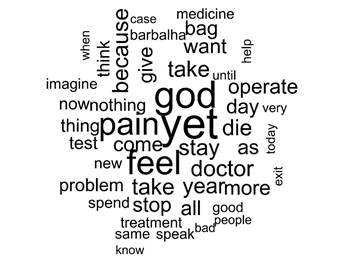
Therefore, when asked about individual considerations about the ostomy, it was observed, based on the processing of the responses by the IRaMuTeQ software, a greater frequency in the textual corpus of the lexical items: yet (n = 14), God (n = 13), feel (n = 11), pain (n = 10) grace (n = 7), take (n = 7), year (n = 7), die (n = 7), doctor (n = 7), stay (n = 7), take (n = 7) and bag (n =6), as illustrated by the word cloud in Figure 1, which aims to graphically represent the frequency and the main terms mentioned in the interview.
Word cloud with the corpus of responses (for the fifth interview question), Juazeiro do Norte, Ceará, 2024.
From the word cloud, aspects can be inferred that reflect the social representations constructed around this theme, based on the oscillation between positive and negative interpretations, which take into account, mainly, their daily implications, accompanied by feelings and the consequences of these devices, and it is possible to observe that for these people, previously afflicted by a painful and uncomfortable illness process, the use of this device is indicated above all as an alternative to overcoming the situation:
No, I think it is a help, it would not be the end, it is a help, it is an option that thank God we have, right, if we didn't have it then the tendency would be to get worse (P1). I think that this is more life that I will have ahead of me, that if I didn't have it I would have died, thank God, so if it is something that I am really obliged to do this, if I don't do it I will die, I have to do it, thank God for everything (P4). No, it's not the end, it's an alternative, he (the doctor) thought it had to be done first, so it wouldn't get worse later and so he wouldn't have to do it in a hurry and everything, so I wouldn't die (P5).
However, the stoma is also seen as a permanent reality, as can be inferred from the transcript of P9's speech, where, when asked whether the stoma would be an alternative or a final condition, it is observed that the patient considers it as a final condition, indicating a permanence, or something that will accompany him/her until the end of his/her life:
For me, it is the end (P9), “in the sense of being its final condition, that is, a permanent and irreversible condition” (author’s emphasis).
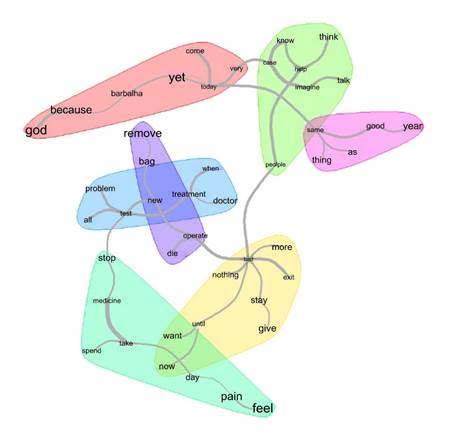
In the meantime, it was observed from the similarity tree, illustrated in Figure 2, the presence of the same lexical items, whose size represents the frequency in which they were cited, also demonstrating their connections with the other terms, according to the semantic correlations established in the interviewees' speeches, being possible to identify in this structure, for example, the connections made by the words “pain” and “feel”, “take” and “bag”, “die” and “operate” and “because” and “God”.
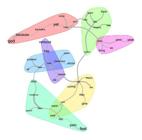
Similarity tree with the corpus of responses to the fifth interview question, Juazeiro do Norte, Ceará, 2024.
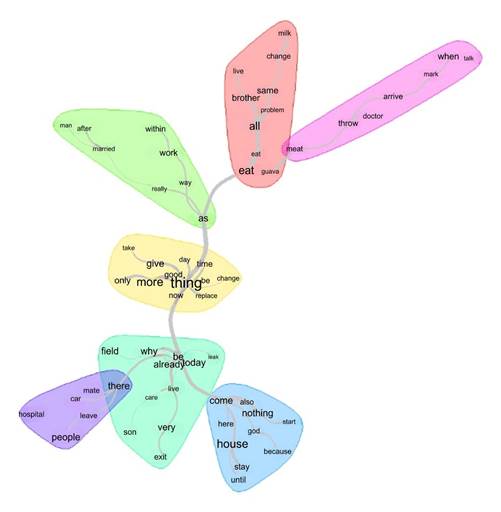
Therefore, when questioning these individuals about the personal, social and family implications, as well as the adaptations necessary for living with a stoma, a greater frequency of the items is observed, based on the similarity tree represented in Figure 3: thing (n = 15), being (n = 15), more (n = 12), eating (n =10), all (n = 10), home (n = 9), how (n = 8) and work (n = 8).
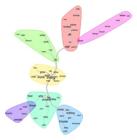
Similarity tree with the corpus of responses to the fourth interview question, Juazeiro do Norte, Ceará, 2024.
It is possible to observe the correlation between the terms: “mate”, “leave”, “car” and “there”, “son”, “care”, “live” and “be”, “eat”, “all” and “problem”, as well as “mark”, “throw”, “doctor” and “talk”, but also “way”, “how” and “work”, which reflect a series of implications generated by these devices, mainly food and work-related:
No, they changed what I ate, they took away the milk, the meat, the fat, now that's it, after two months I went to Juazeiro, to the office, I got there: doctor, I'm going to tell you something (...) and are they going to starve me to death now? (P7).
It changes everything, it messes with the whole family (...) a lot of things change, the schedule changes, the food changes, barbecues are out of the question, if you do it you can't even invite people, because you can't drink, you can't eat anything fatty, you can't, nothing (P5).
You can't do heavy work, things like that, it's over. The little feet I carry are twenty kilos below, but it's not possible to carry them (P12).
Working is fun (...) I don't think it's okay not to live at home (P9).
Another element of great value was the potential of family and social support, as well as the strong religiosity of patients, perceived as a strengthening factor in the face of the adversities of the condition:
I had to live with her because it was just me and my husband and he went out a lot, and with me being there with her, I already had more company, someone to take care of me, there wasn't going to be anyone to take care of me, so they are the ones who take care of me, my daughters (P6).
Thank God I didn't lack anything, neighbors, children, brother, and a lot of money was spent (...) they played bingo, they did a lot of things (P4)
It's difficult, right? She (the daughter) was registered at the factory, he (the son-in-law) too, and they all asked to leave and came, and they're with me to this day, so I have to thank God a lot, right? (P8).
Discussion
Social Representations, defined by Moscovici 10 as forms of knowledge derived from the social construction and sharing of certain groups, express patients' interpretations and worldviews about ostomies and the ostomized person, revealing the implications of this context, which are related not only to biological spheres, but also to social, psychological and spiritual spheres.
The findings show a strong interpretation of the ostomy as the only solution or path to the state of pain, stress and risk that the patients found themselves in, which corroborates the idea of the effectiveness of this medical device in restoring the health of the participants, being understood, above all, as a symptomatic relief, which according to a Portuguese study(14 is more frequent when it comes to patients with malignant diseases, due to the severity of the symptoms.
Therefore, even though it constitutes an alternative, several impacts are observed that occur due to the new reality, among them the need for personal and social adaptations, applied to the lifestyle of the patient and the community that surrounds him/her, in addition to the impacts on aspects such as self-image, work and routine, an aspect that will also be measured based on the location of the device. 15
The feeling of shame, incapacity or dependence on the device corroborates the impacts generated on the self-esteem and self-image of people with ostomies, 7 reducing general well-being and negatively interfering with their mental health, contributing to the prevalence of problems such as anxiety and depression, 16 so that the person with ostomy begins to perceive themselves in the world in a different way, attributing connotations of abnormality and imperfection to their body.
This factor is added to the limitations of the elimination pouch, such as the sounds generated by abdominal gases and odors coming from the intestine, as well as the fear of intestinal efflux leaking; a scenario that impacts the way of life and social relationships, as pointed out by a Brazilian, 5 an Ethiopian 7 and an Arab study, 17 which report the social consequences of this fear, responsible for making it impossible for these people to participate in prayers and group religious events.
Thus, a strong impact on the socialization of these individuals is observed, who, due to fear of leakage, elimination of odors or sounds, avoid socialization, a factor that is also observed in the case of nutritional restrictions, making it difficult to participate in parties and barbecues due to dietary limitations and which, according to the participants, is also an issue that directly affects quality of life and well-being, 5 given the greater selectivity and control introduced by the condition.
In addition, there is a need for adaptation in housing, transportation and work conditions, the latter being an aspect strongly identified in the corpus, where it is possible to infer the impact of the ostomy bag on work realities, making it difficult to carry out its activities, a factor that affects the identity, sense of purpose, social contribution and, above all, the routine of people with stomas, affecting the quality of life and mental health of these individuals, a factor also observed by an Australian study, 18 which reports a quality of life score twice as high in ostomized participants who maintained work activities in comparison to those who did not work or were retired.
In view of this, social institutions, such as the community and the family, are essential elements for treatment, and are also a strong point in the statements, which report the adaptation of these individuals to the new reality of the person with a stoma and the relevance of the family environment in coping with the condition and adaptation to the new reality, an aspect that directly influences the psychosocial adjustment to the stoma, in addition to factors such as age, type and location of the stoma. 19
That said, religiosity also plays a leading role in the support network built around these individuals, appearing as an important ally to quality of life and well-being, constituting a source of comfort and resilience, a factor also identified in other studies. 4
Care for the patient with a stoma requires the health team to understand their social, psychological and spiritual aspects, considering that during this process of health restoration, these professionals act not only in the curative aspect, but must also provide comprehensive care, offering support in adapting to the device, through health education and counseling actions. 20,21
It is about being supported by knowledge that enables a more comfortable adaptation to the new device, where it is possible to work on topics such as the need to continue socializing, how to deal with bodily and nutritional changes, and others mentioned in this study and in the literature.
This aspect is also necessary due to the prominent place occupied by the health service in the patient's recovery process, as well as throughout the period in which the patient has a stoma, where it is possible to observe a great emphasis on the statements regarding these services, a factor that is explained by the needs imposed by the stoma, such as the constant medical, nutritional and nursing consultations, where aspects such as health education and preoperative and postoperative counseling are of great importance for the adaptation process. 21
In addition, this analysis presents the prominent place occupied by spirituality in the treatment of the patient, constituting a potential in the restoration of the integrality of health, considering that this aspect constitutes a factor of encouragement, assisting in the recovery process, being cited by the great majority of patients and denoted as a positive aspect, which gives rise to the importance of the health professional, especially the nursing team, considering this aspect in their line of care, encouraging spiritual practices, when they exist.
Final considerations
The study captures the construction of some meanings by people with elimination stomas around their condition, making it possible to identify the biopsychosocial implications of this scenario, which leads to adaptations and dilemmas that go beyond the biological sphere, and can compromise the well-being and quality of life of patients, due to the limitations and demands that arise from their use. Thus, a series of consequences imposed by stomas are observed, such as social, work and food barriers, which add to the stigmas and negative feelings associated with the self-image and self-perception of these individuals.
That said, the limitation of the study is the fact that it only deals with elimination stomas, as well as the fact that the research mostly includes males and does not include other people who can serve as a reference for understanding social representations, such as friends and family members of people with stomas. Therefore, the need to carry out new, more comprehensive studies is identified, including above all a greater number of participants, including the social circle around these individuals, also considering other types of stomas.
References
- 1. Ayaz-Alkaya S. Overview of psychosocial problems in individuals with stoma: A review of literature. International Wound Journal. 2019;16(1),243-249. doi: 10.1111/iwj.13018
- 2. Cross HH. CE: Nursing Care for Patients After Ostomy Surgery. Am J Nurs. 2023;123(8):34-41. doi: 10.1097/01.NAJ.0000947460.38199.fe
- 3. Brasil. Ministério da Saúde. Secretaria de Atenção à Saúde. Portaria nº 400, de 16 de novembro de 2009. Diário Oficial da União, 2009.
- 4. Diniz IV, Costa IKF, Nascimento JA, Silva IP da, Mendonça AEO de, Soares MJGO. Factors associated to quality of life in people with intestinal stomas. Rev esc enferm USP. 2021;55:e20200377. doi: 10.1590/1980-220X-REEUSP-2020-0377
-
5. Tomasi AVR, Santos SMA dos, Honório GJ da S, Girondi JBR. Living with an intestinal ostomy and urinary incontinence. Texto contexto - enferm. 2022;31:e20210398. doi: 10.1590/1980-265X-TCE-2021-0398en
» https://doi.org/10.1590/1980-265X-TCE-2021-0398en -
6. Petersén C, Carlsson E. Life with a stoma-coping with daily life: Experiences from focus group interviews. J Clin Nurs. 2021;30(15-16):2309-2319. doi: 10.1111/jocn.15769
» https://doi.org/10.1111/jocn.15769 -
7. Zewude WC, Derese T, Suga Y, Teklewold B. Quality of Life in Patients Living with Stoma. Ethiop J Health Sci. 2021;31(5):993-1000. doi: 10.4314/ejhs.v31i5.11
» https://doi.org/10.4314/ejhs.v31i5.11 -
8. Lojo JJ, de la Villa R, Vega-Torres MM, Torres EA. Ostomy-Related Quality of Life in Puerto Ricans Living With Inflammatory Bowel Disease: A Prospective Cohort Study. J Wound Ostomy Continence Nurs. 2023;50(3):222-226. doi: 10.1097/WON.0000000000000964
» https://doi.org/10.1097/WON.0000000000000964 -
9. Costa SM, Soares YM, Silva ILBB, Linhares FMP, Azevedo PR, Silva LDC, et al. Quality of life of people with intestinal ostomies and associated factors. Texto contexto - enferm . 2023;32:e20230118. doi: 10.1590/1980-265X-TCE-2023-0118en
» https://doi.org/10.1590/1980-265X-TCE-2023-0118en - 10. Moscovici S. Representações Sociais: investigações em psicologia social. 11 ed. Petrópolis: Vozes; 2015.
-
11. Sousa YSO, Gondim SMG, Carias IA, Batista JS, Machado KCM. O uso do software Iramuteq na análise de dados de entrevistas. Rev. PPP. 2020;15(2):1-19. Disponível em: http://seer.ufsj.edu.br/revista_ppp/article/view/e3283
» http://seer.ufsj.edu.br/revista_ppp/article/view/e3283 -
12. Cancio I, Soares J. Critérios e estratégias de qualidade e rigor na pesquisa qualitativa. Ciencia y enfermería. 2020;26:28. doi: 10.29393/ce26-22ceis20022
» https://doi.org/10.29393/ce26-22ceis20022 -
13. Brasil. Ministério da Saúde. Conselho Nacional de Saúde. Resolução nº 466, de 12 de dezembro de 2012. Aprovar as seguintes diretrizes e normas regulamentadoras de pesquisas envolvendo seres humanos. Brasil, 2012. Disponível em: https://bvsms.saude.gov.br/bvs/saudelegis/cns/2013/res0466_12_12_2012.html
» https://bvsms.saude.gov.br/bvs/saudelegis/cns/2013/res0466_12_12_2012.html -
14. Silva JO, Gomes P, Gonçalves D, Viana C, Nogueira F, Goulart A, et al. Quality of Life (QoL) Among Ostomized Patients. A cross-sectional study using Stoma-care QoL questionnaire about the influence of some clinical and demographic data on patients’ QoL. J Coloproctol (Rio J). 2019;39(1):48-55. doi: 10.1016/j.jcol.2018.10.006
» https://doi.org/10.1016/j.jcol.2018.10.006 -
15. Mo J, Wendel CS, Sloan JA, Sun V, Hornbrook MC, Grant M, et al. Stoma location and ostomy-related quality of life among cancer survivors with ostomies: A pooled analysis. Am J Surg. 2022;223(5):963-968. doi: 10.1016/j.amjsurg.2021.09.023
» https://doi.org/10.1016/j.amjsurg.2021.09.023 -
16. Farahani MA, Sargolzaei MS, Shariatpanahi S, Dehkordi AH, Dalvand P, Heidari-Beni F. The prevalence of anxiety and depression in patients with ostomy: A systematic review and meta-analysis. Psychooncology. 2022;31(12):2020-2035. doi: 10.1002/pon.5988
» https://doi.org/10.1002/pon.5988 -
17. Alenezi A, Livesay K, McGrath I, Kimpton A. Ostomy-related problems and their impact on quality of life of Saudi ostomate patients: A mixed-methods study. J Clin Nurs. 2023;32(13-14):3707-3719. doi: 10.1111/jocn.16466
» https://doi.org/10.1111/jocn.16466 -
18. Ketterer SN, Leach MJ, Fraser C. Factors Associated With Quality of Life Among People Living With a Stoma in Nonmetropolitan Areas. Nursing Research. 2021;70(4):281-288. doi: 10.1097%2FNNR.0000000000000511
» https://doi.org/10.1097%2FNNR.0000000000000511 -
19. Doucette JE, Mawn BE, Beitz JM, Koren A. Factors Affecting Psychosocial Adjustment in Persons With a Recent Ostomy. J Wound Ostomy Continence Nurs. 2023;50(4):297-306. doi: 10.1097/WON.0000000000000986
» https://doi.org/10.1097/WON.0000000000000986 -
20. Hill B. Stoma care: procedures, appliances and nursing considerations. Br J Nurs. 2020;29(22):S14-S19. doi: 10.12968/bjon.2020.29.22.S14
» https://doi.org/10.12968/bjon.2020.29.22.S14 -
21. Nizum N, Jacob G. Systematic Review of Ostomy Care Pathways. Adv Skin Wound Care. 2022;35(5):290-295. doi: 10.1097/01.ASW.0000823976.96962.b6
» https://doi.org/10.1097/01.ASW.0000823976.96962.b6