Characterization of the patient safety culture in public hospitals of Ecuador: multicentric cross-centric study
Abstract:
Introduction: Patient safety culture is a key determinant in preventing adverse events and improving the quality of care. In Ecuador, evidence regarding its status in public hospitals is scarce, which justifies the need for a systematic evaluation
Objective: To evaluate the patient safety culture in three hospitals within Ecuador’s Comprehensive Public Health Network.
Method: A quantitative, descriptive, cross-sectional study conducted from January 2024 to December 2025. The population consisted of 1,266 physicians and nurses. The sample comprised 303 professionals, selected through systematic random sampling stratified by hospital. The Patient Safety Questionnaire, Spanish version, validated by the University of Murcia, was administered. The analysis was performed using descriptive statistics.
Results: The study identified strengths in dimensions such as Organizational Learning (M= 73.8; SD= 32.7), Teamwork (M= 73.0; SD= 31.1), and Feedback and Error Communication (M= 72.5; SD= 2.1), and weaknesses in the following dimensions: Open communication (M= 48.1, SD= 31.9), Non-punitive response to errors (M= 24.1, SD= 28.1), Staffing (M= 34.9; SD= 32.1), and Hospital management support for patient safety (M= 51.6; SD= 3.6).
Conclusion: The patient safety culture in the three hospitals exhibits systemic flaws, with opportunities for improvement through the implementation of strategies such as viewing reporting as a tool for organizational learning rather than punishment, adequate staffing, and support from senior management in patient safety management a responsibility shared by all.
Keywords:
systematic review; women; violence against women; intimate partner violence; nursing
Resumen:
Introducción: La cultura de seguridad del paciente es un determinante clave para prevenir eventos adversos y mejorar la calidad asistencial. En Ecuador, la evidencia sobre su estado en hospitales públicos es escasa, lo que justifica la necesidad de su evaluación sistémica
Objetivo: Evaluar la cultura de seguridad del paciente en tres hospitales de la Red Pública Integral de Salud de Ecuador.
Método: Estudio con abordaje cuantitativo, descriptivo, transversal, realizado entre enero de 2024 y diciembre de 2025. La población estuvo conformada por 1.266 médicos y enfermeras. La muestra fue de 303 profesionales, seleccionados mediante muestreo aleatorio sistemático estratificado por hospital. Se aplicó el Cuestionario sobre Seguridad de los Pacientes, versión española, validada por la Universidad de Murcia. El análisis se realizó con estadística descriptiva.
Resultados: El estudio encontró fortalezas en dimensiones como aprendizaje organizacional (M= 73.8; DE = 32.7), trabajo en equipo (M = 73.0; DE = 31.1) y feedback y comunicación de errores (M = 72.5; DE = 2.1), y debilidades en las dimensiones franqueza en la comunicación (M= 48.1; DE = 31.9), respuesta no punitiva a los errores (M = 24.1; DE = 28.1), dotación de personal (M= 34.9; DE = 32.1) y apoyo de la gerencia del hospital en la seguridad del paciente (M = 51.6; DE= 3.6).
Conclusión: La cultura de seguridad del paciente en los tres hospitales presenta fallas sistémicas, con oportunidades de mejora mediante la aplicación de estrategias como considerar la notificación como una herramienta de aprendizaje organizacional y no de sanción, una adecuada dotación de personal y apoyo de los mandos superiores en la gestión de la seguridad del paciente, responsabilidad de todos.
Palabras clave:
revisión sistemática; mujeres; violencia contra la mujer; violencia de pareja; enfermería
Resumo:
Introdução: A cultura de segurança do paciente é um determinante central para a prevenção de eventos adversos e para a melhoria da qualidade assistencial. No Equador, as evidências sobre a sua situação nos hospitais públicos são escassas, o que justifica a necessidade de uma avaliação sistemática
Objetivo: Avaliar a cultura de segurança do paciente em três hospitais da Rede Pública Integral de Saúde do Equador.
Método: Estudo de abordagem quantitativa, descritiva e transversal, realizado entre janeiro de 2024 e dezembro de 2025. A população foi composta por 1.266 médicos e enfermeiros. A amostra incluiu 303 profissionais, selecionados por amostragem aleatória sistemática estratificada por hospital. Foi aplicado o Questionário de Segurança dos Pacientes, na versão espanhola, validada pela Universidade de Múrcia. A análise foi realizada por meio de estatística descritiva.
Resultados: O estudo identificou fortalezas em dimensões como Aprendizagem organizacional (M = 73,8; DP = 32,7), Trabalho em equipe (M = 73,0; DP = 31,1) e Feedback e comunicação de erros (M = 72,5; DP = 2,1); e debilidades nas dimensões Franqueza na comunicação (M = 48,1; DP = 31,9), Resposta não punitiva aos erros (M = 24,1; DP = 28,1), Dotação de pessoal (M = 34,9; DP = 32,1) e Apoio da gestão hospitalar à segurança do paciente (M = 51,6; DP = 3,6).
Conclusão: A cultura de segurança do paciente nos três hospitais apresenta falhas sistêmicas, com oportunidades de melhoria por meio de estratégias que considerem a notificação como uma ferramenta de aprendizagem organizacional, e não de sanção, uma adequada dotação de pessoal e maior apoio das instâncias superiores na gestão da segurança do paciente, compreendida como responsabilidade de todos.
Palavras-chave:
revisão sistemática; mulheres; violência contra a mulher; violência por parceiro íntimo; enfermagem
Introduction
Patient safety is a global priority in contemporary healthcare, determined by the interaction of systemic and human factors in highly complex environments. 1 The World Health Organization (WHO) defines it as the conscious effort to prevent harm resulting from the healthcare process and to reduce to an acceptable minimum the risk of unnecessary harm to the patient. 2 Global figures reveal the magnitude of the problem: 1 in 10 patients suffers harm during healthcare, while in low-income and middle-income countries this figure is even higher, with 4 deaths per 100 people attributable to adverse events. 3,4
From an economic perspective, these events represent a potential reduction in global growth of 0.7 % annually, with more than half being preventable. Among the most frequent are medication errors, unsafe surgical procedures, healthcare-associated infections (HAIs), falls, pressure ulcers, and incorrect patient identification. (2
In response to this situation, since 2004, the WHO, through the World Alliance for Patient Safety, has been promoting a systemic and non-punitive approach focused on analyzing the root causes of adverse events, learning from mistakes, and developing safer health systems. 5 Within this framework, the Joint Commission International published the International Patient Safety Goals, evidence-based practices that guide the continuous improvement of care in health systems. 5
A critical component of this agenda is the patient safety culture, understood as the set of values, beliefs, and norms shared within the organization that shape staff attitudes and behaviors regarding safety as a common goal. 6 This culture determines the style of institutional commitment to risk management and the prevention of adverse events. (7 Its key dimensions include open communication, error reporting, teamwork, management support, a non-punitive response to error, and staffing. 8,9
The available evidence shows heterogeneous results in the evaluation of these dimensions. The study by Tello-García et al. identified weaknesses in areas such as management expectations and actions (60.8 %), organizational learning (68.1 %), and feedback on errors (58.9 %), with teamwork being the only dimension rated as a strength (76.3 %). 10 Similarly, the multicenter study by Maya et al. reported high scores in organizational learning (82.94 %) and teamwork (82.94 %), compared to low performance in non-punitive response to error (46.25 %) and openness in communication (45.38 %). (6
In Ecuador, the Ministry of Public Health (MPH) initiated quality improvement processes in 2013 through Hospital Accreditation under the Canadian Model, seeking to consolidate patient safety as the cornerstone of healthcare management. 11 However, adverse events persist: the MPH Epidemiological Bulletin 2021-2022 reported that 16.25 % of hospitalized patients presented with healthcare-associated infections (HAIs), notably ventilator-associated pneumonia (38.7 %), central venous catheter-related bloodstream infections (33.63 %), and catheter-related urinary tract infections (13.17 %). 12
The research problem lies in the persistence of preventable adverse events within the Ecuadorian healthcare system, in a context where evidence on the state of patient safety culture is scarce and fragmented. This knowledge gap limits the identification of institutional strengths and weaknesses, and consequently, the design of improvement strategies based on local evidence. The purpose of this study is to evaluate the patient safety culture among healthcare personnel in three institutions of the Ecuadorian Integrated Public Health Network, generating a baseline to guide decision-making in clinical risk management, prevention of adverse events, and sustained strengthening of the quality of care in the Ecuadorian context.
Metodología
A cross-sectional, descriptive, and quantitative study was conducted, aimed at evaluating the patient safety culture in doctors and nurses from three public hospitals in Ecuador (cities of Quito and Tena).
Selection and description of the hospitals
The three hospitals were intentionally selected because they are referral units of the Integrated Public Health Network (IPHN), belonging to the second and third levels of care, with high demand for services and no prior studies on patient safety culture. Their simultaneous inclusion allows for the comparison of institutional contexts of varying complexity and geographic location, contributing analytical variability to the study. In order to safeguard institutional confidentiality, the facilities were coded as Hospital 1, Hospital 2, and Hospital 3.
Hospital 1 is a secondary care unit providing outpatient, specialized, and inpatient services for adults and children in 16 specialties. Hospital 2 is a tertiary care unit specializing in maternal and pediatric care, with clinical and surgical services. Hospital 3 is a secondary care hospital offering outpatient consultations, emergency services, inpatient care, and medium- and high-complexity surgeries.
Population and sample
The target population consisted of all physicians and nurses from the three participating hospitals (N = 1,266). The sample size was calculated with a 95 % confidence level and a maximum acceptable error of 5 %, resulting in a minimum sample size of 295 participants. Selection was performed using systematic random sampling with proportional allocation by hospital and department. Since this procedure involves rounding quotas by stratum up to the nearest whole number, the final sample size was 303 participants, a statistically acceptable figure and more conservative than the minimum required. The final distribution was: Hospital 1 (n = 78), Hospital 2 (n = 119) and Hospital 3 (n = 106).
Inclusion and exclusion criteria
All physicians and nurses who met the following criteria were included in the study: (a) they worked in any department of the participating hospitals, regardless of their employment status; (b) they had at least one year of seniority at the institution; (c) they worked day or rotating shifts; and (d) they agreed to participate by signing the informed consent form.
Professionals who were on vacation or on leave due to a domestic emergency at the time of data collection, those who expressed their desire not to participate, and those who did not belong to the institutions included in the study were excluded.
Data collection instrument
The Hospital Survey on Patient Safety Culture (HSOPSC), developed by the Agency for Healthcare Research and Quality (AHRQ), was used to collect data. The Spanish version of the instrument has been validated by the Quality Management Research Group of the University of Murcia, with Cronbach's alpha coefficients between 0.64 and 0.88. 9 Since the instrument was originally developed in Spanish and has been widely used in Latin American contexts, no new cultural adaptation was made; however, the results should be interpreted with caution regarding the specific cultural equivalence for the Ecuadorian context.
In the present study, a pilot test was carried out with a representative subsample, obtaining a Cronbach's alpha coefficient of 0.75 for the Ecuadorian sample (n = 303), which indicates adequate internal consistency and supports the viability of the instrument in this context.
The HSOPSC questionnaire assesses 12 dimensions of safety culture grouped into three levels: (A) Safety culture outcomes (adverse event reporting and overall safety perception); (B) Unit/department-level dimensions (management expectations and actions, organizational learning, teamwork, open communication, error feedback, non-punitive response to errors, staffing, and management support); and (C) Hospital-level dimensions (inter-unit teamwork and issues with shift changes and inter-service transitions). It also includes nine multiple-choice questions for the socio-occupational characterization of participants. Responses are recorded on a Likert scale and recoded into three categories: negative, neutral, and positive. Questions phrased negatively are reversed for the overall analysis by dimension.
A dimension is rated as a strength when 75 % or more of the responses are positive (agree/strongly agree, or almost always/always) on positive items, or equivalently negative on negative items. It is considered an opportunity for improvement when between 50 % and 74 % of the responses are negative on positive items, or positive on negative items.
Data collection procedure
Once the sample was defined by stratum (hospital and department), participants were identified from each institution's personnel records. The questionnaire was self-administered in paper format between July and December 2025. Distribution and collection of the forms took place within the departments themselves, during working hours, and in the presence of the research team, in order to clarify any doubts and minimize the non-response rate. The questionnaires were delivered in individual envelopes without participant identification; once completed, they were deposited in a sealed ballot box, guaranteeing the anonymity of the responses. Prior to the start of the survey, institutional authorization was obtained from each hospital, and informed consent was obtained from all participants.
Statistical analysis
The data were processed using SPSS version 25. Descriptive statistics were used: frequency distributions and percentages for qualitative variables; mean (M), standard deviation (SD), median, mode, range, and percentiles for quantitative variables. All point estimates are accompanied by their 95 % confidence interval. The analysis is presented both globally (three hospitals combined) and broken down by hospital and profession.
Ethical considerations
The project was approved by the Research Ethics Committee for Human Subjects of the Central University of Ecuador (RECHS-UCE), under code 002-DOC-FCM-2024. Authorization was obtained from the authorities of each participating institution. Participation was voluntary, anonymous, and confidential; the hospitals were coded to protect their institutional identity, and the questionnaires did not contain any identifying information about the participants.
Results
Socio-labor characteristics of the sample
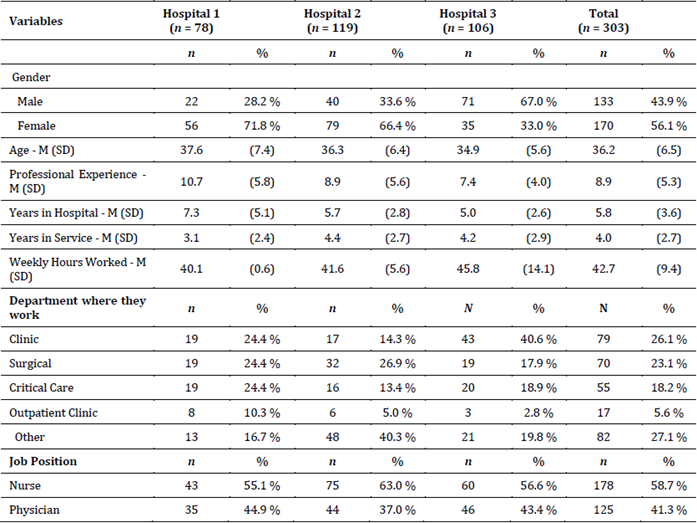
Three hundred and three (303) healthcare professionals participated: 178 nurses (58.7 %) and 125 physicians (41.3 %). Female staff comprised the majority of participants (170; 56.1 %), although the distribution varied by hospital: Hospitals 1 and 2 had a higher proportion of women (71.8 % and 66.4 %, respectively), while Hospital 3 had a higher proportion of male staff (71; 67.0 %). The average age was 36.2 years (SD = 6.5), and the average professional experience was 8.9 years (SD = 5.3). The average workload was 42.7 hours per week (SD = 9.4), with the greatest variability observed in Hospital 3 (M = 45.8; SD = 14.1). A comparison breakdown by hospital is presented in Table 1.
Dimensions of patient safety culture
Analysis of the eight dimensions of safety culture at the unit/department level reveals a heterogeneous profile among hospitals, with strengths identified in the relational dimensions and critical weaknesses in the dimensions linked to error management and human resources.
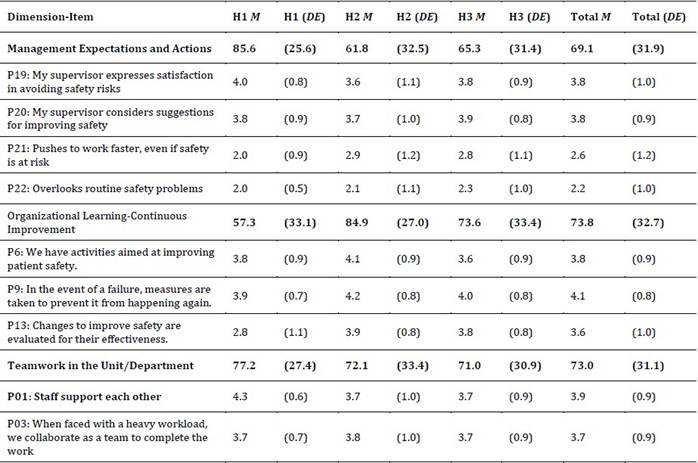
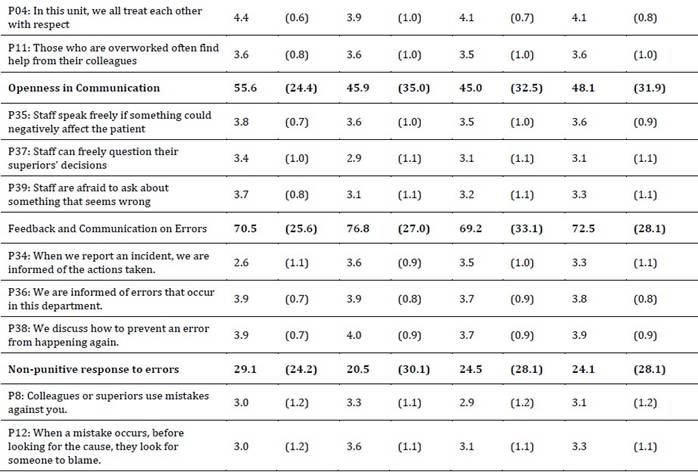
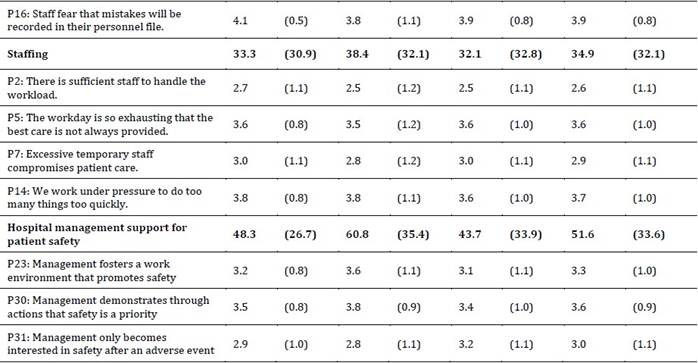
The dimensions with the highest scores in the total sample were: management expectations and actions (M = 69.1; SD = 31.9), organizational learning (M = 73.8; SD = 32.7), teamwork (M = 73.0; SD= 31.1), and feedback on errors (M = 72.5; SD = 28.1). In contrast, the dimensions with the lowest scores were: non-punitive response to errors (M = 24.1; SD = 28.1), staffing (M = 34.9; SD = 32.1), and management support (M = 51.6; SD = 33.6), identifying priority areas for improvement in all three establishments.
Clinically relevant differences were observed among the hospitals. In management expectations and actions, Hospital 1 had the highest score (M = 85.6; SD = 25.6), compared to more moderate scores in Hospitals 2 and 3. This pattern was reversed in organizational learning, where Hospital 2 led (M= 84.9; SD = 27.0) and Hospital 1 showed the lowest score (M = 57.3; SD = 33.1). The non-punitive response dimension was the weakest in all three hospitals, with none reaching scores that could be considered satisfactory. Details by dimension and item are presented in Table 2 . .
Discussion
The results of this study allow us to identify a coherent pattern in the patient safety culture of the three hospitals evaluated; the weaknesses are not randomly distributed among the dimensions, but are articulated around two interdependent axes, the non-punitive response to error and open communication, whose interaction constitutes the main obstacle to transforming error into organizational learning.
The non-punitive response emerged as the most deficient dimension of the study (total M= 24.1), a finding consistent with Latin American evidence. 13,14 The scores reflect the persistence of individual blame dynamics, where staff perceive that errors are used against them, that there is a search for those responsible rather than for the causes, and that formal administrative consequences constitute a real threat. The literature emphasizes that the search for culprits, fear of punishment, and negative records inhibit transparency and prevent the consolidation of a just culture. 15,16 For nursing staff, these environments are also associated with greater emotional exhaustion and reduced safe behavior. 17 These dynamics not only inhibit incident reporting but also create low-trust organizational environments that hinder continuous improvement.
From an interpretive perspective, this punitive culture directly influences communication. The low level of open communication observed (total M = 48.1) indicates that professionals do not perceive themselves as safe enough to express doubts, question clinical decisions, or report adverse events. This phenomenon is explained by the concept of psychological safety, defined as the collective perception that it is possible to take interpersonal risks (reporting errors, disagreeing, asking questions) without fear of retaliation. 18 Recent evidence shows that its absence is associated with lower incident reporting, less participation in improvement processes, and a greater risk of patient harm. 18,19
This creates a negative feedback loop: a stronger punitive culture leads to less psychological safety and less communication; and less communication leads to a greater tendency toward individual blame. This loop explains the observed paradox: the coexistence of formal feedback mechanisms with persistent levels of underreporting. Although the feedback and communication dimension regarding errors reached relatively high values (M = 72.5), the inconsistency in feedback following reports limits the closure of the learning cycle, a phenomenon documented in Latin American health institutions. 13,14 The existence of formal systems is not enough if it is not accompanied by an environment of trust that legitimizes staff participation.
These findings are consistent with the characterization of moderate safety cultures in Latin American contexts, marked by rigid hierarchical structures and limited interprofessional communication. 13,20 In the Ecuadorian context specifically, the patient safety culture reflects an incomplete transition between regulatory development and its effective implementation. The Ministry of Public Health has formal instruments (including the Patient Safety Manual and Hospital Accreditation processes under the Canadian Model) that promote effective communication and the reporting of adverse events; however, these guidelines do not consistently translate into safe organizational environments. 21) The disconnect between policy and practice not only restricts institutional learning but also perpetuates models of individual attribution of error, hindering the consolidation of a just culture consistent with WHO principles on patient safety.
Structural factors reinforce this problem. Insufficient staffing (the second most deficient area in the study (M = 34.9)) shows results consistent with those reported in other Latin American studies 13,22,23 and constitutes a factor that intensifies weaknesses in communication and error response. Work overload reduces opportunities for reflective communication and favors reactive responses focused on immediate resolution, to the detriment of systemic error análisis. 24,25 Previous research confirms that workload and the nurse-patient relationship are significant predictors of adverse events 25 and that work overload explains up to 52 % of the care-related causes associated with their occurrence. 26 These conditions generate physical and mental fatigue, increase errors, and deteriorate the occupational health of the team. (27, 28)
Managerial support showed average levels of satisfaction (M total = 51.6), with Hospital 2 being the best rated, a result different from that reported by Jabarkhil et al., where the averages were lower, indicating greater dissatisfaction. 29 Institutional leadership is a key determinant; reactive or sanction-centered styles weaken staff confidence, while active, learning-oriented leadership promotes open communication and systematic incident reporting. 30
Given this diagnosis, the available evidence allows us to propose specific interventions for the evaluated hospitals. First, the implementation of anonymous and non-punitive reporting systems (such as the confidential incident reporting systems (CIRS) recommended by the WHO) would reduce the barrier of fear of formal consequences. Second, training management teams in transformational leadership and secure communication, with an emphasis on building psychological safety, has been shown to improve communication and error response in controlled interventions. (18, 30) Third, reviewing staffing levels with complexity-adjusted workload criteria and establishing structured spaces for analyzing adverse events (morbidity and mortality meetings with a systemic approach) would contribute to closing the organizational learning cycle. For these interventions to be sustainable, they require support from national public policies that prioritize patient safety as a strategic focus of the Ecuadorian healthcare system.
Limitations of the study
This study has limitations that must be considered when interpreting its findings. The cross-sectional design prevents the establishment of causal relationships and does not allow for capturing the evolution of safety culture over time; the results represent a snapshot of the phenomenon at a specific moment. The sample is limited to physicians and nurses from three hospitals in Quito and Tena, which restricts generalizability to the Ecuadorian healthcare system as a whole and excludes other professionals (nursing assistants, technical and administrative staff) whose perceptions also influence institutional culture. As it is a self-report instrument, the results may be influenced by social desirability bias, particularly in sensitive dimensions such as the non-punitive response to errors. Finally, the HSOPSC questionnaire was administered in its Spanish version, validated in the Iberian context, without a formal process of cultural adaptation for Ecuador. Although its use is widespread in Latin America, this lack of adaptation affects measurement equivalence in the local context and should be explicitly acknowledged.
The findings open up three priority lines of action. Methodologically, it is urgent to advance the validation and cultural adaptation of the HSOPSC for Ecuador, in order to have evidence of measurement equivalence that strengthens the comparability of future studies. Research-wise, longitudinal designs are needed to evaluate the impact of improvement interventions on safety culture, enriching the understanding of the phenomenon at the national level. In terms of healthcare management, the results offer a concrete baseline to guide institutional decisions focused on the most deficient areas: non-punitive reporting systems, staffing reviews, and strengthening managerial leadership in patient safety.
Conclusions
The patient safety culture in the evaluated hospitals exhibits structural weaknesses concentrated in the non-punitive response to errors, staffing levels, and management support, while teamwork and organizational learning emerge as relative strengths. The non-punitive response is the most critical dimension, sustained by dynamics of individual blame and fear of formal consequences that inhibit incident reporting and hinder learning from errors. Poor communication and insufficient psychological safety among staff are mutually reinforcing with the punitive culture, creating a cycle that perpetuates the underreporting of adverse events and undermines continuous improvement. The Ecuadorian context reflects a gap between regulatory development in patient safety and its effective implementation in clinical practice, demanding interventions that link public policies with concrete organizational transformations. Moving towards a mature safety culture requires integrated interventions that include establishing non-punitive reporting systems, strengthening learning-oriented leadership, and ensuring structural conditions (adequate staffing) that make safe care sustainable in Ecuador's Integrated Public Health Network.
References
-
1.Martín T, Monte E, Morillo Verdugo R. Indicadores para la calidad asistencial y la atención farmacéutica al paciente VIH+. Farm Hosp (Internet). 2013 (citado 2026 abr 20);37(4):276-285. Disponible en: Disponible en: https://scielo.isciii.es/scielo.php?script=sci_abstract&pid=S1130-63432013000400002&lng=es&nrm=iso&tlng=es
» https://scielo.isciii.es/scielo.php?script=sci_abstract&pid=S1130-63432013000400002&lng=es&nrm=iso&tlng=es -
2.Organización Mundial de la Salud. Seguridad del paciente (Internet). 2023 (citado 2026 abr 20). Disponible en: Disponible en: https://www.who.int/es/news-room/fact-sheets/detail/patient-safety
» https://www.who.int/es/news-room/fact-sheets/detail/patient-safety -
3.Organización Mundial de la Salud. Plan de acción mundial para la seguridad del paciente 2021-2030: Hacia la eliminación de los daños evitables en la atención de salud (Internet). World Health Organization. 2023 (citado 2026 abr 20). Disponible en: Disponible en: https://iris.who.int/server/api/core/bitstreams/a28c34c0-089c-4f5d-a0b1-5d9c35a3cd67/content
» https://iris.who.int/server/api/core/bitstreams/a28c34c0-089c-4f5d-a0b1-5d9c35a3cd67/content -
4.Dhingra-Kumar N, Brusaferro S, Arnoldo L. Patient Safety in the World. En: Textbook of Patient Safety and Clinical Risk Management. Springer (Internet). 2020 (citado 2026 abr 21), Chapter 8. Disponible en: Disponible en: https://www.ncbi.nlm.nih.gov/books/NBK585617/
» https://www.ncbi.nlm.nih.gov/books/NBK585617/ -
5.González C, Reinoso A. Implementación de metas internacionales de seguridad del paciente en atención ambulatoria CONAMED (Internet). 2015 (citado 2026 abr 21);20:78-82. Disponible en: Disponible en: https://dialnet.unirioja.es/servlet/articulo?codigo=7291932
» https://dialnet.unirioja.es/servlet/articulo?codigo=7291932 -
6.Maya Salazar AM, Marín Restrepo DM. Cultura de la seguridad del paciente en seis centros quirúrgicos de Antioquia. Rev Cuid (Internet). 2020 (citado 2026 abr 21);11(2):e1040. doi: 10.15649/cuidarte.1040
» https://doi.org/10.15649/cuidarte.1040 -
7.Lotici A, do Nascimento Santos-Zonta F, Lotici G, Gaffuri T. Evaluación de la cultura de seguridad del paciente desde la perspectiva de los profesionales de cuidados intensivos. Enferm glob(Internet). 2022 (citado 2026 abr 22);21(67):135-184. doi: 10.6018/eglobal.488311
» https://doi.org/10.6018/eglobal.488311 -
8.Alshammari M, Tyerman J, Beogo I, Craig J. Nurses’ perceptions of patient safety culture measured by the Hospital Survey on Patient Safety Culture in the Gulf Cooperation Council region: A systematic review. International Journal of Nursing Studies Advances (Internet) 2026 (citado 2026 abr 21);10:100512. doi: 10.1016/j.ijnsa.2026.100512
» https://doi.org/10.1016/j.ijnsa.2026.100512 -
9.Ministerio de Sanidad y Consumo. Cuestionario sobre Seguridad de los Pacientes. Versión española del Hospital Survey on Patient Safety (Internet). 2005 (citado 2026 abr 21). Disponible en: Disponible en: https://seguridaddelpaciente.sanidad.gob.es/informacion/publicaciones/2007/docs/CuestionarioSeguridadPacientes.pdf
» https://seguridaddelpaciente.sanidad.gob.es/informacion/publicaciones/2007/docs/CuestionarioSeguridadPacientes.pdf -
10.Tello-García M, Pérez-Briones NG, Torres-Fuentes B, Nuncio-Domínguez JL, Pérez-Aguirre DM, Covarrubias-Solís IF. Percepción del personal de enfermería sobre la cultura y seguridad del paciente. Enferm glob (Internet). 2023 (citado 2026 abr 22);22(70):111-138. doi: 10.6018/eglobal.531691
» https://doi.org/10.6018/eglobal.531691 -
11.Bajaña Romero JA, Ortiz Orobio ML. Cultura de seguridad del paciente en el personal sanitario del Centro de Salud de Canoa. Medisur (Internet). 2023 (citado 2026 abr 22);21(5):985-993. Disponible en: Disponible en: http://scielo.sld.cu/scielo.php?script=sci_arttext&pid=S1727-897X2023000500985&lng=es
» http://scielo.sld.cu/scielo.php?script=sci_arttext&pid=S1727-897X2023000500985&lng=es -
12.Ministerio de Salud Pública. Boletín epidemiológico. Infecciones asociadas a atención de salud (IAAS) (Internet). 2022 (citado 2026 abr 21). Disponible en: Disponible en: https://www.salud.gob.ec/wp-content/uploads/2024/02/boletin_iaas_2021-2022_final.pdf
» https://www.salud.gob.ec/wp-content/uploads/2024/02/boletin_iaas_2021-2022_final.pdf -
13.Camacho-Rodríguez DE, Carrasquilla-Baza DA, Domínguez-Cancino KA, Palmieri PA. Patient Safety Culture in Latin American Hospitals: A Systematic Review with Meta-Analysis. Int J Environ Res Public Health (Internet). 2022 (citado 2026 abr 22);19(21):14380. Disponible en: Disponible en: https://pmc.ncbi.nlm.nih.gov/articles/PMC9658502/
» https://pmc.ncbi.nlm.nih.gov/articles/PMC9658502/ -
14.Hare R, Tapia A, Tyler L, Fan L, Ji S. Surveys on Patient Safety Culture (SOPS). Hospital 2.0 Survey: 2022 User Database Report Part II. AHRQ Publication (Internet). 2022 (citado 2026 abr 21);22(23):0066. Disponible en: Disponible en: https://www.ahrq.gov/sites/default/files/wysiwyg/sops/surveys/hospital/2022-hsops2-database-report-appendixes.pdf
» https://www.ahrq.gov/sites/default/files/wysiwyg/sops/surveys/hospital/2022-hsops2-database-report-appendixes.pdf -
15.Comparative assessment of patient safety culture performance in OECD countries: Findings based on the Hospital Survey on Patient Safety Culture versions 1 and 2 OECD Health Working Papers (Internet). 2024 (citado 2026 abr 20);168. doi: 10.1787/d0552328-en
» https://doi.org/10.1787/d0552328-en -
16.Gutiérrez López MA, Noreña Piedrahita IV, Gómez DA. Cultura Punitiva en Seguridad del Paciente: Revisión Sistemática de la Literatura. Rev Científica Hallazgos (Internet). 2021 (citado 2026 abr 21);6(2):236-259. Disponible en: Disponible en: https://dialnet.unirioja.es/servlet/articulo?codigo=8276772
» https://dialnet.unirioja.es/servlet/articulo?codigo=8276772 -
17.Nafe P, Habibi-Soola A, Aghaei MH, Mehri S. The relationship between error experience and patient safety culture with safe activities of emergency nurses. Sci Rep (Internet). 2025 (citado 2026 abr 22);15:10438. doi: 10.1038/s41598-025-95191-8
» https://doi.org/10.1038/s41598-025-95191-8 -
18.Montgomery A, Chalili V, Lainidi O, Mouratidis C, Maliousis I, Paitaridou K, et al. Psychological safety and patient safety: a systematic and narrative review. PLoS One (Internet). 2025 (citado 2026 abr 22);20(4):e0322215. doi: doi: 10.1371/journal.pone.0322215
» 10.1371/journal.pone.0322215 -
19.Mira J, Madarasova Geckova A, Knezevic B, Sousa P, Strametz R. Psychological Safety in Healthcare Settings. Int J Public Health (Internet). 2024 (citado 2026 abr 22);69:1608073. doi: 10.3389/ijph.2024.1608073
» https://doi.org/10.3389/ijph.2024.1608073 -
20.Pedroso AC, Fernandes FP, Tuma P, Vernal S, Pellizzari M, Seisdedos MG, et al. Patient safety culture in South America: a cross-sectional study. BMJ Open Qual (Internet). 2023 (citado 2026 abr 23);12(4):e002362. doi: 10.1136/bmjoq-2023-002362
» https://doi.org/10.1136/bmjoq-2023-002362 -
21.Ministerio de Salud Pública. Manual de Seguridad del Paciente (Internet). 2016 (citado 2026 abr 20). Disponible en: Disponible en: http://www.acess.gob.ec/wp-content/uploads/2017/08/MANUAL-DE-SEGURIDAD-DEL-PACIENTE.pdf
» http://www.acess.gob.ec/wp-content/uploads/2017/08/MANUAL-DE-SEGURIDAD-DEL-PACIENTE.pdf -
22.Abdelaliem SMF, Alsenany SA. Factors Affecting Patient Safety Culture from Nurses’ Perspectives for Sustainable Nursing Practice. Healthcare (Internet). 2022 (citado 2026 abr 22 );10(10):1889. Disponible en: Disponible en: https://www.mdpi.com/2227-9032/10/10/1889
» https://www.mdpi.com/2227-9032/10/10/1889 -
23.Fassi CF, Mourajid Y, Chahboune M, Hilali A. Patient Safety Culture Perception among Moroccan Healthcare professionals: Cross-Sectional Study in Public Hospitals. Ethiop J Health Sci (Internet). 2023 (citado 2026 abr 21);33(2):273-280. doi: 10.4314/ejhs.v33i2.12
» https://doi.org/10.4314/ejhs.v33i2.12 -
24.Roqueta Egea F, Chanovas Borràs M. Cultura de seguridad del paciente en los servicios de urgencias: resultados de su evaluación en 30 hospitales del Sistema Nacional de Salud español. Emergencias (Internet). 2011 (citado 2026 abr 21);23:356-364. Disponible en: Disponible en: https://revistaemergencias.org/wp-content/uploads/2023/08/Emergencias-2011_23_5_356-64.pdf
» https://revistaemergencias.org/wp-content/uploads/2023/08/Emergencias-2011_23_5_356-64.pdf -
25.Guzmán Gutiérrez A, Gómez López EA. Relación entre la carga laboral de enfermería en las unidades de cuidado intensivo de un hospital de alta complejidad y la ocurrencia de eventos adversos. Acta Colomb Cuid Intensivo (Internet). 2025 (citado 2026 abr 21);26(1). doi: 10.1016/j.acci.2025.09.001
» https://doi.org/10.1016/j.acci.2025.09.001 -
26.Sevilla-Erazo F, Sosa-Bone MP. Eventos adversos relacionados con el cuidado de enfermería en la unidad de cuidados intensivos del Hospital Esmeraldas sur Delfina Torres de Concha. Más vita (Internet). 2023 (citado 2026 abr 22);5(4):78-89. doi: 10.47606/ACVEN/MV0213
» https://doi.org/10.47606/ACVEN/MV0213 -
27.Olds DM, Clarke SP. The Effect of Work Hours on Adverse Events and Errors in Health Care. J Safety Res (Internet). 2010 (citado 2026 abr 23);41(2):153-162. doi: 10.1016/j.jsr.2010.02.002
» https://doi.org/10.1016/j.jsr.2010.02.002 -
28.Al‐Amin M, Li K. Hospitalists staffing levels and hospital performance. Health Serv Res (Internet). 2020 (citado 2026 abr 23);55(1):44-53. doi: 10.1111/1475-6773.13233
» https://doi.org/10.1111/1475-6773.13233 -
29.Jabarkhil AQ, Tabatabaee SS, Jamali J, Moghri J. Assessment of Patient Safety Culture Among Doctors, Nurses, and Midwives in a Public Hospital in Afghanistan. Risk Manag Healthc Policy (Internet). 2021 (citado 2026 abr 23);14:1211-1217. Disponible en: Disponible en: https://www.dovepress.com/assessment-of-patient-safety-culture-among-doctors-nurses-and-midwives-peer-reviewed-article-RMHP
» https://www.dovepress.com/assessment-of-patient-safety-culture-among-doctors-nurses-and-midwives-peer-reviewed-article-RMHP -
30.Fernández García MR, Madrid Rodríguez A. Atención segura para todos los recién nacidos y todos los niños. An Pediatría (Internet). 2025 (citado 2026 abr 23);103(3). Disponible en: Disponible en: http://analesdepediatria.org/es-atencion-segura-todos-recien-nacidos-articulo-S1695403325002243
» http://analesdepediatria.org/es-atencion-segura-todos-recien-nacidos-articulo-S1695403325002243