Relation between Personality and Metacognitive Regulation in a Sample of University Students from Different Countries in Latin America
Abstract:
This research investigates the relationship between personality factors and metacognition in a sample of undergraduate students from Argentina, Colombia, Costa Rica, Panama, and Uruguay. Recognizing the interdisciplinary nature of cognitive science, the study emphasizes the importance of metacognitive abilities-considered executive functions-on academic performance. The sample consisted of 692 students, aged 20 to 30, from various undergraduate programs. Participants completed the Metacognitive Awareness Inventory (MAI) and the Adjective Checklist for Evaluating Personality (AEP). The analysis used multiple regression to examine the relationship between the five major personality factors and eight metacognitive variables across the five countries. Results indicated significant associations between personality traits and metacognitive components, with conscientiousness and openness to new experiences consistently predicting metacognitive regulation and knowledge. These findings align with previous studies suggesting that personality traits influence metacognitive abilities. The study contributes to the understanding of how individual differences in personality can affect learning processes, highlighting the potential for targeted interventions to enhance metacognitive skills.
Keywords:
learning; metacognition; personality; university students; cross cultural studies
Resumen:
Esta investigación examina la relación entre los factores de personalidad y la metacognición en una muestra de estudiantes de pregrado de Argentina, Colombia, Costa Rica, Panamá y Uruguay. A partir de la naturaleza interdisciplinaria de la ciencia cognitiva, el estudio enfatiza la importancia de las habilidades metacognitivas, consideradas como funciones ejecutivas fundamentales en el desempeño académico. La muestra se conformó por 692 estudiantes, de 20 a 30 años, de diversos programas de pregrado. Los participantes completaron el Inventario de conciencia metacognitiva (MAI) y el Listado de adjetivos para evaluar la personalidad (AEP). En el análisis se utilizó regresión múltiple para examinar la relación entre los cinco grandes factores de personalidad y ocho variables metacognitivas en los cinco países. Los resultados indicaron asociaciones significativas entre los factores de personalidad y los componentes metacognitivos, con la escrupulosidad y la apertura prediciendo consistentemente la regulación y el conocimiento metacognitivo. Estos hallazgos se alinean con estudios previos que sugieren que los factores de personalidad influyen en las habilidades metacognitivas. El estudio contribuye a la comprensión de cómo las diferencias individuales en la personalidad pueden afectar los procesos de aprendizaje, destacando el potencial de intervenciones dirigidas para mejorar las habilidades metacognitivas.
Palabras clave:
aprendizaje; metacognición; personalidad; estudiantes universitarios; estudios transculturales
Resumo:
Esta pesquisa examina a relação entre os fatores de personalidade e a metacognição em uma amostra de estudantes de graduação da Argentina, Colômbia, Costa Rica, Panamá e Uruguai. Com base na natureza interdisciplinar da ciência cognitiva, o estudo enfatiza a importância das habilidades metacognitivas, consideradas como funções executivas fundamentais no desempenho acadêmico. A amostra foi composta por 692 estudantes, com idades entre 20 e 30 anos, de diversos programas de graduação. Os participantes completaram o Inventário de Consciência Metacognitiva (MAI) e a Lista de Adjetivos para avaliar a Personalidade (AEP). Na análise, utilizou-se regressão múltipla para examinar a relação entre os cinco grandes fatores de personalidade e oito variáveis metacognitivas nos cinco países. Os resultados indicaram associações significativas entre fatores de personalidade e componentes metacognitivos, com a conscienciosidade e a abertura prevendo consistentemente a regulação e o conhecimento metacognitivo. Esses achados se alinham com estudos anteriores que sugerem que os fatores de personalidade influenciam as habilidades metacognitivas. O estudo contribui para a compreensão de como as diferenças individuais de personalidade podem afetar os processos de aprendizagem, destacando o potencial de intervenções direcionadas para melhorar as habilidades metacognitivas.
Palavras-chave:
aprendizagem; metacognição; personalidade; estudantes universitários; estudos transculturais
Introduction
Cognitive sciences, which include fields as diverse as psychology, linguistics, neuroscience, artificial intelligence, among others, contribute to positioning the idea of an active student who, in addition to having proficient cognitive and academic performance, is capable of learning autonomously and who is self-regulated, based on their own agency. Some authors consider metacognition itself to be an executive function (Ardila & Ostrosky-Solís, 2008; Flores-Lázaro et al., 2014; Follmer & Sperling, 2016) that allows a person to think about their own cognitive processes and products (Flavell, 1979; 1987) or, in other words, to think about thinking (Ozturk, 2020; Topping, 2024; Veenman et al., 2006). This monitoring capacity is considered a skill that can be developed and taught through strategy instruction (Gutierrez de Blume, 2022; Nobutoshi, 2023; Silver et al., 2023; Zsigmond et al., 2025). Metacognitive monitoring is understood as individuals’ ability to successfully understand what they are learning and generally involves a series of metacognitive activities such as questioning, reflection, inference-making, and self-generated feedback. These skills allow individuals to recognize their mastery or understanding of a topic, or when they need to modify their learning strategies to improve their performance (Gutierrez de Blume, 2022; Zsigmond et al., 2025).
Studies conducted with very different interventions and research designs indicate that metacognition can be developed and practiced through appropriate instruction. However, some of the research referring to the effects of interventions on metacognitive monitoring remains inconclusive regarding differences in the effect sizes of monitoring accuracy, with contradictory, inconsistent results (Bol et al., 2005; Bol & Hacker, 2001; Gutierrez & Schraw, 2015; Nietfeld et al., 2005; Pesout & Nietfeld, 2020; Schraw et al., 2014; Wongdaeng, 2022; Yang et al., 2023).
The high variability in the results of interventions and in the reported effect sizes can be explained by the diversity of contextual and sociodemographic variables inherent in these intervention studies on metacognitive monitoring. Contextual variables include classroom climate, teaching style, type of strategies used, and characteristics of the study (Abello et al., 2022; Alonso-Tapia & Ruiz-Díaz, 2022; Bryce et al., 2015; Chiarino et al., 2024; Farrington et al., 2012; Forsberg et al., 2021; Gutierrez de Blume, 2022; Morosanova et al., 2022). Likewise, this diversity is evident in relation to person-centered variables such as learning goals, the cognitive profile of the learner, affect/emotions, academic persistence, growth mindset, and personality factors (Abello et al., 2022; Alonso-Tapia & Ruiz-Díaz, 2022; Bryce et al., 2015; Chiarino et al., 2024; Farrington et al., 2012; Forsberg et al., 2021; Gutierrez de Blume, 2022; Morosanova et al., 2022). Overall, however, there is consensus that general metacognition, including its different subcomponents, can be taught in different learning situations. By the same token, this macro-skill is expected to transfer to new learning experiences according to different environmental demands (Azevedo, 2020; Chew et al., 2018; Chew & Cerbin, 2020; Veenman et al., 2006). In this sense, teaching metacognitive skills fosters the development of students for whom deep learning is possible, a learning objective that requires students to reflect on their own understanding and their own learning process (Sawyer, 2019; 2022). However, the fact that it can be taught as a skill does not necessarily mean that the student will learn it, or that, even if they do learn it, they will be truly aware of how they are learning and willing to use metacognitive skills to achieve more effective performance. In fact, different studies argues that the presence of underconfidence and overconfidence biases inherent to metacognitive judgments and reports of difficulties in discriminating the feeling of knowing and not knowing in students who have difficulties with their metacognitive monitoring process, especially for students with low academic performance (Bol et al., 2005; Chang & Brainerd, 2023; De Bruin et al., 2017; Geraci et al., 2023; Hacker et al., 2000; Kelemen et al. 2007; Kruger & Dunning 1999; Miller & Geraci, 2011; Nietfeld et al., 2006; Zapata-Zapata et al., 2024).
Some studies show overconfidence in predictive judgments on achievement tests, especially among low-achieving students, a phenomenon known as the Dunning-Kruger effect. In contrast, high-achieving students demonstrate more accurate predictions in their performance and moderate their confidence levels relative to their actual performance (Bol et al., 2005; Chang & Brainerd, 2023; De Bruin et al., 2017; Geraci et al., 2023; Hacker et al., 2000; Kelemen et al. 2007; Kruger & Dunning, 1999; Miller & Geraci, 2011; Nietfeld et al., 2006; Zapata-Zapata et al., 2024).
The association between personality factors and metacognitive performance has been relatively understudied. Seminal studies addressing this relationship can be traced back to research led by Wolfe and Grosch (1990), a study that has grown in popularity since the work of researchers such as Kleitman (2008) and Buratti (2013).
Previous studies have indicated a positive relationship between personality traits such as extroversion and overconfidence (Dahl et al., 2010; Pallier et al., 2002; Schaefer et al., 2004). Similarly, there is evidence of an association between the trait of narcissism and overconfidence, possibly because these types of personalities often consider themselves more intelligent than objective performance measures suggest (Buratti et al., 2013; Campbell et al., 2004). On the contrary, in some studies on the association between the components of self-regulated learning and personality, high correlations have been reported between metacognitive measures and personality factors such as conscientiousness and openness to new experiences, and in turn, high correlations between academic performance and these same personality factors (Dumfart & Neubauer, 2016; Kelly & Donaldson, 2016; Morosanova et al., 2022; O’Connor & Paunonen, 2007). Presumably, this can partially be explained by the abstract nature of the construct, given its many theoretical models and the lack of agreement among researchers in the field regarding the components of metacognition and self-regulated learning (Dinsmore et al., 2008; Lyons & Zelazo, 2011; Tobias & Everson, 2009; Zohar & Dori, 2012). In addition, researchers have begun to acknowledge the influence of sociodemographic factors like personality differences and their possible association with the metacognitive performance of the learner (Bibi et al., 2022; De Bruin et al., 2017; Gutierrez de Blume & Montoya Londoño, 2023; Kleitman & Stankov, 2001; 2007; Pallier et al., 2002; Stankov et al., 2014).
Most studies linking the importance of personality factors in the formulation of metacognitive judgments have described associations between metacognitive performance and the personality traits of extraversion, narcissism, need for cognition, and overconfidence (Campbell et al., 2004; Dahl et al., 2010; Pallier et al., 2002; Ronningstam, 2005; Schaefer et al., 2004; Wolfe & Grosch, 1990). Similarly, traits such as openness and level of trust have been associated with the proportion of correct responses (Dahl et al., 2010; Kleitman, 2008) whereas neuroticism/emotional stability shows a negative correlation with feelings of insecurity and trust for different judgment tasks (Mirels et al., 2002; Want & Kleitman, 2006). Yet other studies have described the association between factors such as openness and extraversion with overconfidence in the formulation of first and second order metacognitive judgments (Buratti, 2013; Buratti et al., 2013).
More recently, a study conducted with 244 undergraduate foreign language students in Turkey aimed to establish the relationship between metacognition and personality traits and their interaction with foreign language performance. The results confirmed that factors such as conscientiousness, openness to experience, and agreeableness accounted for 20% of the variability in metacognitive knowledge, and that factors such as conscientiousness and openness to experience accounted for 16% of the variability in metacognitive regulation. Further, factors such as conscientiousness and extroversion predicted reading performance while conscientiousness and openness to experience were significant predictors of language performance (Ozturk, 2021). Another study conducted with 102 college students taking several psychology courses at a university in the southeastern United States examined the association between personality factors, reading comprehension, and metacomprehension accuracy before and after taking a test. Results revealed that openness to experience correlated positively with all confidence assessment measures applied in the reading comprehension task, but did not correlate with actual reading performance or with actual grades, indicating that participants exhibited overconfidence regarding their performance. Likewise, factors such as extroversion correlated negatively with self-reported reading performance and did not predict actual reading performance (Agler et al., 2021). Given the inconsistent findings regarding personality, the present study sought to explore the relationship between personality factors and metacognition in a sample of university students from different Latin American countries.
Research Question
What is the predictive effect of personality factors on metacognitive knowledge and regulation in a sample of undergraduate students from Argentina, Colombia, Costa Rica, Panama, and Uruguay?
Hypothesis
Given that studies demonstrating an association between these variables have yielded diverse and inconclusive results (Bidjerano & YunDai, 2007; Blair et al., 2010; De Bruin et al., 2017; Dörrenbächer & Perels, 2016), the present study posited a general, non-directional rather than a specific, directional hypothesis, expecting some factors such as conscientiousness to correlate positively with metacognition while others such as neuroticism would correlate negatively.
Method
Participants, Sampling, and Research Design
This study employed a non-experimental, cross-sectional quantitative research design with a non-random convenience sampling approach (Tabachnick & Fidell, 2019). The participants were 692 students from different undergraduate programs (mostly psychology and education) from Argentina, Colombia, Costa Rica, Panama, and Uruguay, who were pursuing their educational careers during the year 2023 (post-pandemic). The sample consisted of 305 men and 387 women.
This project received ethical approval from the University of Manizales, Colombia, under the title: "Metacognitive Functioning in the Performance of Teachers and Students from Different Countries. Intercultural Analysis," with bioethical approval in Colombia through internal code FCSH-202006.
The sample was selected intentionally via convenience sampling. Because the participants were pursuing their educational careers at the universities where the authors work, they were first informed of the study’s objectives. Those interested in voluntarily participation read and signed an informed consent form.
All students who participated in the study met the following inclusion criteria: age between 20 and 30 years; absence of psychological and/or psychiatric disorders or history of academic failure (this question was asked directly to the students individually as part of the sociodemographic data collection process during a meeting to sign the informed consent form).
Materials and Instruments
Metacognitive Awareness Inventory (MAI; Schraw & Dennison, 1994). In its original format, this test is a 52-item inventory, grouped into eight subcomponents to measure adults’ metacognitive knowledge and regulation. Scores for each item are marked by a 10-cm vertical bar on a continuous bipolar scale ranging from 0 to 100, where 0 represents “not true for me” and “very true for me” is represented by a score of 100. This rating scheme is superior to an ordinal Likert scale because it increases the instrument’s reliability by increasing the variability of responses (Gutierrez, 2012; Schraw & Dennison, 1994; Weaver, 1990). Participants’ scores on individual scales were obtained by summing all items on that scale and taking the average. Therefore, each participant had eight composite outcomes, one for each of the components of metacognitive knowledge and regulation. Studies using this tool have reported Cronbach’s alpha reliability coefficients ranging from .74 to .91 (Gutierrez de Blume & Montoya Londoño, 2021; Gutierrez de Blume et al., 2023; Gutierrez de Blume et al., 2024; Schraw & Dennison, 1994).
Adjective Checklist for Assessing Personality (AEP; Ledesma et al., 2011; Sánchez & Ledesma, 2007; 2013). This instrument is structured based on the Big Five model of personality (Goldberg, 1992, 1993; Goldberg et al., 2006) through a list of 67 adjectives that describe personality traits. Cronbach’s alpha for the test ranges from .75 for the openness factor to .85 for the neuroticism factor (Ledesma et al., 2011; Sánchez & Ledesma, 2013). The same rating scheme for the MAI was used for the AEP as well (i.e., a continuous 0-100 scale with two qualitative anchors at either end).
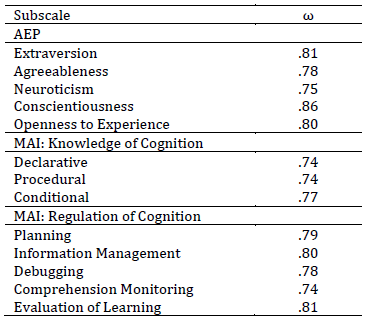
Table 1 reports the reliability indices for this study’s sample. McDonald's omega was used instead of Cronbach’s alpha for all self-report measures because it is a more conservative reliability coefficient (Tabachnick & Fidell, 2019).
Reliability Coefficients, McDonald's omega, for the Eight Subscales of the MAI and the Five Personality Factors of the AEP (N = 692)
Procedure
For data collection, students from the participating countries were convened at two different times by the lead researchers in each country. First, students were presented with the objectives and rationale of the research. Subsequently, students interested in participating read and signed the informed consent form. During this time, the lead researcher in each country was available to answer any questions. Next, students completed the protocol in a single session, consisting of the MAI (Schraw & Dennison, 1994; Gutierrez de Blume et al., 2023; Gutierrez de Blume et al., 2024) and the AEP (Ledesma et al., 2011; Sánchez & Ledesma, 2013).
The protocol was implemented in groups by each of the lead researchers in the respective country, all of whom had experience in implementing this type of task and had doctoral training. Likewise, the ethical standards of each country and respect for participant anonymity were considered during data collection. More specifically, the rules and guidelines of the Declaration of Helsinki were followed, and informed consent was obtained from each participant before completing the survey.
Data Analysis
The data were examined for outliers using the regression subcommand (any case with three or more standard deviations from the group means) and tested with the required statistical assumptions prior to analysis. No outliers that would otherwise bias the parameter estimates were detected, and the data met the assumptions of linearity, homoscedasticity, normality, and lack of collinearity between predictors. Therefore, data analysis was performed without making any statistical adjustments to the data. To answer the research questions, the data were subjected to a series of standard ordinary least squares (multiple) regressions in which the five personality factors served as predictors and the eight metacognitive awareness variables served as criteria for each analysis, respectively. This process was repeated for each of the five participating countries. As each country's data were independent of all other countries, the Bonferroni adjustment for statistical significance to avoid inflation of the familywise Type I error rate was only controlled for the eight analyses conducted for each country (the actual p-value used for all analyses was p ≤ .01). The squared multiple correlation coefficient, R 2 , was employed as the effect size for all analyses. Cohen (1988) provided the following interpretive guidelines for R 2: .010-.499 as small; .500-.799 as moderate; and ≥ .800 as large.
Results
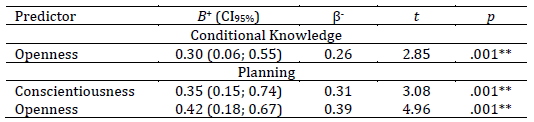
In the case of the Argentine sample, the omnibus regression model was statistically significant, F(5,54) = 6.53, p = .012, R 2 = .315. The regression results revealed that the personality factor of openness to new experiences predicts only conditional knowledge, and that both openness and conscientiousness predict only planning within the regulation scales. As individuals’ perceptions of their openness increase, so does their perception of their conditional knowledge (i.e., when, where, and why strategies are applied given task demands). Furthermore, the more participants’ openness and conscientiousness increase, the more their planning skills improve (Table 2).
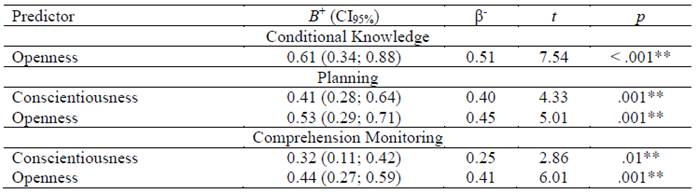
Similarly, in the Colombian sample, the omnibus regression model was statistically significant, F(5,346) = 21.93, p < .001, R 2 = .516. The regression results revealed that openness to new experiences was the only significant positive predictor of conditional knowledge, and that openness and conscientiousness significantly positively predicted planning and comprehension monitoring. Interestingly, the standardized regression coefficients were higher than in the Argentine sample for all aspects except monitoring (Table 3).
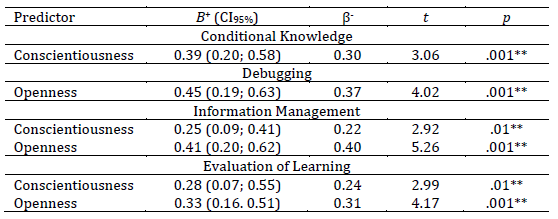
The omnibus regression model was statistically significant for the Costa Rican sample, F(5,95) = 8.35, p < .011, R 2 = .448, where the results differ. The findings indicated that conscientiousness positively predicted conditional knowledge while only openness positively predicted debugging skills. However, both openness and conscientiousness positively predicted information management and evaluation of learning (see Table 4).
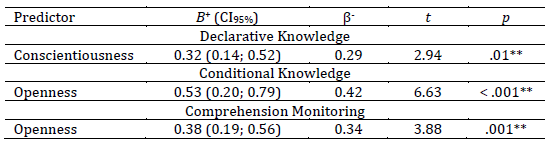
The omnibus regression model was statistically significant for the Panamanian sample, F(5,115) = 7.11, p < .018, R 2 = .296. Table 5 reports that conscientiousness was a positive predictor of declarative knowledge, and that openness positively predicted conditional knowledge and comprehension monitoring.
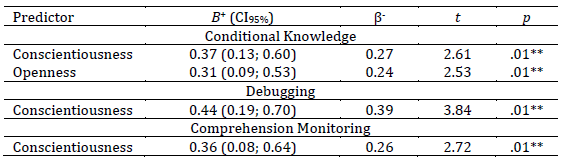
Finally, the omnibus regression model was statistically significant for the Uruguayan sample, F(5,52) = 5.93, p < .023, R 2 = .255. For this sample, the results showed that conscientiousness and openness positively predicted conditional knowledge while only conscientiousness positively predicted debugging and monitoring (Table 6).
From these five Latin American samples, despite nuances of both language and culture, openness to new experiences and conscientiousness were consistently the only personality factors that positively predicted conditional knowledge within knowledge of cognition and the five components of regulation of cognition, although this latter pattern differed by culture.
Discussion
The study of metacognition and its importance for students in achieving successful learning has existed since the seminal studies of Flavell (1979, 1987). However, in the current context, metacognition ceases to be an almost exclusive problem about how the learner understands and regulates their own cognitive resources, and instead approaches metacognition as a much more social construct, involving other variables of the learner such as personality, learning preferences, motivation, gender, executive functions, self-concept, and parenting styles, etc. (Gutierrez de Blume & Montoya Londoño, 2022, 2023; Gutierrez Blume et al., 2022; Händel et al., 2020). The objective of this line of research was to establish the relationship between personality factors and metacognition in an intercultural sample of undergraduate students from different Latin American countries. The relationship between some personality factors and the major components of metacognition was supported by the samples from all participating countries. Thus, it is congruent with has been previously reported in studies that have indicated moderate correlations between metacognitive judgments and different personality factors such as openness and extraversion (Buratti & Allwood, 2012; Gutierrez de Blume & Montoya Londoño, 2020, 2023; Kleitman & Stankov, 2007; Nietfeld & Schraw, 2002; Šafranj et al., 2021; Stankov, 2000; 2018; Stankov & Crawford, 1996; 1997). Likewise, significant correlations have been reported between these same personality factors-openness to experience and extraversion-with metacognitive knowledge and regulation (Öz, 2016), and correlations between personality factors and metacognitive judgments (Händel et al., 2020).
Based on the research tradition in the field, metacognition is considered the most effective predictor of learning outcomes (Özçakmak et al., 2021; Swanson et al., 2024; Thiede et al., 2019; Veenman, 2015; Wang et al., 1990). In this regard, various researchers have indicated that students with adequate metacognitive performance in the face of classroom challenges can differentiate what they know from what they do not know, select appropriate strategies to master the learning they do not yet understand, develop goal-based study behavior, establish study plans, evaluate results, and can adjust plans based on the evaluation process they execute. Thus, metacognition allows students to be more efficient in their learning (Bürgler et al., 2022; Celik, 2022; Stanton et al., 2021). In this regard, given the relevance of metacognition for successful academic performance, researchers are making efforts to clarify the criteria that should be considered in any metacognitive intervention, including: 1) metacognitive instruction as part of the class content; 2) informing students about the usefulness and application of metacognitive strategies; and 3) prolonging training over time to ensure the smooth and sustained application of metacognitive performance. However, research on these intervention criteria remains somewhat unexplored, and thus, provide inconclusive results (Azevedo, 2020).
Studies such as the present study represent a contribution to achieving a better explanation of the inconsistent results derived from different intervention research insofar as these differences are plausibly partially due to moderating effects of personality factors. These factors can enhance or limit the possibilities for the student to make more optimal use of the intervention and the opportunities of the metacognitive reflection process. From this perspective, research has demonstrated that metacognitive monitoring accuracy may be influenced by a more global self-concept of ability, associated with relatively stable personality characteristics, rather than actual performance, which may be one reason why monitoring sometimes seems to be a process so resistant to change (Bol et al., 2005; Bol & Hacker, 2001; Dembo & Seli, 2004; Hacker & Bol, 2004; Hacker et al., 2000; Zimmerman & Moylan, 2009).
Likewise, studies conducted outside the classroom, which address the relationship between personality factors (i.e., the Big Five) and the components of metacognition in everyday life (e.g., metacognitive beliefs, metamemory skills, learning judgments, and judgments of the feeling of knowing) during face name recognition tasks, found that people high in neuroticism/low emotional stability showed lower learning and accuracy judgments than people who showed high extraversion. The study concluded that people with neuroticism traits had little confidence in their memory and reported more negative metacognitive beliefs than people with high extraversion (Irak, 2024).
In the present study, with respect to metacognitive knowledge, a relationship was found between declarative and conditional knowledge and openness to experience for all samples from the four countries. This result is interesting, given that knowledge in general is considered the basis of metacognitive regulation of learners. Declarative knowledge allows learners to know themselves, to know the state of their knowledge, and the type of strategies they possess while conditional knowledge allows them to know when, where, why and for what to employ strategies (Brown, 1987; Gutierrez de Blume et al., 2024; Gunstone & Mitchell, 1998; Jacobs & Paris, 1987; Montoya et al., 2024; Moshman, 2017; Schraw & Moshman, 1995; Soleimani et al., 2018). Hence, it is logical that a personality factor such as openness to experience, which implies a disposition towards an active imagination, the ability to reflect on oneself, and intellectual curiosity (Costa & McCrae, 1985; 1992), leads to greater metacognitive knowledge. This implies the knowledge that people have about their own cognition, or about the cognition in general and, especially, about how one learns.
Similarly, metacognitive regulation skills such as planning and monitoring were related to openness and to conscientiousness in the case of the student samples from Argentina, Colombia, Panama, and Uruguay. In this regard, regulation involves the set of skills that allow learners to have a process of anticipation, control, and judgment on the state of learning from some basic subcomponents like planning, information management, monitoring, debugging, and evaluation (Brown, 1987; Gutierrez de Blume et al., 2024; Jacobs & Paris, 1987; Jiménez & Puente, 2014; Montoya et al., 2024; Moshman, 2017; Schraw & Moshman, 1995; Schraw & Dennison, 1994). Conscientiousness or responsibility, likewise, has been understood as the capacity that individuals have towards self-regulated behavior, to act based on the objectives that they planned, and to establish a system of goals, which allow them to organize and execute their objectives (Genise et al., 2020; Lingjaerde et al., 2001). Hence, it may be closely related to regulation skills involved in the planning and monitoring of the learning process, and even in the adjustment of goals or the action plan, if required.
A relationship was also found between other metacognitive regulation skills such as debugging, information management, and evaluation with openness and conscientiousness in the sample from Costa Rica. This can be explained by the type of policies and curricular guidelines given by the Ministry of Public Education (MEP, 2023) of that country, which openly promotes the teaching of metacognition. Moreover, in its latest guidelines for classroom activities, the MEP indicates that, through the evaluation of learning in the country, it seeks to have students self-regulate their learning process, according to their characteristics and interests, in such a way that they experience processes of self-reflection and feedback around the construction of their knowledge (MEP, 2023). This may partially explain why these two personality factors lead to a better regulatory skill.
Finally, openness to experience and conscientiousness lead to better metacognitive performance, especially in relation to the components of declarative and conditional knowledge, and regulation skills, especially at the level of planning and monitoring. These results are consistent with previous research with undergraduate students at the Turkish State University in which openness to experience and conscientiousness have a positive and significant relationship with metacognition (Sapancı & Güler, 2021). Likewise, this result is consistent with the findings of a study conducted with undergraduate students at a university in Scotland, which found that students who showed a high level of conscientiousness, metacognition was a predictor of their academic performance (Kelly & Donaldson, 2016). These findings are highly relevant when considering that aspects such as responsibility and open-mindedness could influence students’ ability to plan, organize, evaluate, and adjust their study behavior and to persist in the pursuit of successful performance. In this regard, researchers such as Barrick and Mount (1991) and Britwum et al. (2022) argued that students with a high level of openness to experience are those who have a positive attitude toward deep, complex, and challenging learning experiences, and who tend to be more successful in academic performance.
Conclusions
This study supports the positive relationship between personality factors such as conscientiousness and openness to experience with different types of metacognitive knowledge like declarative and conditional, and with different metacognitive regulation skills, especially planning and monitoring. This was evident in most of the countries included in this research. In contrast, the negative relationship between neuroticism and metacognitive performance, which has also been described previously in the literature, was not supported.
Of interest is the relationship found between metacognitive regulation skills such as debugging, information management, and evaluation with the personality factors of openness and conscientiousness in the case of the Costa Rican sample. This result can likely be explained by the promotion of different educational policies for working with innovative proposals focused on metacognition, which have been implemented in that country in recent years.
Implications for Theory, Research, and Practice
Research on the relationship between “warm” variables such as personality and “cold” variables such as metacognition contributes to explaining some inconsistent results in many metacognitive intervention programs. It may be a future line of work to expand the current explanation of metacognitive monitoring problems, especially difficulties in monitoring accuracy. As evidenced in the present study, some personality traits such as openness and conscientiousness appear to positively impact metacognitive performance, especially at the level of declarative knowledge, conditional knowledge, planning, and monitoring.
Limitations and New Research Opportunities
The findings of the present study are exploratory and, although the sample size is relatively large compared to other studies of the same nature, future research should replicate this study with larger sample sizes, especially in countries with a small sample size, to ensure that the correlational and predictive pattern that emerged is stable and consistent across multiple samples. The results highlight the need for multicultural studies to investigate the extent to which the results of this study generalize to other cultures, not just those of Latin American countries.
Future research could continue to explore the possible relationship between personality factors and other metacognitive variables of interest. This could include the relationship between personality factors and types of metacognitive judgments, especially at the level of prediction and postdiction judgments. This could also establish possible differences based on the type of task (cognitive, academic, everyday life, etc.), method of assessment (online, offline), method of application (paper and pencil, virtual), and even focusing the analysis on intercultural differences in the relationship between personality, metacognition, and the effect of sociodemographic variables such as gender, years of schooling, or certain differences in the types of educational policies that vary by country.
References
-
Abello, D. M., Alonso-Tapia, J., & Panadero, E. (2022). El aula universitaria. La influencia del clima motivacional y el estilo de enseñanza sobre la autorregulación y el desempeño de los estudiantes. Revista Complutense de Educación, 33(3), 399. https://doi.org/10.5209/rced.74455
» https://doi.org/10.5209/rced.74455 -
Agler, L. M. L., Noguchi, K., & Alfsen, L. K. (2021). Personality traits as predictors of reading comprehension and metacomprehension accuracy. Current Psychology, 40(10), 5054-5063.https://doi.org/10.1007/s12144-019-00439-y
» https://doi.org/10.1007/s12144-019-00439-y -
Alonso-Tapia, J., & Ruiz-Díaz, M. (2022). Student, teacher, and school factors predicting differences in classroom climate: A multilevel analysis. Learning and Individual Differences, 94, 102115. https://doi.org/10.1016/j.lindif.2022.102115
» https://doi.org/10.1016/j.lindif.2022.102115 - Ardila, A., & Ostrosky-Solís, F. (2008). Desarrollo histórico de las funciones ejecutivas. Revista de Neuropsicología, Neuropsiquiatría y Neurociencias, 8(1), 1-21.
-
Azevedo, R. (2020). Reflections on the field of metacognition: issues, challenges, and opportunities. Metacognition and Learning, 15(2), 91-98. https://doi.org/10.1007/s11409-020-09231-x
» https://doi.org/10.1007/s11409-020-09231-x -
Barrick, M. R., & Mount, M. K. (1991). The Big Five personality dimensions and job performance: A meta-analysis. Personnel Psychology, 44(1), 1-26. https://doi.org/10.1111/j.1744-6570.1991.tb00688.x
» https://doi.org/10.1111/j.1744-6570.1991.tb00688.x -
Bibi, R., Ehsan, N., & Mushtaq, R. (2022). Meta-cognitive learning strategy, personality traits and grit among second language learners. Human Nature Journal of Social Sciences, 3(4), 353-364. https://doi.org/10.71016/hnjss/qe6wqv79
» https://doi.org/10.71016/hnjss/qe6wqv79 -
Bidjerano, T., & YunDai, D. (2007). The relationship between the big-five model of personality and self-regulated learning strategies. Learning and Individual Differences(17), 69-81. https://doi.org/10.1016/j.lindif.2007.02.001
» https://doi.org/10.1016/j.lindif.2007.02.001 -
Blair, C., Calkins, S., & Kopp, L. (2010). Self-regulation as the interface of emotional and cognitive development: Implications for education and academic achievement. En R. H. Hoyle (Ed.), Handbook of personality and self-regulation (pp. 64-90). Blackwell Publishing Ltd. https://doi.org/10.1002/9781444318111.ch4
» https://doi.org/10.1002/9781444318111.ch4 -
Bol, L., & Hacker, D. (2001). A comparison of the effects of practice tests and traditional review on performance and calibration. Journal of Experimental Education, 69(2), 133-151. https://doi.org/10.1080/00220970109600653
» https://doi.org/10.1080/00220970109600653 -
Bol, L., Hacker, D., O’Shea, P., & Allen, D. (2005). The influence of overt practice, achievement level, and explanatory style on calibration accuracy and performance. The Journal of Experimental Education, 73(4), 269-290. https://doi.org/10.3200/JEXE.73.4.269-290
» https://doi.org/10.3200/JEXE.73.4.269-290 -
Britwum, F., Amoah, S. O., Acheampong, H. Y., Sefah, E. A., Djan, E. T., Jill, B. S., & Aidoo, S. (2022). Do extraversion, agreeableness, openness to experience, conscientiousness and neuroticism relate to students academic achievement: the approach of structural equation model and process macro. International Journal of Scientific Management Research, 05(2), 64-79. https://doi.org/10.37502/IJSMR.2022.5205
» https://doi.org/10.37502/IJSMR.2022.5205 - Brown, A. (1987). Metacognition, executive control, self-regulation, and other more mysterious mechanisms. En F. Weinert & R. Kluwe (Eds.), Metacognition, motivación and understanding (pp. 65-116). Lawrence Erlbaum.
-
Bryce, D., Whitebread, D., & Szűcs, D. (2015). The relationships among executive functions, metacognitive skills and educational achievement in 5 and 7 year-old children. Metacognition and Learning, 10(2), 181-198. https://doi.org/10.1007/s11409-014-9120-4
» https://doi.org/10.1007/s11409-014-9120-4 -
Buratti, S. (2013). Meta-metacognition: The regulation of confidence realism in episodic and semantic memory Ineko AB. https://gupea.ub.gu.se/bitstream/handle/2077/32860/gupea_2077_32860_1.pdf?sequence=1
» https://gupea.ub.gu.se/bitstream/handle/2077/32860/gupea_2077_32860_1.pdf?sequence=1 -
Buratti, S., & Allwood, C. (2012). The accuracy of meta-metacognitive judgments: Regulating the realism of confidence. Cognitive Processing, 13(3), 243-253. https://doi.org/10.1007/s10339-012-0440-5
» https://doi.org/10.1007/s10339-012-0440-5 -
Buratti, S., Allwood, C. M., & Kleitman, S. (2013). First- and second-order metacognitive judgments of semantic memory reports: The influence of personality traits and cognitive styles. Metacognition and Learning, 8(1), 79-102. https://doi.org/10.1007/s11409-013-9096-5
» https://doi.org/10.1007/s11409-013-9096-5 -
Bürgler, S., Kleinke, K., & Hennecke, M. (2022). The metacognition in self-control scale (MISCS). Personality and Individual Differences, 199, 111841. https://doi.org/10.1016/j.paid.2022.111841
» https://doi.org/10.1016/j.paid.2022.111841 -
Campbell, W. K., Goodie, A. S., & Foster, J. D. (2004). Narcissism, confidence, and risk attitude. Journal of Behavioral Decision Making, 17(4), 297-311. https://doi.org/10.1002/bdm.475
» https://doi.org/10.1002/bdm.475 -
Celik, B. (2022). The effect of metacognitive strategies on self-efficacy, motivation and academic achievement of university students. Canadian Journal of Educational and Social Studies, 2(4), 37-55. https://doi.org/10.53103/cjess.v2i4.49
» https://doi.org/10.53103/cjess.v2i4.49 -
Chang, M., & Brainerd, C. J. (2023). Changed-goal or cue-strengthening? Examining the reactivity of judgments of learning with the dual-retrieval model. Metacognition and Learning, 18(1), 183-217. https://doi.org/10.1007/s11409-022-09321-y
» https://doi.org/10.1007/s11409-022-09321-y -
Chew, S. L., & Cerbin, W. J. (2020). The cognitive challenges of effective teaching. The Journal of Economic Education, 52(1), 17-40. https://doi.org/10.1080/00220485.2020.1845266
» https://doi.org/10.1080/00220485.2020.1845266 -
Chew, S. L., Halonen, J. S., McCarthy, M. A., Gurung, R. A. R., Beers, M. J., McEntarffer, R., & Landrum, R. E. (2018). Practice what we teach: Improving teaching and learning in psychology. Teaching of Psychology, 45(3), 239-245. https://doi.org/10.1177/0098628318779264
» https://doi.org/10.1177/0098628318779264 -
Chiarino, N., Curione, K., & Huertas, J. A. (2024). Classroom motivational climate in Ibero- American secondary and higher education: a systematic review. Ciencias Psicológicas, 18(2), e-3770. https://doi.org/10.22235/cp.v18i 2.3770
» https://doi.org/10.22235/cp.v18i 2.3770 -
Cohen, J. (1988). Statistical power analysis for the behavioral sciences (2a ed.). Lawrence Earlbaum & Associates. https://doi.org/10.4324/9780203771587
» https://doi.org/10.4324/9780203771587 -
Costa, P. T., & McCrae, R. R. (1985). NEO Personality Inventory (NEO-PI) Psychological Assessment Resources. https://doi.org/10.1037/t07564-000
» https://doi.org/10.1037/t07564-000 -
Costa, P. T., & McCrae, R. R. (1992). Normal personality assessment in clinical practice: The NEO Personality Inventory. Psychological Assessment, 4(1), 5-13. https://doi.org/10.1037/1040-3590.4.1.5
» https://doi.org/10.1037/1040-3590.4.1.5 -
Dahl, M., Allwood, C. M., Rennemark, M., & Hagberg, B. (2010). The relation between personality and the realism in confidence judgements in older adults. European Journal of Ageing, 7(4), 283-291. https://doi.org/10.1007/s10433-010-0164-2
» https://doi.org/10.1007/s10433-010-0164-2 -
De Bruin, A., Kok, E., Lobbestael, J., & De Grip, A. (2017). The impact of an online tool for monitoring and regulating learning at university: overconfidence, learning strategy, and personality. Metacognition Learning, 12(1), 21-43. https://doi.org/10.1007/s11409-016-9159-5
» https://doi.org/10.1007/s11409-016-9159-5 - Dembo, M. H., & Seli, H. (2004). Students' Resistance to Change in Learning Strategies Courses. Journal of Developmental Education, 27(3), 2-11.
-
Dinsmore, D. L., Alexander, P. A., & Loughlin, S. M. (2008). Focusing the conceptual lens on metacognition, self-regulation, and self-regulated learning. Educational Psychology Review, 20(4), 391-409. https://doi.org/10.1007/s10648-008-9083-6
» https://doi.org/10.1007/s10648-008-9083-6 -
Dörrenbächer, L., & Perels, F. (2016). Self-regulated learning profiles in college students: Their relationship to achievement, personality, and the effectiveness of an intervention to foster self-regulated learning. Learning and Individual Differences, 51, 229-241. https://doi.org/10.1016/j.lindif.2016.09.015
» https://doi.org/10.1016/j.lindif.2016.09.015 -
Dumfart, B., & Neubauer, A.C. (2016). Conscientiousness is the most powerful noncognitive predictor of school achievement in adolescents. Journal of Individual Differences, 37(1), 8-15. https://doi. org/10.1027/1614-0001/a000182
» https://doi. org/10.1027/1614-0001/a000182 - Farrington, C. A., Roderick, M., Allensworth, E., Nagaoka, J., Keyes, T. S., Johnson, D. W., & Beechum, N. O. (2012). Teaching adolescents to become learners: the role of noncognitive factors in shaping school performance: A critical literature review Consortium on Chicago School Research.
-
Flavell, J. (1979). Metacognition and cognitive monitoring. A new area of cognitive-developmental inquiry. American Psychologist, 34(10), 906-911. https://doi.org/10.1037/0003-066x.34.10.906
» https://doi.org/10.1037/0003-066x.34.10.906 - Flavell, J. (1987). Speculation about nature and development of metacognition. En F. Weinert & R. Kluwe (Eds.), Metacognition, motivación and understanding (pp. 21-29). Hillsdale.
- Flores-Lázaro, J. C., Ostrosky-Schejet, F., & Lozano-Gutiérrez, A. (2014). BANFE - 2. Batería neuropsicológica de funciones ejecutivas y lóbulos frontales Manual Moderno.
-
Follmer, D. J., & Sperling, R. (2016). The mediating role of metacognition in the relationship between executive function and self-regulated learning. British Journal of Educational Psychology, 86(4), 1-17. https://doi.org/10.1111/bjep.12123
» https://doi.org/10.1111/bjep.12123 -
Forsberg, A., Blume, C. L., & Cowan, N. (2021). The development of metacognitive accuracy in working memory across childhood. Developmental Psychology, 57(8), 1297-1317. https://doi.org/10.1037/dev0001213
» https://doi.org/10.1037/dev0001213 -
Genise, G., Ungaretti, J., & Etchezahar, E. (2020). El Inventario de los Cinco Grandes Factores de Personalidad en el contexto argentino: puesta a prueba de los factores de orden superior Diversitas: Perspectivas en Psicología, 16(2), 325-340. https://doi.org/10.15332/22563067.6298
» https://doi.org/10.15332/22563067.6298 -
Geraci, L., Kurpad, N., Tirso, R., Gray, K. N., & Wang, Y. (2023). Metacognitive errors in the classroom: The role of variability of past performance on exam prediction accuracy. Metacognition and Learning, 18(1), 219-236. https://doi.org/10.1007/s11409-022-09326-7
» https://doi.org/10.1007/s11409-022-09326-7 -
Goldberg, L. (1992). The development of markers for the Big-Five factor structure. Psychological Assessment
, (4), 26-42. https://doi.org/10.1037/1040-3590.4.1.26
» https://doi.org/10.1037/1040-3590.4.1.26 -
Goldberg, L. (1993). The structure of phenotypic personality traits. American Psychologist, 48, 26-34. https://doi.org/10.1037/0003-066X.48.1.26
» https://doi.org/10.1037/0003-066X.48.1.26 -
Goldberg, L., Johnson, J., Eber, H., Hogan, R., Ashton, M., Cloninger, R., & Gough, H. (2006). The international personality item pool and the future of public-domain personality measures. Journal of Research in Personality, 40, 84-96. https://doi.org/10.1016/j.jrp.2005.08.007
» https://doi.org/10.1016/j.jrp.2005.08.007 - Gunstone, R., & Mitchell, I. (1998). Metacognition and conceptual change. En J. Mintzes, J. Wandersee, & J. Novak (Eds.), Teaching science for understanding (pp. 133-163). Academic Press.
-
Gutierrez de Blume, A. P. (2022). Calibrating calibration: A meta-analysis of learning strategy interventions to improve metacognitive monitoring accuracy. Journal of Educational Psychology, 114(4), 681-700. https://doi.org/10.1037/edu0000674
» https://doi.org/10.1037/edu0000674 -
Gutierrez de Blume, A. P., & Montoya Londoño, D. M. (2020). Relationship between personality factors and metacognition in a sample of students in the last semester of training in baccalaureate degree programs in education in Colombia. Educación y Humanismo, 22(39), 1-20. https://doi.org/10.17081/eduhum.22.39.4048
» https://doi.org/10.17081/eduhum.22.39.4048 -
Gutierrez de Blume, A. P., & Montoya Londoño, D. M. (2021). Validation and examination of the factor structure of the Metacognitive Awareness Inventory (MAI) in Colombian university students. Psicogente, 24(46), 1-28. https://doi.org/10.17081/psico.24.46.4881
» https://doi.org/10.17081/psico.24.46.4881 -
Gutierrez de Blume, A. P., & Montoya Londoño, D. M. (2022). Exploring the relation between executive functions (EFs) and metacognition: Do EFs predict metacognition? Praxis & Saber, 13(33), e12500. https://doi.org/10.19053/22160159.v13.n33.2022.12500
» https://doi.org/10.19053/22160159.v13.n33.2022.12500 -
Gutierrez de Blume, A. P., & Montoya Londoño, D. M. (2023). Exploring the relation between metacognition, gender, and personality in Latin-American university students. Psykhe, 32(2), 1-21. https://doi.org/10.7764/psykhe.2021.30793
» https://doi.org/10.7764/psykhe.2021.30793 -
Gutierrez de Blume, A. P., Montoya Londoño, D. M., Daset, L., Cuadro, A., Molina Delgado, M., Morán Núñez, O., García de la Cadena, C., Beltrán Navarro, M. B., Arias Trejo, N., Ramirez Balmaceda, A., Jiménez Rodríguez, V., Puente Ferreras, A., Urquijo, S., Arias, W. L., Rivera, L. I., Schulmeyer, M., & Rivera-Sanchez, J. (2023). Normative data and standardization of an international protocol for the evaluation of metacognition in Spanish-speaking university students: A cross-cultural analysis. Metacognition and Learning, 18(2), 495-526. https://doi.org/10.1007/s11409-023-09338-x
» https://doi.org/10.1007/s11409-023-09338-x -
Gutierrez de Blume, A. P., Montoya Londoño, D. M., Jiménez Rodríguez, V., Morán Núñez, O., Cuadro, A., Daset, L., Molina Delgado, M., García de la Cadena, C., Beltrán Navarro, M. B., Puente Ferreras, A., Urquijo, S., & Arias, W. L. (2024). Psychometric properties of the metacognitive awareness inventory (mai): Standardization to an international spanish with 12 countries. Metacognition and Learning Advance online publication. https://doi.org/10.1007/s11409-024-09388-9
» https://doi.org/10.1007/s11409-024-09388-9 -
Gutierrez de Blume, A. P., Montoya-Londoño, D. M., Landínez-Martínez, D., & Toro-Zuluaga, N. A. (2022). Las variables sociales y la conciencia meta-cognitiva de los jóvenes adultos colombianos. Revista Latinoamericana de Ciencias Sociales, Niñez y Juventud, 20(3), 700-731.https://doi.org/10.11600/rlcsnj.20.3.5379
» https://doi.org/10.11600/rlcsnj.20.3.5379 -
Gutierrez, A. (2012). Enhancing the calibration accuracy of adult learners: A multifaceted intervention University Libraries -University of Nevada- Las Vegas. https://digitalscholarship.unlv.edu/thesesdissertations/1568/
» https://digitalscholarship.unlv.edu/thesesdissertations/1568/ -
Gutierrez, A. P., & Schraw, G. (2015). Effects of strategy training and incentives on students’ performance, confidence, and calibration. Journal of Experimental Education, 83(3), 386-404. https://doi.org/10.1080/00220973.2014.907230
» https://doi.org/10.1080/00220973.2014.907230 - Hacker, D., & Bol, L. (2004). Metacognitive theory: Considering the social-cognitive influences. En D. McInerney & S. Van Etten (Eds.), Research on sociocultural influences on motivation and learning: Big theories revisited (pp. 275-297). Information Age Press.
-
Hacker, D., Bol, L., Horgan, D. D., & Rakow, E. A. (2000). Test prediction and performance in a classroom context. Journal of Educational Psychology, 92(1), 160-170. https://doi.org/10.1037/0022-0663.92.1.160
» https://doi.org/10.1037/0022-0663.92.1.160 -
Händel, M., de Bruin, A. B. H., & Markus Dresel, M. (2020). Individual differences in local and global metacognitive judgments. Metacognition and Learning, 15(1), 51-75. https://doi.org/10.1007/s11409-020-09220-0
» https://doi.org/10.1007/s11409-020-09220-0 -
Irak, M. (2024). Effects of personality traits and mood induction on metamemory judgments and metacognitive beliefs. The Journal of General Psychology, 1-32. https://doi.org/10.1080/00221309.2024.2404396
» https://doi.org/10.1080/00221309.2024.2404396 -
Jacobs, J. E., & Paris, S. G. (1987). Children’s Metacognition about Reading: Issues in Definition, Measurement, and Instruction. Educational Psychologist, 22, 225-278. https://doi.org/10.1080/00461520.1987.9653052
» https://doi.org/10.1080/00461520.1987.9653052 - Jiménez R., V., & Puente F., A. (2014). Modelo de estrategias metacognitivas. Revista de Investigación Universitaria, 3(1), 11-16.
-
Kelemen, W. L., Winningham, R. G., & Weaver, C. A. III. (2007). Repeated testing sessions and scholastic aptitude in college students' metacognitive accuracy. European Journal of Cognitive Psychology, 19(4-5), 689-717. https://doi.org/10.1080/09541440701326170
» https://doi.org/10.1080/09541440701326170 - Kelly, D., & Donaldson, D. (2016). Investigating the complexities of academic success: Personality constrains the effects of metacognition. Psychology of Education Review, 40(2), 17-24.
- Kleitman, S. (2008). Metacognition in the rationality debate. Self-confidence and its calibration VDM Verlag Dr. Mueller.
-
Kleitman, S., & Stankov, L. (2001). Ecological and person-oriented aspects of metacognitive processes in test-taking. Applied Cognitive Psychology, 15(3), 321-341. https://doi.org/10.1002/acp.705
» https://doi.org/10.1002/acp.705 -
Kleitman, S., & Stankov, L. (2007). Self-confidence and metacognitive processes. Learning and Individual Differences, 17(2), 161-173. https://doi.org/10.1016/j.lindif.2007.03.004
» https://doi.org/10.1016/j.lindif.2007.03.004 -
Kruger, J., & Dunning, D. (1999). Unskilled and unaware of it: How difficulties in recognizing one's own incompetence lead to inflated self-assessments. Journal of Personality and Social Psychology, 77(6), 1121-1134. https://doi.org/10.1037/0022-3514.77.6.1121
» https://doi.org/10.1037/0022-3514.77.6.1121 -
Ledesma, R., Sánchez, R., & Díaz-Lázaro, C. (2011). Adjective checklist to assess the Big Five personality factors in the Argentine population. Journal of Personality Assessment, 93(1), 46-55. https://doi.org/10.1080/00223891.2010.513708
» https://doi.org/10.1080/00223891.2010.513708 - Lingjaerde, O., Regine Foreland, A., & Engvik, H. (2001). Personality structure in patients with winter depression, assessed in a depression -free state according to the five- factor model of personality. Journal of Affective Disorders, 62(3), 165-174.
-
Lyons, K. E., & Zelazo, P. D. (2011). Monitoring, metacognition, and executive function: Elucidating the role of self-reflection in the development of self-regulation. En B. B. Janette (Ed.), Advances in child development and behavior (Vol. 40, pp. 379-412). Elsevier Academic Press. https://doi.org/10.1016/B978-0-12-386491-8.00010-4
» https://doi.org/10.1016/B978-0-12-386491-8.00010-4 -
Miller, T. M., & Geraci, L. (2011). Training metacognition in the classroom: The influence of incentives and feedback on exam predictions. Metacognition and Learning, 6(3), 303-314. https://doi.org/10.1007/s11409-011-9083-7
» https://doi.org/10.1007/s11409-011-9083-7 -
Ministerio de Educación Pública de Costa Rica. (2023). Ruta de la Educación 2022- 2023. Lineamientos técnicos de evaluación para el aprendizaje, 2023 Gobierno de Costa Rica. https://ddc.mep.go.cr/sites/all/files/ddc_mep_go_cr/adjuntos/lineamientos_tecnicos_evaluacion_v1.pdf
» https://ddc.mep.go.cr/sites/all/files/ddc_mep_go_cr/adjuntos/lineamientos_tecnicos_evaluacion_v1.pdf -
Mirels, H. L., Greblo, P., & Dean, J. B. (2002). Judgmental self-doubt: Beliefs about one’s judgmental prowess. Personality and Individual Differences, 33(5), 741-758. https://doi.org/10.1016/S0191-8869(01)00189-1
» https://doi.org/10.1016/S0191-8869(01)00189-1 - Montoya, D. M., Tamayo, O. E., Orrego, M., & Dussan, C (2024). Monitoreo metacognitivo en el aula: Calibración y juicios metacognitivos en el aprendizaje Universidad de Caldas.
-
Morosanova, V. I., Bondarenko, I. N., & Fomina, T. G. (2022). Conscious self-regulation, motivational factors, and personality traits as predictors of students’ academic performance: a linear empirical model. Psychology in Russia, 15(4), 170. https://doi.org/10.11621/pir.2022.0411
» https://doi.org/10.11621/pir.2022.0411 -
Moshman, D. (2017). Metacognitive theories revisited. Educational Psychology Review, 30(2), 599-606. https://doi.org/10.1007/s10648-017-9413-7
» https://doi.org/10.1007/s10648-017-9413-7 -
Nietfeld, J. L., Cao, L., & Osborne, J. W. (2006). The effect of distributed monitoring exercises and feedback on performance, monitoring accuracy, and self-efficacy. Metacognition and Learning, 1, 159-179. https://doi.org/10.1007/s10409-006-9595-6
» https://doi.org/10.1007/s10409-006-9595-6 -
Nietfeld, J. L., Cao, L., Osborne, J. W., & Osbourne, J. W. (2005). Metacognitive monitoring accuracy and student performance in the postsecondary classroom. The Journal of Experimental Education, 74(1), 7-28. https://doi.org/10.2307/20157410
» https://doi.org/10.2307/20157410 -
Nietfeld, J., & Schraw, G. (2002). The effect of knowledge and strategy training on monitoring accuracy. Journal of Educational Research, 95(3), 131-142. https://doi.org/10.1080/00220670209596583
» https://doi.org/10.1080/00220670209596583 -
Nobutoshi, M. (2023). Metacognition and reflective teaching: a synergistic approach to fostering critical thinking skills. Research and Advances in Education, 2(9), 1-14. https://doi.org/10.56397/rae.2023.09.01
» https://doi.org/10.56397/rae.2023.09.01 -
O’Connor, M.C., & Paunonen, S. V. (2007). Big Five personality predictors of post-secondary academic performance. Personality and Individual Differences, 43(5), 971-990. https://doi.org/10.1016/j. paid.2007.03.017
» https://doi.org/10.1016/j. paid.2007.03.017 -
Öz, H. (2016). The importance of personality traits in students' perceptions of metacognitive awareness. Procedia - Social and Behavioral Sciences
232, 655-667. https://doi.org/10.1016/j.sbspro.2016.10.090
» https://doi.org/10.1016/j.sbspro.2016.10.090 -
Özçakmak, H., Köroglu, M., Korkmaz, C., & Bolat, Y. (2021). The effect of metacognitive awareness on academic success. African Educational Research Journal, 9(2), 434-448. https://doi.org/10.30918/AERJ.92.21.020
» https://doi.org/10.30918/AERJ.92.21.020 - Ozturk, N. (2020). An analysis of teachers’ metacognition and personality. Psychology and Education, 57(1), 40-44.
-
Ozturk, N. (2021). The Relation of metacognition, personality, and foreign language performance. International Journal of Psychology and Education al Studies, 8(3), 103-115. https://doi.org/10.52380/ijpes.2021.8.3.329
» https://doi.org/10.52380/ijpes.2021.8.3.329 -
Pallier, G., Wilkinson, R., Danthiir, V., Kleitman, S., Knezevic, G., Stankov, L., & Roberts, R. (2002). The role of individual differences in the accuracy of confidence judgments. Journal of General Psychology, 129(3), 257-299. https://doi.org/10.1080/00221300209602099
» https://doi.org/10.1080/00221300209602099 -
Pesout, O., & Nietfeld, J. (2020). The impact of cooperation and competition on metacognitive monitoring in classroom context. The Journal of Experimental Education, 89(2), 237-258. https://doi.org/10.1080/00220973.2020.1751577
» https://doi.org/10.1080/00220973.2020.1751577 - Ronningstam, E. (2005). Identifying and understanding the narcissistic personality University Press.
-
Šafranj, J., Gojkov-Rajić, A., & Katić, M. (2021). Personality traits and students employment of metacognitive strategies in foreign language learning and achievement.Croatian Journal of Education: Hrvatski časopis za odgoj i obrazovanje,23(2), 511-543. https://doi.org/10.15516/cje.v23i2.3213
» https://doi.org/10.15516/cje.v23i2.3213 - Sánchez, R., & Ledesma, R. (2007). Los cinco grandes factores: cómo entender la personalidad y cómo evaluarla. En A. Monjeau (Ed.), Conocimiento para la transformación (Serie Investigación y Desarrollo, pp. 131-160). Ediciones Universidad Atlántida Argentina.
- Sánchez, R., & Ledesma, R. (2013). Listado de adjetivos para evaluar la personalidad: Propiedades psicométricas y normas para una población argentina. Revista Argentina de Clínica Psicológica, 22(2), 147-160.
-
Sapancı, A., & Güler, A. (2021). The mediating role of metacognitive processes in the relationship between personality traits and academic achievement of university students. Sakarya University Journal of Education, 11(3), 501-525. https://doi.org/10.19126/suje.974304
» https://doi.org/10.19126/suje.974304 - Sawyer, R. K. (2019). The creative classroom: Innovative teaching for 21 st -century learners Teachers College Press.
- Sawyer, R. K. (2022). An introduction to the learning sciences. En R. K. Sawyer (Ed.), The Cambridge handbook of the learning sciences (3a ed., pp. 1-24). Cambridge University Press.
-
Schaefer, P. S., Williams, C. C., Goodie, A. S., & Campbell, W. K. (2004). Overconfidence and the Big Five. Journal of Research in Personality, 38(5), 473-480. https://doi.org/10.1016/j.jrp.2003.09.010
» https://doi.org/10.1016/j.jrp.2003.09.010 -
Schraw, G., & Dennison, R. S. (1994). Assessing metacognitive awareness. Contemporany Educational Psychology, 19(4), 460-475. https://doi.org/10.1006/ceps.1994.1033
» https://doi.org/10.1006/ceps.1994.1033 -
Schraw, G., & Moshman, D. (1995). Metacognitive theories. Educational Psychology Review, 7(4), 351-371. https://doi.org/10.1007/BF02212307
» https://doi.org/10.1007/BF02212307 -
Schraw, G., Kuch, F., Gutierrez, A. P., & Richmond, A. (2014). Exploring a three-level model of calibration accuracy. Journal of Educational Psychology, 106, 1192-1202. https://doi.org/10.1037/a0036653
» https://doi.org/10.1037/a0036653 - Silver, N., Kaplan, M., LaVaque-Manty, D., & Meizlish, D. (Eds.) (2023). Using reflection and metacognition to improve student learning: Across the disciplines, across the academy Taylor & Francis.
-
Soleimani, N., Nagahi, M., Nagahisarchoghaei, M., & Jaradat, R. (2018). The relationship between personality types and the cognitive-metacognitive strategies. Journal of Studies in Education, 8(2), 29-44. https://doi.org/10.5296/jse.v8i2.12767
» https://doi.org/10.5296/jse.v8i2.12767 -
Stankov, L. (2000). Complexity, metacognition, and fluid intelligence. Intelligence, 28(2), 121-143. https://doi.org/10.4135/9781412963848.n110
» https://doi.org/10.4135/9781412963848.n110 -
Stankov, L., & Crawford, J. (1996). Confidence judgments in studies of individual differences. Personality and Individual Differences, 21(6), 971-986. https://doi.org/10.1016/S0191-8869(96)00130-4
» https://doi.org/10.1016/S0191-8869(96)00130-4 -
Stankov, L., & Crawford, J. (1997). Self-confidence and performance on tests of cognitive abilities. Intelligence, 25(2), 93-109. https://doi.org/10.1016/S0160-2896(97)90047-7
» https://doi.org/10.1016/S0160-2896(97)90047-7 -
Stankov, L., Morony, S., & Lee, Y. P. (2014). Confidence: The best non-cognitive predictor of academic achievement? Educational Psychology, 34(1), 9-28. https://doi.org/10.1080/01443410.2013.814194
» https://doi.org/10.1080/01443410.2013.814194 -
Stanton, J. D., Sebesta, A. J., & Dunlosky, J. (2021). Fostering metacognition to support student learning and performance. CBE-Life Sciences Education, 20(2), 20-27. https://doi.org/10.1187/cbe.20-12-0289
» https://doi.org/10.1187/cbe.20-12-0289 -
Swanson, H. J., Ojutiku, A., & Dewsbury, B. (2024). The Impacts of an academic intervention based in metacognition on academic performance. Teaching & Learning Inquiry, 12 https://doi.org/10.20343/teachlearninqu.12.12
» https://doi.org/10.20343/teachlearninqu.12.12 -
Tabachnick, B. G., & Fidell, L. S. (2019). Using multivariate statistics (7a ed.). Pearson. https://www.pearson.com/us/higher-education/program/Tabachnick-Using-Multivariate-Statistics-7th-Edition/PGM2458367.html
» https://www.pearson.com/us/higher-education/program/Tabachnick-Using-Multivariate-Statistics-7th-Edition/PGM2458367.html -
Thiede, K. W., Oswalt, S., Brendefur, J. L., Carney, M. B., & Osguthorpe, R. D. (2019). Teachers' judgments of student learning of mathematics. En J. Dunlosky & K. A. Rawson (Eds.), The Cambridge handbook of cognition and education (pp. 678-695). Cambridge University Press. https://doi.org/10.1017/9781108235631.027
» https://doi.org/10.1017/9781108235631.027 - Tobias, S., & Everson, H. (2009). The importance of knowing what you know: A knowledge monitoring framework for studying metacognition in education. En D. J. Hacker, J. Dunlosky, & A. Graesser (Eds.): Handbook of Metacognition in Education (pp. 107-228). Routledge.
- Topping, K. J. (2024). Improving thinking about thinking in the classroom: What works for enhancing metacognition Taylor & Francis.
- Veenman, M. V. (2015). Metacognition. En P. Afflerbach (Ed.), Handbook of Individual Differences in Reading. Reader, Text, and Context (pp. 26-40). Routledge.
-
Veenman, M. V. J., Van Hout-Wolters, B. H. A. M., & Afflerbach, P. (2006). Metacognition and learning: Conceptual and methodological considerations. Metacognition and Learning, 1(1), 3-14. https://doi.org/10.1007/s11409- 006-6893-0
» https://doi.org/10.1007/s11409- 006-6893-0 -
Wang, M. C., Haertel, G. D., & Walberg, H. J. (1990). What influences learning? A content analysis of review literature. The Journal of Educational Research, 84(1), 30-43. https://doi.org/10.1080/00220671.1990.10885988
» https://doi.org/10.1080/00220671.1990.10885988 -
Want, J., & Kleitman, S. (2006). Imposter phenomenon and self-handicapping: Links with parenting styles and self-confidence. Personality and Individual Differences, 40(5), 961-971. https://doi.org/10.1016/j.paid.2005.10.005
» https://doi.org/10.1016/j.paid.2005.10.005 -
Weaver, C. A. (1990). Constraining factors in calibration of comprehension. Journal of Experimental Psychology: Learning, Memory, and Cognition, 16(2), 214-222. https://doi.org/10.1037/0278-7393.16.2.214
» https://doi.org/10.1037/0278-7393.16.2.214 -
Wolfe, R. N., & Grosch, J. W. (1990). Personality correlates of confidence in one’s decisions. Journal of Personality, 58(3), 515-534. https://doi.org/10.1111/j.1467-6494.1990.tb00241.x
» https://doi.org/10.1111/j.1467-6494.1990.tb00241.x - Wongdaeng, M. (2022). Evaluation of metacognitive and self-regulatory programmes for learning, pedagogy and policy in tertiary EFL contexts (Tesis doctoral inédita). Durham University.
-
Yang, C., Zhao, W., Yuan, B., Luo, L., & Shanks, D. R. (2023). Mind the gap between comprehension and metacomprehension: Meta-analysis of metacomprehension accuracy and intervention effectiveness. Review of Educational Research, 93(2), 143-194. https://doi.org/10.3102/00346543221094083
» https://doi.org/10.3102/00346543221094083 -
Zapata-Zapata, A., Vesga Bravo, G. J., Puente Ferreras, A., & Alvarado Izquierdo, J. M. (2024). Juicios metacognitivos en los procesos de aprendizaje en la educación superior: una revisión sistemática 2018-2023. Revista Latinoamericana de Psicología, 56(15), 147-155. https://doi.org/10.14349/rlp.2024.v56.15
» https://doi.org/10.14349/rlp.2024.v56.15 - Zimmerman, B., & Moylan, A. (2009). Self -regulation: where metacognition and motivation intersect. En D. J. Hacker, J. Dunlosky & A. Grasser (Eds.), Handbook of Metacognition in Education (pp. 239-315). Routledge.
- Zohar, A., & Dori, Y. (2012). Metacognition in Science education. Trends in current research Springer.
-
Zsigmond, I., Metallidou, P., Misailidi, P., Iordanou, K., & Papaleontiou-Louca, E. (2025). Metacognitive monitoring in written communication: Improving reflective practice. Education Sciences, 15(3), 299. https://doi.org/10.3390/educsci15030299
» https://doi.org/10.3390/educsci15030299