Empathy as a Promoter of Interpersonal Forgiveness in Argentinean Adolescents
Abstract:
Empathy is a fundamental psychological variable in the process of forgiveness at all stages of the life cycle. The present study aimed to examine the relationship between the cognitive and emotional dimensions of empathy and forgiveness, and to assess the influence of the dimensions of empathy on forgiveness in adolescence, a key developmental period for socio-moral formation. We worked with a sample of 272 adolescents aged 15 to 18 years (M = 16.68, SD = .96), 175 females (64.34 %), assessed with the instruments: Interpersonal Reactivity Index, Forgiveness Likelihood Scale, and Forgiveness Scale. Pearson correlations and multiple linear regressions were performed. Perspective taking was positively correlated with and predicted the presence of positive attitudes towards the offender and the likelihood of forgiveness. Empathic concern and personal distress was negatively correlated with and predicted the absence of negative attitudes towards the offender. The results are discussed in the light of current theories of forgiveness.
Keywords:
empathy; forgiveness; perspective taking; adolescence
Resumen:
La empatía es una variable psicológica fundamental en el proceso del perdón en todas las etapas del ciclo vital. El presente trabajo tuvo como objetivos evaluar la relación entre las dimensiones cognitivas y emotivas de la empatía con el perdón y evaluar la influencia de las dimensiones de la empatía sobre el perdón, en la adolescencia, período evolutivo clave para la formación socio moral. Se trabajó con una muestra de 272 adolescentes de 15 a 18 años (M = 16.68, DE = .96), 175 mujeres (64.34 %), evaluados con los instrumentos: Índice de Reactividad Interpersonal, Escala de Probabilidad de Perdón, y Escala de Perdón. Se realizaron análisis de correlación de Pearson y regresiones lineales múltiples. La toma de perspectiva correlacionó positivamente y predijo positivamente la presencia de actitudes positivas hacia el ofensor y la probabilidad de perdón. La preocupación empática y el malestar personal correlacionaron de forma negativa y predijeron de forma negativa la ausencia de actitudes negativas hacia el ofensor. Los hallazgos se reflexionan a la luz de las teorías actuales sobre el perdón.
Palabras clave:
empatía; perdón; toma de perspectiva; adolescencia
Resumo:
A empatia é uma variável psicológica fundamental no processo de perdão em todas as etapas do ciclo vital. O presente estudo teve como objetivos avaliar a relação entre as dimensões cognitivas e emocionais da empatia com o perdão, bem como analisar a influência das dimensões da empatia sobre o perdão na adolescência, período evolutivo central para a formação socio moral. Foi trabalhada uma amostra de 272 adolescentes de 15 a 18 anos (M = 16,68; DP = 0,96), sendo 175 meninas (64,34 %), avaliados com os instrumentos: Índice de Reatividade Interpessoal, Escala de Probabilidade de Perdão e Escala de Perdão. Foram realizadas análises de correlação de Pearson e regressões lineares múltiplas. A tomada de perspectiva correlacionou-se positivamente e predisse positivamente a presença de atitudes positivas em relação ao ofensor e a probabilidade de perdão. A preocupação empática e o mal-estar pessoal correlacionaram-se de forma negativa e predisseram de forma negativa a ausência de atitudes negativas em relação ao ofensor. Os achados são discutidos à luz das teorias atuais sobre o perdão.
Palavras-chave:
empatia; perdão; tomada de perspectiva; adolescência
Understanding the psychological variables that promote high ethical standards, prosocial orientation, and personal well-being is fundamental for the study of socio-moral development. Currently, even among youth with adequate schooling, behaviors that negatively affect others’ well-being are observed, highlighting the need to address both the cognitive and affective components of this development (Bandura, 2016; Eisenberg et al., 2015).
Hypotheses have been proposed regarding emotion as a dimension that influences moral development in adolescents. Studies by Eisenberg (2000, 2014) show a close relationship between prosocial moral reasoning, empathy, and prosocial behavior.
Pérez Sosto and Romero (2025) conducted an exploratory qualitative and quantitative study with youths aged 16 to 18 who were attending the final two years of secondary school and residing in the metropolitan area of Buenos Aires, with the aim of contributing to the understanding of young people’s ideas, thoughts, and expectations. When describing the results obtained through the Rokeach Value Survey, they note that: “Values such as forgiveness and helpfulness, which are prosocial values that involve taking others into account-that is, being empathetic-are among the least prioritized” (Pérez Sosto & Romero, 2025, p. 335). These authors warn of an increase in recent years in individualistic attitudes among young people and a decline in empathic capacity.
Empathy is a skill that comprises both a cognitive and an affective component (Mehrabian & Epstein, 1972). It involves a person’s relational sensitivity and refers to the ability to experience, through thoughts and emotions, a situation that another person is going through (Davis, 1983). Understood in this way, empathy plays a central role in individuals’ prosocial disposition. It is a multidimensional construct consisting of cognitive and affective factors, involving both putting oneself in another person’s place and feeling with that person, and it is a highly important variable in socialization (Hoffman, 2001). Among multidimensional approaches, Davis’s (1983) model has gained considerable prominence through the Interpersonal Reactivity Index (IRI). This instrument includes cognitive components such as perspective taking, which refers to the ability that a person has to adopt the point of view of another, as well as fantasy, which assesses the individual’s capacity to identify with fictional characters and the like. It also includes affective or emotional components of empathy, such as empathic concern, which evaluates feelings of concern for others, and personal distress, which assesses anxiety and discomfort in response to others’ negative experiences.
Susilawati et al. (2025) explored how religiosity, self-esteem, and empathy are related to the tendency to forgive in adolescents, also considering the moderating role of social support. The results show that forgiveness is facilitated by the interaction among these factors: religiosity provides a moral and spiritual framework, self-esteem promotes emotional stability, and empathy facilitates understanding of others. Social support, in turn, enhances these effects by providing emotional validation and resilience, thus shaping a multidimensional model of forgiveness in adolescence.
Empathy is a fundamental element for initiating forgiveness as a personal or communal process in which thoughts, feelings, attitudes, and behaviors are transformed, replacing anger, revenge, bitterness, and avoidance with empathy, goodwill, and benevolence toward the offender or toward oneself.
Toro et al. (2023) classified the family contexts of children and adolescents based on risk factors, socioemotional climate, and caregiving patterns, identifying three types: secure, hostile, and vulnerable. The secure context is characterized by stable relationships and a positive emotional environment; the hostile context by family transitions and inconsistent caregiving; and the vulnerable context by a deteriorated climate and neglect in care. The results showed that empathy significantly predicted forgiveness in the secure and vulnerable contexts, but not in the hostile one, suggesting that the emotional conditions of the family environment moderate the role of empathy in the development of forgiveness.
On the other hand, the capacity to forgive plays a fundamental role in prosocial functioning. There is prior research that conceptualizes forgiveness as a prosocial attitude (Moreno et al., 2021). Thus, “forgiving implies an internal and, at the same time, prosocial change toward a figure or situation perceived as transgressive, within the context of an interpersonal relationship” (Casullo, 2006, p. 11). McCullough et al. (2000) state that forgiveness is a prosocial change toward the offender that occurs within the person who has been harmed or wronged. Numerous studies have demonstrated the benefits of interpersonal forgiveness for emotional and social well-being, including lower levels of anger, anxiety, and depression, and higher levels of mental health, social support, and sense of purpose in life (Coyle & Enright, 1997; McCullough et al., 2000; Rodriguez, 2020). Taken together, these findings show that forgiveness promotes socioemotional adjustment and overall psychological well-being.
Within the conceptualization of forgiveness, Enright (1999) proposes that interpersonal forgiveness involves the affective, cognitive, and behavioral domains of the individual, and defines it as follows: “the willingness to abandon the resentment to which one is entitled, negative judgments, and indifferent behavior toward the person who has unjustly harmed us, while fostering qualities of compassion, generosity, and even love toward him or her” (Enright & Rique, 2000, p. 1). Following Enright’s conceptualizations, Rye et al. (2001) define interpersonal forgiveness as a response to the offender in which negative affects, cognitions, and behaviors are set aside, allowing for the development of positive attitudes toward the offender.
Younger populations (adolescents and young adults) consider forgiveness important for having a second chance after making a mistake, and forgiveness is also associated with inner peace (Casullo, 2006). The same studies have shown that men are motivated to forgive in order to forget and move forward, thereby improving social coexistence, whereas women consider that one should forgive in order to be forgiven, also expressing that it is an indicator of intelligence (Casullo, 2006).
School bullying has increased in recent years in Argentina, and recent studies (Resett et al., 2015) describe the frequency and modes of peer aggression. This highlights the importance of forgiveness in such situations of offense in order to restore relationships among peers or within families, which are essential sources of emotional support at this stage of life (Resett et al., 2013). Although the present study does not focus exclusively on the dynamics of school bullying, it acknowledges that the prevalence of this phenomenon in the Argentine educational system constitutes a critical context that justifies the need to investigate the variables that promote the repair of relationships and prosocial coexistence. Both empirical studies and theoretical contributions in this line have emphasized the importance of forgiveness for social harmony among adolescents and young people, as forgiveness has the capacity to restore damaged relationships, provided that such restoration does not compromise the integrity of the offended person (Rodriguez & Moreno, 2023).
Among the background studies on these topics, it is worth noting that research has shown empathy to be a strong predictor of the capacity to forgive, as individuals who feel affection toward the offender or are able to put themselves in the place of those who have harmed or offended them may find their forgiveness process facilitated (McCullough et al., 2003; McCullough et al., 1997).
In recent years, research on empathy and forgiveness has been enriched by systematic reviews and meta-analyses, thereby reinforcing the relevance of these constructs in adolescents’ socioemotional development. For example, one meta-analysis found that empathy acts as a mediator between peer influence and prosocial behavior in adolescence, suggesting that the ability to take others’ perspectives is a central mechanism in moral socialization processes (Li et al., 2025). Likewise, another meta-analytic study on forgiveness-based educational interventions in children and adolescents showed a significant medium effect on increasing forgiveness and reducing anger, indicating that forgiveness can be cultivated through structured programs (Rapp et al., 2022). Given this emerging evidence, it is timely to investigate how the cognitive and affective dimensions of empathy predict interpersonal forgiveness in Argentine secondary school contexts, considering that this population has been scarcely explored using multidimensional designs.
Taken together, the reviewed literature highlights the relevance of empathy and forgiveness in socio-moral development, although most studies have been conducted in other cultural contexts. In the case of Argentine adolescents, empirical evidence on the relationship between the cognitive and affective dimensions of empathy and interpersonal forgiveness remains limited, especially in school settings.
The objectives of this study are: to assess the relationship between the cognitive and emotional dimensions of empathy and forgiveness, and to evaluate the influence of empathy dimensions on forgiveness among secondary school students, a key developmental period for socio-moral formation.
Considering that adolescence is a critical stage in which the cognitive and affective components of moral development are being redefined, the present study was guided by the following hypotheses: (1) the cognitive dimensions of empathy (perspective taking) will positively and significantly predict both the likelihood of forgiving and the presence of positive attitudes toward the offender; (2) the affective dimensions (empathic concern and personal distress), by involving high emotional sensitivity to harm, will be negatively associated with the capacity to abandon negative feelings toward the transgressor, thereby hindering the forgiveness process.
This study seeks to provide empirical evidence in a relatively underexplored cultural context, integrating forgiveness as a resource for coexistence in school environments where issues such as peer bullying require well-founded prosocial responses.
Method
Design
This study is descriptive, correlational, and cross-sectional, using a quantitative methodology, aimed at analyzing the relationship between the independent variables-dimensions of empathy-and two forgiveness scales (dependent variables) in secondary school students, provided that adolescents had the corresponding informed consent from their parents or legal guardians.
Participants
A non-probabilistic purposive sampling design was employed. The resulting sample consisted of 272 secondary school students aged 15 to 18 years (M = 16.68; SD = .96), including 175 females (64.34%) and 97 males (35.66%), enrolled in grades 10 to 12 (equivalent to 4th to 6th year) in two private schools and one public school in Paraná, Entre Ríos, Argentina. The sample size for this study is considered adequate and sufficient, following the criteria proposed by Hair et al. (2019), who suggest that multivariate analyses require a minimum of 10 to 15 observations per measured variable.
Instruments
Ad hoc questionnaire for sociodemographic data collection.
Interpersonal Reactivity Index (IRI; Davis, 1980, 1983). The Argentine version by Richaud de Minzi (2008) was used. This instrument consists of 28 items rated on a five-point Likert scale (from does not describe me well to describes me very well), divided into four subscales: two cognitive-Perspective Taking and Fantasy-and two affective-Empathic Concern and Personal Distress. Perspective Taking assesses the individual’s ability to adopt another person’s viewpoint (e.g., “I think there are two sides (different points of view) to every question and try to take them into account”). Fantasy evaluates the tendency to identify with fictional characters in literature and film, as well as imaginative capacity (e.g., “When I watch a good movie, I can very easily put myself in the place of the protagonist”). Empathic Concern measures the tendency to experience feelings of compassion and concern for others (reverse-coded item example: “I am not concerned about other people’s problems”). Personal Distress assesses feelings of anxiety and discomfort when witnessing others’ negative experiences (e.g., “In emergency situations, I feel apprehensive and ill at ease”). The Argentine adaptation by Richaud de Minzi (2008) supported the original factor structure, with internal consistency indices (Cronbach’s alpha) ranging from .70 to .73 for the subscales. In the present sample, Cronbach’s alpha coefficients for the IRI dimensions were: Fantasy = .70; Personal Distress = .68; Perspective Taking = .57; and Empathic Concern = .56. Some of these values may be considered acceptable, while others are modest. The latter are consistent with previous research in adolescents, where the brevity of the subscales (7 items) and the complexity of the construct often affect response homogeneity. Nevertheless, these dimensions were retained in the analyses due to their theoretical relevance and their demonstrated criterion validity in prior regional studies (Richaud de Minzi, 2008).
Forgiveness Likelihood Scale (Rye et al., 2001). The Argentine adaptation for adolescents by Menghi et al. (2017) was used. This scale assesses the likelihood of forgiving across 10 hypothetical offense scenarios (e.g., infidelity, deception, theft). After reading each scenario, participants indicate how likely they would be to forgive the offender using a five-point Likert scale ranging from 1 (not at all likely) to 5 (extremely likely). Example scenario: “A friend spread a very unpleasant rumor about you that is untrue and negatively affected how others treat you. What is the likelihood that you would forgive your friend?” The Argentine adaptation by Menghi et al. (2017) supported the original structure, with a Cronbach’s alpha of .76. In the present sample, the internal consistency coefficient (Cronbach’s alpha) was .75.
Forgiveness Scale (Rye, 1998; Rye et al., 2001). Adapted for Argentine youth by Rodriguez et al. (2018), this scale is based on Enright’s (1999) concept of interpersonal forgiveness. The original version includes 15 items grouped into two dimensions: absence of negative thoughts, feelings, and behaviors toward the offender, and presence of positive thoughts, feelings, and behaviors toward the offender. However, the adapted version consists of 10 items (5 per dimension). Responses are recorded on a five-point Likert scale ranging from 1 (strongly disagree) to 5 (strongly agree). The Argentine adaptation by Rodriguez et al. (2018) supported the original structure, with a Cronbach’s alpha of .70 for the total scale. In the present sample, Cronbach’s alpha was .66 for the total scale, with subscale values of .64 for absence of negative attitudes toward the offender and .79 for presence of positive attitudes toward the offender.
Data Collection Procedures
The schools in which the study was conducted were selected based on accessibility. The instruments were administered in person in a group format, as they were self-report measures, after parents or legal guardians of the adolescents had provided informed consent. The research protocol was approved by the Central Committee on Bioethics in Practice and Biomedical Research of the Ministry of Health of the Province of Entre Ríos, Argentina.
Data Analysis Procedures
Data analyses were conducted to evaluate the relationships between the dimensions of empathy and forgiveness, as well as the predictive power of the former over the latter. First, descriptive analyses (means and standard deviations) were computed for each dimension of the instruments used. Subsequently, Pearson’s bivariate correlations were calculated to examine the direction and magnitude of the associations between variables. To analyze the influence of empathy dimensions on forgiveness, multiple linear regression analyses were performed, considering the IRI dimensions as predictor variables and the dimensions of the Rye Forgiveness Scale, along with the total score of the Forgiveness Likelihood Scale, as dependent variables. Prior to these analyses, the assumptions of normality, independence, and homoscedasticity of residuals were tested, as well as the absence of multicollinearity among predictors; all assumptions were adequately met. Data were analyzed using SPSS version 25.
Results
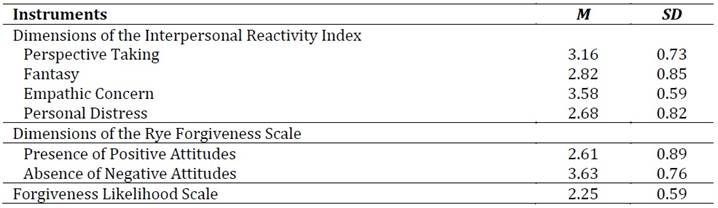
First, we present the descriptive results (means and standard deviations) obtained with the instruments used (Table 1).
Means and standard deviations of the IRI dimensions, the Forgiveness Scale, and the Forgiveness Likelihood Scale (N = 272)
From a descriptive perspective, the results show that, in this sample, within the dimensions of the Empathy Scale, Empathic Concern ranked first, followed by Perspective Taking, Fantasy, and Personal Distress in fourth place. Regarding the dimensions of the Rye Forgiveness Scale, Absence of Negative Attitudes obtained a higher mean than Positive Presence.
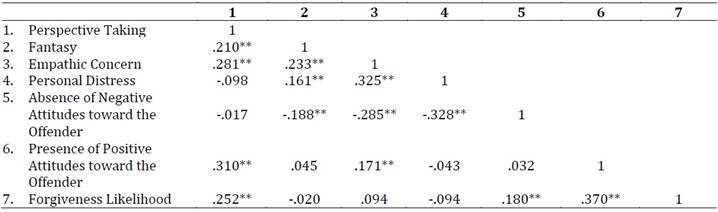
With respect to the first objective, namely, to evaluate the relationship between the cognitive and emotional dimensions of empathy and forgiveness, correlations were computed among the IRI dimensions, the dimensions of the Forgiveness Scale, and the total score of the Forgiveness Likelihood Scale, in order to assess the direction and strength of the associations between these variables.
Using Pearson’s r coefficient (Table 2), the results showed that the degree of positive linear association between the IRI dimensions and the total score of the Forgiveness Likelihood Scale was significant only for the Perspective Taking dimension (.252). A positive linear association was also found between the presence of positive attitudes toward the offender and both Perspective Taking (.310) and Empathic Concern (.171). In addition, a negative linear association was observed between the absence of negative attitudes toward the offender and Personal Distress (-.328), Empathic Concern (-.285), and Fantasy (-.188).
With respect to the second objective, namely, to evaluate the influence of the dimensions of empathy on forgiveness, three multiple linear regression analyses were conducted to assess the IRI dimensions as predictor variables of the two dimensions of the Forgiveness Scale and the total score of the Forgiveness Likelihood Scale.
IRI Dimensions and Forgiveness Likelihood
The assumptions of normality, independence, homoscedasticity, and absence of multicollinearity were verified. The histogram and the P-P plot of standardized residuals indicated an approximately normal distribution; the Durbin-Watson statistic (1.98) indicated independence of errors; and tolerance values (> .78) and VIF (< 1.28) confirmed the absence of multicollinearity among predictors. In the multiple linear regression analysis (Table 3) examining the relationship between the IRI dimensions (predictor variables) and the total score of the Forgiveness Likelihood Scale (dependent variable), the model yielded F (4, 268) = 5.51, p < .001, indicating statistical significance. Overall, the explained variance was 7.6% (R² = .076; R² adj = .062). As shown in Table 3, the only significant predictor was Perspective Taking, with a standardized beta coefficient (β) of .24. This indicates that higher levels of Perspective Taking are associated with a greater likelihood of forgiving.
Multiple linear regression analysis of the IRI dimensions on the total score of the Forgiveness Likelihood Scale (N = 272)
IRI Dimensions and Positive Presence and Absence of Negative (Rye Forgiveness Scale)
Prior to the second regression, the assumptions of the multiple linear regression model were tested. Inspection of the histogram and the normal P-P plot of standardized residuals showed an approximately normal distribution, indicating that the normality assumption was met. The scatterplot of predicted values and residuals did not reveal systematic patterns, suggesting adequate homoscedasticity and linearity. Likewise, the Durbin-Watson statistic (1.97) indicated independence of errors. Finally, tolerance values (between .78 and .91) and variance inflation factors (VIF < 1.30) confirmed the absence of multicollinearity among predictors. Regarding the predictors, the multiple linear regression analysis (Table 4) examining the relationship between the IRI dimensions (predictor variables) and the Positive Presence dimension of the Rye Forgiveness Scale (dependent variable) yielded F (4, 268) = 8.01, p < .001, indicating statistical significance. Overall, the explained variance was 10.7 % (R² = .107; R² adj = .094). As shown in Table 4, the only significant predictor was Perspective Taking, with a standardized beta coefficient (β) of .28. This indicates that higher levels of Perspective Taking are associated with greater Positive Presence on the Rye Forgiveness Scale, that is, it predicts the presence of positive thoughts, feelings, and behaviors toward the offender.
Multiple linear regression analysis of the Empathy Scale dimensions on the Positive Presence dimension of the Rye Forgiveness Scale (N = 272)
Prior to the third regression, the assumptions of linear regression were verified. The standardized residuals showed an approximately normal distribution, as confirmed by inspection of the histogram and the normal P-P plot. The scatterplot of residuals versus predicted values indicated a random distribution of points, supporting adequate homoscedasticity and linearity. Likewise, tolerance values (> .78) and variance inflation factors (VIF < 1.28) ruled out the presence of multicollinearity among predictors. The Durbin-Watson statistic (2.16) suggested independence of errors. Overall, the assumptions of the model were considered to be met for the analysis conducted. In the multiple linear regression analysis (Table 5) examining the relationship between the IRI dimensions (predictor variables) and the Absence of Negative dimension of the Rye Forgiveness Scale (dependent variable), the model yielded F (4, 268) = 12.23, p < .001, indicating statistical significance. The overall explained variance was 15.5 % (R² = .155; R²adj = .142). As shown in Table 5, the significant predictors were Empathic Concern, with a standardized beta coefficient (β) of −.19, and Personal Distress, with β = −.25. This indicates that higher levels of Empathic Concern and Personal Distress predict a lower level of absence of negative thoughts, feelings, and behaviors toward the offender on the Rye Forgiveness Scale.
Multiple linear regression analysis of the Empathy Scale dimensions on the Absence of Negative dimension of the Rye Forgiveness Scale (N = 272)
Discussion
Forgiveness and empathy are highly important as associated variables, a relationship that has already been highlighted in intervention models such as REACH (Recall, Empathize, Altruistic gift, Commit, Hold) and FREE (Forgiveness and Reconciliation through Experiential Education) proposed by Worthington et al. (2014), which consider empathy a central variable in the forgiveness process.
The present study constitutes a significant contribution to understanding the relationship between the different dimensions of empathy and forgiveness, as well as the influence of these dimensions on forgiveness. This contribution is noteworthy, as different directional patterns in these relationships have been identified depending on the type of empathy dimension (cognitive or affective).
First, it is important to highlight that Perspective Taking, a cognitive dimension of empathy that involves the individual’s ability to put themselves in another person’s place (Davis, 1983), showed a positive relationship with both forgiveness likelihood and the presence of positive attitudes toward the offender. In other words, higher levels of perspective taking are associated with a greater likelihood of forgiveness and a stronger presence of positive attitudes toward the offender. These findings are consistent with studies which, although conducted in different populations, show that an adequate perception of victims’ emotions and perspective taking on the part of the offender can lead to a higher likelihood of forgiveness (Berndsen & Wenzel, 2021). Other empirical studies conducted with young people have demonstrated that adopting another person’s perspective, specifically, when the offended individual considers themselves as having been an aggressor at some point in their life, leads to more benevolent attributions toward the offender, thereby promoting a greater likelihood of forgiveness (Takaku, 2001). This would explain not only the positive association between perspective taking and forgiveness found in the present study, but also the predictive role of perspective taking on forgiveness observed in the regression analyses.
From this perspective, although empathy has been widely shown to promote forgiveness, recent empirical studies have been able to distinguish which forms of empathy promotion are more closely linked to forgiveness. Experimental studies by Cornish et al. (2020) have demonstrated that the general promotion of empathy leads to higher levels of self-reported forgiveness. However, although self-reported forgiveness increases in these studies, the promotion of empathy does not lead to greater behavioral helping toward the offender. Therefore, the authors suggest that empathy does not necessarily have an impact on behavioral forgiveness.
Meta-analytic studies have highlighted the importance of empathy in general, and perspective taking in particular, for forgiveness interventions (Karahan, 2023), which is consistent with the findings of this study showing Perspective Taking (the cognitive component of empathy) as the strongest predictor of forgiveness.
In general, intervention models or programs on forgiveness involve three steps: revisiting the hurt, increasing empathy toward the offender, and consolidating gains. Specifically, during the stage of increasing empathy, work focuses on cognitive empathy and, if possible, on helping the offended person develop emotional empathy toward the offender (Worthington et al., 2014). This highlights that there are differences in how the subscales of empathy relate to forgiveness, with emotional components of empathy being more difficult to engage in the forgiveness process. In the present study, Empathic Concern and Personal Distress (both affective or emotional components of empathy in Davis’s model) were negatively correlated with and predicted the Absence of Negative Attitudes toward the offender; that is, adolescents who generally show higher levels of empathic concern and personal distress also exhibit higher levels of negative attitudes toward the offender. Given that these variables (both empathic concern and fantasy) involve concern for others and identification with different people and characters, this reflects a heightened sensitivity to the social environment, which may also translate into heightened negative sensitivity toward the offender, making it more difficult to move out of a non-forgiving state.
Specifically, the findings regarding Empathic Concern are somewhat contradictory, as there are empirical studies in emerging adulthood showing that empathic concern is negatively associated with self-forgiveness, but positively associated with interpersonal forgiveness and forgiveness of situations (Aloia & Pederson, 2021). This opens a line of research that warrants further exploration.
The findings regarding the predictive capacity of Perspective Taking gain particular relevance when considering current challenges in social coexistence, such as the increase in peer bullying observed in recent years. In this sense, interpersonal forgiveness is proposed as a relational restoration tool that complements intervention strategies in school settings.
Among the limitations of the present study, it should be noted that it relies on self-reported measures of forgiveness and empathy, without incorporating any external assessments. Future studies could include other indicators, such as sociograms. Additionally, the moderate internal consistency observed in some dimensions of the scales should be considered a limitation. This suggests that, in adolescent populations from this region, certain items may be interpreted heterogeneously. Future research should consider the semantic adaptation of some items to improve measurement precision in local school contexts.
Furthermore, this is a cross-sectional study, which does not allow for the examination of changes or trajectories of the variables and their associations over time. Longitudinal studies could address this issue to evaluate the development and relationships of the variables involved. On the other hand, gender and age were not controlled for, as the primary objective focused on the theoretical interaction between empathy and forgiveness dimensions rather than on demographic differences; however, this could be addressed in future research. It should also be noted that only general aspects of empathy, through its different dimensions, were assessed, which did not allow for the examination of potentially relevant aspects such as the attributions made by offended individuals toward the offender. Finally, it is important to consider that only negative empathy was assessed, and not positive empathy (see Hess & Mesurado, 2023), which could be incorporated into future research on forgiveness in adolescents.
References
-
Aloia, L. S., & Pederson, J. (2021). Dispositional forgiveness in emerging adulthood: The influence of family verbal aggression, trait anger, and empathetic concern. Western Journal of Communication, 85(5), 675-691. https://doi.org/10.1080/10570314.2021.1961014
» https://doi.org/10.1080/10570314.2021.1961014 - Bandura, A. (2016). Moral disengagement: How people do harm and live with themselves. Worth Publishers.
-
Berndsen, M., & Wenzel, M. (2021). Offenders’ claims of taking the victims’ perspective can promote forgiveness, or backfire! The moderating role of correctly voicing the victims’ emotions in collective apologies. European Journal of Social Psychology, 51(1), 5-22. https://doi.org/10.1002/ejsp.2710
» https://doi.org/10.1002/ejsp.2710 -
Casullo, M. M. (2006). Las razones para perdonar: Concepciones populares o teorías implícitas. Psicodebate, 7, 9-20. https://doi.org/10.18682/pd.v7i0.424
» https://doi.org/10.18682/pd.v7i0.424 -
Cornish, M. A., Guyll, M., Wade, N. G., Lannin, D. G., Madon, S., & Chason, K. C. (2020). Does empathy promotion necessarily lead to greater forgiveness? An experimental examination. Current Psychology, 39(3), 1001-1011. https://doi.org/10.1007/s12144-018-9816-8
» https://doi.org/10.1007/s12144-018-9816-8 -
Coyle, C. T., & Enright, R. D. (1997). Forgiveness as an intervention goal with postabortion men. Journal of Consulting and Clinical Psychology, 65(6), 1042-1046. https://doi.org/10.1037/0022-006X.65.6.1042
» https://doi.org/10.1037/0022-006X.65.6.1042 - Davis, M. H. (1980). Interpersonal Reactivity Index: A Multidimensional Approach to Individual Differences in Empathy. American Psychological Association.
-
Davis, M. H. (1983). Measuring individual differences in empathy: Evidence for a multidimensional approach. Journal of Personality and Social Psychology, 44(1), 113-126. https://doi.org/10.1037/0022-3514.44.1.113
» https://doi.org/10.1037/0022-3514.44.1.113 -
Eisenberg, N. (2000). Emotion, regulation, and moral development. Annual Review of Psychology, 51, 665-697. https://doi.org/10.1146/annurev.psych.51.1.665
» https://doi.org/10.1146/annurev.psych.51.1.665 - Eisenberg, N. (2014). Altruistic Emotion, Cognition, and Behavior. Psychology Press.
-
Eisenberg, N., Spinrad, T.L., & Knafo-Noam, A. (2015). Prosocial Development. En R. M. Lerner (Ed.), Handbook of Child Psychology and Developmental Science John Wiley & Sons. https://doi.org/10.1002/9781118963418.childpsy315
» https://doi.org/10.1002/9781118963418.childpsy315 - Enright, R. D. (1999). Forgiveness. Encyclopedia of emotions and behavior. Macmillan.
- Enright, R. D., & Rique, J. (2000). The Enright Forgiveness Inventory Manual.
- Hair, J. F., Black, W. C., Babin, B. J., & Anderson, R. E. (2019). Multivariate data analysis (8.ª ed.). Cengage Learning EMEA.
-
Hess, C., & Mesurado, B. (2023). Adaptación y validación de la Escala Disposicional de Empatía Positiva a población adolescente argentina. Acta Colombiana de Psicología, 26(1), 27-44. https://doi.org/10.14718/ACP.2023.26.1.3
» https://doi.org/10.14718/ACP.2023.26.1.3 - Hoffman, M. (2001). Empathy and moral development: Implications for caring and justice. Cambridge University Press.
-
Karahan, A. S. (2023). A Interventions for Forgiveness: A Review. Psikiyatride Güncel Yaklaşımlar, 15(2), 56-369. https://doi.org/10.18863/pgy.1156545
» https://doi.org/10.18863/pgy.1156545 -
Li, Y. J., He, Q.-F., Lan, J.-Z., Rehman, A.-U., Ge, M.-W., Shen, L.-T., Hu, F.-H., Jia, Y.-J., & Chen, H.-L. (2025). Empathy as a mediator of the relation between peer influence and prosocial behavior in adolescence: A meta-analysis. Journal of Youth and Adolescence, 54, 682-703. https://doi.org/10.1007/s10964-024-02079-3
» https://doi.org/10.1007/s10964-024-02079-3 -
McCullough, M. E., Fincham, F. D., & Tsang, J. (2003). Forgiveness, forbearance, and time: The temporal unfolding of transgression-related interpersonal motivations. Journal of Personality and Social Psychology, 84(3), 540-557. https://doi.org/10.1037/0022-3514.84.3.540
» https://doi.org/10.1037/0022-3514.84.3.540 - McCullough, M. E., Pargament, K. I., & Thoresen, C. T. (2000). Forgiveness: Theory, research, and practice Guilford Press.
-
McCullough, M. E., Worthington, E. L., & Rachal, K. C. (1997). Interpersonal forgiving in close relationships. Journal of Personality and Social Psychology, 73(2), 321-336. https://doi.org/10.1037/0022-3514.73.2.321
» https://doi.org/10.1037/0022-3514.73.2.321 -
Mehrabian, A., & Epstein, N. (1972). A measure of emotional empathy. Journal of Personality, 40(4), 525-543. https://doi.org/10.1111/j.1467-6494.1972.tb00078.x
» https://doi.org/10.1111/j.1467-6494.1972.tb00078.x -
Menghi, M. S., Rodriguez, L. M., Tortul, M. C., & Moreno, J. E. (2017). Adaptación de la Escala de Probabilidad de Perdón a población adolescente argentina. Interdisciplinaria Revista de Psicología y Ciencias Afines, 34(2), 489-498. https://doi.org/10.16888/interd.2017.34.2.15
» https://doi.org/10.16888/interd.2017.34.2.15 -
Moreno, J. E, Pereyra, M. R., & Rodríguez, L. M. (2021). Manual del Cuestionario de Actitudes ante Situaciones de Agravio (CASA). Actualización 2021. Serie Cuadernos de Psicología y Psicopedagogía N.º 2. Universidad Católica Argentina. https://repositorio.uca.edu.ar/bitstream/123456789/11362/1/manual-cuestionario-actitudes-agravio.pdf
» https://repositorio.uca.edu.ar/bitstream/123456789/11362/1/manual-cuestionario-actitudes-agravio.pdf - Pérez Sosto, G., & Romero, M. (2025). Futuros imaginados e inimaginables: discurso e imaginario de estudiantes de enseñanza secundaria del AMBA después de 40 años de democracia ininterrumpida en Argentina. Aula y Andamios.
-
Rapp, H., Xu, J. W., & Enright, R. D. (2022). A meta-analysis of forgiveness education interventions’ effects on forgiveness and anger in children and adolescents. Child Development, 93(5), 1249-1269. https://doi.org/10.1111/cdev.13771
» https://doi.org/10.1111/cdev.13771 -
Resett, S. A., Costa, D., Murata, C., & Falcone, N. (2015). Equivalencia factorial del cuestionario de agresores/víctimas de Olweus según género. Interdisciplinaria Revista de Psicología y Ciencias Afines, 32(1), 169-181. https://doi.org/10.16888/interd.2015.32.1.9
» https://doi.org/10.16888/interd.2015.32.1.9 -
Resett, S. A., Rodríguez, L. M., & Moreno, J. E. (2013). Evaluación de la calidad de la amistad en niños argentinos. Acta Psiquiátrica y Psicológica de América Latina, 59(2), 94-103. https://ri.conicet.gov.ar/handle/11336/19118
» https://ri.conicet.gov.ar/handle/11336/19118 -
Richaud de Minzi, M. C. (2008). Evaluación de la empatía en población infantil argentina. Revista de Investigación en Psicología, 11(1), 101-115. https://doi.org/10.15381/rinvp.v11i1.3880
» https://doi.org/10.15381/rinvp.v11i1.3880 - Rodriguez, L. M. (2020). El rol del perdón en la prosocialidad. En B. Mesurado (Ed.), Diez fundamentos psicológicos de la conducta de ayuda (pp. 277-297). EUNSA.
-
Rodriguez, L. M., & Moreno, J. E. (2023). El perdón como fortaleza para la armonía social en adolescentes y jóvenes. En Psicología y Comunión. Una experiencia desde Latinoamérica Serie Cuadernos de Psicología y Psicopedagogía
N° 12 (pp. 35-43). Universidad Católica Argentina. https://omp.uca.edu.ar/index.php/uca/catalog/download/78/103/437?inline=1
» https://omp.uca.edu.ar/index.php/uca/catalog/download/78/103/437?inline=1 -
Rodriguez, L. M., Tortul, M. C., Menghi, M. S., & Moreno, J. E. (2018). El perdón en adolescentes y jóvenes: una propuesta para su medición en Argentina. Revista Psicodebate: Psicología, Cultura y Sociedad, 18(1), 21-34. https://doi.org/10.18682/pd.v18i1.702
» https://doi.org/10.18682/pd.v18i1.702 - Rye, M. S. (1998). Evaluation of a secular and a religiously integrated forgiveness group therapy program for college students who have been wronged by a romantic partner. (Disertación doctoral inédita). Bowling Green State University.
-
Rye, M. S., Loiacono, D. M., Folck, C. D., Olszewski, B. T., Heim, T. A. & Madia, B. P. (2001). Evaluation of the psychometric properties of two forgiveness scales. Current Psychology, 20, 260-277. https://doi.org/10.1007/s12144-001-1011-6
» https://doi.org/10.1007/s12144-001-1011-6 -
Susilawati, H., Sugiharto, D., Sunawan, S., & Mugiarso, H. (2025). Understanding forgiveness in adolescents: the role of religiosity, self-esteem, and empathy with social support as a moderator. Jurnal Konseling dan Pendidikan, 13(2), 286-296. https://doi.org/10.29210/1151700
» https://doi.org/10.29210/1151700 -
Takaku, S. (2001). The effects of apology and perspective taking on interpersonal forgiveness: A dissonance-attribution model of interpersonal forgiveness. The Journal of Social Psychology, 141(4), 494-508. https://doi.org/10.1080/00224540109600567
» https://doi.org/10.1080/00224540109600567 -
Toro, R., Barreto-Zambrano, M. L., Garzón-Velandia, D. C., Sandoval-Escobar, M., Pineda-Marín, C., O’Sullivan, C., Taylor, L., Kerezsy-Morales, G. K., Giraldo-Puerto, M. A., Cárdenas-Ruiz, S., Ramírez-Sierra, Y. V., Alfonso, D., Duarte Valderrama, J. V., & Niño Amézquita, J. L. (2023). Empatía, agresividad y perdón en contextos de vulnerabilidad, hostilidad y seguridad en niños y adolescentes. Revista Latinoamericana de Psicología, 55(1), 18-28. https://doi.org/10.14349/rlp.2023.v55.3
» https://doi.org/10.14349/rlp.2023.v55.3 -
Worthington Jr., E. L., Wade, N. G., & Hoyt, W. T. (2014). Positive psychological interventions for promoting forgiveness: History, present status, and future prospects. En A. C. Parks & S. M. Schueller (Eds.), The Wiley Blackwell handbook of positive psychological interventions (pp. 20-41). Wiley Blackwell. https://doi.org/10.1002/9781118315927.ch2
» https://doi.org/10.1002/9781118315927.ch2