Factorial Structure, Internal Consistency, and Measurement Invariance of a Self-Report Scale for Assessing Mental Health Problems in Adults
Abstract:
Background: In Latin America, there is a lack of brief, valid, and culturally appropriate instruments for assessing adult mental health, which may hinder early detection and primary access to interventions.
Objective: This aim of this study was to adapt and validate a self-report scale for adults derived from the Adolescent Self-Report (ADA), designed to assess psychopathological symptoms and personal strengths
Method: A total of 9,885 Uruguayan adults (M = 41.5 years; 62.7% women) participated by completing the abbreviated version of the instrument, the ADAL (Adult version of the ADA), along with the Personal Wellbeing Index (PWI-A). Confirmatory factor analyses, reliability assessments, measurement invariance tests by gender, age, and socioeconomic status, and correlational analyses with wellbeing and sociodemographic variables were conducted
Results: The six-factor model showed good fit (CFI = .951, TLI = .944, RMSEA = .031) and adequate reliability (ordinal α = .71-.90). Configural, metric, and scalar invariance were confirmed across gender, age, and socioeconomic groups. Correlations with wellbeing provided evidence of validity based on relations with external variables
Conclusions: The ADAL is a brief, valid, and reliable instrument for assessing adult mental health, with potential applications in clinical, community, and research settings within Spanish-speaking populations
Keywords:
intervención parental; participación; implicación; padres
Resumen:
Antecedentes: En América Latina existen pocos instrumentos breves, válidos y culturalmente pertinentes para la evaluación de la salud mental de adultos, lo que puede dificultar la detección temprana y el acceso a intervenciones oportunas
Objetivo: Adaptar y validar una escala de autoinforme para adultos, derivada del Autoinforme de Adolescentes (ADA), que evalúa la sintomatología psicopatológica y las fortalezas personales
Método: Participaron 9.885 adultos uruguayos (M = 41.5 años; 62.7 % mujeres), quienes completaron la versión abreviada del instrumento ADAL (versión para adultos del ADA) y el Índice de Bienestar Personal (PWI-A). Se realizaron análisis factoriales confirmatorios, análisis de fiabilidad, pruebas de invarianza por género, edad y nivel socioeconómico, y de relación con el bienestar y las variables sociodemográficas
Resultados: El modelo de seis dimensiones mostró buen ajuste (CFI = .951, TLI = .944, RMSEA = .031) y fiabilidad adecuada (α ordinal = .71-.90). Se confirmó la invarianza configural, métrica y escalar para los grupos de género, edad y nivel socioeconómico. Las correlaciones con el bienestar evidencian validez basada en relaciones con otras variables externas. Conclusión: El ADAL es un instrumento breve, válido y fiable para evaluar la salud mental en adultos, con aplicaciones potenciales en contextos clínicos, comunitarios y de investigación en la población hispanohablante
Palabras clave:
salud mental; evaluación psicológica; propiedades psicométricas; invarianza factorial; Índice de Bienestar Personal
Resumo:
Antecedentes: Na América Latina, existem poucos instrumentos breves, válidos e culturalmente apropriados para a avaliação da saúde mental de adultos, o que pode dificultar a detecção precoce e o acesso a intervenções oportunas
Objetivo: O objetivo deste estudo foi adaptar e validar uma escala de autorrelato para adultos, derivada do Autorrelato de Adolescentes (ADA), que avalia sintomatologia psicopatológica e forças pessoais
Método: Participaram 9.885 adultos uruguaios (M = 41,5 anos; 62,7 % mulheres), que responderam à versão abreviada do instrumento ADAL (versão para adultos do ADA) e ao Índice de Bem-Estar Pessoal (PWI-A). Foram realizadas análises fatoriais confirmatórias, análises de confiabilidade, testes de invariância por gênero, idade e nível socioeconômico, e análises de correlação com bem-estar e variáveis sociodemográficas
Resultados: O modelo de seis dimensões apresentou bom ajuste (CFI = 0,951, TLI = 0,944, RMSEA = 0,031) e confiabilidade adequada (α ordinal = 0,71-0,90). Confirmou-se a invariância configural, métrica e escalar para os grupos de gênero, idade e nível socioeconômico. As correlações com o bem-estar evidenciaram validade baseada em relações com outras variáveis externas
Conclusões: O ADAL é um instrumento breve, válido e confiável para avaliar a saúde mental em adultos, com potencial de aplicação em contextos clínicos, comunitários e de pesquisa em populações de língua espanhola
Palavras-chave:
intervenção parental; engajamento; envolvimento; pais
Mental health in adulthood is a central component of both individual and collective well-being, as well as a key determinant of quality of life (Diener et al., 2018). In Latin America, the burden associated with mental disorders is high (Pan American Health Organization (PAHO), 2023). Limited availability of highly specialized professionals and standardized assessment tools poses major challenges for the development and implementation of effective interventions (PAHO, 2023).
Sociocultural factors such as socioeconomic inequality, stigma, and barriers to accessing mental health services further underscore the urgency of developing assessment instruments and interventions that are culturally sensitive and appropriate for Latin American contexts. According to the World Health Organization (WHO, 2022a), between 76 % and 85 % of people with severe mental disorders in low- and middle-income countries do not receive treatment, compared with 35-50 % in high-income countries. Following the COVID-19 pandemic, the prevalence of psychopathological symptoms increased substantially-particularly anxiety and depression-and this trend remains a global concern (WHO, 2022b; PAHO, 2023). Prior studies have also documented gender differences in how mental health affects men and women (Otten et al., 2021; Prowse et al., 2021).
In this context, early detection of symptoms can substantially enhance preventive and therapeutic interventions. Nonetheless, in Latin America there is still a shortage of validated screening instruments in Spanish for adult populations (Tejada et al., 2014). In contrast, Uruguay has developed or validated several tools focused on child and adolescent mental health (e.g., Castillo & Ortuño, 2023; Costa-Ball et al., 2023; Daset et al., 2015; Machado et al., 2021), highlighting a gap in the cultural and linguistic adaptation of instruments specifically designed for adults in Uruguay.
The availability of psychometrically valid and reliable instruments is essential for supporting evidence-based public policy development and evaluation (WHO, 2022c). International organizations recommend the use of screening tools as an efficient strategy for timely detection in both clinical and community settings (WHO, 2022a; PAHO, 2023). In this context, brief screening instruments are especially useful and strategic for the early identification of symptoms in the general population, facilitating access to services, informing clinical decision-making, and generating evidence for public policy design. Such instruments are particularly suited to primary care settings because they are easy to administer and score (WHO, 2018).
Following these guidelines, Uruguay developed a screening instrument called the Adolescent Self-Report (ADA) to assess psychopathological, resilient, and prosocial dimensions in adolescents (Daset et al., 2015). Instrument construction followed a progressive process of psychometric refinement and empirical validation, beginning with an initial 117-item version. Several exploratory factor analyses (EFA) were carried out to identify the internal structure, and successive item reductions improved the instrument’s parsimony and reliability. The 82-item version was established after removing redundant items or those with low discriminative power, yielding six clinically meaningful dimensions with good model fit (χ² = 3488.89, df = 2844, χ²/df = 1.22, CFI = .94, TLI = .93, RMSEA = .026) and Cronbach’s alpha coefficients ranging from .84 to .94. Subsequently, a 24-item abbreviated version was developed by selecting the four items with the highest factor loadings for each of the six dimensions. This abbreviated ADA has shown good psychometric properties in adolescent samples (Daset et al., 2021), with acceptable fit indices (χ² = 320.12, df = 237, p < .001, χ²/df = 1.35, CFI = .95, TLI = .96, RMSEA = .031) and adequate reliability (ordinal alpha): F1 (depression/anxiety) = .91, F2 (dissocial/addictive behavior) = .78, F3 (emotional dysregulation) = .76, F4 (social anxiety) = .81, F5 (resilience/prosociality) = .76, and F6 (obsession/compulsion) = .65.
Both the ADA and its adult version, the ADAL, are based on Achenbach’s Achenbach System of Empirically Based Assessment (ASEBA; Achenbach, 1978), which has been empirically validated and adapted across multiple cultural contexts (e.g., Lemos et al., 1992; López-Soler et al., 2010; Verhulst & Achenbach, 1995). ASEBA provides a comprehensive framework for the empirical assessment of emotional and behavioral problems across the lifespan. Originally designed for children and adolescents through the Youth Self-Report (YSR), it has consistently shown a stable hierarchical structure that organizes symptoms into specific syndromes and broad internalizing and externalizing dimensions. This factorial coherence motivated its extension to adulthood through the development of the Adult Self-Report (ASR), with the aim of maintaining conceptual continuity and enabling longitudinal comparisons across the life span. This methodological and conceptual continuity makes ASEBA particularly valuable for studying the persistence and transformation of psychopathological patterns from adolescence into adulthood (Achenbach et al., 2017).
In addition, assessing subjective psychological well-being alongside indicators of psychopathological symptoms makes it possible to understand the mental health-illness continuum in a more balanced way. This dual focus supports the early detection of vulnerabilities and the identification of protective factors that may buffer the risk of psychopathology. Such integration is consistent with mental health approaches that emphasize both the detection of distress and the promotion of personal strengths (Hedley et al., 2021). Higher levels of psychological well-being function as a protective factor against mental disorders, whereas lower levels are associated with increased depressive and anxious symptomatology (Diener et al., 2018; Anselmi et al., 2024). Interventions aimed at enhancing well-being have shown both preventive and therapeutic efficacy (Fernández et al., 2018; Fernández et al., 2024), making its inclusion in mental health assessments both methodologically sound and clinically relevant (Enríquez et al., 2023).
Several studies have documented negative associations between the Personal Wellbeing Index (PWI; Cummins et al., 2003) and symptoms of anxiety and depression, and positive associations with protective factors such as resilience and prosociality (Hedley et al., 2021; Jeyagurunathan et al., 2025). Among adolescents and young adults, greater emotional and behavioral difficulties are linked to lower well-being, whereas higher levels of resilience are associated with greater personal well-being (Soriano-Díaz et al., 2022; Tomyn & Weinberg, 2018).
This study aimed to adapt and psychometrically validate a screening instrument for psychopathological symptoms and strengths in the Uruguayan adult population, based on the Adolescent Self-Report (ADA), originally developed for adolescents aged 12-18 years (Daset et al., 2015; Daset et al., 2021). The adult version, called ADAL, preserves the basic structure of the ADA, with an abbreviated 24-item version distributed across six dimensions. A five-point Likert-type scale is used to assess the frequency of emotions, behaviors, and thoughts during the past month.
This article describes the psychometric analyses of the ADAL in a Uruguayan adult sample, including factorial structure, invariance, reliability, and its relationships with sociodemographic variables and psychological well-being. Validating the ADAL may represent an important advance for adult mental health assessment in Uruguay and other countries in the region. Its brevity, accessibility, and cultural relevance make it a potentially valuable tool for clinical practice, public health, and research.
Method
An instrumental, empirical design was used (Ato et al., 2013), following the International Test Commission guidelines for test adaptation (Hernández et al., 2020), current standards for the development of psychological assessment instruments, and methodological recommendations for factor analysis (Carretero & Pérez-Díaz, 2005; Ferrando et al., 2022; López-Pina & Veas, 2024). The study was framed within a quantitative approach that employed descriptive, comparative, and associative strategies (Ato et al., 2013).
Participants
The sample consisted of 9,885 individuals aged 19 years and older (M = 32.78, SD = 12.24), recruited using non-probabilistic purposive sampling. Of these, 61.9 % identified as cisgender women, 36.7 % as cisgender men, 0.5 % as transgender, and 0.7 % either selected another gender identity or did not respond. By age group, 35 % were emerging adults (19-24 years), 48 % were young adults (25-44 years), and 17 % were adults/older adults (45-88 years). Regarding socioeconomic status (SES), 8 % were classified as low SES, 66 % as middle SES, and 26 % as high SES. Geographically, 68 % resided in the metropolitan area and 32 % in other regions of the country.
Instruments
The Adult Self-Report Questionnaire (ADAL) was developed at the Universidad Católica del Uruguay to assess psychopathological, resilient, and prosocial dimensions in adults. It is derived from the Adolescent Self-Report Questionnaire (ADA; Daset et al., 2015), preserving its six-factor structure: F1 = depression/anxiety; F2 = dissocial/addictive behavior; F3 = disruptive mood dysregulation; F4 = social anxiety; F5 = resilience/prosociality; and F6 = obsession/compulsion. The 24 items are rated on a five-point Likert scale (1: Strongly disagree; 5: Strongly agree).
Adaptation of the abbreviated ADA version for adult use followed international standards for linguistic adaptation and content-based validity (American Educational Research Association (AERA) et al., 2014). The goal was to ensure that the 24 items preserved the original psychological constructs while being expressed in language appropriate for Uruguayan adults. The adaptation process involved expert review to ensure semantic equivalence and contextual adequacy. In the first stage, the Psychopathology and Wellbeing Research Team at the Universidad Católica del Uruguay-the group responsible for developing the original ADA-carried out a preliminary linguistic reformulation of the items, adjusting expressions, verb tenses, and wording to ensure clarity, naturalness, and conceptual equivalence with the adolescent version. For example, second-person singular pronouns were adapted from “tú” to the more formal “usted,” and context-specific terms such as “liceo” (high school) were replaced with “work/study.”
In the second stage, a content evaluation was conducted through expert judgment. Two PhD-level psychologists specializing in psychopathology (one based in Spain and one in Uruguay) reviewed the items and evaluated them in terms of (1) linguistic appropriateness for adults, (2) content sufficiency, (3) clarity, (4) conceptual coherence with each ADA dimension, and (5) relevance to the target construct. Their qualitative feedback was analyzed and integrated by the research team, and adjustments were made where necessary to preserve the original meaning. This process resulted in a linguistically adapted version-ADAL-that maintains the conceptual structure and six dimensions of the ADA, providing strong content-based validity evidence for use with adult populations.
The Personal Wellbeing Index-Adult (PWI-A; International Wellbeing Group, 2024) assesses subjective satisfaction across seven life domains using an 11-point Likert-type scale ranging from 0: not satisfied at all to 10: completely satisfied. The total score is obtained by averaging the seven items and then converting this mean to a 0-100 scale using the formula (mean/10) × 100, where 0 indicates the lowest possible wellbeing and 100 the highest. The Uruguayan validated version was used, which showed adequate unidimensional fit (χ²(13) = 260.52, p < .001; RMSEA = .063; CFI = .979; TLI = .966; SRMR = .022) and good reliability (ordinal α = .84; Fernández et al., 2021).
To characterize participants, the ADA Sociodemographic Survey (Daset et al., 2021) was used to gather information on sociodemographic variables (gender, age, educational level, employment status, and relevant family background) and health-related behaviors (e.g., sleep patterns and substance use). Socioeconomic status was assessed with the short form of the Socioeconomic Level Index (INSE; Perera, 2018), a widely used national indicator that combines education, occupation, and household infrastructure to classify families into three comparable socioeconomic strata (low, middle, and high).
Procedure
Data were collected through an online questionnaire distributed via social media and email, using non-probabilistic purposive sampling. The form, hosted on Google Forms, began with an information page detailing the study’s objectives, estimated duration (up to 20 minutes), voluntary participation, anonymity, and informed consent. The instruments were presented in the following order: (1) sociodemographic survey, (2) Socioeconomic Level Index (INSE), (3) ADAL questionnaire, and (4) Personal Wellbeing Index-Adult (PWI-A).
All procedures complied with national regulations on research involving human participants (Decree 001-4573/2007 and Law No. 18.331). Participant confidentiality and anonymity were guaranteed. All data were stored in a secure database accessible only to the research team. The project was approved by the Ethics Committee of the Universidad Católica del Uruguay.
Data were collected between February and July 2022.
Data Analysis
The psychometric analysis was organized into five sequential stages, following a cross-validation design and the standards proposed by AERA et al. (2014). The non-representative sample (N= 9,885) was randomly split into two equivalent halves using the SOLOMON procedure (Lorenzo-Seva, 2022).
Stage 1: Exploratory Factor Analysis (EFA)
Using the first subsample (n = 4,943), an EFA was conducted with the FACTOR program (Lorenzo-Seva & Ferrando, 2006), using a polychoric correlation matrix, unweighted least squares (ULS) estimation, and Promin oblique rotation (Lorenzo-Seva & Ferrando, 2019). Sampling adequacy was evaluated using the KMO index (values ≥ .70) and Bartlett’s test of sphericity (p < .05). The number of factors to retain was determined using the BIC criterion (Gibson et al., 2020). Assumptions of univariate normality (Kolmogorov-Smirnov test), skewness (|Sk| < 3), and kurtosis (K < 8) were examined. Item quality was assessed using the QIM index and the MSA coefficient (Lorenzo-Seva & Ferrando, 2021), and items with MSA values below .50 were excluded. Internal reliability was estimated using ordinal alpha.
Stage 2: Confirmatory Factor Analysis (CFA)
With the second subsample (n = 4,942), a CFA was carried out in Mplus 8.5 (Muthén & Muthén, 2017) using the WLSMV estimator, which is suitable for ordinal categorical variables. The model identified in the EFA was evaluated using χ², χ²/df, CFI, TLI, RMSEA, and SRMR, according to recommended cut-off values (Schreiber et al., 2006): CFI and TLI values ≥ .95 indicate excellent fit and ≥ .90 acceptable fit; RMSEA ≤ .06 and SRMR ≤ .08 indicate good fit. The model was subsequently tested in the total sample to confirm the stability of the factorial solution. Composite reliability (CR) and average variance extracted (AVE) were computed to assess internal consistency and convergent validity. CR values ≥ .70 were considered adequate, indicating a sufficient proportion of true-score variance relative to measurement error (Hair et al., 2020). AVE values ≥ .50 were interpreted as evidence that a construct explains at least 50% of the variance in its items (Fornell & Larcker, 1981). Discriminant validity was assessed using the Heterotrait-Monotrait ratio (HTMT), calculated from polychoric item correlations; values < .85 were considered evidence of adequate discriminant validity (Henseler et al., 2015). Internal consistency was also evaluated using ordinal alpha (Zumbo et al., 2007), appropriate for ordinal items based on polychoric correlations (Gadermann et al., 2014). Standardized loadings, standard errors, and item-level coefficients of determination (R²) were reported.
Stage 3: Multigroup Invariance Evaluation (MG-CFA) in the Total Sample
Using the full sample, factorial invariance of the six-factor model across gender, age, and SES was examined using MG-CFA in Mplus 8.5 (Muthén & Muthén, 2017) with the WLSMV estimator. Configural, metric, and scalar models were tested sequentially, and overall model fit was evaluated using invariance criteria based on changes of ΔCFI ≤ .010 and ΔRMSEA ≤ .015 (Chen, 2007; Cheung & Rensvold, 2002). Grouping variables were defined according to adult developmental theory. Age was categorized into three developmental groups (1: emerging adulthood, 20-24 years; 2: early and mid-adulthood, 25-44 years; and 3: middle and late adulthood, 45 years or older; Arnett, 2000; Dyussenbayev, 2017). The other grouping variables were gender (1: men, 2: women) and SES (1: low, 2: middle, 3: high).
Stage 4: Evidence of External Validity
Validity based on relationships with external variables (gender, age, SES, and subjective well-being) was then examined. Because of non-normal distributions and the ordinal nature of the data, Spearman correlations, Kruskal-Wallis tests, and post hoc comparisons were used. Hypotheses were formulated based on prior literature (Cummins et al., 2014; Jeyagurunathan et al., 2025), anticipating negative correlations between psychological distress dimensions (F1, F2, F3, F4, and F6) and subjective well-being (PWI), and a positive correlation with the resilience-prosociality dimension (F5) (Martínez-Moreno et al., 2020; Tomyn & Weinberg, 2018). International evidence consistently shows a social gradient in mental health: adults with lower SES present higher levels of depression, anxiety, and psychological distress (Lorant et al., 2003). In line with this pattern, lower SES was expected to be associated with poorer mental health indicators in this sample. It was also expected that women would show higher rates of internalizing disorders and men higher rates of externalizing disorders (Kayrouz et al., 2025), and that younger adults would present higher rates of anxiety and depression than middle-aged and older adults (Collier Villaume et al., 2023).
Stage 5: Additional Evidence of External Validity Through Comparison with ADA Normative Values
To provide further evidence of external validity, ADAL scores in the adult sample were compared with ADA normative values reported for adolescents in the original study (Daset et al., 2015). Because the aim was to contrast adult means with reference values, the normality assumption was first evaluated. The Kolmogorov-Smirnov and Anderson-Darling tests indicated significant deviations from normality (p < .001), so the one-sample t test was discarded. Instead, the nonparametric one-sample Wilcoxon test was used, which is appropriate for comparing an observed median against a theoretical value. Effect size was estimated using the rank-biserial correlation (r), interpreted as small (≈ .10), medium (≈ .30), or large (≥ .50), following Cohen’s (1988) criteria. All analysis stages followed reporting standards recommended for psychometric validation studies (Brown, 2015; Kline, 2023).
Results
Stage 1: Exploratory Factor Analysis (EFA)
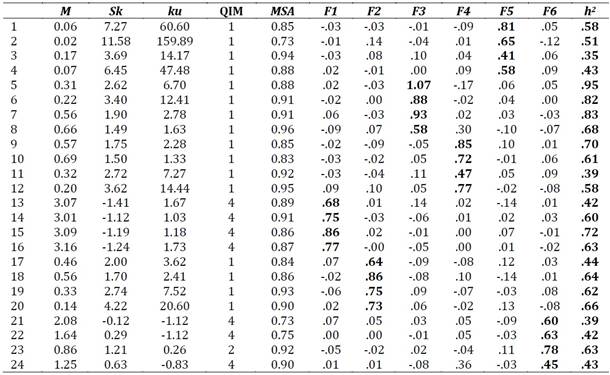
Preliminary analyses showed significant deviations from univariate normality for all items (Table 1), with extreme skewness and kurtosis values. Consequently, a polychoric correlation matrix was used for the EFA, in line with current recommendations (Lloret-Segura et al., 2014). Bartlett’s test of sphericity was significant, χ² (276) = 56,795.2, p < .001, and the KMO index was .88, indicating adequate sampling adequacy.
As a complementary measure of structural validity, the Quartile of Ipsative Means (QIM) statistic was applied. The QIM showed a clear differentiation between distress-related items (first quartile) and prosocial-resilience items (fourth quartile). This pattern is expected in instruments that assess mental health symptoms, since the relatively low prevalence of such symptoms in non-clinical populations tends to produce skewed distributions and restricted variance (Clark & Watson, 1995).
The factor-retention analysis using the BIC criterion suggested a six-factor solution with very good fit indices (χ² = 255.98, df = 147, χ²/df = 1.73; CFI = .99; TLI = .99; RMSEA = .012; RMSR = .021), accounting for 72 % of the total variance.
Factor determinacy indices (FDI = .92-.98) confirmed the precision of the factor scores. Overall, the six ADAL dimensions were clearly defined and yielded highly reliable factor score estimates (Ferrando & Lorenzo-Seva, 2016).
The factor loadings showed that each set of items clustered coherently within the six latent dimensions, with high loadings on the theoretically expected factor, minimal cross-loadings, and high communalities. These results provide empirical support for the structural validity of the instrument (Table 1), indicating that items are adequately represented by the retained common factors, in accordance with recommended psychometric standards (Lloret-Segura et al., 2014).
In summary, the EFA conducted with the first subsample identified a six-factor solution that replicates the structure reported in ADA psychometric studies (Daset et al., 2015) and in the updated adolescent self-report manual (Daset et al., 2021). This replication of the factorial pattern provides initial validity evidence in adult populations and suggests conceptual consistency of the model across developmental stages.
Stage 2: Confirmatory Factor Analysis (CFA)
A CFA was conducted on the second subsample (n = 4,943) using the WLSMV estimator, appropriate for ordinal items. The six-factor model identified through EFA was evaluated. The results indicated excellent model fit (χ²(237) = 3658.44, p < .001; CFI = .965; TLI = .959; RMSEA = .054, 90 % CI (.053-.056); SRMR = .052), according to recommended cut-off criteria (Schreiber et al., 2006).
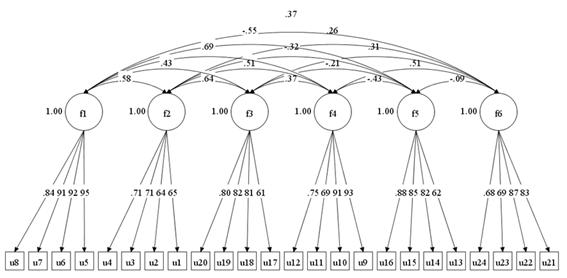
All standardized factor loadings were significant (p < .001) and greater than .61, indicating that items cluster coherently within their respective factors (Brown, 2015). Inter-factor correlations were moderate and consistent with the interrelated nature of the domains assessed, supporting partial independence among dimensions.
Once the six-factor structure was confirmed in the second subsample, the CFA was replicated in the full sample (N = 9,885). Again, the model showed excellent fit (χ²(237) = 7955, p < .001; CFI = .96; TLI = .95; RMSEA = .057; SRMR = .052) (Figure 1).
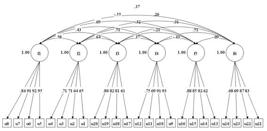
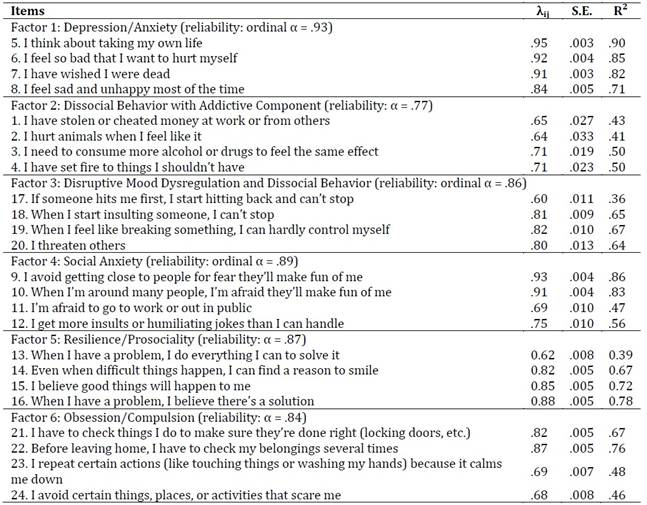
Table 2 presents the standardized factor loadings, standard errors, ordinal alpha reliability estimates, and item communalities for the six-factor model. All items showed significant loadings, low standard errors, and acceptable communalities, indicating adequate representation of the latent factors. All factor loadings were statistically significant (p < .001), indicating that items cluster coherently within the proposed dimensions.
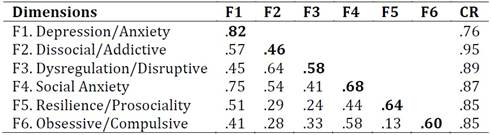
After confirming the ADAL factorial structure through CFA, indicators of construct reliability and validity were examined. Composite reliability (CR) and average variance extracted (AVE) were first estimated to assess internal consistency and convergent validity for each dimension. Discriminant validity among factors was then evaluated using the HTMT index (Heterotrait-Monotrait Ratio of Correlations), calculated from polychoric correlations between items. Table 3 summarizes CR, AVE, and HTMT values for the six model dimensions, providing evidence of the instrument’s psychometric quality.
Stage 3: Evaluation of Multigroup Invariance (MG-CFA) in the Total Sample
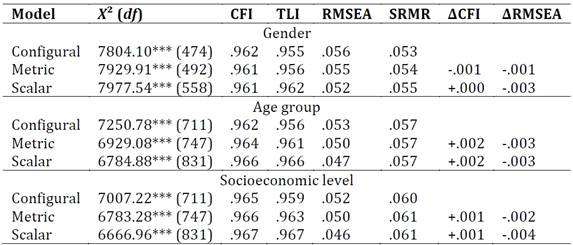
Factorial invariance of the ADAL was assessed across gender, age group, and SES using a sequential hierarchical approach that included configural, metric, and scalar models. Before conducting the analysis, response categories were recoded to avoid estimation problems due to empty cells in some group-category combinations. The original five response options collapsed into four categories while preserving each item’s theoretical directionality. For psychological distress items (1-12 and 17-24), the highest response options (4 and 5) were combined because of low frequency, whereas for resilience items (13-16), the lowest categories (1 and 2) were grouped. This recoding stabilized parameter estimates and ensured the validity of the multigroup analysis.
Fit indices for each model are presented in Table 4. Across the three grouping variables (gender, age, and SES), models showed adequate fit at each level of constraint, and changes between consecutive models were below recommended thresholds (ΔCFI < .010; ΔRMSEA < .015; Chen, 2007).
These results indicate that the six-factor ADAL model demonstrates configural, metric, and scalar equivalence across men and women, age groups, and socioeconomic levels. Thus, latent mean comparisons across groups can be interpreted as reflecting true differences in the underlying constructs rather than measurement artifacts (Milfont & Fischer, 2010). This evidence of factorial invariance supports the instrument’s use in comparative studies within the Uruguayan adult population.
Stage 4: Evidence of Validity with External Variables
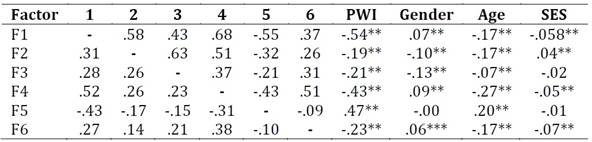
To examine convergent validity and the external robustness of the model, relationships between the six ADAL dimensions and theoretically relevant external variables were explored: gender, age, SES, and the Personal Wellbeing Index (PWI; Cummins et al., 2003).
Correlations showed significant associations (p < .001) of moderate to high magnitude among the latent factors, supporting both internal coherence and conceptual differentiation of the dimensions (Brown, 2015). The resilience/prosociality dimension correlated positively with subjective well-being, whereas dimensions linked to psychological distress (depression/anxiety, social anxiety, obsession/compulsion, and dissocial/addictive behavior) correlated negatively with the PWI (Table 5).
These results provide strong convergent validity evidence, with a correlation pattern consistent with subjective well-being theory and the mental health literature (Cummins et al., 2014; Jeyagurunathan et al., 2025; Martínez-Moreno et al., 2020; Tomyn & Weinberg, 2018). Associations with sociodemographic variables, although small in magnitude, aligned with well-established patterns in international research: greater emotional vulnerability among women-particularly in depression and anxiety-and higher externalizing indicators among men (Kayrouz et al., 2025); higher distress among younger adults (Collier Villaume et al., 2023); and poorer mental health in individuals with low SES (Lorant et al., 2003). These findings further support the external validity of the instrument.
Differences by Sex, Age, and Socioeconomic Status
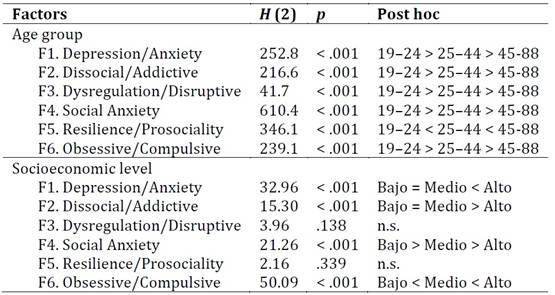
Given the ordinal nature of the items and the non-normal distribution of the scores, nonparametric tests were used. The Mann-Whitney U test indicated significant sex differences in five of the six dimensions. Women scored higher on depression/anxiety, social anxiety, and obsessive-compulsive symptoms, whereas men scored higher on dissocial/addictive behavior and disruptive mood dysregulation. No sex differences were observed in resilience/prosociality.
The Kruskal-Wallis test revealed age-group differences across all six dimensions, with effect sizes ranging from small to moderate (ε² = .00-.06). Scores decreased progressively from the youngest group (19-24 years) to the oldest group (≥ 45 years), except for Resilience-Prosociality, where older adults obtained higher values. Regarding socioeconomic status, differences emerged in four dimensions (F1, F2, F4, and F6): participants with low SES showed higher levels of psychological distress, whereas those with high SES reported greater involvement in dissocial behavior (Table 6).
Stage 5: Additional Evidence of External Validity Through Comparison with ADA Normative Values
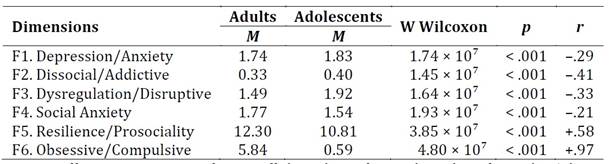
Because the aim was to compare adult scores with published adolescent means (Daset et al., 2015), the normality assumption was first examined. As distributions showed significant violations (p< .001), the nonparametric one-sample Wilcoxon test was used, accompanied by effect size estimates (rank-biserial correlation, r).
The results (Table 7) showed statistically significant differences across all dimensions. In most psychological distress factors, adults scored significantly lower than adolescents, suggesting lower emotional distress in adulthood. In contrast, dimensions associated with personal strengths and control-oriented behaviors followed the opposite pattern: adults scored significantly higher in resilience/prosociality (F5) and especially in obsessive/compulsive tendencies (F6), the latter showing a very large effect size.
Comparison Between Adult Results (ADAL) and Published Adolescent Means (ADA; Daset et al., 2015)
Discussion
The findings of this study provide robust empirical evidence for the structural validity, factorial invariance, internal reliability, and convergent validity of the ADAL, supporting its usefulness as a brief, psychometrically sound instrument for assessing psychopathological symptoms and mental health strengths in adults. The six-dimensional model showed excellent fit in both exploratory and confirmatory factor analyses and remained invariant across sociodemographic groups (gender, age, and SES), demonstrating factorial invariance. These results reflect the stability of the underlying construct and its theoretical coherence with the original ADA model (Daset et al., 2015), in line with international guidelines for the validation of psychological assessment instruments (AERA et al., 2014; Muñiz & Fonseca-Pedro, 2019).
Factor loadings were high across all dimensions, and reliability indices confirmed the precision of the measurements. The depression/anxiety factor showed the highest internal consistency, consistent with its clinical and epidemiological relevance in the general population. These findings are in line with previous studies using the adolescent ADA version (Daset et al., 2015; Fernández et al., 2018). The ADAL factors exhibit a structural pattern compatible with the ASEBA model proposed by Achenbach et al. (2017), indicating conceptual continuity across developmental stages and reinforcing the instrument as a transgenerational screening tool.
Correlations with the PWI also followed the theoretically expected pattern. ADAL dimensions associated with psychological distress (F1, F2, F3, F4, and F6) were negatively related to subjective well-being (Jeyagurunathan et al., 2025), whereas the resilience/prosociality dimension (F5) showed a positive association with this indicator (Anselmi et al., 2024; Diener et al., 2018; Fernández et al., 2018; Martínez-Moreno et al., 2020; Tomyn & Weinberg, 2018).
Significant differences in subscale scores by gender, age, and SES further demonstrated the instrument’s sensitivity to sociodemographic variability in symptom profiles. Gender analyses were consistent with WHO reports (2022a), which point to higher prevalence of psychological distress and mental disorders among women, particularly anxiety and depression. Similarly, the present results showed higher levels of anxious-depressive symptoms in women and younger adults, consistent with recent post-pandemic data (Anselmi et al., 2024). In contrast, men more frequently reported dissocial behaviors and emotional dysregulation (Leadbeater et al., 2023). This evidence underscores the importance of gender-sensitive approaches to mental health assessment and intervention, recognizing both differences and commonalities in the psychological trajectories of men and women.
A developmental pattern was also observed, characterized by decreased psychological distress and increased resilience in adulthood, consistent with developmental models highlighting improvements in emotional regulation and coping strategies with age (Charles & Carstensen, 2010), as well as findings showing a negative association between resilience and psychological distress (Harms et al., 2018).
Differences by SES confirmed that low SES is associated with higher levels of depression/anxiety and social anxiety, consistent with the social gradient in mental health described by Lorant et al. (2003). In contrast, high SES was associated with higher scores in obsession/compulsion and lower involvement in dissocial/addictive behaviors, suggesting that psychological distress may manifest differently depending on socioeconomic context.
Finally, comparisons between adults and adolescents indicated a significant reduction in personal distress during adulthood, along with increased resilience, prosociality, and control-oriented behaviors associated with obsessive-compulsive traits. These patterns suggest a developmental trajectory toward greater affective and behavioral self-regulation, consistent with psychological maturity processes described by Soto et al. (2011).
The validation of the ADAL represents a meaningful advance for psychological assessment in Uruguay by providing a psychometrically strong, brief instrument that is sensitive to the characteristics of the local population. Its multidimensional structure aligns with the ASEBA framework-on which it is conceptually based-and with the empirically grounded assessment models developed by Achenbach and Rescorla (2001). The ADAL can be applied in clinical, community, and academic settings, facilitating early screening for mental health problems as well as monitoring psychosocial strengths. Its accessible design also supports efficient implementation in primary care services and mental health promotion and prevention programs, contributing to better resource allocation and evidence-based clinical decision-making.
Among the main limitations of this study, it is acknowledged that the initial validation was conducted with a non-representative sample obtained through non-probabilistic sampling. While this design limits strict generalizability, the large sample size and the sociodemographic and geographic diversity of participants-from various regions of the country-provide a robust and culturally heterogeneous empirical basis that strengthens the validity of the psychometric findings. In addition, the cross-sectional design prevents conclusions about causality or temporal stability of the evaluated profiles.
Future studies should use probabilistic sampling, validate the instrument in clinical populations, and examine concurrent validity by comparing ADAL scores with other standardized mental health measures. It would also be useful to explore its applicability in specific clinical contexts and in particular subpopulations, such as older adults or groups facing psychosocial vulnerability. Overall, further research is recommended to evaluate the convergent, predictive, and discriminant validity of the ADAL using gold-standard measures and ROC curve analyses, with the aim of estimating its sensitivity and specificity parameters.
References
-
Achenbach, T. M. (1978). The child behavior profile: I. Boys aged 6-11. Journal of Consulting and Clinical Psychology, 46(3), 478-488. https://doi.org/10.1037/0022-006X.46.3.478
» https://doi.org/10.1037/0022-006X.46.3.478 - Achenbach, T. M., & Rescorla, L. A. (2001). Manual for the ASEBA school-age forms & profiles University of Vermont, Research Center for Children, Youth, & Families.
-
Achenbach, T. M., Ivanova, M. Y., & Rescorla, L. A. (2017). Empirically based assessment and taxonomy of psychopathology for ages 1½-90+ years: Developmental, multi-informant, and multicultural findings. Comprehensive Psychiatry, 79, 4-18. https://doi.org/10.1016/j.comppsych.2017.03.006
» https://doi.org/10.1016/j.comppsych.2017.03.006 - American Educational Research Association, American Psychological Association & National Council on Measurement in Education. (2014). Standards for educational and psychological testing American Educational Research Association.
-
Anselmi, A., Cracco, C., Estradé, A., Solmi, M., & Correll, C. U. (2024). Impactos de la pandemia de covid-19 sobre el bienestar y la salud mental de adultos uruguayos. Ciencias Psicológicas, 18(2), e-4059. https://doi.org/10.22235/cp.v18i2.4059
» https://doi.org/10.22235/cp.v18i2.4059 -
Arnett J. J. (2000). Emerging adulthood. A theory of development from the late teens through the twenties. The American Psychologist, 55(5), 469-480. https://doi.org/10.1037/0003-066x.55.5.469
» https://doi.org/10.1037/0003-066x.55.5.469 -
Ato, M., López, J. J., & Benavente, A. (2013). Un sistema de clasificación de los diseños de investigación en psicología. Anales de Psicología, 29(3), 1038-1059. https://doi.org/10.6018/analesps.29.3.178511
» https://doi.org/10.6018/analesps.29.3.178511 - Brown, T. A. (2015). Confirmatory factor analysis for applied research (2a ed.). The Guilford Press.
- Carretero-Dios, H., & Pérez, C. (2005). Normas para el desarrollo y revisión de estudios instrumentales. International Journal of Clinical and Health Psychology, 5(3), 521-551.
-
Castillo, M., & Ortuño, V. (2023). Estudio psicométrico del Cuestionario de Capacidades y Dificultades (SDQ) para niños de 2 a 4 años en Uruguay. Revista de Psicología, 19(37), 7-22. https://doi.org/10.46553/RPSI.19.37.2023.p7-22
» https://doi.org/10.46553/RPSI.19.37.2023.p7-22 -
Charles, S. T., & Carstensen, L. L. (2010). Social and emotional aging. Annual Review of Psychology, 61, 383-409. https://doi.org/10.1146/annurev.psych.093008.100448
» https://doi.org/10.1146/annurev.psych.093008.100448 -
Chen, F. F. (2007). Sensitivity of goodness of fit indexes to lack of measurement invariance. Structural Equation Modeling, 14(3), 464-504. https://doi.org/10.1080/10705510701301834
» https://doi.org/10.1080/10705510701301834 -
Cheung, G. W., & Rensvold, R. B. (2002). Evaluating goodness-of-fit indexes for testing measurement invariance. Structural Equation Modeling, 9(2), 233-255. https://doi.org/10.1207/S15328007SEM0902_5
» https://doi.org/10.1207/S15328007SEM0902_5 -
Clark, L. A., & Watson, D. (1995). Constructing validity: Basic issues in objective scale development. Psychological Assessment, 7(3), 309-319. https://doi.org/10.1037/1040-3590.7.3.309
» https://doi.org/10.1037/1040-3590.7.3.309 - Cohen, J. (1988). Statistical Power Analysis for the Behavioral Sciences (2nd ed.). Lawrence Erlbaum Associates, Publishers.
-
Collier Villaume, S., Chen, S., & Adam, E. K. (2023). Age disparities in prevalence of anxiety and depression among US adults during the covid-19 pandemic. JAMA network open, 6(11). https://doi.org/10.1001/jamanetworkopen.2023.45073
» https://doi.org/10.1001/jamanetworkopen.2023.45073 -
Costa-Ball, C. D., Cracco, C., Cuadro, A., & López García, J. J. (2023). Strengths and Difficulties Questionnaire (SDQ): An update of the literature and instrumental study with schoolchildren. Revista Latinoamericana de Psicología, 55, 140-148. https://doi.org/10.14349/rlp.2023.v55.16
» https://doi.org/10.14349/rlp.2023.v55.16 -
Cummins, R. A., Eckersley, R., Pallant, J., Van Vugt, J., & Misajon, R. (2003). Developing a national index of subjective wellbeing: The Australian Unity wellbeing index. Social Indicators Research, 64, 159-190. https://doi.org/10.1023/A:1024704320683
» https://doi.org/10.1023/A:1024704320683 -
Cummins, R. A., Li, N., Wooden, M., & Stokes, M. (2014). A demonstration of set-points for subjective wellbeing. Journal of Happiness Studies: An Interdisciplinary Forum on Subjective Well-Being, 15(1), 183-206. https://doi.org/10.1007/s10902-013-9444-9
» https://doi.org/10.1007/s10902-013-9444-9 -
Daset, L. R., Fernández-Pintos, M. E., Costa-Ball, D., López-Soler, C., & Vanderplasschen, W. (2015). Desarrollo y validación del Autoinforme de Adolescentes: ADA. Ciencias Psicológicas, 9(1), 85-104. https://doi.org/10.22235/cp.v9i1.169
» https://doi.org/10.22235/cp.v9i1.169 -
Daset, L. R., Fernández, M. E., Costa-Ball, D., Peirano, N., Castelluccio, L., & López-Soler, C. (2021). Autoinforme de Adolescentes (ADA): Manual de aplicación, corrección e interpretación Universidad Católica del Uruguay. https://doi.org/10.22235/ada2021
» https://doi.org/10.22235/ada2021 -
Diener, E., Oishi, S., & Tay, L. (2018). Advances in subjective well-being research. Nature Human Behaviour, 2(4), 253-260. https://doi.org/10.1038/s41562-018-0307-6
» https://doi.org/10.1038/s41562-018-0307-6 -
Dyussenbayev, A. (2017). Age periods of human life. Advances in Social Sciences Research Journal, 4(6). https://doi.org/10.14738/assrj.46.2924
» https://doi.org/10.14738/assrj.46.2924 -
Enríquez, S. I. R., García, P. J. J., Vega, H. B., & Luján, J. C. B. (2023). Medición del bienestar psicológico mediante la utilización de cuestionarios de autorreporte. Una revisión sistemática. Psicología y Salud, 33(1), 209-216. https://doi.org/10.25009/pys.v33i1.2784
» https://doi.org/10.25009/pys.v33i1.2784 -
Fernández, M. E., Castelluccio, L., & Cummins, R. A. (2021). Examining the factor structure of the Personal Well-Being Index for Uruguayan schoolgoing adolescents. Journal of Well-Being Assessment, 4(4), 539-554. https://doi.org/10.1007/s41543-021-00047-3
» https://doi.org/10.1007/s41543-021-00047-3 -
Fernández, M. E., Castelluccio, L., Sanjurjo, I., & Daset, L. (2024). Adolescent and parental risk perception of alcohol and marijuana use and well-being of adolescents in Uruguay. En M. Florence, W. Vanderplasschen, M. Yu, J. De Maeyer, & S. Savahl (Eds.), Handbook of Addiction, Recovery and Quality of Life: Cross-cutting Perspectives from Around the Globe (pp. 435-446). Springer. https://doi.org/10.1007/978-3-031-65873-0_30
» https://doi.org/10.1007/978-3-031-65873-0_30 -
Fernández, M. E., Van Damme, L., De Pauw, S., Costa-Ball, D., Daset, L., & Vanderplasschen, W. (2018). The moderating role of age and gender differences in the relation between subjective well-being, psychopathology and substance use in Uruguayan adolescents. Revista Latinoamericana de Psicopatología Fundamental, 21(3), 486-510. https://doi.org/10.1590/1415-4714.2018v21n3p486.5
» https://doi.org/10.1590/1415-4714.2018v21n3p486.5 -
Ferrando, P. J., & Lorenzo-Seva, U. (2016). A note on improving EAP trait estimation in oblique factor-analytic and item response theory models. Psicológica, 37(2), 235-247. https://www.uv.es/revispsi/articulos2.16/7Ferrando.pdf
» https://www.uv.es/revispsi/articulos2.16/7Ferrando.pdf -
Ferrando, P. J., Lorenzo-Seva, U., Hernández-Dorado, A., & Muñiz, J. (2022). Decálogo para el análisis factorial de los ítems de un test. Psicothema, 34(1), 7-17. https://doi.org/10.7334/psicothema2021.456
» https://doi.org/10.7334/psicothema2021.456 -
Fornell, C., & Larcker, D. F. (1981). Evaluating structural equation models with unobservable variables and measurement error. Journal of Marketing Research, 18(1), 39-50. https://doi.org/10.2307/3151312
» https://doi.org/10.2307/3151312 -
Gadermann, A., Guhn, M., & Zumbo, B. D. (2014). Ordinal Alpha. En A. C. Michalos (Ed.), Encyclopedia of Quality of Life and Well-Being Research Springer. https://doi.org/10.1007/978-94-007-0753-5_2025
» https://doi.org/10.1007/978-94-007-0753-5_2025 -
Gibson, T. O., Jr., Morrow, J. A., & Rocconi, L. M. (2020). A modernized heuristic approach to robust exploratory factor analysis. The Quantitative Methods for Psychology, 16(4), 295-307. https://doi.org/10.20982/tqmp.16.4.p295
» https://doi.org/10.20982/tqmp.16.4.p295 -
Cummins, R. A. (Ed.). (2024). Personal Wellbeing Index Adult - Manual (6a
ed., Version 2). International Wellbeing Group. https://www.acqol.com.au/uploads/pwi-a/pwi-a-english.pdf
» https://www.acqol.com.au/uploads/pwi-a/pwi-a-english.pdf - Hair, J. F., Black, W. C., Babin, B. J., & Anderson, R. E. (2019). Multivariate data analysis (8a ed.). Cengage Learning.
- Harms, P. D., Brady, L., Wood, D., & Silard, A. (2018). Resilience and well-being. En E. Diener, S. Oishi, & L. Tay (Eds.), Handbook of well-being (pp.642-653). DEF Publishers.
-
Hedley, D., Hayward, S. M., Denney, K., Uljarević, M., Bury, S., Sahin, E., Brown, C. M., Clapperton, A., Dissanayake, C., Robinson, J., Trollor, J., & Stokes, M. A. (2021). The association between covid-19, personal wellbeing, depression, and suicide risk factors in Australian autistic adults. Autism Research: Official Journal of the International Society for Autism Research, 14(12), 2663-2676. https://doi.org/10.1002/aur.2614
» https://doi.org/10.1002/aur.2614 -
Henseler, J., Ringle, C. M., & Sarstedt, M. (2015). A new criterion for assessing discriminant validity in variance-based structural equation modeling. Journal of the Academy of Marketing Science, 43(1), 115-135. https://doi.org/10.1007/s11747-014-0403-8
» https://doi.org/10.1007/s11747-014-0403-8 -
Hernández, A., Hidalgo, M. D., Hambleton, R. K., & Gómez-Benito, J. (2020). International Test Commission guidelines for test adaptation: A criterion checklist. Psicothema, 32(3), 390-398. https://doi.org/10.7334/psicothema2019.306
» https://doi.org/10.7334/psicothema2019.306 -
Jeyagurunathan, A., Abdin, E., Shafie, S., Vaingankar, J. A., Sambasivam, R., Zhang, Y. J., Chua, B. Y., Tan, W., Chan, C. L., & Subramaniam, M. (2025). Personal Well-Being Index (PWI) and its association with physical health, mental health and leisure activities: Results from the Health and Lifestyle Survey Journal of Happiness Studies, 26(3), 1-19. https://doi.org/10.1007/s10902-025-00889-1
» https://doi.org/10.1007/s10902-025-00889-1 -
Kayrouz, R., Karin, E., Staples, L., Dear, B., Nielssen, O., & Titov, N. (2025). A review of the 257 meta-analyses of the differences between females and males in prevalence and risk, protective factors, and treatment outcomes for mental disorder. BMC Psychiatry, 25(1), 677. https://doi.org/10.1186/s12888-025-06848-7
» https://doi.org/10.1186/s12888-025-06848-7 - Kline, R. B. (2023). Principles and practice of structural equation modeling (5a ed.). Guilford Press.
-
Leadbeater, B. J., Merrin, G. J., Contreras, A., & Ames, M. E. (2023). Trajectories of oppositional defiant disorder severity from adolescence to young adulthood and substance use, mental health, and behavioral problems. Journal of the Canadian Academy of Child and Adolescent Psychiatry = Journal de l'Académie canadienne de psychiatrie de l'enfant et de l'adolescent, 32(4), 224-235. https://doi.org/10.53789/ccap202332224
» https://doi.org/10.53789/ccap202332224 - Lemos, S., Fidalgo, A. M., Calvo, P., & Menéndez, P. (1992). Estructura factorial de la prueba YSR y su utilidad en psicopatología infanto-juvenil. Análisis y Modificación de Conducta, 18(62), 883-905.
-
Lloret-Segura, S., Ferreres-Traver, A., Hernández-Baeza, A., & Tomás-Marco, I. (2014). El análisis factorial exploratorio de los ítems: Una guía práctica, revisada y actualizada. Anales de Psicología, 30(3), 1151-1169. https://doi.org/10.6018/analesps.30.3.199361
» https://doi.org/10.6018/analesps.30.3.199361 - López Soler, C., Alcántara, M. V., Fernández, V., Castro, M., & López Pina, J. A. (2010). Características y prevalencia de los problemas de ansiedad, depresión y quejas somáticas en una muestra clínica infantil de 8 a 12 años, mediante el CBCL (Child Behavior Checklist). Anales de Psicología, 26(2), 325-334.
-
López-Pina, J.-A., & Veas, A. (2024). Validation of psychometric instruments with Classical Test Theory in social and health sciences: A practical guide. Anales de Psicología, 40(1), 163-170. https://doi.org/10.6018/analesps.583991
» https://doi.org/10.6018/analesps.583991 -
Lorant, V., Deliège, D., Eaton, W., Robert, A., Philippot, P., & Ansseau, M. (2003). Socioeconomic inequalities in depression: a meta-analysis. American Journal of Epidemiology, 157(2), 98-112. https://doi.org/10.1093/aje/kwf182
» https://doi.org/10.1093/aje/kwf182 -
Lorenzo-Seva, U. (2022). SOLOMON: A method for splitting a sample into equivalent subsamples in factor analysis. Behavior Research Methods, 54(6), 2665-2677. https://doi.org/10.3758/s13428-021-01750-y
» https://doi.org/10.3758/s13428-021-01750-y -
Lorenzo-Seva, U., & Ferrando, P. J. (2006). FACTOR: a computer program to fit the exploratory factor analysis model. Behavior Research Methods, 38(1), 88-91. https://doi.org/10.3758/bf03192753
» https://doi.org/10.3758/bf03192753 -
Lorenzo-Seva, U., & Ferrando, P. J. (2019). Robust Promin: A method for diagonally weighted factor rotation. Liberabit, 25(1), 99-106. https://doi.org/10.24265/liberabit.2019.v25n1.08
» https://doi.org/10.24265/liberabit.2019.v25n1.08 -
Lorenzo-Seva, U., & Ferrando, P. J. (2021). MSA: The forgotten index for identifying inappropriate items before computing exploratory item factor analysis. Methodology: European Journal of Research Methods for the Behavioral and Social Sciences, 17(4), 296-306. https://doi.org/10.5964/meth.7185
» https://doi.org/10.5964/meth.7185 -
Machado, A. I., Bobbio, A., Arbach, K., Parra, A., Riestra, C., & Hernández-Cervantes, Q. (2021). Evidencia de estructura y consistencia interna del Inventario de Riesgo Suicida en Adolescentes (IRISA) uruguayos. Ciencias Psicológicas , 15(1), e-2214. https://doi.org/10.22235/cp.v15i1.2214
» https://doi.org/10.22235/cp.v15i1.2214 -
Martínez-Moreno, A., Ibáñez-Pérez, R. J., Cavas-García, F., & Cano-Noguera, F. (2020). Older adults' gender, age and physical activity effects on anxiety, optimism, resilience and engagement. International Journal of Environmental Research and Public Health, 17(20), 7561. https://doi.org/10.3390/ijerph17207561
» https://doi.org/10.3390/ijerph17207561 -
Milfont, T. L., & Fischer, R. (2010). Testing measurement invariance across groups: Applications in cross-cultural research. International Journal of Psychological Research, 3(1), 111-130. https://doi.org/10.21500/20112084.857
» https://doi.org/10.21500/20112084.857 -
Muñiz, J., & Fonseca-Pedrero, E. (2019). Diez pasos para la construcción de un test. Psicothema, 31(1), 7-16. https://doi.org/10.7334/psicothema2018.291
» https://doi.org/10.7334/psicothema2018.291 - Muthén, L. K., & Muthén, B. O. (1998-2017). Mplus user’s guide (8a ed.). Muthén & Muthén.
-
Organización Mundial de la Salud. (2022a). Informe mundial sobre salud mental: Transformar la salud mental para todos https://www.who.int/es/publications/i/item/9789240050860
» https://www.who.int/es/publications/i/item/9789240050860 -
Organización Mundial de la Salud. (2022b, 2 de marzo). La pandemia de covid-19 aumenta en un 25 % la prevalencia de la ansiedad y la depresión en todo el mundo https://www.who.int/es/news/item/02-03-2022-covid-19-pandemic-triggers-25-increase-in-prevalence-of-anxiety-and-depression-worldwide
» https://www.who.int/es/news/item/02-03-2022-covid-19-pandemic-triggers-25-increase-in-prevalence-of-anxiety-and-depression-worldwide -
Organización Mundial de la Salud. (2022c). Plan de acción integral sobre salud mental 2013-2030 (Comprehensive mental health action plan 2013-2030). https://apps.who.int/iris/handle/10665/364104
» https://apps.who.int/iris/handle/10665/364104 -
Organización Panamericana de la Salud. (2023). Una nueva agenda para la salud mental en la Región de las Américas: Informe de la Comisión de Alto Nivel sobre Salud Mental y covid-19 https://doi.org/10.37774/9789275327227
» https://doi.org/10.37774/9789275327227 -
Otten, D., Tibubos, A. N., Schomerus, G., Brähler, E., Binder, H., Kruse, J., Ladwig, K. H., Wild, P. S., Grabe, H. J., & Beutel, M. E. (2021). Similarities and differences of mental health in women and men: A systematic review of findings in Three Large German Cohorts. Frontiers in Public Health, 9. https://doi.org/10.3389/fpubh.2021.553071
» https://doi.org/10.3389/fpubh.2021.553071 -
Perera, M. (2018). Indicadores sociales de la niñez y la adolescencia en Uruguay (INSE 2018) Instituto Nacional de Estadística. https://www.ine.gub.uy/documents/10181/53200/INSE-2018-documento-final.pdf
» https://www.ine.gub.uy/documents/10181/53200/INSE-2018-documento-final.pdf -
Prowse, R., Sherratt, F., Abizaid, A., Gabrys, R. L., Hellemans, K. G. C., Patterson, Z. R., & McQuaid, R. J. (2021). Coping with the covid-19 pandemic: Examining gender differences in stress and mental health among university students. Frontiers in Psychiatry, 12 https://doi.org/10.3389/fpsyt.2021.650759
» https://doi.org/10.3389/fpsyt.2021.650759 -
Schreiber, J. B., Nora, A., Stage, F. K., Barlow, E. A., & King, J. (2006). Reporting structural equation modeling and confirmatory factor analysis results: A review. The Journal of Educational Research, 99(6), 323-338. https://doi.org/10.3200/JOER.99.6.323-338
» https://doi.org/10.3200/JOER.99.6.323-338 -
Soriano-Díaz, C., Moreno-Manso, J. M., García-Baamonde, M. E., Guerrero-Molina, M., & Cantillo-Cordero, P. (2022). Behavioral and emotional difficulties and personal wellbeing of adolescents in residential care. International Journal of Environmental Research and Public Health, 20(1), 256. https://doi.org/10.3390/ijerph20010256
» https://doi.org/10.3390/ijerph20010256 -
Soto, C. J., John, O. P., Gosling, S. D., & Potter, J. (2011). Age differences in personality traits from 10 to 65: Big Five domains and facets in a large cross-sectional sample. Journal of Personality and Social Psychology, 100(2), 330-348. https://doi.org/10.1037/a0021717
» https://doi.org/10.1037/a0021717 -
Tejada, P. A., Jaramillo, L. E., Sánchez-Pedraza, R., & Sharma, V. (2014). Revisión crítica sobre los instrumentos para la evaluación psiquiátrica en atención primaria. Revista de la Facultad de Medicina, 62(1), 101-110. https://doi.org/10.15446/revfacmed.v62n1.43759
» https://doi.org/10.15446/revfacmed.v62n1.43759 -
Tomyn, A. J., & Weinberg, M. K. (2018). Resilience and subjective wellbeing: A psychometric evaluation in young Australian adults. Australian Psychologist, 53(1), 68-76. https://doi.org/10.1111/ap.12251
» https://doi.org/10.1111/ap.12251 -
Verhulst, F. C., & Achenbach, T. M. (1995). Empirically based assessment and taxonomy of psychopathology: Cross-cultural applications: A review. European Child & Adolescent Psychiatry, 4(2), 61-76. https://doi.org/10.1007/BF01977734
» https://doi.org/10.1007/BF01977734 -
World Health Organization. (2018). Mental health in primary care: Illusion or inclusion?https://www.who.int/publications/i/item/WHO-HIS-SDS-2018.38
» https://www.who.int/publications/i/item/WHO-HIS-SDS-2018.38 -
Zumbo, B. D., Gadermann, A. M., & Zeisser, C. (2007). Ordinal versions of coefficients alpha and theta for Likert rating scales. Journal of Modern Applied Statistical Methods, 6(1), 21-29. https://doi.org/10.22237/jmasm/1177992180
» https://doi.org/10.22237/jmasm/1177992180