Subjective Well-Being of Students and Teachers in Uruguay: Life Satisfaction, Affective Profiles and Academic Emotions
Abstract:
Although affect and well-being occupy a central place in educational discourse, resources and evidence are still scarce. This study sought to analyze the psychometric properties of brief instruments, identify affective profiles and explore the emotions that students associate with their institution. The participants were teachers (n = 350), middle school students (n = 357) and high school students (n = 375) from Uruguay, who completed subjective well-being scales (SWLS and PANAS) and an open-ended question processed through automated text analysis. Factor, reliability and correlation analyses suggest the validity of both scales; cluster analysis suggests the existence of four affective profiles similar to Norlander et al.'s (2002) model: self-fulfilling, self-destructive, high-affective and low-affective. Although the educational institution is predominantly associated with unpleasant experiences (such as stress, tiredness, sadness and anxiety), it is also associated with joy and happiness. Differences were identified depending on the affective profile: for example, associations with interest, motivation and curiosity are distinctive of the self-fulfilling profile, while disappointment, displeasure and loneliness are distinctive of the self-destructive profile. The results suggest that the conjunction of scales and text analysis allows for insights into well-being in educational contexts.
Keywords:
well-being; affectivity; secondary education; psychological assessment; adolescents
Resumen:
Aunque el afecto y el bienestar ocupan un lugar central en el discurso educativo, los recursos y la evidencia son todavía escasos. Este trabajo buscó analizar propiedades psicométricas de instrumentos breves, identificar perfiles afectivos y explorar las emociones que el estudiantado asocia a su institución. Participaron docentes (n = 350), estudiantes de educación media básica (n = 357) y media superior (n= 375) de Uruguay, quienes cumplimentaron escalas de bienestar subjetivo (SWLS y PANAS) y una pregunta abierta procesada mediante análisis automatizado de textos. Los análisis factoriales, de fiabilidad y de correlación sugieren la validez de ambas escalas, mientras que los análisis de conglomerados sugieren la existencia de cuatro perfiles afectivos asimilables al modelo de Norlander et al. (2002): autorrealizado, autodestructivo, alta-afectividad y baja-afectividad. Aunque la institución educativa es asociada predominantemente a experiencias desagradables (como estrés, cansancio, tristeza y ansiedad) también se la asocia con alegría y felicidad. Se identificaron diferencias dependiendo del perfil afectivo: por ejemplo, las asociaciones con interés, motivación y curiosidad son distintivas del perfil autorrealizado, mientras que decepción, desagrado y soledad lo son del autodestructivo. Los resultados sugieren que la conjunción de escalas y análisis de texto permite obtener insights sobre el bienestar en contextos educativos.
Palabras clave:
bienestar; afectividad; enseñanza secundaria; evaluación psicológica; adolescentes
Resumo:
Embora o afeto e o bem-estar ocupem um lugar central no discurso educacional, os recursos e as evidências ainda são escassos. Este estudo buscou analisar propriedades psicométricas de instrumentos breves, identificar perfis afetivos e explorar as emoções que os estudantes associam à sua instituição. Participaram docentes (n = 350) e estudantes de ensino fundamental 2 (n = 357) e ensino médio (n = 375) do Uruguai, que responderam a escalas de bem-estar subjetivo (SWLS e PANAS) e a uma pergunta aberta processada por meio de análise de texto automatizada. As análises fatoriais, de confiabilidade e de correlação sugerem a validade de ambas as escalas, enquanto as análises de conglomerados indicam a existência de quatro perfis afetivos semelhantes ao modelo de Norlander et al. (2002): autorrealizado, autodestrutivo, alta afetividade e baixa afetividade. Embora a instituição educacional esteja predominantemente associada a experiências desagradáveis (como estresse, cansaço, tristeza e ansiedade), também é associada à alegria e felicidade. Foram identificadas diferenças dependendo do perfil afetivo: por exemplo, as associações com interesse, motivação e curiosidade são características do perfil autorrealizado, enquanto decepção, desagrado e solidão são típicos do perfil autodestrutivo. Os resultados sugerem que a combinação de escalas e análise de texto permite obter insights sobre o bem-estar em contextos educacionais.
Palavras-chave:
bem-estar; afetividade; ensino médio; avaliação psicológica; adolescentes
The focus on emotional well-being appears to be part of an epochal ethos with profuse manifestations in both educational and academic contexts, as well as in public policy agendas (Curren et al., 2024; Palacios-Díaz et al., 2023; Rivera-Vargas & Oyanedel, 2023; World Health Organization & United Nations Children's Fund (UNICEF), 2021). Consequently, many proposals -with different approaches and objectives- seek to address affects in the school environment. This trend, strengthened since the COVID-19 pandemic (Anselmi et al. 2024; Carrizo, 2021), is far from being a simple phenomenon: discussing affect and well-being in education involves addressing technical issues, but also philosophical and ethical-political ones (Palacios-Díaz et al., 2023).
In this context, it seems essential to have evidence and resources to attend to well-being in a systematic and non-reductionist way, analyze its dynamics, and project professional, institutional, and social actions. Addressing this need, this work analyzes the functioning of two brief instruments for evaluating student and teacher well-being, validates a person-oriented affective profiles model, and -bridging quantitative results with everyday language- conducts an analysis of students' open-ended responses regarding emotions associated with the educational institution.
Subjective well-being as an operationalization of happiness
In line with the diversity of semantic fields associated with happiness, the good life, and well-being, there has been a multiplicity of conceptual and methodological frameworks for their philosophical and empirical approach (Brown & Potter, 2024). This work operationalizes well-being from a hedonic conception (Ryan & Deci, 2001), focusing on pleasure, satisfaction, and affective experience (Crisp, 2017). Due to its simplicity and operationalizability, this approach has been able to provide a general picture of well-being at both individual and collective levels (Diener et al., 2017; Gallup, 2024; Rowan, 2022). However, the parsimony that gives it its power also imposes its limits: by reducing well-being to its affective dimension and satisfaction judgments, these approaches are unable to see -and perhaps render invisible- other relevant dimensions of the good life (Ahmed, 2021; Camps, 2019), such as autonomy, self-acceptance, positive relationships, or life purpose (Dávila et al., 2024). This work, therefore, does not address happiness but rather an operationalization: subjective well-being (SWB).
Subjective well-being and affective profiles
The model proposed by Diener (1994) identifies three components of subjective well-being (SWB): Satisfaction With Life (SWL), Positive Affect (PA), and Negative Affect (NA).
SWL, the cognitive component, refers to the general judgment a person makes about their life: a "global assessment of a person's quality of life according to their own chosen criteria" (Diener, 1994, p. 69). Although this judgment may be affected by emotional aspects, it is not an affective measure but rather the result of a cognitive process of comparison between the person's conscious perception of their life circumstances and their own explicit or implicit standards (Pavot & Diener, 2008).
The affective component, given by PA and NA, refers to pleasant and unpleasant emotional experience. Although affect is a theoretically problematic term (Feldman-Barrett & Bliss-Moreu, 2009), a generic definition like the one adopted by García (2023) captures the generality of the term's use in the SWB field: the conscious experience of feelings derived from automatic responses of the nervous system to internal and external stimuli, and -more generally- the day-to-day feelings that color experience (García, 2023). One of the core characteristics of affect is valence or hedonic tone, referring to the pleasantness/unpleasantness quality of experience that is susceptible to introspection (Feldman-Barrett & Bliss-Moreu, 2009). Taking into account evidence from psychometric studies and theoretical considerations (Diener, 1994; Diener et al., 2017), PA and NA are conceptualized and evaluated as two independent variables (in contrast with, for example, Feldman-Barrett & Bliss-Moreu, 2009). Previous research (e.g., Caicedo et al., 2018; Flores-Kanter & Medrano, 2016, 2018; Santángelo et al., 2019) consistently shows that NA and PA are not strongly and negatively related (and therefore, would not constitute two poles of a dimension), although evidence suggests they would not be completely independent either. In this regard, García (2023) has proposed that affectivity constitutes a dynamic and adaptive meta-system with NA and PA as two subsystems that are independent at a low level but interrelated at a high level.
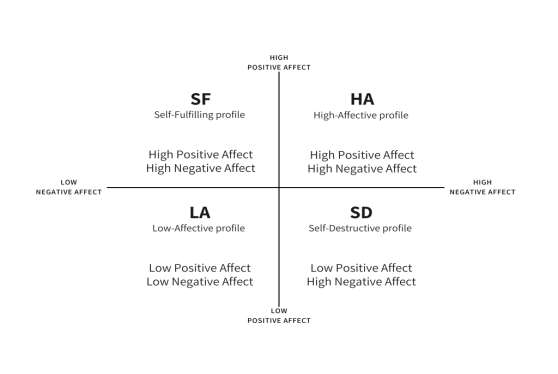
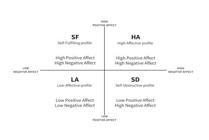
Considering this relative independence of PA and NA, Norlander et al. (2002) proposed a model (subsequently called the affective profiles model) that identifies and names four possible combinations of high/low NA and PA (Figure 1): a Self-Fulfilling profile (SF), a Self-Destructive profile (SD), a High-Affective profile (HA) and Low Affective profile (LA).
Findings regarding the characteristics of these profiles consistently suggest differences in SWL and other well-being indicators, such as autonomy, self-acceptance, etc. (García, 2023; Sagone & De Caroli, 2023) as well as in variables linked to education, such as procrastination and grades (Sagone et al., 2023). While there is clear interest in investigating these affective variables in the Río de la Plata region (Caicedo et al., 2018; Flores-Kanter & Medrano, 2018; Santángelo et al., 2019) and abundant literature on affective profiles exists, produced especially in Europe (García, 2023), studies on this model in the region are scarce (cf. Brunet et al., 2024).
The present study: well-being in educational contexts
In the context of Uruguayan education, addressing affective variables is relevant not only because of their relationship with motivation and self-regulation of learning (Chiarino et al., 2024; Huertas, 2012) and other academic variables of interest (Cunsolo, 2017; UNICEF, 2022), but also because the situation in this regard is far from ideal (Carrizo, 2021; National Institute for Educational Evaluation (INEEd), 2020, 2023a). Although well-being figures in Uruguay are comparable to those of other countries (Fernández et al., 2024; Gallup, 2024), a concerning proportion of adolescents and young people report having attempted (1.2%) or considered (3.3%) self-elimination; 14.4% say they have felt so sad or hopeless that they stopped doing their usual activities for two or more weeks (UNICEF, 2022). In this regard, the prevalence of risk behaviors in this population appears to have increased over the last decade (INEEd, 2023b; UNICEF, 2022). In the case of teachers, 26% can be considered to have low well-being when considering both positive factors (such as motivation and enthusiasm) and their stress and burnout symptoms (INEEd, 2020); which is problematic both in itself and because of its consequences on other variables (Mels et al., 2024). In the Latin American (Bravo-Sanzana et al., 2025; Dávila et al., 2024) and Uruguayan context, where there is clearly interest in evaluating the well-being of teachers (INEEd, 2020; Mels et al., 2024) and adolescents (García-Álvarez et al., 2020; INEEd, 2023b; Portela, 2021), it is striking that the scales most frequently used to evaluate hedonic well-being (Fernandes & Araujo, 2018) are not validated in educational contexts. This study aims toward that objective.
By focusing on educational contexts, it seems necessary to complement general evaluations with situated measures (Dávila et al., 2024; Fernandes & Araujo, 2018) and produce information that is relevant and interpretable for the agents involved (Zenteno-Osorio & Leal-Soto, 2023). Along these lines, this work complements the analysis of SWB scales with the exploration of an affective variable situated in the educational context -academic emotions- using an easily interpretable approach: automated analysis of words used by students in open-ended responses.
Academic emotions (AE) are defined as those experienced by students in academic settings, both those associated with learning outcomes and processes (Pekrun et al., 2023) and those related to the relationship with teachers (Lei et al., 2018). In addition to their intrinsic value associated with well-being (Stockinger et al., 2025), their relationship with learning (Tan et al., 2021), academic performance (Camacho et al., 2021), motivation and self-regulation (Pekrun et al., 2023), among other variables of interest, has also been documented.
Although other approaches have been used, the retrospective self-report scale is the most frequent type of instrument for evaluating SWB and AE (Diener et al., 2017; Pekrun, 2016). Given the subjective and conscious nature of well-being (Diener, 1994; García, 2023), it seems that the subject would be in a privileged position to report it (cf., however, Ahmed, 2021; Ogden & Lo, 2011). Even accepting this premise, the inherent limitations of the Likert-type scale make it desirable to complement this type of measure (Ogden & Lo, 2011). It has become common, in this regard, to use computational tools to quantify affective dimensions in textual data, using language as a window into experience (Boyd & Schwartz, 2021; Vine et al., 2020). This approach has been used in education (Papamitsiou & Economides, 2014; Zhou & Ye, 2020) and in the study of well-being (García et al., 2019; García & Sikström, 2023). However, its implementation in Spanish-speaking educational environments has been limited (Manchini, Jiménez et al., 2024).
In this context, this study aims to analyze SWB and AE in Uruguayan secondary education teachers and students. Specifically, it proposes to: (1) analyze the psychometric properties of two SWB scales with Uruguayan secondary education teachers and students, (2) identify affective profiles of students and teachers, and (3) explore the AE that adolescents associate with high school considering the different affective profiles.
Method
Participants
The sample consisted of 357 Lower Secondary Education students (EMB, by its acronym in Spanish; M age = 13.6, SD = 0.76; 54.6 % female), 375 Upper Secondary Education students (EMS; M age= 16.5, SD = 0.78; 61 % female), and 350 Teachers (M age = 36.3, SD = 12.4; 76.2 % female) from Uruguay. Students belonged to public institutions in the region of Colonia. 95.3 % of teachers worked in public education across multiple institutions and levels. Considering the diversity of centers and levels in which the teaching staff works in the Uruguayan context, and the consequent diversity of emotional associations, academic emotions were not explored in this sample. Purposive sampling was based on accessibility to institutions and availability of participants to be part of the study.
Instruments
Satisfaction with Life Scale (SWLS). This unidimensional scale measures Satisfaction with Life (SWL) including five items that present statements with which agreement/disagreement must be expressed (e.g., I am satisfied with my life). The score for each item ranges from 1 to 7, with a minimum total score of 7 and maximum of 35. The original version was published by Diener et al. (1985) and has been used across a wide range of ages and populations (Pavot & Diener, 2008). The version adapted to Rioplatense Spanish by Mikulic et al. (2019) was used, with reliability of α = .81 in their study.
Positive and Negative Affect Schedule (PANAS, brief version). This bidimensional scale is designed to independently measure Negative Affect (NA) and Positive Affect (PA). The original English version (Watson et al., 1988) was adapted and validated for the Rioplatense variant of Spanish (Medrano et al., 2015). The brief version (Flores-Kanter & Medrano, 2018), composed of 10 items presented as adjectives describing emotions (NA: distressed (afligido), guilty (culpable), scared (asustado), nervous (nervioso), afraid (temeroso); PA: interested (interesado), enthusiastic (entusiasmado), inspired (inspirado), determined (decidido), active (activo), which are scored according to the frequency with which the subject feels this way, on a 5-point Likert scale. The brief version was chosen due to its proven validity in educational contexts and its efficiency for large sample studies (Flores-Kanter & Medrano, 2018). In previous research, the reliability of the subscales in Rioplatense populations varies between α = .75 to α = .85 (Flores-Kanter & Medrano, 2018; Santángelo et al., 2019).
An open-ended question about Academic Emotions (AE), written in Rioplatense Spanish: Thinking about the last semester, what emotions and moods do you specifically associate with high school? (Pensando en el último semestre, ¿qué emociones y estados de ánimo asociás específicamente al liceo?) This is used to collect emotional vocabulary related to the educational institution; for reasons previously mentioned, this question was only included for students.
Procedure
Participants were invited through institutional means (email, internal groups, educational platforms, classroom invitations and posters) and social media (in the case of teachers) to respond to a self-administered online questionnaire using their own devices. All gave their informed consent, and in the case of underaged participants, consent was also requested from the institution and responsible adults. Contact with students was mediated by the institution, and no data that would allow identification of subjects was collected. In exchange for their participation, institutions obtained a general report on the well-being of their students. The procedures and protocols were approved by the Ethics Committee of the University of Málaga, registry number 152-2022-H.
Data Analysis
The data were explored using descriptive statistics, graphical methods, and Kolmogorov-Smirnov test (K-S). Based on these explorations, non-parametric tests and robust estimators were used. To assess the psychometric properties of the scales, confirmatory factor analysis (CFA) was conducted for each sample, using the models validated by Mikulic et al. (2019) and Flores-Kanter and Medrano (2018). Considering the ordinal nature of the data, their non-normal distribution (Li, 2016; Tarka, 2017), and the precedents established by Caicedo et al. (2018), Santángelo et al. (2019), and Melo et al. (2023), the DWLS (Diagonally Weighted Least Squares) estimator was used in its robust variant WLSMV (Weighted Least Squares Means and Variance adjusted), with CFI (Comparative Fit Index), TLI (Tucker Lewis Index), RMSEA (Root Mean Square Error of Approximation), and SRMR (Standardized Root Mean Square Residual) as fit indices (Rosseel, 2012). The interpretation followed Hu and Bentler (1999) criteria: RMSEA and SRMR < .08 acceptable, < .05 excellent; CFI and TLI > .90 acceptable, > .95 excellent. Cronbach’s alpha coefficients (α) and McDonald’s omega (ω) were calculated, and correlations between scales were determined using Spearman’s rho.
To determine affective profiles, a non-hierarchical cluster analysis (k-means) with k = 4 was conducted, following the model originally proposed by Norlander et al. (2002) and the methodological considerations of García and MacDonald (2023). To explore the validity of the profiles, convergence with a simple yet empirically and theoretically robust method -median-splits- (García & MacDonald, 2023) was assessed, comparing intra-group homogeneity using WSS (Within-Cluster Sum of Squared Errors) value. Kruskal-Wallis tests were conducted to determine whether differences existed between profiles in PA, NA, and SWL, consistent with the literature and theory, using η² as effect size measure (Tomczak & Tomczak, 2014); pairwise comparisons were performed using Dunn’s test with Bonferroni correction (Ogle et al., 2023).
The preceding analyses were carried out for all samples (EMB, EMS, and teachers), whereas the following analyses were conducted only for the EMB and EMS samples, for which open-ended responses regarding EA were available.
To analyze relationships between EA and SWB variables, open-ended responses were processed using a dictionary-based approach (Boyd & Schwartz, 2021), following Silge and Robinson's (2016) procedures. To remove words from undesired grammatical categories -conjunctions, articles, pronouns, etc.- the inventories for Uruguay from CORPES XXI (Real Academia Española, n.d.) and the Spanish stopwords list by Feinerer et al. (2008) were used. The Annotated Dictionary of Emotional Vocabulary (DAVE) (Manchini, Jiménez et al., 2024) was used to compute the proportion of words with positive, negative, and neutral-ambivalent valence. Since students responded only using explicit emotional vocabulary, the proportions of positive/negative/neutral-ambivalent words are directly related; for the sake of simplicity, only the proportion of negative words was used to compute the correlation with SWL, NA, and PA. The distinctive vocabulary of each student profile was explored using the Term Frequency - Inverse Document Frequency (TF-IDF) statistic (Silge & Robinson, 2016) and was graphically represented using word clouds. These analyses were carried out using the procedures developed in R (R Core Team, 2021) by Revelle (2022), Rosseel (2012), Silge and Robinson (2016), and Wickham et al. (2019).
Results
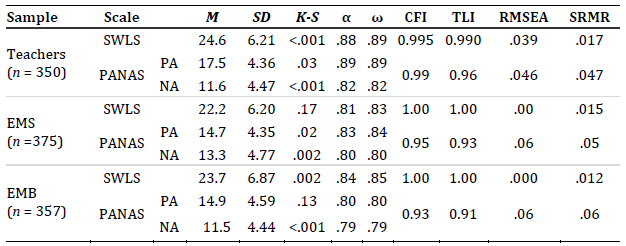
As shown in Table 1, the scales exhibited acceptable values of α and ω, and SWL showed excellent model fit across the three samples, similar to what was reported by Mikulic et al. (2019), Ruiz et al. (2019), and Melo et al. (2023). In the case of PANAS, model fit was excellent for teachers and acceptable for EMS and EMB students.
The correlation analysis showed a weak but significant positive relationship (rho = .11, p = .033) between NA and PA in the EMB sample; it was not significant in the EMS student sample (rho = .01, p = .9) nor in the teacher sample (rho = .09, p = .08).
The correlation with SWL was positive and moderate for PA in the teacher sample (rho = .3, p < .001), EMS students (rho = .36, p < .001), and EMB students (rho = .31, p < .001), while it was negative and moderate for NA in the teacher sample (rho = -.41, p < .001), EMS (rho = -.34, p < .001), and EMB (rho = -.26, p < .001).
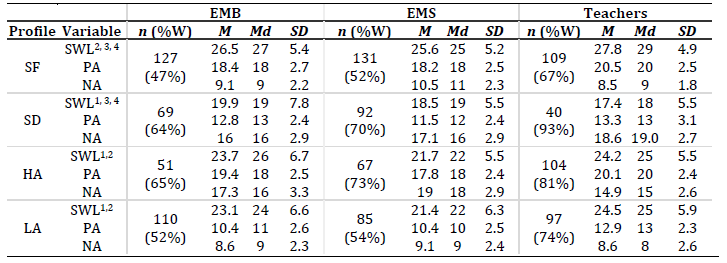
In all three samples (Table 2), cluster analysis produced profiles comparable to the proposed model (García, 2023). To explore these profiles and their relationship with the split-median method -using the median as a cutoff point (García & MacDonald, 2023)- a confusion matrix was generated between both approaches, graphical explorations were conducted, and the agreement percentage was calculated. Quantitative results and graphical exploration suggest that the profiles produced by both methods are equivalent, with a high agreement percentage (78 % in EMB, 88.5 % in EMS, and 78 % in teachers); the WSS calculation for both methods suggests that the profiles generated by k-means are more homogeneous, both for the EMB sample (WSS k-means = 4657.3 , WSS median-split= 5168.7), the EMS sample (WSS k-means = 4737.1, WSS median-split= 5015.7), and the teacher sample (WSS k-means = 4141.9, WSS median-split= 4446.4).
Regarding the differences in NA and PA by affective profile, the Kruskal-Wallis test indicated significant differences in PA scores across profiles in the EMB sample (χ²(df=3) = 269.25, p < .001, η2= 0.75), EMS (χ²(df=3) = 279.22, p < .001, η2 = 0.74) and Teachers (χ²(df= 3) = 242.36, p < .001, η2= 0.69). The results for NA were also significant in EMB (χ²(df=3) = 235.49, p < .001, η2 = 0.66), EMS (χ²(df=3) = 277.43, p < .001, η2 = 0.74) and teachers (χ²(df=3) = 253.12, p < .001, η2 = 0.72).
Results suggest significant differences in SWL scores across profiles for EMB (χ²(df= 3) = 39.12, p < .001, η2 = 0.1), EMS (χ²(df= 3) = 73.77, p < .001, η2 = 0.19) and teachers (χ²(df= 3) = 75.36, p < .001, η2 = 0.21). In all samples, pairwise comparison results (Table 2) suggest significant differences in SWL between all profiles except between LA and HA.
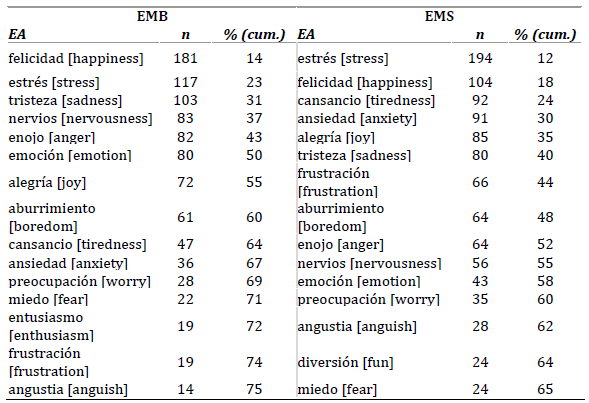
After preprocessing, DAVE was able to identify 2,906 (91 %) of the 3,201 words written by students in relation to their educational institution, 1,291 in the EMB sample and 1,615 in the EMS sample. The words not identified (295) were manually reviewed, confirming that they generally corresponded to cases in which students explained the reasons for their associations (“liceo” (school), “deberes” (homework), “compañeros” (classmates), etc.), adverbs (“no,” “muy”), and, in some cases, spelling errors not recognized by DAVE (“felis,” “juzgación,” “triztesa,” “alegradusimo,” “afrijido”) or terms not considered emotional vocabulary (“sueño” (sleepiness)). These results are relevant for considering the inherent noise in quantitative approaches to text analysis (Boyd & Schwartz, 2021). However, as shown in Table 3, in both samples a small proportion of lexical families accounts for a very large proportion of the words used by students, suggesting that these cases likely have minimal influence.
It is worth noting that the proportion represented by the 15 most frequent words is lower in the EMS sample, which suggests a broader vocabulary. In both samples, a higher proportion of AE has a negative polarity: in the case of EMB, 53.1% are negative, 8.1 % neutral-ambivalent, and 38.8 % positive, while in EMS, 65.8 % are negative, 5.7 % neutral-ambivalent, and 28.3 % positive.
The correlational analysis suggests that the proportion of negative terms is significantly correlated with AN, AP, and SWL, both for EMS and EMB. In EMS, the proportion of negative terms showed positive correlations with AN (rho = .211, p < .001) and negative correlations with AP (rho= -.238, p < .001) and SWL (rho = -.257, p < .001). The EMB sample showed similar results: the proportion of negative terms correlated positively with AN (rho = .212, p < .001) and negatively with AP (rho = -.220, p < .001) and SWL (rho = -.288, p < .001).
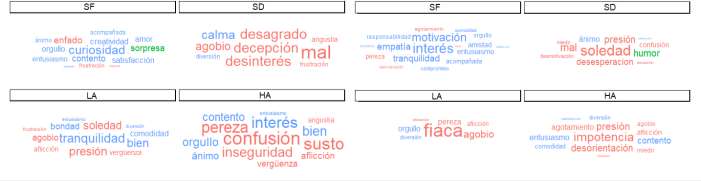
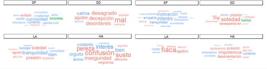
The analysis of distinctive vocabulary suggests the existence of specific affective associations for each of the profiles (Figure 2). The words with the highest TF-IDF values (exact values in parentheses) for each of the profiles were:
-
-SF profile: for the EMS sample, “interés” (interest) (.029), “motivación” (motivation) (.026), “tranquilidad” (calmness) (.021), and “empatía” (empathy) (.018); for the EMB sample, “curiosidad” (curiosity) (.016), “contento” (content/happy) (.010), “creatividad” (creativity) (.010), and “satisfacción” (satisfaction) (.010).
-
-SD profile: for the EMS sample, “soledad” (loneliness) (.034), “desesperación” (despair) (.021), “presión” (pressure) (.019), and “confusión” (confusion) (.017); for the EMB sample, “decepción” (disappointment) (.020), “desagrado” (displeasure) (.020), “desinterés” (disinterest) (.020), and “mal” (bad) (.020).
-
-LA profile: for the EMS sample, “fiaca” (laziness/sluggishness) (.039), “agobio” (overwhelm) (.019), “orgullo” (pride) (.013), “pereza” (laziness) (.013); for the EMB sample, “tranquilidad” (calmness) (.018), “presión” (pressure) (.014), “soledad” (loneliness) (.014), and “bien” (well) (.012).
-
-HA profile: for the EMS sample, “impotencia” (helplessness) (.027), “desorientación” (disorientation) (.022), “presión” (pressure) (.019), and “agotamiento” (exhaustion) (.017); for the EMB sample, “confusión” (confusion) (.028), “inseguridad” (insecurity) (.021), “interés” (interest) (.021), and “pereza” (laziness) (.021).
Discussion
This study aimed to analyze, within the Uruguayan educational context, the properties of two instruments that assess SWB, identify affective profiles, and explore students' AE. Although more evidence is desirable, the overall results suggest that SWLS and PANAS are valid instruments for assessing SWB, and that their use in conjunction with the affective profiles model and the analysis of open-ended responses allows for a reasonable representation of affective trends and experiences in academic settings.
Psychometric properties of the scales
SWLS showed excellent properties across all samples, equivalent to those found in Río de la Plata populations (Mikulic et al., 2019) and in other regions (Pavot & Diener, 2008). The correlations between this scale and PANAS, significant but moderate, are consistent with the literature (Pavot & Diener, 2008). For PANAS, reliability indicators were acceptable, and the CFA -with the orthogonal model originally proposed by Watson et al. (1998)- showed excellent fit indices for teachers and acceptable ones for students. In line with previous findings from the Río de la Plata region (Caicedo et al., 2018; Flores-Kanter & Medrano, 2018; Santángelo et al., 2019) and other regions (García, 2023), the results indicate that the short version of PANAS may be a useful tool for the independent assessment of NA and PA. The indicators suggest a less optimal performance in the younger student sample; in samples mostly composed of young students, it may be advisable to use alternative versions of PANAS (Brunet et al., 2024) or, if using this version, to interpret its results with caution. Moreover, this highlights the need to consider developmental aspects of SWB across the life cycle.
The correlation between PA and NA -non-significant in teachers and EMS, and significant and positive in EMB- is consistent with previous studies suggesting that PA and NA may not be completely independent (e.g., Caicedo et al., 2018). From a broader perspective, these results are consistent with the proposal that, since PA and NA are part of a dynamic adaptive meta-system, it is desirable to combine variable-oriented approaches with person-oriented ones-such as the affective profiles model (García, 2023; Schütz et al., 2013).
Affective profiles
The intrinsic properties of the PANAS scale -namely the dispersion of total scores and the absence of correlation between subscales- result in the potential to identify four profiles. The results from graphical explorations, quantitative analysis, and language analysis suggest that this model, proposed by Norlander et al. (2002), is a reasonable way to represent affective trends and experiences of secondary education students and teachers, with a focus on the person.
To identify the profiles, cluster analysis proved to be more appropriate than the median-split method, both for theoretical reasons, as it focuses on similarities between individuals rather than on central tendency measures of the variable, and for empirical reasons, as it showed greater within-group homogeneity. However, the high agreement rates (similar to those reported by García et al., 2015) suggest that the median-split method should not be dismissed as less reliable (García & MacDonald, 2023). In turn, this convergence also increases the reliability of aligning the clusters obtained through k-means with the four-affective-profile model.
As expected, significant differences in SWL were observed between the SF and SD profiles; however, no differences were found between the LA and HA profiles in any of the samples; these profiles showed significantly higher SWL scores than the SD profile, but lower than the SF profile. Although consistent with the trend of the SF, HA, and LA profiles to have high SWL (García, 2023), these results differ from those of García and MacDonald (2023) in the US, who found differences between HA and LA but not between SF and HA. Considering the cognitive and reflective nature of LS, it seems reasonable to hypothesize that these differences may stem from cultural differences regarding which affective experiences are typically deemed compatible with a satisfying life. Just as the US accepts and validates traits associated with the HA profile (García & MacDonald, 2023), it is plausible that a culture like Uruguay’s -which is stereotyped as “measured and calm” (Pais, 2019), “family-oriented,” “complaining,” “nostalgic,” “lazy,” and “traditionalist” (Pérez, 2007)- may be more inclined than the American one to relativize the value of positive experience and to consider a life with low affectivity as satisfying.
The lower proportion of female participants observed in the SF and LA profiles is consistent with previous findings (Adrianson, 2023; García et al., 2015; Sagone et al., 2023). However, as García and MacDonald (2023) point out, it is more plausible that affectivity is not related to gender per se, but rather to how individual differences -such as personality- are encoded according to a person's gender. Given the relevance of gender stereotypes in the construction of identity -particularly in the affective domain (Manchini & Martínez, 2025)- it is necessary to conduct studies that examine this variable in detail, investigating not only the various ways of expressing a masculine or feminine identity, but also the identities of non-binary, trans and queer individuals, inter alia.
Academic emotions
Previous studies, such as those by García et al. (2016) and García & Sikström (2023), suggest the possibility of incorporating language measures into the discussion on affective profiles, particularly by using texts generated directly in relation to the psychological phenomenon of interest. The results of this study show that this approach is fruitful: it not only found a distinctive use of vocabulary (García et al., 2016), consistent with theory (García, 2023), but also that this vocabulary also qualitatively illustrates the experience of students from each profile.
In quantitative terms, the results are consistent with previous findings (e.g., Wong et al., 2024; Zalazar-Jaime et al., 2022) in suggesting that SWB is related to AE, or more precisely in this case, to the positive/negative polarization of students’ reports (i.e., the proportion of AE with negative valence). Although predictable, this is still a relevant finding for practice: when thinking about well-being in the educational context in a situated way, alongside sociopolitical and institution-specific factors, one must also consider person-related factors (Dávila et al., 2024).
In qualitative terms, given that emotional vocabulary conveys diverse information about experience (Cochrane, 2009; Soriano, 2016), the report can be used as a window into different ways of experiencing the educational institution. For example, students in the SD profile are distinguished by more frequent reports of unpleasant emotions; but beyond valence, words such as loneliness, disinterest, lack of motivation, disappointment, pressure, and despair point to an experience of repulsion (vs. attraction), of weakness and uncertainty (vs. power and predictability), and of social disconnection (Cochrane, 2009). In contrast, students from the SF profile are characterized by reporting positively valenced emotions that indicate attraction (such as curiosity, motivation, interest, and enthusiasm), power (such as pride, responsibility, and creativity), predictability (such as calmness, satisfaction, and contentment), and social connection (such as empathy, friendship, companionship and love). As theoretically expected (García, 2023), the results for the LA and HA profiles are varied; however, it stands out that in both samples, the distinctive vocabulary of the HA profile appears to point to an experience of weakness and uncertainty (confusion, insecurity, powerlessness, fright, and fear).
Overall, these results suggest that combining brief scales with open-ended questions is a valid and efficient way to obtain situated information about well-being in educational settings. Integrating them into systems that routinely assess psychoeducational variables (e.g., Zenteno-Osorio & Leal-Soto, 2023) would allow institutions to access relevant feedback about their functioning. Responsibly monitoring and understanding well-being dynamics supports the development of informed and targeted actions at the personal, institutional, and sociopolitical levels (Dávila et al., 2024). For example, interventions aimed at addressing emotional regulation strategies at the personal level (Body et al., 2016; Salcido-Cibrián et al., 2019; Schmitz, 2024; Stockinger et al., 2025) can be more effectively targeted if the diversity of affective profiles is taken into account: it is expected that individuals will benefit from different types of practices and resources depending on their profile.
At institutional level, using students’ own emotional vocabulary provides insight into the cognitive component of the academic experience, going beyond positive and negative affect (Soriano, 2016). For example, references to experiences of anxiety, stress, and tiredness not only communicate a negative experience, but also suggest that the educational institution is perceived as an unappealing environment that generates feelings of powerlessness, lack of control, and disconnection from others. This can serve as a guide for implementing educational interventions -both inside and outside the classroom (Manchini, Mels et al., 2024)- as well as for fostering the development of classroom-based and institution-based interventions that specifically address the identified emotions.
Finally, at the social and political level, it is especially important to have resources that represent students’ emotions in their own words, thereby avoiding biased portrayals driven by interests external to those of the subjects of education (Palacios-Díaz et al., 2023); for instance, in Uruguay, such bias has been documented in emotional educations projects promoted by conservative sectors (Palacios-Díaz et al., in press).
Well-being and emotional experience lie at the core of the educational project; the tools and models proposed, while limited and in need of refinement, allow us to attend to them in a rigorous manner.
Limitations and future directions
In addition to limitations inherent to the used methods, this study has several specific limitations. First, the cross-sectional design does not allow for the study of well-being development throughout adolescence, or the establishment of relevant causal relationships (e.g., between SWB and AE); likewise, the intentional nature of the sample raises questions about the generalizability of these results. In this regard, it would be advisable to move toward longitudinal studies with representative samples. Second, to confirm the validity of the scales more thoroughly, it would be desirable to include additional measures (e.g., of eudaimonic well-being or mental health, which would allow for the assessment of convergent and divergent validity); it would also be desirable to analyze test-retest reliability. Third, although this study includes both teachers and students, the design does not allow for addressing interesting questions about interactions between these groups (e.g., whether teachers’ SWB influences students’ SWB or AE). Finally, it is worth noting that many of these variables could have interesting relationships with data that institutions themselves generate and record about their students (grades, attendance, participation in activities, sociograms, sociodemographic data, etc.). Linking these measures is necessary in order to advance models that account for well-being in educational contexts and to design interventions that actively promote it.
Conclusions
In a context where well-being is becoming increasingly central, this work provides evidence and assessment resources that support advances in research and guide systematic actions to promote it among students and teachers. In addition to validating frequently used scales, it integrated a person-centered model of affective profiles and techniques of quantitative language analysis, allowing for a more contextualized view of affective experience in the educational setting. Both questionnaires and language open a window into experience in educational contexts, enabling a more thorough understanding of their dynamics. Having evidence and tools to address well-being allows for approaching some of education’s perennial challenges -such as student retention, motivation, and teacher-student relationships- from new perspectives. It also allows educational institutions to systematically approach the most general of goals: the good living.
References
-
Adrianson, L. (2023). Affective profiles, health, and well-being in Indonesia. En D. García (Ed.), The affective profiles model (pp. 175-190). Springer. https://doi.org/10.1007/978-3-031-24220-5_2
» https://doi.org/10.1007/978-3-031-24220-5_2 - Ahmed, S. (2021). La promesa de la felicidad Caja negra.
-
Anselmi, A., Cracco, C., Estradé, A., Solmi, M., & Correll, C. U. (2024). Impactos de la pandemia de COVID-19 sobre el bienestar y la salud mental de adultos uruguayos. Ciencias Psicológicas, 18(2), e-4059. https://doi.org/10.22235/cp.v18i2.4059
» https://doi.org/10.22235/cp.v18i2.4059 - Body, L., Ramos, N., Recondo, O., & Pelegrina, M. (2016). Desarrollo de la inteligencia emocional a través del programa mindfulness para regular emociones (PINEP) en el profesorado. Revista Interuniversitaria de Formación del Profesorado, 30(87), 47-59.
-
Boyd, R., & Schwartz, H. (2021). Natural language analysis and the psychology of verbal behavior: The past, present, and future states of the field. Journal of Language and Social Psychology, 40(1), 1-21. https://doi.org/10.1177/0261927X20967028
» https://doi.org/10.1177/0261927X20967028 -
Bravo-Sanzana, M., Casas, F., Rodríguez-Rivas, M. E., Oriol, X., Varela, J. J., Miranda, R., & Terán-Mendoza, O. (2025). Instruments for measuring hedonic and eudaimonic well-being of adolescents in the Latin American school contexts: A systematic review. Child Indicators Research, 18(3), 955-1000. https://doi.org/10.1007/s12187-025-10231-z
» https://doi.org/10.1007/s12187-025-10231-z -
Brown, J. L. D., & Potter, S. (2024). Integrating the philosophy and psychology of well-being: An opinionated overview. Journal of Happiness Studies, 25(5). https://doi.org/10.1007/s10902-024-00763-6
» https://doi.org/10.1007/s10902-024-00763-6 - Brunet, N., Tórtora, G., Suñol, N., & Fernández-Berrocal, P. (2024). Evaluación de la aplicación del Positive and Negative Affect Schedule (PANAS-N) para adolescentes uruguayos en contextos de vulnerabilidad social. En V. Ortuño (moderador), Simposio de desarrollo y adaptación de instrumentos de evaluación psicológica en el Uruguay VI Simposio de Investigación en Psicología , Universidad Católica del Uruguay, Montevideo, Uruguay
-
Caicedo, E., Michelini, Y., Belaus, A., Mola, D. J., Godoy, J. C., & Reyna, C. (2018). Further considerations regarding PANAS: Contributions from four studies with different Argentinean samples. Suma Psicológica, 25(2), 133-145. https://doi.org/10.14349/sumapsi.2018.v25.n2.5
» https://doi.org/10.14349/sumapsi.2018.v25.n2.5 -
Camacho, J., Slemp, G.R., Pekrun, R., Loderer, K., Hou, H., & Oades, L. (2021). Activity achievement emotions and academic performance: A meta-analysis. Educational Psychology Review, 33(4), 1051-1095. https://doi.org/10.1007/s10648-020-09585-3
» https://doi.org/10.1007/s10648-020-09585-3 - Camps, V. (2019). La búsqueda de la felicidad Arpa.
-
Carrizo L. (2021). Salud mental en Uruguay en época de COVID 19 Informe de Estado de Situación, (4). Academia Nacional de Ciencias del Uruguay. https://anciu.org.uy/risep/serie-estados-de-situacion-risep.html
» https://anciu.org.uy/risep/serie-estados-de-situacion-risep.html -
Chiarino, N., Curione, K., & Huertas Martinez, J. A. (2024). Clima motivacional de clase en la enseñanza media y superior iberoamericana: una revisión sistemática. Ciencias Psicológicas, 18(2), e-3770. https://doi.org/10.22235/cp.v18i2.3770
» https://doi.org/10.22235/cp.v18i2.3770 -
Cochrane, T. (2009). Eight dimensions for the emotions. Social Science Information, 48(3), 379-420. https://doi.org/10.1177/0539018409106198
» https://doi.org/10.1177/0539018409106198 -
Crisp, R. (2017). Well-Being. En E. N. Zalta (Ed.), The Stanford Encyclopedia of Philosophy https://plato.stanford.edu/archives/fall2017/entries/well-being
» https://plato.stanford.edu/archives/fall2017/entries/well-being -
Cunsolo, S. (2017). Subjective wellbeing during adolescence: a literature review on key factors relating to adolescents’ subjective wellbeing and education outcomes. Studi Sulla Formazione, 20(1), 81-94. https://doi.org/10.13128/Studi_Formaz-20941
» https://doi.org/10.13128/Studi_Formaz-20941 -
Curren, R., Boniwell, I., Ryan, R. M., Oades, L., Brighouse, H., Unterhalter, E., Kristjánsson, K., De Ruyter, D., Macleod, C., Morris, I., & White, M. (2024). Finding consensus on well-being in education. Theory and Research in Education, 22(2), 117-157. https://doi.org/10.1177/14778785241259852
» https://doi.org/10.1177/14778785241259852 -
Dávila, J. R., Huertas, J. A., & Leal-Soto, F. (2024). Estructura psicológica del bienestar docente: justificación de un modelo situado. Revista de Psicodidáctica, 29(1), 19-27. https://doi.org/10.1016/j.psicod.2023.11.001
» https://doi.org/10.1016/j.psicod.2023.11.001 - Diener, E. (1994). Bienestar subjetivo. Intervención Psicosocial, 3(8), 67-113.
-
Diener, E., Emmons, R. A., Larsen, R. J., & Griffin, S. (1985). The Satisfaction with Life Scale. Journal of Personality Assessment, 49(1), 71-75. https://doi.org/10.1207/s15327752jpa4901_13
» https://doi.org/10.1207/s15327752jpa4901_13 -
Diener, E., Heintzelman, S. J., Kushlev, K., Tay, L., Wirtz, D., Lutes, L. D., & Oishi, S. (2017). Findings all psychologists should know from the new science on subjective well-being. Canadian Psychology, 58(2), 87-104. https://doi.org/10.1037/cap0000063
» https://doi.org/10.1037/cap0000063 -
Feinerer, I., Hornik, K., & Meyer, D. (2008). Text mining infrastructure in R. Journal of Statistical Software, 25(5), 1-54. https://doi.org/10.18637/jss.v025.i05
» https://doi.org/10.18637/jss.v025.i05 -
Feldman-Barrett, L., & Bliss-Moreau, E. (2009). Affect as a psychological primitive. Advances in Experimental Social Psychology, 41, 167-218. https://doi.org/10.1016/S0065-2601(08)00404-8
» https://doi.org/10.1016/S0065-2601(08)00404-8 -
Fernandes, R., & Araujo, N. (2018). Bienestar subjetivo de niños/as y adolescentes: revisión integradora. Ciencias Psicológicas, 12(2), 249-260. https://doi.org/10.22235/cp.v12i2.1689
» https://doi.org/10.22235/cp.v12i2.1689 -
Fernández, M. E., Castelluccio, L., Sanjurjo, I., & Daset, L. (2024). Adolescent and parental risk perception of alcohol and marijuana use and well-being of adolescents in Uruguay. En M. Florence, W. Vanderplasschen, M. Yu, J. De Maeyer & S. Savahl (Eds.), Handbook of Addiction, Recovery and Quality of Life International Handbooks of Quality-of-Life (pp. 435-446). Springer. https://doi.org/10.1007/978-3-031-65873-0_30
» https://doi.org/10.1007/978-3-031-65873-0_30 -
Flores-Kanter, P. E., & Medrano, L. A. (2016). El afecto y sus dimensiones: Contrastes de modelos ortogonales y oblicuos mediante análisis factorial confirmatorio de la escala PANAS. LIBERABIT, 22(2), 173-184. https://doi.org/10.24265/liberabit.2016.v22n2.05
» https://doi.org/10.24265/liberabit.2016.v22n2.05 -
Flores-Kanter, P. E., & Medrano, L. A. (2018). Comparación de dos versiones reducidas de la Escala PANAS: Análisis factoriales en una muestra argentina. Revista Iberoamericana de Diagnóstico y Evaluación, 49(4), 37-46. https://doi.org/10.21865/ridep49.4.03
» https://doi.org/10.21865/ridep49.4.03 -
Fondo de las Naciones Unidas para la Infancia. (2022). Situación de bienestar psicosocial y salud mental en adolescentes y jóvenes en Uruguay https://bibliotecaunicef.uy/documentos/267_Situacion%20de%20bienestar%20psicosocial%20salud%20mental%20adolescentes%20Uruguay.pdf
» https://bibliotecaunicef.uy/documentos/267_Situacion%20de%20bienestar%20psicosocial%20salud%20mental%20adolescentes%20Uruguay.pdf - Gallup. (2024). Gallup Global Emotions Report 2024
-
García, D. (2023). The story of the affective profiles model: Theory, Concepts, Measurement, and Methodology. En: D. García (Ed.), The affective profiles model (pp. 3-23). Springer. https://doi.org/10.1007/978-3-031-24220-5_1
» https://doi.org/10.1007/978-3-031-24220-5_1 -
García, D., & MacDonald, S. (2023). The (mis)measurement of the affective profiles model: Should I split or should I cluster? En D. García (Ed.), The affective profiles model (pp. 25-48). Springer. https://doi.org/10.1007/978-3-031-24220-5_2
» https://doi.org/10.1007/978-3-031-24220-5_2 -
García, D., & Sikström, S. (2023). Innovative methods for affectivity profiling: Quantitative semantics. En D. García (Ed.), The affective profiles model (pp. 89-104). Springer. https://doi.org/10.1007/978-3-031-24220-5_4
» https://doi.org/10.1007/978-3-031-24220-5_4 -
García, D., Kjell, O. N. E., & Sikström, S. (2019). A collective picture of what makes people happy: Words representing social relationships, not money, are recurrent with the word ‘happiness’ in online newspapers. En P. Benson, B. Dalmaso, & I. Stefan (Eds.), The psychology of social networking Vol. 2: Identity and relationships in online communities (pp. 4-16). De Gruyter Open Poland. https://doi.org/10.1515/9783110473858-003
» https://doi.org/10.1515/9783110473858-003 -
García, D., Kjell, O. N. E., Sikström, S., & Archer, T. (2016). Using language and affective profiles to investigate differences between individuals. Clinical and Experimental Psychology, 2(2), 123. https://doi.org/10.4172/2471-2701.1000123
» https://doi.org/10.4172/2471-2701.1000123 -
Garcia, D., MacDonald, S., & Archer, T. (2015). Two different approaches to the affective profles model: Median splits (variable-oriented) and cluster analysis (person-oriented). PeerJ, 3, e1380. https://doi.org/10.7717/peerj.1380
» https://doi.org/10.7717/peerj.1380 -
García-Álvarez, D., Hernández, J., Espinosa, J., & Soler, M. (2020). Validación de la escala de bienestar psicológico para jóvenes de Casullo en adolescentes montevideanos. Revista Latinoamericana de Hipertensión, 15(5), 1-12. https://doi.org/10.5281/zenodo.4487296
» https://doi.org/10.5281/zenodo.4487296 -
Hu, L., & Bentler, P. M. (1999). Cutoff criteria for fit indexes in covariance structure analysis: Conventional criteria versus new alternatives. Structural Equation Modeling, 6, 1-55. https://doi.org/10.1080/10705519909540118
» https://doi.org/10.1080/10705519909540118 -
Huertas, J. A. (2012). Los efectos de los afectos en la motivación y la autorregulación. Ciencias Psicológicas, 6(1), 45-55. https://doi.org/10.22235/cp.v6i1.62
» https://doi.org/10.22235/cp.v6i1.62 - Instituto Nacional de Evaluación Educativa. (2020). Estudio de salud ocupacional docente
- Instituto Nacional de Evaluación Educativa. (2023a). Informe sobre el estado de la educación en Uruguay 2021-2022
- Instituto Nacional de Evaluación Educativa. (2023b). Aristas 2022: Informe de Resultados de Educación Media
-
Lei, H., Cui, Y., & Chiu, M. M. (2018). The Relationship between Teacher Support and Students' Academic Emotions: A Meta-Analysis. Frontiers in Psychology, 8, 2288. https://doi.org/10.3389/fpsyg.2017.02288
» https://doi.org/10.3389/fpsyg.2017.02288 -
Li, C. (2016). Confirmatory factor analysis with ordinal data: Comparing robust maximum likelihood and diagonally weighted least squares. Behavioral Research Methods
48, 936-949. https://doi.org/10.3758/s13428-015-0619-7
» https://doi.org/10.3758/s13428-015-0619-7 -
Manchini, N., & Martínez, M. (2025). “Basta que me enamores -o que me mandes flores”: género, experiencia y emociones en el corpus del pop-rock en español. Archiv für Textmusikforschung, 9(1), 1-21. https://doi.org/10.15203/ATeM_2025_1.7
» https://doi.org/10.15203/ATeM_2025_1.7 -
Manchini, N., Jiménez, O., Ramos-Díaz, N., & Trías, D. (2024). Affect and words: An instrument for the quantitative analysis of emotional vocabulary in open-ended responses https://doi.org/10.31234/osf.io/tmnxw
» https://doi.org/10.31234/osf.io/tmnxw - Manchini, N., Mels, C., & Lacruz, N. (2024). Educar en habilidades emocionales en Uruguay. En C. Mels, M. Báez & N. Lacruz (Coords.), ¿Cómo educar en habilidades socioemocionales? (pp. 135-143). Universidad Católica del Uruguay.
- Medrano, L., Flores, P, Trógolo, M. Curarello, A., & González, J. (2015). Adaptación de la Escala de Afecto Positivo y Negativo (PANAS) para la población de estudiantes universitarios de Córdoba. Anuario de investigaciones de la Facultad de Psicología, 2(1), 22-36.
-
Melo, G., Dias, C. L., Ramos, I. A., Brandão, M., & Winckler, C. (2023). Psychometric properties of the Satisfaction with Life Scale in Brazilian Para athletes. Cuadernos de Psicología del Deporte, 23(2), 133-145. https://doi.org/10.6018/cpd.530191
» https://doi.org/10.6018/cpd.530191 - Mels, C., De Lema, S., & Irigoyen, M. (2024). Bienestar docente en Uruguay: una exploración desde la perspectiva de docentes de educación primaria y media Agencia Nacional de Investigación e Innovación, Universidad Católica del Uruguay, Administración Nacional de Educación Pública.
- Mikulic, I. M., Crespi, M., & Caballero, R. Y. (2019). Escala de Satisfacción con la Vida (SWLS): Estudio de las propiedades psicométricas en adultos de Buenos Aires. Anuario de Investigaciones Facultad de Psicología de la UBA, 27, 395-402.
-
Norlander, T., Bood, S.-Å., & Archer, T. (2002). Performance during stress: Affective personality, age, and regularity of physical exercise. Social Behavior and Personality: An International Journal, 30(5), 495-508. https://doi.org/10.2224/sbp.2002.30.5.495
» https://doi.org/10.2224/sbp.2002.30.5.495 -
Ogden, J., & Lo, J. (2011). How meaningful are data from Likert scales? An evaluation of how ratings are made and the role of the response shift in the socially disadvantaged. Journal of Health Psychology, 17(3), 350-361. https://doi.org/10.1177/1359105311417192
» https://doi.org/10.1177/1359105311417192 -
Ogle, D., Doll, J., Wheeler, A., & Dinno, A. (2023). FSA: Simple Fisheries Stock Assessment Methods R package version 0.9.5 (Software). https://CRAN.R-project.org/package=FSA
» https://CRAN.R-project.org/package=FSA -
Organización Mundial de la Salud & Fondo de las Naciones Unidas para la Infancia. (2021). Investing in our future: A comprehensive agenda for the health and well-being of children and adolescents https://iris.who.int/bitstream/handle/10665/350239/9789240037793-eng.pdf?sequence=1&isAllowed=y
» https://iris.who.int/bitstream/handle/10665/350239/9789240037793-eng.pdf?sequence=1&isAllowed=y -
Pais, A. (2019, 13 de febrero). ¿Es cierto que los uruguayos son "todos buenos" (y qué tienen que ver los argentinos con ese estereotipo)? BBC News Mundo https://www.bbc.com/mundo/noticias-47148158
» https://www.bbc.com/mundo/noticias-47148158 -
Palacios-Díaz, D., Dufraix, I., Sisto, V., & Ramírez, L. (2023). Conteniendo afectos: análisis discursivo de orientaciones educativas en Chile. Cadernos de Pesquisa, 53(1). https://doi.org/10.1590/1980531410053
» https://doi.org/10.1590/1980531410053 - Palacios-Díaz, D., Manchini, N., & Báez, T. (en prensa). Legislar las emociones: Análisis discursivo de proyectos de ley sobre educación emocional en Chile y Uruguay. Archivos Analíticos de Políticas Educativas
- Papamitsiou, Z., & Economides, A. A. (2014). Learning analytics and educational data mining in practice: A systematic literature review of empirical evidence. Educational Technology y Society, 17(4), 49-64.
-
Pavot, W., & Diener, E. (2008). The Satisfaction with Life Scale and the emerging construct of life satisfaction. The Journal of Positive Psychology, 3(2), 137-152. https://doi.org/10.1080/17439760701756946
» https://doi.org/10.1080/17439760701756946 -
Pekrun, R. (2016). Using self-report to assess emotions in education. Methodological Advances in Research on Emotion and Education, 43-54. https://doi.org/10.1007/978-3-319-29049-2_4
» https://doi.org/10.1007/978-3-319-29049-2_4 -
Pekrun, R., Marsh, H. W., Elliot, A. J., Stockinger, K., Perry, R. P., Vogl, E., Goetz, T., Van Tilburg, W. A. P., Lüdtke, O., & Vispoel, W. P. (2023). A three-dimensional taxonomy of achievement emotions. Journal of Personality and Social Psychology, 124(1), 145-178. https://doi.org/10.1037/pspp0000448
» https://doi.org/10.1037/pspp0000448 -
Pérez, P. (2007). Identidades, actitudes y estereotipos nacionales y supranacionales en una muestra uruguaya. Ciencias Psicológicas, 1(1), 81-102. https://doi.org/10.22235/cp.v0i1.574
» https://doi.org/10.22235/cp.v0i1.574 -
Portela, M. (2021). Estudio preliminar de las propiedades psicométricas de la escala de funcionamiento psicológico positivo para una muestra de adolescentes uruguayos. Ciencias Psicológicas, 15(1), e-2396. https://do i.org/10.22235/cp.v15i1.2396
» https://do i.org/10.22235/cp.v15i1.2396 -
R Core Team. (2021). R: A language and environment for statistical computing (Software). R Foundation for Statistical Computing. https://www.R-project.org/
» https://www.R-project.org/ -
Real Academia Española. (s.f.). Corpus del Español del siglo XXI (CORPES). Recuperado el 23 de junio de 2024, de Recuperado el 23 de junio de 2024, de https://www.rae.es/corpes/
» https://www.rae.es/corpes/ -
Revelle, W. (2022). psych: Procedures for psychological, psychometric, and personality research (R package version 2.2.9) (Software). https://CRAN.R-project.org/package=psych
» https://CRAN.R-project.org/package=psych -
Rivera-Vargas, P., & Oyanedel, J. C. (2023). Subjective well-being in online and mixed educational settings. Frontiers in Psychology, 14, 1152373. https://doi.org/10.3389/fpsyg.2023.1152373
» https://doi.org/10.3389/fpsyg.2023.1152373 -
Rosseel, Y. (2012). lavaan: An R Package for Structural Equation Modeling . Journal of Statistical Software, 48(2), 1-36. https://doi.org/10.18637/jss.v048.i02
» https://doi.org/10.18637/jss.v048.i02 - Rowan, A. N. (2022). World happiness report 2022. WellBeing News, 4(3), 2.
-
Ruiz, F. J., Suárez-Falcón, J. C., Flórez, C. L., Odriozola-González, P., Tovar, D., López-González, S., & Baeza-Martín, R. (2019). Validity of the Satisfaction with Life Scale in Colombia and factorial equivalence with Spanish data. Revista Latinoamericana de Psicología, 51(2), 58-65. https://doi.org/10.14349/rlp.2019.v51.n2.1
» https://doi.org/10.14349/rlp.2019.v51.n2.1 -
Ryan, R. M., & Deci, E. L. (2001). On happiness and human potentials: A review of research on hedonic and eudaimonic well-being. Annual Review of Psychology, 52, 141-166. https://doi.org/10.1146/annurev.psych.52.1.141
» https://doi.org/10.1146/annurev.psych.52.1.141 -
Sagone, E., & De Caroli, M. (2023). Affectivity and well-being in Italian samples of adolescents and young adults. En D. García (Ed.), The affective profiles model (pp. 191-205). Springer. https://doi.org/10.1007/978-3-031-24220-5_11
» https://doi.org/10.1007/978-3-031-24220-5_11 -
Sagone, E., De Caroli, M., & Indiana, M. (2023). Differences in procrastination, well-being, and average grades in exams among Italian university students with different affective profiles. En D. García (Ed.), The affective profiles model (pp. 207-224). Springer. https://doi.org/10.1007/978-3-031-24220-5_12
» https://doi.org/10.1007/978-3-031-24220-5_12 -
Salcido-Cibrián, L. J., Ramos, N. S., Jiménez, Ó., & Blanca, M. J. (2019). Mindfulness to regulate emotions: The Mindfulness and Emotional Intelligence Program (PINEP) and its adaptation to a virtual learning platform. Complementary Therapies in Clinical Practice, 36, 176-180. https://doi.org/10.1016/j.ctcp.2019.07.003
» https://doi.org/10.1016/j.ctcp.2019.07.003 -
Santángelo, P. R., Brandariz, R., Cremonte, M., & Conde, K. (2019). Nuevas evidencias de las propiedades psicométricas del PANAS en población estudiantil argentina. Revista Argentina de Clínica Psicológica, 28(5), 752-760. https://doi.org/10.24205/03276716.2019.1118
» https://doi.org/10.24205/03276716.2019.1118 -
Schmitz, B. (2024). What teachers can do to enhance students’ well-being: Discussion. Learning and Instruction, 94, 101980. https://doi.org/10.1016/j.learninstruc.2024.101980
» https://doi.org/10.1016/j.learninstruc.2024.101980 -
Schütz, E., Sailer, U., Al Nima, A., Rosenberg, P., Andersson Arntén, A.-C., Archer, T., & García, D. (2013). The affective profiles in the USA: Happiness, depression, life satisfaction, and happiness-increasing strategies. PeerJ, 1, e156. https://doi.org/10.7717/peerj.156
» https://doi.org/10.7717/peerj.156 -
Silge, J., & Robinson, D. (2016). tidytext: Text mining and analysis using tidy data principles in R. Journal of Open Source Software, 1(3). https://doi.org/10.21105/joss.00037
» https://doi.org/10.21105/joss.00037 - Soriano, C. (2016). El lenguaje de las emociones. En M. C. Horno Chéliz, I. Ibarretxe Antuñano & J. L. Mendívil Giró (Eds.), Panorama actual de la ciencia del lenguaje (pp. 243-259). Prensas de la Universidad de Zaragoza.
-
Stockinger, K., Dresel, M., Marsh, H., & Pekrun, R. (2025). Strategies for Regulating Achievement Emotions: Conceptualization and Relations with University Students’ Emotions, Well-Being, and Health PsyArXiv https://doi.org/10.31234/osf.io/egm2p_v2
» https://doi.org/10.31234/osf.io/egm2p_v2 -
Tan, J., Mao, J., Jiang, Y., & Gao, M. (2021). The influence of academic emotions on learning effects: A systematic review. International Journal of Environmental Research and Public Health, 18(18), 9678. https://doi.org/10.3390/ijerph18189678
» https://doi.org/10.3390/ijerph18189678 -
Tarka, P. (2017). The comparison of estimation methods on the parameter estimates and fit indices in SEM model under 7-point Likert scale. Archives of Data Science, 2(1). https://doi.org/10.5445/KSP/1000058749/10
» https://doi.org/10.5445/KSP/1000058749/10 - Tomczak, M., & Tomczak, E. (2014). The need to report effect size estimates revisited: An overview of some recommended measures of effect size. Trends in Sport Sciences, 21(1), 19-25.
-
Vine, V., Boyd, R. L., & Pennebaker, J. W. (2020). Natural emotion vocabularies as windows on distress and well-being. Nature Communications, 11(1), 4525. https://doi.org/10.1038/s41467-020-18349-0
» https://doi.org/10.1038/s41467-020-18349-0 -
Watson, D., Clark, L. A., & Tellegen, A. (1988). Development and validation of brief measures of positive and negative affect: the PANAS scales. Journal of Personality and Social Psychology, 54(6), 1063-1070. https://doi.org/10.1037//0022-3514.54.6.1063
» https://doi.org/10.1037//0022-3514.54.6.1063 - Wickham, H., Averick, M., Bryan, J., Chang, W., McGowan, L., François, R., Grolemund, G., Hayes, A., Henry, L., Hester, J., Kuhn, M., Pedersen, T., Miller, E., Bache, S., Müller, K., Ooms, J., Robinson, D., Seidel, D., Spinu, V., … Yutani, H. (2019). Welcome to the tidyverse. Journal of Open Source Software, 4(43), 1686.
-
Wong, Z. Y., Liem, G. A. D., Chan, M., & Datu, J. A. D. (2024). Student engagement and its association with academic achievement and subjective well-being: A systematic review and meta-analysis. Journal of Educational Psychology, 116(1), 48-75. https://doi.org/10.1037/edu0000833
» https://doi.org/10.1037/edu0000833 -
Zalazar-Jaime, M. F., Moretti, L. S., & Medrano, L. A. (2022). Contribution of academic satisfaction judgments to subjective well-being. Frontiers in Psychology, 13, 772346. https://doi.org/10.3389/fpsyg.2022.772346
» https://doi.org/10.3389/fpsyg.2022.772346 -
Zenteno-Osorio, S., & Leal-Soto, F. (2023). Transfer of an information system and monitoring of psychological well-being in educational contexts: A collaborative experience between a research center and schools in the Tarapacá region - Chile. Praxis Educativa, 27(1), 1-22. https://doi.org/10.19137/praxiseducativa-2023-270120
» https://doi.org/10.19137/praxiseducativa-2023-270120 -
Zhou, J., & Ye, J. (2020). Sentiment analysis in education research: a review of journal publications. Interactive Learning Environments, 31(3), 1252-1264. https://doi.org/10.1080/10494820.2020.1826985
» https://doi.org/10.1080/10494820.2020.1826985