Fruit descriptors for Feijoa sellowiana: Basis for selection and breeding
Abstract:
The introduction and evaluation garden of native fruit tree species, located at INIA Las Brujas, Uruguay, is the result of extensive efforts of prospecting and introducing germplasm for over 20 years. The garden comprised wild, native accessions from Uruguay, foreign cultivars as well as progenies derived from planned hybridizations. This study presents the phenotypic characterization of 329 feijoa genotypes that are part of this collection, based on 24 fruit descriptors (12 qualitative and 12 quantitative traits), evaluated over two growing seasons (2021-2022 and 2022-2023). The most frequently observed characteristics included trees of medium to low fruit load (up to 10 kg per plant), medium-sized fruits (30-50 g), flavor ranging from moderate to good, light green color, slightly rough skin texture, ellipsoid fruit shape, semi-open sepal position, rounded apex and base, translucent flesh, clearly defined locules, and undetectable flesh browning from one-minute assays. The wide distribution of states of expression for each trait, or the dispersion of values for the quantitative traits evaluated, indicated that the feijoa collection exhibited high variability in fruit-related traits, serving as essential raw material for improving fruit quality in feijoa.
Keywords:
genetic variability; germplasm collection; feijoa; native fruit; phenotypic selection
Resumen:
El jardín de introducción y evaluación de frutales nativos ubicado en INIA Las Brujas es el resultado de la prospección de materiales desde distintos puntos del país, desde fuera del país y de cruzamientos dirigidos que se han realizado en más de 20 años de trabajo. En este estudio se presenta la caracterización fenotípica de 329 genotipos de guayabo del país que forman parte de esta colección, que se realizó a partir de 24 descriptores de frutos (12 caracteres cualitativos y 12 cuantitativos), durante dos temporadas productivas (2021-2022 y 2022-2023). Los estados que se presentaron con mayor frecuencia fueron: árboles con carga de fruta media y baja (hasta 10 kg/planta), frutos de tamaño medio (30-50 g), sabor de medio a bueno, color verde claro, textura de la cáscara poco rugosa, forma del fruto elipsoide, posición de sépalos semiabiertos, forma del ápice y de base redondeada, color de pulpa traslucida, lóculos definidos y pulpa que no se oxida en menos de un minuto. La amplia distribución de estados por carácter o dispersión de valores para los caracteres cuantitativos evaluados indicó que la colección dispone de una amplia variabilidad fenotípica, siendo la «materia prima» esencial para mejorar la calidad de fruta del guayabo del país.
Palabras clave:
variabilidad genética; colección de germoplasma; guayabo del país; fruto nativo; selección fenotípica
Resumo:
O jardim de introdução e avaliação de frutais nativos localizado no INIA Las Brujas é o resultado da prospecção de materiais de diferentes pontos do país, fora do país e de cruzamentos direcionados que foram realizados em mais de 20 anos de trabalho. Neste estudo é apresentada a caracterização fenotípica de 329 genótipos de goiabeira-serrana que formam parte de esta coleção, realizou-se a partir de 24 descritores de frutos (12 caracteres qualitativos e 12 quantitativos), durante duas safras produtivas (2021-2022 e 2022-2023). Os caracteres que apresentaram maior freqüência foram árvores com carga de fruta média e baixa (até 10 kg/planta), frutos de tamanho médio (30-50 g), sabor de médio a bom, cor verde-clara, textura da pele pouco rugosa, forma do fruto elipsóide, posição de sépalas semiabertos, forma do ápice e da base redondeada, cor de polpa translúcida, lóculos definidos e polpa que não se oxidam em menos de um minuto. A amplia distribuição de estados por caráter, ou a dispersão de valores para os caracteres quantitativos avaliados, indica que a coleção possui uma grande variabilidade fenotípica, sendo a “matéria-prima” essencial para melhorar a qualidade da fruta da goiabeira-serrana.
Palavras-chave:
variabilidade genética; coleção de germoplasma; goiabeira-serrana; fruta nativa; seleção fenotípica
1. Introduction
The Feijoa sellowiana (O. Berg) O. Berg1, commonly known worldwide as feijoa, is a fruit species of the Myrtaceae family, native to northeastern Uruguay and southern Brazil2, with great potential for commercialization as fresh fruit. In Uruguay, the production and commercialization of the fruit have expanded in recent years3. According to data from the Unidad Agroalimentaria Metropolitana (UAM), Uruguay's main fruit and vegetable market, five tons of fruit were sold in 20224, doubling by 20245. However, much of the fruit bypasses UAM, being marketed directly by producers. The genetic improvement of the feijoa tree in Uruguay began over 20 years ago through collaboration between the Instituto Nacional de Investigación Agropecuaria (INIA) and the Facultad de Agronomía, Universidad de la República (Fagro-Udelar). Breeding objectives have been focused on developing feijoa cultivars with improved agronomic performance, plant and fruit uniformity as well as high quality fruits targeting the fresh fruit market3. To evaluate and select for superior phenotypes, diverse genotypes need to be grown under the same environmental conditions. For this reason, the garden for the introduc tion and evaluation of native fruit trees was established at INIA Las Brujas (INIA LB), where the base germplasm used by the breeding program is conserved ex situ and assessed. This collection currently consisted of more than 400 feijoa genotypes, comprising prospections from wild populations in Uruguay, introduced cultivars, and segregating progenies from controlled crossings. Recently, the first four feijoa cultivars developed in Uruguay were released as a result of the first breeding phase6)(7) . Nonetheless, further improvement advances are needed in fruit size, flesh yield, fruit uniformity, and yield per plant, among other traits.
Descriptors are essential tools for cataloguing and standardizing the observable traits of fruit trees, enabling comparison and analysis of their diversity across different collections and environments. Based on a set of feijoa cultivars, the International Union for the Protection of New Varieties of Plants8 developed a list of descriptors for this species. Additionally, Puppo and others9 proposed descriptors based on the variability recorded in wild feijoa populations in Uruguay. However, the extent of the variability of some fruit traits has not been fully characterized yet. Properly assessing the variability among feijoa genotypes is relevant for its effective utilization in both national and international breeding programs.
This study aimed to i) apply and review the relevance of published fruit descriptors, for the characterization of a feijoa collection located at the introduction and evaluation garden of native fruit trees of INIA LB; ii) build a photographic guide of qualitative fruit descriptors to ensure a correct and comprehensive identification of corresponding states of expression; iii) report the phenotypic variation in the feijoa collection based on 24 fruit-related descriptors.
2. Materials and Methods
This study analyzed a collection of 329 feijoa genotypes located at the introduction and evaluation garden of native fruit trees at INIA LB (Rincón del Colorado, Canelones, Uruguay; 34°40'02" S, 56°20'26" W, 22 m.a.s.l.), during two crop cycles (seasons 2021-2022 and 2022-2023). These harvests were characterized by low rainfall compared to historical averages for the area (1100 mm per year10), with rainfall of 828.7 mm from June 2021 to May 2022 and 500 mm from June 2022 to May 2023. Average temperatures were 16 °C in 2021-2022 and 17 °C in 2022-202310. The total genotypes were planted in two adjacent blocks, with a spacing of 4 m between rows and 2.5 m between plants on Brunisol soils, with ridged rows and drip irrigation. Phytosanitary management was restricted to the control of fruit flies (Anastrepha fraterculus and Ceratitis capitata), through mass trapping (100 traps/ha) and toxic bait, applied only at times when high populations were detected. Weed management and fertilization were carried out following Uruguay's integrated production standards for traditional fruit trees11. The inter-row was kept covered by grass, mowed when necessary, and treated with herbicide twice a year. Organic fertilizer (poultry litter) was applied every three years (10 t/ha), in addition to chemical fertilization through fertigation with potassium nitrate in autumn (preharvest) and foliar applications of macro and micronutrients in spring. Plants were trained in an open vase system with three or four leaders, and annual winter pruning was performed.
The fruit load per plant was visually evaluated, and 10 fruits per plant were randomly sampled for fruit characterization. Fruits were considered ready to harvest when they were easily detached from the tree upon touching.
Twelve qualitative fruit traits previously described in the literature8)(9) were evaluated across the 329 genotypes. These variables included seven descriptors of external fruit quality: skin color and overcolor (SC), fruit shape (FS), fruit size (SI), skin texture (ST), sepal position (SP), apex shape (AS), and base shape (BS); three internal quality descriptors: locule definition (LD), pericarp flesh oxidation (FO), and intralocular flesh color (FC); as well as fruit flavor (FF) and fruit load per tree (LO). Table 1 describes the qualitative characteristics and the respective evaluation criteria. The number of classes or states per variable was expanded when necessary. The inclusion of the FF variable related to fruit flavor was considered relevant to the breeding program and was based on the judgment of three trained observers. Although it relies on subjective, sensory evaluations, the FF descriptor is widely used by curators of collections of several fruit species12, and it is a prioritized trait within the breeding objectives for this species. In the case of ST, which is generally not homogeneous throughout the fruit, the predominant texture on the fruit skin was recorded.
Qualitative traits, trait states, and evaluation criteria of Feijoa sellowiana fruits used for fruit evaluation of 329 genotypes present in the garden for the introduction and evaluation of native fruit trees of INIA Las Brujas
In those cases that the feijoa genotypes exhibited outstanding fruit qualities for the breeding program, such as large or very large fruit size, thin skin, pink flesh, or good flavor, among others, fruits sampled from these genotypes were subjected to further quality evaluation, under laboratory conditions. In total, 98 of the 329 genotypes were selected at this stage, and nine quantitative fruit traits were directly measured from samples of 10 fruits per genotype, randomly collected from the tree canopy. These traits included fruit length (FL), fruit weight (FW), flesh weight (FLW), fruit diameter (FD), skin weight (SW), skin thickness (STH), number of locules (NL), total soluble solids (TSS), and titratable acidity (TA). Also, three additional variables were calculated: the length:diameter ratio (LE), the flesh yield (FY), calculated as the ratio between FLW and FW, and the TSS/TA (RA) ratio, adding a total of 12 quantitative variables. TA was determined from 5 mL of juice diluted in 20 mL of distilled water, titrated with 0.1 M NaOH to pH 8.2, measured with a table-top pH meter13. Results were expressed as a percentage of citric acid. Table 2 presents the evaluation criteria and units of measurement used for each of the quantitative variables.
A descriptive statistical analysis was performed with the data collected. The frequency distribution of categorical variables was represented with bar charts. For the quantitative variables, mean, median, minimum, maximum and coefficient of variation were calculated. In addition, a correlation analysis was performed among quantitative variables using Pearson's correlation coefficient (p≤0.05).
Quantitative traits, evaluation criteria and unit of measurement used for fruit evaluation from 98 genotypes of Feijoa sellowiana from the garden for the introduction and evaluation of native fruit trees at INIA Las Brujas
3. Results and Discussion
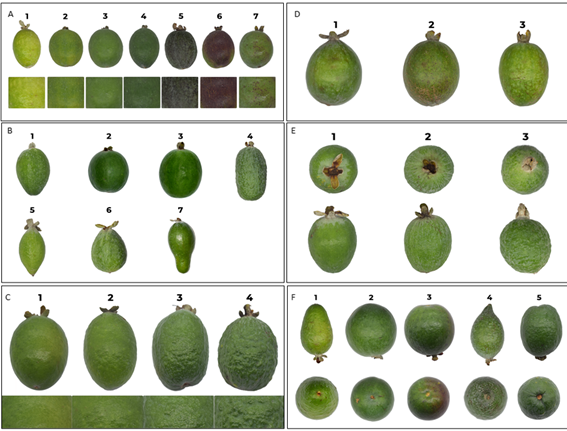
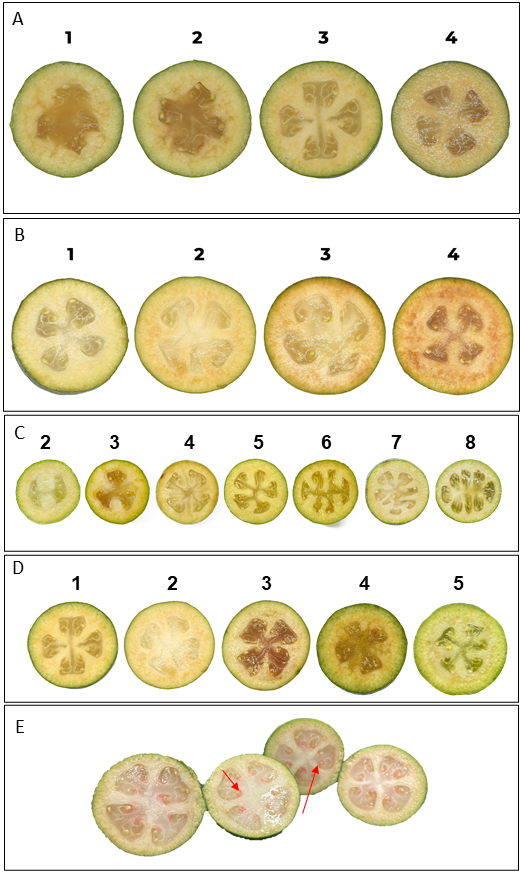
This study focused on the characterization of the phenotypic variability of a feijoa collection placed at the introduction and evaluation garden at INIA LB, by applying previously reported fruit descriptors for this species. A total of 12 qualitative (Table 1) and 12 quantitative variables (Table 2) related to fruit quality and production were considered. Qualitative characterization was applied to 329 genotypes. To assist in the assignment of expression states for each qualitative trait recorded in this study, an illustrated guide was created featuring representative images for each variable (Figure 1 and Figure 2). In addition, for further clarification, a glossary with relevant definitions is provided (Supplementary Material). For the fruit color variable, a total of seven states were identified, including four shades of green (Figure 1 A, 1-4). Three of these (Figure 1 A, 2-4) could be similar to those previously reported by Puppo and others9 and UPOV8, while one (yellowish green; Figure 1 A, 1) had not been previously described. Three additional states were identified, including blackish green skin color (Figure 1 A, 5), reddish overcoloration (Figure 1 A, 6), and red dots on a green background (Figure 1 A, 7). Overcoloration refers to an area of the fruit, generally more exposed to the sun, that develops a reddish or darkened hue, either continuous (reddish overcolor, Figure 1 A, 6), or discontinuous, generating small red dots (overcolor with red dots, Figure 1 A, 7).
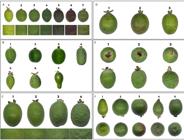
All the fruit shape variants described by UPOV8 as: oboval, circular, elliptical, oblong, rhombic, oval, and oblanceolate were identified in the collection; however, terminology was adjusted to refer to the three-dimensional shape of the fruit: obovoid, spherical, ellipsoid, oblong, fusiform, ovoid, and pyriform. The pyriform type described by the Brazilian Ministry of Agriculture (MAPA) was also reported14 (Figure 1 B). The rhombic shape described by UPOV8 has a very subtle difference with the lanceolate shape described by the MAPA in Brazil14 in the angles formed in the middle of the fruit. Since this difference is not really evident, both shapes were unified under the term fusiform, considering that they coincide in the length:diameter ratio, shape of the apex and the acute base, and that the middle part is wider and gradually narrows towards both ends. It is important to note that 86% of the genotypes presented two or more different fruit forms within the same tree. Patterson15 suggested that the frequent heterogeneity in fruit size and shape observed in Feijoa sellowiana plants could be explained by pollination mode and pollen origin, as this affects seed development, which, in turn, determines the fruit's development pattern, which ultimately defines its shape and final size.
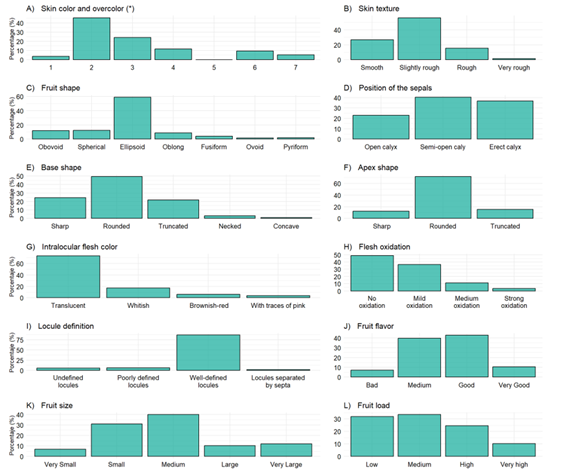
For the traits: skin texture (Figure 1 C), apex shape (Figure 1 D), sepal position (Figure 1 E) and base shape (Figure 1 F), all the states previously reported by Puppo and others9 for wild populations of feijoa in Uruguay were found. Consequently, for these fruit-related traits, the feijoa collection at INIA LB provided a good representation of the extent of the natural variability of wild feijoa from Uruguay (Figure 3). Some differences were observed in the distribution of state frequencies for the six characters. The most frequent states were: light green color (Figure 3 A), slightly rough skin (Figure 3 B), ellipsoid fruit shape (Figure 3 C), semi-open sepals (Figure 3 D), and rounded apex and base (Figure 3 E and F).
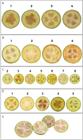
Locule definition, one of the internal quality attributes of feijoa fruits (see glossary for further description, in Supplementary Material), showed four states (Figure 2 A). The most frequent observation was well-defined locules (Figure 3 I); however, some genotypes presented fruits with undefined locules. Undefined locules in feijoa fruit, with an overripe appearance, has been negatively rated by fresh fruit consumers during periodic fruit exhibitions carried out by the Fruit Research Unit at INIA LB. Apart from that, the fruits with locules separated by septa were unfrequent (Figure 3 I).
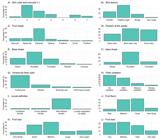
Relative frequencies of 12 fruit traits measured in 329 genotypes of Feijoa sellowiana present in the introduction and evaluation garden at INIA Las Brujas, Uruguay
A minimal browning of fruit flesh, caused by enzymatic oxidation, shortly after feijoa cutting, is another relevant trait for the acceptance of feijoa by both consumers and fruit marketers. All four states of flesh oxidation were recorded (Figure 2 B); however, for a large number of genotypes (85%), only null or very slight oxidation were detected in the one-minute assays (Figure 3 H). Conversely, Puppo Mackinnon16 reported noticeable flesh browning in 71% of prospected wild feijoa genotypes, in Uruguay. These markedly contrasting results may indicate that acceptable as well as very favorable levels of reduced flesh oxidation were well represented among feijoa genotypes of the INIA LB collection, resulting in a relevant starting point for further improvement of this trait. However, it is also possible that this difference might result from different ecological conditions that affect plant growth, which vary between native forests and orchard plots. Moreover, it is important to consider that in this study evaluation was conducted in the field immediately after harvest, while flesh oxidation is highly influenced by postharvest time and conditions. For some fruit species, including Feijoa sellowiana, oxidation or browning of the flesh has been associated with polyphenol oxidase (PPO) activity, which decreases with higher citric acid levels17. Commercial cultivars such as 'Gemini' and 'Marian' have low levels of PPO activity and are associated with mild browning, while 'Apollo', with higher PPO activity, shows more intense browning17. This study allows for the selection of genotypes with low browning as an important characteristic to maintain and incorporate into future cultivars. In addition, it would be interesting to identify the factors responsible for the rapid flesh oxidation observed in some genotypes. García-Rivera and others18 reported that high carbohydrate and calcium contents in fruits would be the possible cause of this browning.
The color of the intralocular flesh referred to the internal color of the locules (translucent, whitish and greenish) (Figure 2 D)9)(14) , and two were described here for the first time: reddish-brown and brown. The most frequently identified state was translucent, present in more than 70% of the genotypes (Figure 3 G). Notably, 12 of the 329 genotypes exhibited pink traces within the intralocular flesh, indicating a novel characteristic for feijoa fruit (Figure 2 E). These genotypes were prospected from a single subspontaneous population, in Maldonado, Uruguay19. Despite the need of a detailed anatomical description, this novel characteristic could confer feijoa fruit with a distinctive appeal.
Genotypes ranged from low to very high fruit load (Figure 3 L), with the latter category representing a minority (10%) of the genotypes and generally related to very small fruit sizes. To select for a superior genotype, fruit load and size should be considered simultaneously, first selecting the genotypes with good fruit size potential and with medium to high fruit load. Previous reports indicated that the cultivar 'INIA-Fagro Cerrillana' is the one with the highest potential for fruit load per tree, reaching up to 40 kg per year in adult plants; however, such high yields usually affect fruit size. Some recent experiences by the fruit growing research group of INIA LB showed that severe pruning in 'INIA-Fagro Cerrillana' managed to reduce the number of fruits per plant, improving fruit size without compromising productivity (unpublished data).
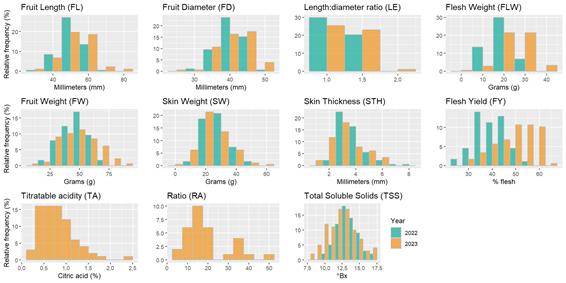
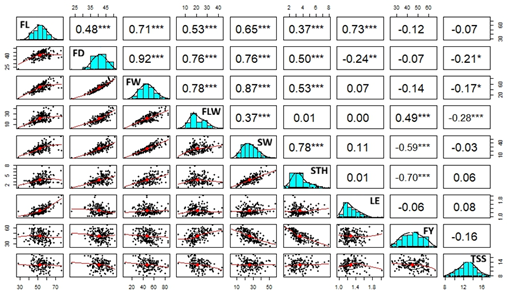
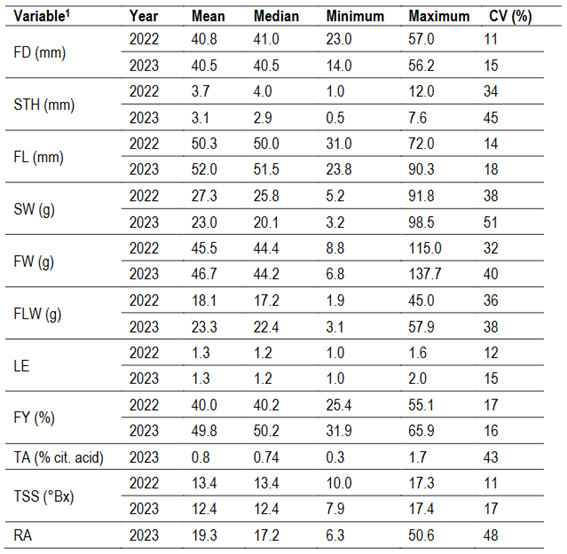
For 98 of the 329 feijoa genotypes, fruit samples were further evaluated for 12 quantitative, fruit-related variables. The number of locules (Figure 2 C) ranged between two and eight, with four locules being the most frequent (80%). Patterson15 reported a range between two to six locules when studying five New Zealand feijoa cultivars, with four locules as the most frequent state, with occurrence varying between 53 and 70% of the sampled fruits depending on the cultivar. The results related to the remaining 11 variables are presented in Table 3 (central and descriptive tendency values) and Figure 4 (relative frequency histograms). Traits with high variation coefficients (CV over 30%) included FW, FLW, STH, SW, TA, and RA, for which the highest CV values were associated with STH, SW, FW and TA. The remaining five traits: FD, FL, LE, TSS, and FY showed CVs below 18%. These results are consistent with previous reports for feijoa trees9, and other fruit species20)(21) . Such broad CV ranges could be explained in part by true variability between genotypes, but also by estimable intra-plant fruit heterogeneity, that is consistent with genotypes at early stages of domestication22.
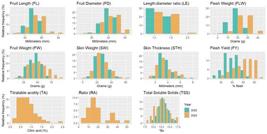
Frequency distribution histograms of 11 fruit quality traits of 98 genotypes of Feijoa sellowiana present in the introduction and evaluation garden of INIA Las Brujas, Uruguay, in 2022 and 2023
The FW ranged from 9 g to 115 g in 2022, and from 7 g to 138 g in 2023, with a mean and median of 45 g. This wide range in terms of fruit weight has been also reported in feijoa populations conserved by indigenous communities as well as placed at protected areas in southern Brazil, where fruits weighed 6 g to 126 g with a mean of 32 g23. However, for those feijoa genotypes that have undergone a more targeted selection process, an average fruit weight of 73 g with a range of 52 g to 105 g was reported24. Sánchez-Mora and others25 reported that in the Active Germplasm Bank (BAG) of São Joaquim (Santa Catarina, Brazil), over 80% of the feijoa genotypes presented fruits of more than 60 g, while in genotypes grown in Mexico, fruit weight varied from 30 g to 50 g26. This illustrates that feijoa breeding programs have successfully increased fruit size. In the introduction and evaluation garden of INIA LB, 23% of the genotypes have large and very large fruits (over 50 g per fruit) (Figure 3 K) providing the breeding program with promising materials. Fruit size is also easily affected by climatic conditions, such as rainfall, temperature, altitude, and solar radiation27, as reflected in variations between years25. However, within the same year, the same plant often produces heterogeneous fruit sizes, likely due to the timing of fruit set stage. Fruits that form earlier tend to accumulate more sugars and grow more than those that develop later28. The improvement on fruit size homogeneity could be carried out at later stages of the breeding program, by the application of management practices adjusted to each cultivar or by further advanced selection.
For FLW, the average values were 18 g (2022) and 23 g (2023) with maximum values between 45 and 58 g, approximately. Mean FD values (41 mm; range 14-57 mm) were similar to those reported in Brazilian communities (mean 35 mm; range 19-60 mm)23; however, the range was more limited in genotypes grown in Mexico (31-39 mm)26. A similar pattern was observed for FL: in this study, fruits averaged 51 mm, range 23-90 mm; in Brazil, 42 mm, range 24-74 mm23; and in Mexico, it varied between 51 and 55 mm26. The LE ratio, associated with and shape, was similar in both years, but with a wider range in 2023. The observed range of LE (1 to 2) represents the range of fruit shapes, from spherical (LE ≤ 1.1) to more elongated shapes (LE> 1.1). The obovoid, ellipsoid, oblong, and ovoid fruits present LE between 1.2 and 1.6, and the fusiform or elongated ellipsoid shape corresponded to LE over 1.5. The main characteristic of the pyriform fruit shape is its narrow base, forming a “neck” which often also results in LE ratios over 1.5. The most frequent value (LE = 1.2) represents fruits with lengths 20% greater than their diameter, consistent with the high representation of ellipsoid fruits described in Figure 3 C.
Flesh yield ranged from 32 to 66% with an average of 50% in 2023, and 40% in 2022 (Table 3). In Brazil, much lower flesh yield was recorded in feijoa plants from both indigenous communities and protected areas (mean 32%; range 17-50%)23, as well as in the São Joaquim BAG (mean 28%; range 10-45%)25. Flesh yield is a relevant trait for both fresh and processed fruit markets, as consumers prefer a higher percentage of flesh in the fruit, while it also directly affects industrial profitability. The FY variable (FLW/FW) is directly influenced by FW, FLW, and SW. In 2022, SW ranged from 5 g to 92 g, and in 2023, from 3 g to 99 g. Regarding the STH, the mean values varied between 3 and 4 mm, with ranges from 0.5 mm to 12 mm, depending on the year and genotype. Both SW and STH displayed a wide variability, in which the genotypes with the lowest values are particularly relevant for improving fresh fruit quality in Uruguay, and are also consistent with the typical feijoa fruit of Uruguay29.
The TSS averaged 13 °Bx (10 to 17) in 2022 and 12 °Bx (8 to 17) in 2023. In Mexico, TSS ranged from 12 to 14 °Bx26 and in Brazil from 7 to 17 °Bx23)(25) . In varieties from different breeding programs, the TSS of the fruits had an average of 12 °Bx, varying between 10 and 13 °Bx24. For the TA variable, data were available only for 2023, with values ranging from 0.3% to 1.7% (mean 0.8%). Both TA and RA presented high coefficient variation (45%). These variables are closely related to fruit flavor and palatability, therefore to consumer acceptability, which is particularly important for breeding programs of poorly-known fruits such as feijoa, where flavor can determine repeated consumption30. According to the authors’ flavor criteria, the vast majority of the genotypes evaluated in this research showed acceptable to good flavor (82%), while the extremes of unpleasant and very good flavor were found in 7% and 11%, respectively (Figure 3 L). Given its subjective nature, the main purpose of flavor evaluation in this study was to discard genotypes with unpleasant flavor, generally associated with an imbalance between sugar and acidity, excessive levels of astringency, or bitterness. There is a high probability that fruit classified as unpleasant will not be accepted, at least by most fresh fruit consumers. On the other hand, some of the evaluated genotypes stood out for presenting fruits with very good flavor, making them good potential cultivars or progenitors of new hybridizations. Future studies focusing on a smaller number of genotypes should include sensory assessment panels, to implement hedonic, discriminative or descriptive tests, depending on research objectives31. It would be important to determine the range of the relationship between sugar and acidity (measured as the relationship between TSS and TA) that is most accepted among feijoa consumers, in order to have a more objective indicator when selecting genotypes in genetic improvement.
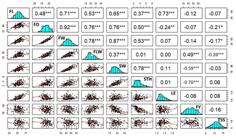
The analysis of phenotypic correlations between fruit-related quantitative traits described the patterns of association between variables, allowing for the determination of how quality traits relate to fruit size and shape. This information is relevant for designing efficient selection strategies in the breeding programs, including indirect selection of traits that are difficult to measure.
The variables related to fruit, flesh and skin dimensions: FL, FD, FW, FLW, SW, and STH showed high, positive and significant correlations with each other, except for STH and FLW, which were not correlated. This result is important since it suggests possible genetic independence between FLW and STH, facilitating simultaneous breeding by higher flesh weight and thinner skin. It is interesting to note that FW and FLW were more related to FDPC than to FL. FY, a key trait for breeding, was negatively correlated with fruit size traits, except for FLW, with which it had a positive correlation (0.32). It is noteworthy that the negative correlation between FY was much higher with STH (-0.76) than with SW (-0.57), indicating that thin-skin selection would be an effective strategy to increase FY. TSS showed zero or low negative correlation with the other variables, indicating that its variation is independent of the rest. The LE variable, an indicator of fruit shape, presented zero or low negative correlation levels with the FW, FLW, SW, STH and FY. These results seemed to suggest a weak tendency toward greater skin development (SW, STH) and lower FY, as the fruit shape becomes more elongated (greater LE) (Figure 5).
The large phenotypic variability observed in the feijoa collection from the introduction and evaluation garden of native fruit trees at INIA LB adequately reflected the extent of natural phenotypic and genotypic variability reported for wild feijoa populations in Uruguay29. On the other hand, a high degree of genetic relatedness has been reported for feijoa cultivars developed in different breeding programs from the United States, New Zealand and Italy, indicating that they likely derived from a reduced number of genotypes32.
Based on the recent history of feijoa as a crop, as well as the extensive phenotypic variability reported9)(16)25, this species might be still at an early stage of domestication. Accordingly, it does not yet present the expected traits associated with the “domestication syndrome”, such as an increased fruit size, intra-plant fruit homogeneity, and greater fruit retention on the tree after reaching maturity22)(33) . Intra-plant heterogeneity in fruit shape, size and internal quality is a typical feature of both feijoa cultivars and wild plants15. This lack of uniformity poses a challenge for genetic improvement, which aims to identify and select genotypes that, in addition to desirable fruit quality characteristics, exhibited homogeneous and stable performance over the years.
In this context, it is essential to have clear, precise, and standardized fruit descriptors for feijoa, such as those proposed in this study. These descriptors facilitate the objective characterization and recording of differences and similarities among genotypes, as well as the communications between researchers, technicians, nurserymen, and breeders. In addition, descriptors support the comparability between studies, optimizes the selection of superior genotypes, and strengthens the documentation and registration processes in breeding programs.
Based on the variability data collected in this study, 70 feijoa genotypes that represented all states of all analyzed parameters and grouped a significant portion of the variability were selected. These genotypes will be utilized to establish the first feijoa germplasm bank (BAG) in Uruguay, enabling ex situ conservation of the species’ variability. This BAG will ensure safe preservation, organization, and access to genetic material for research, breeding, and conservation programs of the species.
4. Conclusions
This study provided an illustrated guide of descriptors related to external and internal qualitative traits for feijoa fruits, which included additional states of expression for the characteristics fruit color, over color, and intralocular flesh color.
The feijoa collection at INIA Las Brujas exhibited wide variability in fruit-related traits. Several feijoa genotypes exhibiting outstanding qualities can serve as candidates for new cultivars or can be utilized in the breeding program.
Representative feijoa genotypes covering the full range of variability of fruit-related traits were identified to establish the first feijoa germplasm bank (BAG) in Uruguay. The feijoa BAG will contribute with the ex situ conservation and utilization of genetic variability of economically interesting traits of feijoa, marking a milestone in the feijoa breeding program in Uruguay.
Acknowledgements:
The authors thank the National Agency for Research and Innovation (ANII) for funding the first author's postgraduate scholarship.
We also acknowledge the National Institute of Agricultural Research (INIA) for the resources provided in the use of materials and infrastructure; the entire fruit growing team of INIA Las Brujas, especially Carlos Bonilla and Richard Franco, for their support with fieldwork, and Irvin Rodríguez, for his contribution to the photographic works.
References:
-
1. Lucas EJ, Holst B, Sobral M, Mazine FF, Nic Lughadha EM, Proença CEB, da Costa IR, Vasconcelos TNC. A new subtribal classification of Tribe Myrteae (Myrtaceae). Syst Bot. 2019;44(3):560-9. Doi: 10.1600/036364419X15620113920608.
» https://doi.org/10.1600/036364419X15620113920608 - 2. Brussa C, Grela I. Flora Arbórea del Uruguay: con énfasis en las especies de Rivera y Tacuarembó. Rivera: CONFUSA; 2007. 544p.
- 3. Vignale B, Cabrera D, Rodríguez P, Machado G. Selección de frutales nativos en Uruguay. Hortic Argent. 2016;35:19-29.
-
4. Observatorio Granjero. Anuario estadístico UAM (Internet). Montevideo: MGAP; 2022 (cited 2025 Aug 14). Available from: Available from: https://uam.com.uy/wp-content/uploads/2020/10/Anuario_UAM-_2022.pdf
» https://uam.com.uy/wp-content/uploads/2020/10/Anuario_UAM-_2022.pdf -
5. Observatorio Granjero. Anuario estadístico UAM (Internet). Montevideo: MGAP ; 2024 (cited 2025 Aug 14). Available from: Available from: https://uam.com.uy/wp-content/uploads/2025/02/Anuario-UAM-2024-Observatorio-Granjero.pdf
» https://uam.com.uy/wp-content/uploads/2025/02/Anuario-UAM-2024-Observatorio-Granjero.pdf - 6. Cabrera D, Vignale B, Rodríguez P, Luizzi D, Dini M. INIA FAGRO ARMONÍA: nuevo cultivar de guayabo del país para Uruguay. Rev INIA. 2023;(75):71-6.
- 7. Cabrera D, Vignale B, Machado G, Rodríguez P, Zoppolo R, Nebel JP. Primeras selecciones registradas de guayabo del país en Uruguay. Rev INIA . 2018;52:29-32.
-
8. UPOV. Feijoa: Acca sellowiana (Berg) Burret (Internet). Ginebra: UPOV; 2015 (cited 2025 Aug 14). 31p. Available from: Available from: https://www.upov.int/edocs/mdocs/upov/es/tc_51/tg_acca_proj_5.pdf
» https://www.upov.int/edocs/mdocs/upov/es/tc_51/tg_acca_proj_5.pdf - 9. Puppo M, Rivas M, Franco J, Barbieri RL. Proposal of descriptors for Acca sellowiana (Berg.) Burret. Rev Bras Frutic. 2014;36(4):957-70.
-
10. Instituto Nacional de Investigación Agropecuaria. Banco de Datos Agroclimáticos (Internet). Montevideo: INIA; (cited 2025 Aug 14). Available from: https://www.inia.uy/gras/Clima/Banco-datos-agroclimatico
» https://www.inia.uy/gras/Clima/Banco-datos-agroclimatico -
11. Ministerio de Ganadería, Agricultura y Pesca, DGSA (UY). Norma para la producción integrada de manzano: actualización 2020 (Internet). Montevideo: MGAP ; 2021 (cited 2025 Aug 14). 40p. Available from: Available from: https://www.gub.uy/ministerio-ganaderia-agricultura-pesca/comunicacion/publicaciones/norma-para-produccion-integrada-manzano-actualizacion-2020
» https://www.gub.uy/ministerio-ganaderia-agricultura-pesca/comunicacion/publicaciones/norma-para-produccion-integrada-manzano-actualizacion-2020 - 12. Höfer M, Giovannini D. Phenotypic characterization and evaluation of European cherry collections: a survey to determine the most commonly used descriptors. Scientific Pages Hortic. 2017;1(1):7-12.
- 13. Mendes EM, Alves de Gois V, de Lima RH, Aroucha MC, Sobreira M. Acidez em frutas e hortaliças. Rev Verde Agroecologia Desenvolv Sustent. 2010;5(2):1-4.
-
14. Ministério da Agricultura e Pecuária e Abastecimento, Serviço Nacional de Proteção de Cultivares (BR). Instruções para execução dos ensaios de distinguibilidade, homogeneidade e estabilidade de cultivares de goiabeira serrana (Acca sellowiana) (Internet). Brasília: MAPA; 2017 (cited 2025 Aug 14). 9p. Available from: Available from: https://www.gov.br/agricultura/pt-br/assuntos/insumos-agropecuarios/insumos-agricolas/protecao-de-cultivar/arquivos-frutiferas/goiabeira-serrana-formul-c1rio-290ut2008-p.doc
» https://www.gov.br/agricultura/pt-br/assuntos/insumos-agropecuarios/insumos-agricolas/protecao-de-cultivar/arquivos-frutiferas/goiabeira-serrana-formul-c1rio-290ut2008-p.doc -
15. Patterson KJ. Effects of hand pollination on fruit set and fruit quality of the feijoa (Acca sellowiana). Acta Hortic. 1989;(240):197-200. Doi: 10.17660/ActaHortic.1989.240.36.
» https://doi.org/10.17660/ActaHortic.1989.240.36 - 16. Puppo Mackinnon M. Prospección y caracterización de poblaciones silvestres de Acca sellowiana (Berg) Burret. (Guayabo del País) (bachelor's thesis). Montevideo (UY): Universidad de la República, Facultad de Agronomía; 2008. 141p.
-
17. Wang S, Lin T, Man G, Li H, Zhao L, Wu J, Liao X. Effects of anti-browning combinations of ascorbic acid, citric acid, nitrogen and carbon dioxide on the quality of banana smoothies. Food Bioprocess Technol. 2013;7(1):161-73. Doi: 10.1007/s11947-013-1107-7.
» https://doi.org/10.1007/s11947-013-1107-7 -
18. García-Rivera LM, Váquiro-Herrera HA, Solanilla-Duque JF. Caracterización fisicoquímica y análisis de la composición nutricional de la feijoa en tres diferentes estadios de madurez. Agron Colomb. 2016;34(2):217-27. Doi: 10.15446/agron.colomb.v34n2.56030.
» https://doi.org/10.15446/agron.colomb.v34n2.56030 - 19. Cruz C, Escanda F, Machado J, Rameau C. Caracterización de una población de Guayabo del país (Acca sellowiana Berg. Burret) de pulpa rosada. In: 6º Encuentro Nacional sobre Frutos Nativos. Canelones: INIA; 2012. p. 45-7.
- 20. Gaona-García A, Alia-Tejacal I, López-Martínez V, Andrade-Rodríguez M, Colinas-León MT, Villegas-Torres O. Characterization of sapote mamey fruits (Pouteria sapota), in the southwest region of morelos. Rev Chapingo Ser Hortic. 2008;14(1):41-7.
- 21. Medina EL, Zavaleta AL, Rivero AEG, León JM, de la Cruz Castillo AJ, Zapata LV. Fruit and seed morphometry of “ají mochero” capsicum chinense Jacq. Cienc Tecnol Agropecuaria Méx. 2020;21(3):1-11.
-
22. Parker IM, López I, Petersen JJ, Anaya N, Cubilla-Rios L, Potter D. Domestication syndrome in Caimito (Chrysophyllum cainito L.): fruit and seed characteristics. Econ Bot. 2010;64(2):161-75. Doi: 10.1007/s12231-010-9121-4.
» https://doi.org/10.1007/s12231-010-9121-4 -
23. Borsuk LJ, Saifert L, Otalora Vollamil JM, Sánchez Moura FD, Nodari RO. Phenotypic variability in feijoa fruits (Acca sellowiana (O. Berg.) Burret) on indigenous lands, quilombolas communities and protected areas in the south of Brazil. Rev Bras Frutic . 2017;39(1). Doi: 10.1590/0100-29452017699.
» https://doi.org/10.1590/0100-29452017699 - 24. Pasquariello MS, Mastrobuoni F, Di Patre D, Zampella L, Capuano LR, Scortichini M, Petriccione M. Agronomic, nutraceutical and molecular variability of feijoa (Acca sellowiana (O. Berg) Burret) germplasm. Sci Hortic. 2015;191:1-9.
-
25. Sánchez-Mora FD, Saifert L, Ciotta MN, Ribeiro HN, Petry VS, Rojas-Molina AM, Lopes ME, Lombardi GG, dos Santos KL, Ducroquet JPHJ, Nodari RO. Characterization of phenotypic diversity of feijoa fruits of germplasm accessions in Brazil. Agrosyst Geosci Environ. 2019;2(1):1-11. Doi: 10.2134/age2019.01.0005.
» https://doi.org/10.2134/age2019.01.0005 -
26. González-García KE, Guerra-Ramírez D, Del Ángel-Coronel OA, Cruz-Castillo JG. Atributos físicos y químicos del fruto de feijoa en Veracruz, México. Rev Chapingo Ser Hortic . 2018;24(1):5-12. Doi: 10.5154/r.rchsh.2017.01.006.
» https://doi.org/10.5154/r.rchsh.2017.01.006 - 27. Parra-Coronado A, Fischer G, Chaves-Cordoba B. Thermal time for reproductive phenological stages of Pineapple Guava (Acca sellowiana (O. Berg) Burret). Acta Biolo Colomb. 2015;20(1):153-62.
-
28. Harman JE. Feijoa fruit: growth and chemical composition during development. N Z J Exp Agr. 1987;15(2):209-15. Doi: 10.1080/03015521.1987.10425561.
» https://doi.org/10.1080/03015521.1987.10425561 -
29. Rivas M, Puppo M, Baccino E, Quezada M, Franco J, Pritsch C. Phenotypic and molecular diversity of wild populations of Acca sellowiana (Berg.) burret in the southern area of natural distribution. Horticulturae. 2024;10(4):360. Doi: 10.3390/horticulturae10040360.
» https://doi.org/10.3390/horticulturae10040360 -
30. Crisosto CH, Crisosto GM, Metheney P. Consumer acceptance of ‘Brooks’ and ‘Bing’ cherries is mainly dependent on fruit SSC and visual skin color. Postharvest Biol Technol. 2003;(28):159-67. Doi: 10.1016/S0925-5214(02)00173-4.
» https://doi.org/10.1016/S0925-5214(02)00173-4 - 31. Rodríguez SDC, Generoso SM, Gutierrez DR, Questa AG. Application of sensory analysis in the evaluation of quality fresh-cut vegetables. Simiente. 2015;85:21-38.
-
32. Bini L, Gori M, Novello MA, Biricolti S, Giordani E, Lara MV, Niella F, Nunziata A, Rocha P, Filippi JM, Natale R. Assessing the genetic diversity of wild and commercial Feijoa sellowiana accessions using AFLPs. Horticulturae. 2024;10(4):366. Doi: 10.3390/horticulturae10040366.
» https://doi.org/10.3390/horticulturae10040366 -
33. Li LF, Olsen KM. To have and to hold: selection for seed and fruit retention during crop domestication. Curr Top Dev Biol. 2016;119:63-109. Doi: 10.1016/bs.ctdb.2016.02.002.
» https://doi.org/10.1016/bs.ctdb.2016.02.002