Antioxidant and antimicrobial properties of nanoemulsions made with rosemary and thyme essential oils and their application in the preservation of meat sausages
Abstract:
In this work, nanoemulsions were developed encapsulating essential oils (EOs) for the preservation of meat products, based on rosemary (Salvia rosmarinus) and thyme (Thymus vulgaris), which possess bioactive and antimicrobial properties that make them ideal for replacing preservative agents in meat products. Two nanoemulsions with an R = 2:5 factor (oil/surfactant ratio) were developed and stored under refrigeration (4 °C), evaluating their stability, particle size, rheology and antioxidant capacity. For the preparation of the sausages, three standard formulations were used according to NTC-1325 to determine the percentages of each nanoemulsion to be added (0.47% rosemary EO and 0.08% thyme EO), substituting the percentage corresponding to nitrates and nitrites. Microbiological tests were carried out on the sausages for coliforms, Staphylococcus aureus, Listeria monocytogenes and Clostridium sulfite reductant to determine the microbial activity of the EOs incorporated in the formulation; moisture, color, texture and sensory analysis were also evaluated. The nanoemulsions remained stable during storage time, without significant changes; while microbiological analyses were below the <10 UFC/g range at 21 days of storage for the nanoemulsion sausages, moisture and texture did not show differences. In the sensory analysis, good comments were obtained with respect to the odor and flavor provided by the EOs; color was the attribute with the lowest acceptance. It was demonstrated that the use of EOs as a replacement for chemical additives in meat products helps to extend their shelf life, taking advantage of their bioactive and antimicrobial properties.
Keywords:
essential oils; nanoemulsions; antioxidant activity; antimicrobial; sausage
Resumen:
En este trabajo se desarrollaron nanoemulsiones encapsulando aceites esenciales (AE) para la conservación de productos cárnicos, a base de romero (Salvia rosmarinus) y tomillo (Thymus vulgaris), que poseen propiedades bioactivas y antimicrobianas que los hacen idóneos para sustituir los agentes conservantes en productos cárnicos. Se desarrollaron dos nanoemulsiones con un factor R = 2:5 (relación aceite/surfactante) y se almacenaron en refrigeración (4 °C), evaluando la estabilidad, tamaño de partícula, reología y capacidad antioxidante. Para la elaboración de las salchichas, se emplearon tres formulaciones estándar de acuerdo con la NTC-1325 para determinar los porcentajes de cada nanoemulsión a adicionar (0,47% AE de romero y 0,08% AE de tomillo), sustituyendo el porcentaje correspondiente a nitratos y nitritos. Se realizaron pruebas microbiológicas a las salchichas para coliformes, Staphylococcus aureus, Listeria monocytogenes y Clostridium sulfito reductor, para determinar la actividad microbiana de los AE incorporados en la formulación; también se evaluaron humedad, color, textura y se realizó un análisis sensorial. Las nanoemulsiones permanecieron estables el tiempo de almacenamiento, sin exhibir cambios significativos; mientras los análisis microbiológicos estuvieron por debajo del rango <10 UFC/g a los 21 días de almacenamiento para las salchichas con nanoemulsión, la humedad y la textura no presentaron diferencias. En el análisis sensorial, se obtuvieron buenos comentarios con respecto al olor y el sabor aportados por los AE; el color fue el atributo con menor aceptación. Se demostró que al emplear AE como reemplazantes de aditivos químicos en productos cárnicos estos ayudan a alargar su vida útil, aprovechando sus propiedades bioactivas y antimicrobianas.
Palabras clave:
aceites esenciales; nanoemulsiones; actividad antioxidante; antimicrobiana; salchicha
Resumo:
Neste trabalho foram desenvolvidas nanoemulsões, encapsulando óleos essenciais (OE) para a conservação de produtos cárneos, à base de alecrim (Salvia rosmarinus) e tomilho (Thymusvulgaris), que possuem propriedades bioactivas e antimicrobianas, tornando-os adequados para substituir conservantes em produtos cárneos. Foram desenvolvidas duas nanoemulsões com um fator R= 2:5 (relação óleo/surfactante) e armazenadas sob refrigeração (4 °C), avaliando-se a estabilidade, o tamanho das partículas, a reologia e a capacidade antioxidante. Para a preparação dos enchidos, foram utilizadas três formulações padrão segundo a norma NTC-1325 para determinar as percentagens de cada nanoemulsão a adicionar (0,47% de OE de alecrim e 0,08% de OE de tomilho), substituindo a percentagem correspondente aos nitratos e nitritos. Foram realizados testes microbiológicos nos enchidos para a pesquisa de coliformes, Staphylococcus aureus, Listeria monocytogenese Clostridium sulphite-reducing, para determinar a atividade microbiana dos OEs incorporados na formulação, umidade, cor, textura e foi também realizada uma análise sensorial. As nanoemulsões mantiveram-se estáveis ao longo do tempo de armazenamento, não apresentando alterações significativas; enquanto as análises microbiológicas se situaram abaixo do intervalo <10 UFC/g aos 21 dias de armazenamento para as salsichas em nanoemulsão, a umidade e a textura não apresentaram diferenças. Na análise sensorial, obtiveram-se bons comentários relativamente ao odor e sabor proporcionados pelos OEs, sendo a cor o atributo menos aceitável. Foi demonstrado que a utilização de OE como substituto de aditivos químicos em produtos à base de carne ajuda a prolongar o seu prazo de validade, tirando partido das suas propriedades bioactivas e antimicrobianas.
Palavras-chave:
óleos essenciais; nanoemulsões; atividade antioxidante; antimicrobiana; salsicha
1. Introduction
The use of artificial additives is essential for preserving the quality and shelf life of meat products. Nitrates, nitrites, sulfites, and polyphosphates are among the most commonly used additives, which enhance organoleptic characteristics and prevent the rapid deterioration of processed meat products. However, regular intake of these substances may lead to adverse health effects, prompting a growing interest in consuming healthier and more natural foods. Therefore, there is a search for natural alternatives without adverse health effects for consumers, employing essential oils from rosemary and thyme by incorporating them into the product formulation as nanoemulsions, aiming to replace the nitrites and nitrates typically used for the preservation of meat derivatives. Essential oils possess antioxidant and antimicrobial properties which help extend the shelf life of products, particularly in the food sector1)(2) .
In meat products and derivatives, the main factors of deterioration are microbial growth, color changes, and rancidity due to oxidation. These deterioration principles can be reduced or prevented with the implementation of chemical additives that, although effective, can be counterproductive to health in the long term or when consumed in excess. Sausages are one of the processed meat products that fall into the category of cooked and cured products made from meat, with the addition of permitted substances and preservatives, which, as mentioned, can be harmful to consumer health. In sausage formulation3, these substances comprise a significant percentage that not only ensures product preservation but also contributes to organoleptic characteristics such as color, flavor, aroma, and texture that enhance product quality.
Sausages, being one of the most consumed meat derivatives in family diets, are of great interest for replacing chemical preservatives with more natural alternatives, mainly focusing on essential oils extracted from plants, which are a viable option due to their antioxidant and antimicrobial properties that provide similar preservative action. However, the use of essential oils has limitations such as high volatility, low stability, and low solubility in water, which diminish their potential effects4; in light of this, efforts have been made to find healthier alternatives to substitute chemical preservatives in these products. Among these alternatives, essential oils have stood out not only for their antioxidant and antimicrobial properties but also because their incorporation into nanoemulsions significantly increases the availability of bioactive compounds, enhancing nutritional quality and contributing to the product's aroma and flavor.
Essential oils are found in products such as oils, vinegars, pickles, and sausages. In confectionery, they are used to flavor and aroma products like candies and chocolates. They are also used in the preparation of alcoholic and non-alcoholic beverages, soft drinks, and ice creams. Another application is as natural additives: flavorings, colorings, antioxidants, or preservatives5. The function of the oils is linked to the preparation of a nanoemulsion, which consists of a dispersion of two immiscible liquids (usually oil and water), where one of the liquids is dispersed in the form of small spherical droplets (<200 nm) in the other6. Among the main advantages of using nanoemulsions in the development of new food products, compared to conventional emulsions, is that the droplet size is so small that they have virtually no light backscattering, so they tend to be transparent, which has less impact on the optical properties of the food7; high physical stability against particle aggregation and gravitational separation, increasing the stability of the nanoemulsion during storage8; and the potential to significantly enhance the bioavailability of lipid-based bioactive compounds9.
In line with the above, this study aims to evaluate the bioactive and antimicrobial properties of nanoemulsions based on essential oils of rosemary (Salvia rosmarinus) and thyme (Thymus vulgaris) in the preservation of sausages against microorganisms such as Escherichia coli, Listeria monocytogenes, Staphylococcus aureus and Clostridium sulfite reductant.
2. Materials and Methods
2.1 Preparation of Nanoemulsions
The mass of the surfactant was determined considering the concentrations of essential oil used, which was 10%w /w, and according to tests carried out the best ratio of oil/surfactant was 2.5, achieving an emulsion with greater stability and with the capacity to encapsulate the active compound. These results are consistent with previous studies that employed a similar mass of surfactant10.
Two nanoemulsions were designed and developed from each of the essential oils with an R factor = 2:5 (oil/surfactant ratio). The oils were purchased from a company specializing in this type of product. For this purpose, 5 g of the extracted essential oil and 12.5 g of the surfactant Tween 80 were weighed. The dispersion was then agitated for 1 hour at 50 °C. After this process, 32.5 g of distilled water was slowly dripped with constant stirring. After the dripping was finished, the mixture was stirred for 1 h at 50 °C until the nanoemulsions were obtained and stored under refrigeration (4 ± 2 °C)11.
The selected concentration of 10%w /w was chosen according to previous storage trials of meat products (data not shown), where the best inhibition results were presented at the selected concentration; at lower concentrations the product exhibited no improvement. Furthermore, in previous studies it was shown that the essential oils used obtained better results at concentrations higher than 10%w /w12.
2.2 Characterization of Nanoemulsions
The selected techniques are used to characterize dispersed systems. Particle size determination (PSD) allows knowing the distribution of particles in nanoemulsions, differentiating whether they are emulsions, nanoemulsions or microemulsions. In addition, by periodically evaluating the variation of the PSD, it is possible to determine how stable the nanoemulsions are and to understand the destabilization mechanisms they present, such as flocculation and coalescence.
It is essential to know the viscosity and the type of flow regime in nanoemulsions, since variations in these parameters may indicate the onset of destabilization processes. This information also allows the selection of the appropriate pumping and conveying equipment or mechanisms in piloting or in industrial scale-up stages.
The stability of the system can be evaluated by relating the two techniques mentioned above, and constitutes an essential parameter in dispersed systems, considering that nanoemulsions are thermodynamically unstable, which can be complemented by visual observation13.
2.2.1 Flow Behavior of Nanoemulsions
The flow behavior analysis was conducted to determine the rheological behavior (fluid type and viscosity) of the nanoemulsions under storage conditions (4 ± 2 °C). A rheometer AR-G2 (TA Instruments, Waters LLC; Newcastle, DE, USA) with a cone-plate geometry of 40 mm diameter and a 2° angle was used for the determination; gap = 1000 μm, at a constant temperature of 25 ± 1 °C, controlled using a thermostatic bath (Julabo ACW100, Julabo Labortechnik; Seelbach, Germany) adapted to the rheometer. The analyses were conducted on the initial nanoemulsions and over three weeks after their preparation, subjecting them to an increasing shear rate from 0.01 to 200 s⁻¹. The tests were performed in triplicate, and prior to the tests, the nanoemulsions were allowed to rest for 2 min to achieve thermal equilibrium. Finally, the flow curves were fitted to the Power Law rheological model14.
2.2.2 Steady-State Stability
Ten milliliters of each nanoemulsion were placed in graduated test tubes and, after 24 h, a visual observation was made. This was done weekly for one month after preparation to evaluate whether the emulsions showed apparent physical changes, such as phase separation or changes in turbidity that would indicate destabilization processes.
2.2.3 Particle Size Distribution
The particle size analysis of the thyme and rosemary nanoemulsions was conducted at 25 ± 1 °C, utilizing complementary dynamic light scattering (DLS) measurements. To measure the particle size distribution of the nanoemulsions using DLS (photon correlation spectroscopy), a Malvern Mastersizer ZSP ZEN 5600 analyzer (Malvern Panalytical Ltd; Worcestershire, UK) was employed, where aliquots of each nanoemulsion were poured into a cell (model DTS0012) using a 175° detection optic. The particle size was expressed as De Brouckere, the volume-weighted mean diameter14.
2.3 Determination of Antioxidant Capacity of the Emulsions (Total Phenols, DPPH, and ABTS)
Total phenol (TP) content was determined according to the methodology described by Zorić and others15 (mg Gallic acid/mL). The DPPH free radical scavenging activity (mg of trolox/mL) and ABTS (mg of trolox/mL) were determined according to the extraction methodology proposed by Sridhar and Linton-Charles16, and quantification according to Casagrande and others17.
2.4 Formulation and Production of Meat Products (Sausages) with and without Nanoemulsion
For the preparation of the sausages, a standard formulation was employed in accordance with the Colombian Technical Standard (NTC 1325)3, and it was necessary to conduct three different trials to determine the percentages to be added of each nanoemulsion (based on a calculation base of 400 g); these corresponded to 0.44% of the rosemary nanoemulsion and 0.11% of the thyme nanoemulsion, replacing the corresponding percentage of nitrates and nitrites (Table 1).
In each of the three trials, to obtain an appropriate product formulation, the process began with the preparation of the meat for subsequent weighing and grinding (using a 4 mm disk). Next, the meat emulsion was made at a controlled temperature below 15 °C with the addition of the meat and each of the dry ingredients, liquid smoke, and ice (previously weighed). The corresponding amount of each nanoemulsion was added gradually, and once the meat emulsion was obtained, it was stuffed into specific casings for sausages and scalded until an internal temperature of 72 °C was reached. Finally, the sausages were cooled in ice water before being labeled and stored.
The protein, moisture and fat contents of the sausages were determined using the methods given by AOAC International18, where the moisture content (method 925.10) was determined by gravimetric method in an oven at 105 °C, until a constant weight was reached. The fat (method 920.39) was determined by solid-liquid extraction (Soxhlet method) and the protein (method 920.15) was determined by quantifying the total nitrogen content in the sample (Kjeldahl), with a factor of 6.25; while the content of salt, nitrates, non-meat protein, phosphates, ascorbates and starch were calculated by performing a material balance based on the information supplied in the technical data sheet by the supplier of the different inputs used (proximal composition) and the quantities used according to the calculation base of 400 g that were prepared from each formulation.
2.5 Measurement of Moisture Percentage, Water Activity (aw), Color, and Texture in Sausages
Humidity percentage Official method AOAC18; water activity (aw): determined with a spray point hygrometer at 25 °C (Aqualab series 3TE, Decagon, Devices, Pullman, WA, USD)19. Color was determined through the CIE-L*a*b* coordinates, using Hunter lab colorimeter spectrum (ColorQuest XE, USA) with D65 illuminant and 10° observer as reference in CIEL*a*b* space19. For the measurement of the texture profile (TPA), a texturometer (Stable Micro Systems TA.XT plus C, Godalming Surrey, UK) was used to perform a deformation compression on the sausages, simulating the conditions when they are subjected to the normal chewing process of a person20. For the determination, samples were taken from sausages cut into 3 cm long cylinders.
For each test, 3 repetitions were performed in the sausage formulation.
2.6 Microbiological Testing
Microbiological tests were conducted for Coliforms, Staphylococcus aureus, Listeria monocytogenes and Clostridium sulfite reductant, following the parameters established by NTC 13253 to determine microbial activity for both the meat emulsion and sausages with the incorporated nanoemulsions after 21 days of refrigeration.
2.7 Sensory Analysis and Product Acceptability
The sensory analysis aimed to evaluate the level of liking and acceptability of the sausage samples with the addition of rosemary and thyme nanoemulsions stored at refrigeration temperatures of 4 ± 2 °C. Characteristics such as odor, color, flavor, and texture were assessed using a 5-point hedonic scale, with the following descriptions: I dislike it very much = 1, I slightly dislike it = 2, I neither like nor dislike it = 3, I slightly like it = 4, and I like it very much = 5. This evaluation was conducted with 9 untrained panelists over an estimated period of 21 days, at two sampling times (day 0 and day 21).
Additionally, during the same 21 days, 9 sampling times every 3 days were conducted to assess the product's consumption suitability, where panelists were asked whether they would consume the refrigerated sausages based on their sensory attributes, in order to estimate the shelf life using survival statistical methodology21.
3. Results
3.1 Characterization of Nanoemulsions
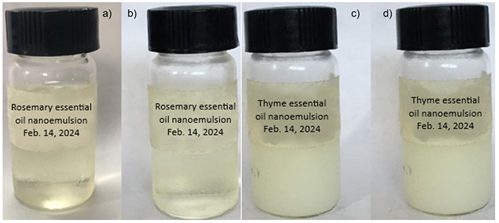
The two nanoemulsions were developed from each of the essential oils of rosemary (Salvia rosmarinus) and thyme (Thymus vulgaris) (Figure 1), with a concentration of essential oil in each nanoemulsion of 10 g/100 g. The obtained nanoemulsions were stored in refrigeration (4 ± 2 °C) for further characterization; it was confirmed that the nanoemulsions remained stable during the established storage period, without exhibiting significant changes in particle size, rheological properties, aggregation states, and antioxidant capacity.
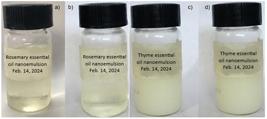
Developed Nanoemulsions a) and c) correspond to the rosemary and thyme nanoemulsions 24 hours after preparation, respectively; b) and d) represent the same emulsions on day 21 of storage
3.2 Flow Behavior of Nanoemulsions
The rheological data obtained from both nanoemulsions were fitted to the power law rheological model with a fit for thyme and rosemary of R² = 0.9981; 0.9998, respectively. The model indices indicated that the systems exhibited Newtonian behavior with values of n and K for the thyme nanoemulsion of 1.01 ( 0.10 and 0.73 ( 0.09 (Pasⁿ), respectively. Similarly, the values for the rosemary nanoemulsion were n = 0.98 ( 0.20 and K = 0.351 ( 0.15 (Pasⁿ), being a behavior characteristic of nanoemusions11.
3.3 Steady-State Stability
The visual appearance of the nanoemulsions was analyzed at 24 h and at days 7, 14 and 21 of storage. Figure 1a and Figure 1c correspond to rosemary and thyme nanoemulsions stored under refrigeration (4 ± 2 °C) after 24 h of preparation, while Figure 1b and Figure 1d show the same nanoemulsions after one month of storage. The systems showed no evident changes in turbidity, results that could indicate a low destabilization by flocculation or creaming, additionally these results agree with the rheological behavior (see section 3.2) and the particle size distributions of the nanoemulsions (Figure 2).
3.4 Particle Size Distribution
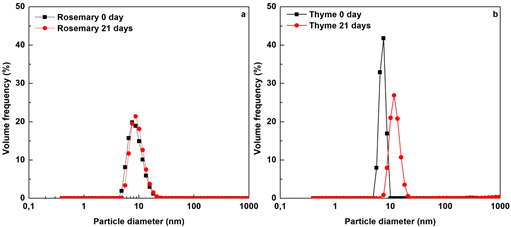
Figure 2a shows the droplet size distribution of the rosemary and thyme nanoemulsions on days 1 and 21, respectively. A monomodal droplet distribution in the nanometric range was observed, attributed to the characteristics of the surfactant used (TWEEN 80), which has the ability to form nanometric droplets in an aqueous medium. After 21 days of storage, both nanoemulsions did not exhibit representative increases in droplet size distributions. The stability of nanoemulsions is related to the average droplet size, being considered stable when they remain unchanged for long periods of time22.
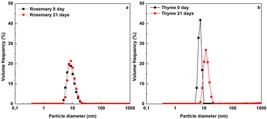
Particle Size Distribution of rosemary (a) and thyme (b) nanoemulsions on days 1 and 21 of storage
3.5 Antioxidant Capacity of Nanoemulsions
Using the DPPH method, the antioxidant capacity concentration of thyme essential oil (EO) was 0.004 ± 0.000 mg/mL, while that of rosemary was 0.0021 ± 0.000 mg/mL. For the ABTS method, the concentration for thyme was 13.766 ± 0.043 µM/mL and for rosemary 4.109 ± 0.026 µM/mL. Additionally, using the total phenols method, similar to the other two methods, the antioxidant capacity concentration of thyme EO was higher at 16.328 ± 0.087 mg/L, while rosemary was 8.914 ± 0.043 mg/L.
3.6 Formulation and Production of Meat Products (Sausages) with Nanoemulsions
The percentages used for the thyme and rosemary nanoemulsions were 0.11% and 0.44%, respectively. To establish these percentages, several trials were conducted to ensure that the amount of essential oil in each nanoemulsion did not result in negative sensory alterations, using formulations with a calculation base of 400 g. Once these percentages were established, the quality indices of the sausages were determined, which allowed for the assessment of product quality. As shown in Table 2, the results obtained for sausages with and without nanoemulsions presented differences in some parameters, as the formulation without nanoemulsions contained higher percentages of meat proteins, affecting all quality indices. However, considering the guidelines established by NTC 13253, the sausages with nanoemulsions were classified as a premium product.
Quality indices obtained from the preparation of sausages using the formulations presented in Table 1
3.7 Microbiological Tests
The results of the microbiological analyses for the detection of total Coliforms, Staphylococcus aureus, Listeria monocytogenes and Clostridium sulfite reductant in the meat emulsion and the sausages with nanoemulsion on days 0 and 21 at refrigeration temperatures of 4 ± 2 °C were obtained. The results (Table 3) indicated that the values were within the established ranges, remaining below the minimum permissible limits for a high-quality product according to NTC 13253.
Microbiological analysis results of the meat emulsion and sausages on days 0 and 21 of storage with nanoemulsions
3.8 aw
Sausages are a highly perishable food with a water activity (aw) ranging from 0.93 to 0.99, making them prone to significant bacterial proliferation23. The aw of the sausages with nanoemulsions was measured 21 days after production and during refrigeration (4 ± 2 °C), yielding a value of aw= 0.9496 ± 0.0004. This indicated a good state for the sausages and confirmed that the thyme and rosemary nanoemulsions did not adversely affect this parameter, as it remained within the acceptable range for this type of product.
3.9 Moisture
The moisture content of the sausages was 60.91 ± 0.76%, which is within the range established by NTC 13253. According to the theoretical quality indices obtained for the formulation used, the initial moisture percentage of the sausages was approximately 57.26%, as shown in Table 2. Despite the difference between the theoretical and experimental moisture data, both values were found to be within the permitted range (58% to 62%).
The moisture percentage, along with other parameters, helps define the quality of the sausages as premium, selected, or standard. Considering this, it can be stated that the sausages made with thyme and rosemary nanoemulsions were of premium quality, especially given that the starch percentage was very low.
3.10 Color
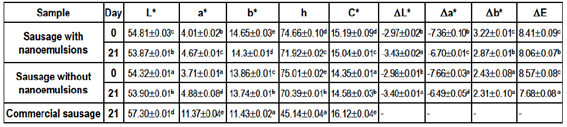
Table 4 presents the color results for the sausages with and without nanoemulsions for both the initial (0) and final (21) days, as well as for the commercial sausage, which serves as the standard sample.
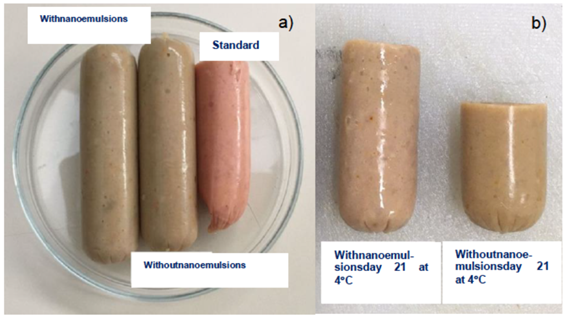
Regarding luminosity (L*), both samples with and without nanoemulsions exhibited lower values after 21 days compared to the initial measurements, though the difference was less than 1. In contrast, when comparing these samples to the standard, a significant difference of approximately 2.50 to 3.50 was observed, which was also visually evident (Figure 3a). The commercial sausage displayed the characteristic pink color from nitrites, while the sausages made with nanoemulsions appeared paler. However, as seen in Figure 3b, the sausages with nanoemulsions exhibited a more pronounced pink hue compared to the darker sausages without nanoemulsions, despite being stored at the same temperature (4 ± 2 °C). This difference can be attributed to the antioxidant effects of the essential oils from thyme and rosemary.
Regarding the parameters a* and b*, the positive values indicated red and yellow tones. Similar to the luminosity, a* values showed significant differences, while b* values approached those of the standard sample, as illustrated in Table 4 and Figure 3.
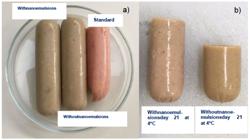
a) Sausages with and without nanoemulsions and standard (commercial), day 0; b) Sausages with and without nanoemulsions stored at 4 °C, day 21
3.11 Texture Profile of the Sausages
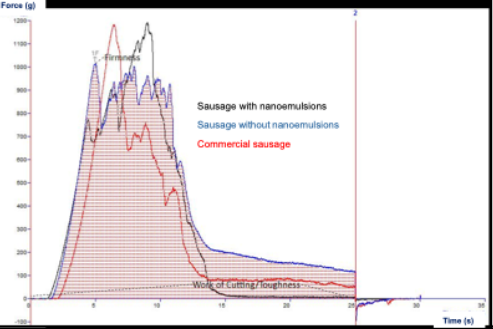
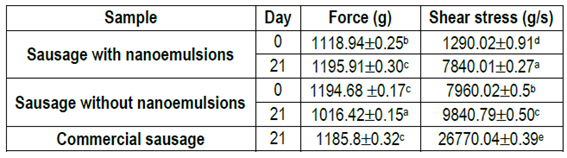
Figure 4 shows the curve of the behavior of the sausage samples on day 21 regarding the time taken by the texturometer to measure the texture profile. It is evident that the sausage sample without nanoemulsions exhibited the most peaks, and as shown in Table 5, it also had the highest cutting force, requiring the most effort to cut compared to the standard sausage and the one with nanoemulsions. The sample with nanoemulsions and the standard sausage yielded similar values.
Moreover, Table 5 indicates that over the course of 21 days, the force required for the sausage without nanoemulsions decreased, while that of the sausage with nanoemulsions increased, approaching the value obtained with the standard sausage. These results were also reflected during handling, as the sausage without nanoemulsions had lost firmness and was much more malleable than the other two.
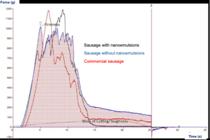
Curves of the behavior of sausage samples on day 21, based on the applied force in the Texture Profile Analysis (TPA)
3.12 Sensory Analysis
In the sensory evaluation, the degree of acceptability was determined, revealing statistically significant differences in the attributes of color, odor, flavor, and texture on days 0 and 21 in the sausages with nanoemulsion compared to the commercial sausage, finding statistically significant differences (p<0.05).
Table 6 shows the results of the sensory analysis, showing that the variables odor, flavor and texture presented the highest values above 4.3, varying very little between days 0 and 21 of storage, while color obtained the lowest value (3.22 - 2.89) in the same days of storage.
4. Discussion
The flow behavior of the nanoemulsions was evaluated based on data fitted to the power law model (R² = 0.9981; 0.9998), where K represents the consistency index and n represents the flow behavior index. When n < 1, the model predicts a pseudo-plastic behavior, where the apparent viscosity decreases with increasing strain rate. Conversely, when n > 1, it indicates dilatant behavior, where the apparent viscosity increases with increasing strain rate. When n = 1, the model reduces to Newton's law of viscosity with μ = K14. The values of n and K for the thyme nanoemulsion were 1.010 and 0.730 (Pasn), respectively, while for the rosemary nanoemulsion, the values were n = 0.968 and K = 0.351 (Pasn), which indicates that both fluids present Newtonian behavior, which is characteristic of nanoemulsions; additionally, when they exhibit a low increase in droplet size during storage time, and the n and k indices do not register significant changes p > 0.05, it could indicate the absence of destabilization processes such as creaming or coalescence (Figure 1 and Figure 2)13)(24) .
In addition, a paper published by Llinares and others22 reports that the addition of an oil phase contributes to the increase in viscosity of the nanoemulsion not only because it is more viscous, but also because it makes the structures formed closer together, creating interactions between the droplets that increase viscosity. This phenomenon occurs with the addition of a surfactant, as there is a positive correlation between the surfactant/oil ratio and K. In addition, it was observed that samples with low oil content and low surfactant-oil ratio have an exponent close to 1, indicating that their behavior is very similar to that of a Newtonian fluid, since the micelles are so dispersed, the predominant behavior will be that of the dispersed phase, which in this case is water25)(26) . On the other hand, the nanoemulsions in this study showed values indicating Newtonian behavior, similar to that of the rosemary and thyme nanoemulsion, concluding that these results are in line with the typical behavior of emulsions, corresponding to an increase in the interactions of supramolecular structures1125)(26) . Therefore, the results obtained in this work demonstrate considerable stability in nanoemulsions formulations with small increases in droplet size, which guarantees that the active compounds of rosemary and thyme remain encapsulated, making nanoemulsions a good alternative as encapsulant and transport systems.
Regarding total antioxidant capacity (TAC), it is defined as the potential of a substance or compound to inhibit or hinder the oxidation of a substrate in very small amounts (<1%, commonly 1-1,000 mg/L). The antioxidant capacity of the sample is quantified by comparison with a calibration curve in units equivalent to the standard27.
For the DPPH method, the concentration for thyme was 0.004 mg/mL, and for rosemary it was 0.0021 mg/mL. Previous studies have reported results of 0.072 and 0.012 mg/mL28, respectively. In the ABTS method, the concentration for thyme was 13.766 µm/mL, and for rosemary it was 4.109 µm/mL; in this case, reported results were 38.1 and 20.5 µm/mL28, respectively. Several factors influence the concentration of antioxidants and explain this phenomenon. The first factor is the wavelength at which measurements were taken for each assay. Another reason could be the reaction mechanism of DPPH with antioxidants, which is directly related to their structural conformation. Specifically, a smaller antioxidant with greater access to the radical will show better antioxidant activity, considering that DPPH is sterically hindered. Lastly, this difference could be based on the reversible reaction of the DPPH radical with phenols such as eugenol and its derivatives, which could lead to lower readings of antioxidant activity28.
On the other hand, for the total phenols method, the antioxidant concentrations were higher in the thyme nanoemulsion (0.016 mg/mL), while the rosemary nanoemulsion showed a lower concentration (0.008 mg/mL). These values are lower than those reported by Mercado and others28, who indicated values of 1.3 and 0.057 mg/mL, respectively.
The sausages exhibited favorable microbiological behavior, considering that artificial preservatives (nitrates and nitrites) used for such products were replaced by nanoemulsions containing essential oils of rosemary and thyme. These oils have demonstrated, in various studies, the ability to disrupt and penetrate the lipid structure of microbial cell membranes, leading to cell death29. After 21 days of refrigeration, the sausages did not show significant microbial growth, indicating that the addition of the nanoemulsions effectively preserved the product under conditions suitable for human consumption. Additionally, significant results were obtained regarding the microorganism Listeria monocytogenes, as its absence was confirmed in each 25 g sample. All of this relates not only to food safety but also to quality factors such as color, flavor, and texture, since after 21 days the sausages exhibited a firm texture and pleasant odor and flavor.
The mechanism of antimicrobial action of EOs is unclear due to their complex matrix composition, the necessary interaction between the major and minor components of each EO, and the nature of the bacteria. The known mechanisms of action of ECs on bacterial cells, where the lipophilic nature of ECs can alter the cell wall structure and cause cell dysfunction, i.e. when the compounds penetrate through bacterial membranes into the cell interior, affect both the outer envelope and the cytoplasm of the cell, resulting in changes in the lipid composition of the membrane (polysaccharide molecules). This process affects vital cellular activities such as membrane transport, nutrient processing, energy production, synthesis of structural components and other metabolic regulatory functions, ultimately leading to cell death30.
The antimicrobial activity of ECs is also related to the decrease of cell membrane potential, the disruption of proton pumps (H+/K+-ATPase) and the reduction of intracellular levels of adenosine triphosphate (ATP), releasing extracellular ATP, loss of adsorbent materials and leakage of potassium ions which significantly affect the biosynthesis of the main components related to the biogenesis of bacterial cell walls, impeding bacterial growth by altering cell membranes, changing the lipid profile, inhibiting ATPase and inhibiting cell division30.
In addition, phenolic compounds present in EOs can bind to proteins and inactivate their functions, this mechanism subsequently leads to coagulation of internal cellular components in the cytoplasm, disruption of metabolic pathways and disruption of the bonds between lipid and protein layers in the cell30.
Regarding color, the Lab* coordinates of each sample compared to the standard were obtained for both the difference in ΔL* (luminosity) and Δa* (between red and green), with negative values indicating greater darkness and greenish tones, respectively. In contrast, for the difference Δb* (between yellow and blue), the obtained values were positive, indicating yellowish tones. Additionally, Figure 3 illustrates the color difference of each sausage, where the standard sausage appears with more red tones compared to the other two, which aligns with the results obtained.
Furthermore, considering previous studies on color analysis of sausages, where the reduction in the amount of nitrites added to each batch caused a decrease in the value of the a* coordinate (positive values) and an increase in luminosity (L*)31, it is evident that these additives directly influence the coloration of the sausage. Specifically, a higher quantity of nitrites results in stronger red and yellow tones. The absence of these additives in the formulation of such products can affect consumer perception. In the referenced study, the sausages contained 200 mg/Kg of nitrites and yielded a value of 5.73 ± 0.7131, whereas the sausages containing the nanoemulsions showed values of 4.01 ± 0.02 for the a* parameter. Although a change is evident, this color difference is not significant enough to warrant concern, suggesting that a natural or artificial colorant could be used without the need to add nitrites or alter flavor.
In terms of sensory analysis, it was determined that the differences were most prominent in the color attribute compared to the other three attributes (odor, flavor, and texture), indicating that color was the least favorable attribute of the sausages and faced greater rejection by the evaluators from the first sampling (day 0) to the second sampling (day 21). A comparison of color and odor on days 0 and 21 showed statistically significant differences (p < 0.05), suggesting that the sensory attribute rated highest was odor. However, despite this, none of the attributes presented differences among themselves after 21 days of refrigeration, indicating that they changed according to the evaluators' perceptions.
Nitrates and nitrites, which are synthetic additives, are traditionally used as curing agents in meat products, to improve quality characteristics, develop distinctive flavors and red color stability, counteract lipid oxidation, and microbiological safety, by exerting bacteriostatic and bactericidal action against spoilage microorganisms and food borne pathogens such as Clostridium botulinum and Listeria monocytogenes. However, the use of nitrites and nitrates is currently under study due to its relationship with cardiovascular diseases and colorectal cancer32. This work aims to replace them with the use of thyme and bay leaf EO with very good results, it is special from the microbiological point of view, from the organoleptic point of view the color is the least desirable variable, one could think of adding more coloring, but the NTC13253 has the restriction of maximum 100ppm. Premi and others32 propose several options that could be the possible use of coagulase-negative staphylococci (NEC) as substitutes for nitrate and nitrite in meat foods, a microorganism that reproduces the characteristic red pigmentation and maintains the typical high-quality features of cured meats, thanks to its arginine degradation pathway, thus providing the desirable attributes related to nitrite in cured meat. Another option could be to supplement the meat with arginine to release nitricoxide (NO) and obtain a meat characterized by the desired pinkish-red color.
However, the use of essential oils AEs as preservatives in foods has some limitations, such as the flavoring power of some of them. On the other hand, undesirable organoleptic effects can be limited by carefully selecting the essential oil according to the type of food under consideration, but it is important to note that in most cases the concentrations of oils used are so low that they do not modify the organoleptic qualities of the food. Another aspect to be taken into account is to check that the essential oil selected does not have an antimicrobial effect against useful bacteria, in particular acidification, flavoring and refining ferments, which are essential for the manufacture of the product. With these usual precautions, the use of essential oils during food processing can have a triple benefit: flavoring, antioxidant and antimicrobial33.
5. Conclusions
The nanoemulsions of rosemary (Salvia rosmarinus) and thyme (Thymus vulgaris) demonstrated stability for over a month, exhibiting non-Newtonian rheology with pseudoplastic and dilatant behavior, respectively, a nanometric particle size, and low phase dispersion. Moreover, despite the thyme nanoemulsion appearing cloudier, it was determined to have a higher antioxidant capacity.
The sausages made with nanoemulsions received high sensory acceptance, particularly highlighting the attributes of odor and flavor contributed by thyme and rosemary. However, the removal of nitrites, the chemical additive responsible for imparting color to such products, resulted in a less appealing color that was not well accepted sensorially. In comparison, sausages formulated without both nitrites and nanoemulsions showed better results, as the nanoemulsions helped reduce oxidation.
Microbiologically, the sausages proved to be a safe product of good quality, with no increase in UFC/g over 21 days of refrigeration (4 °C) from the time of production. The preservation of the product can be attributed to the nanoemulsions incorporated into the formulation.
The development and implementation of nanoemulsions with encapsulated essential oils enable the utilization of their bioactive, antioxidant, and antimicrobial properties for the preservation of meat products, serving as a viable alternative to chemical additives such as nitrates and nitrites.
References:
-
1. Pimiento-Fonseca K, Varela-Velásquez P, Velandia-Parra D. Productos y subproduc-tos cárnicos: Principales aditivos y sus efectos en la salud humana: revisión sistemática de literatura (undergraduate thesis on Internet). Bucaramanga (CO): Universidad Cooperativa de Colombia, Medicina Veterinaria y Zootecnia; 2023 (cited 2025 Jul 11). 34p. Available from: Available from: https://hdl.handle.net/20.500.12494/48949
» https://hdl.handle.net/20.500.12494/48949 -
2. Prado-Lucas JA, Viteri-Puertas LD. Efecto de la sustitución del nitrito de sodio con aceite de romero en la calidad final de una jamonada (undergraduate thesis on Internet). Calceta (EC): Escuela Superior Politécnica Agropecuaria de Manabí Manuel Félix López; 2017 (cited 2025 Jul 11). 48p. Available from: Available from: http://repositorio.espam.edu.ec/handle/42000/657
» http://repositorio.espam.edu.ec/handle/42000/657 - 3. Instituto Colombiano de Normas Técnicas y Certificación. Industrias alimentarias: productos cárnicos procesados no enlatados: NTC 1325:2008. Bogotá: ICONTEC; 2008. 32p.
- 4. Prakash B, Kiran S. Essential oils: a traditionally realized natural resource for food preservation. Curr Sci. 2016;110(10):1890-2.
-
5. Rivera D, Riquelme N, Arancibia C. Nanoemulsiones para la fortificación de alimentos. Contrib Cient Tecnolo. 2020;45(2):7-20. Doi: 10.35588/cdicyt.v45i2.4871. Subscription required to view.
» https://doi.org/10.35588/cdicyt.v45i2.4871 -
6. Liu B, Hu X. Hollow micro- and nanomaterials: synthesis and applications. In: Zhao Q, editor. Advanced nanomaterials for pollutant sensing and environmental catalysis. Amsterdam: Elsevier; 2020. p. 1-38. Doi: 10.1016/b978-0-12-814796-2.00001-0.
» https://doi.org/10.1016/b978-0-12-814796-2.00001-0 -
7. Simonazzi A, Cid AG, Villegas M, Romero AI, Palma SD, Bermúdez JM. Nanotechnology applications in drug-controlled release. In: Grumezescu AM, editor. Drug targeting and stimuli sensitive drug delivery systems. Oxford: William Andrew Publishing; 2018. p. 81-116. Doi: 10.1016/b978-0-12-813689-8.00003-3.
» https://doi.org/10.1016/b978-0-12-813689-8.00003-3 -
8. Liu Q, Huang H, Chen H, Lin J, Wang Q. Food-grade nanoemulsions: preparation, stability and application in encapsulation of bioactive compounds. Molecules. 2019;24(23):4242. Doi: 10.3390/molecules24234242.
» https://doi.org/10.3390/molecules24234242 -
9. Montes de Oca-Ávalos JM, Candal RJ, Herrera ML. Nanoemulsions: stability and physical properties. Curr Opin Food Sci. 2017;16:1-6. Doi: 10.1016/j.cofs.2017.06.003.
» https://doi.org/10.1016/j.cofs.2017.06.003 -
10. Dávila-Rodríguez M, López-Malo A, Palou E, Ramírez-Corona N, Jiménez-Munguía MT. Antimicrobial activity of nanoemulsions of cinnamon, rosemary, and oregano essential oils on fresh celery. LWT - Food Sci Technol. 2019;112:108247. Doi: 10.1016/j.lwt.2019.06.014.
» https://doi.org/10.1016/j.lwt.2019.06.014 -
11. Martin-Piñero MJ, Ramirez P, Muñoz J, Alfaro MC. Development of rosemary essential oil nanoemulsions using a wheat biomass-derived surfactant. Colloids Surf B Biointerfaces. 2019;173:486-92. Doi: 10.1016/j.colsurfb.2018.10.024.
» https://doi.org/10.1016/j.colsurfb.2018.10.024 -
12. Bashir O, Amin T, Hussain SZ, Naik HR, Goksen G, Wani AW, Manzoor S, Malik AR, Wani FJ, Proestos C. Development, characterization and use of rosemary essential oil loaded water-chestnut starch based nanoemulsion coatings for enhancing post-harvest quality of apples var. Golden delicious. Curr Res Food Sci. 2023;7:100570. Doi: 10.1016/j.crfs.2023.100570.
» https://doi.org/10.1016/j.crfs.2023.100570 -
13. McClements DJ. Food Emulsions principles, practices, and techniques. 3rd ed. Boca Raton: CRC Press; 2015. 714p. Doi: 10.1201/b18868.
» https://doi.org/10.1201/b18868 -
14. Henao Ossa JS, Wagner JR, Palazolo GG. Acid emulsions stabilized by soy whey concentrates and soluble soybean polysaccharides: role of biopolymer interaction strategies on stability against environmental stresses. Food Chem. 2023;424:136421. Doi: 10.1016/j.foodchem.2023.136421.
» https://doi.org/10.1016/j.foodchem.2023.136421 -
15. Zorić Z, Pelaić Z, Pedisić S, Garofulić IE, Kovacević DB, Dragović-Uzelac V. Effect of storage conditions on phenolic content and antioxidant capacity of spray dried sour cherry powder. LWT - Food Sci Technol . 2017;79:251-9. Doi: 10.1016/j.lwt.2017.01.049.
» https://doi.org/10.1016/j.lwt.2017.01.049 -
16. Sridhar K, Charles AL. In vitro antioxidant activity of Kyoho grape extracts in DPPH and ABTS assays: estimation methods for EC50 using advanced statistical programs. Food Chem . 2019;275:41-9. Doi: 10.1016/j.foodchem.2018.09.040.
» https://doi.org/10.1016/j.foodchem.2018.09.040 -
17. Casagrande M, Zanela J, Wagner-Júnior A, Busso C, Wouk J, Lurckevicz G, Fernandes-Montanher P, Yamashita F, Maneck-Malfatti CR. Influence of time, temperature and solvent on the extraction of bioactive compounds of Baccharis dracunculifolia: In vitro antioxidant activity, antimicrobial potential, and phenolic compound quantificatión. Ind Crops Prod. 2018;125:207-19. Doi: 10.1016/j.indcrop.2018.08.088.
» https://doi.org/10.1016/j.indcrop.2018.08.088 - 18. AOAC International. Official methods of analysis of AOAC International. 20th ed. Rockville: AOAC International; 2016. 2v.
-
19. Lucas-Aguirre JC, Giraldo-Giraldo GA, Cortés-Rodríguez M. Effect of the spray drying process on the quality of coconut powder fortified with calcium and vitamins C, D3 and E. Adv J Food Sci Technol. 2018;16(SPL):102-24. Doi: 10.19026/ajfst.16.5943.
» https://doi.org/10.19026/ajfst.16.5943 -
20. Cabrera-Martínez LE, Vivar-Vera MA, Hernández-Cázares AS, Pérez-Silva A, Chavez-Zepeda LP. Elaboración y caracterización física de salchichas de carne de cerdo con inflorescencias de Chamaedorea tepejilote. Journal CIM. 2019;7(1):1699-706. Doi: 10.5281/zenodo.4278474.
» https://doi.org/10.5281/zenodo.4278474 - 21. Hough G, Fiszman S. Estimación de la vida sensorial de los alimentos. Madrid: Programa CYTED; 2005. 111p.
-
22. Llinares R, Santos J, Trujillo-Cayado LA, Ramírez P, Muñoz J. Enhancing rosemary oil-in-water microfluidized nanoemulsion properties through formulation optimization by response surface methodology. LWT - Food Sci Technol . 2018;97:370-5. Doi: 10.1016/j.lwt.2018.07.033.
» https://doi.org/10.1016/j.lwt.2018.07.033 -
23. Quino ML, Alvarado JA. Efectos fisicoquímicos y sensoriales del uso de fibra dietéti-ca en salchichas tipo Viena reducida en grasas. Rev Boliv Quim (Internet). 2014 (cited 2025 Jul 11);31(2):110-5. Available from: Available from: https://www.redalyc.org/articulo.oa?id=426339682010
» https://www.redalyc.org/articulo.oa?id=426339682010 -
24. Moreno-Ríos DA, Lucas-Aguirre JC, Pinzón-Fandiño MI, Henao-Ossa JS. Evaluation of the performance of low-fat (oil-fat) dressings based on chemically modified Guayabo plantain starch (Musa paradisiaca L.). Food Sci Technol Int. 2024:10820132241297741. Doi: 10.1177/10820132241297741.
» https://doi.org/10.1177/10820132241297741. -
25. Penagos IA, Gallo JP, Álvarez OA. Análisis multiescala de nanoemulsiones directas (undergraduate thesis on Internet). Bogotá (CO): Universidad de los Andes; 2018 (cited 2025 Jul 11). 16p. Available from: Available from: https://hdl.handle.net/1992/40142
» https://hdl.handle.net/1992/40142 -
26. Sinzato YZ, Dias NJS, Cunha FR. An experimental investigation of the interfacial tension between liquid-liquid mixtures in the presence of surfactants. Exp Therm Fluid Sci. 2017;85:370-8. Doi: 10.1016/j.expthermflusci.2017.03.011.
» https://doi.org/10.1016/j.expthermflusci.2017.03.011 -
27. Benítez-Estrada A, Villanueva-Sánchez J, González-Rosendo G, Alcántar-Rodríguez VE, Puga-Díaz R, Quintero-Gutiérrez AG. Determinación de la capacidad antioxidante total de alimentos y plasma humano por foto quimioluminiscencia: correlación con ensayos fluorométricos (ORAC) y espectrofotométricos (FRAP). Tip Rev Espec Cienc Quím Biol. 2021;23:1-9. Doi: 10.22201/fesz.23958723e.2020.0.244.
» https://doi.org/10.22201/fesz.23958723e.2020.0.244 -
28. Mercado-Mercado G, Carrillo L, Wall-Medrano A, López-Días JA, Álvarez-Parrilla E. Compuestos polifenólicos y capacidad antioxidante de especias típicas consumidas en México. Nutr Hosp. 2013;28(1):36-46. Doi: 10.3305/nh.2013.28.1.6298.
» https://doi.org/10.3305/nh.2013.28.1.6298 - 29. Ore-Areche F, Aguirre-Huayhua L, Ticsihua-Huaman J. Acción del aceite esencial de romero y perejil en la aceptabilidad de la hamburguesa de carne de alpaca. Polo del conocimiento. 2020;5(09):432-45.
-
30. Pizzo JS, Visentainer JV, da Silva ALBR, Rodrigues C. Application of essential oils as sanitizer alternatives on the postharvest washing of fresh produce. Food Chem . 2023;407:135101. Doi: 10.1016/j.foodchem.2022.135101.
» https://doi.org/10.1016/j.foodchem.2022.135101 -
31. Pinzón-Zarate, Lina, Hleap-Zapata JI, Ordoñez-Santos LE. Análisis de los parámetros de color en salchichas Frankfurt adicionadas con extracto oleoso de residuos de chonta-duro (Bactris Gasipaes). Inf Tecnol. 2015;26(5):45-54. Doi: 10.4067/S0718-07642015000500007.
» https://doi.org/10.4067/S0718-07642015000500007 -
32. Premi L, Rocchetti G, Lucini L, Morelli L, Rebecchi A. Replacement of nitrates and nitrites in meat-derived foods through the utilization of coagulase-negative staphylococci: a review. Curr Res Food Sci . 2024;8:100731. Doi: 10.1016/j.crfs.2024.100731.
» https://doi.org/10.1016/j.crfs.2024.100731 -
33. Konfo TRC, Djouhou FMC, Koudoro YA, Dahouenon-Ahoussi E, Avlessi F, So-Hounhloue CKD, Simal-Gandara J. Essential oils as natural antioxidants for the control of food preservation. Food Chem Adv. 2023;2:100312. Doi: 10.1016/j.focha.2023.100312.
» https://doi.org/10.1016/j.focha.2023.100312