Development of brownie formulated with soybean co-product and carob
Abstract:
Healthfulness and full use of food are quality topics that have been approached during decades in the food industry, considering trends with growth prospection. In this context, okara, a co-product of the production of aqueous soybean extract, is a promising ingredient for confectionery, promoting nutritional improvement and waste reduction, as well as carob -a cocoa substitute that does not contain caffeine-. Thus, the present work aimed to develop a brownie formulated with these ingredients and to evaluate the physicochemical parameters and sensory acceptance. The soybean BRS 232 was used to obtain okara, which was dehydrated and milled to be used in the preparation of the brownie, adding eggs, sugar, oil and carob. In the physicochemical analyses, 17.3% of moisture, 1.7% of ash, 29.3% of lipids, 18.9% of proteins and 34.03% of carbohydrates were quantified. Sensory acceptance was assessed using a 10-point hybrid hedonic scale, considering four attributes: appearance 8.18, texture 6.65, flavor 7.19, and general acceptance 7.23, whose results were satisfactory, as values above 70% mean approval by consumers. The results indicated that the brownie formulated with okara and carob is a functional food, due to the high content of soy proteins, and with good sensory acceptance, making it an interesting option regarding the nutritional aspect, adequate to diets with restricted consumption of gluten and caffeine.
Keywords:
cocoa substitute; gluten free; healthfulness; okara
Resumen:
La saludabilidad y el aprovechamiento total de los alimentos son temas de calidad que se han abordado durante décadas en la industria alimentaria, considerados tendencias con perspectivas de crecimiento. En este contexto, el okara, un coproducto de la producción de extracto acuoso de soja, es un ingrediente prometedor para la confitería que promueve la mejora nutricional y la reducción de desechos, así como la algarroba, un sustituto del cacao que no contiene cafeína. Por lo tanto, el presente trabajo tuvo como objetivo desarrollar un brownie formulado con estos ingredientes y evaluar los parámetros fisicoquímicos y la aceptación sensorial. La soja BRS 232 se utilizó para obtener el okara que fue secado y molido para ser utilizado en la elaboración del brownie, junto con huevos, azúcar, aceite y algarroba. En los análisis fisicoquímicos se cuantificó 17,3% de humedad, 1,7% de cenizas, 29,3% de lípidos, 18,9% de proteínas y 34,03% de carbohidratos. La aceptación sensorial se evaluó mediante una escala hedónica híbrida de 10 puntos, considerando cuatro atributos: apariencia 8,18, textura 6,65, sabor 7,19 y aceptabilidad en general 7,23, cuyos resultados fueron satisfactorios, ya que valores superiores a 70% significan aprobación por parte de los consumidores. Los resultados indicaron que el brownie de okara y algarroba es un alimento funcional, por el alto contenido de proteínas provenientes de la soja, y con buena aceptación sensorial, lo que lo convierte en una opción interesante que apunta al aspecto nutricional, cumpliendo con dietas con consumo restringido de gluten y cafeína.
Palabras clave:
sustituto del cacao; sin gluten; saludabilidad; okara
Resumo:
A saudabilidade e o aproveitamento integral de alimentos são tópicos de qualidade abordados há décadas na indústria alimentícia, considerados tendências com prospecção de crescimento. Diante desse contexto, o okara, coproduto da produção de extrato aquoso de soja, é um ingrediente promissor para a confeitaria, promovendo melhora nutricional e redução do desperdício, assim como a alfarroba -um substituto do cacau que não contém cafeína. Deste modo, o presente trabalho teve como objetivo desenvolver um brownie formulado com esses ingredientes e avaliar os parâmetros físico-químicos e a aceitação sensorial. A soja BRS 232 foi utilizada para a obtenção do okara, o qual foi seco e moído para ser utilizado na elaboração do brownie, juntamente com ovos, açúcar, óleo e alfarroba. Nas análises físico-químicas foram quantificados 17,3% de umidade, 1,7% de cinzas, 29,3% de lipídios, 18,9% de proteínas e 34,03% de carboidratos. A aceitação sensorial foi avaliada usando uma escala hedônica híbrida de 10 pontos, considerando quatro atributos: aparência 8,18; textura 6,65; sabor 7,19 e aceitação geral 7,23, cujos resultados foram satisfatórios, pois valores acima de 70% significam aprovação pelos consumidores. Os resultados indicaram que o brownie de okara e alfarroba é um alimento funcional, pelo alto teor de proteínas oriundas da soja, e com boa aceitação sensorial, tornando-se uma opção interessante visando o aspecto nutricional, atendendo a dietas com restrição do consumo de glúten e cafeína.
Palavras-chave:
substituto do cacau; sem glúten; saudabilidade; okara
1. Introduction
Consumer trends are growing in the direction of healthfulness combined with sensory quality also in the specific area of bakery, traditionally associated with tasty and indulgent products. This category of products is opportune for the development of healthier versions with the challenge of maintaining the attributes of sensoriality and pleasure1.
Okara, also known as soy pulp, is the solid fraction resulting of soybean aqueous extract (popularly named “soymilk”) production. As a co-product in many parts of the world, except Asia, it is still discarded or used in feed. The protein content of around 30% and over 50% dietary fiber, isoflavones profile2 and the possibility to attend consumers with gluten celiac or non-celiac intolerance make it a promising food ingredient3.
Carob is a possible substitute for cocoa powder due to its sweetness, a dark cocoa-like color, the absence of lactose, caffeine, and gluten, summed to the fiber content4. The sensory similarity makes it a good replacer in bakery products5.
At the food research and development area there is available information concerning bakery products made with okara or carob, but there are no references on the use of these two ingredients in combination, suggesting a promising field for the development of indulgent, tasty, and healthy products.
The brownie, a dessert that originated in the United States, is known for its dense, moist texture, which distinguishes it from traditional cakes. This unique characteristic results from the absence of yeast in the recipe. Despite this, the basic ingredients, such as eggs, oil, sugar, chocolate powder and wheat flour, are used in both brownies and conventional cakes6.
This research aimed to develop a brownie focusing on the total replacement of wheat flour by okara and cocoa by carob. The brownie was chosen because of its wide acceptance among consumers of different ages and cultures; in addition, its versatility, simplicity and ease of preparation make it an ideal base for developing functional and innovative versions. To evaluate the product characteristics and adequacy analysis of proximate composition, microbial safety and sensory acceptance were held.
2. Materials and Methods
2.1 Materials
Soybeans BRS 282 cultivar used in the formulation were supplied by Embrapa Soja (Brazilian Agriculture and Livestock Company). Powder carob Santo Óleo® (Gaspar, SC, Brazil) and the other ingredients to the formulation were purchased in local market, Londrina, Paraná, Brazil.
2.2 Okara Production
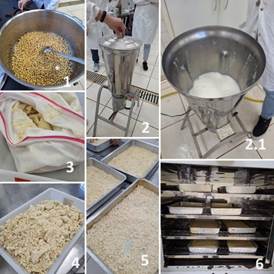
For the development of the okara brownie with carob it was necessary to obtain the soybean co-product, using the method described by Seibel2) (Figure 1): 1,000 g of soybeans were submitted to soaking (1:3 in water at 95 °C/5 minutes), drained and chilled with cold water for 5 minutes. After it was drained, the overnight maceration (soybeans:water, 1:3) proceeded, the beans were drained again, then boiled (1:10, discounting the water absorbed by the grains) for 5 minutes. Soybeans with the cooking water were ground in industrial blender (Metvisa) for 5 minutes, and the mixture was submitted to centrifugation at 2800 rpm (Consul) in proper polyester bag to separate the liquid extract from the solid portion named wet okara. The okara was dehydrated in laboratory oven (Marconi) at 60 °C until reaching 12% moisture. Dried okara was milled (NM-8300, Nima) at room temperature and then named okara flour7.
2.3 Brownie Preparation
The product formulation was defined based on traditional brownies and adapted from the publication of Freire8 to achieve the objectives of this work. The first formulation tested had too much sugar, which led to a gradual reduction until the ideal amount was reached, defined by tasting by the research group and colleagues. Four tests were needed until the final formulation described in Table 1.
For the development of this confectionery product, eggs and sugar were homogenized, followed by the addition of oil, okara and finally carob, mixing at each step. This dough was added to a 20×30 cm aluminum cake pan and baked in a preheated oven at 180 °C for approximately 25 minutes7.
2.4 Chemical Analysis
Prior to proceeding with each analysis, brownie samples were ground manually using a mortar and pestle. To find the proximate composition, moisture, ash, fat and protein were analyzed as described by Adolfo Lutz Institute9, and carbohydrate was calculated by difference. Each analysis was conducted in triplicate.
Moisture was based on the weight difference before and after dehydration in oven at 105 °C; ash was determined as the inorganic residue of the sample after calcination in muffle at 550 °C; fat was determined by extraction with hexane in Soxhlet apparatus, and protein by micro-Kjeldahl method involving digestion, distillation and titration steps using the Nitrogen conversion factor of 6.25. Carbohydrate was calculated as the difference between 100 and the sum of the other components.
2.5 Microbiological Analysis
Though the brownie was produced according to the Good Manufacturing Practices, microbiological analyses were carried out to demonstrate the product safety priorly to sensory analyses. Brazilian legislation was consulted and the most appliable category of products was “breads, cakes, biscuits and other baked goods that are not stable at room temperature”, established by Normative Instruction 161/202210, which describes the upper limits to Salmonella, Bacillus cereus, Escherichia coli, Staphylococcus coagulase-positive, and Yeast and Mold. Detailed methodology was followed, as published by da Silva and others11. The sample preparation and analysis were made in aseptic conditions: grounding as described in item 2.4, and dissolution of 25 g in 225 mL of sterile peptone tamponed water 0.1%.
Salmonella sp. detection11 requires a sample pre-enrichment followed by concomitant and separate incubation with Rappaport-Vassiliadis broth (RVS) and Tetrathionate broth, to forward incubation in Petri plates with XLD (Xylose-Lysine-Desoxycholate) Agar (37 °C for 24 h).
To B. cereus count11 two serial decimal dilutions were performed, and 0.1 mL of each one were inoculated in Petri plate with Mannitol Egg Yolk Polymyxin Agar (MYP). The plates were incubated at 32 °C for 24 h.
The detection of E. coli11 was made using Petrifilm®E. coli/ coliform count plate containing modified Violet Red Bile (VRB) nutrients, a cold-water-soluble gelling agent, an indicator of glucuronidase activity, 5-bromo-4-chloro-3-indolyl-D-glucuronide (BCIG), and a tetrazolium indicator. For each dilution 1 mL sample was inoculated and incubated at 35 °C for 24 h.
After three serial sample dilutions Staphylococcus coagulase-positive11 was tested by inoculation in Baird Parker Agar (BDA) with egg yolk solution and potassium tellurite 1%. The plates were incubated at 37 °C for 48 h.
Yeast and Mold11 count was proceeded: two serial dilutions of sample were inoculated into Sabouraud Dextrose Agar (SDA) with incubation at 25 °C for five days.
2.6 Sensory Analysis
For sensory evaluation an acceptance test was applied with a 10-point hybrid hedonic scale. The judges were asked to evaluate the attributes by grades from 0 to 10, were the grade 0 was assigned to “totally disliked” and the grade 10 to “liked it extremely”12, and they could mark any point on the scale. The parameters investigated were appearance, texture, taste, and general acceptance, asked in this order by means of a printed formulary. Brownie was served at room temperature in a portion of approximately 4.5×4.5 cm to each participant.
Prior to the sensory test application, the detailed project was submitted to the ethics committee of Federal University of Technology - Paraná (UTFPR), through the Plataforma Brasil, and received approval, with the substantiated opinion number 6,167,540. Then, judges over 18 years of age and non-allergic to any component of the brownie were invited to perform the analysis. Each participant received and signed an informed consent form with detailed information about the sample and the analysis, besides a questionnaire about sociodemographic data and eating habits.
3. Results
Regarding wet okara obtained in this research, the yield was plus then twice in relation to soybean weight utilized. After drying and milling the hypothesis was to achieve the same granulometry of wheat flour (60 mesh). However, it was not experimentally viable: only 10% of okara flour has this granulometry while 90% of the product particles measured 30 mesh, so this is the final granulometry used in the brownie formulation.
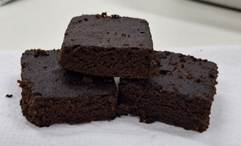
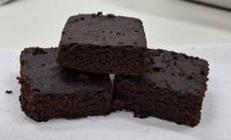
The formulation (Table 1) yielded approximately 550 g of baked brownie for each pan. The okara brownie with carob (Figure 2) resulted in an appearance like a traditional brownie.
3.1 Chemical Analysis
The results obtained through the physicochemical analyses are shown in Table 2.
3.2 Microbiological Analysis
Brazilian Normative Instruction 161/202210 was the reference to carry microbial analysis and consult upper limits to ensure the microbial safety of the developed product (Table 3).
3.3 Sensory Analysis
A total of 58 untrained tasters participated in the sensory analysis, whose profile was determined based on the answers provided on the evaluation forms. Of these, 82.76% were between 18 and 35 years old, and 17.24% were between 35 and 51 years old; 53.45% were male and 46.55% were female. All participants said they liked brownies.
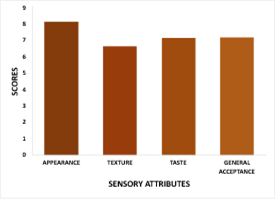
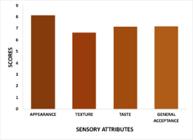
The okara brownie with carob received scores of 8.18 for appearance, 6.65 for texture, 7.19 for taste, and 7.23 for general acceptance (Figure 3) at the hedonic test.
4. Discussion
Wet okara had a yield three times superior to the commented in literature due to the cultivar BR282 used and methodology adaptations2. There is no published research on okara brownie with carob, so the product development proposed and achieved in this work can be considered an innovative product, that gives possibilities to improvement and supports the study of novel formulations combining these two food ingredients7.
A traditional brownie made with wheat flour and cocoa powder has approximately 60.27% carbohydrate, 9.52% fat, and 6.06% protein13. Chemical analyses of the brownie formulated with okara and carob revealed 34.03% carbohydrate, 29.30±1.43% fat and a significant protein value of 18.90±0.30%. Major carbohydrate in the formulation is from the okara, that contains around 60% of dietary fiber2, favoring the product health claim. In addition, according to the World Health Organization14, daily intake recommendation 40-70% of total energy supplied from carbohydrate in the diet is associated with reduced risk of mortality. Besides the soybean oil used in the formulation, the use of okara (around 10% fat) contributes to the total with the effect of fats from soybean in reducing the LDL (low-density lipoprotein) cholesterol2, known as the “bad” one. The significant protein of the developed product is also from the okara, which means an improvement compared to wheat flour brownies. Additionally, the new product developed in this research is a gluten- and caffeine-free option of an indulgent and largely consumed product.
The production of the brownie according to the Good Manufacturing Practices was effective in ensuring the microbial safety of the product (Table 3), complying with Brazilian legislation specific to bakery products non-stable at room temperature10.
Regarding the sensory analysis, the appearance of the brownie with okara and carob had the major acceptance probably due to the similarity with traditional products. Even though the okara used in the brownie formulated has superior size particles compared to wheat flour traditionally used, tasters accepted this parameter. The overall acceptance was around 7 also for the taste, indicating that the product was pleasant to the eye, the mouth and the papillae.
5. Conclusions
Considering the proximal composition, microbial safety, and sensory acceptance, the development of the okara brownie with carob reveals promising properties from a nutritional and technological point of view. It responds to the challenge of the food industry to develop products that are both healthy and indulgent, that provide pleasure, wellness and even happiness.
Acknowledgements:
The authors want to thank Professor Dr. Alexandre Rodrigo Coelho from the Department of Food Technology, Federal University of Technology - Paraná Campus Londrina for the support in microbiological analyses.
References:
- 1. Bergo PLS, Caetano M, Pessoa JDC, Cruvinel PE. Transformando desperdício de alimentos em indulgência com o uso de novas tecnologias. In: Villas-Boas PR, Martins MA, Milori DMBP, Martin Neto L, editors. Anais do SIAGRO: ciência, inovação e mercado 2019. São Carlos: Embrapa Instrumentação; 2019. p. 33-7.
- 2. Seibel NF. Produtos não fermentados de soja. In: Seibel NF, editor. Soja: cultivo, benefícios e processamentos. Curitiba: Editora CRV; 2018. p. 81-102.
-
3. Ostermann-Porcel MV, Quiroga-Panelo N, Rinaldoni AN, Campderro ME. Incorporation of okara in gluten-free cookies of high quality and nutritional value. J Food Qual. 2017;2017:071585. Doi: 10.1155/2017/4071585.
» https://doi.org/10.1155/2017/4071585 -
4. Martins AM. Alfarroba: uma opção saudável de substituição ao cacau. Nutrivisa (Internet). 2016 (cited 2025 Jul 09);2(3):141-6. Available from: Available from: https://revistas.uece.br/index.php/nutrivisa/issue/view/457/389
» https://revistas.uece.br/index.php/nutrivisa/issue/view/457/389 -
5. Legnaioli S. Alfarroba: uma semente que substitui o chocolate. eCycle (Internet). 2010 (cited 2025 Jul 09). Available from: Available from: https://www.ecycle.com.br/alfarroba/
» https://www.ecycle.com.br/alfarroba/ - 6. Umbelino ALA, Tavares EJS, Mota BEF, Pereira PAP, Cunha AC, Cunha SFV. Desenvolvimento de brownies funcionais com substituição do açúcar comum. In: Verruck S, editor. Avanços em Ciência e Tecnologia de Alimentos. Guarujá: Editora Científica, 2020. p. 132-47.
- 7. Rodrigues SO. Desenvolvimento e aceitação sensorial de brownie de okara com alfarroba (undergraduate thesis). Londrina (BR): Universidade Tecnológica Federal do Paraná; 2023. 45p.
- 8. Freire TLG. Elaboração e caracterização de brownie obtido a partir de farinha de casca de beterraba (undergraduate thesis). Cuité (BR): Universidade Federal de Campina Grande; 2017. 60p.
- 9. Instituto Adolfo Lutz. Métodos físico-químicos para análise de alimentos. 4a ed. Brasilia: ANVISA; 2008. 1018p.
- 10. Brasil. Instrução Normativa nº 161, de 1° de julho de 2022. Estabelece os padrões microbiológicos dos alimentos. Brasília: Diário Oficial da União; 2022. Seção 1; p. 235.
- 11. Silva N da, Junqueira VCA, Silveira NFA,Taniwaki MH, Gomes RAR, Okazaki MM. Manual de métodos de ánalise microbiológica de alimentos e água. São Paulo: Blucher; 2017. 560p.
-
12. Villanueva NDM, Petenate AJ, Silva MAAP da. Performance of the hybrid hedonic scale as compared to the traditional hedonic, self-adjusting and ranking scales. Food Qual Prefer. 2005;16:691-703. Doi: 10.1016/j.foodqual.2005.03.013.
» https://doi.org/10.1016/j.foodqual.2005.03.013 -
13. Martins LF, Lima KKB, Orsine JVC. Caracterização físico-química e microbiológica de brownie de chocolate utilizando-se ingredientes dietéticos, light e não dietéticos. R Bras Tecnol Agroindustr. 2016;10(2):2053-68. Doi: 10.3895/rbta.v10n2.1986.
» https://doi.org/10.3895/rbta.v10n2.1986 -
14. World Health Organization. WHO updates guidelines on fats and carbohydrates (Internet). Geneve: WHO; 2023 (cited 2025 Jul 09). Availabe from: Availabe from: https://www.who.int/news/item/17-07-2023-who-updates-guidelines-on-fats-and-carbohydrates
» https://www.who.int/news/item/17-07-2023-who-updates-guidelines-on-fats-and-carbohydrates