Reconciling conservation and sustainable use: The Rota dos Butiazais/Red Palmar international network
Abstract:
Butia is a genus of palm trees in South America comprising 24 species threatened by agriculture, overgrazing by livestock and urban expansion. These palms compose ecosystems with socio-environmental importance. The challenge is to reconcile the conservation of ecosystems with development and income generation from meat production, cooking, crafts, landscaping, and tourism activities. This review presents and critically analyzes the strategies developed by the international network Rota dos Butiazais/Red Palmar to promote conservation and sustainable use of this plant's genetic resources and its biocultural landscapes. Institutions, NGOs and people from Argentina, Brazil and Uruguay were networked to promote advances in scientific knowledge, income generation, to offer training courses, and to strengthen local identity and social inclusion. The alliances established allowed several advances in technical-scientific knowledge, development of technologies, training courses and design of new public policies. The dynamic of Rota dos Butiazais/Red Palmar promoted a change in the way people see biodiversity, which resulted in greater awareness about the conservation of Butia palm groves ecosystems. In this review, progress is analyzed, and gaps are detected to establish an action plan for the network for the next few years.
Keywords:
biocultural landscape; Butia; plant genetic resources; sustainability
Resumen:
Butia es un género de palmeras de América del Sur que comprende 24 especies amenazadas por la agricultura, el sobrepastoreo y la expansión urbana. Estas palmeras componen ecosistemas de importancia socioambiental. El desafío es conciliar la conservación de los ecosistemas con el desarrollo y la generación de ingresos en la producción de carne, la gastronomía, la artesanía, el paisajismo y el turismo. Esta revisión presenta y analiza críticamente las estrategias desarrolladas en la red internacional Rota dos Butiazais/Red Palmar para promover la conservación y el uso sostenible de estos recursos fitogenéticos y sus paisajes bioculturales. Instituciones, ONG y personas de Argentina, Brasil y Uruguay se integraron a la red para promover avances en el conocimiento científico y la generación de ingresos, capacitar personas y fortalecer la identidad local con inclusión social. Las alianzas establecidas permitieron diversos avances en conocimiento técnico-científico, desarrollo de tecnologías, entrenamientos/capacitaciones y diseño de políticas públicas. La dinámica de la Rota dos Butiazais/Red Palmar promovió un cambio en la forma de apreciar la biodiversidad, resultando en una mayor conciencia sobre la conservación de los ecosistemas de los palmares. En esta revisión, se analizan los avances y se detectan vacíos para establecer un plan de acción de la red para los próximos años.
Palabras clave:
paisaje biocultural; Butia; recursos fitogenéticos; sostenibilidad
Resumo:
Butia é um gênero de palmeiras da América do Sul, compreendendo 24 espécies ameaçadas pela agricultura, pastoreio excessivo pela pecuária e expansão urbana. Essas palmeiras compõem ecossistemas com importância socioambiental. O desafio é conciliar a conservação dos ecossistemas com o desenvolvimento e a geração de renda a partir da produção de carne, culinária, artesanato, paisagismo e atividades turísticas. Esta revisão apresenta e analisa criticamente as estratégias desenvolvidas na rede internacional Rota dos Butiazais/Red Palmar para promover a conservação e o uso sustentável desses recursos genéticos vegetais e suas paisagens bioculturais. Instituições, ONGs e pessoas da Argentina, Brasil e Uruguai foram conectadas em rede para promover avanços no conhecimento científico, geração de renda, capacitação de pessoas, fortalecimento da identidade local e inclusão social. As alianças estabelecidas permitiram diversos avanços no conhecimento técnico-científico, desenvolvimento de tecnologias, capacitação de pessoas e elaboração de novas políticas públicas. A dinâmica da Rota dos Butiazais/Red Palmar promoveu uma mudança na forma como as pessoas vêem a biodiversidade, o que resultou em maior conscientização sobre a conservação dos ecossistemas dos butiazeiros. Nesta revisão, são analisados os avanços e detectadas lacunas para estabelecer um plano de ação para a rede nos próximos anos.
Palavras-chave:
paisagem biocultural; Butia; recursos genéticos vegetais; sustentabilidade
1. Introduction
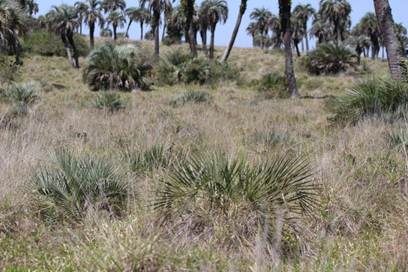
Butia is a genus of palm trees (Arecaceae) that occurs in South America, whose 24 species are distributed in Brazil, Paraguay, Uruguay, and Argentina. These palms usually occur grouped, composing ecosystems that have great scenic, biodiversity and historical-cultural value. These Butia palm groves ecosystems are known as palmares in Paraguay, Uruguay, and Argentina, and as butiazais in Brazil. They comprise a valuable diversity of associated native flora and fauna, where trophic chains and energy flows characteristic of the community occur1. The grasslands associated with these ecosystems have a diversity of herbaceous species, mainly grasses and legumes, with recognized forage, medicinal and ornamental value2)(3) .
Many species of Butia produce bunches of edible fruits, popularly known as butiás, yatay or coquinho-azedo, depending on the region. These species have deep connections with the culture and history of the people who inhabit the territories where they occur4)(5) . These links between people and the palm grove, especially the consumption of fruits, have been recorded in archaeological sites dating back to the early Holocene6)(7)8)(9)10. Already in colonial times, the use of palms to build corrals to enclose livestock and for traditional uses such as fresh consumption, making caña with butiá or “coconut coffee”, demonstrate the socio-cultural value of Butia palms5)(11) . At the beginning of the 20th century, leaves of many species of Butia were used to produce vegetable horsehair, a type of fiber used to fill mattresses and upholstered furniture12. However, with the advent of the petrochemical industry, this material was no longer produced13)(14) .
Currently, in addition to fresh consumption, butiá is used to produce various types of food, beverages and crafts14)(15) . The plants are also used in rural and urban landscaping4. However, they are still considered underutilized species with high potential to generate income. The Butia palm groves ecosystems are a source of various environmental services, such as cultural, production and habitat maintenance3)(16) .
Despite the biological, social and cultural value of the Butia palm groves, they are threatened both by their directdestruction and by the lack of regeneration caused by overgrazing by livestock. The main challenge that arises is how to conserve the Butia palm groves ecosystems and their intrinsic biodiversity, given the production needs of rural properties, in search of sustainable development. One strategy for conserving these agroecosystems is the promotion of their multiple uses (beverage and food production, handicrafts, ornamental and pharmaceutical use, landscaping, meat production, and tourism). This could be done by the adoption of good management practices, to guarantee their permanence for future generations and ecosystem sustainability, considering environmental, social, and economic perspectives.
In this context, based on what is established in international agreements (the Convention on Biological Diversity17, the International Treaty for Plant Genetic Resources for Food and Agriculture18, and the UN Sustainable Development Goals19), the institutions committed to the topic of conservation and sustainable use of Butia palm groves in Uruguay, Brazil and Argentina have joined their forces.
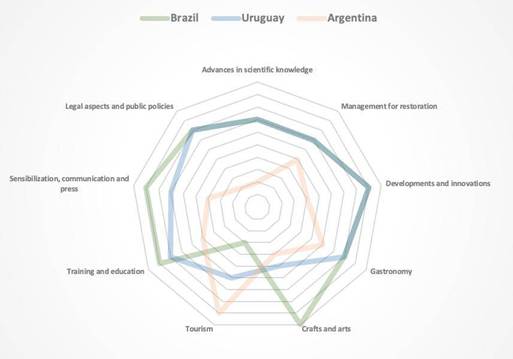
This work describes and evaluates the activities carried out under the Rota dos Butiazais/Red Palmar international network during the period November 2015-August 2024. The evaluation was performed by the authors based on their accumulated knowledge and direct involvement in the network’s activities in Brazil, Uruguay and Argentina. This approach was chosen due to the practical and dynamic nature of the network, which makes a formal systematic review challenging. To facilitate the discussion and outline a guideline for future activities of the Rota dos Butiazais/Red Palmar, we assigned scores for each main area ranging from 0 to 5 based on our assessment of the results obtained by the three countries in the network. These scores, which reflect our direct observations and accumulated knowledge, were visualized in a web graph to provide a comparative overview of the progress achieved by each country across different axes.
The evaluation criteria were based on a deep authors' familiarity with the network’s processes, actions, and products, due the ongoing and direct involvement, and the experience gained by active participation in meetings, workshops, field events, and other network activities. This hands-on engagement allowed us to assess the progress in each axis with a nuanced understanding of the network’s dynamics.
2. Project Participants: A Network of Knowledge
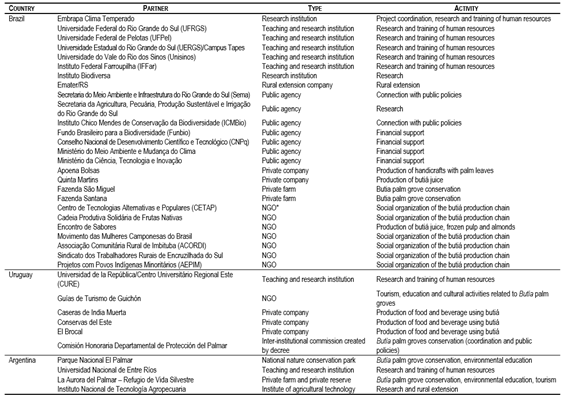
We are convinced that a research, development and innovation network connecting very diverse stakeholders could strengthen people's ties with these palms and encourage its conservation through the use. In this way, Embrapa proposed the construction of an international network to strengthen conservationthrough a sustainable use of these genetic resources and biocultural landscapes. This network was named Rota dos Butiazais (in Portuguese) and Red Palmar (in Spanish), and now, after nine years of activities, it is consolidated as an international network that brings together a wide range of people, institutions and social organizations (Table 1) committed to the use of butiás and the conservation of the remaining Butia palm groves ecosystems. This was an innovative project, involving a diversity of stakeholders and proposing an exchange of knowledge between different communities that had different ways of relationship to these plants20. The stakeholders participating at that network are farmers, ranchers, extractivists, artisans, chefs, tourist guides, landscapers, consumers, environmental technicians, teachers, students, researchers, businesspeople, public managers, agribusinesses, and civil society organizations.
Embrapa Clima Temperado (Brazil) and Universidad de la República (Uruguay) have been conducting several research and development projects since 2010, focusing on the conservation and sustainable use of Butia palm groves, with the support of several funding sources. In 2012, an international cooperation project between these two institutions from Brazil and Uruguay was approved under the Capes/Udelar call for proposals, with the aim of contributing to the conservation, characterization and sustainable use of Butia odorata (Barb. Rodr.) Noblick in the Brazilian and Uruguayan Pampa biome, establishing the basis for the creation of the Rota dos Butiazais/Red Palmar, which started in November 2015.
Initially financially supported by the Brazilian Ministry of the Environment (from 2015 to 2017), the Rota dos Butiazais/Red Palmar received further sponsorship from the National Council for Scientific and Technological Development (CNPq) and the Brazilian Ministry of Science, Technology and Innovations (from 2018 to 2021); the Global Environment Fund and the Brazilian Biodiversity Fund (from 2021 to 2024).Recently, in Brazil, Finep (Studies and Projects Funding) approved further funding that guarantees the continuity of the Rota dos Butiazais/Red Palmar until 2027.
At the beginning, the objective of the Rota dos Butiazais/Red Palmar was to promote the conservation and sustainable use of biodiversity associated with Butia palm groves. Over time, the network objectives evolved to strengthen the butiá production chain associated with income generation, social inclusion, and conservation of Butia palm groves.
3. Process of People Integration, Organization and Meetings
Initially, in 2015, the network was limited to areas associated with Butia palm groves from the species Butia odorata (municipalities of Santa Vitória do Palmar, Tapes, Barra do Ribeiro and Barão do Triunfo), Butia lallemantii Deble & Marchiori (Alegrete, Manoel Vianna and São Francisco de Assis) and Butia yatay (Mart.) Becc. (Giruá and Quaraí), all of them in Brazil. At that time, the inclusion of localities associated with B. odorata palm groves in Uruguay (Castillos and San Luis, Rocha) and B. yatay palm groves in Argentina (Entre Rios) and Uruguay (Paysandú/Río Negro) was planned for a second phase.
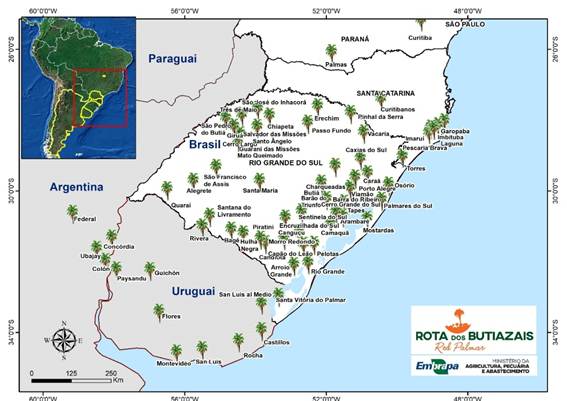
However, in a few months, the project team strengthened international ties, and the network grew much more than had been imagined. How did this happen? We believe that this was the result of existing partnerships between Embrapa and Brazilian universities, the Universidad de la República (Uruguay) and Parque Nacional El Palmar (Argentina), as well as communication and press outreach activities, meetings and workshops that brought people from different segments of society together. In addition, there was coordination with non-governmental organizations and other networks whose interests were socio-biodiversity, neglected and underutilized native plants, and food based on natural products, such as the Slow Food movement and the solidarity-based production chain of native fruits in Rio Grande do Sul. The network gained new followers among butiá lovers and expanded, currently reaching a total of 73 municipalities, 60 in Brazil, 9 in Uruguay and 4 in Argentina (Figure 1).
The researchers from the institutions involved add their capabilities and expertise to continue this international collaboration in pursuit of the common objective for all: promoting the strengthening of the butiá production chain associated with income generation, social inclusion, and conservation of Butia palm groves ecosystems. Besides research done by different institutions related to the use, management, and conservation of Butia palm groves, local leaders promoted events like gastronomic competitions, workshops, seminars, and tourist tours in the Butia palm groves.
At the First International Meeting of the Rota dos Butiazais, held in Ubajay, Argentina, in 2016, participants from Uruguay and Argentina chose to name this network as Red Palmar (in Spanish, red means network, and palmar refers to palm groves).
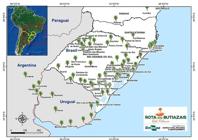
Current map (2024) showing the municipalities that compose the Rota dos Butiazais/Red Palmar network in Brazil, Uruguay and Argentina
With the growth of the Rota dos Butiazais, there was a need to establish prerequisites for interested municipalities to be recognized as an integral part of the network. The municipality should have a focal point that carries out activities in favor of the Butia palm groves conservation and the sustainable use of butiás, and at least one of the following elements:
-
• Butia palm groves ecosystems,
-
• a significant amount of Butia palms in the courtyards of houses,
-
• artisans who use parts of these palms,
-
• teaching/research institutions that develop activities with Butia species,
-
• NGOs that encourage the use of these palms, and/or
-
• tourists offer with attractions, services and events related.
After nine years of activities, we consolidate ourselves as an international network that brings together a wide range of people, institutions and social organizations interested in the use of butiás and the conservation of the remaining Butia palm groves ecosystems14)(20)21)(22) .
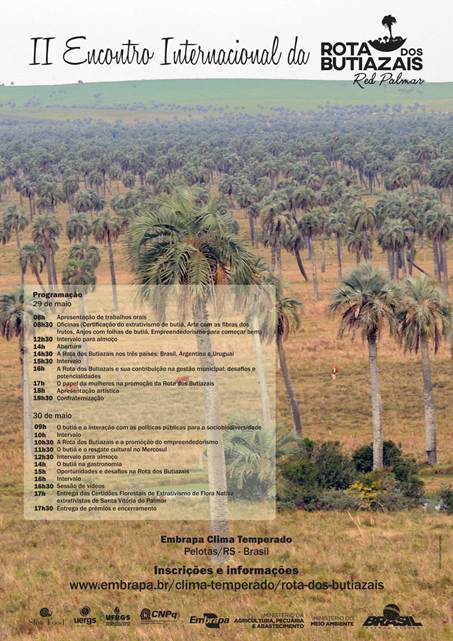
As a strategy to strengthen the international network with the exchange of knowledge between the stakeholders, five International Meetings of the Rota dos Butiazais/Red Palmar were held: in Ubajay/Argentina (2016), Pelotas/RS (2018 - Figure 2), Guichón/Uruguay (2018), Rocha/Uruguay (2019), and in Giruá/RS (2023). These International Meetings had the participation of people and institutions from the three countries, both in the organization and attendance.
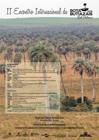
Promotional poster for the 2nd International Meeting of the Rota dos Butiazais/Red Palmar, held in Pelotas, Brazil
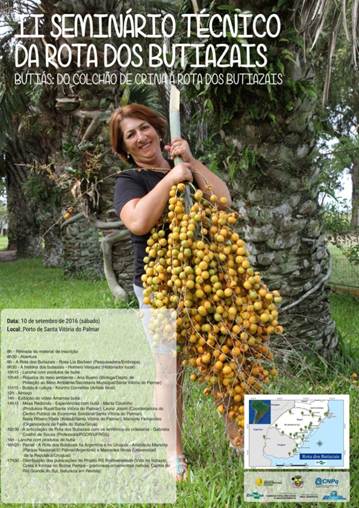
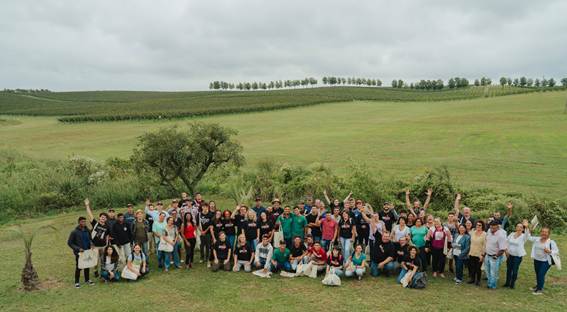
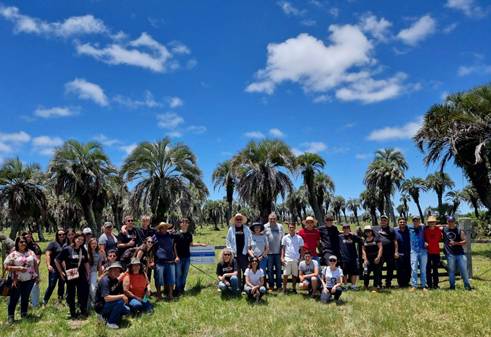
In Uruguay, in 2016, the Seminar “The palm grove: Update on the alternatives and challenges for its conservation and sustainable development” was held in Rocha and it was very important to introduce the network and recruit new members. In Argentina, in 2018, within the framework of the “Encuentro de Frutos Nativos”, the Red Palmar Argentina was created, which has remained active by holding several meetings over the years. In Brazil, from 2016 to 2024, 11 Technical Seminars were held to discuss different topics related to the Rota dos Butiazais/Red Palmar: in Porto Alegre/RS (2016), Santa Vitória do Palmar/RS (2016 - Figure 3), Barra do Ribeiro/RS (2016), Imbituba/SC (2017), Butiá/RS (2017), Tapes/RS (2019), Giruá/RS (2019), Camaquã/RS (2022), Encruzilhada do Sul/RS (2023 - Figure 4), Imbituba/SC (2024) and Santa Vitória do Palmar (2024).
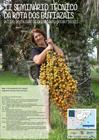
Promotional poster for the 2nd Seminar of the Rota dos Butiazais/Red Palmar, held in Santa Vitória do Palmar, Brazil
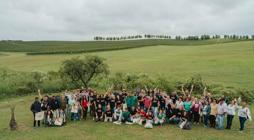
Participants of the 10th Seminar of the Rota dos Butiazais/Red Palmar, held in Encruzilhada do Sul, Brazil
4. Advances in Scientific Knowledge
The scientific advances presented below are the result of the Rota dos Butiazais/Red Palmar. This is not a review of everything that has been done related to Butia, but only of the scientific advances resulting from a multi-institutional team linked to our network.
4.1 Food Science
Analysis of bioactive compounds and functional properties of ripe butiá fruits showed high contents of vitamin C, carotenoids and phenolic compounds from fruits collected in Brazil23)(24)25. A study carried out by the Faculty of Agronomy in Uruguay found no differences on nutritional quality between yellow, orange or red fruits, and that the consumption of 100 g of butiá fruits in natura would provide 14% of the dietary fiber, 8% of beta carotenes and 57% of the vitamin C required daily by an adult26.
In Brazil, a study identified 22 phenolic compounds in ripe butiá fruits and showed that the composition of phenolic compounds varied between Butia species27. The high content of phenolic compounds makes butiá an excellent source of natural antioxidants for food and pharmaceutical applications. The antioxidant and anti-hyperglycemic activities of ripe fruits of Butia catarinensis Noblick & Lorenzi, Butia eriospatha (Mart. ex Drude) Becc., and B. odorata were evaluated25. The results showed that the fruits of these species can be used to prevent diseases associated with aging, such as cardiovascular and neurological diseases, and to control glycemic spikes after meals, characteristic of type 2 diabetes. The anti-hyperglycemic effect was verified in vitro, by the inhibition of the enzymes α-glucosidase and α-amylase, which promote the slowing down of carbohydrate breakdown, glucose absorption in the intestine and transport to the bloodstream, to reduce the incidence of glycemic spikes. Antioxidant activity was identified by the ability to capture hydroxyl radicals and nitric oxide, radicals that are naturally produced by the body and that in excess can cause damage at a cellular level.
4.2 Cartography
Cartography was the tool used to assess the integrity of the Butia palm groves ecosystems. With it, not only the locations of these groups of palm trees were mapped, but also the density of palm trees in these populations.
For the Castillos' palm grove, a density map was constructed (number of palm trees per hectare: <50, 50-150, 150-250, 250-350, >350)28. This allowed, by superimposing layers in a Geographic Information System (GIS), to obtain detailed information on the area and density of palm groves for each rural area and property. This analysis identified 212 properties with palm groves, although only 18 of them have 68.9% of the palm grove area (6952.4 hectares). This tool is highly valuable for designing conservation policies and allocating incentives29.
Embrapa Clima Temperado developed a methodology for mapping Butia palm groves based on high spatial resolution remote sensing images and field assessments30. This methodology makes it possible to distinguish individual Butia palms and, therefore, count the individuals and estimate their density per hectare. This methodology was used to map the Butia palm groves of Tapes and Barra do Ribeiro municipalities in Rio Grande do Sul state (Brazil), and to quantify the number of palms in the region31. The results indicate a continuous area of Butia palm groves ecosystem occupying 2,997 hectares on five farms, with the presence of approximately 307 thousand palms of the species B. odorata in reproductive age. The occurrence of a large continuous area of Butia palm grove crossing these farms constitutes a large ecological corridor. The remnants of B. catarinensis in Imbituba municipality in Santa Catarina state were also mapped. This species was found in areas of shrubby and grassland restinga, occupying approximately 504 hectares in addition to 53 locations with smaller clusters, presenting different states of conservation and population densities32.
4.3 Ecology
The results of research produced by several institutions linked to the Rota dos Butiazais, over several years of studies, in the Butia palm grove maintained by São Miguel Farm, were brought together in the book by Tozetti and others16. Located in the municipality of Tapes, in the Brazilian Pampa biome, São Miguel Farm maintains an area of 750 hectares under cattle management with the best preserved Butia palm grove ecosystem (Butia odorata species). The publication brings together data on the paleoenvironment and paleoclimate that contributed to the formation of this ecosystem33, the native flora associated with the Butia palm grove34, the bird species35 and the mammals that live there36, the floral visitors of Butia odorata37, the anuran amphibians associated with this ecosystem38, the importance of the Butia palm grove for amphibian reproduction39)(40) , and the livestock farming as a strategy for the in situ conservation of genetic resources in this ecosystem41.
In the Tapes' palm grove, in Brazil, 2,290 insects were collected visiting the flowers of Butia odorata37. They were classified into 9 orders, 42 families and 140 species. These numbers demonstrate the great diversity of life that is sustained by the butiá flowers. In turn, in the Castillos' palm grove, in Uruguay, 498 morphospecies were recorded distributed in 41 families of the order Coleoptera, including new records for Uruguay and two species of phytophagous for butiá -Coraliomela quadrimaculata and Rhinostomus barbirostris, the latter being the most abundant42.
In the São Miguel Farm, 261 species of herbaceous and subshrub flora were identified, grouped into 170 genera and 54 families34. The families Poaceae, Asteraceae, Fabaeae and Cyperaceae presented the largest number of species. In a grassland of the Castillos' palm grove (Rocha, Uruguay), 70 taxa from 23 plant families were found, with 57.1% belonging to the Poaceae family2. Furthermore, at the level of the palm grove landscape, including natural grasslands, forests, wetlands and rocky outcrops, 302 native taxa belonging to 224 genera and 87 families were identified, mostly Poaceae (16.6%) and Asteraceae (16.9%). Among these taxa, numerous plant genetic resources with diverse uses stand out: medicinal, ornamental, fodder, food, timber and fiber29.
After evaluating the responses of taxonomic and functional diversity on grassland communities to palm density and grazing intensity43, researchers recommended that grazing intensity management must be based on the autochthonous tree density, applying higher grazing intensity in areas with higher density of encroaching plants, in addition to maintaining other regions conducive to Butia palm regeneration through fallows.
4.4 Local Knowledge, History and Biocultural Landscapes
Butia odorata palm grove in southeast Uruguay is a particular landscape of the Pampa biome, which has been inhabited and transformed by human populations since pre-historic ages. Analysis done by researchers from Uruguay support the idea of these ecosystems as a landscape under construction since the Holocene, through a coevolutionary process with humans, resulting from the historical interaction between culture and nature5. They particularly discuss the changes that palm grove landscapes may have experienced during the Spanish/Portuguese colonization period until nowadays, integrating the ecological, cultural and socioeconomic aspects through a historicalperspective of the past and ongoing processes of landscape domestication. This could serve as the basis for a participatory definition of the most appropriate instrument for conservation through sustainable use.
Moreover, several palm corrals that were built in colonial times to enclose livestock have also been the subject of study in southeastern Uruguay11, regarding their construction methods, age and origin. These corrals are part of the cultural heritage of the palm grove landscape, requiring actions for their conservation and enhancement.
A semi-structured interview with 14 network participants from the three countries showed that the bond shared between people and the Butia palm goes beyond national borders. Most people believe that the conservation of Butia palm groves can be accomplished through appropriate extractivist practices, sustainable management, and pertinent public policies and specific legislation aimed at protecting this environment44)(45) . Besides, upon an interview with 20 other key members of the network, four thematic categories were highlighted: life story with butiá, memories related to butiá, breaking the endocarps and eating almonds, and cachaça with butiá. The participants' accounts demonstrate childhood memories, games, and personal and family memories, which are portrayed in customs and are social representations brought to the present day46.
Another relevant work was the systematizationof the range of uses of B. odorata in southeastern Uruguay, based on the review of written and audiovisual references, as well as interviews with local actors. A total of 48 ways of use were identified, 36 previously cited and 12 new ones. The versatility of uses linked to different parts of the palm tree is highlighted, with the fruits and leaves being the main but not the only ones. The uses with the greatest number of reports were the liquor made from the fruit, the “coconut coffee” made from the almonds, the filling of cushions with the fibers retrieved from the leaves, and the production of jelly from the fruit. Among the novel uses, the ornamental and landscaping use of the butiá palm stands out12.
After interviewing 36 people to investigate the significance of B. eriospatha in Atlantic Forest biome in Brazil, a study reported 41 uses for 8 parts of the plant, including production of food, drink, handicrafts and utilities, in landscaping, medicinal applications, and celebrations25. The main uses were the consumption of the fruit in natura, almonds, liquor, and cachaça flavored with butiá. The leaf was the plant part with the most different uses. The use of the leaves was highlighted in festivities and religious celebrations, such as June festivals and “Palm Sunday”, one of the most important Christian celebrations. In the past, the commercialization of butiá leaf products was an important economic activity for five of the families interviewed. The species B. eriospatha is an example of how a native plant can reach symbolic and affective dimensions, helping to build the vision of belonging and the social construction of a territory.
Studies related to the local knowledge of the plant genetic resources that are distributed along the Butia palm grove landscape in Castillos (Uruguay) as part of a strategy for the conservation of the biocultural landscape showed that 106 species are being used by local residents withmedicinal, construction, food, ornamental, aromatic and fuel uses47. Furthermore, 149 landraces of horticultural species were further identified, mainly squash, beans, sweet potatoes, corn, and bell peppers/chili peppers1)(5) .
Finally, work related to human-environmental relationships and how these affect the perceptions of the palm grove landscape and its conservation is highlighted48)(49)50.
5. Management for Restoration
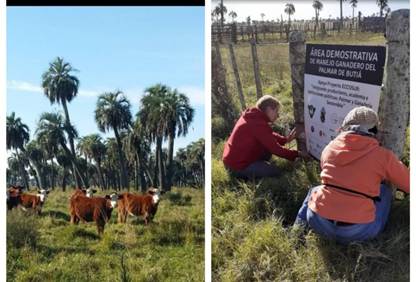
Butia odorata palm groves in southern Brazil and eastern Uruguay are seriously affected by overgrazing. The Butia palm groves are centenarians, and no regeneration is observed in these production systems. To develop a friendly productive proposal that allows their conservation associated with livestock, different grazing practices were evaluated in the Castillos' palm groves (Uruguay) to favor the Butia regeneration and grassland conservation. It was found that permanent grazing exclusions rapidly changed to shrubby vegetation, unsuitable for regeneration of Butia palms. On the contrary, winter exclusions and continuous grazing along the rest of the year13 provided improved Butia regeneration as well as increased the composition of more valuable forage species51. To evaluate this practice, an experimental area was established in Tapes, Brazil (Figure 5). The results obtained in the number of new Butia plants already established are astonishing52. More recently, seven demonstration areas of this livestock management have been installed on private properties of the two B. odorata palm groves in Uruguay (Figure 6), in which both the young palms and the evolution of the weight of the cattle are monitored49.
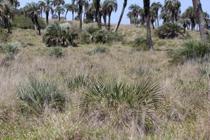
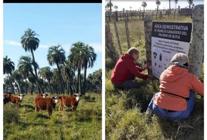
A guideline to monitor the restoration status of Butia palm groves on native grasslands under livestock management53 was developed as a result of a cooperation between Embrapa and the Rio Grande do Sul Environment Secretariat. It contains technical guidelines to support the restoration of these ecosystems and is important for restorers to understand basic aspects of the ecology of these ecosystems and the restoration methods to be considered before they can move forward with the systematic monitoring of ongoing projects.
Another type of restoration practice that is beginning to be tested is the transplantation of young palms originating from the germplasm of each Butia population54.
6. Developments and Innovations
The diversity of products created since the network came into operation has been impressive. Artisans and artists, farmers, chefs, butiá lovers, organizations and small businesses from different localities have contributed and made this possible.
In Brazil, artisans have been giving free rein to their creativity, adapting techniques and creating new ones, to explore the uses of leaf fibers and fruit pulp, as well as endocarps, spathes and rachillae in the development of a wide range of products. These include bags, backpacks, wallets, notebook folders, mats, slippers, hats, rugs, decorated boxes and bottles, trays, lamps, planters, various decorative objects, earrings, necklaces, bracelets and key chains. Uruguay and Argentina have an increasing number of craft initiatives, and there is a need for training and incentives to enhance it.
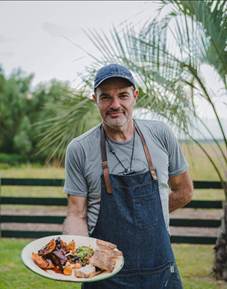
New gastronomy products include, to name just a few, mustard, chutney, beer, draft beer, kombucha, vinegar, kefir and cookies, some of them developed in Brazil, while others are from Uruguay and Argentina. The Amargo Frutal, a yerba mate mix containing small pieces of dehydrated B. yatay, is a standardized product that was generated from the work of students in science clubs at the Agricultural School of Quebracho (Uruguay). Universities in the region and research institutions have also worked on product development, as is the case of the “Sabores del Yatay” project, which aimed to develop a gastronomic tourism product based on the sustainable use and revaluation of the B. yatay fruit, work done by INTA Concordia, the Municipality of Ubajay, El Palmar National Park and the private refuge La Aurora del Palmar in Entre Ríos (Argentina). Another example of the collaborative work between universities, public institutions and private actors is the one of Universidad Nacional de Entre Ríos for the development of alternative ingredients, sweets and desserts based on B. yatay. Added to this multitude of initiatives are the gastronomic competitions, such as the one organized a few years ago by the “Alma de Yatay” event in Ubajay, Argentina (Figure 7).

Chef Jacinto Echandia showing his dish: rice caponata with pork ribs and yatay barbecue, Gastronomic competition “Alma de Yatay”, Ubajay, Argentina
A highly relevant product of the Rota dos Butiazais/Red Palmar was the book Butiá para todos os Gostos15, published by Embrapa and produced in partnership with the Slow Food movement. It brings 141 recipes for dishes and drinks, which were created by butiá lovers, teachers and students of gastronomy courses, and chefs, bringing the plurality of very different views that people have on the butiás. The publication had international recognition and received the Gourmand Award in 2023, as the best gastronomy book of the year available online for free. Other publications on this topic deserve to be mentioned, such as the chapter on butiá in the book Gastronomía Regional Uruguaya55 and the article on butiá in the newsletter La cocina al rescate de los cultivos olvidados56 of the Ibero-American Network of underutilized and marginalized crops with agri-food value of CYTED (Ibero-American Science and Technology Program for Development).
7. Tourism
In the town of Ubajay, in the province of Entre Ríos, Argentina, tourism around the Butia yatay palm groves is most developed. El Palmar National Park, created in 1965, recovers a total area of 8,200 hectares57, and receives more than 150,000 visitors per year. In turn, the private establishment “Aurora del Palmar”, which is a wildlife refuge also located in the heart of the B. yatay palm grove in Ubajay58, receives between 20,000 and 30,000 tourists a year. In both cases, tourism activities are closely linked to environmental education programs as well as to many activities supporting development and income generation from local products, gastronomy and crafts manufacturing ventures. Also in Argentina, in the Iberá National Park (Corrientes), where B. paraguayensis palm groves are found, around 60,000 visitors are received per year59.
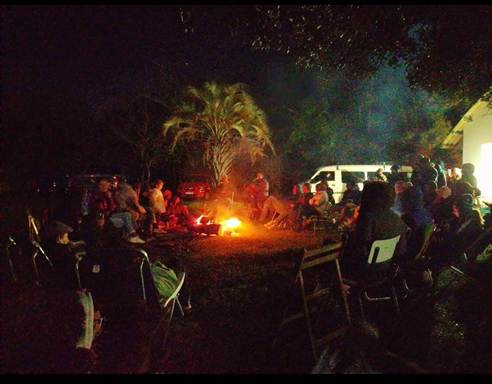
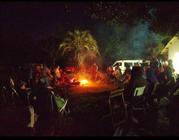
In the B. yatay palm grove in Guichón (Paysandú, Uruguay), the Tourist Guides group organizes visits to the palm grove and events such as “Full Moon in El Palmar”, which has been held since 2016, only interrupted in 2020 and 2021 due the Covid-19 pandemic (Figure 8). The “Festa do Butiá”, now renamed to “Feira do Butiá”, is an annual event held in the municipality of Giruá, in Brazil, which brings together producers of food, beverages and crafts based on butiá. The “Balaio de Sabores” is a gastronomic competition held in that event, which awards prizes to the best dishes and drinks prepared with butiá.
In Brazil and Uruguay, tourism has not yet been developed according to its potential. Although there is academic work in consultation with local stakeholders to establish different ecotourism circuits in the Butia palm grove in Castillos, Uruguay54, these circuits have not yet been implemented. Meanwhile, butiá-related activities are limited to a few small private enterprises open to visitors, such as “Palmar de Lucas” in Castillos (Uruguay) and in the localities of Tapes and Imbituba (Brazil).
The participation of different businesses linked to butiá in local, national and regional fairs and events is another way of bringing tourists closer to the Butia landscape as well as to highlight the cultural and scenic value of Butia palm groves60. The Slow Food movement, with representation in Uruguay and Brazil, has been important in this regard14)(15)61.
8. Training and Educational Activities
The network has promoted formal education and training activities as well as a set of informal activities organized by universities, Embrapa, entrepreneurs and local organizations, involving the most diverse stakeholders related to the sustainable uses of butiá and the conservation of Butia palm groves. The activities included training workshops on the utilization of butiá fruits in gastronomy and different parts of the palm tree in handicrafts, as well as several environmental education workshops addressed to elementary school children, and field trips designed to discover and learn about the Butia palm groves (Figure 9).
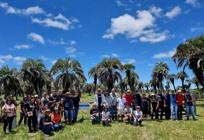
Field trip on livestock management practices in grassland for the restoration of the Butia palm groves in Tapes, Brazil
Among the formal activities, courses have been held at universities such as the continuing education course “Tools for sustainable management of the Palmar de Butiá in Rocha”, held virtually in 2020 by the Centro Regional Universitario del Este (CURE - Udelar) of Uruguay, which had participants from the three countries of the network. In Brazil, the Reference Circle in Agroecology, Sociobiodiversity, Sovereignty and Food and Nutrition Security (AsSsAN Círculo de Referência), working together with the Postgraduate Program in Rural Development (PGDR) at Universidade Federal do Rio Grande do Sul (UFRGS), promoted web conferences related to sustainable use and conservation of Butia palm groves. The Rota dos Butiazais/Red Palmar has also been included in some university courses, and several students have developed their undergraduate and postgraduate theses with topics related to Butia palm groves.
In technical schools and universities, the preparation of products and dishes and the development of innovative recipes have been part, for example, of the network’s activities in B. yatay, such as at the Universidad del Trabajo in Uruguay (Guichón and Quebracho, Uruguay), and INTA Concordia and Universidad Nacional de Entre Ríos (Argentina).
Considering only the post-pandemic period (2022, 2023 and 2024), in Brazil, 47 workshops were held (cooking with butiá, good practices for fruit processing, crafts with butiá leaves and fibers, environmental education, seedling rescue, environmental restoration in the Pampa biome, and entrepreneurship), which resulted in the training of 983 people. These events took place in the Brazilian municipalities of Barão do Triunfo, Camaquã, Eldorado do Sul, Encruzilhada do Sul, Giruá, Imbituba, Porto Alegre, Rio Grande, Salvador das Missões, Sentinela do Sul, Tapes and Vale do Sol. They brought together the most diverse beneficiaries of the Rota dos Butiazais, considering generational succession and gender equity.
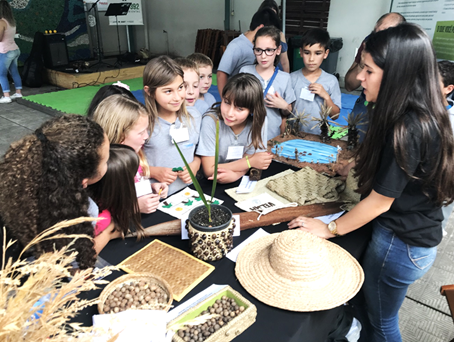
Environmental education workshops were held in schools from Brazil and Uruguay (Figure 10). These workshops involved discussions about the use and conservation of Butia palm groves, exhibition of handicrafts and photographs, film screenings, and creation of crafts using the leaves (such as braids to make little fish) or fruit fibers (such as making decorative masks).
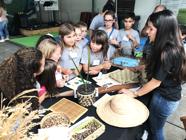
Environmental education workshop for children aged 9 and 10 years old, from public schools, at the Public Market in Pelotas, Brazil
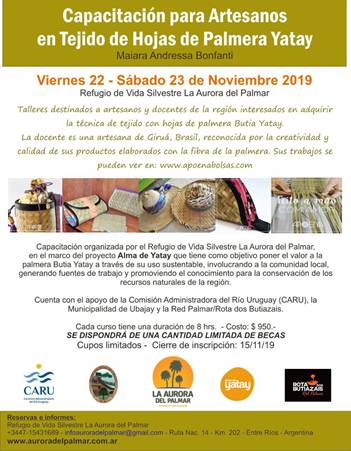
In Argentina and Uruguay, with the support of entrepreneurs from Brazil, several training activities for the use of butiá leaves and fruits by artisans have been done since 2016: in Ubajay (Argentina - Figure 11), and Guichón, Rivera and Castillos (Uruguay).
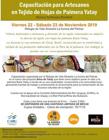
Promotional card for the craft workshop held in Argentina, taught by a Brazilian artisan, one of the connections resulting from the network
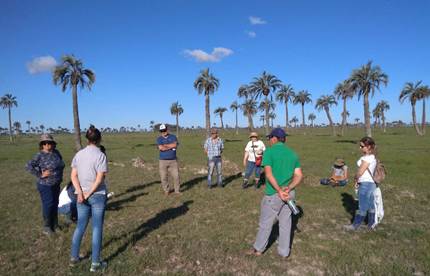
Another level of training is related to livestock producers aiming to set up demonstration areas for grazing management in the palm grove to promote restoration. During the years that the network has been operating, several field days have been held, both in Uruguay and Brazil (Figure 12).
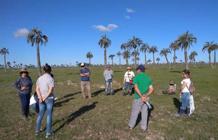
Field day on livestock management of palm groves in the Sexta de Rocha, Palmar de San Luis, Rocha, Uruguay
9. Sensibilization, Communication and Press
The different activities developed by the network have been the subject of several reports in the media, both in the broadcast mediaand written press, with local and national coverage. Several videos have been produced for scientific dissemination. Two television programs broadcasting throughout Brazil and with a major impact on public opinion deserve special mention: i) A special report on the Globo Rural program, the main program on agriculture on Brazilian television (broadcasted in May 2023), and ii) an interview on the Conexão Ciência program (April 2020). The videos are available on YouTube, and they can be accessed on the Rota dos Butiazais/Red Palmar website62.
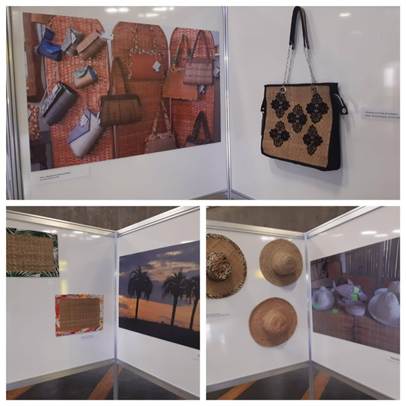
An exhibition of images and products from the Rota dos Butiazais/Red Palmar was displayed in several locations along the Rota dos Butiazais in the three countries involved. The photos illustrate various Butia palm groves in Brazil, Uruguay and Argentina, with images of the genetic diversity for Butia species and the ways in which the fruits are commercialized, besides artisanal products (Figure 13). This exhibition played an important role in publicizing the network and captured the attention of people of various ages and interests.
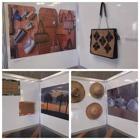
Exhibition of images and products from the Rota dos Butiazais/Red Palmar displayed at Brasilia, Brazil
10. Legal Aspects and Public Policies
One important result from the network was a consequence of a debate between participants about the need to establish an international butiá day. This debate was held online among many people from different parts of the Rota dos Butiazais/Red Palmar. It started in the WhatsApp group, which brings together more than 250 members from the three countries involved and continued in some meetings held via Google Meeting. The group chose March 13th as the most appropriate date for establishing the butiá day, as in the three countries from the network the butiá fruits are ripe at that time, and there would be no coincidence with the Easter holiday for the next 50 years. After that, in Uruguay, Law 20,170, in 2023, established the date as the National Butiá Day63. In Brazil, Law 15,922, in 2022, established the same date for butiá day in the State of Rio Grande do Sul64. In Argentina, the formalizationof this date is under discussion with legislators. With this, progress is being made so that March 13th is really recognized as International Butiá Day. In 2024, several butiá day celebrations were held involving different communities, in Castillos and Guichón (Uruguay), Tapes, Garibaldi and Porto Alegre (Brazil), and Ubajay (Argentina), with talks, workshops, tours in the palm groves and tasting of products with butiá.
Within the framework of the actions undertaken by the Rota dos Butiazais/Red Palmar in Uruguay, a meeting between academia, public institutions and producers was possible. Based on this conjunction of interests around the conservation and sustainable use of the Butia palm groves, negotiations were made with the Departmental Board of Rocha, which through a series of exchanges decided to form an ad hoc inter-institutional commission that operated between 2017 and 2020. The main product of the commission's work was the formulation of a departmental decree that was approved in 2020 and declared the conservation of the palm groves in Rocha to be of “general interest”, created the Departmental Honorary Commission for the Protection of the Butia Palm Grove (CHD), the “Rocha Departmental Board Award for Environmental Conservation”, and entrusted the commission with formulating a territorial planning instrument that “establishes a statute for the protection and management of the palm grove based on the establishment of appropriate grazing management practices for the regeneration of the palm grove and the conservation of the natural field”. The CHD has been in operation since 2020 and is made up of councilors from different political parties, representatives of the departmental government, ministries, and universities, and delegates from producers. In addition to organizing the commemoration of butiá day, it has awarded prizes in 2023 to producers and settlers who have demonstration areas for the livestock management of Butia palm groves, and in 2024 to entrepreneurs who make products derived from butiá. Meanwhile, some of the members of the CHD made contacts with the two departmental representatives in the National Parliament, which allowed the promulgation of National Law No. 20170 in 2023 that, in addition to establishing March 13th as the day of the butiá, declares of “general interest” the promotion and support of art activities, the realization of festivals linked to the butiá and the development of products derived from the butiá; the recognition of the landscape, biodiversity and historical-cultural values of the Butia palm groves; declares the palm grove as biocultural heritage and the conservation and sustainable use of the Butia palm grove of national interest. It also creates -although not yet regulated- a plan for the articulation of national and departmental public policies for the conservation of this unique landscape in the region, for its regeneration within the framework of sustainable use.
11. Concluding Remarks
The authors believe this knowledge-based approach provides a valid and realistic view of the network’s dynamics. Although the evaluation was not formal or systematic, it was grounded on the authors' ongoing commitment to the network and its development over the years, making it a reliable reflection of the actions and outcomes observed. Figure 14 presents the web graph with the results obtained by the three countries in the network, which was designed based on the authors' experience and knowledge. Since the inception of Rota dos Butiazais/Red Palmar in 2015, the authors have participated in all meetings, courses and workshops organized by the initiative. They are familiar with all the locations that make up the network and play a key role in organizing events and managing the website, social media, and the WhatsApp group with stakeholders.
The Rota dos Butiazais/Red Palmar has achieved significant milestones and diverse initiatives have been essential for increasing the visibility and protection of these ecosystems.
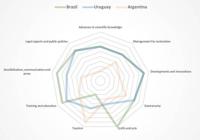
Web graph comparing the results obtained by the Rota dos Butiazais/Red Palmar in Brazil, Uruguay and Argentina, the three countries that form the network
The development of artisanal and gastronomic products has been the fastest-growing area within the network, with Uruguay leading in terms of organization and production infrastructure, and Brazil standing out with crafts. These initiatives not only promote the sustainable use of Butia palm groves but also generate income for local communities, strengthening the region’s cultural identity. Argentina, in turn, is in a growth phase but still needs to improve the organization of its production chain. Overcoming these obstacles requires a joint effort to enhance technical support, develop incentive policies, and increase the visibility of butiá-related products.
The real-world achievements of the Rota dos Butiazais/Red Palmar network, such as the establishment of butiá day and the design of policies recognizing the cultural and ecological value of Butia palm groves, exemplify the practical application of the scientific insights presented by the paper by Sosinski and others3. Further research had underscored the relevance of recognizing Butia palm groves as ecologically significant non-forest ecosystems that are integral to the biodiversity and cultural heritage of southern Brazil, Uruguay, and Argentina5. The network’s collaborative efforts to establish legal protections, promote sustainable management practices, and engage local communities directly address the challenges highlighted by the authors, illustrating how scientific recommendations can be transformed into concrete actions. By aligning conservation initiatives with scientific knowledge, the Rota dos Butiazais/Red Palmar network not only enhances the visibility and protection of Butia palm groves but also serves as a model to showcase how integrated, multi-stakeholder approaches can drive meaningful policy changes and conservation outcomes. This synergy between scientific research and community-driven actions highlights the vital role of collaborative networks in achieving sustainable conservation of unique ecosystems like the Butia palm groves.
The network has also played a key role in promoting sustainable management practices for Butia palm groves, including controlled grazing and the restoration of degraded areas. These practices have contributed to the conservation of Butia palm ecosystems and the maintenance of traditional livestock activities, especially in the Pampa biome. However, implementing these practices faces significant challenges, such as the lack of consensus on the best management methods, an issue still evident in Brazil, Uruguay and Argentina. The lack of local research validating the effectiveness of these practices in different contexts limits the confidence of managers and producers in adopting such measures. Added to this is the lack of government incentives for producers to adopt these practices.
Tourism associated with Butia palm groves, particularly ecotourism, has been growing, especially in Argentina, which stands out for managing areas like El Palmar National Park and the private establishment Aurora del Palmar57)(58) . The initiatives about palm grove-related tourism are just starting in Uruguay and Brazil, and inadequate tourism infrastructure and the lack of well-defined routes are challenges that limit the sector’s development. There is also an urgent need for reinforcing tourist guide training programs and promoting awareness of the ecological value of Butia palm groves among tourists. To make tourism an effective tool for conservation and economic development, it is essential to invest in infrastructure, training, and promotional public campaigns aligned with environmental conservation goals.
The network has been effective in integrating various institutions and communities across the three countries, promoting conservation, sustainable management, and the valorization of Butia palm groves. With the inclusion of 73 municipalities in Argentina, Brazil, and Uruguay, the Rota dos Butiazais/Red Palmar has become a model of international collaboration. However, this integration faces considerable challenges, such as the difficulties in harmonizing regulations across the countries and the lack of sufficient resources to expand participation from more isolated communities, with Brazil facing the greatest obstacles in this regard. The absence of institutions from Paraguay in this network, as well as representatives from critical regions from Argentina, Brazil and Uruguay, highlights the need for more effective engagement strategies, especially targeted to involve stakeholders who have not yet fully connected to the network.
Progress in environmental education and public awareness about the importance of Butia palm groves has been notable, with actions including workshops, educational events, and the inclusion of the topic in university curricula, with Brazil leading in environmental education. However, despite these initiatives, the continuity of these activities depends on funding and the ongoing engagement of local communities. Additionally, formal education, especially at universities, still needs to systematically incorporate traditional and scientific knowledge about Butia palm groves, creating an educational foundation that strengthens long-term conservation. To overcome these challenges, it is necessary to develop more comprehensive educational programs that encompass both technical training and societal awareness.
The comparative graph of the results obtained by the Rota dos Butiazais/Red Palmar in the three countries -Brazil, Uruguay and Argentina- highlights significant variations in performance and the implementation of conservation and sustainable management actions. As shown in Figure 10, Uruguay and Brazil display more balanced results in terms of policy integration, product development, and ecosystem management. Brazil still faces greater challenges, particularly due to the pressure from monocultures and urban expansion compromising the integrity of Butia palm groves. This suggests the need to strengthen technical and financial support, in addition to intensifying efforts in environmental education and training. The data analysis also reinforces the importance of adapting management strategies and public policies according to the specificities of each country, promoting an exchange of best practices among network members.
The Rota dos Butiazais/Red Palmar made a huge progress in enhancing the cultural, ecological, and economic value of Butia palm groves in Argentina, Uruguay and Brazil. However, there is still significant work ahead to ensure that the impacts of its actions are fully understood and maximized. Implementing impact indicators and monitoring methodologies will be crucial to measure outcomes and guide public policies and management practices more effectively. The comparative analysis of the three countries highlights the need for tailored strategies that address specific challenges, such as the need for greater technical and financial support and the reinforcement of successful practices. Strengthening coordination among research institutions and other stakeholders is essential, establishing a common agenda that prioritizes conservation and sustainable use. Meetings, seminars and conferences dedicated to the topic can serve as key platforms to expand dialogue, foster new collaborations and share best practices across the network. In this way, the network not only consolidates its achievements but also prepares us to face future challenges in an integrated and collaborative manner.
Acknowledgements:
Rota dos Butiazais/Red Palmar was supported by the Brazilian Ministry of Science, Technology, and Innovations (MCTI), by the National Council for Scientific and Technological Development (CNPq) (processes 441493/2017-3, 315202/2018-1 and 140811/2020-6), by the Global Fund for the Environment (GEF) under the Strategies for Conservation, Restoration and Management for Caatinga, Pampa and Pantanal Biodiversity (GEF Terrestrial), which is coordinated by the Ministry of Environment and Climate Change (MMA) and has the Inter-American Development Bank (IDB) as the implementing agency, and the Brazilian Biodiversity Fund (Funbio) as the executing agency. It received support through the public policy of Mandatory Forest Repositioning of the State Secretariat for the Environment and Infrastructure of Rio Grande do Sul State (SEMA/RS), with resources from CPFL. In Uruguay, the network was supported by the National Research and Innovation Agency (ANII in Spanish), the Scientific Research Committee (CSIC in Spanish), and the Departmental Government of Rocha (IDR in Spanish). The authors are grateful to Parque Nacional El Palmar and to all the institutions, NGOs and people who are part of the network.
References:
-
1. Rivas M, Barbieri RL. Butiá: Butia odorata (Internet). Montevideo: IICA; 2018 (cited 2025 May 26). 23p. Available from: Available from: https://www.procisur.org.uy/adjuntos/procisur_butia-procisur_67c.pdf
» https://www.procisur.org.uy/adjuntos/procisur_butia-procisur_67c.pdf -
2. Rivas M, Jaurena M, Gutiérrez L, Barbieri RL. Diversidad vegetal del campo natural de Butia odorata (Barb.Rodr.) Noblick en Uruguay. Agrocienc Urug. 2014;18 (2):14-27. Doi: 10.31285/AGRO.18.445.
» https://doi.org/10.31285/AGRO.18.445 -
3. Sosinski Jr EE, Urruth LM, Barbieri RL, Marchi MM, Martens SG. On the ecological recognition of Butia palm groves as integral ecosystems: Why do we need to widen the legal protection and the in situ/on-farm conservation approaches? Land Use Policy. 2019;81:124-30. Doi: 10.1016/j.landusepol.2018.10.041.
» https://doi.org/10.1016/j.landusepol.2018.10.041 - 4. Barbieri RL. Vida no butiazal. Brasília: Embrapa; 2015. 200p.
-
5. Rivas M, Dabezies JM, Del Puerto L. Historical evolution and multidimensional characterisation of the Butia palm landscape: a comprehensive conservation approach. Land. 2023;12(3):648. Doi: 10.3390/land12030648.
» https://doi.org/10.3390/land12030648 - 6. López Mazz J, Dabezies JM, Capdepont I. La gestión de recursos vegetales en las poblaciones prehistóricas de las tierras bajas del sureste del Uruguay: un abordaje multidisciplinar. Lat Am Antiq. 2014,25(3):256-77.
-
7. López Mazz J. Early human occupation of Uruguay: radiocarbon database and archaeological implications. Quat Int. 2013;301:94-103. Doi: 10.1016/j.quaint.2012.07.004.
» https://doi.org/10.1016/j.quaint.2012.07.004 -
8. Bonomo M, Capeletti LE. Uso prehispánico de las palmeras Syagrus romanzoffiana y Butia yatay en el Nordeste argentino: aportes desde la etnografía y la biometría. Rev Mus Antropol (Internet). 2014 (cited 2025 May 26);7(2):227-34. Avaliable from: Avaliable from: https://www.scielo.org.ar/pdf/remua/v7n2/v7n2a04.pdf
» https://www.scielo.org.ar/pdf/remua/v7n2/v7n2a04.pdf - 9. Del Puerto L, Gianotti C, Inda H. Gestión del medio y producción de recursos en las tierras bajas del nores-te de Uruguay: análisis paleoetnobotánico del sitio Pago Lindo. Cad Lepaarq. 2016,13(25):198-222.
- 10. Suárez Vespa DS, Del Puerto L, Inda H. Dónde hubo fuego macrorestos quedan: paleoetnobotánica de un cerrito de indios del sitio CH2D01. Tessituras. 2022,10(1):171-202.
- 11. Dabezies JM, Suárez CM, Bañobre C, Del Puerto L, Iroldi FR. Encierros ganaderos en la frontera colonial de la Banda Oriental: el caso de los corrales de palmas del sureste del Uruguay. Lat Am Antiq . 2021;33(2):336-54.
- 12. Dabezies JM, Rivas M. Usos de la palma Butia odorata en el sureste del Uruguay. In: Hilgert NI, Pochettino ML, Hernández JE, editors. Palmeras NUS al sur de la América Austral. Madrid: CYTED; 2020. p. 159-80.
- 13. Rivas M, Barbieri RL. Buenas prácticas para el manejo sostenible del palmar de butiá. Brasília: Embrapa ; 2015. 66p.
- 14. Rivas M, Barbieri RL, Marchi MM, Sosinski Jr EE, Costa FA. La Red Palmar/Rota dos Butiazais: una red internacional para la conservación de la biodiversidad de los palmares por el uso sostenible. In: Hilgert NI, Pochettino ML, Hernández JE, editors. Palmeras NUS al sur de la América Austral . Madrid: CYTED : 2020. p. 195-221.
- 15. Dutra JP, Santos AAM, Barbieri RL, Marchi MM. Butiá para todos os gostos. Brasília: Embrapa ; 2021. 320p.
- 16. Tozetti AM, Farina RK, Raguse-Quadros M. Patrimônio natural dos butiazais da Fazenda São Miguel. Porto Alegre: Editora Fi; 2022. 182p.
-
17. Convention on Biological Diversity (Internet). (place unknown): UN; (cited 2025 May 26). Available from: https://www.cbd.int/
» https://www.cbd.int/ -
18. FAO. International treaty on plant genetic resources for food and agriculture (Internet). Rome: FAO; (cited 2025 May 26). Available from: https://www.fao.org/plant-treaty/en/
» https://www.fao.org/plant-treaty/en/ -
19. United Nations. Department of Economic and Social Affairs: Sustainable Development (Internet). (place unknown): UN ; (cited 2025 May 26). Available from: https://sdgs.un.org/
» https://sdgs.un.org/ - 20. Barbieri RL, Muniz AVCS, Marchi MM, Sosinski Jr EE. Ações de conservação in situ de fruteiras nativas. In: Silva Jr JF, Souza FVD, Pádua JG, editores. A arca de Noé das frutas nativas brasileiras. Brasília: Embrapa ; 2021. p. 198-205.
- 21. Sosinski Jr EE, Barbieri RL, Marchi MM, Urruth LM. Certificação agroflorestal e extrativista como incentivo à conservação pelo uso da biodiversidade: a experiência da Rota dos Butiazais. In: Urruth LM, Bassi JB, Chemello D, Raguse-Quadros M, Steenbock W, editors. Certificação agroflorestal: a experiência do Rio Grande do Sul na regularização de manejos de base ecológica e no incentivo aos produtos da sociobiodiversidade. Brasília: Instituto Chico Mendes; 2022. p. 47-56.
- 22. Abreu AG, Pádua JG, Barbieri RL. Conservação e uso de recursos genéticos vegetais para a alimentação e a agricultura no Brasil. Brasília: Embrapa ; 2022. 112p.
-
23. Vinholes J, Reis SF, Lemos GS, Barbieri RL, Freitas V, Franzon RC, Vizzotto M. Effect of in vitro digestion on functional properties of Psidium cattleianum Sabine (araçá), Butia odorata (Barb. Rodr.) Noblick (butiá) and Eugenia uniflora L. (pitanga) fruit extracts. Food Funct. 2018;9:6380-90. Doi: 10.1039/C8FO01329B.
» https://doi.org/10.1039/C8FO01329B -
24. Wagner JG, Cruz JG, Silveira T, Ferri NML, Richter VB, Lima FM, Figueira KU, Mistura CC, Vizzotto M, Barbieri RL. Accessing the nutritional variability of Butia odorata: a food with identity. Food Sci Technol. 2022;42:e54822. Doi: 10.1590/fst.54822.
» https://doi.org/10.1590/fst.54822 - 25. Wagner JG. Caracterização e funcionalidades de recursos genéticos de butiá (Arecaceae) (doctoral dissertation). Pelotas (BR): Universidade Federal de Pelotas, Faculdade de Agronomia; 2024. 162p.
-
26. Záccari F, Del Puerto M, Cabrera MC. Butia: physical, nutritional and antioxidant properties of red, orange and yellow fruits. Agrocienc Urug. 2021;25(NE2):e789. Doi: 10.31285/AGRO.25.789.
» https://doi.org/10.31285/AGRO.25.789 -
27. Hoffmann JF, Crizel Rl, Madruga NA, Barbieri RL, Rombaldi CV, Chaves FC. Flavan-3-ol, flavanone, flavone, flavonol, phenolic acid, and stilbene contents of four Butia species (Arecaceae). Fruits. 2018;73(2):125-37. Doi: 10.17660/th2018/73.2.5.
» https://doi.org/10.17660/th2018/73.2.5 - 28. Zaffaroni C, Rivas M, Resnichenko Y, Hernández J. Aporte para la conservación de paisajes singulares: el caso de los palmares de Butia capitata (Mart.) Becc., en el departamento de Rocha, Uruguay. In: Anais do X Encontro de Geógrafos da América Latin. São Paulo: Universidade de São Paulo; 2005. p. 16611-22.
-
29. Rivas M, Filippini JM, Cunha H, Resnichenko Y, Faccio JMH, Barbieri RL. Palm forest landscape in Castillos (Rocha, Uruguay): contributions to the design of a conservation area. Open J For. 2017;7(2):97-120. Doi: 10.4236/ojf.2017.72007.
» https://doi.org/10.4236/ojf.2017.72007 -
30. Costa FA, Barbieri RL, Sosinski Jr EE, Heiden G. Caracterização e discriminação espectral de butiazeiros (Butia odorata, Arecaceae) utilizando técnicas de sensoriamento remoto (Internet). Pelotas: Embrapa Clima Temperado; 2017 (cited 2025 May 26). 7p. Available from: Available from: http://www.infoteca.cnptia.embrapa.br/handle/doc/1085148
» http://www.infoteca.cnptia.embrapa.br/handle/doc/1085148 -
31. Costa FA, Sosinski Jr EE, Barbieri RL. Estado de conservação dos butiazais em Tapes e Barra do Ribeiro, Rio Grande do Sul (Internet). Pelotas: Embrapa Clima Temperado ; 2020 (cited 2025 May 26). 15p. Available from: Available from: https://ainfo.cnptia.embrapa.br/digital/bitstream/item/218159/1/DOCUMENTOS-493.pdf
» https://ainfo.cnptia.embrapa.br/digital/bitstream/item/218159/1/DOCUMENTOS-493.pdf -
32. Costa FA, Barbieri RL, Sosinski Jr EE, Marchi MM. Subsídios para conservação in situ mapeamento dos remanescentes de Butia catarinensis em Imbituba (Internet). Pelotas: Embrapa Clima Temperado ; 2022 (cited 2025 May 26). 21p. Available from: Available from: https://ainfo.cnptia.embrapa.br/digital/bitstream/doc/1149499/1/CPACT-DOCUMENTOS-530.pdf
» https://ainfo.cnptia.embrapa.br/digital/bitstream/doc/1149499/1/CPACT-DOCUMENTOS-530.pdf - 33. Salgado ET, Mizusaki AMP, Coe HHG. O passado no butiazal de Tapes: o paleoambiente e o paleoclima que contribuíram para a formação desse ecossistema. In: Tozetti AM, Farina RK, Raguse-Quadros M, editors. Patrimônio natural dos butiazais da Fazenda São Miguel . Porto Alegre: Editora Fi ; 2022. p. 49-61.
- 34. Marchi MM, Barbieri RL, Sallés JM, Sosinski Jr EE. Flora do butiazal. In: Tozetti AM, Farina RK, Raguse-Quadros M, editors. Patrimônio natural dos butiazais da Fazenda São Miguel . Porto Alegre: Editora Fi ; 2022. p. 62-80.
- 35. Glória CM, Tozetti AM. Espécies de aves associadas aos butiazais da Fazenda São Miguel. In: Tozetti AM, Farina RK, Raguse-Quadros M, editors. Patrimônio natural dos butiazais da Fazenda São Miguel . Porto Alegre: Editora Fi ; 2022. p. 151-65.
- 36. Santana AV, Farina RK, Raguse-Quadros M. Mamíferos do butiazal. In: Tozetti AM, Farina RK, Raguse-Quadros M, editors. Patrimônio natural dos butiazais da Fazenda São Miguel . Porto Alegre: Editora Fi ; 2022. p. 166-82.
- 37. Raguse-Quadros M, Souza GC, Souza-Jesus MF, Blochtein B. Visitantes florais de Butia odorata na Fazenda São Miguel. In: Tozetti AM, Farina RK, Raguse-Quadros M, editors. Patrimônio natural dos butiazais da Fazenda São Miguel . Porto Alegre: Editora Fi ; 2022. p. 94-113.
- 38. Farina RK, Tozetti AM. Anfíbios anuros associados ao butiazal da Fazenda São Miguel. In: Tozetti AM, Farina RK, Raguse-Quadros M, editors. Patrimônio natural dos butiazais da Fazenda São Miguel . Porto Alegre: Editora Fi ; 2022. p. 114-24.
- 39. Wingen NMA, Cubas GK, Oliveira GT. Girinos como modelos de estudo para a qualidade do habitat nos butiazais. In: Tozetti AM, Farina RK, Raguse-Quadros M, editors. Patrimônio natural dos butiazais da Fazenda São Miguel . Porto Alegre: Editora Fi ; 2022. p. 134-44.
- 40. Silva JD, Avila FR, Schneider AEB, Tozetti AM. A importância dos butiazais para a reprodução dos anfíbios. In: Tozetti AM, Farina RK, Raguse-Quadros M, editors. Patrimônio natural dos butiazais da Fazenda São Miguel . Porto Alegre: Editora Fi ; 2022. p. 125-33.
- 41. Sosinski Jr EE, Barbieri RL, Marchi MM, Costa FA, Souza GC. A pecuária como uma estratégia de conservação in situ dos recursos genéticos nos ecossistemas de butiazais no Bioma Pampa. In: Tozetti AM, Farina RK, Raguse-Quadros M, editors. Patrimônio natural dos butiazais da Fazenda São Miguel . Porto Alegre: Editora Fi ; 2022. p. 80-93.
- 42. Burla JP. Caracterización de coleópteros asociados al palmar de Butia odorata y a su decaimiento en Uruguay (master’s thesis). Montevideo (UY): Facultad de Agronomía, Universidad de la República; 2020. 101p.
-
43. Souza GC, Jarenkow JA, Raguse-Quadros M, Maldonado G, Urruth LM, Sosinski Jr EE, Oliveira JM. Palm density and grazing effects on plant communities: implications for livestock management in a Butia palm grove. An Acad Bras Cienc. 2023;95(3). Doi: 10.1590/0001-3765202320220853.
» https://doi.org/10.1590/0001-3765202320220853 -
44. Silveira T, Godinho PS, Portelinha MK, Dias JMG, Cruz JG, Wagner JG, Barbieri RL. Use and conservation of Butia palm groves: the link that goes beyond borders. Ethnobot Res Appl. 2022;23. Doi: 10.32859/era.23.21.1-16.
» https://doi.org/10.32859/era.23.21.1-16 - 45. Portelinha MK, Barbieri RL, Godinho OS, Almeida C. Os butiazeiros e a Rota dos Butiazais: sementes de cuidado e conexão. Vitalle. 2020;32(1):135-45.
- 46. Portelinha MK, Barbieri RL. A inter-relação dos integrantes chave da Rota dos Butiazais com o butiá. R Bras Meio Amb Sustentab. 2021;1(1):27-44.
- 47. Vidal R, Rivas M, Chiappe M, Quintero D, Castro X, Calvete A, Del Puerto L, Bonifacino M. Conocimientos tradicionales asociados a los usos de los recursos genéticos en Uruguay. Montevideo: PNUD; 2021. 112p.
- 48. Dabezies JM. Negotiating the taskscape: relocating human - environmental relationships in conservation proposals around palm forests in Uruguay. Conserv Soc. 2019;17(3):236-49.
-
49. Dabezies JM. Human-environmental relations, planning and conservation: “Doing nothing” and “doing some-thing” in the protection of local knowledge. GeoJournal. 2021;87:1873-86. Doi: 10.1007/s10708-020-10348-4.
» https://doi.org/10.1007/s10708-020-10348-4 -
50. Dabezies JM, Taks J. Environmental knowledge and the definition of a community of practice: improvisation and identity of the Butiaceros of Southern Uruguay. Geoforum. 2021;118:30-7. Doi: 10.1016/j.geoforum.2020.10.008.
» https://doi.org/10.1016/j.geoforum.2020.10.008 - 51. Rivas M, Scarpitta N. Enfoque agroecológico: acciones para la transición hacia la conservación, restauración y valorización del Palmar de Butiá: un área de todos. Rev Plan Agropecu. 2022;181:49-51.
- 52. Sosinski Jr EE, Barbieri RL, Rivas M, Costa FA. Pecuária em campo nativo: uma aliada na restauração dos butiazais. In: Hilgert NI, Pochettino ML, Hernández JE, editors. Palmeras NUS al sur de la América Austral . Madrid: CYTED : 2020. p. 181-94.
- 53. Urruth LM, Raguse-Quadros M, Sosisnksi Jr EE. Monitoramento da restauração de butiazais em campo nativo sob manejo pecuário. Pelotas: Embrapa Clima Temperado ; 2023. 18p.
- 54. Rivas M, Vilaró M, Sánchez A, Sosa A, Di Candia A, Dabezies JM, Do Carmo M, Claramunt M. Integrando productores, academia e instituciones públicas para la conservación y uso sostenible de los palmares de butiá. In: 10º Encuentro Nacional sobre Frutos Nativos. Canelones: INIA; 2021. p. 43-8.
- 55. Rivas M. De la conservación del Palmar. In: Varese JA, editor. Gastronomía regional uruguaya. Montevideo: Planeta; 2023. 468p.
-
56. Barbieri RL, Rivas M, Marchi MM, Zubía MS. Butiás en Red. In: Vignale ND, Pochettino ML, Hernández Bermejo JE, editors. La cocina al rescate de los cultivos olvidados (Internet). (place unknown): CultIVA; 2021 (cited 2025 May 26). p. 187-92. Available from: Available from: https://repositorio.ulisboa.pt/bitstream/10400.5/21789/1/REP-la_cocina_al_rescate.pdf
» https://repositorio.ulisboa.pt/bitstream/10400.5/21789/1/REP-la_cocina_al_rescate.pdf -
57. Parque Nacional El Palmar. Historia y naturaleza en el corazón del Palmar (Internet). Argentina.gob.ar. (cited 2025 May 26). Available from: https://www.argentina.gob.ar/interior/ambiente/parquesnacionales/elpalmar
» https://www.argentina.gob.ar/interior/ambiente/parquesnacionales/elpalmar -
58. La Aurora del Palmar (Internet). Entre Ríos: La Aurora del Palmar; (cited 2025 May 26). Avaliable from: https://www.auroradelpalmar.com.ar/en/
» https://www.auroradelpalmar.com.ar/en/ - 59. Maranta A. Nuevas valoraciones en la conservación de las sabanas de Butia yatay: historia ecológica del Parque Nacional el Palmar. In: Hilgert NI, Pochettino ML, Hernández JE, editors. Palmeras NUS al sur de la América Austral . Madrid: CYTED : 2020. p. 123-58.
- 60. Portes N. Aportes para la valorización del Palmar de Butia odorata de Laguna Negra: catálogo de atractivos y propuesta de ruta ecoturística (bachelor’s thesis). Rocha: Universidad de la República, Centro Universitario Regional del Este; 2018. 121p.
-
61. Fortaleza do Butiá do Litoral Catarinense. Slow Food Brasil (Internet). 2023 (cited 2025 May 26). Avaliable from: Avaliable from: https://slowfoodbrasil.org.br/fortaleza/fortaleza-do-butia-do-litoral-catarinense/
» https://slowfoodbrasil.org.br/fortaleza/fortaleza-do-butia-do-litoral-catarinense/ -
62. Rota dos Butiazais (Internet). Pelotas: Rota dos Butiazais; 2024 (cited 2025 May 26). Available from: Available from: https://rotadosbutiazais.com.br/
» https://rotadosbutiazais.com.br/ -
63. Poder Legislativo (UY). Declaración del Día Nacional del butiá: 13 de marzo de cada año. Ley N° 20.170. 2023 (cited 2025 May 26). Avaliable from: Avaliable from: https://www.impo.com.uy/bases/leyes/20170-2023
» https://www.impo.com.uy/bases/leyes/20170-2023 -
64. Institui o Dia Estadual do Butiá no âmbito do Estado do Rio Grande do Sul, a ser comemorado, anualmente, no dia 13 de março, e dá outras providências. Lei Ordinária Nº 15.922. 2022 (cited 2025 May 26). Available from: Available from: https://leisestaduais.com.br/rs/lei-ordinaria-n-15922-2022-rio-grande-do-sul-institui-o-dia-estadual-do-butia-no-ambito-do-estado-do-rio-grande-do-sul-a-ser-comemorado-anualmente-no-dia-13-de-marco-e-da-outras-providencias
» https://leisestaduais.com.br/rs/lei-ordinaria-n-15922-2022-rio-grande-do-sul-institui-o-dia-estadual-do-butia-no-ambito-do-estado-do-rio-grande-do-sul-a-ser-comemorado-anualmente-no-dia-13-de-marco-e-da-outras-providencias