




Servicios Personalizados
Revista
Articulo
 texto en
 Inglés (pdf)
 Articulo en XML
 Referencias del artículo

 Traducción automática
 Enviar articulo por email
Indicadores
-
 Citado por SciELO
-
 Accesos
Links relacionados
-
 Similares en
SciELO
Compartir

 Permalink

Ciencias Psicológicas
versión impresa ISSN 1688-4094versión On-line ISSN 1688-4221
Cienc. Psicol. vol.19 no.1 Montevideo 2025 Epub 01-Jun-2025
https://doi.org/10.22235/cp.v19i1.4267
Original Articles
Brief version of the emotional competence and abilities questionnaire for teachers
1
 http://orcid.org/0000-0003-2314-3744
2
http://orcid.org/0000-0002-2083-4278
3
http://orcid.org/0000-0001-6920-0412
1 Instituto Politécnico de Porto Alegre, CARE - Centro de Investigação em Saúde e Ciências Sociais, Brasil, svalente@ipportalegre.pt
2 Universidad de San Martín de Porres
4 Instituto Politécnico de Porto Alegre
Numerous studies demonstrate the beneficial effects of emotional intelligence on teachers’ work, and it is, therefore, increasingly becoming an essential skill for teachers. However, although several studies have shown that emotional intelligence positively impacts the teaching and learning process, there are few instruments to assess emotional skills and competence specifically in teachers. The present study aimed to analyse the internal structure of the Emotional Skills and Competence Questionnaire for Teachers (ESCQ-T) and to derive a short version. 1619 teachers from Portuguese schools participated in the study, divided into two samples (validation and replication). The analysis was framed within the framework of exploratory structural equation modelling. A short version of the 15-item ESCQ-T (ESCQ-T15) was obtained considering several criteria with favourable psychometric evidence: empirical equivalence with the ESCQ-T, well-defined internal structure, and adequate reliability coefficients. After consolidating the short version, the invariance between men and women in the two samples was analysed. The results showed that the ESCQ-T15 is valid and reliable. It is concluded that this short version can be a valuable instrument for assessing teachers’ emotional skills and competences.
Keywords: emotional competence; emotional intelligence; emotional abilities; teachers; measurement validity
Diversas investigaciones demuestran los efectos beneficiosos de la inteligencia emocional en el trabajo docente, por lo que se está convirtiendo cada vez más en una competencia esencial para los profesores. Aunque varios estudios han demostrado que la inteligencia emocional tiene un impacto positivo en el proceso de enseñanza y aprendizaje, existen pocos instrumentos para evaluar las habilidades y competencias emocionales, específicamente en los profesores. El objetivo del presente estudio fue realizar un análisis de la estructura interna del Emotional Skills and Competence Questionnaire for Teachers (ESCQ-T) y obtener una versión breve. Participaron en el estudio 1.619 profesores de escuelas portuguesas, divididos en dos muestras (validación y replicación). El análisis se enmarcó en la modelización exploratoria de ecuaciones estructurales. Se obtuvo una versión corta de la ESCQ-T de 15 ítems considerando diversos criterios que tuvo evidencia psicométrica favorable: una equivalencia empírica con la ESCQ-T, una estructura interna bien definida y coeficientes de fiabilidad adecuados, así como evidencias de invarianza de medición entre hombres y mujeres en las dos muestras. Los resultados mostraron que el ESCQ-T15 es válido y fiable. Se concluye que esta versión puede ser una herramienta valiosa para evaluar las habilidades y la competencia emocional de los profesores.
Palabras clave: competencia emocional; inteligencia emocional; habilidades emocionales; profesores; validez de medición
Introdução: Diversos estudos comprovam os efeitos benéficos da inteligência emocional no trabalho docente e que esta, cada vez mais, é uma competência essencial aos professores. No entanto, embora diversos estudos demonstrem que a inteligência emocional tem um impacto positivo no processo de ensino e aprendizagem, existem poucos instrumentos para avaliar as capacidades e competência emocional especificamente em professores. O objetivo do presente estudo foi analisar a estrutura interna do Emotional Skills and Competence Questionnaire for Teachers (ESCQ-T), e obter uma versão reduzida deste questionário. Participaram no estudo 1619 professores de escolas portuguesas, divididos em duas amostras (validação e replicação). Na análise estatística foi usada a modelação exploratória de equações estruturais. Foi obtida uma versão curta de 15 itens do ESCQ-T, considerando vários critérios, que apresentou evidências psicométricas favoráveis: equivalência empírica com o ESCQ-T, estrutura interna bem definida e coeficientes de fiabilidade adequados, bem como evidências de invariância de medida entre homens e mulheres nas duas amostras. Os resultados mostraram que o ESCQ-T15 é válido e fiável. Conclui-se que esta versão curta pode ser um instrumento valioso para avaliar as aptidões e competências emocionais dos professores.
Palavras-chave: competência emocional; inteligência emocional; capacidades emocionais; professores; validade de medição
Introduction
In a society marked by the globalisation of information and knowledge, anticipating changes in education requires an understanding of the necessary competences that teachers need to develop to face the challenges of new contexts and ensure the success of the teaching and learning process (Valente et al., 2022). Therefore, emotional intelligence (EI) stands out as one of the essential competencies for teaching (Agyapong et al., 2022; Valente & Lourenço, 2020). EI is an emotional competence that refers to the ability to perceive, express, understand and manage emotions (Mayer & Salovey, 1997). This skill is a protective factor against the emotional burden felt in certain professions (Bru-Luna et al., 2021), especially in the educational context, where its importance is recognised on teachers (Peláez-Fernández et al., 2021).
Mayer and Salovey’s (1997) theoretical model views EI as an emotional information processing competence that links emotions and rationale. It enables the use of emotions to facilitate effective reasoning and intelligent thinking about emotional life. This model is composed of four interconnected abilities:
i) Emotional perception, evaluation and expression: the ability to consciously perceive and recognise emotions and identify what we feel, thus knowing how to perceive, evaluate and express emotions accurately; ii) Emotional facilitation of thought: the ability to produce emotions that facilitate thinking; iii) Emotional understanding and analysis: the ability to integrate what we feel into our thoughts and to understand the capacity of the emotional changes experienced; and iv) Emotional management and regulation: the ability to effectively manage and regulate emotions, both positive and negative, in oneself and others
Based on Mayer and Salovey’s (1997) model, different measures were developed to assess EI. For example, the Mayer-Salovey-Caruso Emotional Intelligence Test (MSCEIT; Brackett & Salovey, 2006), the Emotional Skills and Competence Questionnaire (ESCQ; Takšić et al., 2009) and the Wong and Law Emotional Intelligence Scale (WLEIS; Wong & Law, 2002). Of these, the ESCQ stands out (Takšić et al., 2009) due to the fact that it was previously validated in the Portuguese context with teachers (Valente et al., 2023).
The ESCQ is a 45-item self-report measure that assesses three emotional EI abilities: perceive and understand emotions (assesses the ability to identify and discriminate emotions in one’s feelings, thoughts and behaviours); express and label emotions (measures the ability to express one’s emotional states and name them correctly appropriately); and manage and regulate emotions (refers to the ability to effectively readjust one’s emotions to achieve a desired outcome). This instrument presents favourable psychometric evidence of different types (content, structural, predictive, etc.) and in different cultural contexts (Takšić et al., 2009) and occupational: with secondary school students (Costa & Faria, 2022; Schoeps et al., 2021); with secondary and university students (Faria & Lima-Santos, 2012); with students from the Education Faculty, i.e. future teachers (Gabrijelčič et al., 2021); and with elementary and secondary school teachers (Valente et al., 2023).
One derived measure is the Emotional Skills and Competence Questionnaire for Teachers (ESCQ-T), oriented to teachers, since the items were modified to reflect the classroom experience (it talks about the classroom, students, etc.). Psychometric evidence in Portugal shows that the ESCQ-T factorial structure reproduces the three original dimensions of the ESCQ, and the different indicators provided favorable psychometric evidence (Valente et al., 2023). Considering the teachers’ emotional reality and the increasing difficulty these professionals have in finding time to answer long questionnaires, the initial question of this study was whether a shorter questionnaire would have good psychometric properties for assessing teachers' emotional capacities and competencies.
The role of emotional intelligence in teaching practice
Labor demands have increased in recent decades (Fitzgerald et al., 2019), and this forces teachers to adjust emotionally to the different roles they play that involve greater participation and decision-making inherent in their teaching practice (Valente et al., 2022), as being a teacher is a professional activity marked by high levels of stress and burnout (Agyapong et al., 2022). This situation makes them prone to developing mental health problems (Fu et al., 2021) which affects their teaching practice (Peláez-Fernández et al., 2021; Wang, 2022), and the classroom conflict management (Valente & Lourenço, 2020). In this context, teachers develop their professional activity surrounded by disorders requiring high emotional competencies for personal well-being and success in their professional practice (Valente et al., 2022).
It should be noted that teachers are the main emotional leaders of students, and their ability to perceive, understand and regulate emotions is the best indicator of the emotional balance of a classroom (Fernández-Berrocal & Extremera, 2002), which has a positive impact on students’ academic performance (Wang, 2022). So, considering that teachers’ EI improves their health and well-being (Kant & Shanker, 2021), facilitates interpersonal relationships (Gill & Sankulkar, 2017), favours pedagogic approaches (Lourenço et al., 2024) and promotes greater work engagement (Fu et al., 2021), It is essential to provide more information related to the link between EI and other constructs (basic research), as well as interventions to promote teachers’ health and well-being and also a more positive and effective teaching and learning environment, which benefits both teachers and students (applied research). In this respect, there are different EI training programmes and different EI abilities developed in teachers (Pacheco et al., 2021; Schoeps et al., 2020). However, a key aspect for both scenarios (basic and applied research) is to have adequate instruments, where the use of short versions of instruments already consolidated at the psychometric level stands out.
Importance of short versions
Short versions provide greater efficiency in data collection, which is especially valuable in studies with large samples and little time available for evaluation, or even if it is a study with multiple variables (Dominguez-Lara et al., 2023). In contrast, when assessing with long scales, participants may become tired or demotivated, leading to rushed and possibly inaccurate responses, affecting the data quality. In this sense, short scales minimise this risk by increasing the likelihood of obtaining more careful and reliable responses, as short scales are less intimidating, which may increase participants’ willingness to complete the survey. In addition, when assessing the effectiveness of interventions, short scales allow for a rapid and continuous assessment of participants’ progress.
Therefore, considering the importance of teachers’ EI and the advantages of short instruments, it was decided to develop an abbreviated version of the ESCQ-T. Thus, this study aimed to carry out an analysis of the ESCQ-T internal structure (Valente et al., 2023) and derive a short version from this, called ESCQ-T15. With regard to the research hypotheses, a three-dimensional internal structure was expected, both in the extended version (specific hypothesis 1.1.) and in the short version (specific hypothesis 1.2). After that, both long and short versions were expected to be empirically equivalent (specific hypothesis 2). Finally, about the brief version, it was expected that the measure would be invariant between men and women (specific hypothesis 3), that there would be no differences between the scores of the two groups (specific hypothesis 4), and that reliability would be acceptable in all cases (specific hypothesis 5).
Method
Participants
The sampling process was non-probabilistic, by convenience. The teachers were recruited non-randomly from Portuguese public schools. 1619 teachers (primary to secondary) participated in this study. In the validation sample (n = 776), 55.4% are female the age range is between 21 and 67 years (Mage = 50.16; SDage = 8.78). Regarding professional experience: 19.1% has less than 10 years of experience, 19.3% between 11 and 20 years, 33.2% between 21 and 30 years and 28.4% more than 30 years. Regarding academic qualifications: 4% have a bachelor’s degree, 54.9% a degree, 13.5% a postgraduate degree, 25.4% a master’s degree and 2.2% a doctorate. In the repetition sample (n = 843), 61.2% are women, and the age range is between 21 and 67 years (Mage = 51.07; SDage = 8.78). Regarding professional experience: 9.6% have less than 10 years, 27% 11 to 20 years, 42.7% 21 to 30 years, and 20.6% more than 30 years. Regarding academic qualifications: 2.4% have a bachelor’s degree, 75.6% a degree, 20.4% a master’s degree and 1.7% a doctorate.
Instruments
The Emotional Skills and Competence Questionnaire for Teachers (ESCQ-T; Valente et al., 2023) was used, with 45 items in a Likert-type response format, ranging from 1 (never) to 5 (always). The ESCQ-T is a self-report measure of teachers’ EI, distributed across three dimensions: perceive and understand emotions (PUE; 15 items; e.g., “I can easily see the mood swings in my students”), express and label emotions (ELE; 14 items; e.g., “I express my emotions well during classes”), and manage and regulate emotions (MRE; 16 items; e.g., “I can keep in a good mood, even when something unpleasant happens during class”).
A socio-demographic questionnaire was also administered to collect information to characterise the sample regarding age, gender, professional experience and academic background.
Procedures
All procedures followed were in accordance with the ethical standards of the national research committee and were approved by the school directors and the participating teachers. This study was conducted by the Declaration of Helsinki (World Medical Association, 2013). The data were collected by the researchers, and before data collection, which took place at a single point in time in each school, the participating teachers were informed about the study aim and the ethical procedures, i.e., anonymity, confidentiality of responses and voluntary participation, were guaranteed. The application was done collectively, on paper, in groups of 15-20 teachers per school. Although sampling was non-probabilistic and by convenience, procedures were adopted to ensure a balanced representativeness between validation and replication samples, based on criteria such as geographical distribution (including schools from different regions of Portugal) and diversity of educational levels (1st cycle, 2nd cycle, 3rd cycle and secondary education). Recruitment took place in similar school contexts, ensuring diversity in terms of gender, age, years of professional experience and academic qualifications to maximise comparability between samples. The inclusion criterion for this study was that the participating teachers worked in public schools.
Data Analysis
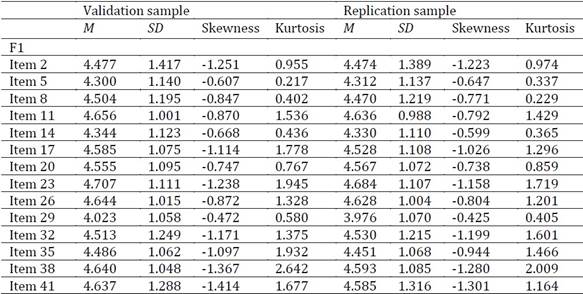
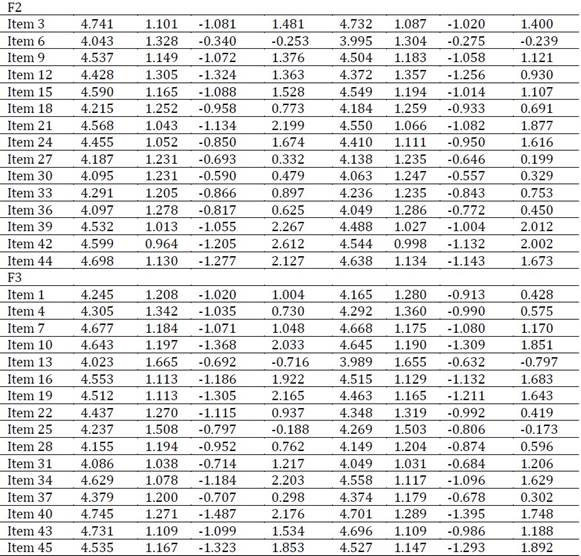
A preliminary descriptive analysis of the items was carried out before analysing the validity evidence in relation to the internal structure of the long version, which served as the basis for the short version. Univariate normality was assessed by skewness (< 2) and kurtosis (< 7), while multivariate normality was analysed by the G2 coefficient (< 70).
As for the measurement models, the 45-item oblique three-factor model (original version) and the 15-item ESCQ-T15 (short version) were evaluated. Regarding the configuration of the ESCQ-T15, we first considered the five items with the highest factor loadings on each factor (Valente et al., 2023) to raise the empirical presentation of the construct. Secondly, the correlation between items in each dimension was analysed to rule out redundancy, as magnitudes greater than .85 indicate multicollinearity. Thirdly, the internal structure was analysed using an exploratory structural equation modeling (ESEM) with both samples to consolidate the constructs. Finally, it was analysed whether both versions (long and short) are equivalent, and for this purpose, a corrected correlational analysis was used because the long and short versions share items and correlations above .70 were considered acceptable.
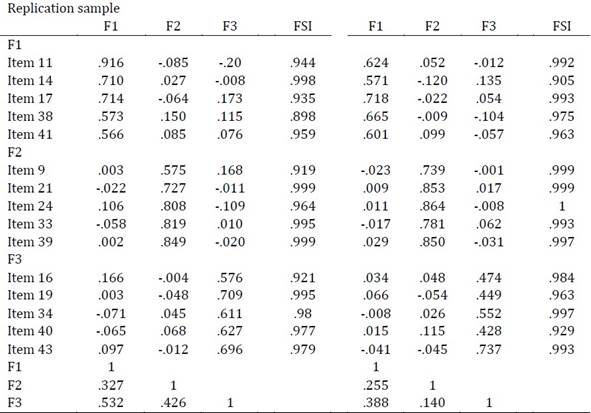
The analysis was framed within the ESEM (Asparouhov & Muthén, 2009) with the weighted least squares mean-variance adjusted (WLSMV) for the validation (n = 776) and replication (n = 843) samples, with oblique target rotation (ε = .5; Asparouhov & Muthén, 2009), i.e., factor loadings belonging to the main factor were freely estimated, while secondary factor loadings were specified as close to zero (~0).
The measurement models were evaluated in the validation and replication samples. The relevance of the models was assessed by considering fit indices such as the comparative fit index (CFI; > .90), the root mean square error of approximation (RMSEA; < .08), and the weighted root mean square residual (WRMR; ?? 1.00). In the case of the short version, we assessed the magnitude of the factor loadings (> .50) and, additionally, considering the main focus (ESEM), we analysed whether the secondary loadings impact the internal structure of the scale. In this sense, the factorial simplicity index (FSI) was estimated, which reports whether the item is predominantly influenced by one or more factors, and magnitudes greater than .70 indicate that an item is predominantly influenced by a single factor. Similarly, interfactor correlations were considered significant above .20.
After the consolidation of the ESCQ-T15, the invariance between men and women in the two samples was analysed (validation and replication). Then, some constraints were gradually incorporated to test for configural invariance, weak invariance, strong invariance and strict invariance. Thus, an acceptable degree of invariance is evident according to the variability of the fit indices (ΔCFI > -.01; ΔRMSEA < .015). Subsequently, differences between males and females on each dimension were analysed using a magnitude of effect approach, and a Cohen’s d greater than .41 was considered significant. Finally, reliability was estimated at the level of scores (α > .70) and the construct (ω > .80).
As for the software support, the factor and reliability analyses were carried out with the Mplus version 7 programme (Muthén & Muthén, 1998-2015), while correlations were calculated using SPSS version 29.
Results
Preliminary analysis indicates that multivariate normality was not supported in the validation sample (G2 = 560.162) nor the replication (G2 = 555.447). However, the items show acceptable magnitudes of skewness and kurtosis (Appendix A, Table A1).
Regarding the items selected for the ESCQ-T15, it was observed that they present an acceptable degree of association within each factor in both the validation sample and the validation sample (ELE: raverage = .303; PUE: raverage = .564; MRE: raverage = .241) as well as replication (ELE: raverage = .346; PUE: raverage = .547; MRE: raverage = .278), indicating a lack of redundancy. On the other hand, as for the preliminary structural analysis of the extended version, the fit indices were acceptable for males and females in both samples (Table 1).
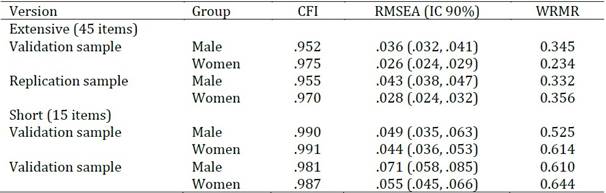
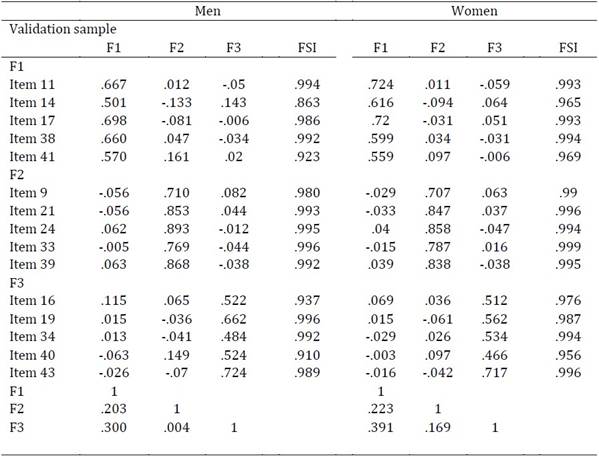
Regarding the ESEM analysis, the ESCQ-T15 showed good fit indices for both men and women in the validation and replication samples (Table 1). Specifically, acceptable factor loadings are also observed for all items (short version) and an acceptable degree of factor complexity and significant interfactor correlations between dimensions in all groups (Appendix B, Table B1). These results empirically support specific hypotheses 1.1 and 1.2.
Likewise, regarding the equivalence between the long and short version (according to sample and gender), most dimensions are equivalent between versions in the two samples studied according to the corrected correlation coefficient (> .70; Table 2), as only the MRE dimension in the validation sample is slightly below the established limit in three comparisons. Overall, specific hypothesis 2 was supported.
Table 2: Reliability and version equivalence report
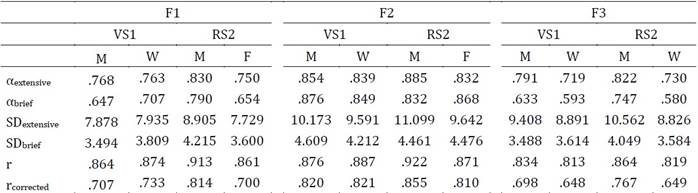
Note: F1: Express and label emotions; F2: Perceive and understand emotions; F3: Manage and regulate emotions; VS1: Validation sample; RS2: Replication sample; M: Men; W: Women; SD: Standard deviation; r: Correlation coefficient.
Thus, the ESCQ-T15 shows an acceptable degree of measurement invariance between men and women in both the validation and replication samples (Table 3), and there are no significant differences in EI dimensions between men and women in the two samples (Table 4), which empirically supports specific hypotheses 3 and 4, respectively. Subsequent analyses were then conducted without distinction of gender or sample type.
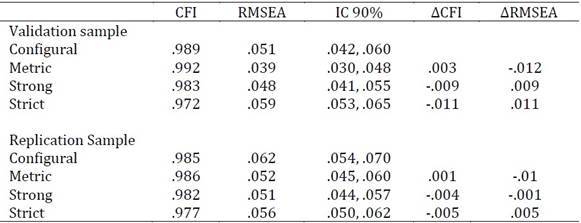
Table 4: Differences between men and women
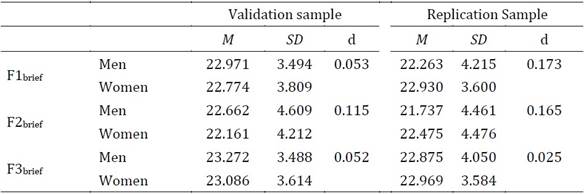
Note: F1: Express and label emotions; F2: Perceive and understand emotions; F3: Manage and regulate emotions; M: Mean; SD: Standard deviation; d: Cohen’s d.
Thus, excellent fit indices were found for the total sample (n = 1619; CFI = .989; RMSEA = .050, IC 90% .044, .055; WRMR = 0.016), as well as acceptable factor loadings in all cases and significant associations (> .20) between dimensions (Table 5).
Table 5: ESEM analysis with full sample
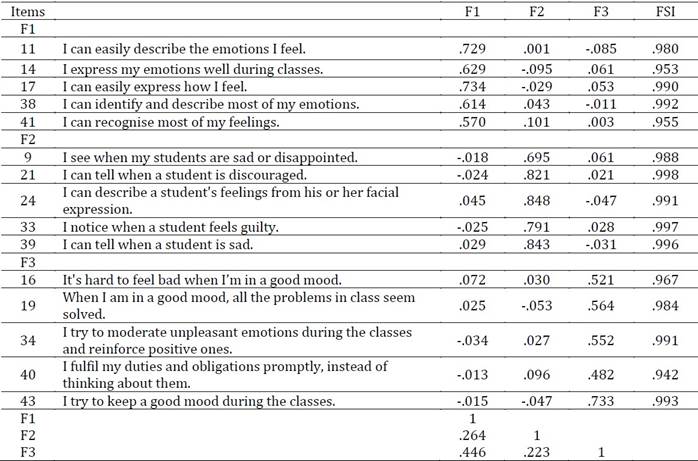
Note: F1: Express and label emotions; F2: Perceive and understand emotions; F3: Manage and regulate emotions; FSI: Factorial simplicity index.
As for the reported ESCQ-T15 reliability, it is acceptable at the level of scores for ELE (α = .700) and PUE (α = .858), although for MRE it is below the expected (α = .634). However, construct reliability is adequate on all three dimensions: ELE (ω = .791), PUE (ω = .899) and MRE (ω = .709). These results empirically support specific hypothesis 5.
Discussion
The present study aimed to carry out an analysis of the ESCQ-T internal structure and to obtain a brief version (ESCQ-T15). The results confirm the initially proposed internal structure of the three correlated factors of the ESCQ-T15, which means that the dimensionality of this short version retains good discriminatory power and is empirically equivalent to the long version (ESCQ-T). This indicates that the reduction of items did not significantly impact the construct assessment, i.e., the variance explained by the items that make up the short version is equivalent to the variance explained by the long version.
With regard to the ELE dimension, the items that make up the shortened version reflect the construct to a greater extent, given that, although the other items have a recognition component, in some cases the content of the deleted items focused on other actors in the educational environment (item 29: “Students are always able to describe my mood”) or is tangential to the core of the construct (item 8: “I manage to captivate my students easily”). For the dimension PUE the scenario is similar, as all items retained in the shortened version focus on recognising a wide range of emotions in students, while the items that were removed focused on providing support (item 3: “When I meet a student, I immediately notice his/her mood”; item 15: “I can easily cheer up a student when he/she is sad”) or making positive interactions (item 44: “I know how to pleasantly surprise my students”). Finally, with regard to the MRE dimension, the items in the short version focus on handling everyday situations in the classroom using positive emotions as a resource, while the items that are not part of this version mentioned other people both in terms of activities (item 10: “When a student praises me, I work with more enthusiasm”) and emotional management (item 31: “I can easily persuade a student that there is nothing to worry about”). Thus, from a content point of view, the items that make up each dimension of the brief version more accurately reflect each construct, while the other items, while significantly assessing the construct content, do not seem as relevant.
Furthermore, it confirms that, even in a different sample from the one used as a basis for constructing the instrument, the items effectively reflect the emotional experience of both men and women. So, this structure has similar values to those found in the original version (Takšić et al., 2009) and in subsequent studies (e.g., Costa & Faria, 2022; Schoeps et al., 2021), thus supporting the structural validity of this short version.
The correlations between the three dimensions were also significant, highlighting that they are not independent of each other and that they converge in the assessment of the EI construct, confirming that adequate emotional management requires good emotional understanding, which in turn requires adequate emotional perception.
Importantly, an analysis of measurement invariance between men and women was carried out, and it was found that both groups have the same understanding of the construct and no differences in their scores, unlike in other studies with the ESCQ (e.g., Gabrijelčič et al., 2021; Schoeps et al., 2021). Analysing men and women separately provides a broader perspective on the results, as these groups are usually analysed together when there are likely to be some different characteristics in terms of emotional experiences.
The dimensions show adequate internal consistency in score terms (α > .70) and construct (ω > .70), close to the values obtained in previous studies with extensive versions (e.g., Costa & Faria, 2022; Valente et al., 2023). The values found suggest that the items are consistent with the dimensions to which they belong. However, within each dimension, there are some differences in factor loadings, indicating that the items do not homogeneously represent the assessed construct, i.e., that some items are better than others at assessing the construct, with possible implications for reliability estimation.
In terms of the study’s strengths, the use of a large sample size should be highlighted (n > 1000) and two samples, validation and replication. This provides greater robustness to the findings, as sometimes the use of a single sample may bias the results towards some specific characteristics of the group, while the use of more than one sample consolidates the findings of the first sample, providing a picture of replicability (Centeno-Leyva & Dominguez-Lara, 2020). On the other hand, limitations include, firstly, that this study is based on non-probability sampling procedures using a convenience sample and that it was only carried out in public schools, which would limit its use and applications in public schools that sometimes present structural differences. Secondly, the underrepresentation of the construct in a short version is an inherent limitation, given that the final structure of an instrument is generally a significant sampling of the behaviours that operationalise the construct, but as indicated in the introductory section, the use of a short version is not widespread and is recommended only when there is little time to assess or a high number of variables to consider, since in the absence of these limitations the long version will always be recommended.
Regarding the study implications, it is important to note that the ESCQ-T15 is an instrument that allows for assessing teachers’ EI with evidence of internal structure validity. Similarly, it is important to note that it is also a good tool for evaluating intervention programmes focusing on teachers’ EI, as it is a short questionnaire that facilitates data collection.
It is concluded that the ESCQ-T15 demonstrates good psychometric properties (internal structure, measurement invariance and reliability) for assessing the perception of emotional skills and competence in teachers. However, it is advisable to implement other validity strategies, such as association with other similar (e.g., other EI measures) or theoretically related variables (e.g., teacher self-efficacy) and to include other evidence of measurement invariance that for reasons of space could not be addressed in this manuscript (e.g., age or work experience), as well as to analyse the longitudinal behaviour of the brief scale. Repeated measures studies are also suggested to assess construct stability.
REFERENCES
Agyapong, B., Obuobi-Donkor, G., Burback, L., & Wei, Y. (2022). Stress, burnout, anxiety and depression among teachers: A scoping review. International Journal of Environmental Research and Public Health, 19(17). https://doi.org/10.3390/ijerph191710706 [ Links ]
Asociación Médica Mundial. (2013). Declaración de Helsinki. [ Links ]
Asparouhov, T., & Muthén, B. (2009). Exploratory Structural Equation Modeling. Structural Equation Modeling: A Multidisciplinary Journal, 16(3), 397-438. https://doi.org/10.1080/10705510903008204 [ Links ]
Brackett, M. A., & Salovey, P. (2006). Measuring emotional intelligence with the Mayer-Salovery-Caruso emotional intelligence test (MSCEIT). Psicothema, 18, 34-41. [ Links ]
Bru-Luna, L. M., Martí-Vilar, M., Merino-Soto, C., & Cervera-Santiago, J. L. (2021). Emotional intelligence measures: a systematic review. Healthcare, 9(12). https://doi.org/10.3390/healthcare9121696 [ Links ]
Centeno-Leyva, S., & Dominguez-Lara, S. (2020). La replicabilidad en la investigación psicológica: una reflexión. Interacciones, 6(3). https://doi.org/10.24016/2020.v6n3.172 [ Links ]
Costa, A., & Faria, L. (2022). The impact of implicit theories on students’ emotional outcomes. Current Psychology, 41, 2354-2363. https://doi.org/10.1007/s12144-020-00750-z [ Links ]
Dominguez-Lara, S., Peceros-Pinto, B., Valente, S. N., Lourenço, A. A., & Flores-Cataño, K. R. (2023). Análisis estructural de una versión breve de la Trait Meta-Mood Scale en adolescentes peruanos. Revista Fuentes, 25(1), 82-100. https://doi.org/10.12795/revistafuentes.2023.22077 [ Links ]
Faria, L., & Lima-Santos, N. (2012). Emotional intelligence in the Portuguese academic context validation studies of the emotional skills and competence questionnaire (ESCQ). Behavioral Psychology/Psicología Conductual, 20(1), 91-102. https://www.behavioralpsycho.com/wp-content/uploads/2019/08/06.Faria_20-1.pdf [ Links ]
Fernández-Berrocal, P., & Extremera Pacheco, N. (2002). La inteligencia emocional como una habilidad esencial en la escuela. Revista Iberoamericana de Educación, 29(1), 1-6. https://doi.org/10.35362/rie2912869 [ Links ]
Fitzgerald, S., McGrath-Champ, S., Stacey, M., Wilson, R., & Gavin, M. (2019). Intensification of teachers’ work under devolution: A ‘tsunami’ of paperwork. Journal of Industrial Relations, 61(5), 613-636. https://doi.org/10.1177/0022185618801396 [ Links ]
Fu, W., Wang, C., Tang, W., Lu, S., & Wang, Y. (2021). Emotional intelligence and well-being of special education teachers in China: The mediating role of work-engagement. Frontiers in Psychology, 12. https://doi.org/10.3389/fpsyg.2021.696561 [ Links ]
Gabrijelčič, M. K., Antolin, U., & Istenič, A. (2021). Teacher’s social and emotional competences: A study among student teachers and students in education science in Slovenia. European Journal of Educational Research, 10(4), 2033-2044. https://doi.org/10.12973/eu-jer.10.4.2033 [ Links ]
Gill, G. S., & Sankulkar, S. (2017). An exploration of emotional intelligence in teaching: comparison between practitioners from the United Kingdom & India. Journal of Psychology and Clinical Psychiatry, 7(2), 1-6. https://doi.org/10.15406/jpcpy.2017.07.00430 [ Links ]
Kant, R., & Shanker, A. (2021). Relationship between emotional intelligence and burnout: An empirical investigation of teacher educators. International Journal of Evaluation and Research in Education, 10(3), 966-975. https://doi.org/10.11591/ijere.v10i3.21255 [ Links ]
Lourenço, A. A., Valente, S., Dominguez-Lara, S. & Fulano, C. S. (2024). El impacto de la inteligencia emocional en los modelos de enfoques de enseñanza. Revista Electrónica Interuniversitaria de Formación del Profesorado, 27(3), 171-187. https://doi.org/10.6018/reifop.614521 [ Links ]
Mayer, J. D., & Salovey, P. (1997). What is Emotional Intelligence? En P. Salovey & J. Sluyter (Eds.), Emotional development and emotional intelligence: Educational implications (pp. 3-31). Basic Books. [ Links ]
Muthén, L. K., & Muthén, B. O. (1998-2015). Mplus User's Guide (7th edition). [ Links ]
Extremera Pacheco, N., Mérida-López, S., Rey, L., & Peláez-Fernández, M. A. (2021). Programa CRECIENDO: creando competencias de inteligencia emocional en nuevos docentes. Know and Share Psychology, 1(4). https://doi.org/10.25115/kasp.v1i4.4340 [ Links ]
Peláez-Fernández, M. A., Mérida-López, S., Sánchez-Álvarez, N., & Extremera Pacheco, N. (2021). Managing teachers' job attitudes: the potential benefits of being a happy and emotional intelligent teacher. Frontiers in Psychology, 12. https://doi.org/10.3389/fpsyg.2021.661151 [ Links ]
Schoeps, K., Postigo Zegarra, S., Mónaco, E., González, R., & Montoya Castilla, I. (2020). Valoración del programa de educación emocional para docentes (Mademo). Know and Share Psychology, 1(4), 159-170. https://doi.org/10.25115/kasp.v1i4.4380 [ Links ]
Schoeps, K., Tamarit, A., Zegarra, S. P., & Montoya-Castilla, I. (2021). Los efectos a largo plazo de las competencias emocionales y la autoestima en los síntomas internalizantes en la adolescencia. Revista de Psicodidáctica, 26(2), 113-122. https://doi.org/10.1016/j.psicod.2020.12.001 [ Links ]
Takšić, V., Mohorić, T., & Duran, M. (2009). Emotional skills and competence questionnaire (ESCQ) as a self-report measure of emotional intelligence. Horizons of Psychology, 18(3), 7-21. https://doi.org/10.1037/t63691-000 [ Links ]
Valente, S., & Lourenço, A. A. (2020). Conflict in the classroom: How teachers’ emotional intelligence influences conflict management. Frontiers in Education, 5, 5. https://doi.org/10.3389/feduc.2020.00005 [ Links ]
Valente, S. N., Lourenço, A. A., & Dominguez-Lara, S. (2022). Teachers in the 21st Century: Emotional intelligence skills make the difference. En H. Şenol (Ed.), Pedagogy - Challenges, Recent Advances, New Perspectives, and Applications (pp. 1-15). IntechOpen Limited. https://doi.org/10.5772/intechopen.103082 [ Links ]
Valente, S. N., Lourenço, A. A., Dominguez-Lara, S., Mohorić, T., & Takšić, V. (2023). Psychometric proprieties of the emotional skills and competence questionnaire for teachers. International Journal of Instruction, 16(4), 55-70. https://doi.org/10.29333/iji.2023.1644a [ Links ]
Wang, L. (2022). Exploring the relationship among teacher emotional intelligence, work engagement, teacher self-efficacy, and student academic achievement: A moderated mediation model. Frontiers in Psychology, 12. https://doi.org/10.3389/fpsyg.2021.810559 [ Links ]
Wong, C. S., & Law, K. S. (2002). The effects of leader and follower emotional intelligence on performance and attitude: An exploratory study. Leadership Quarterly, 13(3), 243-274. http://doi.org/10.1016/s1048-9843(02)00099-1 [ Links ]
How to cite: De Valente, S. N., Dominguez-Lara, S., Lourenço A. A., Amaro, P., & Almeida, L. S. (2025). Brief version of the emotional competence and abilities questionnaire for teachers. Ciencias Psicológicas, 19(1), e-4267. https://doi.org/10.22235/cp.v19i1.4267
Authors’ contribution (CRediT Taxonomy): 1. Conceptualization; 2. Data curation; 3. Formal Analysis; 4. Funding acquisition; 5. Investigation; 6. Methodology; 7. Project administration; 8. Resources; 9. Software; 10. Supervision; 11. Validation; 12. Visualization; 13. Writing: original draft; 14. Writing: review & editing. S. N. V. has contributed in 1, 2, 3, 5, 6, 13; S. D. L. in 1, 2, 3, 5, 6, 9, 13; A. A. L. in 1, 2, 3, 5, 6, 8, 9, 13; P. A. in 3, 5, 13, 14; L. S. A. in 10, 11, 12, 14.
Received: September 19, 2024; Accepted: April 21, 2025
 Este es un artículo publicado en acceso abierto bajo una licencia Creative Commons
