Bovine hepatogenic photosensitization caused by chronic fasciolasis
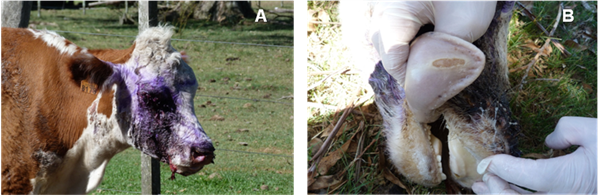
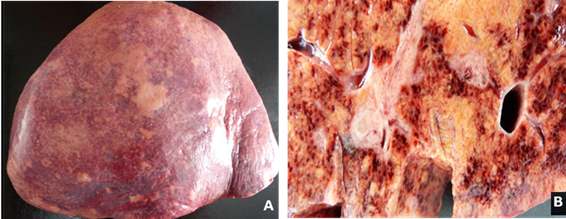
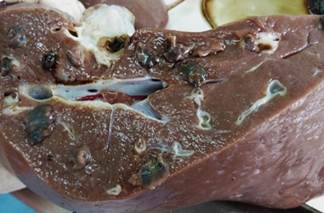
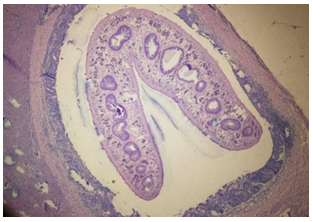
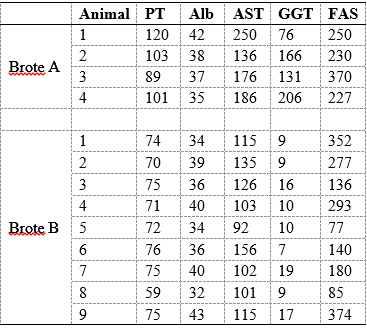
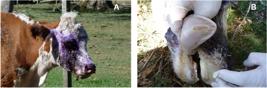
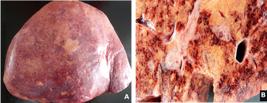
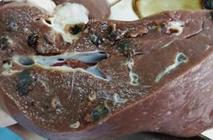
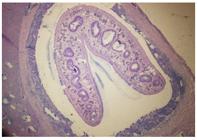
Bovine hepatogenic photosensitization can be caused by several causes, such as hepatocellular damage due to by Fasciola hepatica. Hepatogenic photodermatitis is one of the clinical signs that can be observed in chronic fasciolasis, caused by hepatic fibrosis and cholangitis with bile stasis. The objective of this work was to describe two outbreaks of hepathogenic photosensitization in cattle in the counties of Tacuarembó and Soriano (Uruguay). The disease affected a herd of Hereford and crossbreed cows and a herd of crossbreed heifers. In both outbreaks the animals grazed in damp forest fields. The main clinical signs observed were weight loss, scabs and peeling on the snout, photophobia, hypersalivation and ocular bleeding. In all necropsies performed, the relevant macroscopic findings were bilateral necrotic dermatitis of the eyelids, ulcers on the ventral surface of the tongue. In the liver, there was thickening of the Glisson's capsule, diffuse fibrosis, and chronic cholangitis with calcification of the bile canaliculi. Histopathologically the main lesion was liver fibrosis and canalicular obstruction with the presence of F. hepatica. Based on the clinical signs, macro and microscopic findings, the photosensitization observed in the animals of both outbreaks was directly related to the chronic liver alterations caused by F. hepatica.
Keyword:
bovine photodermatitis; phylloerythrin; chronic distomatosis
 Thumbnail
 Thumbnail
 Thumbnail
 Thumbnail