Clinical manifestations "not criteria" of Antiphospholipid Syndrome. Presentation of a national cohort.
Introduction: Antiphospholipid syndrome (APS) is an autoimmune condition characterized by thrombosis, recurrent fetal loss, and antiphospholipid antibodies. There are clinical manifestations not contemplated in the classification criteria, which are called non-criterion manifestations.
Objective: To analyze the clinical manifestations of APS, emphasizing the non-criterion manifestations and their relationship with the autoantibody profile in a general hospital in Montevideo, Uruguay.
Methods: A retrospective analysis of the medical records of patients with a definitive or suspected diagnosis of APS in an outpatient medicine service for autoimmune diseases, at the Maciel Hospital, assisted between 2010 and 2019, was carried out.
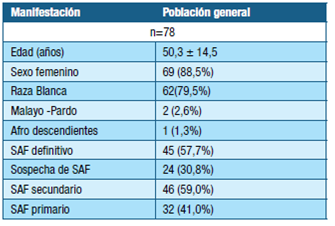
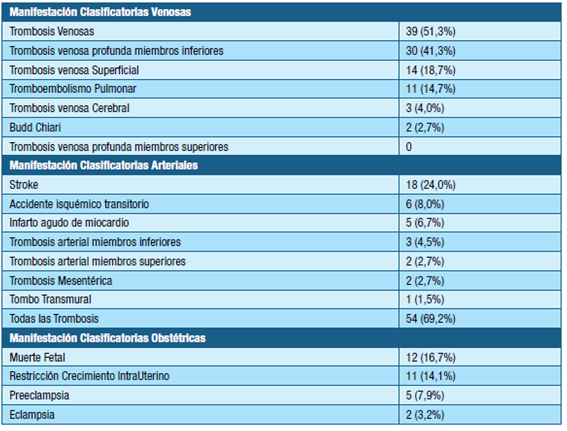
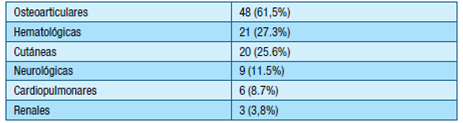
Results: 78 patients were included, with a mean age of 50.3 +/- 14.5 years, 69 (88.5%) were female. Forty-six (59.0%) patients presented secondary APS, of which 28 (35.9%) associated SLE. Venous thrombosis of the lower limbs was the most frequent manifestation (51.3%). Eighteen (24.0%) patients presented arterial thrombosis in the form of cerebrovascular accident. Fifty-nine (75.6%) cases presented, in addition to the classification manifestations, some of the "non-criterion" manifestations and these manifested in an isolated way in 10 (12.8%) patients. The most frequent non-classifying manifestations were arthralgia, livedo reticularis, migraine and thrombocytopenia. A significant association was observed between the presence of anti-β2GPI with cutaneous manifestations and thrombocytopenia with at least one thrombotic manifestation.
Conclusions: Non-criterion manifestations of APS occurred in almost 3 out of 4 cases, a frequency similar to that observed in other series. The isolated presence of “non-criterion” manifestations could lead to suspicion of APS and, in some cases, lead to the request for antibodies.
Key words:
antiphospholipid syndrome; "non-criterion" clinical manifestations; autoantibodies