A Cartel’s Split: Roll Call Votes and Factional Warfare in the Federal District’s Legislative Assembly
Abstract:Cox and McCubbins' procedural cartel theory expects majority party conflict in final passage votes to be reduced to a minimum. This is a consequence of agenda control by key party members. I inspect roll call voting in the 4th Legislature of Mexico City's Assembly (2006-09) uncovering a frequent majority party split in the plenary. Ideal point estimation with roll call data reveals two lines of Assembly cleavage, one the classic left-right divide on economic issues, the other mostly related to appointments of officers at different levels. While the left-leaning PRD majority showed cohesion in the first dimension, the presence of two distinct factions is manifest in the second. The paper speculates about the need for more theory on late-stage agenda control instruments in the legislative process
Keywords:
Parties; party factions; agenda power; roll call votes; subnational legislatures
 Thumbnail
 Thumbnail
 Thumbnail
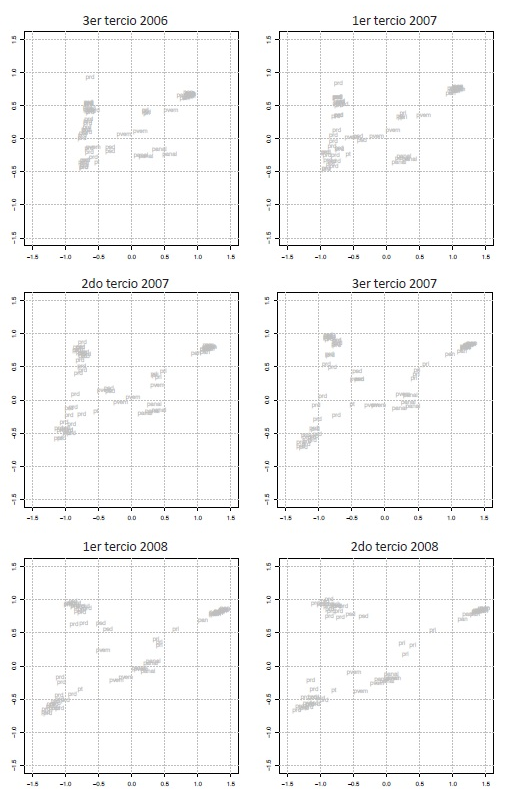
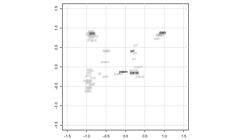
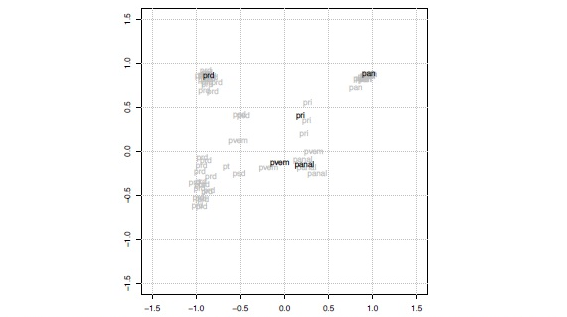 Cada punto reporta la mediana de la distribución a posteriori del punto ideal de cada diputado, identificado según el partido. Los nombres en letra negrita son coordinadores de partidos con status de grupo parlamentario. El eje horizontal es el continuo izquierda-derecha convencional, el eje vertical el nombramiento de funcionarios electorales de la Ciudad
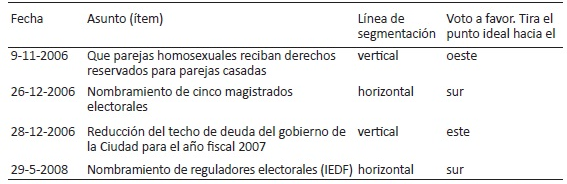
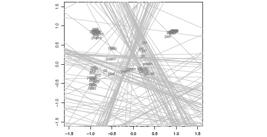
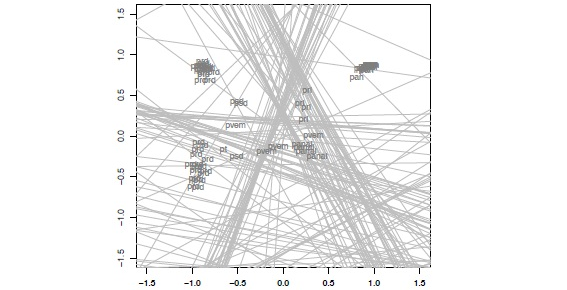 Cada línea de corte representa una votación nominal y se espera que los diputados ubicados de un lado voten a favor, el restante en contra (sujeto a error aleatorio).