Probabilidad diagnóstica de endocarditis infecciosa antes de la realización del ecocardiograma.: Sobreutilización del ecocardiograma transesofágico
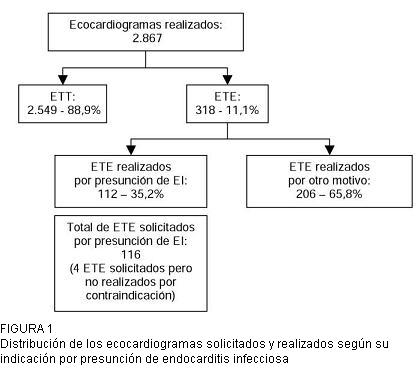
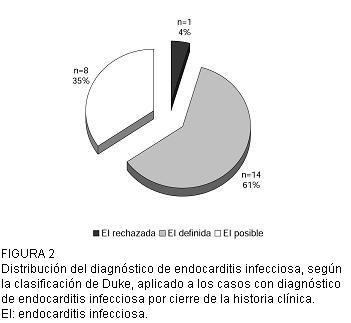
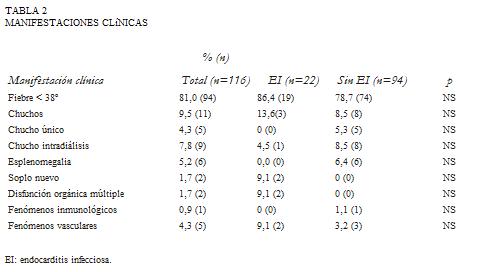
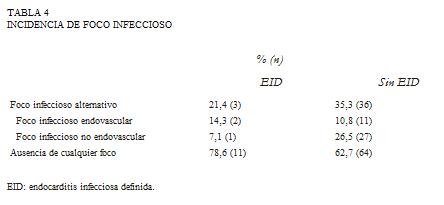
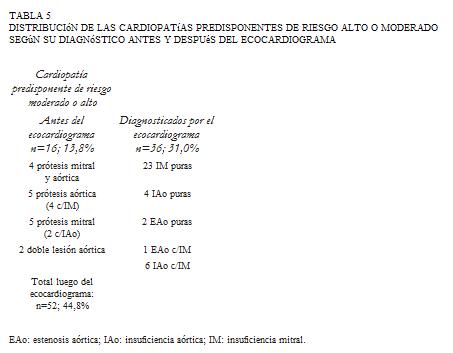
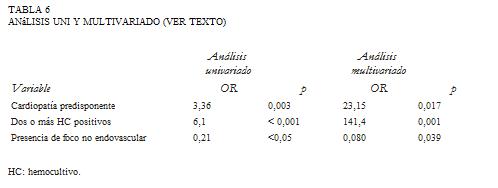
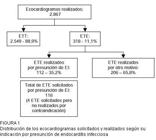
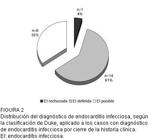
SUMMARY Transesophage echocardiogram (ETE) is an efficient tool for infective endocarditis (EI). Objective: to individualize clinical criteria to identify populations in which ETE is efficient to diagnosis. Methods: a prospective study of 116 patients suspected of EI who underwent ETE. Echocardiographic results were compared to those obtained by clinical history analysis and Duke criteria. Uni and multivaried analysis were used to determine clinical conditions associated with EI. Results: 23 cases of EI were found as conclusion of clinical history analysis, among them 14 were definitive (EID). ETE was positive in 22 cases (18.96%) included in the 23 cases above-mentioned; ETE was positive for suspected infective endocarditis (EIP) in 8 cases, without positive blood cultures (HC). Multivariate analysis showed that presence of cardiopathy prior to ETE, 2 or more positive HC and lack of non-endovascular focus implies an 88% probability of EID. Lack of these criteria indicates 0% probability of EID and 7.8% probability of EIP. Conclusions: there is an overindicated use of ETE for EI. Lack of 2 or more positive HC, predispositional cardiopathy and lack of infectious non-endovascular focus might imply no use of ETE. If ETE would have been limitated to these criteria, 67.9 (58.5%) could have been saved.
ENDOCARDITIS; ECHOCARDIOGRAPHY; ECHOCARDIOGRAPHY, TRANSESOPHAGEAL; DIAGNOSIS
 Thumbnail
 Thumbnail