Admissions for acute myocardial infarction in the four years following the implementation of the prohibition of smoking in closed spaces
Abstract
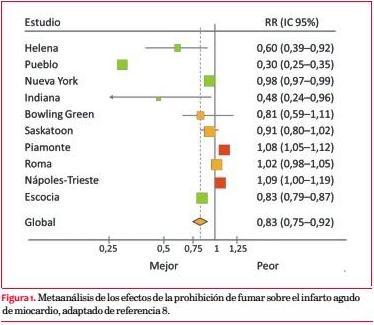
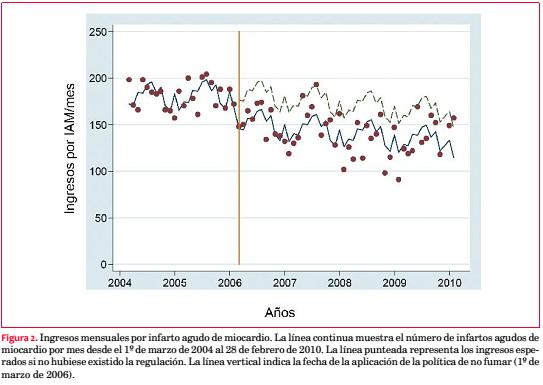
Tobacco health harm is multiple and affects smokers and second-hand smokers. Tobacco control policies have been successful in Uruguay, particularly the prohibition of smoking in public closed spaces. Several investigations confirmed its wide acceptance, resulting in a reduction in air contamination levels, either in tobacco smoke contaminant particles as in nicotine levels. Also, in the two years following prohibition (March 1st, 2006) there was a reduction in hospital admissions for myocardial infarction in the country. To determine its impact after four years we collected data about admissions from March 1st, 2004 to February 28th, 2010 and analyzed, using multiple regression, the number of admissions by month using time as independent variable. We confirmed a 17% reduction in myocardial infarction admissions (relative risk 0,83, IC 95% 0,74-0,92), which was uniform through the 48 months analyzed (p 0.25). These findings showed that the control tobacco policy improved population cardiovascular health during the four years after that policy was introduced in our country.
TOBACCO SMOKE POLLUTION; TOBACCO USE CESSATION; ENVIRONMENTAL RESEARCH; RESEARCH IN HEALTH SERVICES
 Thumbnail
 Thumbnail