Cesáreas en Uruguay
Abstract
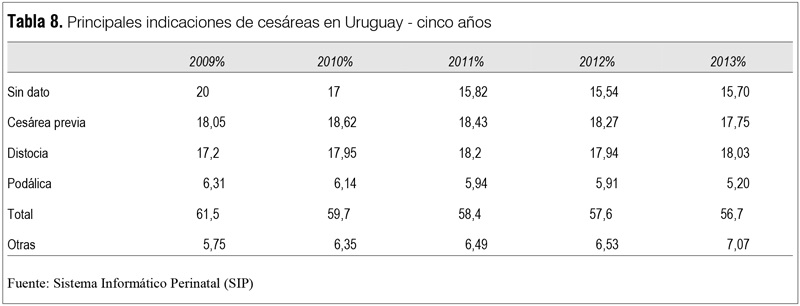
Abstract The World Health Organization (WHO) recommends a c-section rate of 15%, understanding that over that figure there is no improvement in maternal-neonatal results. Global distribution of c-section rates is rather uneven and ranges from a deficit (under 5%) and an excess (over 30%). In those countries where they can not have access to it (for instance in African countries) a growing number of c-sections is seen, regardless of the starting point. In Uruguay there is a progressive increase since 2009 (35.3%) and until 2013 (43.7%), although there are several institutions whose rate is over 55%, and even a few rise up to 70%. It is always more usual in the private sector than in the public sector. All maternal complications are greater in the c-section when compared to delivery (haemorrhage needing hysterectomy, complications with anaesthesia, stroke, thromboembolism and greater puerperal infection). Also, fetal pulmonary distress appears as a frequent complication. We analysed the four most widely used arguments to explain the phenomenon: economic benefit for the gynaecologist, women are gradually asking more for a c-section without a medical justification, the increase of legal claims and the fact that the number of women requiring c-sections is also increasing. The study concludes that the c-section rate constitutes a public health issue and it needs to be treated as such. Recommendations are made, a policy by which the WHO recommendations are applied, audits are made and midwives are reinstated as a fundamental and autonomous human resource to assist low risk labors.
CESAREAN SECTION, utilization; URUGUAY