Modified snorkeling facemasks for safe application of non-invasive ventilation. A pilot study
Introduction: within the context of the SARS-CoV-2 pandemic, different authors proposed adaptations to snorkeling masks available in the market (modified masks: MM) to provide oxygen therapy with positive pressure ventilation or not. Until today, none of them has assessed its performance as an interface for non-invasive ventilation (NIV) in the inspiratory pressure support mode.
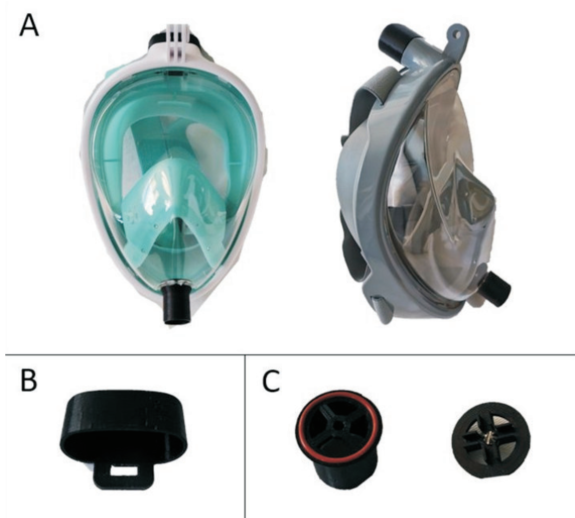
Objective: to develop an interface of NIV using MM and assess its performance with a conventional full mask.
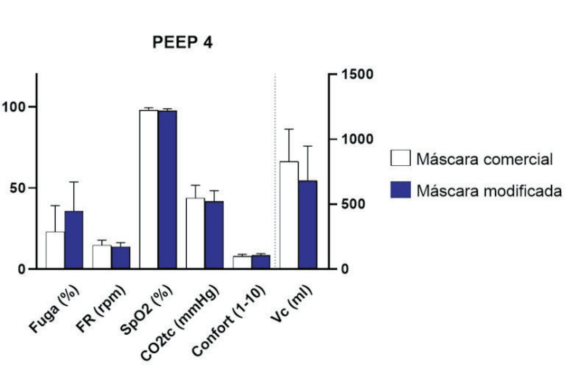
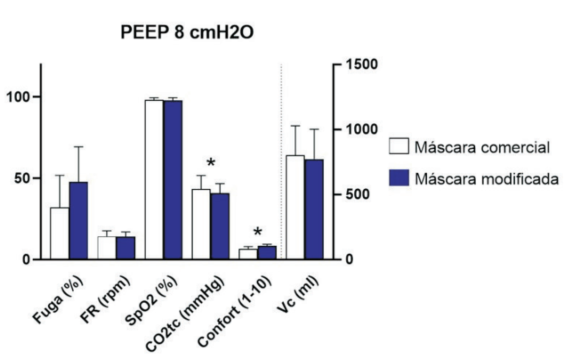
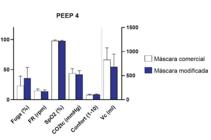
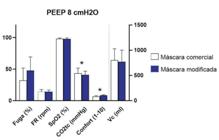
Method: the MM were adapted as NIV interfaces using two pieces created by 3D printing. Their performance was compared to a that of a conventional mask in 10 healthy volunteers in inspiratory pressure support (3 cmH2O) mode with two levels of positive pressure towards the end of expiration (PEEP 4 and 8 cmH2O). The following were compared: system leaks, respiratory rate, normal volume, pulse oximetry, transcutaneous car bon dioxide and comfort.
Results: with 4 cmH2O of PEEP, no significant differences were found between masks in none of the variables studied. With 8 cmH2O de PEEP, the use of MM were associated to a lower level of CO2tc (41.0±5.7 vs 43.5±8.1 mmHg; p=0.03) and greater comfort (8.3±1.1 vs 6.5±1.4; p<0.01) than conventional masks (CM).
Conclusions: in healthy volunteers, MM for NIV evidence a similar performance than that of standard oronasal masks, and have a further advantage, as they are more comfortable and cheaper. Even if further studies are needed to support its use, modified snorkeling masks could represent a valid option during the health emergency caused by the SARS-CoV-2 pandemic in consideration of the scarce interfaces available in the market.
Key words:
Noninvasive ventilation; Diving masks; COVID-19
 Thumbnail
 Thumbnail
 Thumbnail