Cultural adaptation and validation of the Job Contents Questionnaire (JCQ) for Argentine workers
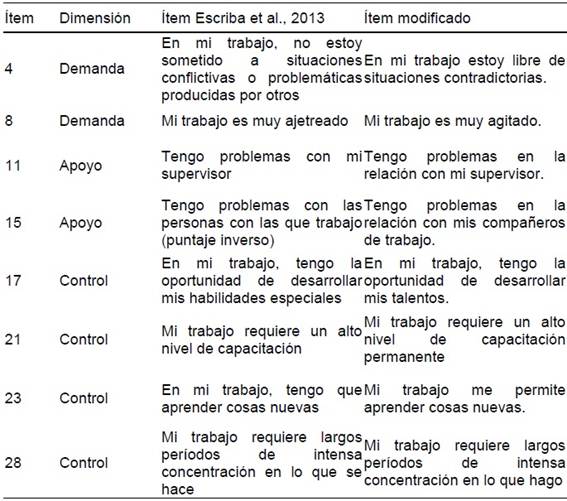
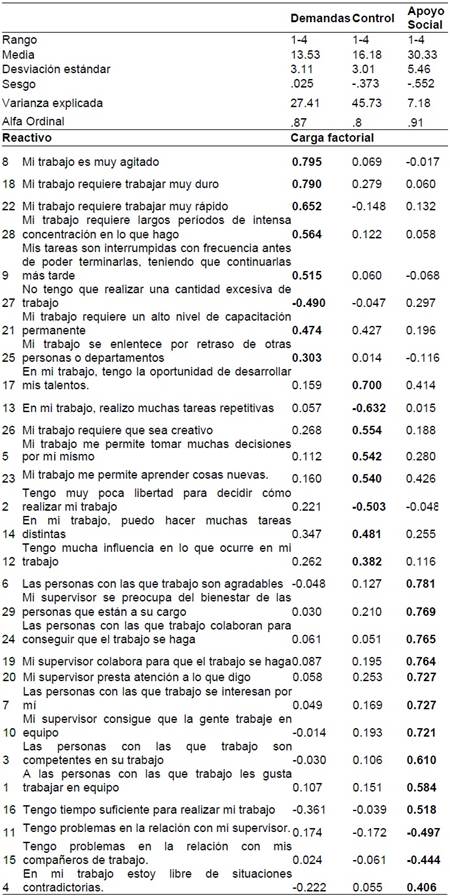
This article aims to present the cultural adaptation and the psychometric study of the Spanish version of the Job Contents Questionnaire (JCQ, originally built by Karasek) for workers from the Ciudad Autónoma de Buenos Aires and Gran Buenos Aires. The sample consisted on 331 workers (70% are female and 30% are male, mean age of 33.15, SD=11,84). In the first instance, a cultural adaptation was carried out based on the evaluation of expert judges and a pilot test. The adapted version was made up of 29 items. To evaluate the behavior of the items, an exploratory factor analysis was performed under the polychoric correlation modality, applying the unweighted least squares (ULS) method with a Varimax rotation method. The instrument was made up of 21 items that fit the model proposed by Karasek. In summary, the items that make up the factor Demands (5), Control (6) and Social Support (10). The results show face, content and construct validity criteria, with excellent reliability indices (ordinal alphas greater than .86). In addition, external validity was evidenced by taking the STAI State Anxiety scale as a criterion measure. The instrument presented satisfactory psychometric properties for its application in the local context.
Keywords:
Job stress; Job Contents Questionnaire; cultural adaptation; psychometric validation