Dental service utilization among elderly people in Chile year 2017
Abstract
Objective: To describe the use of dental services among people aged 60 years and older in Chile in 2017.
Materials and methods: Cross-sectional study, secondary analysis of the 2017 National Socioeconomic Characterization Survey (CASEN) database, including individuals aged 60 years and older (n = 42619). The outcome variable was having visited a dentist in the last three months; explanatory variables included predisposing and enabling factors. Associations between categorical variables were analyzed using the Chi-square test, with 95% confidence (p < 0.05), and analyses were stratified by sex.
Results: 5.6% reported visiting a dentist in the last three months, more frequently among women, those aged 60-69 years, urban residents, individuals with tertiary education, those in the highest socioeconomic quintile, and those with private health insurance. In addition, 0.4% reported receiving emergency dental care in the last 12 months, but only 61.1% of them used the access and coverage guarantee available in Chile (AUGE-GES).
Conclusions: There is unequal utilization of dental services among elderly people in Chile according to the predisposing and enabling factors studied. This study shows the presence of socioeconomic gradients in the utilization of dental services among elderly people in Chile.
Keywords:
Dentistry; Health Services Accessibility; Dental Care for the Aged; Healthcare Disparities; Health Inequities
Resumen
Objetivo: Describir el uso de servicios odontológicos en personas de 60 o más años en Chile en 2017.
Materiales y métodos: Estudio transversal, análisis secundario de la base de datos de la Encuesta de caracterización socioeconómica nacional (CASEN) de 2017, considerando como muestra a personas de 60 o más años (n=42619). La variable resultado, fue haber visitado al dentista en los últimos tres meses y se usaron variables explicativas predisponentes y facilitadoras. La asociación de variables categóricas fue analizada con Chi-cuadrado, con un 95% de confianza (p< 0,05) y el análisis fue estratificado por sexo.
Resultados: El 5,6% visitó al dentista en los últimos tres meses, siendo más frecuente en mujeres, entre 60-69 años, que viven en zonas urbanas, con nivel de estudios terciario, pertenecientes al quintil socioeconómico más aventajado y con seguro de salud privado. El 0,4% recibió atención odontológica de urgencia en los últimos 12 meses, pero, solo el 61,1% de ellos usó la garantía de acceso y cobertura de atención disponible en Chile (AUGE-GES).
Conclusiones: Existe una utilización desigual de servicios odontológicos en las personas mayores en Chile según las variables predisponentes y facilitadoras estudiadas. Este estudio evidencia la presencia de gradientes socioeconómicas en la utilización de servicios odontológicos en población adulta mayor en Chile.
Palabras clave:
Odontología; Accesibilidad a los Servicios de Salud; Anciano; Disparidades en Atención de Salud; Inequidades en Salud
Resumo
Objetivo: Descrever a utilização de serviços odontológicos em pessoas com 60 anos ou mais no Chile em 2017.
Materiais e métodos : Estudo transversal, análise secundária da base de dados da Pesquisa Nacional de Caracterização Socioeconômica (CASEN) de 2017, considerando como amostra pessoas com 60 anos ou mais (n=42619). A variável desfecho foi ter visitado o dentista nos últimos três meses, sendo utilizadas variáveis explicativas predisponentes e facilitadoras. A associação das variáveis categóricas foi analisada pelo teste qui-quadrado, com 95% de confiança (p < 0,05) e a análise foi estratificada por sexo.
Resultados: 5,6% visitaram o dentista nos últimos três meses, sendo mais frequente em mulheres, entre 60-69 anos, residentes em áreas urbanas, com ensino superior, pertencentes ao quintil socioeconômico mais favorecido e com plano de saúde privado. 0,4% receberam atendimento odontológico de emergência nos últimos 12 meses, mas apenas 61,1% deles utilizaram a garantia de acesso e cobertura de atendimento disponível no Chile (AUGE-GES).
Conclusões: Há um uso desigual de serviços odontológicos entre idosos no Chile de acordo com as variáveis predisponentes e facilitadoras estudadas. Este estudo mostra a presença de gradientes socioeconômicos no uso de serviços odontológicos entre a população idosa no Chile.
Palavras-chave:
Odontologia; Acessibilidade aos Serviços de Saúde; Velho; Disparidades nos Cuidados de Saúde; Desigualdades em Saúde
Introduction
We live in an aging society. According to the 2017 Census results, 11.4% of people in Chile are 65 years or older 1, and the life expectancy of the Chilean population has increased, reaching 83.4 years in women and 77.9 in men in 2019 2. Along with this, elderly people have experienced changes in their oral health status. This is reflected in greater retention of teeth in the mouth in old age 3. In fact, the average number of teeth in the mouth in the 64-74 age group in Chile increased from 7.61 to 11.35 between 2003 and 2016-17. However, despite these advances, elderly people in Chile continue to present greater deterioration of their oral health compared to other age groups. The latest National Health Survey of 2016-17 3 reports that 81.7% of elderly people do not have functional dentition, 57.2% have cavitated caries, and 65.8% use total removable prostheses. There is also a social gradient by educational level, where oral deterioration is greater in those with fewer years of study.
Frequent use of dental services has been associated with less caries experience, greater tooth retention in the mouth, and better self-perception of oral health 4. This aspect is especially important in older adults, since the availability of and access to dental services allows early diagnosis of oral diseases and the implementation of preventive and treatment measures in this group (5.
Chile has a mixed health system, in which people can choose between public and private health insurance. Following the 2005 health reform, elderly people are guaranteed access to care regardless of their type of insurance, through the Explicit Health Guarantees (GES), formerly known as AUGE (Universal Access to Explicit Guarantees). This includes comprehensive dental care at age 60, as well as coverage for outpatient dental emergencies 6. In addition, elderly people may access dental treatment in primary health care settings through the Primary Health Care Reinforcement Programs (PRAPS). Other initiatives include the More Smiles for Chile Program and the Comprehensive Dental Program for Men (formerly the Low-Income Men Program), launched in 2014 and 2015 respectively, which provide care to vulnerable adults aged 20 and over with a higher burden of oral disease. Since 2019, the Domiciliary Dental Care Program has also offered services to people with severe dependency (7.
The prevalence of dental visits among elderly people before and after the health reform in Chile has increased. The National Health Surveys, conducted in 2003, 2009-10 and 2016-17 3, reports the prevalence of dental visits in the last year, showing, among people aged 65 to 74 years, rates of 29.4%, 44%, and 39.3% respectively, and among those aged 75 years and older, rates of 20.4%, 34.9%, and 30.8% respectively. In the National Health Surveys measurement, dental visits include those for treatment as well as routine control or check-up visits, which may overestimate the reported use of dental services, since in private dental care in Chile it is possible to access free diagnostic services without this necessarily translating into access to dental therapies for those who need them.
The possibility of visiting the dentist for preventive and/or curative dental services should be available to all. However, systematic reviews and meta-analyses have reported that the use of dental services is highly unequal in the adult population (4,8, as it tends to be higher in countries with a higher human development index 8, in women, and in people living in urban areas, while it is lower among those who belong to ethnic minorities or are immigrants 4. Likewise, greater use of services is also associated with higher levels of education and income 4, higher levels of health literacy 8, access to private health insurance (4, and better general and oral health 8.
The Andersen Model 9 proposes that the use of dental services is determined by predisposing factors (e.g., age, sex, marital status, and level of education), facilitating or enabling factors (e.g., socioeconomic level, place of residence, and type of health insurance), and need factors (e.g., self-perception of needing dental care and/or the level of oral deterioration diagnosed by the dentist).
Based on the above, this study aims to describe the prevalence of the use of dental services in people aged 60 years or older in Chile in 2017 through a secondary analysis of the 2017 National Socioeconomic Characterization Survey (CASEN) database, which corresponds to the last one conducted before the onset of the COVID-19 pandemic.
Materials and methods
A cross-sectional study was conducted, with a secondary analysis of the 2017 CASEN survey database. This survey is carried out in Chile every two or three years, with the purpose of monitoring social policies and characterizing the socioeconomic situation of the population, using a randomized sample of national representation in both urban and rural areas. Details of the methodology of this survey and the database used in this study can be downloaded from the website of the Ministry of Social Development and Family (10.
The study population comprised the participants of the 2017 CASEN survey available in the database. The sample for this study was established considering as selection criteria people aged 60 years or older, excluding those with missing data and “Don’t know” responses.
Out of the variables measured in the CASEN survey, twelve were used for the analysis and were operationalized as follows: dental visit in the last three months (yes/no); place of care (public, private, or other); type of payment for care (full, partial, or free); dental emergency treatment in the last 12 months (yes/no); whether covered by GES/AUGE (yes, no, or unknown); reasons for no coverage; sex (female, male); age (60-69, 70-79, 80 years and older); area of residence (urban or rural); educational level (never attended, primary, secondary, or tertiary); socioeconomic level (socioeconomic quintiles, with quintile V being the most advantaged); and type of health insurance (public, corresponding to the National Health Fund (FONASA); private, corresponding to Health Insurance Institutions (ISAPRE); or other, such as those belonging to the Armed Forces and Law Enforcement. Based on Andersen’s model 9 of dental service utilization, the outcome variable considered was having visited the dentist in the last three months. As explanatory predisposing variables, age, sex, and educational level were included; and as explanatory enabling variables, socioeconomic level, area of residence, and type of health insurance.
For the statistical analysis, STATA 14.0® software was used. Payment method and place of dental care among those who visited the dentist in the last three months were described, along with the prevalence of dental emergency treatment in the last 12 months, GES/AUGE coverage, and reasons for non-coverage. The prevalence of dental visits in the last three months was determined according to the explanatory variables studied. The Chi-square test was applied to analyze the association between these categorical variables, with 95% confidence and a p-value of 0.05, stratifying the analysis by sex.
This study was conducted with the approval of the Ethics Committee of the Universidad de Antofagasta (folio number 341/21).
Results
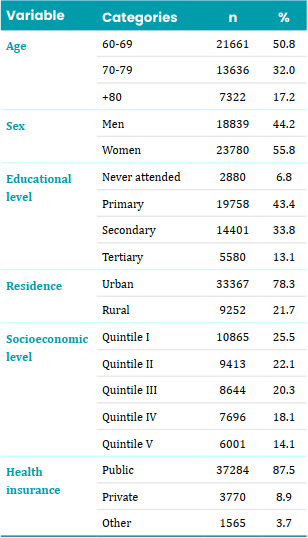
The sample studied consisted of 42619 people aged 60 years or older. The sociodemographic and economic characteristics of the sample are shown in Table 1. Women accounted for 55.8%, the majority were between 60 and 69 years of age (50.8%), lived in urban areas (78.2%), had primary education (43.3%), and had public health insurance (87.4%).
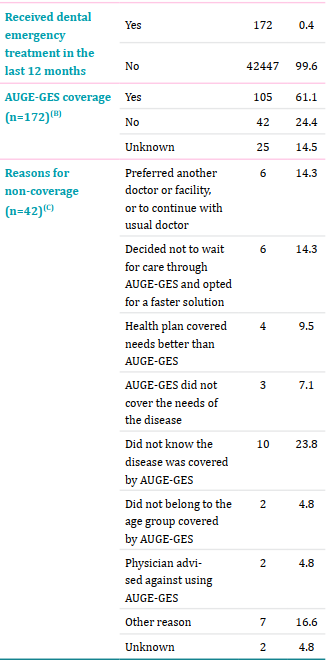
Only 5.6% (2405 people) of the sample had visited a dentist in the last three months. Care was free in half of the cases (53.5%) and occurred in a public service (52.2%) (see Table 2). The prevalence of treatment for dental emergencies in the last twelve months was 0.4%, and in 61.1% of cases it was covered by AUGE-GES, with reported reasons for non-coverage also described (see Table 2).
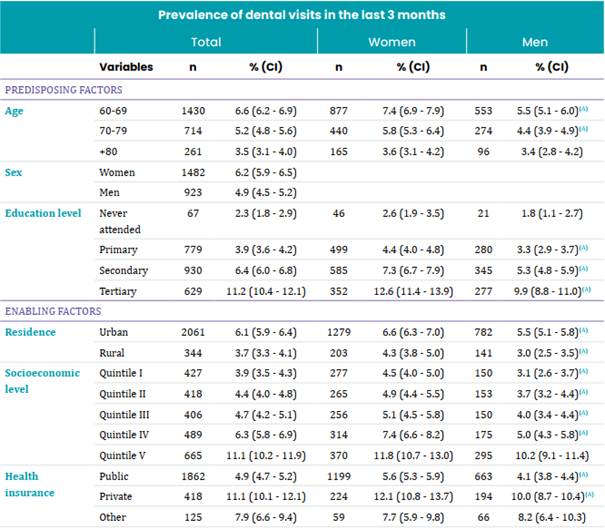
The prevalence of visits to the dentist in the last three months according to explanatory variables and by sex is shown in Table 3. The prevalence of visits was significantly higher in women, except in the following groups: those aged 80 years or older, those who never attended or completed courses in the educational system, those belonging to the most advantaged socioeconomic quintile, and those with another type of health insurance (p>0.05). A higher frequency of dental visits in the last three months was observed among people aged 60-69 years, living in urban areas, with tertiary education, belonging to the most advantaged socioeconomic quintile, and with private health insurance (p<0.05).
Discussion
This study aims to describe the use of dental services among people aged 60 years or older in Chile in 2017. Findings reveal unequal utilization of dental services among elderly people in Chile, according to the predisposing and enabling variables studied.
The prevalence of dental visits retrieved in this study was lower than that reported in the 2003, 2009, and 2016-17 National Health Surveys in Chile 3. This difference is not only due to the different recall periods used for self-reporting of dental visits (3 and 12 months, respectively), but also to the fact that CASEN excludes routine check-ups from its measurement, whereas the National Health Surveys includes them. Since private dental providers in Chile often offer the first consultation for diagnostic purposes free of charge, regardless of the individual’s health insurance coverage, surveys such as the National Health Survey may overestimate utilization. This is because individuals may access a free diagnostic visit without necessarily receiving further preventive or curative treatment that would impact their oral health 11. Thus, our results may more accurately reflect the effective utilization of dental services among elderly people in Chile.
It was identified that approximately half of the older adults who visited a dentist in the last three months did so in public health services, where care did not involve out-of-pocket expenditure. Nevertheless, slightly more than a quarter of them paid the full cost of the dental treatment received. The highest frequency of visits in the last three months was retrieved among elderly people aged 60-69 years, residing in urban areas, with tertiary education, belonging to the most advantaged socioeconomic quintile, and with private health insurance. These results are consistent with international evidence reported in systematic reviews and meta-analyses 4) on the utilization of dental services in adult populations.
The Andersen Model identifies predisposing and enabling factors that influence the use of dental services, as well as need factors, which may be either self-perceived or diagnosed by a professional 9. In line with this model, this study analyzed predisposing factors such as sex, age and educational level, and enabling factors such as socioeconomic status, type of health insurance and place of residence.
Sex-stratified analysis revealed a significantly higher prevalence of dental visits among women across nearly all variables studied. The literature indicates that social factors contribute to men seeking dental care less frequently and, when they do, it is generally in response to a dental problem rather than for preventive purposes 12. With that being said, retirement age may also play a role: in Chile, women retire at 60 and men at 65, which could provide women with greater availability of time to seek care. Furthermore, the gender approach of the More Smiles for Chile program, which prioritizes women and offers broader coverage than the program aimed at men, may further explain this difference.
It has also been documented that dental visits decline with age among elderly people 13, a trend confirmed in our study. The highest frequency of visits was observed in the 60-69 age group, nearly three percentage points higher than among those aged 80 years or older, with sex differences no longer statistically significant. This may be explained by the fact that, at age 60, elderly people with both public and private insurance in Chile are beneficiaries of the GES program for comprehensive dental care at age 60 6,7. Indeed, a recent analysis covering the period 2006-2017 showed a trend toward greater utilization of dental services in the age group of elderly people potentially benefiting from this GES, compared to those who can no longer access it 14. These findings reinforce the need-already suggested by various national authors 15,16-to expand GES coverage for comprehensive dental care beyond age 60 to at least 69 years (17, acknowledging the heterogeneity of the older population and increasing life expectancy. In addition, a larger proportion of people aged 60-69 remain independent and self-sufficient 18, while disability or functional limitations are recognized barriers to dental care in elderly people 19,20. In this regard, it is worth highlighting the implementation of the Domiciliary Dental Care Program for dependent persons, introduced in 2019 as part of PRAPS (7, which facilitates access to care for this vulnerable group.
Educational level was also a significant determinant of service utilization. A clear social gradient was observed: elderly people with tertiary education had nearly seven percentage points more frequent dental visits than those with only primary education. Higher education is associated with greater health literacy-defined as the social and cognitive skills that determine an individual’s motivation and ability to access, understand, and use information to maintain good health (9,21-which may encourage individuals to seek timely dental care. Educational level is also linked to higher socioeconomic status, which, according to the Andersen Model, is an enabling factor for service use 9. In our study, a marked socioeconomic gradient was observed, with higher utilization among women, except in the most advantaged quintile (quintile V), where sex differences were no longer significant.
Elderly people generally have lower earning power, which is a barrier to dental care, limiting their ability to pay for treatment (19. In fact, studies among elderly people living independently in the Maule region have reported that the cost of services is the main barrier to dental care 22. This is consistent with our finding that more than a quarter of those who visited a dentist in the last three months paid the full cost of treatment.
Given the relationship between earning power and ability to pay for care, one proposed strategy to increase dental service use in elderly people is to expand access to low-cost services (23. Raison H y Harris RV 24, after a systematic literature review, also suggested that interventions to reduce socioeconomic inequalities in dental service utilization should focus on improving access for disadvantaged groups. This approach has been implemented in dental PRAPS programs, which target the most vulnerable populations 7. However, these programs are primarily curative in nature and do not aim to keep patients under ongoing dental care, promote oral health, or prevent oral diseases over time (25.
Inequalities in dental service utilization favoring those with private health insurance have also been reported in other age groups in Chile 26, even after health reform 27. Our analysis among elderly people showed the same pattern: despite nearly 90% of the study population having public insurance, about half of those who received dental care did so in private services. This may reflect a shortage of dentists in the public sector, where only 23% of Chilean dentists work, even though public providers serve almost 85% of the population. The estimated deficit of dentists in the public sector is around 40% 28, which may push publicly insured individuals toward private care. Castillo-Laborde C and Villalobos-Dintrans P (29 further show that, in Chile, out-of-pocket health expenditures are higher among the privately insured overall, but the proportion of out-of-pocket expenditures on dental care is higher among the publicly insured. Nonetheless, our findings should be monitored over time. In Chile, co-payments for health care in the public system were eliminated at the end of 2022, a change that may now reduce the influence of ability to pay (socioeconomic status) as an enabling factor in the utilization of dental services.
Our results show a lower frequency of dental visits among elderly people living in rural areas, a finding consistent with previous studies in adult populations 4,8. This may be explained by various geographical barriers that affect the possibility of visiting the dentist (for example, transportation difficulties to travel from their homes to places of care), as well as by the lower availability of dental services in rural areas, since these tend to be concentrated in urban centers 4,20.
Recently, a declining trend in GES dental emergency consultations recorded in Chile’s public health care network has been described for the 2017-2020 period, and persons aged 65 years and older constitute the age group with the lowest rate of outpatient dental emergency consultations 30. In our study, the prevalence of emergency dental treatment in the last year was 0.4%, and only 61.1% of the elderly people who received this care did so under GES emergency dental coverage. Among the reasons for non-coverage, lack of awareness of GES coverage stands out, as do patient preferences to be treated by another professional or to resolve the problem more quickly. Previous work has demonstrated limited awareness among GES beneficiaries of their entitlement to comprehensive dental care at age 60, reflected in low utilization of this guarantee (31, which may also be contributing to the underuse of GES emergency dental services in this group.
Among the strengths of this study is that it contributes to understanding patterns of dental service utilization among elderly people in Chile. In addition, we highlight the representativeness of the results, since they were obtained using the CASEN database, which has national coverage and includes both urban and rural areas. Regarding limitations, because this is a secondary analysis of data obtained through a cross-sectional design, it is not possible to establish causal relationships between dental visits and the variables studied, so the findings must be interpreted with caution. At the same time, it was not possible to analyze dental visits according to need factors described in Andersen’s model of health services utilization 9-such as perceived need for dental care, oral health status, or diagnoses made by dentists-because these variables were not measured in the original CASEN study. Therefore, the analysis was limited to predisposing factors (age, sex, and educational level) and enabling factors (socioeconomic level, place of residence, and type of health insurance). Finally, because CASEN data are self-reported, they may be affected by recall bias. However, inaccuracy in self-reporting of health service utilization increases when recall periods of 12 months or more are used 32; in this case, dental visits were estimated over the last three months, and dental emergency care over the last twelve months.
Conclusions
In conclusion, this study detected low utilization of dental services among people aged 60 years or older in Chile in 2017. It also identified unequal utilization, with visits being more frequent among women, those aged 60-69 years, urban residents, individuals with tertiary education, members of the highest socioeconomic level, and those with private health insurance. As the number of elderly people continues to grow in Chile and worldwide, the results of this study indicate the need for adjustments in public dental policies benefiting older adults in Chile, with the aim of increasing the utilization of dental services in this group.
References
-
1 Instituto Nacional de Estadísticas (INE). Síntesis de resultados Censo 2017 (Internet). Santiago de Chile; 2018 (citado el 9 abril, 2025). Disponible en: https://www.ine.gob.cl/estadisticas/sociales/censos-de-poblacion-y-vivienda/censo-de-poblacion-y-vivienda
» https://www.ine.gob.cl/estadisticas/sociales/censos-de-poblacion-y-vivienda/censo-de-poblacion-y-vivienda -
2 Instituto Nacional de Estadísticas (INE). Estimaciones y proyecciones de la población de Chile 2002-2035 totales, regionales, población urbana y rural. Síntesis de resultados (Internet). Santiago de Chile; 2019. (citado el 9 abril, 2025) Disponible en: https://www.ine.gob.cl/estadisticas/sociales/demografia-y-vitales/proyecciones-de-poblacion
» https://www.ine.gob.cl/estadisticas/sociales/demografia-y-vitales/proyecciones-de-poblacion -
3 Ministerio de Salud. Informe Encuesta Nacional de Salud 2016-2017: Salud Bucal. (Internet). Santiago de Chile; 2019. (citado el 9 abril, 2025) Disponible en: https://epi.minsal.cl/resultados-encuestas/
» https://epi.minsal.cl/resultados-encuestas/ -
4 Reda SF, Reda SM, Thomson WM, Schwendicke F. Inequality in Utilization of Dental Services: A Systematic Review and Meta-analysis. Am J Public Health. 2018 Feb;108(2):e1-e7. doi: 10.2105/AJPH.2017.304180
» https://doi.org/10.2105/AJPH.2017.304180 -
5 Drachev SN, Puriene A, Aleksejuniene J, Stankeviciene I, Stangvaltaite-Mouhat L. Prevalence of and factors associated with dental service utilization among early elderly in Lithuania. BMC Health Serv Res. 2022 Jan 2;22(1):16. doi: 10.1186/s12913-021-07388-y
» https://doi.org/10.1186/s12913-021-07388-y -
6 Jara G, Werlinger F, Cabello R, Carvajal P, Espinoza I, Giacaman R et al. Sinopsis de la Situación de Salud Oral en Chile - Parte I: Garantías Explícitas y Guías Clínicas. Rev. Clin. Periodoncia Implantol. Rehabil. Oral. 2018; 11(3): 187-190. doi: 10.4067/S0719-01072018000300187.
» https://doi.org/10.4067/S0719-01072018000300187 -
7 Ministerio de Salud. Plan Nacional de salud bucal 2021-2030. (Internet). Santiago de Chile; 2021. (citado el 9 abril, 2025) Disponible en: https://www.minsal.cl/wp-content/uploads/2022/02/PLAN-NACIONAL-DE-SALUD-BUCAL-2021-2030.pdf
» https://www.minsal.cl/wp-content/uploads/2022/02/PLAN-NACIONAL-DE-SALUD-BUCAL-2021-2030.pdf -
8 Reda SM, Krois J, Reda SF, Thomson WM, Schwendicke F. The impact of demographic, health-related and social factors on dental services utilization: Systematic review and meta-analysis. J Dent. 2018 Aug; 75:1-6. doi: 10.1016/j.jdent.2018.04.010
» https://doi.org/10.1016/j.jdent.2018.04.010 -
9 Hajek A, Kretzler B, König HH. Factors Associated with Dental Service Use Based on the Andersen Model: A Systematic Review. Int J Environ Res Public Health. 2021 Mar 3;18(5):2491. doi: 10.3390/ijerph18052491
» https://doi.org/10.3390/ijerph18052491 -
10 Ministerio de Desarrollo Social y Familia. Encuesta de Caracterización Socioeconómica Nacional (Casen) 2017. (Internet) Santiago de Chile; 2017 (citado el 9 abril, 2025) Disponible en: https://observatorio.ministeriodesarrollosocial.gob.cl/encuesta-casen-2017
» https://observatorio.ministeriodesarrollosocial.gob.cl/encuesta-casen-2017 -
11 Harris RV. Operationalisation of the construct of access to dental care: a position paper and proposed conceptual definitions. Community Dent Health. 2013 Jun;30(2):94-101. doi: 10.1922/CDH_3042Harris08
» https://doi.org/10.1922/CDH_3042Harris08 -
12 Lipsky MS, Su S, Crespo CJ, Hung M. Men and Oral Health: A Review of Sex and Gender Differences. Am J Mens Health. 2021 May-Jun;15(3):15579883211016361. doi: 10.1177/15579883211016361
» https://doi.org/10.1177/15579883211016361 -
13 Spinler K, Aarabi G, Valdez R, Kofahl C, Heydecke G, König HH et al. Prevalence and determinants of dental visits among older adults: findings of a nationally representative longitudinal study. BMC Health Serv Res. 2019 Aug 20;19(1):590. doi: 10.1186/s12913-019-4427-0
» https://doi.org/10.1186/s12913-019-4427-0 -
14 Aravena-Rivas Y, Venturelli R, Stennett M, Tsakos G. Inequalities in dental services use by older adults in Chile according to eligibility for a national dental programme. Community Dent Oral Epidemiol. 2024; 52(2): 161-170. doi: 10.1111/cdoe.12909
» https://doi.org/10.1111/cdoe.12909 -
15 Valenzuela, MJ. Buscando un mejoramiento en la salud oral de los adultos mayores: ¿es necesaria una reforma al GES-60 años? Revista Chilena de Salud Pública. 2015;19(2): 181-187.doi: https://doi.org/10.5354/0719-5281.2015.36782
» https://doi.org/https://doi.org/10.5354/0719-5281.2015.36782 -
16 León S, Giacaman R, Guarnizo C, Molina E, Morales J, Bustamante M et al. Policy brief: Salud bucodental en todas las políticas: personas mayores (Internet). Santiago, Chile: Universidad de Chile. 2021 (citado el 9 abril, 2025). Disponible en: https://repositorio.uchile.cl/handle/2250/183000
» https://repositorio.uchile.cl/handle/2250/183000 -
17 Red Transdisciplinaria sobre Envejecimiento, Unidad de Redes Transdisciplinarias, Vicerrectoría de Investigación y Desarrollo, Universidad de Chile. Policy paper "Salud oral en personas mayores: un desafío multidimensional para Chile". Policy paper Nº2. Serie Envejecimiento (Internet). Santiago, Chile: Universidad de Chile. 2019 (citado el 9 abril, 2025). Disponible en: https://uchile.cl/dam/jcr:10a2db26-06c8-456e-a24d-5882f72234e7/policy-paper-salud-oral.pdf
» https://uchile.cl/dam/jcr:10a2db26-06c8-456e-a24d-5882f72234e7/policy-paper-salud-oral.pdf -
18 Servicio Nacional del Adulto Mayor. Estudio Nacional de la Dependencia en la Personas Mayores. (Internet) Santiago de Chile; 2010. (citado el 9 abril, 2025). Disponible en: https://globalag.igc.org/health/world/2010/Estudio_Dependencia_Personas_Mayores.pdf
» https://globalag.igc.org/health/world/2010/Estudio_Dependencia_Personas_Mayores.pdf -
19 Li C, Yao NA, Yin A. Disparities in dental healthcare utilization in China. Community Dent Oral Epidemiol. 2018 Dec;46(6):576-585. doi: https://doi.org/10.1111/cdoe.12394
» https://doi.org/https://doi.org/10.1111/cdoe.12394 -
20 Ghanbarzadegan A, Bastani P, Luzzi L, Brennan D. Inequalities in utilization and provision of dental services: a scoping review. Syst Rev. 2021 Aug 10;10(1):222. doi: 10.1186/s13643-021-01779-2
» https://doi.org/10.1186/s13643-021-01779-2 -
21 Wittink H, Oosterhaven J. Patient education and health literacy. Musculoskelet Sci Pract. 2018 Dec; 38:120-127. doi: 10.1016/j.msksp.2018.06.004
» https://doi.org/10.1016/j.msksp.2018.06.004 -
22 Mariño R, Giacaman RA. Patterns of use of oral health care services and barriers to dental care among ambulatory older Chilean. BMC Oral Health. 2017 Jan 9;17(1):38. doi: 10.1186/s12903-016-0329-2
» https://doi.org/10.1186/s12903-016-0329-2 -
23 Xu M, Cheng M, Gao X, Huijing Wu, Ding M, Zhanget C al. Factors associated with oral health service utilization among adults and older adults in China, 2015-2016. Community Dent Oral Epidemiol. 2020; 48: 32-41. Doi: 10.1111/cdoe.12497.
» https://doi.org/10.1111/cdoe.12497 -
24 Raison H, Harris RV. Interventions to reduce socio-economic inequalities in dental service utilisation - a systematic review. Community Dent Health. 2019 Feb 25;36(1):39-45. doi: 10.1922/CDH_4306Raison07
» https://doi.org/10.1922/CDH_4306Raison07 -
25 Fajreldin-Chuaqui V, Borgeat-Meza M, Danke-Hausdorf K, Valenzuela-Faunes B, Torres-Ceballos C. Desafíos de la Odontología Chilena en el Contexto del Nuevo Pacto Social. Int. J. Odontostomat.. 2021 Dic; 15(4):1005-1008. doi: 10.4067/S0718-381X2021000401005.
» https://doi.org/10.4067/S0718-381X2021000401005 -
26 Garrido-Urrutia C, Tapia-Pinto C, Cornejo-Ovalle M. Socioeconomic inequalities in dental visits among high school students in Chile, years 2013 and 2017. Community Dent Health. 2023 Aug 31;40(3):134-138. doi: 10.1922/CDH_00276Garrido-Urrutia05
» https://doi.org/10.1922/CDH_00276Garrido-Urrutia05 -
27 Cornejo-Ovalle M, Paraje G, Vásquez-Lavín F, Pérez G, Palència L, Borrell C. Changes in socioeconomic inequalities in the use of dental care following major healthcare reform in Chile, 2004-2009. Int J Environ Res Public Health. 2015 Mar 4;12(3):2823-36. doi: 10.3390/ijerph120302823
» https://doi.org/10.3390/ijerph120302823 -
28 Cousiño S. ¿Cuántos somos actualmente los dentistas en Chile? La burbuja odontológica. (Internet) Revista Digital Contraangulo. 2013 (citado el 9 abril, 2025). Disponible en: http://www.contraangulo.com/2013/07/cuantos-somos-actualmente-los-dentistas.html
» http://www.contraangulo.com/2013/07/cuantos-somos-actualmente-los-dentistas.html -
29 Castillo-Laborde C, Villalobos Dintrans P. Caracterización del gasto de bolsillo en salud en Chile: una mirada a dos sistemas de protección. Rev. méd. Chile. 2013 Nov; 141(11):1456-1463. doi: http://dx.doi.org/10.4067/S0034-98872013001100013
» https://doi.org/http://dx.doi.org/10.4067/S0034-98872013001100013 -
30 Moya P, Vidal C, Escobar MJ, Garrido C. Urgencia odontológica ambulatoria en la población de la red pública de salud en Chile, 2017-2020. J. health med. sci (Internet). 2022 (citado el 9 abril, 2025); 8(3):185-192. Disponible en: https://pesquisa.bvsalud.org/portal/resource/pt/biblio-1442801
» https://pesquisa.bvsalud.org/portal/resource/pt/biblio-1442801 -
31 Zaffiri V, Cristoffanini C, Albers D, San Martín V, Mujica I, Arenas G. Comparación de la salud oral integral de pacientes usuarios y no usuarios GES 60 años hospitalizados. Appli Sci Dent (Internet). 2021 (citado el 9 abril, 2025); 3(2): 10-25. Disponible en: https://revistas.uv.cl/index.php/asid/article/view/3219
» https://revistas.uv.cl/index.php/asid/article/view/3219 -
32 Bhandari A, Wagner T. Self-reported utilization of health care services: improving measurement and accuracy. Med Care Res Rev. 2006 Apr;63(2):217-35. doi: 10.1177/1077558705285298
» https://doi.org/10.1177/1077558705285298