Level of oral health knowledge of caregivers and its relationship with the oral health status of their children in a health center in Lima, Peru
Abstract
Objectives: To assess the level of oral health knowledge among caregivers and its relationship with the oral health status of children aged 3 to 6 years attending a health center in Lima, Peru.
Methods: A cross-sectional observational study was conducted involving 70 children aged 3 to 6 years and their respective caregivers, who attended a health center in Lima, Peru. The children’s oral health status was evaluated using the DMFT/dmft and OHI-S indices. A validated questionnaire, assessed by expert judgment, was used to measure caregivers’ oral health knowledge.
Results: A total of 58.6% of caregivers demonstrated a medium level of oral health knowledge. Among the children, 41.4% had a very low DMFT/dmft score, and 58.6% had a good OHI-S score. No statistically significant differences were found between the questionnaire responses and caregivers’ sociodemographic characteristics. Furthermore, no association was observed between children’s oral health status and the level of knowledge of their caregivers (p < 0.05).
Conclusions: The children presented good oral health, and caregivers showed a medium level of knowledge. No relationship was found between caregivers’ level of knowledge and their children's oral health status in the studied sample.
Key words:
Parents; Knowledge; Oral health; Pediatric dentistry; Dental caries
Resumen
Objetivos: Determinar el conocimiento sobre salud bucal de cuidadores y su relación con el estado bucodental de niños de 3 a 6 años de un centro de salud peruano.
Métodos: Se diseñó un estudio observacional y transversal en 70 niños de 3 a 6 años con sus respectivos cuidadores, los cuales asistieron a un Centro de Salud de Lima, Perú. Se registró el CPOD/ceo-d e IHOS para evaluar el estado bucodental de los niños, asimismo, mediante un cuestionario validado previamente por juicio de expertos se midió el nivel de conocimiento sobre salud bucal de los cuidadores.
Resultados: 58.6% de los cuidadores encuestados tuvieron un nivel de conocimiento medio. El CPOD/ceo-d e IHOS de los niños fue muy bajo y bueno en el 41.4% y 58.6% del total de evaluados, respectivamente. No hubo diferencias estadísticas cuando se compararon las respuestas de cada pregunta del cuestionario y las características sociodemográficas. Además, no se evidenció relación entre el estado bucodental de los niños con el nivel de conocimiento de los cuidadores (p<0.05)
Conclusiones: Los niños presentaron un buen estado de salud bucodental y los cuidadores presentaron un nivel de conocimiento medio. No hubo relación entre el nivel de conocimiento de los cuidadores con el estado bucodental del niño en la muestra estudiada.
Palabras clave:
Padres, Conocimientos; Salud bucodental; Odontopediatría; Caries dental
Resumo
Objetivos: determinar o conhecimento sobre saúde bucal dos cuidadores e sua relação com o estado de saúde bucal de crianças de 3 a 6 anos de idade de um centro de saúde em uma amostra peruana.
Métodos: foi elaborado um estudo observacional e transversal com 70 crianças de 3 a 6 anos de idade e seus respectivos cuidadores, que frequentavam um centro de saúde em Lima, Peru. O CPOD/ceo-d e o IHOS foram registrados para avaliar o estado de saúde bucal das crianças, e um questionário validado por julgamento de especialistas foi usado para medir o nível de conhecimento sobre saúde bucal dos responsáveis.
Resultados: 58,6% dos cuidadores pesquisados tinham um nível médio de conhecimento. O CPOD/ceo-d e o IHOS das crianças eram muito baixos e bons em 41,4% e 58,6% de todos os entrevistados, respectivamente. Não houve diferenças estatísticas na comparação das respostas a cada pergunta do questionário e das características sociodemográficas. Além disso, não houve relação entre o estado de saúde bucal das crianças e o nível de conhecimento dos responsáveis (p<0,05).
Conclusões: As crianças apresentaram um bom estado de saúde bucal e os cuidadores apresentaram um nível médio de conhecimento. Não houve relação entre o nível de conhecimento dos cuidadores e o estado de saúde bucal das crianças na amostra estudada.
Palavras-chave:
Pais, Conhecimento; Saúde oral; Odontopediatria; Cárie dentária
Introduction
Oral conditions represent a major health issue in the healthcare systems of developing countries (1. They tend to appear at a very early age and, due to their multifactorial nature, pose a challenge for dentists (2. Carious lesions are currently a predominant condition, progressing with the loss of both primary and permanent teeth. It has multiple causes and is most prevalent in children under five years of age (3. According to statistics from the Peruvian Ministry of Health in 2016, the frequency was 59.1% in primary dentition and 85.6% in mixed dentition, mainly due to poor preventive practices at home and insufficient oral hygiene (4.
The prevalence of caries in infants varies depending on the study population. Castillo J et al. 5 mention that, based on the second national survey conducted in Peru in 25 cities between 2012 and 2014, 76.2% of teeth were found to be decayed in children aged 3 to 5 years. On the other hand, Pesaressi E et al. 6 found a 64.3% rate of carious enamel lesions in 3-year-old children in Lima. Likewise, Cayo-Tintaya et al. (7) reported 89.43% childhood caries in 2019, indicating a moderate level of severity.
Gingivitis is one of the most prevalent periodontal diseases in children and adolescents. It begins with reddening of the tissues that support the teeth and is largely caused by the accumulation of bacterial plaque 8. Therefore, oral hygiene is associated with the condition of the gingival tissue 9. The frequency of gingival-periodontal diseases is variable. According to a study by Vargas-Palomino et al. in 2019 10, a prevalence of 53.4% of severe gingival inflammation, 77.1% of gingival bleeding, and 72.9% of bacterial plaque was found in a Peruvian pediatric population. According to the Peruvian Ministry of Health, the frequency of gingival problems is 85% in the general population, and this condition has been classified as a national emergency by the Pan American Health Organization (PAHO). (11
As shown, gingivitis, periodontitis, and dental caries are highly prevalent conditions, and due to their multifactorial nature, education and knowledge may be influential factors in their development. Peru is a multicultural country with diverse traditions, behaviors, and lifestyles; consequently, each family contributes to the personal development of its members. The oral health knowledge of caregivers could influence children, as they spend most of their time interacting with them 12,13. Because schoolchildren aged 2 to 5 years are not yet capable of brushing their teeth properly, and their manual dexterity and awareness of maintaining good oral health are still developing, they depend largely on their caregivers to achieve proper oral hygiene through a process of learning and discipline 14.
Currently, due to social and economic circumstances, caregivers may be devoting more time to work and survival activities, thereby reducing the time spent on child supervision and education. Various studies report the importance of the role played by parents and caregivers in maintaining good oral health during a developmental stage that is crucial for forming habits that will last into adulthood (15,16.
In light of this, the purpose of this study was to determine the level of oral health knowledge among caregivers and its relationship with the oral health status of their children at the Nicolás de Piérola - Chosica public health center, which corresponds to the first level of care.
Methodology
Research was conducted on a sample of children aged 3 to 6 years, of both sexes, along with their respective caregivers, who attended the Nicolás de Piérola Health Center in Chosica, Lima, Peru, between April and June 2024. This was an observational, cross-sectional study. A non-probabilistic convenience sample was used, consisting of 70 caregiver/child pairs. The sample size was based on a prior study by Hamasha A, et al. (17.
The study was approved by the Research Ethics Committee of the University of San Martín de Porres under code No. 001-2024-CEI/FO-USMP.
A caregiver was defined as the individual responsible for the child's care, supervision, and habit formation. Caregivers who were illiterate, had obvious cognitive or mental limitations, or were related to the dental profession were excluded. Each caregiver signed two informed consent forms-the first for their own participation and the second for authorizing the clinical evaluation of the child in their care.
To assess the child's oral health, caries experience and oral hygiene status were evaluated using the DMFT/ceo-d index and the Oral Hygiene Index (OHI), respectively. Before data collection, the researcher was trained using a pilot group under the guidance of an expert in preventive and community dentistry. Inter-examiner and intra-examiner agreement was then assessed using the Kappa statistic, yielding values of 0.80 and 0.85, respectively. Clinical evaluation of the children was performed in a dental chair under a white LED lamp.
To measure OHI, gentian violet was applied to six teeth across four quadrants using a swab. The teeth were assessed in thirds: code 0 indicated no plaque; code 1 indicated deposits covering up to one-third of the surface; code 2 indicated deposits on more than one-third; and code 3 indicated deposits covering more than two-thirds of the surface. OHI scores were categorized as excellent (0.0), good (0.1-1.2), fair (1.3-3.0), and poor (3.1-6.0).
To assess caries experience, prophylaxis was performed on the children beforehand. A visual and tactile technique was used during recording, with a mouth mirror and round-tipped explorer. Teeth that were decayed, filled due to caries, missing, or indicated for extraction due to caries were recorded. Non-cavitated lesions were also classified as decayed. The numerical DMFT/ceo-d values were grouped into the following categories: very low (0.0-1.1), low (1.2-2.6), moderate (2.7-4.4), high (4.5-6.5), and very high (6.6 and above).
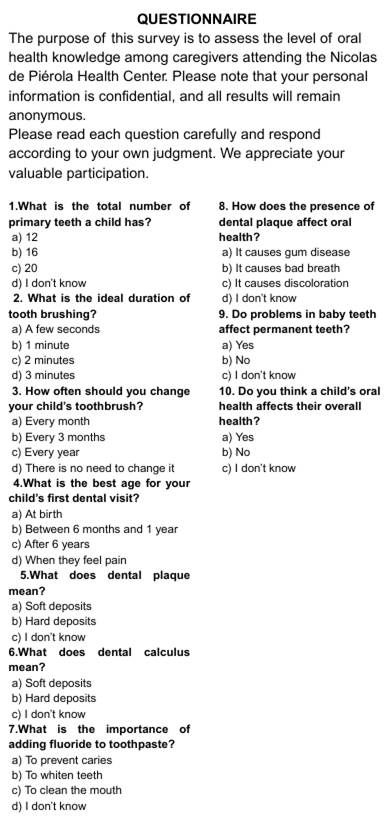
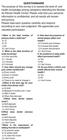
To assess caregivers' knowledge of oral health, a questionnaire previously validated by Hamasha A, et al. 17 was used. The instrument consisted of 10 questions, each with three to four distractors, of which only one was correct. The questionnaire covered topics such as the number of primary teeth, tooth brushing, the ideal timing for dental visits, the meaning of dental plaque and calculus, the importance of fluoride, the relationship between primary and permanent teeth, and the impact of oral health on general health. It was translated from English into Spanish (Figure 1) and reviewed by five experts in community preventive stomatology, pediatric dentistry, and cariology. The V Aiken concordance analysis showed agreement indices equal to or greater than 0.8 for the dimensions of relevance (0.96), importance (0.96), and clarity (0.8). Each correct answer was assigned a score of 1, and incorrect answers received 0. To categorize the scores of correct answers, a standard-setting procedure was applied using percentile-based cut-off points, resulting in three knowledge levels: high (8-10 points), medium (4-7 points), and low (0-3 points). The questionnaire also included sociodemographic questions such as gender, age (categorized as young: 18-26 years; adult: 27-59 years; and senior: 60 years and over), education level, and socioeconomic status. The latter was determined based on the caregiver’s current home address, which was cross-referenced with the block-level stratification map of Lima developed by the National Institute of Statistics and Informatics, classifying socioeconomic status as low, lower-middle, middle, upper-middle, or high. Instructions for completing the questionnaire were provided in advance.
The data were analyzed using the SPSS® statistical package, version 25. The relationship between each question’s answers and the demographic characteristics was assessed using the chi-square test and Fisher’s exact test. The relationship between caregivers’ knowledge and the children’s DMFT/ceo-d and OHI indices was evaluated using Spearman’s correlation, with a 95% confidence level and a significance level of 0.05.
Results
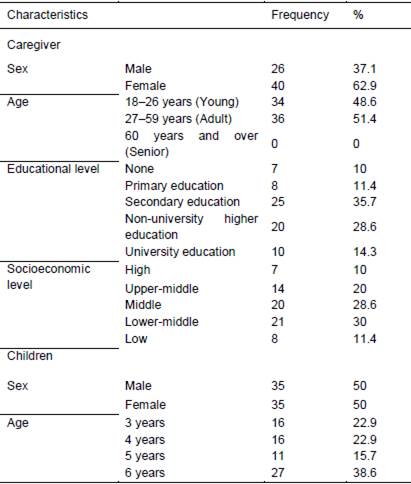
The demographic characteristics of the study sample are shown in Table 1.
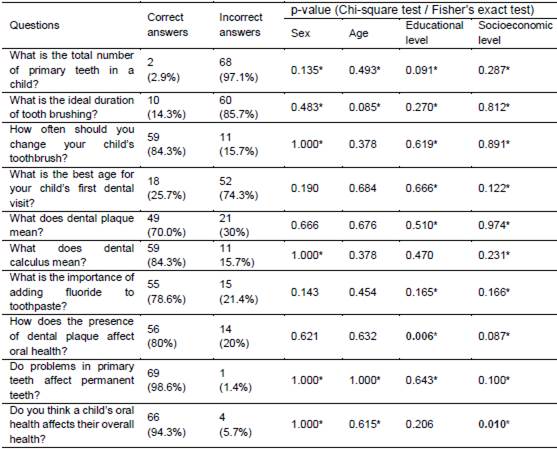
The percentage of correct and incorrect answers, as well as the relationship with the sociodemographic characteristics for each question, are shown in Table 2. Most questions had a correct response rate above 70%. In contrast, the question about the total number of primary teeth had an incorrect response rate of 97.1%. The two other questions with the highest rates of incorrect answers were: “What is the ideal duration of tooth brushing?” and “What is the best age for your child’s first dental visit?” with 85.7% and 74.3% incorrect responses, respectively.
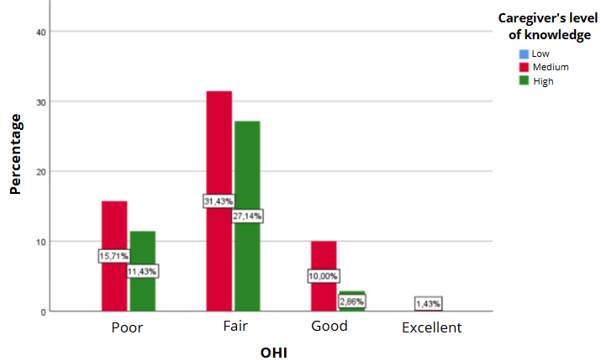
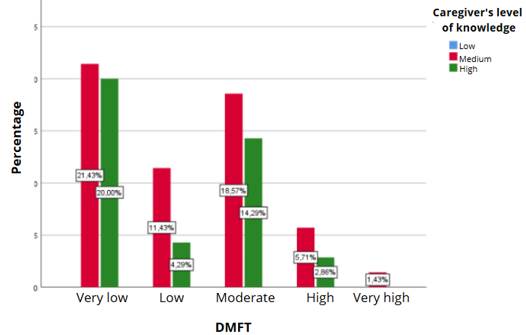
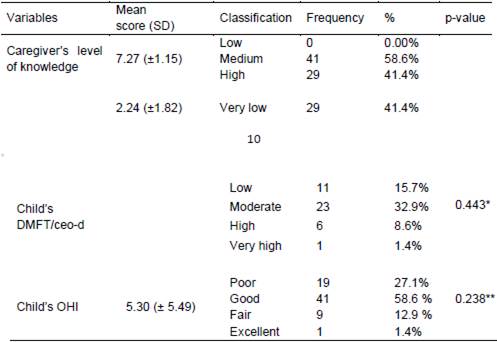
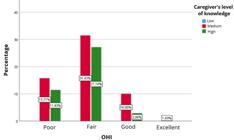
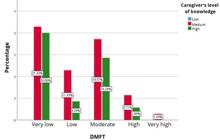
Table 3 and Figures 2 and 3 show the relationship between the caregiver's level of knowledge and the child's DMFT/ceo-d and OHI scores, indicating no statistically significant relationship between the variables (p < 0.05).
Discussion
Since caregivers spend more time with the children under their care, they are directly involved in shaping their habits. Several studies have shown a correlation between guardians’ level of knowledge and the presence of dental caries and oral hygiene indices in children (18,19.
In this study, more than 70% of caregivers were unable to correctly identify the number of primary teeth in children, the duration of tooth brushing, and the best age for a first dental visit. These results are consistent with those reported by Hamasha et al. (17, who found a similar lack of knowledge in response to these questions. Likewise, in the study by Alshammari et al. 20, 83.2% of participants answered incorrectly when asked about the best time to visit the dentist.
When asked about how often to replace a toothbrush, the percentage of correct responses in our study (84.3%) was much higher than that reported by Nepaul et al. (62.5%) (21 and another similar study 17.
Regarding knowledge about dental plaque and calculus, as well as how plaque affects oral health, more than 70% of respondents answered correctly, a figure significantly higher than that reported in a previous study (17.
With regard to the importance of adding fluoride to toothpaste, 78.6% of respondents in our study answered correctly. These results are comparable to those found by Nassar et al. (22), who reported a similar response rate of 74.1%. However, Hamasha et al. 17 and Sehrawat et al. (23 observed lower rates of 46.3% and 43.0%, respectively.
Furthermore, in our study, when caregivers were asked about the impact of primary teeth on permanent teeth, nearly all respondents (98.6%) answered correctly. This figure is higher than that reported by Patil et al. (49%) 24, Mehta N et al. (32.7%) (25, and Dikshit et al. (47.6%) (26. Addressing caregivers’ understanding of the importance of primary teeth is crucial, as a study by Suma et al. 27 concluded that a lack of knowledge in this area could increase the risk of dental caries by 1.67 times.
Currently, there is a growing emphasis on recognizing oral health as an integral part of general health, where changes in oral status can affect an individual’s systemic health 28. Despite its importance, this concept is not sufficiently addressed in questionnaires assessing knowledge, attitudes, and practices related to oral health. In our study, nearly all respondents (94.3%) correctly identified this relationship.
This study found an association between caregivers’ level of knowledge and their level of education, specifically in response to the question about how dental plaque affects oral health. These results are in line with the findings of Chen et al. 29, who reported that parents with higher levels of education tend to have better oral health knowledge. Similarly, a relationship was observed between caregivers’ knowledge and socioeconomic status in the question about children’s oral health and its impact on general health. This aligns with findings by Rojas-Briceño et al. (12, who reported that untreated dental caries are more prevalent among economically disadvantaged children. Additionally, our study found no differences in the level of knowledge based on the gender of the caregivers-results that contrast with those reported by Rajeh (30, who concluded that female caregivers had better knowledge of oral health.
This investigation did not find a relationship between caregivers’ level of knowledge and children’s caries experience or oral hygiene index. This may be explained by findings from Abduljalil et al. 31, who noted that while parents may have a reasonably good level of knowledge, this does not always translate into effective oral health care practices for their children. It is also important to consider that caregivers were surveyed prior to a dental appointment at a health center, which may mean that the children's oral health needs were already being met through routine treatment, regardless of the caregiver’s level of knowledge.
One of the limitations of this study is the lack of research involving populations similar to ours. As a result, comparisons with other studies may be influenced by geographical and cultural factors.
Conclusion
Caregivers in the study sample generally demonstrated a medium level of knowledge regarding oral care. Additionally, the children's DMFT/ceo-d and OHI scores were very low and good, respectively. No differences were found in caregivers’ level of knowledge based on the sociodemographic characteristics studied, nor was any association observed with the children's oral health status.
References
-
1 Pranno N, Zumbo G, Tranquilli M, Stamegna L, Zara F, Vozza I. Oral Hygiene Habits and Use of Fluoride in Developmental Age: Role of Parents and Impact on their Children. Biomed Res Int. 2022;2022(1):6779165. doi:10.1155/2022/6779165
» https://doi.org/10.1155/2022/6779165 -
2 Wong HM. Childhood Caries Management. Int J Environ Res Public Health. 2022;19(14):8527. doi:10.3390/IJERPH19148527
» https://doi.org/10.3390/IJERPH19148527 -
3 Kazeminia M, Abdi A, Shohaimi S, et al. Dental caries in primary and permanent teeth in children's worldwide, 1995 to 2019: a systematic review and meta-analysis. Head Face Med. 2020;16(1). doi:10.1186/S13005-020-00237-Z
» https://doi.org/10.1186/S13005-020-00237-Z -
4 Ministerio de Salud del Perú. Guía de Práctica Clínica para la Prevención, Diagnóstico y Tratamiento de la Caries Dental en Niñas y Niños. MINSA. Published October 2017. Accessed July 5, 2024. https://www.gob.pe/institucion/minsa/informes-publicaciones/280858-guia-de-practica-clinica-para-la-prevencion-diagnostico-y-tratamiento-de-la-caries-dental-en-ninas-y-ninos-guia-tecnica
» https://www.gob.pe/institucion/minsa/informes-publicaciones/280858-guia-de-practica-clinica-para-la-prevencion-diagnostico-y-tratamiento-de-la-caries-dental-en-ninas-y-ninos-guia-tecnica -
5 Castillo JL, Palma C, Cabrera-Matta A. Early Childhood Caries in Peru. Front Public Health. 2019;7:337. doi:10.3389/FPUBH.2019.00337
» https://doi.org/10.3389/FPUBH.2019.00337 -
6 Pesaressi E, Villena RS, Frencken JE. Dental caries and oral health-related quality of life of 3-year-olds living in Lima, Peru. Int J Paediatr Dent. 2020;30(1):57-65. doi:10.1111/IPD.12582
» https://doi.org/10.1111/IPD.12582 - 7 Cayo-Tintaya N, Cosme-Raymundo T, Morales-Vadillo R. Caries dental y su relación con el nivel de conocimiento sobre salud bucal de los padres de familia en preescolares. KIRU. 2019;16(3):102-107.
-
8 Singh O, Reddy V, Sharma L, Pradhan D, Srivastava R. Association of gingivitis with children oral health-related quality of life in Lucknow: A cross-sectional study. J Family Med Prim Care. 2020;9(2):1177. doi:10.4103/JFMPC.JFMPC_956_19
» https://doi.org/10.4103/JFMPC.JFMPC_956_19 -
9 Pawlaczyk-Kamienska T, Torlinska-Walkowiak N, Borysewicz-Lewicka M. The relationship between oral hygiene level and gingivitis in children. Adv Clin Exp Med. 2018;27(10):1397-1401. doi:10.17219/ACEM/70417
» https://doi.org/10.17219/ACEM/70417 -
10 Vargas-Palomino K, Chipana-Herquinio C, Arriola-Guillén L. Condiciones de salud oral, higiene oral y estado nutricional en niños que acuden a un establecimiento de salud de la región Huánuco, Perú. Rev Peru Med Exp Salud Publica. 2019;36(4):653-657. doi:10.17843/rpmesp.2019.364.4891
» https://doi.org/10.17843/rpmesp.2019.364.4891 -
11 Minsa: La caries dental es la enfermedad más común entre la población infantil. Accessed July 5, 2024. https://www.elperuano.pe/noticia/209887-minsa-la-caries-dental-es-la-enfermedad-mas-comun-entre-la-poblacion%20infantil
» https://www.elperuano.pe/noticia/209887-minsa-la-caries-dental-es-la-enfermedad-mas-comun-entre-la-poblacion%20infantil -
12 Rojas-Briceño NB, Oc Carrasco OJ, Silva Díaz YA, et al. Knowledge and Attitudes of Parents about Oral Health in the Primary Dentition Stage in a Peruvian High Andean City. Int J Environ Res Public Health. 2024;21(2). doi:10.3390/IJERPH21020154/S1
» https://doi.org/10.3390/IJERPH21020154/S1 -
13 Sogi HPS, Hugar SM, Nalawade TM, Sinha A, Hugar S, Mallikarjuna RM. Knowledge, attitude, and practices of oral health care in prevention of early childhood caries among parents of children in Belagavi city: A Questionnaire study. J Family Med Prim Care. 2016;5(2):286. doi:10.4103/2249-4863.192332
» https://doi.org/10.4103/2249-4863.192332 -
14 Kaushik M, Sood S. A Systematic Review of Parents' Knowledge of Children's Oral Health. Cureus. 2023;15(7). doi:10.7759/CUREUS.41485
» https://doi.org/10.7759/CUREUS.41485 -
15 Naidu R, Nunn J, Forde M. Oral healthcare of preschool children in Trinidad: a qualitative study of parents and caregivers. BMC Oral Health. 2012;12(1). doi:10.1186/1472-6831-12-27
» https://doi.org/10.1186/1472-6831-12-27 -
16 De Castilho ARF, Mialhe FL, De Souza Barbosa T, Puppin-Rontani RM. Influence of family environment on children's oral health: a systematic review. J Pediatr (Rio J). 2013;89(2):116-123. doi:10.1016/J.JPED.2013.03.014
» https://doi.org/10.1016/J.JPED.2013.03.014 -
17 Hamasha AAH, Rasheed SJ, Aldosari MM, Rajion Z. Parents Knowledge and Awareness of their Children's Oral Health in Riyadh, Saudi Arabia. Open Dent J. 2019;13(1):236-241. doi:10.2174/1874210601913010236
» https://doi.org/10.2174/1874210601913010236 -
18 Abdat M, Ramayana I. Relationship between mother's knowledge and behaviour with oral health status of early childhood. PJoD. 2020;32(3):166-173. doi:10.24198/PJD.VOL32NO2.24734
» https://doi.org/10.24198/PJD.VOL32NO2.24734 -
19 Azimi S, Taheri JB, Tennant M, Kruger E, Molaei H, Ghorbani Z. Relationship Between Mothers' Knowledge and Attitude Towards the Importance of Oral Health and Dental Status of their Young Children. Oral Health Prev Dent. 2018;16(3):265-270. doi:10.3290/J.OHPD.A40760
» https://doi.org/10.3290/J.OHPD.A40760 -
20 Alshammari FS, Alshammari RA, Alshammari MH, et al. Parental Awareness and Knowledge toward their Children's Oral Health in the City of Dammam, Saudi Arabia. Int J Clin Pediatr Dent. 2021;14(1):100-103. doi:10.5005/JP-JOURNALS-10005-1894
» https://doi.org/10.5005/JP-JOURNALS-10005-1894 -
21 Nepaul P, Mahomed O. Influence of parents' oral health knowledge and attitudes on oral health practices of children (5-12 years) in a rural school in KwaZulu-Natal, South Africa. J Int Soc Prev Community Dent. 2020;10(5):605-612. doi:10.4103/JISPCD.JISPCD_273_20
» https://doi.org/10.4103/JISPCD.JISPCD_273_20 -
22 Nassar AA, Fatani BA, Almobarak OT, Alotaibi SI, Alhazmi RA, Marghalani AA. Knowledge, Attitude, and Behavior of Parents Regarding Early Childhood Caries Prevention of Preschool Children in Western Region of Saudi Arabia: A Cross-Sectional Study. Dent J (Basel). 2022;10(12):218. doi:10.3390/DJ10120218
» https://doi.org/10.3390/DJ10120218 -
23 Sehrawat P, Shivlingesh KK, Gupta B, Anand R, Sharma A, Chaudhry M. Oral health knowledge, awareness and associated practices of pre-school children's mothers in Greater Noida, India. Niger Postgrad Med J. 2016;23(3):152-157. doi:10.4103/1117-1936.190344
» https://doi.org/10.4103/1117-1936.190344 -
24 Patil AN, Karkare S, Jadhav HS, Damade Y, Punjari BK. Knowledge, Attitude, and Practice of Parents toward Their Children's Oral Health and its Influence on the Dental Caries Status of 5-10-year-old Schoolchildren in Nashik, Maharashtra: A Cross-sectional Study. Int J Clin Pediatr Dent. 2022;15(Suppl 2):S126. doi:10.5005/JP-JOURNALS-10005-2137
» https://doi.org/10.5005/JP-JOURNALS-10005-2137 -
25 Mehta N, Ankola A, Chawla N, Rajpurohit L. Association of maternal oral health-related knowledge, attitude, and socioeconomic status with dental caries status of preschoolchildren in Belgaum City: A cross-sectional study. J Indian Assoc Public Health Dent . 2019;17(3):186. doi:10.4103/JIAPHD.JIAPHD_227_18
» https://doi.org/10.4103/JIAPHD.JIAPHD_227_18 -
26 Dikshit P, Limbu S, Gupta S, Pradhan R. Evaluation of Knowledge, Attitude and Practices of Parents toward their Children Oral Health Compared with their Dental Caries status. BJHS. 2018;3(2):447-452. doi:10.3126/BJHS.V3I2.20943
» https://doi.org/10.3126/BJHS.V3I2.20943 -
27 Suma G, Anisha P. Evaluation of the Association of Parent's Oral Health Knowledge and Development of Dental Caries in their Children. Austin J Dent. 2017;4(7):1092. https://austinpublishinggroup.com/dentistry/fulltext/jd-v4-id1092.php
» https://austinpublishinggroup.com/dentistry/fulltext/jd-v4-id1092.php -
28 Dörfer C, Benz C, Aida J, Campard G. The relationship of oral health with general health and NCDs: a brief review. Int Dent J. 2017;67:14-18. doi:10.1111/IDJ.12360
» https://doi.org/10.1111/IDJ.12360 -
29 Chen L, Hong J, Xiong D, et al. Are parents' education levels associated with either their oral health knowledge or their children's oral health behaviors? A survey of 8446 families in Wuhan. BMC Oral Health. 2020;20(1). doi:10.1186/S12903-020-01186-4
» https://doi.org/10.1186/S12903-020-01186-4 -
30 Rajeh MT. Gender Differences in Oral Health Knowledge and Practices Among Adults in Jeddah, Saudi Arabia. Clin Cosmet Investig Dent. 2022;14:235-244. doi:10.2147/CCIDE.S379171
» https://doi.org/10.2147/CCIDE.S379171 - 31 Abduljalil H, Abuaffan A. Knowledge and Practice of Mothers in Relation to Dental Health of Pre-School Children. Adv Genet Eng. 2016;5(1):1-7.