Dental eruption at 12 years of age in schools of Montevideo: cross-sectional study
Abstract
Objective: To know the sequence and chronology of tooth emergence in 12-year-old schoolchildren in Montevideo, with emphasis on the eruption of the second molar in relation to the replacement of the mesially located teeth.
Materials and methods: This work was based on secondary data from a cross-sectional observational study involving 1,136 schoolchildren. A questionnaire was administered to collect sociodemographic variables. Height and weight were measured for each participant, and BMI was calculated. The clinical examination recorded the erupted permanent teeth.
Results: The prevalence of altered sequence of eruption was 2.03% (95% CI: 1.26-3.31), and eruption delay was 1.6% (95% CI: 0.89-3.2). Schoolchildren whose mothers had fewer than six years of education showed a higher prevalence of altered eruption sequence. Overweight schoolchildren were 2% less likely to experience delayed emergence of the second permanent molar (OR = 0.98; 95% CI: 0.97-0.99; p ≤ 0.01) compared to their normal-weight peers.
Conclusion: A total of 2.06% of the schoolchildren exhibited an unfavorable eruption sequence, where the second molar erupted before the canine or premolars. A slight delay in the eruption chronology was observed and associated with nutritional status: overweight and obese children showed less delay compared to normal-weight children.
Keywords:
“tooth emergence”; “Eruption time”; “Sequence of eruption”; “Dentition, Mixed”; “permanent teeth”; “body mass index”; “Socioeconomic Factors”
Resumen
Objetivo: Conocer la secuencia y cronología de la emergencia dentaria en escolares montevideanos de 12 años, con énfasis en la erupción del segundo molar en relación con el recambio de las piezas ubicadas mesialmente.
Metodología: este trabajo se basó en datos secundarios de un estudio observacional transversal, participaron 1136 escolares. Se aplicó un cuestionario para estudio con variables sociodemográficas. Fue medida la altura y el peso de cada individuo y calculado el IMC. El examen clínico registró las piezas dentarias permanentes erupcionadas.
Resultados: La prevalencia de la alteración de la secuencia fue 2,03% (IC 95%:1.26-3.31) y el retraso el 1,6% (IC 95%:0.89-3.2) de la emergencia dentaria. Los escolares con madres con menos de 6 años de escolaridad presentaron mayor prevalencia en la alteración secuencia. Los escolares con sobrepeso presentaron un 2% menos probabilidad de tener retraso en la emergencia del segundo molar permanente (OR= 0,98 (0,97-0,99) p≤0,01) que aquellos escolares con normopeso.
Conclusión: El 2.06% de los escolares presentó una secuencia desfavorable en donde el segundo molar erupcionó antes que canino o premolares. Los escolares presentaron un pequeño retraso en la cronología de erupción y este se relacionó con el estado nutricional, los niños con sobrepeso y obesidad muestran un menor retraso en comparación con los niños normopeso.
Palabras Claves:
“emergencia dentaria”; “cronología de erupción”; “secuencia de erupción”; “dentición mixta”; “piezas dentarias permanentes”; “índice de masa corporal”; “factores sociodemográficos”
Resumo
Objetivo: Conhecer a sequência e a cronologia da emergência dentária em escolares de Montevidéu, de 12 anos, com ênfase na erupção do segundo molar em relação à substituição de dentes localizados mesialmente.
Metodologia: este trabalho foi baseado em dados secundários de um estudo observacional transversal, participaram 1.136 escolares. Foi aplicado um questionário para estudo com variáveis sociodemográficas. A altura e o peso de cada indivíduo foram medidos e o IMC foi calculado. O exame clínico registrou os dentes permanentes irrompidos.
Resultados: A prevalência de alteração de sequência foi de 2,03% (IC 95%: 1,26-3,31) e o atraso foi de 1,6% (IC 95%: 0,89-3,2) do surgimento dentário. Escolares cujas mães tinham menos de 6 anos de escolaridade tiveram maior prevalência da alteração de sequência. Escolares com excesso de peso tiveram 2% menos chances de apresentar atraso no surgimento do segundo molar permanente (OR= 0,98 (0,97-0,99) p≤0,01) do que escolares com peso normal.
Conclusão: 2,06% dos escolares apresentaram sequência desfavorável em que o segundo molar irrompeu antes dos caninos ou pré-molares. Os escolares apresentaram um pequeno atraso na cronologia de erupção e isso foi relacionado ao estado nutricional; as crianças com sobrepeso e obesidade apresentaram um atraso menor em comparação às crianças com peso normal.
Palavras-chave:
“emergência dentária”; “cronologia de erupção”; “sequência de erupção”; “dentição mista”; “dentes permanentes”; “índice de massa corporal”; “fatores sociodemográficos”
Introduction
Tooth eruption is the process by which a tooth moves from its original position in the jaw or crypt to its emergence in the oral cavity, ultimately reaching its functional position 1,2.
This development stage is particularly important in several dental disciplines such as pediatric dentistry, orthodontics, oral surgery, and legal and forensic dentistry, as it provides a reference for determining chronological age and to indicate the biological maturation of an individual (3,4.To study tooth eruption, it is essential to assess both its chronology-the moment the tooth appears in the oral cavity, expressed in months or years-and the sequence of eruption, the order in which the teeth erupt.
Regarding the eruption timing of permanent teeth, several general factors have been shown to influence it, including sex, ethnicity or race, systemic and hereditary factors, as well as local factors such as place of residence, caries experience, socioeconomic status, fluoride exposure, and nutritional conditions (3,5-7. The most frequently observed sequence of eruption in the upper jaw is 6-1-2-4-3-5-7 or 6-1-2-4-5-3-7, while in the lower jaw the most common patterns are 6-1-2-3-4-5-7 or 6-1-2-4-3-5-7 (1,2,5. The most unfavorable sequence-due to the potential shortening of the dental arch perimeter-occurs when the second permanent molar erupts before the canine or premolars. This may exert mesial pressure on the first molar and lead to space deficiency, compromising the proper positioning of the above teeth 1,2.
At the age of 12-which is the reference age for epidemiological studies 8-a complete permanent dental arch, excluding third molars, is expected. However, local factors such as physical obstructions to eruption (odontomas, supernumerary teeth, etc.), trauma, or premature loss of a primary tooth can accelerate or delay the eruption of its successor. Systemic conditions may also interfere with the normal eruption sequence, potentially leading to occlusal alterations (9,10.
At national level, no studies have described the chronology or sequence of dental emergence in Uruguayan schoolchildren.
The objective of this study was to assess the sequence and chronology of dental emergence in 12-year-old schoolchildren from Montevideo using secondary data, with particular emphasis on the eruption of the second molar relative to the replacement of the mesially positioned teeth. The study also aimed to explore associations with various sociodemographic and biological indicators.
Methodology:
Study design
This study used secondary data from a cross-sectional and analytical observational study on the prevalence and experience of dental caries in 12-year-old schoolchildren (11, conducted between August 2011 and July 2012 in Montevideo, Uruguay.
Population and sample
The schoolchildren included in the study attended public and private schools in Montevideo. A sample of 1,235 children was estimated, based on a caries prevalence of 60%, a 95% confidence level, a precision of ±4%, and an anticipated non-response rate of 30%. A stratified probability sample was designed according to the type of school, based on enrollment data from the last two school years (5th and 6th grade). As a result, 16% of the children were enrolled in private schools and 84% in state schools. A total of 1,733 schoolchildren born in 1999 and/or 2000 were invited to participate; 1,154 children were examined, and 1,136 were ultimately included in the analysis after excluding those with fixed orthodontic treatment (928 from state schools and 208 from private schools).
Data collection
A structured questionnaire was administered to the children's families, collecting information on socioeconomic variables and access to health services. A second questionnaire was completed by the children, addressing oral hygiene habits and diet.
Anthropometric measurements were taken. Height was measured with children barefoot and wearing light clothing, using a measuring tape placed perpendicular to the floor against a wall without a baseboard. Weight was measured twice using a digital scale, and the average of the two readings was recorded.
Clinical examinations were performed in a classroom adapted for the study, with the children in a supine position. The examination used mirrors, cotton tweezers, and a CPI/WHO probe, along with cotton rolls and portable lamps to ensure a dry and well-lit working field. All erupted permanent teeth were recorded. A tooth was considered to have erupted if it had broken through the gingiva and was visible in the oral cavity. The criteria described by Carvalho 12 were used to determine the eruption status of the second permanent molars.
Training and Reproducibility
The examiners received both theoretical and practical training for the clinical recordings. Theoretical and illustrative sessions were held using photographs to discuss the eruption stages of the second molars. Practical training was then conducted with patients to evaluate the timing, sequence, and registration of the clinical examination.
Data analysis
The outcome variable was defined as the expected sequence and chronology of dental eruption at age 12, based on the presence or absence of the second molar in relation to the mesially located permanent teeth at the time of examination. It was considered an alteration in the eruption sequence when the second molar was present and at least one of the mesial permanent teeth was absent in any quadrant. A delay in eruption was defined when none of the second molars had erupted into the oral cavity.
Explanatory variables included sociodemographic characteristics such as sex (female/male), type of school (public/private), and maternal education level (<6 years, 7-11 years, ≥12 years). Nutritional status was also considered, using the 2007 WHO child growth standards 13. Body mass index (BMI) was calculated by dividing weight (kg) by the square of height (m). Based on BMI and according to WHO 2007 cut-off points, children were categorized by sex into: normal weight (z-score <1), overweight (z-score between 1 and 2), obesity (z-score ≥2), and severe obesity (z-score ≥3), using the classification table by Fernandez et al. (14.
For statistical analyses, a post-calibration of the data was carried out using a weighting variable to adjust for any discrepancies in school selection probability, population distribution by sex and school type (public or private), and the participation rate of each school 11.
The prevalence of altered sequence and delayed eruption was reported as percentages with their corresponding 95% confidence intervals (CI). Associations were analyzed using contingency tables, and statistical significance was tested at the 5% level using the Chi-square test. The strength of the association between the explanatory variables and the prevalence of altered dental eruption was evaluated through logistic regression models. Variables with a p-value < 0.20 in the bivariate (unadjusted) analysis were included in the multivariate (adjusted) model. Finally, only variables with a p-value ≤ 0.05 were considered statistically significant.
Ethical Considerations
This study was evaluated and approved by the Ethics Committee of the Faculty of Dentistry of UDELAR (Exp. 091900-000028-22). Parents or legal guardians of the participating schoolchildren provided informed consent for the oral examination and completed a structured questionnaire.
Results
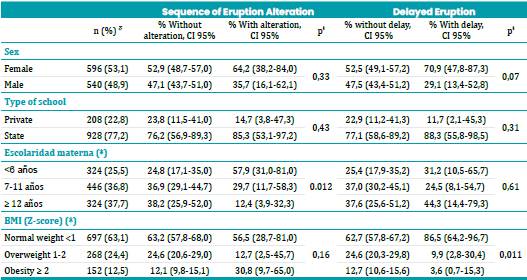
A total of 1,136 schoolchildren participated in the study; 53.1% were girls, and 77.2% attended public schools. Regarding maternal education, 25.5% of schoolchildren had mothers with less than 6 years of schooling, 36.8% between 7 and 11 years, and 37.7% with 12 or more years. As for nutritional status, 63.1% of the children had normal weight, while 36.9% were classified as overweight (24.4%) or obese (12.5%) (Table 1).
The presence of the second molar by quadrant was 53.2% in quadrant 1, 53.7% in quadrant 2, 65.9% in quadrant 3, and 64.9% in quadrant 4, with lower molars being approximately 12% more frequent than upper molars.
The prevalence of altered eruption sequence was 2.03% (95% CI: 1.26-3.31), defined as the presence of the second molar and the absence of a mesially located tooth (canine or premolar) in at least one quadrant. Regarding eruption chronology, 1.6% (95% CI: 0.89-3.2) of schoolchildren presented a delay in eruption in at least one quadrant.
The association between the prevalence of altered sequence and eruption delay with explanatory variables is presented in Table 1. It was found that schoolchildren whose mothers had less than 6 years of schooling showed a higher prevalence of altered dental sequence (57.9% (95% CI: 31.0-81.0)) than those whose mothers had 7-11 years (29.7% (95% CI: 11.0-58.6)) and ≥12 years of schooling (12.4% (95% CI: 3.9-32.3)), with p=0.012. Regarding eruption chronology, overweight and obese schoolchildren had a lower prevalence of second molar eruption delay, at 9.9% (95% CI: 2.8-30.4) and 3.6% (95% CI: 0.7-15.3), respectively, compared to 86.5% (95% CI: 64.2-96.7) in children with normal weight, with p=0.011.
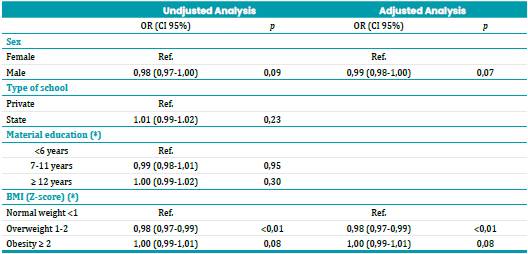
Upon analyzing the strength of association with the delayed eruption, overweight schoolchildren were 2% less likely to present delayed eruption of the second permanent molar (OR = 0.98 (95% CI: 0.97-0.99); p ≤ 0.01), whereas obese schoolchildren showed no significant difference compared to those with normal weight (OR = 1.00 (95% CI: 0.99-1.01); p = 0.08), in both the unadjusted and adjusted analyses (Table 2). On the other hand, no statistically significant association with altered second molar emergence was found in the adjusted model (non-reported data).
Discussion
This study is the first to report, at the population level, the sequence and chronology of dental emergence in 12-year-old schoolchildren. At this age, a complete permanent dentition-excluding third molars-is expected. However, this population showed an eruption delay of 1.6% (95% CI: 0.89-3.2), and an alteration in eruption sequence of 2.03% (95% CI: 1.26-3.31).
This research was based on a secondary analysis of a population sample originally calculated for the prevalence of dental caries, which may represent a limitation in relation to this work’s objective. Nevertheless, the sample of 1,136 schoolchildren was more than adequate to analyze the delay and alteration in dental emergence. Similarly, when evaluating BMI in this dataset, results were consistent with those reported by Estragó et al. 13, who analyzed arterial hypertension and nutritional status in Montevideo schoolchildren aged 10 to 13 years, and found that 39.9% were overweight or obese.
Regarding the sequence of eruption and sex, previous studies have reported varying results, particularly in the eruption sequence of posterior teeth. Nevertheless, most studies agree that the second molar is typically the last to erupt. In this study, it was not possible to establish the complete eruptive sequence among the schoolchildren, as the population had a narrow age range, with a mean age of 12 years and 22 months (95% CI: 12.20-12.24), and only one clinical examination was conducted. Therefore, only one alteration could be identified concerning the emergence of the second molar: 2.03% of the population presented a less favorable sequence for maintaining arch perimeter, in which the second molar emerged before the mesially located teeth in at least one quadrant. No statistically significant association was found with sex (Table 1). A cross-sectional study by Bayrak et al. in a population aged 5 to 15 years reported a similar alteration in the maxilla, with the second molar erupting before the second premolar in 1.9% of cases. In the mandible, this figure was 16.7% (5. This discrepancy may partly be explained by the use of Carvalho’s criteria (12 in this study, where a tooth was considered to be erupted when one-third of its occlusal surface was visible in the oral cavity-potentially leading to a slight underestimation of the true prevalence.
When analyzing sociodemographic factors and their relationship with eruption chronology, no statistically significant association with sex was found (p = 0.07) (Tables 1 and 2). This may be due to the standardized reference age of 12 years, at which point a complete permanent dentition is expected in both sexes. However, the literature remains divided: some authors report earlier eruption in females, while others have found certain posterior teeth to erupt earlier in males. Notably, many of these studies were based on wider age ranges.
Socioeconomic status in this study was assessed using the variables "type of school" and "maternal schooling." No statistically significant association was found between school type and either the eruption sequence or chronology (Tables 1 and 2). This aligns with findings by Kaur et al. 15, who also reported no significant difference in eruptive delay between children from public and government schools, despite the latter being of lower socioeconomic status.
In contrast, only 12.4% (95% CI: 3.9-32.3) of schoolchildren whose mothers had ≥12 years of education presented at least one quadrant with altered second molar emergence (i.e., before canines or premolars), compared to those whose mothers had fewer years of education (p = 0.012). A possible explanation for this finding is that children with more educated mothers may experience fewer caries lesions and related complications in their primary dentition, thereby reducing premature tooth loss or other local factors that might delay eruption of the successor teeth mesial to the second molar.
It has also been suggested that individuals from higher socioeconomic backgrounds tend to exhibit earlier dental development 16, likely due to better access to healthcare and improved nutritional status. Still, the literature remains inconsistent. For example, Kutesa et al. found no statistically significant association between socioeconomic status and eruption timing, while Oziegbe et al. 17 observed earlier eruption of maxillary and mandibular incisors in children from higher socioeconomic levels, but paradoxically reported delayed emergence of the upper second molar and the mandibular second premolar and molar in comparison to children from middle socioeconomic backgrounds.
A systematic literature review (18 found a positive correlation between overweight/obesity and earlier tooth eruption. Although only two studies were included in the exploratory meta-analysis, they showed that obese 12-year-old children were likely to have one more erupting tooth than their peers, with a standardized mean difference of 0.99 (95% CI: 0.63-1.35). Wong et al. 19 also found this association in their cross-sectional study of 12-year-old children, where overweight and obese children had a significantly higher number of erupted permanent teeth compared to their normal-weight peers. In this study, the association between BMI and dental emergence was evaluated in terms of eruption delay. A significantly lower prevalence of delayed eruption was observed among overweight (9.9%, 95% CI: 2.8-30.4) and obese children (3.6%, 95% CI: 0.7-15.3) compared to children with normal weight (Table 1). Furthermore, overweight schoolchildren were 2% less likely to present delayed eruption of the second molars than those with normal weight, with an odds ratio of 0.98 (95% CI: 0.97-0.99) (Table 2).
Conclusions
Twelve-year-old schoolchildren from Montevideo showed a 2.03% prevalence (95% CI: 1.26-3.31) of an unfavorable dental emergence sequence (specifically, the second molar emerging before the canine or premolars) This finding should be considered in clinical practice to help preserve arch perimeter during the second transitional phase and prevent mesial drift of the posterior teeth, which can compromise the space required for the eruption of lateral teeth.
While 1.6% of the children (95% CI: 0.89-3.2) exhibited delayed dental emergence, indicating that the permanent dentition was not yet complete at this age. A statistically significant association was found between the chronology of second molar eruption and nutritional status: overweight and obese children showed a lower prevalence of delayed eruption than those with normal weight.
Obtaining a more comprehensive understanding of the sequence and timing of dental emergence in the Uruguayan population requires evaluations beginning at earlier ages and extending over longer periods of time. As such, longitudinal studies are recommended.
Clinical monitoring of the sequence of dental eruption is advised between the ages of 10 and 11 years, particularly in children with overweight or obesity, to detect possible alterations in eruption patterns.
References
- 1 Moyers RE. Manual de ortodoncia. 4 edición. Argentina: Editorial Medica Panmericana S.A.; 1992. 550 p.
- 2 Šindelářová R, Žáková L, Broukal Z. Standards for permanent tooth emergence in Czech children. BMC Oral Health. diciembre de 2017;17(1):140.
- 3 Šindelářová R, Broukal Z. Polymorphism in sequence of permanent tooth emergence in Czech children. Cent Eur J Public Health. 26 de junio de 2019;27(2):165-9.
- 4 Almonaitiene R, Balciuniene I, Tutkuviene J. Factors influencing permanent teeth eruption. Part one - general factors . Stomatologija. 2010;12(3):67-72.
- 5 Bayrak S, Sen Tunc E, Tuloglu N, Acikgoz A. Timing of Permanent Teeth Eruption in Turkish Children. J Clin Pediatr Dent. . diciembre de 2012;37(2):207-11.
- 6 Kochhar R, Richardson A. The chronology and sequence of eruption of human permanent teeth in Northern Ireland. Int J Paediatr Dent.. diciembre de 1998;8(4):243-52.
- 7 Obilade OA, Sanu OO, Costa OO Impact of three malocclusion traits on the quality of life of orthodontic patients. Int Orthod.. septiembre de 2016;14(3):366-85.
-
8 Petersen PE, Baez RJ, World Health Organization. Oral health surveys: basic methods (Internet). 5th ed. Geneva: World Health Organization; 2013 (citado 30 de octubre de 2023). Disponible en: Disponible en: https://iris.who.int/handle/10665/97035
» https://iris.who.int/handle/10665/97035 - 9 Almonaitiene R, Balciuniene I, Tutkuviene J. Standards for permanent teeth emergence time and sequence in Lithuanian children, residents of Vilnius city. Stomatologija 2012;14(3):93-100.
- 10 Suri L, Gagari E, Vastardis H. Delayed tooth eruption: Pathogenesis, diagnosis, and treatment. A literature review. Am J Orthod Dentofacial Orthop.. octubre de 2004;126(4):432-45.
- 11 Fabruccini A, Alves LS, Alvarez L, Alvarez R, Susin C, Maltz M. Comparative effectiveness of water and salt community-based fluoridation methods in preventing dental caries among schoolchildren. Community Dent Oral Epidemiol. diciembre de 2016;44(6):577-85.
- 12 Carvalho JC, Ekstrand KR, Thylstrup A. Dental Plaque and Caries on Occlusal Surfaces of First Permanent Molars in Relation to Stage of Eruption. J Dent Res. mayo de 1989;68(5):773-9.
-
13 Estragó V, Tabárez A, Muñoz M, González G, Bulla D, Díaz J, et al. Sobrepeso, obesidad e hipertensión arterial en niños, una aproximación al problema. Arch. Pediatr. Urug.. 2018; 89(5):301-310. https://doi.org/10.31134/ap.89.5.2.
» https://doi.org/10.31134/ap.89.5.2. - 14 Fernández JR, Redden DT, Pietrobelli A, Allison DB. Waist circumference percentiles in nationally representative samples of African-American, European-American, and Mexican-American children and adolescents.J Pediatr.. octubre de 2004;145(4):439-44.
- 15 Kaur I, Singal P, Bhatnagar DP. Timing of Permanent Teeth Emergence and Dental Caries among Jatsikh Children of Public and Government Schools of Patiala District. Anthropologist. abril de 2010;12(2):141-8.
- 16 Clements EMB, Davies-Thomas E, Pickett KG. Time of Eruption of Permanent Teeth in British Children at Independent, Rural, and Urban Schools. Br Med J.. 29 de junio de 1957;1(5034):1511-3.
- 17 Oziegbe EO, Esan TA, Oyedele TA. Brief communication: Emergence chronology of permanent teeth in Nigerian children: Emergence Chronology of Permanent Teeth. Am J Phys Anthropol. marzo de 2014;153(3):506-11.
- 18 Mohamedhussein N, Busuttil-Naudi A, Mohammed H, UlHaq A. Association of obesity with the eruption of first and second permanent molars in children: a systematic review. Eur Arch Paediatr Dent.. febrero de 2020;21(1):13-23.
- 19 Wong HM, Peng SM, Yang Y, King NM, McGrath CPJ. Tooth eruption and obesity in 12-year-old children. J Dent Sci.. junio de 2017;12(2):126-32.