| The use of nasal conformer in a newborn improves alar symmetry. |
| 2 |
Not mentioned |
Not mentioned |
Not mentioned |
| 3 |
Grayson-type orthopedics improve feeding. Most children with bilateral clefts can eat correctly and show substantial improvement with the use of orthopedic plates. |
Grayson-type orthopedics progressively aligns the maxillary segments, retracts the premaxilla, and approximates the alveolar ridges. |
NAM uses a nasal extension to shape and reposition the deformed alar cartilage. In bilateral cleft lip cases, it lengthens the columella and supports the cleft nasal floor. |
| Orthopedics aligns the three maxillary segments of patients with bilateral cleft lip and palate. |
| 4 |
Not mentioned |
Preoperative orthopedics is essential and widely used. In an effort to align the three maxillary segments, lengthen the prolabium and the columella. NAM helps reduce the distance between the maxillary segments. |
Not mentioned |
| 5 |
NAM contributes to breastfeeding and child feeding. |
NAM allows clinicians to redirect bone and soft tissues to a favorable anatomic position early. Primary lip surgery benefits from reducing the width of the palatal and alveolar cleft. |
Preoperative orthopedics provides improved esthetic results, and primary lip surgery benefits from reduced soft tissue tension. NAM achieves greater symmetry of the lip, nasal cartilages,and improved nasal tip projection. |
| 6 |
Presurgical orthopedics facilitates feeding. |
NAM aligns the alveolar processes, narrows the alveolar gap, shapes the alar cartilages, and brings the philtrum and columella into a better position. |
NAM improves nasal symmetry in unilateral cleft cases, and elongates the columella in bilateral cases.The most significant benefit is repositioning the columella from an oblique position to a vertical and midline direction. This results in better nasal tip projection, and symmetry of the alar cartilages. |
| The nasoalveolar modeling plate is used in practice with good results in gaps from 3-8 mm to 14 mm. |
This technique minimizes scarring, and in patients with bilateral clefts, it eliminates the need for a second surgery to elongate the columella, which causes scarring at the columella-labial junction. |
| 7 |
NAM improves feeding. |
NAM reduces the distance between labial segments, allows for growth stimulation and redirection in order to reposition alveolar segments in a controlled manner. |
NAM improves esthetic appearance and nasal symmetry without affecting nasal growth. |
| The cases presented (case 1 and 2) show minimal or almost no scarring, and almost normal anatomy of the lip and palate was achieved. |
| CASE 1: patient with unilateral cleft lip and palate that has been treated with NAM for three months. The nose has not changed significantly because the child was already three months old when the condition was reported. |
| 8 |
Strong evidence indicates that preoperative orthopedics does not improve the efficiency and effectiveness of breastfeeding. |
Since there is no evidence in favor or against preoperative orthopedics, we suggest that the treatment be prescribed according to the surgeon’s experience. |
The expert committee agrees that the results of preoperative orthopedics in nasal symmetry depend on the treating professional’s skills and experience. |
| One study reported pressure ulcer as an adverse effect. Therefore, the authors state that no conclusions can be drawn on the usefulness of preoperative orthopedics from the studies reviewed. |
| 9 |
Presurgical orthopedics facilitates feeding. |
Presurgical orthopedics reduces the gap and repositions the maxillary segments. However, some people believe that it is not necessary and that the advantages of monitoring the cleft patient (rather than treating orthopedically) and of surgery are greater. |
Further studies are needed. |
| 10 |
In the first few days, the infant may need time to get used to feeding with the NAM method. |
NAM reduces the severity of the initial gap between maxillary segments. Good alveolar alignment helps the surgeon to achieve a better and more predictable surgical result, in addition to a successful gingivioplasty. |
Long-term studies of the NAM technique indicate improved lip and nose shape, reduction of nasal fistula and lip deformities. This technique has eliminated the need for surgical reconstruction of the columella and the resulting scar in bilateral cleft lip and palate. |
| The NAM technique has been shown to significantly improve the surgical outcome in primary cleft lip and palate repair compared to other preoperative orthopedic techniques. |
| Long-term studies of NAM therapy indicate that the change in nasal shape is stable with less scar tissue, and there is improved nasal and lip shape. |
| 11 |
Not mentioned |
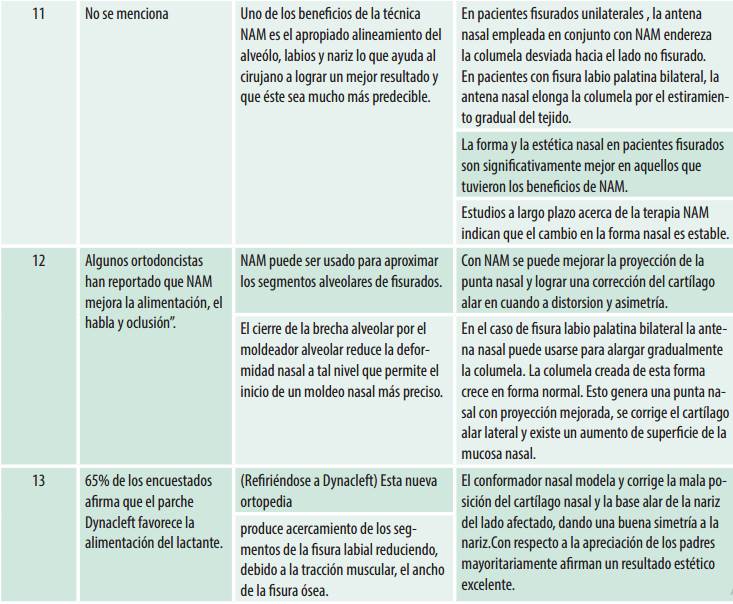
One of the benefits of the NAM technique is proper alveolar, lip, and nasal alignment, which helps achieve a better and more predictable surgical result. |
In unilateral cleft patients, the nasal stent used jointly with NAM straightens the deviated columella toward the noncleft side. In patients with bilateral cleft lip and palate, the nasal stent elongates the columella by stretching the tissue gradually. |
| Nasal shape and esthetics in cleft patients are significantly better in patients who underwent NAM treatment. |
| Long-term studies of NAM therapy indicate that the change in nasal shape is stable. |
| 12 |
Some orthodontists have reported that NAM improves feeding, speech, and occlusion. |
NAM can be used to approximate the alveolar segments. |
NAM can improve nasal tip projection and correct alar cartilage distortion and asymmetry. |
| Closing the alveolar gap with an alveolar shaper reduces the nasal deformity so that more precise nasal shaping can be implemented. |
The nasal stent can be used in bilateral cleft lip and palate patients to lengthen the columella gradually. The columella thus created grows normally. This creates a nasal tip with improved projection, the lateral alar cartilage is corrected, and there is an increase in nasal mucosal surface. |
| 13 |
Sixty-five percent of respondents say that the Dynacleft patch promotes infant feeding. |
This new orthopedics (Dynacleft) |
The nasal conformer models and corrects the malposition of the nasal cartilage and the alar base of the nose on the affected side, making the nose symmetrical.Most parents believe that the esthetic result is excellent. |
| brings together the segments of the cleft lip by reducing the width of the bone fissure with muscular traction. |
| 14 |
Not mentioned |
Dynacleft and Grayson’s NAM: both methods significantly decrease gap width. |
Both methods improve nasal asymmetry. Our findings show that both methods have similar results. |
| 15 |
With NAM, newborns can suckle without nausea or difficulty. |
NAM reduces the size of the alveolar gap after molding and repositioning bone and soft tissue segments. |
Using NAM, deficient tissues can be expanded, and malpositioned structures can be repositioned before surgical correction. |
| Initially, the gap was 6-mm wide, and after 11 weeks with NAM, it was 1-mm wide. |
NAM successfully rehabilitates the newborn by closing the oronasal communication. |
| 16 |
NAM precludes traditional breastfeeding in almost all cases. |
Not mentioned |
Not mentioned |
| How infants undergoing NAM therapy breastfeed: 75% used a Haberman feeder, and 2% used the nipple. |
| 17 |
Not mentioned |
NAM improves nasal angle symmetry in patients with unilateral and bilateral cleft lip and palate, and nostril span. |
Not mentioned |
| 18 |
Not mentioned |
The gap between maxillary segments decreases. |
A significant improvement in esthetics was observed in patients who used NAM compared with those who did not. |
| 19 |
Not mentioned |
PNAM repositions premaxilla and alveolar processes. |
In this case, the nasal width decreased, the columella length increased, and the alar cartilages were molded to a normal shape. The shape of the repaired nostril was the same as the opposite side, resulting in an appearance of facial symmetry. Post-surgery scars on the upper lip were barely identifiable. |
| The results of this study show a significant decrease in the intra-alveolar gap. The alveolar segments touched, and the labial segments were closer together. |
| NAM also includes support and modeling of the nasal cartilages, correcting nasal projection, and lengthening the columella before primary surgery. |
| 20 |
Not mentioned |
NAM plays an essential role in reducing the gap between segments and associated nasoalveolar and nasal deformities. Specifically, it has been argued that NAM acts as an inductive mechanism to stimulate the activity of immature nasal chondroblasts. It leads to interstitial expansion associated with improved nasal morphology. |
NAM can improve several essential features like nasal cartilage deformity and nasal asymmetry. It can also stretch the nasal mucosal lining and lengthen the columella without surgery, improving appearance. |
| 21 |
Not mentioned |
Not mentioned |
NAM minimizes wound healing disturbances and scar severity after surgery. |
| 22 |
Presurgical orthopedic treatment in children with cleft palate improves tongue function and facilitates newborn feeding. |
Presurgical orthopedic treatment seeks to align the segments and reduce gap width to reduce soft tissue tension and facilitate cheiloplasty. |
Presurgical orthopedic treatment aims to shape the nasal cartilages and reshape the columella. The durability of these effects is controversial. |
| 23 |
Not mentioned |
Intermaxillary segments in patients with NAM (CAD/CAM) and manual NAM decreased. |
Not mentioned |
| 24 |
Not mentioned |
Not mentioned |
Not mentioned |
| 25 |
Not mentioned |
After six months with NAM treatment, the posterior alveolar segments were aligned, and the premaxilla retracted into the oral cavity. Three alveolar segments were repositioned into their proper shape within the arch, and the lips were brought closer together. |
Not mentioned |

 Presurgical orthopedics in patients with cleft lip and palate: nutrition, aesthetics and gap between maxillary segments. A systematic review
 Thumbnail
 Thumbnail