The peer-review process to ensure the quality of scientific journals
Abstract:
The peer-review process is one of the main pillars of scientific journals. It is a complex and rigorous activity conducted by national or foreign experts, which allows for a critical assessment of manuscripts. In the health area, this process becomes highly relevant, especially regarding assessing the credibility of the research results and the description of procedures and resolution of cases.
Keywords:
peer review; expert evaluation; arbitration process
Resumen:
La revisión por pares representa uno de los pilares más importantes sobre los que se sustentan las revistas científicas. Es un proceso complejo y riguroso realizado por expertos nacionales y/o extranjeros que permite la evaluación crítica de los manuscritos. En el área salud, este proceso toma una dimensión relevante sobretodo en la valoración de la credibilidad de los resultados de investigaciones y en la descripción de procedimientos y resolución de casos.
Palabras clave:
revisión por pares; evaluación de expertos; proceso arbitral
Resumo:
De avaliação pelos pares representa um dos pilares mais importantes no qual estão baseados os periódicos científicos de avaliação pelos pares. É um processo complexo e rigoroso conduzido por peritos nacionais ou estrangeiros, que permite uma avaliação crítica dos manuscritos. Na área da saúde, este processo leva acima de tudo uma dimensão relevante na avaliação da credibilidade dos resultados da pesquisa e na descrição de procedimentos e resolução de casos.
Palavras chave:
Revisão por pares; avaliação especializada; proceso de arbitragem
The peer-review process
Peer review of papers is one of the major pillars of scientific publications, such as the case of Odontoestomatología. It is a complex and rigorous process conducted by national and/or foreign experts that allow for the critical evaluation of manuscripts submitted for publication in a scientific journal. In the area of health, this process becomes even more critical, especially in assessing the credibility of the results of studies and in describing procedures and solving cases.
Peer review has advantages for everyone involved in the editorial process, namely: editors because expert evaluation contributes to the editorial decision on manuscripts and authors since the peer reviewers' suggestions, adjustments and corrections allow them to improve the paper, optimizing its quality1.
Selecting the right peer reviewers, according to the subject matter of the manuscript, is one of the main tasks of the editorial team of scientific journals, as well as systematic compliance with the stages involved. For instance, when the peer reviewer requests a new revision after the authors' adjustments, when the two peer reviewers issue contradictory reports (one accepts, and the other rejects a paper), so an additional reviewer must be selected in order to make a reliable decision, among other things.
Types of peer review
Peer review can be done in three ways: a) single-blind, b) double-blind, and c) open2.
-
a) In the single-blind peer review, the reviewer knows the author's identity, but the author does not know who the reviewer is; this is currently accepted practice.
-
b) In the double-blind peer review, both reviewers and authors remain anonymous; it is the most widely accepted practice as all indicators of identity (authors and reviewers) are removed. This approach seeks to preserve anonymity, thus ensuring that the review is done fairly. However, in a small area such as Uruguay, it is difficult to conceal the identity of an author, so in general, the peer reviewers selected to evaluate a national paper are foreigners.
-
c) Open peer review reveals the identities of both authors and reviewers, and authors can identify reviewers’ comments3).
-
Peer reviewers suggest improvements to the manuscript when guiding, commenting on and making suggestions to the author based on their knowledge. Additionally, they help the editor detect unethical practices or behaviors in the sense of detecting plagiarism and fraud in scientific publications4.
The peer-review process
The anonymity of reviewers is a general practice, although all experts do not necessarily accept it. First, the publishing team may receive a complaint from a peer reviewer asking to be informed of the names and/or institutional affiliations of the authors, though this happens very rarely. In fact, good peer reviewers, knowledgeable in their field and the researchers working in it, would be able to detect the origin of a work, at least at the level of the research group, without the specific information having been provided. Therefore, it may sometimes happen that specialists who are requested to act as peer reviewers decline to do so because they know one of the authors or have conflicts of interest.
In an anonymous system, the authors do not know the identity of the peer reviewers who evaluate their work to avoid conflicts and possible clashes.
The time and effort generously given by peer reviewers are only compensated by the satisfaction of having been selected to evaluate a manuscript given the recognition of their expertise in the subject.
To act with transparency, it is good practice for scientific publications to publicly and regularly disclose the identity of the reviewers who have contributed over some time.
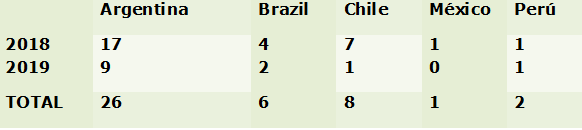
In this sense, the following is the list of Odontoestomatología reviewers who worked with us in 2018 and 2019 (Tables 1,2 and 3). During this period, 40 papers were published, including 20 national and 20 foreign articles, 10 of which were not accepted.
References
-
1 Ladrón de Guerrera M, Hincapié J, Jaclman J, Herrera O, Caballero CV. Revisión por pares, ¿Qué es y para qué sirve? Revista Científica Salud Uninorte 2008 24(2). Disponible en: http://rcientificas.uninorte.edu.co/index.php/salud/article/viewArticle/1847/6165
» http://rcientificas.uninorte.edu.co/index.php/salud/article/viewArticle/1847/6165 -
2 Nassi-Calò L. Revisión por pares: modalidades, pros y contras, Internet. SciELO en Perspectiva, 2015. Disponible en: https://blog.scielo.org/es/2015/03/27/revision-por-pares-modalidades-pros-y-contras/
» https://blog.scielo.org/es/2015/03/27/revision-por-pares-modalidades-pros-y-contras/ -
3 Scientific Electronic Library Online. SciELO Guidelines: The Peer Review Process in Journal Publishing. Version September 2018.Disponible en: https://docs.google.com/document/d/1iTmddgQqqbZGqBLHst1r40mowkCsAHEpKcNhtYIGnW0/edit#
» https://docs.google.com/document/d/1iTmddgQqqbZGqBLHst1r40mowkCsAHEpKcNhtYIGnW0/edit# -
4 Committee on Publication Ethics -COPE. Text recycling guidelines for editors . 29 de marzo 2016. Disponible en: https://publicationethics.org/text-recycling-guidelines
» https://publicationethics.org/text-recycling-guidelines