Construction and instrumental validation of Gamboa monofilaments for orofacial somatosensorial assessment
Abstract
This study aimed to construct and instrumentally validate disposable low-cost monofilaments to evaluate orofacial sensitivity. The monofilaments were called Gamboa monofilaments and were created with nylon fishing line monofilaments of different diameters (0.16 to 0.8 mm) and lengths (10 to 110 mm) glued perpendicularly to the ends of wooden popsicle sticks. Semmes-Weinstein monofilaments were used as a reference for the target force. The force exerted by both monofilaments was measured with a precision scale. The coefficient of variation assessed force data variability of Semmes-Weinstein and Gamboa monofilaments, and a two-sample t-test was used to compare the force exerted by Semmes-Weinstein and Gamboa monofilaments. The force variability ranges of Semmes-Weinstein and Gamboa monofilaments range from 0.5 to 10.9 % and 0.33 to 16.97 %, respectively. Thirty-eight Gamboa monofilaments did not show differences from the 0.008 to 100 g Semmes-Weinstein monofilaments. The force exerted by 0.02, 0.07, 0.16, 0.4, 0.6, 1, 4, 8, 10, 15, and 100 g Semmes-Weinstein monofilaments can be obtained by varying the diameter and length of Gamboa monofilaments. In conclusion, this study developed and validated low-cost disposable monofilaments, showing that Gamboa monofilaments could replicate the force of Semmes-Weinstein monofilaments within the range of 0.008 and 100 g. This finding suggests potential applications in the future, particularly in the context of evaluating orofacial sensations.
Keywords:
Sensory thresholds; Signal detection; Semmes-Weinstein monofilaments; Tactile perception; instrumentation
Resumen
El presente estudio tiene como objetivo construir y validar instrumentalmente monofilamentos desechables de bajo coste para evaluar la sensibilidad orofacial. Los monofilamentos se denominaron monofilamentos Gamboa y se crearon con monofilamentos de hilo de pescar de nylon de diferentes diámetros (de 0,16 a 0,8 mm) y longitudes (de 10 a 110 mm) adheridos perpendicularmente a uno de los extremos de los palitos de helado. Se utilizaron los monofilamentos Semmes-Weinstein como referencia para la fuerza objetivo. La fuerza ejercida por ambos monofilamentos se midió con una balanza de precisión. A través del coeficiente de variabilidad se evaluó la variabilidad de los datos de fuerza ejercida por los monofilamentos Semmes-Weinstein y Gamboa, y se utilizó una prueba t de dos muestras para comparar la fuerza ejercida por ambos monofilamentos. Los rangos de variabilidad de la fuerza de los monofilamentos Semmes-Weinstein y Gamboa van del 0,5 al 10,9 % y del 0,33 al 16,97 %, respectivamente. Treinta y ocho monofilamentos Gamboa no mostraron diferencias con respecto a los monofilamentos Semmes-Weinstein de 0,008 a 100 g. La fuerza ejercida por monofilamentos Semmes-Weinstein de 0,02, 0,07, 0,16, 0,4, 0,6, 1, 4, 8, 10, 15 y 100 g puede obtenerse variando el diámetro y la longitud de los monofilamentos Gamboa. En conclusión, el estudio desarrolló y validó monofilamentos desechables de bajo coste, demostrando que los monofilamentos Gamboa podían replicar la fuerza de los monofilamentos Semmes-Weinstein dentro del rango de 0,008 y 100 g. Este hallazgo sugiere aplicaciones potenciales en el futuro, particularmente en el contexto de la evaluación de las sensaciones orofaciales.
Palabras clave:
Umbral sensorial; Detección de Señal; Monofilamentos de Semmes-Weinstein; Percepción del Tacto; instrumentación
Resumo
O presente estudo teve como objetivo construir e validar instrumentalmente monofilamentos descartáveis de baixo custo para avaliar a sensibilidade orofacial. Os monofilamentos foram chamados de monofilamentos de Gamboa e foram criados com monofilamentos de linha de pesca de náilon de diferentes diâmetros (0,16 a 0,8 mm) e comprimentos (10 a 110 mm) colados perpendicularmente às extremidades de palitos de picolé. Os monofilamentos de Semmes-Weinstein foram usados como referência para a força-alvo. A força exercida por ambos os monofilamentos foi medida com uma balança de precisão. O coeficiente de variabilidade avaliou a variabilidade dos dados de força dos monofilamentos de Semmes-Weinstein e Gamboa, e um teste t de duas amostras foi usado para comparar a força exercida pelos monofilamentos de Semmes-Weinstein e Gamboa. As faixas de variabilidade de força dos monofilamentos de Semmes-Weinstein e Gamboa variam de 0,5 a 10,9 % e de 0,33 a 16,97 %, respectivamente. Trinta e oito monofilamentos de Gamboa não apresentaram diferenças em relação aos monofilamentos de Semmes-Weinstein de 0,008 a 100 g. A força exercida pelos monofilamentos de Semmes-Weinstein de 0,02, 0,07, 0,16, 0,4, 0,6, 1, 4, 8, 10, 15 e 100 g pode ser obtida variando-se o diâmetro e o comprimento dos monofilamentos de Gamboa. Concluindo, o estudo desenvolveu e validou monofilamentos descartáveis de baixo custo, demonstrando que o monofilamentos de Gamboa pode reproduzir a força do monofilamentos de Semmes-Weinstein na faixa de 0,008 e 100 g. Esse achado sugere possíveis aplicações no futuro, especialmente no contexto da avaliação das sensações orofaciais.
Palavras-chave:
Limiar sensorial; Detecção de Sinal; Monofilamentos de Semmes-Weinstein; Percepção do Tato; instrumentação.
Introduction and Background
The central nervous system depends on peripheral input from orofacial mechanoreceptors to regulate the sensorimotor control of oral behaviors, enabling functions such as swallowing, speech articulation, and mastication1. These signals involve a variety of stimuli, including touch, pressure, vibration, temperature, and pain. The integration of these pathways supports conscious perception of jaw, lip, and tongue location, position, and movement2.
Semmes-Weinstein monofilaments (SWMs) are rapid and straightforward tools used to assess somatosensory function in the skin and mucosa of the orofacial region, as well as in other parts of the body, in both animals and humans3. These instruments consist of straight nylon filaments of varying diameters, angled from their base, with each filament exerting a specific force ranging from 0.008 to 300 g. SWMs operate on Euler’s theory, which states that an elastic fiber of constant diameter will exert a continuous force when one end is pressed vertically against a surface (e.g., the skin) while the opposite end remains fixed. The force can increase until the filament begins to bend, beyond which no additional force can be generated. The magnitude of this force is directly proportional to the stiffness of the filament, which is determined by its thickness and inversely proportional to the square of its length. Each monofilament’s force can be precisely quantified using a precision scale4.
The forces exerted by SWMs are commonly used to determine several sensory parameters, including tactile detection threshold, discrimination threshold, and pain threshold. The tactile detection threshold refers to the minimum force a participant can perceive. The discrimination threshold is the ability to distinguish between two stimuli of differing intensities applied to the same site. The pain threshold is the lowest force perceived as a nociceptive stimulus3.
The orofacial region-particularly the lips and tongue-is characterized by dense and sensitive innervation, which is why numerous studies have focused on this area. Despite being considered the gold standard in sensory testing, SWMs pose several challenges. The size of both the filament and handle can limit access and maneuverability within the oral cavity5. Additionally, due to exposure to saliva, they require high-level disinfection, subjecting the monofilaments to moisture and disinfectants. This can result in loss of calibration or damage, ultimately reducing their lifespan2,6,7. The high cost of replacing SWMs6,7 has motivated the development of more affordable alternatives. Some of these alternatives have used nylon fishing line or surgical sutures2,4,8. De Sousa et al. developed monofilaments using 0.35 mm nylon fishing line and ice-cream sticks. These were constructed with one, two, or three nylon strands glued together and varied in length from 30 to 100 mm, producing a force range from 7.5 to 120.1 g4. Bearelly and Cheung created monofilaments using nylon sutures and ureteral catheters. The sutures ranged from 2-0 to 7-0 in diameter and measured 20 mm in length, exerting forces between 0.018 and 4.86 g2. Eliav and Gracely used Proline 7-0 sutures between 0.5 and 2.5 inches long to generate forces ranging from 0.2 to 72 g8. However, none of these studies were able to replicate the full range of forces provided by SWMs, particularly the 0.008 g monofilament, which is essential for assessing highly sensitive areas such as the tip of the tongue.
This study introduces a novel approach: the fabrication of disposable monofilaments of varying diameters and lengths, with special attention to the creation of lighter monofilaments not previously developed in earlier research.
In light of the foregoing, this study aims to develop and validate low-cost, disposable monofilaments-referred to as Gamboa monofilaments (GMs)-constructed from nylon fishing line of various diameters and lengths, designed for use in the somatosensory assessment of orofacial sensation.
Materials and Methods
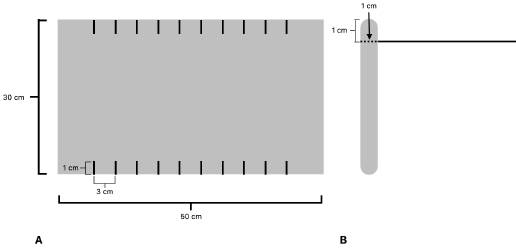
The GMs were created in a closed room under ambient temperature and humidity, following protocols established in previous studies2,4. The materials used included nylon fishing line and wooden ice cream sticks. Nylon monofilaments (Nylon, Ekilon®, Equipesca, Brazil) with diameters of 0.16 mm, 0.20 mm, 0.25 mm, 0.30 mm, 0.35 mm, 0.40 mm, 0.50 mm, 0.60 mm, 0.70 mm, and 0.80 mm were employed. Since fishing line is commercially supplied wound on spools, a tensioning process was implemented to straighten the material. To this end, a compact cardboard board with 10 grooves was designed (Figure 1A). Two-meter segments of each nylon thickness were tensioned between opposite grooves on the board and held in place solely by tension for a period of two weeks. After this period, straightened sections were selected and cut into 120 mm lengths. For the handles, wooden popsicle sticks (Marzu, Chile) measuring 1.0 × 11.2 × 0.3 cm were used. A hot glue gun (HL-N2, Hand, China) was employed to adhere the nylon monofilaments to the wooden sticks. A silicone bead approximately 3 mm thick and 1 cm long was applied 1 cm from the edge of the stick, where the nylon was positioned (Figure 1B), and pressed with a spatula to ensure the adhesive remained flush with the stick’s edges. Each monofilament was then cut to lengths ranging from 10 mm to 110 mm in 10 mm increments, for each nylon diameter, resulting in the GMs.
A. Diagram of the cardboard piece with grooves used to tension nylon threads. B. Schematic representation of a Gamboa monofilament, with the dotted line indicating the position and amount of silicone applied.
SWMs (Aesthesio®, Precise Tactile Sensory Evaluator, DanMic Global, California, USA) were used as the reference instruments. These monofilaments are standardized, with constant lengths and varying diameters. Each monofilament is calibrated by the manufacturer to exert its target force within a 5% standard deviation. SWMs were used to define target force values and to train the operator.
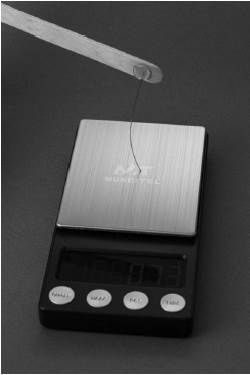
The technique used to measure the force exerted by all monofilaments consisted of positioning the free end of the monofilament perpendicularly to the platform of a precision scale (Professional Digital Jewellery Scale, 8028-series, China) and applying manual pressure until the filament deflected. At the moment of deflection, the maximum force displayed on the scale was recorded (Figure 2).
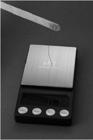
For operator calibration, training was provided to achieve the target force described by the SWM manufacturer, ensuring visual control of the application angle to keep it perpendicular to the scale platform, as well as control of the speed of force application. A smooth and controlled movement of the operator’s hand was used to achieve a single point of contact with the platform. For standardization of force measurement, the operator positioned the free end of the GM 1 cm from the center of the scale platform and approached it until contact was made, taking approximately one second. Contact was maintained until the filament visibly deflected, which also took about one second. The operator then recorded the force exerted by each of the 20 SWMs three times. This procedure was repeated one week later to avoid SWM and operator fatigue. Agreement between the two sessions was assessed using Cohen’s kappa statistic, which indicated almost perfect agreement (0.85).
The force exerted by each GM was recorded using the same technique described above. The length, diameter, and force exerted by each filament were measured three times and documented in an Excel table (Microsoft Corporation, USA).
The Shapiro-Wilk test was applied to assess the distribution of the data. The coefficient of variation of the force exerted by SWMs and GMs was calculated, and a two-sample t-test was used to compare the force exerted between the two types of monofilaments. A P value < 0.05 was considered statistically significant. Data analysis was performed using the Data Analysis function in Excel (Microsoft Corporation, USA).
Results
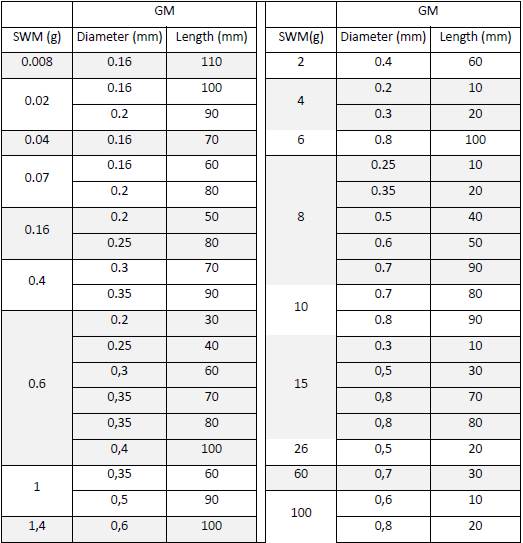
The variability in force for SWMs and GMs ranged from 0.5% to 10.9% and from 0.33% to 16.97%, respectively. Table 1 presents the diameter and length of the 38 GMs that showed no significant difference in force (in grams) compared with SWMs (P > 0.05). It should be noted that the force of certain SWMs can be replicated with different GMs by varying diameter and length (SWM 0.02, 0.07, 0.16, 0.4, 0.6, 1, 4, 8, 10, 15, and 100 g).
Discussion
The literature shows the use of SWMs from 0.008 to 6 g to assess tactile detection thresholds and from 4 to 100 g to assess pain thresholds in areas such as the skin of the upper lip9, the chin9, the cheeks10-12, the gingiva10,12-14, the hard and soft palate14,15, and the tongue10,11,13,14,16-19. Although SWMs are considered a standardized and non-invasive option for assessing tactile and nociceptive orofacial sensations, several factors have been described that could affect their performance20. Studies have demonstrated increased plasticity and reduced flexural strength of SWMs triggered by rises in temperature and humidity21,22 or by the need for high-level disinfection2. These factors should be taken into account when considering the application of monofilaments in the oral cavity. In addition, repeated loading of SWMs could affect bending strength, even after a period of rest6,22,23. For Gamboa monofilaments (GMs), nylon was used as the construction material, similar to SWMs and to other monofilaments used in previous studies. The studies by Eliav and Gracely8 and Bearelly and Cheung2 used suture nylon to construct their monofilaments, whereas De Sousa et al.4 used nylon fishing line as in this study. These materials are compatible with the intraoral environment, but to avoid the effects of moisture and repeated loading, it is recommended that they be disposable.
The target force of the SWMs in the GMs was achieved by varying both the length and the diameter of the monofilaments. In the aforementioned studies, a different approach was employed-either fixing the diameter and varying the length4,8 or fixing the length and varying the diameter2-resulting in forces ranging from 0.02 to 120 g, whereas with GMs, the forces ranged from 0.008 to 100 g. These findings are consistent with the principles outlined in Euler’s theory and demonstrate the potential to produce the force required to assess tactile or pain thresholds in the orofacial area, with the 0.008 g GM being of particular importance. To access deep regions of the orofacial area, such as the palatal mucosa in the posterior sector, Komiyama et al.14 used SWMs cut in half; however, this procedure increases the force exerted by the original SWMs. In this context, the versatility of GMs allows the investigator to create longer or shorter versions of the monofilaments, enabling the evaluation of both superficial and deep areas of the orofacial region. This adaptability may enhance comfort for both patients and clinical evaluators.
In summary, the clinical relevance of GMs lies in their ability to cover the force range required to evaluate tactile and pain thresholds in the orofacial region. A key advantage of these devices is that investigators can manufacture them in various lengths and diameters that exert similar forces, allowing clinicians to select the most appropriate monofilament for a given orofacial area.
Limitations
Based on the results of this study, it is suggested that nylon fishing line monofilaments with thicknesses either thinner or thicker than those used in this study be developed to produce a broader range of monofilament combinations. Each monofilament should be evaluated prior to patient use to ensure that the bending force is accurate. The operator should be calibrated to control both the speed of application and the depth of insertion of the monofilament.
Conclusions
This study developed and instrumentally validated low-cost disposable monofilaments. The results showed that, by using nylon monofilaments of different diameters and lengths, 38 Gamboa monofilaments were produced, capable of reproducing the force of Semmes-Weinstein monofilaments within the 0.008 to 100 g range. This finding points to a promising avenue for future research, particularly in the assessment of orofacial tactile and pain sensations.
References
- 1 Trulsson M, Johansson RS. Orofacial mechanoreceptors in humans: encoding characteristics and responses during natural orofacial behaviors. Behavioural brain research. 2002 Sep;135(1-2):27-33.
- 2 Bearelly S, Cheung SW. Sensory Topography of Oral Structures. JAMA Otolaryngol Head Neck Surg. 2017 Jan;143(1):73-80.
- 3 Etter NM, Breen SP, Alcala MIM, Ziegler GR, Hayes JE. Assessment of Midline Lingual Point-Pressure Somatosensation Using Von Frey Hair Monofilaments. J Vis Exp. 2020 Feb;(156).
- 4 De Sousa MVP, Ferraresi C, de Magalhães AC, Yoshimura EM, Hamblin MR. Building, testing and validating a set of home-made von Frey filaments: a precise, accurate and cost effective alternative for nociception assessment. J Neurosci Methods. 2014 Jul;232:1-5.
- 5 Van der Cruyssen F, Van Tieghem L, Croonenborghs TM, Baad-Hansen L, Svensson P, Renton T, et al. Orofacial quantitative sensory testing: Current evidence and future perspectives. Eur J Pain. 2020 Sep;24(8):1425-39.
- 6 Lavery LA, Lavery DE, Lavery DC, Lafontaine J, Bharara M, Najafi B. Accuracy and durability of Semmes-Weinstein monofilaments: what is the useful service life? Diabetes Res Clin Pract. 2012 Sep;97(3):399-404.
- 7 Chikai M, Ozawa E, Takahashi N, Nunokawa K, Ino S. Evaluation of the variation in sensory test results using Semmes-Weinstein monofilaments. Annu Int Conf IEEE Eng Med Biol Soc. 2015 Aug;2015:1259-62.
-
8 Eliav E, Gracely RH. Sensory changes in the territory of the lingual and inferior alveolar nerves following lower third molar extraction. Pain (Internet). 1998;77(2):191-9. Available from: https://www.sciencedirect.com/science/article/pii/S0304395998001006
» https://www.sciencedirect.com/science/article/pii/S0304395998001006 - 9 Heft MW, Robinson ME. Age differences in suprathreshold sensory function. Age (Dordr). 2014 Feb;36(1):1-8.
- 10 Komiyama O, De Laat A. Tactile and pain thresholds in the intra- and extra-oral regions of symptom-free subjects. Pain. 2005 Jun;115(3):308-15.
- 11 Michelotti A, Farella M, Stellato A, Martina R, De Laat A. Tactile and pain thresholds in patients with myofascial pain of the jaw muscles: a case-control study. J Orofac Pain. 2008;22(2):139-45.
- 12 Okayasu I, Komiyama O, Ayuse T, De Laat A. Tactile sensory and pain thresholds in the face and tongue of subjects asymptomatic for oro-facial pain and headache. J Oral Rehabil. 2014 Dec 19;41(12):875-80.
- 13 Teranaka S, Shibaji T, Minakuchi S, Uematsu H. Age-related changes in oral mechanosensitivity of symptom-free subjects. J Med Dent Sci. 2008 Mar;55(1):61-9.
- 14 Komiyama O, Gracely RH, Kawara M, Laat A De. Intraoral measurement of tactile and filament-prick pain threshold using shortened Semmes-Weinstein monofilaments. Clin J Pain. 2008 Jan;24(1):16-21.
- 15 Park MJ, Byun JS, Jung JK, Choi JK. The correlation of gagging threshold with intra-oral tactile and psychometric profiles in healthy subjects: A pilot study. J Oral Rehabil. 2020 May;47(5):591-8.
- 16 Miles BL, Van Simaeys K, Whitecotton M, Simons CT. Comparative tactile sensitivity of the fingertip and apical tongue using complex and pure tactile tasks. Physiol Behav. 2018 Oct;194:515-21.
- 17 Honda M, Iida T, Kamiyama H, Masuda M, Kawara M, Svensson P, et al. Mechanical sensitivity and psychological factors in patients with burning mouth syndrome. Clin Oral Investig. 2019 Feb;23(2):757-62.
- 18 Okayasu I, Oi K, De Laat A. The effect of nonfunctional tooth contact on sensory and pain perception in patients with myofascial pain of the jaw muscles. J Prosthodont Res. 2012 Apr;56(2):87-92.
- 19 Appiani M, Rabitti NS, Methven L, Cattaneo C, Laureati M. Assessment of Lingual Tactile Sensitivity in Children and Adults: Methodological Suitability and Challenges. Foods. 2020 Nov;9(11).
- 20 Virgin LN. On the mechanics of monofilaments used in touch sensory perception. Med Eng Phys. 2024 Jan;123:104083.
- 21 Haloua MH, Sierevelt I, Theuvenet WJ. Semmes-weinstein monofilaments: influence of temperature, humidity, and age. J Hand Surg Am. 2011 Jul;36(7):1191-6.
- 22 Lum E, Murphy PJ. Effects of ambient humidity on the Cochet-Bonnet aesthesiometer. Eye (Lond). 2018 Oct;32(10):1644-51.
- 23 Chikai M, Ino S. Buckling Force Variability of Semmes-Weinstein Monofilaments in Successive Use Determined by Manual and Automated Operation. Sensors (Basel). 2019 Feb;19(4).