Children’s speech out of time and place:On conflictual relationships in the mother tongue
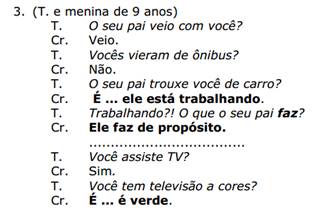
This paper discusses the interpretation of symptomatic speech, characterized by a remarkable and perplexing grammatical organization from which its pragmatic inadequacy is derived. The clinical dialogue, locus of symptom displacements, is driven by the hard encounter among conflicting speech chains and the unequal positions between therapist and patient. Faced with insistently disordered speech chains, clinician finds himself pressed by questions on subjectivity. Foucault (1980) is punctual: in the domain of the clinic, "the fantastic articulation between knowledge and suffering" is unavoidable: listening is challenged by subject’s difficult relationship with his speech and his conditions of speaker.
The theoretical background here assumed does not see dialogue as dyadic - la langue is a third element in this relation. In this work, of a theoretical nature, the discussion is developed under the light of European Structuralism assuming, with respect to the subject, the hypothesis of the unconscious (Freud 1900 (1970)).
Key words:
pathological speech; clinical speech interpretation; subject-speaker and language. Child-language relation
 Thumbnail
 Thumbnail
 Thumbnail