Knowledge organization and film production: interdisciplinary dialogues on film indexing under a socio-cultural perspectiveOrganización del conocimiento y producción cinematográfica: diálogos interdisciplinarios sobre la indexación cinematográfica desde una perspectiva socioculturalOrganização do conhecimento e produção cinematográfica: diálogos interdisciplinares sobre indexação cinematográfica sob uma perspectiva sociocultural
Abstract
This study proposes to discuss the sociocultural approach in KO with focus on interdisciplinary relations, within the scope of film indexing in cinema collections, considering two perspectives: the process of film making and the documents generated during this journey; and the design of aspects utilized to analyze and represent films for an information service. For this, film production is considered as a long and complex process that goes through multiple stages, ultimately forming an extensive chain until the film is finalized. In this sense, even after completion, the filmic object still undergoes several phases in the exhibition stage. As a consequence, a proposal for the organic organization of a film's documentation, should consider its pre-production, production and post- production processes, in order to ensure, among other aspects, the context in which the records were created, as well as the discourses that permeate this process. Thus, the proposal for the organic organization of this knowledge must take into account the dynamic context in which it is produced, interpreted and used and some possible facets can be drawn up to lead to access points resulting from the film indexing process are proposed: Cast, Characters; Conflict Matrix; Film Story Summary; Space and Time; and Film Setting as well as the source documents that subsyde the analytic process.
Keywords:
FILM INDEXING; FILM PRODUCTIN; FILM DOCUMENTATION; FILM FAMILY TREE
Resumen
Este estudio propone discutir el enfoque sociocultural en KO, con énfasis en las relaciones interdisciplinarias, en el ámbito de la indexación de películas en colecciones cinematográficas, a partir de dos perspectivas: el proceso de creación de películas y los documentos generados durante este proceso; y el diseño de los aspectos utilizados para analizar y representar películas para un servicio de información. Para ello, la producción cinematográfica se considera un proceso largo y complejo que atraviesa múltiples etapas, conformando finalmente una extensa cadena hasta su finalización. En este sentido, incluso después de su finalización, el objeto fílmico aún atraviesa distintas fases en la etapa de exhibición. En consecuencia, una propuesta para la organización orgánica de la documentación de una película debe considerar sus procesos de preproducción, producción y posproducción, para asegurar, entre otros aspectos, el contexto en el que se crearon los registros, así como los discursos que permean este proceso. Así, la propuesta para la organización orgánica de este conocimiento debe tener en cuenta el contexto dinámico en el que se produce, interpreta y utiliza, y se pueden trazar algunas posibles facetas que conduzcan a los puntos de acceso resultantes del proceso de indexación cinematográfica: Elenco, Personajes; Matriz de Conflictos; Resumen de la história de la película; Espacio y tiempo; y ambientación cinematográfica, así como los documentos fuente que sustentan el proceso analítico.
Keywords:
INDEXACIÓN DE PELÍCULAS; PRODUCCIÓN DE PELÍCULAS; DOCUMENTACIÓN DE PELÍCULAS; ÁRBOL GENEALÓGICO DE PELÍCULAS
Resumo
Este estudo propõe discutir a abordagem sociocultural em KO com foco nas relações interdisciplinares, no âmbito da indexação fílmica em acervos cinematográficos, considerando duas perspectivas: o processo de realização cinematográfica e os documentos gerados durante esse percurso; e o design dos aspectos utilizados para analisar e representar filmes para um serviço de informação. Para tanto, a produção cinematográfica é considerada um processo longo e complexo que passa por múltiplas etapas, formando uma extensa cadeia até a finalização do filme. Nesse sentido, mesmo após a conclusão, o objeto fílmico ainda passa por diversas fases na fase de exibição. Consequentemente, uma proposta de organização orgânica da documentação de um filme deve considerar seus processos de pré-produção, produção e pós-produção, a fim de garantir, entre outros aspectos, o contexto em que os registros foram criados, bem como os discursos que permeiam esse processo. Assim, a proposta de organização orgânica desse conhecimento deve levar em conta o contexto dinâmico em que ele é produzido, interpretado e utilizado, e algumas facetas possíveis podem ser elaboradas para conduzir aos pontos de acesso resultantes do processo de indexação cinematográfica: Elenco, Personagens; Matriz de Conflitos; Resumo da História do Filme; Espaço e Tempo; e Cenário do Filme, bem como os documentos-fonte que subsidiam o processo analítico.
Palavras-chave:
INDEXAÇÃO FILMÁTICA; PRODUÇÃO FILMÁTICA; DOCUMENTAÇÃO FILMÁTICA; ÁRVORE FAMILIAR CINEMATOGRÁFICA
Introduction
The sociocultural perspective within Knowledge Organization - KO has been largely inspired by the ideas of Birger Hjørland (2002a , 2002b, 2004, 2008, 2017), who has highlighted the importance of this field in recognizing its own episteme and, in particular, understanding the contexts in which its processes, instruments and outputs are carried out. According to the author, concepts in KO are clearly social constructs based on socially negotiated meanings “which must be identified by the study of discourses, and not by studying users” (Hjørland 2009, p. 1530).
From this perspective, historical, temporal and spatial conditions and the idiosyncrasies of the communities involved in knowledge production and use play a preponderant role in such a way that the KO processes (analysis, synthesis, representation), instruments (knowledge organization systems) and outputs (indexes, notations, descriptors) are directly impacted by the cultural diversity of the context in which they are produced, interpreted and used.
Notably from this century onwards, the KO area, and especially the ISKO environment, has revealed clear investigative concerns with this dimension, as demonstrated by the themes of ISKO's international congresses, such as: “Challenges for knowledge representation and organization of in the 21st century: integration of knowledge across boundaries” (Granada 2002); “Culture and identity in the knowledge organization ” (Montréal 2008) and “Knowledge Organization for a sustainable world: challenges and perspectives for cultural, scientific and technological sharing in a connected society” (Rio de Janeiro 2016).
Additionally, studies can be pointed out, including studies related to the “power to name” by the indexer (Olson 2002), to the establishment of a transcultural ethics of mediation (García-Gutiérrez 2002), to cultural warrant and hospitality in knowledge organization systems (Beghtol 2002, 2005), to the search for universality in representation without sacrificing diversity, integrating sociocultural differences and contemplating minorities (López-Huertas 2008), to the dependence of aboutness on the social and ideological perspectives of the system designer (Campbell 2000), and to the recognition of metaphors as vehicles of meaning for specific discursive communities (Pinho and Guimarães 2012), among others.
The sociocultural approach has provided KO with a theoretical-methodological foundation which enhances our understanding of how the concepts, actors, processes, instruments and outputs of this field are created and begin to make sense based on the contexts in which they are inserted, in a continuous helical dynamic. Such approach presupposes the ethical commitment of KO to social diversity.
For Olson (2002), a sociocultural approach to KO presupposes: a) the recognition of diversity as something inherent to KOS and the impact of human and social factors on KO activities, b) the conception of the KO domain as a social product, c) the suggestive (rather than prescriptive) nature of KOS, which should act as tools to promote global dialogue, and d) the shift from normalization (such as vocabulary control) to the promotion of intercommunication (such as interoperability). these insights lead to the recognition that any organization or representation of knowledge is aligned to a certain worldview and, as a consequence, is biased.
This sociocultural approach aligns with Bruno Latour's ideas on expanding hybrids through multiplication, which transitions “from the simultaneity of a hybrid (social-natural) to the identification of modes of emergence of heterogeneous collectives” (Santaella; Cardoso, 2020, p. 16). These collectives are shaped by a system of forces established by a network of humans and non- humans, all of whom considered actors, existing with agency power (Latour, 1993). In this sense, the natural dynamics is centered not around the subject- society but around a collective responsible for the production of things and men.
One of the main backgrounds of the sociocultural approach to KO is the domain analysis, which can be defined as o “the study of knowledge domains as though or discursive communities, which are parts of the society´s labor division” (Hjørland; Albrechtsen, 1995). The domain analysis presupposes an interdisciplinary view not only in its own nature, by means of dialogues with cognitive sciences as Psychology, Education, Linguistics etc. (Hjørland; Albrechtsen, 1995) and with the sociological concepts of invisible colleges and epistemic communities (Smiraglia, 2012; Evangelista; Gracio; Guimarães, 2022) but also in its practice because the concept of domain goes much beyond to disciplines to comprehend interdisciplinary spaces. In this sense, López-Huertas, 2015) points out the importance of bibliometric, terminological, epistemological, and user studies as methodological tools to face the challenge of interdisciplinarity in KO.
In view of this scenario, this study proposes to discuss the sociocultural approach in KO with focus on interdisciplinary relations, within the scope of film indexing in cinema collections, considering two perspectives: the process of film making and the documents generated during this journey; and the design of aspects utilized to analyze and represent films for an information service.
The first one focuses on examining the processes of preproduction, production, release and dissemination, resulting the film´s family tree (Cordeiro 2000; Cordeiro and Amancio, 2005; La Barre and Cordeiro 2012, 2016). The contextual nature of producing cinematographic work for subsequent use is evident, establishing and organic relationship in which the knowledge to be represented emerges from a set of documentary instances which, if considered in isolation, no longer make sense for the context that generated them. In this approach, our discussion focuses on analog cinematography and in particular on the collections of cinema libraries and personal archives. In the second perspective, centered on the product (the film) generated and on the approach to film analysis proposals within cinema studies, the text discusses the diversity of paths traced by scholars for these analyses and, consequently, the interpretation of a film analysis proposal
is examined for indexing purposes (such as Bordwell and Thompson 2010, 2013) is discussed (such as Bordwell and Thompson 2010).
The combination of these two approaches within a dialogical perspective ensures respect for the involved contexts (Foster and Rafferty 2016), taking into account the diversity inherent in knowledge organization systems. This strategy aims to shift these systems from being overly prescriptive towards more suggestive (Olson 2002) so that KO practices can be developed by considering the social representation of information for heterogeneous collectives demonstrating an ethical commitment to social diversity. In other words, and according to the film indexing examples which will be explored in the paper, it is possible to affirm that the socio-cultural perspective applied to film indexing by means of the representation of the organic relationship between film production and film products can contribute to the KO field as an ethical support for social justice and inclusiveness.
Film production as a complex context
Film production is a long and complex process that goes through multiple stages, ultimately forming an extensive chain until the film is finalized. Even after completion, the filmic object still undergoes several phases in the exhibition stage. Screenings at film festivals, movie theaters, streaming platforms, and both open and cable television can all be part of a film's trajectory. Throughout each stage of the filmmaking process, specific documents are generated, which are essential for the subsequent analysis of the information produced by the audiovisual work.
It is essential to emphasize that film production is heterogeneous and influenced by geographical, social, economic, and class-related factors. Despite sharing certain workflows during production, each film will have unique characteristics that generate specific registry for that particular work. An independent film produced in Brazil with public funding will follow a production process entirely different from that of an independent film produced in the United States, where the film industry is one of the largest in the country and has maintained its hegemony for nearly a century. All these factors must be considered.
The making of a film can be divided in three main phases: preproduction, production and release. Preproduction usually starts when the script has come to a stage in which it gets close to its final form. Changes are expected during the process, but the first document that is crucial to kick-off the preproduction of a film is the script. In in there all the elements for the further steps will be found such as number of characters, locations, type of costumes and objects, etc. Regarding on independent films or, in case of Brazil, most of the films, funding resources are also fundamental to start a film production. Raising those funds also can generate a big number of documents which are specific and differs from source to source. Funding the film usually is a task assumed by the production team, which is responsible for the financial and organizational part of the film (Bordwell, Thompson, 2010)
During preproduction each department will generate documents that will contribute to the development of the creative and technical features of the film. During this step the Assistant Director does a very comprehensive analysis of the script, identifying all the requirements that film have. This process is called Script Breakdown. All characters, stunts, cars, objects, pieces of clothing, locations and more will be added to a detailed report which will guide the whole preproduction and production processes. From this report all the departments will have, based on the script, a list of what they will have to work on, and all the elements written down on the script.
Also, during preproduction, the Production department will be working with all the contracts and organizing all the budget that the film will require. Employment contracts, suppliers’ contracts, authorizations from governmental entities, insurance contracts, those are just a few examples of the huge number of documents created during this step. From the Direction department, along with Photography and Production Design documents such as storyboards, ground plans form the locations, drafts of the camera angles, drafts the sets and costumes and its specificities, the angles and shots that are intended for that location are being made. Those are a few examples, but it varies from production to production. Different teams in different places work in specific ways and every production is unique and requires a unique combination of documents to be accomplished.
Production can be defined as the phase of shooting the film itself. During this step, all the cast and crew will be assembled during weeks to record the scenes of the film. During production, most of the documents generated are reports generated in the set. Those can be call sheets, camera and sound reports, logging reports and more contracts that can be signed during this phase. Also, the script supervisor will be responsible for the continuity of the film. This is very important because scenes usually are not filmed in plot order, what happens for budget matters. The script supervisor can generate a series of documents such as pictures of the cast during shooting, pictures of the sets and locations and annotations on the script.
Postproduction is the stage that usually starts right after the end of the shootings. This phase is called by Bordwell and Thompson as ‘Assembly Phase’. Multiple stages will take place during this phase. The film will have the image edited, which means to recreate the plot assembling the takes made during shooting. During editing the plot from the script may or may not be followed, which means that editing is a very important and creative part of making a film. Sound will also be edited and mixed. Foley, ADRs and soundtrack will be created, recorded and mixed as well. Color grading will also happen during postproduction. During this stage the GFX will be developed as well. All these processes generate a large number of reports and documents that are very important and can be very specific to each stage. It is hard to create a list of documents that is apprehensive enough to embrace the complete postproduction stage.
Distribution is the stage where the film will be taken to the audience to watch. This can be on the theatres, at home in streaming services, on television, etc. During this phase there will be marketing campaigns being created, releasing strategies, distribution contracts. The list of processes increases the bigger the film becomes. Also, during distribution the audience reports are made, where the income and the number of viewers are being registered.
The organic nature of film indexing: challenges and perspectives
A proposal for the organic organization of a film's documentation, which considers its pre-production, production and post-production processes, seeks to ensure, among other aspects, the context in which the records were created, as well as the discourses that permeate this process (Cordeiro 2000; Cordeiro; Amancio, 2005; La Barre; Cordeiro 2012, 2016). These documents narrate the trajectory followed by the director, the production team and the entire team involved in making the film, in addition to providing information about the logic of distribution and dissemination of the work, determined by socio-cultural, temporal and spatial conditions.
From this perspective, a field of tension can be observed between the context of production and the context of subsequent use. By way of illustration, we can mention, in many Latin American countries, especially when going back a few decades, the influence of private life on the professional trajectory of women filmmakers, an issue that can be seen both in the production of their films and in the formation of the film collections. The challenge then arises of organizing these documents for contemporary use, without losing reference to the production context of their time. Many of the Information Science methods for organizing knowledge, as in other sciences, “were developed considering a supposed universal subject (...). For women, who are not part of this universal subject, it is almost impossible to think about this public-private separation about their professional trajectories” (Tedesco; Cordeiro, 2024).
It is worth mentioning that these collections are not always available in archives, cinema libraries, libraries or information services in the public sphere. Often, these are personal archives, that is, documentary sets of a private nature, held by the creators of the works. These collections are largely fragmented in relation to their organic nature, and the documents are not always easy to identify, taking into account the documentary item itself. In addition, there is a set of records, such as photographs, negatives, among others, which are included with the film documentation, but may have been used in whole or in part in the preparation of the work. This leads us to emphasize the importance of the document identification stage in its technical treatment being in line with the film's family tree.
At this point, it seems important to make a brief digression on an aspect related to the link between archives and the making of cinematographic works. Just as the documentation that is produced for and from films (film's family tree) is of great importance for archives, especially with regard to the use and preservation of audiovisual production, archival collections are also fundamental for the production of so-called “archive films” or “archive cinema”, in which the “(re)use” of archive material occurs.
This integrative vision manifests a set of documentary instances that, when analyzed in isolation, do not allow us to recover the context of the work's production nor the implicit discourse. In this way, the marks of the conditions, circumstances and influences that involve the creation of a given work are erased, in which several activities, phases and collective procedures occur in a parallel and simultaneous manner, culminating in the production of the film and the generation of different documentary species, which indicate the nature of the actions carried out and the form of their records.
Regarding the constitution of these collections, in addition to the fragmentation of the aforementioned documentation, a common and frequently observed aspect is the absence of documents related to the pre-production, production and post- production process of a film in archives, cinema libraries and other information services, which compromises the organic approach to documentation in its organization.
In the KO of film documentation, it appears that knowledge about the film making process and the documents generated along the way are fundamental to the audiovisual reading process carried out by the IS professional. This makes it possible to contextualize and anticipate evidence related to the production of meaning in a film, within the dynamics of indexing, taking into account the film's family tree. In other words, the aim is to study the documents produced for and from the film, in order to identify, through them, information that provides the indexer with parameters to establish a contextualized indexing analysis, based on the generating documents, expanding their use and indicating relevant aspects of the film. However, indexing the film itself cannot be replaced by indexing its documents. The filmic object brings together elements that characterize it as unique in its audiovisual narrative grammar.
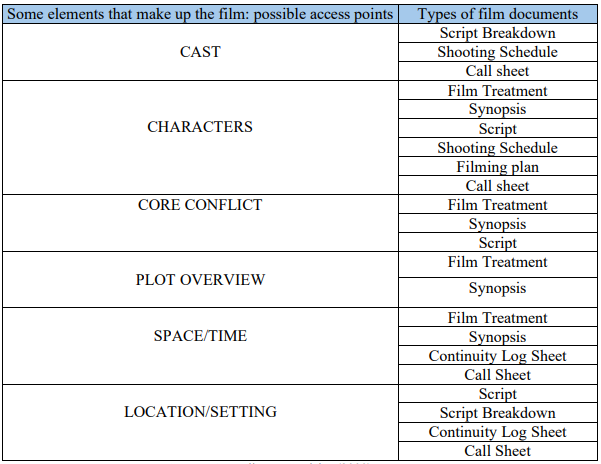
Below are examples of some elements that make up a film (such as the cast, characters, among others), which can serve as access points for a search, as well as the types of documents related to them, which are part of the film's family tree.
KO's sociocultural approach to film production broadens and deepens the understanding of system design in relation to its processes, instruments and outputs/products. This expansion becomes particularly relevant when considering factors previously discussed in this article, such as: interdisciplinarity between areas; knowledge of the sociocultural, temporal and spatial conditions of production of the work; the organic relationship between film production and generated documents, and, with regard to this last factor, the understanding of the flow and informative potential of these documents for the cinematographic work as a whole. For example - information about characters, locations and other elements can be found in different records, as illustrated in the table above.
Film analysis and indexing of cinematographic works
As already explained, and recognizing that interdisciplinarity is a phenomenon inherent to IS, in this section we seek to establish a dialogue between the domains of KO and film analysis, which moves in the field of Arts. In view of this, we turned to Lemay (2014) whose research addresses the expansion of the use of archives for creative purposes, highlighting, among other aspects, the relevance of better understanding why creators are interested in archives and how this interest is reflected in their productions. The author argues that the use of archival documents for creative purposes has progressively spread, both in the artistic world and in the cultural scene in general. In addition to challenging the traditional conception of archives and their social role, this approach also enables new ways of understanding Archivology.
In KO's field, our objective is to highlight the possibility of rapprochement between the use of some elements of film analysis and the principles of indexing, aiming to enhance the indexing and use of the film itself. In particular, we examine the work from the perspective of the narrative resource and consider the use of the concept of “heterogeneous collective” in information services. In this way, we seek to move away from a dichotomous view and reflect on dynamics that privilege interactions between the individual and the collective - a challenge in indexing studies, given the status quo established in the foundations and practice of the specialty.
It is important to highlight the importance of not simplifying any analysis of a film by the mere use of the expression “film analysis”, since this term has a specific meaning within the scope of cinema studies. Furthermore, the analyst must examine the work technically, based on its theoretical apparatus and assumptions.
In this sense, Aumont and Marie (2003, p. 72), warn: “the film that will be a question in film analysis will, therefore, be neither on the side of movement nor on the side of fixity, but between the two in the engendering of the film-projection by the film-film, in the negation of this film-film by the film-projection”. Complementing this perspective, Vanoye and Goliot-Lété (1994, p. 10, 15) emphasize that “the definition of the context and the final product is, therefore, essential to the framing of the analysis” of the film, as it “allows us to outline, at least in part, its limits, its forms and its supports, its axes or axis”.
The authors go on to clarify that “analyzing a film or fragment is, first of all… decomposing it into its constituent elements… Through this stage, the analyst acquires a certain distance from the film”. It is interesting to note that these authors emphasize the need to understand that “deconstruction is equivalent to description” and reconstruction “corresponds to what is often called ‘interpretation’” (Vanoye and Goliot-Lété, 1994, p. 15).
With regard to deconstruction, Stam (2003, p.206) mentions that it should be highlighted in cinema theory and film analysis, especially as a reading method.
The emphasis on skeptical reading... the assumption that no text takes a position that it itself, at the same time, does not contribute to sabotage, and the idea that all texts are contradictory by definition have permeated cinema studies ever since. Post-structuralism promoted the destabilization of textual meaning, shaking semiology's previous scientific faith that analysis would be capable of definitively capturing the entire meaning of a film by highlighting its codes.
It is observed, therefore, that it is not the case of directly applying film analysis in the practice of indexing, but of identifying elements already tested in the study of films, recurring in cinema research, which can be used in information services to guide the indexing of cinematographic works and expand their search access points.
Among other authors, Stam (2003), Cousins (2005), Aumont and Marie (2011), Bordwell and Thompson (2013), Burch (2020), analyze the history and theories of cinema studies, or, more precisely, the historical trajectory of cinematic aesthetic schools. Thus, Vanoye and Goliot-Lété (1994, p. 23) state that considering cinema as art implies “locating the film in a history of filmic forms”.
Film analysis in these studies follows different paths outlined by their authors for the interpretation of the film. This topic is the subject of controversy among scholars, who warn about the lack of a single method of analysis. On this aspect, Aumont and Marie (2011, p. 263) are emphatic when they state: “We have often insisted on (…) there is no ‘pure’, ‘absolute’ analysis, nor a ‘universal’ method of analysis”. They add that a film is always analyzed “in terms of theoretical assumptions - even if these are not named, and even unconscious”. Furthermore, they warn “even more than for any other form of artistic production, the analysis of the film needs to resort to different phases, different documents, 'instruments'” (2011, p.43). For these authors, the term instrument has a very particular meaning and is divided into descriptive, citational and documentary instruments.
Aumont and Marie (2003, p. 13-14) point out that the first textual analyzes of films were carried out by emblematic filmmakers, such as Eisenstein, who in 1934 analyzed a fragment of 14 shots from The Battleship Potemkin (1925), from Hitchcock to Godard, who transformed his self-analyses into true filmed essays.
However, it was in the 1960s, with the ideal of structuralism, that film analysis was consolidated as a cinematographic field. The authors of these analyzes received, over time, theoretical influences from different domains of knowledge, such as linguistics - exemplified by Christian Metz's linguistically inspired semiology -, structuralist semiotics combined with psychoanalysis, as in Bellour's studies, narratology, with analyzes by Chateau, Gardies, Vernet and Vanoye, studies of variations in point of view, addressed by Branigan and Jost, Casetti's conception of enunciation and Odin's pragmatic logic, in addition to the vast descriptive research by “neoformalists” (Bordwell, Staiger, Thompson), among other analytical currents that developed in parallel (Aumont and Marie, 2003, p. 14-15).
In the context of excessive interpretation, there is a recurring criticism that points out that many works are more concerned with style than with methodology, in which they do not seek to explain the film according to its own rules, but rather according to the rules of a “scriptural” instance that involves both the analyst and the analyzed text.
Aumont and Marie (2003, p. 15) conclude their considerations on film analyzes by commenting that they are often “a projective exercise, in which the analyst, who sometimes gives himself the air of an exegete, becomes a ‘hermeneut’, in the very particular sense that this word has gained” in his philosophical current.
In this search for interdisciplinary dialogue between KO and cinema studies, it is essential to reflect on the possibilities of indexing that expand users' access points to a film, considering an expanded perspective of an information service. The aim is, therefore, to move away from a model based on a supposed universal subject. Furthermore, it is necessary that the procedures applied are viable for inclusion in the indexing guidelines for cinematographic works in large collections.
Thus, based on Cordeiro and Amâncio (2005), some categories related to the analysis of the representation of film content will be listed, which emerge from their narrative and are established in cinema studies. They are: temporal record of the plot; temporal hook; historical reference; themes represented; narrative structure; nature of the representation; relevant sequences from the film; thematic approaches to the chosen sequence(s) and synopsis.
Before outlining each of these categories, it is worth mentioning that the narrative is defined by Bordwell and Thompson (2013, p. 144) as “a chain of events linked by cause and effect, occurring in time and space”. These authors also define narration as:
Process by which plot conveys or retains story information. The narration can be more or less restricted to the character's knowledge and more or less profound in presenting the character's thoughts and perceptions (Bordwell and Thompson, 2013, p. 748).
According to Cordeiro and Amâncio (2005), in the “temporal record” category, two focuses emerge: the temporal hook and the historical reference. In the temporal register, it is identified whether the narrative takes place in the past, present or future. When possible, this information is characterized by year, decade or century dating.
The temporal hook refers to the most comprehensive historical event present in the plot, while the historical reference consists of the allusion to specific historical facts highlighted in the plot. In relation to the themes represented, the aim is to explain the issues developed in the chain of actions.
The nature of the representation can be documentary, reconstituted, random or mixed. The authors clarify that, after several attempts at systematization, they chose to name the narrative structures as simple or complex.
The relevant sequences are conceived in a broad sense and categorized as action, sex, psychological drama, dance, horror, suspense, great interpretations, humor, aesthetic daring, musical interpretations, documentaries, special effects, political tone and classic scenes. Furthermore, the thematic approach of the chosen sequence is included, as in the case of Latin American melodrama.
Film synopses are often not created for the purpose of representing and retrieving information in an information service. They are constructed from the perspective of the film makers. However, in an information service, synopses can be produced based on criteria established by specific institutional guidelines, so that their construction is guided both by principles related to content and by formal aspects of writing.
Some guiding criteria for preparing the synopsis: presentation and objective of the main character, conflicts described through narrative facts and characters, and the outcome of the plot. When possible, information is added about the space and time in which conflicts occur (Cordeiro and Amâncio, 2005).
In this sense, it is important to establish relationships between the categories and the synopsis mentioned, enriching them based on one of the possible “models” of meaning of a film presented in cinema literature, which are also applied in studies in other areas.
It is also important to emphasize that film analyzes are always arbitrary and conventional. However, in the present study, such analyzes can be incorporated into the guidelines of indexing practice, contributing to the expansion of access points in the search for information about films in information services. It is understood here the need to expand the access points of cinematographic works, in accordance with the perspective of polyrepresentation discussed by Ingwersen in the 1990s. Furthermore, Hjørland (1997) observes that the conception of an information service based on a single type of thematic representation can be limiting, as it only considers a certain knowledge interest.
Bordwell and Thompson (2013) propose analysis four types of meaning that can be extracted from a film: referential, explicit, implicit and symptomatic. According to the authors, the referential meaning “alludes to particular extra- filmic knowledge that the viewer is expected to recognize” in the work (Bordwell and Thompson, 2013, p. 750).
This approach seems to constitute a possible path, among others, for a proposal for film analysis aimed at indexing films in information services. These meanings integrate the aesthetic form of the film and relate to its concreteness, as the authors mention. They explain that form “is a specific system of standardized relationships that we perceive in a work of art” (2013, p. 139).
This type of meaning focuses on the most basic and evident level of the film, that is, on what is presented in a clear and directly perceptible way by the viewer. This is a reading based on the information and explicit meanings transmitted by the work (2013, p. 119). For this analysis, the viewer needs to identify elements that, in themselves, already have meaning, such as the space and period in which the narrative takes place.
The authors illustrate this situation with the following example, in relation to the film The Wizard of Oz (1939, directed by Victor Fleming): “the mid-west of the United States in the 1930s and its economic difficulties”. Furthermore, they highlight that the theme of a film is generally determined through referential meaning, as occurs in The Wizard of Oz, whose theme is “North American rural life in the 1930s” (2013, p. 120).
The explicit meaning is presented “overtly, usually in oral or written form and often near the beginning or end of the film” (Bordwell and Thompson, 2013, p. 750). This meaning answers the question: “what is the meaning of the film - what is it trying to convey?” (Bordwell and Thompson, 2013, p. 121). It is defined by the context intentionally conveyed by the film. However, the authors caution that a film's “explicit meanings arise from the film as a whole and are placed in a dynamic formal relationship with each other” (Bordwell and Thompson, 2013, p. 750).
The implicit meaning is “left tacit for the viewer to discover after analysis and reflection” (Bordwell and Thompson, 2013, p. 750), leaving it up to him to interpret the subtext proposed by the film. This meaning is not expressed directly in the work and requires a more in-depth interpretation, going beyond what is visually presented. Implicit analysis refers to underlying and less evident meanings, which can be inferred from the cinematic narrative. Although the interpretation of the work is up to the viewer, it should be noted that readings may vary, as “one of the attractions of the work of art is that it invites us to interpret it in several ways at once” (Bordwell and Thompson, 2013, p. 121, 750).
Finally, symptomatic meaning corresponds to “the meaning that the film divulges (…) due to its historical or social context” (Bordwell and Thompson, 2013, p. 750). This meaning is related to ideologies and social or cultural contexts that permeate the work, reflecting values and beliefs of the time in which it was produced. To this set of revealed values, the authors attribute the name of social ideology. Thus, “the fact that we perceive symptomatic meanings means that meaning, regardless of whether it is referential, explicit or implicit, is a largely social phenomenon” (Bordwell and Thompson, 2013, p. 123).
The authors also warn that, like other artistic works, films can be analyzed from the perspective of symptomatic meaning. However, the general or abstract characteristic of these meanings can distract from the analysis of the concrete form of the film. In this sense, it is possible to infer from the authors' proposal that meanings are based on specific aspects of the cinematographic work (Bordwell and Thompson, 2013, p. 124).
Regarding these four meanings, the authors conclude:
An index of our engagement with a film, as an experience, is our search for referential, explicit, implicit and symptomatic meanings. The more abstract and general our attributions of meaning, the more we risk losing our understanding of the film's specific formal system; therefore, when analyzing a film, we must balance our attention to this concrete system with our urgency to give it a broader meaning (Bordwell and Thompson, 2013, p. 24).
From the above, we verified that the first two meanings (referential and explicit) are more evident and viable to be extracted from the film. The third and fourth meanings, in turn, have a broader level of abstraction, especially the implicit meaning, which may require greater reflective maturation of the work for its nomination in representation and access points.
As for the symptomatic aspect, it can be identified, but it requires a broad repertoire from the analyst, in its historical, social and cultural dimensions. It is a fact that these indications of meaning should be thought of as parameters (inputs) for the use of advanced technologies capable of analyzing large sets of data and indicating predictions to be validated by indexers in the categories and in the construction of synopses.
Finally, in relation to this section, the systematization of what was presented can be configured as follows:
Documentary representation of the film
-
a) Indexing categories and possible search access points:
-
-Temporal registration of the plot (referential meaning).
-
-Temporal hook (referential meaning).
-
-Themes represented (referential meaning).
-
-Historical reference (symptomatic meaning).
-
-Relevant sequence(s) and their theme(s): There is an approach to the referential meaning in determining the theme, but the selection of the sequence considered relevant in the film as a whole is difficult to define and comes close to the explicit meaning, as it seeks to indicate in the sequence the central ideas that the film conveys, that is, the message that the work intends to communicate.
-
b) Synopsis: possible indications for its description.
The narrative description of the film must include referential, explicit and symptomatic meanings. The referential meaning can be enriched with the presentation and objective of the main character, in addition to the contextualization of the plot in time and space. The intention of the film lies in its explicit meaning, as it directly expresses what the work intends to convey. The description of historical, social, cultural and ideological contexts is extracted from the filmic whole and adjusts to the symptomatic meaning.
However, in the synopsis, the indication of the conflict(s), described through narrative facts and characters (including the time and space in which they occur), demands a more in-depth analysis of the work for its application in an information service. In the proposal by Bordwell and Thompson (2013), this identification is not commented on, but it constitutes a relevant guideline for information services that seek to make it viable.
The issues discussed in this section, by bringing together areas of KO and some of their specific practices, such as indexing and film analysis, can be incorporated into information services to contribute to the development of strategies that take into account the cultural diversity of the context in which cinematographic works are produced, interpreted and used. In this way, progress is made, above all, in understanding the indicative aspects of film narratives, which, sometimes, are not sufficiently explored in the design of services and in the indexing process.
Conclusion
The issue of interdisciplinarity constitutes an intrinsic element to IS and, even more vertically, to KO, an aspect that is increasingly evident in our times, when disciplinary limits become more fluid and interactions become more and more necessary. In this vein, aspects of a sociocultural nature come to be considered in the development of KO processes, products and instruments, such as subjects, cultures, values, theories, as well as the space-time delimitations involved (Guimarães, 2017). Such aspects, in turn, can be synthesized in the notion of context, which manifests itself in both a physical dimension (of a spatiotemporal nature) and a social dimension (of a cultural and linguistic nature). The context incorporates elements inherent to the actors of a communicative process, such as beliefs, expectations and values (Van Dijk, 1977; Edmonds, 1999).
This contextual element is especially present - and necessary - when addressing the interdisciplinary relationship that is established between KO - especially in the context of indexing - and the filmic universe, which is constructed from a continuum - pre-production, production and post-production - which, in turn, highlights an intrinsic context that characterizes it.
This presupposes that film indexing is done in a way that respects - and reflects - an intrinsic organicity, whose elements go far beyond the thematic aspect. To this end, the rescue and representation of the referential, implicit, explicit and symptomatic meaning of a film as well as its trajectory are fundamental elements so that indexing can effectively account for a rich and complex context.
To this end, the possibility of bringing together elements of film analysis and the principles that guide KO procedures are especially significant as they allow for enhancing indexing and access and use of the film itself, as it is based on intrinsic contextual elements (the organicity of documentation) - and extrinsic ones, both physical and cultural.
When organizing knowledge about film collections, it is essential to consider the various stages of production of the work for the arrangement, description and representation of the documents belonging to a film. This process guarantees the principles of original order and provenance, while respecting the contextual order of the creation of the records, determined by their sociocultural, temporal and spatial conditions.
In relation to indexing, it is observed that documents that provide information about the narrative of the work (history of the film) expand the access points for its representation and enrich its informative potential. On the other hand, the presence of elements in the documents that do not directly relate to the plot of that audiovisual work (the history of the film), but rather to technical aspects of the recorded operation, can make their use more restricted to specialists in the area.
The analysis of the documentary family allows us to understand the links in the chain of documents produced for the audiovisual work, showing that it is an integrated process. To this end, it is essential to understand the operations that make up the film production activity, in order to articulate these links. This is made possible by examining the content and function of the documents.
In addition, the documents that make up the film provide support for descriptive and content analysis, assisting the indexer and clarifying relevant aspects of the work. Thus, it is clear that the study of the production process contributes to a deeper understanding of the film and to the improvement of its representation.
References
- Aumont, J. & Marie, M. (2011). A análise do filme Rio de Janeiro: Saraiva.
- Aumont, J. & Marie, M. (2003). Dicionário teórico e crítico de cinema Campinas, SP: Papirus.
- Beghtol, Clare. A. (2002). A proposed ethical warrant for global knowledge representation and organization systems. Journal of Documentation, 58(5), 507-532.
- Beghtol, Clare. A. (2005). Ethical decision-making for knowledge representation and organization systems for global use. Journal of the American Society for Information Science and Technology, 56(9), 903-912.
- Bordwell, D. & Thompson, K. (2013). A arte do cinema: uma introdução Campinas, SP, Unicamp: São Paulo: Edusp.
- Bordwell, D. & Thompson, K. (2010). Film art: an introduction New York: McGraw- Hill.
- Burch, N. (2020). Práxis do cinema São Paulo: Perspectiva.
- Campbell, D. G. (2000). Queer theory and the creation of contextualized subject access tools for gay and lesbian communities. Knowledge Organization, 47(3), 122-131.
- Cordeiro, R. I. de N. & Tunico A. (2005). Análise e representação de filmes em unidades de informação. Ciência da Informação, 34(1), 89- 94.
- Cordeiro, R. I. de N. (2000). Imagem e movimento Rio de Janeiro: UFF: Programa de Pós-Graduação em Ciência da Arte.
- Cousins, M. (2004). Historia del Cine Barcelona: Blume.
- Edmonds, B. (1999). The Pragmatic Roots of Context. In: Proceedings of the 2nd International and Interdisciplinary Conference on Modeling and Using Context. Berlin; Heidelberg; New York, v. 1688, 1999. pp. 119-132.
- Evangelista, I. V.; Grácio, M. C. C. & Guimarães, J. A. C. (2022). The concepts of domain, discourse community and epistemic community affinities and specificities. Brazilian Journal of Information Science: Research Trends, 16, e02138.
- Foster, A. & Rafferty, P. (Eds.). (2016). Managing digital cultural objects: analysis, discovery and retrieval London: Facet Publishing.
- Guimarães, J.A.C. (2017). Slanted knowledge organization as a new ethical perspective. In: Andersen, J.; Skouvig, L. (org.). The organization of knowledge: caught between global structures and local meaning.. Bingley: Emerald, pp. 87-102
- García-Gutierrez, A. L. (2002). Knowledge organization from a culture of the border: towards a transcultural ethics of mediation. In M. J. López-Huertas (Ed.) Challenges in Knowledge Representation and Organization for the 21st Century: Integration of Knowledge Across Boundaries (pp. 516-22). Würzburg: Ergon.
- Hjørland, B. & Albrechtsen, H. (1995). Toward a new horizon in information science: domain analysis. Journal of the American Society for Information Science, 46(6), 400-425.
- Hjorland, B. (1997). Information seeking and subject representation Westport: Greenwood Press.
- Hjørland, B. (2002a). Epistemology and the socio-cognitive perspective in information science. Journal of the American Society for Information Scienceand Technology, 53(4), 257-270.
- Hjørland, Birger. (2002b). Domain analysis in information science: eleven approaches- traditional as well as innovative. Journal of Documentation, 58(4), 422- 462.
- Hjørland, Birger. (2004). Domain analysis: a socio-cognitive orientation for information science research. Bulletin of the American Society for Information Science and Technology, 30(3), 17-21.
- Hjørland, Birger. (2008). Deliberate bias in knowledge organization? In C Arsenault & J. T. Tennis (Eds.). Culture and identity in knowledge organization (pp. 256-61). Würzburg: Ergon .
- Hjørland, Birger. (2009). Concept Theory. Journal of the American Society for Information Science and Technology, 60(8), 1519-1536.
- Hjørland, Birger. (2017). Domain analysis. In Birger Hjørland & Claudio Gnoli (Eds). ISKO encyclopedia of knowledge organization, https://www.isko.org/cyclo/domain_analysis
- Ingwersen, P. (1996). Cognitive perspectives of information retrieval, interaction: elements of a cognitive IR theory. Journal of Documentation, 52(1), 3-50.
- La Barre, Kathryn & Cordeiro, Rosa Inês de Novais. (2016). Film Retrieval on the Web: Sharing, Naming, Access and Discovery. In Allan Foster & Pauline Rafferty (Eds.). Managing Digital Cultural Objects: Analysis, Discovery and Retrieval (pp. 199-217). London: Facet Publishing .
- La Barre, Kathryn & Cordeiro, Rosa Inês Novais de. (2012). That obscure object desire: facets for film access and discovery. In Diane Rasmussen Neal (Ed.). Indexing and Retrieval of Non-Text Information (pp. 234-62). Berlin: De Gruyter.
- Latour, Bruno. (1993). We have never been modern Cambridge, MA: Harvard University Press.
- Lemay, Yvon (2014). Archives et création: nouvelles perspectives sur l’archivistique In Yvon Lemay & Anne Klein (Eds.). Archives et création: nouvelles perspectives sur l'archivistique, (Cahier 1, pp. 7-19). Université de Montréal. Faculté des Arts et des Sciences. École de Bibliothéconomie et des Sciences de l’Information.
- López-Huertas, Maria José. (2008). Some current research questions in the field of knowledge organization. Knowledge Organization , 35(2/3), 113-136.
- López-Huertas, Maria José. (2015). Domain analysis for interdisciplinary knowledge domains. Knowledge Organization , 42(8), 570-580.
- Olson, Hope A. (2002). The power to name Dordrecht: Kluwer.
- Pinho, Fábio Assis & José Augusto Chaves Guimarães . (2012). Male homosexuality in brazilian indexing languages: some ethical questions. Knowledge Organization , 39(5), 363-369.
- Santaella, Lucia & Tarcísio Cardoso . (2020). Mediação segundo Pierce e Latour. Lumina, 14(3), p. 5-21.
- Smiraglia, R. P. (2012). Epistemology of domain analysis. In Smiraglia, R.P. & Lee, H.-L. (Eds.) Cultural Frames of Knowledge, 111-124. Wurzburg: Ergon.
- Stam, R. (2003). Introdução à teoria do cinema Campinas, SP: Papirus .
- Van Dijk, T. A. (1977). Text and Context London: Longman.
- Vanoye, F. & Anne Goliot- Lété (1994). Ensaio sobre a análise fílmica Campinas, SP: Papirus .