Attitudes Towards Death in Latin American Nursing Professionals: An Integrative Review
Abstract:
Introduction:Death is part of the existing social taboos and can foster attitudes that are far from its explicit approach in relation to care
Objective:To analyze attitudes towards death in nursing professionals according to scientific publications in the Latin American context in the period 2018 to 2022
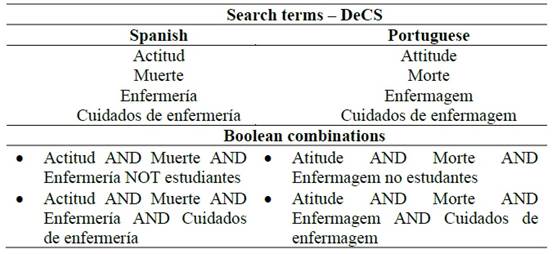
Methodology:An integrative literature review was conducted of Latin American scientific publications regarding attitudes towards death in the context of Nursing, using the following standardized terms: attitude, death, nursing and nursing care. Eight articles published in the defined period were included, in Spanish and Portuguese, in which the subject of the review was explicitly addressed. The information in the articles was analyzed using the concepts of the theory of transitions as a reference
Results:Both quantitative (50 %) and qualitative (50 %) designs were found, all of them elaborated in the hospital setting. The main results show the predominance of indifference to death in the context of care. In relation to the theory of transitions, most of the articles address the conditions under which these occur, in addition to the concepts of nursing therapeutics and response patterns
Conclusions:The production of research on the attitude towards death in nursing professionals is scarce in Latin America. Experiences of close losses, training and institutional support are the basis for contributing to a better attitude towards death
Keywords:
attitude; death; nursing; nursing care; nursing theory
Resumen:
Introducción:La muerte es parte de los tabúes sociales existentes y puede fomentar actitudes que distan de su abordaje explícito en relación con los cuidados
Objetivo:Analizar las actitudes ante la muerte en profesionales de enfermería de acuerdo con las publicaciones científicas en el contexto latinoamericano en el período 2018 a 2022
Metodología:Se realizó una revisión de literatura integrativa de las publicaciones científicas latinoamericanas respecto de las actitudes ante la muerte en el contexto de la enfermería, empleando los siguientes términos estandarizados: actitud, muerte, enfermería y cuidados de enfermería. Se incluyeron 8 artículos publicados en el período definido, en idioma español y portugués, en los que se abordó explícitamente la temática de la revisión. La información de los artículos fue analizada tomando como referencia los conceptos de la teoría de las transiciones
Resultados:Se encontraron diseños tanto cuantitativos (50 %) como cualitativos (50 %), elaborados en su totalidad en el ámbito hospitalario. Los principales resultados dan cuenta del predominio de la indiferencia ante la muerte en el contexto de los cuidados. En relación con la teoría de las transiciones, la mayoría de los artículos abordan las condiciones en que estas se dan, además de los conceptos de terapéutica de enfermería y patrones de respuesta
Conclusiones:La producción de investigaciones sobre la actitud ante la muerte en profesionales de enfermería es escasa en Latinoamérica. Las experiencias de pérdidas cercanas, la capacitación y el soporte institucional son la base para contribuir a una mejor actitud hacia la muerte
Palabras clave:
actitud; muerte; enfermería; cuidados de enfermería; teoría de enfermería
Resumo:
Introdução:A morte faz parte dos tabus sociais existentes e pode fomentar atitudes que se distanciam de sua abordagem explícita em relação aos cuidados
Objetivo:analisar as atitudes diante da morte em profissionais de enfermagem de acordo com as publicações científicas no contexto latino-americano no período de 2018 a 2022
Metodologia:Foi realizada uma revisão de literatura integrativa de publicações científicas latino-americanas sobre atitudes diante da morte no contexto da enfermagem, utilizando os seguintes termos padronizados: atitude, morte, enfermagem e cuidados de enfermagem. Foram incluídos 8 artigos publicados no período definido, em espanhol e português, nos quais o tema da revisão foi abordado explicitamente. As informações dos artigos foram analisadas tendo como referência os conceitos da teoria das transições
Resultados:Foram identificados desenhos quantitativos (50 %) e qualitativos (50 %), elaborados totalmente no âmbito hospitalar. Os principais resultados mostram a predominância da indiferença diante da morte no contexto do cuidado. Em relação à teoria das transições, a maioria dos artigos aborda as condições em que as transições ocorrem, além dos conceitos de terapêutica de enfermagem e padrões de resposta
Conclusões:A produção de pesquisas sobre atitudes diante da morte em profissionais de enfermagem é escassa na América Latina. As experiências de perdas próximas, a capacitação e o apoio institucional são a base para contribuir para uma melhor atitude em relação à morte
Palavras-chave:
atitude; morte; enfermagem; cuidados de enfermagem; teoria de enfermagem
Introduction
Death as a theme has become part of the existing social taboos, bringing to light the fragility and vulnerability of the human condition in the context of health-illness processes, which generates the opportunity to foster attitudes that are far from being explicitly addressed in various contexts, among them the health sector. (1,2)
Attitudes, although understood as complex webs with cognitive, affective, and behavioral components, might be defined as a learned “predisposition” to respond consistently favorably or unfavorably to an event, mediated by historical circumstances, socio-demographic characteristics, as well as personal or behavioral beliefs concerning the socially established normative beliefs and attitudes. (3, 4, 5)
It is significant that the social construction of the subject of death facilitates its recognition as an essential part of the human being and, therefore, makes it possible to forge attitudes that favor behaviors that promote its incorporation into everyday life, both in the social environment and the sanitary context.
From a world-historical perspective, death has been linked to negative aspects, becoming invisible since Hippocrates and Galen, who focused their premises on life and health, shaping in this way a sanitary culture that responded to it. Nevertheless, on a social level, a close bond was maintained, reflected in dying in close surroundings accompanied by relatives and in social sharing in cemeteries, scenarios that were also a source of other socioeconomic activities. This rationality brought about by the Enlightenment influenced these aspects, giving rise to new bonds, linked to a necessary participation of sanitary institutions, and the aseptic vision from which they exercise their labors. (6,7)
The institutional response to this issue in Latin America has been pragmatic, focusing its actions on legal and biosafety aspects, as reflected in some of the institutional protocols of El Salvador, Argentina, and Guatemala. (8, 9, 10)
In Chile, it can be found that the guidelines and regulations issued by the sanitary authorities regarding life-course, include from birth to old age, being the closest to the subject of death, the document titled Technical Orientation of Universal Palliative Care. (11) The name implies that it addresses users with palliative care requirements, linking psychosocial and spiritual aspects that involve both the user’s environment and the health care team that provides this type of care on an ongoing basis.
Based on the above, it can be affirmed that there is a lack of general technical guidelines regarding the care of the deceased in contexts other than palliative care, including post-mortem management beyond the management of the corpse itself, linking not only ethical aspects but also psychosocial care.
In the Chilean context, there are actions aimed at raising awareness related to the normalization of death as part of life, and this is the basis of the methodology called Café de la Muerte. (12) It consists of informal meetings that have a structure for its execution and that aim to contribute to the reduction of taboos and at the same time, to facilitate the dialogue that allows a more daily approach to death. Although these types of meetings are not specifically aimed at the health sector, they are an alternative to be considered for intentional work in these contexts.
It can be considered that the existing technical guidelines, training, and awareness-raising sessions are part of the strategies that contribute to building a much more inclusive vision of death, which benefits professionals in general and the care they provide to their users. It is worth bearing in mind that, for nurses, the incorporation of these strategies is a necessity, considering their majority representation as a human resource in the sanitary field, and their constant presence in the care provided to users, families, and communities throughout the life course, at the different levels of care. (13) This allows for closer contact and thus facilitates therapeutic communication, especially in times of crisis, both normative and non-normative, that may arise in the face of the loss of a loved one. (14,15)
From a disciplinary perspective, death has been approached as part of the Transitions Theory of Afaf Ibrahim Meleis, (16) who proposes the need to investigate the transitions experienced by human beings. In this theory, he suggests incorporating different aspects from the perspective of care, proposing the concepts of types of patterns of transitions, properties of the transition experience, conditions of transitions, response patterns or process and outcome indicators, and, finally, nursing therapeutics. Based on these foundations, it would be possible to consider that nursing professionals are individuals who must adapt to transitions in a healthy way -using the language of the theory-, just as the people under their care are expected to do, recognizing in this process, the existence of organizational transitions, which are understood as those that link the changes in the environmental conditions that affect the lives of both users and employees. (16)
In consideration of the above, the general objective of this review was to analyze attitudes towards death in nursing professionals according to scientific publications in the Latin American context in the period 2018 to 2022. As specific objectives: to describe the characteristics of the publications in relation to the country of origin, year, and design; to identify the main results and relate the findings to the concepts of the theory of transitions of Meleis.
Methodology
An integrative literature revision was conducted, (17) including scientific publications regarding attitudes toward death in Nursing professionals in Latin America, between 2018 and 2022, using the meta-search engine EBSCO as a database.
DeCS terms in Spanish and Portuguese were established as search criteria, combined using the Booleans AND, NOT, and OR (Table 1).
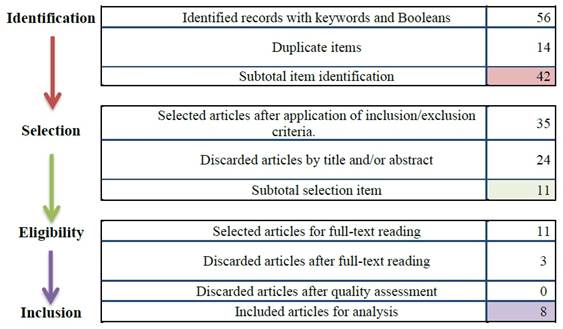
The following inclusion criteria were established: scientific articles from research works, open access to full text, that had been submitted to peer review and that their content explicitly addressed the subject of the review or included content related to it. Letters to the editor, reflection articles, review articles and undergraduate theses were excluded. Table 2 shows the selection process based on the PRISMA methodology. (18) In the identification stage, 56 articles were obtained; the articles included in the eligibility stage were read in full text and their quality was evaluated using the STROBE (19) and CASPe (20) parameters as a reference. A final sample of 8 articles was obtained from the MedicLatina, Academic Search Ultimate and CINAHL Complete databases. It is worth mentioning that a multicenter article was included, since it included a Latin American country, but only the results related to that context were taken into account for the analysis.
The information was organized in an Excel file for subsequent analysis by the authors, taking into consideration the specific objectives. For the third objective, the theory of transitions was incorporated as a reference, in order to give a disciplinary sense to the interpretation of the information and because it is relevant to the topic to be analyzed, thus allowing to know the main approaches of the published research and those that require further research.
The disciplinary analysis was carried out by placing in the Excel file the concepts of the theory of transitions in the form of columns, in order to establish the frequency of aspects related to it as reported in each article of the final sample, according to the interpretation of this theory made by the authors of this text. The information collected was analyzed both quantitatively and qualitatively.
Results
Nurses’ attitudes towards death and dying have not been studied in depth in Latin America, as evidenced by the small number of studies found in this review.
The selected articles came from Chile, Colombia, Brazil, and Mexico, with two publications per country, equivalent to 25% for each of them.
About half of the publications developed qualitative designs, including phenomenological, phenomenological-hermeneutic, descriptive-exploratory approaches, and textual-discursive analysis.
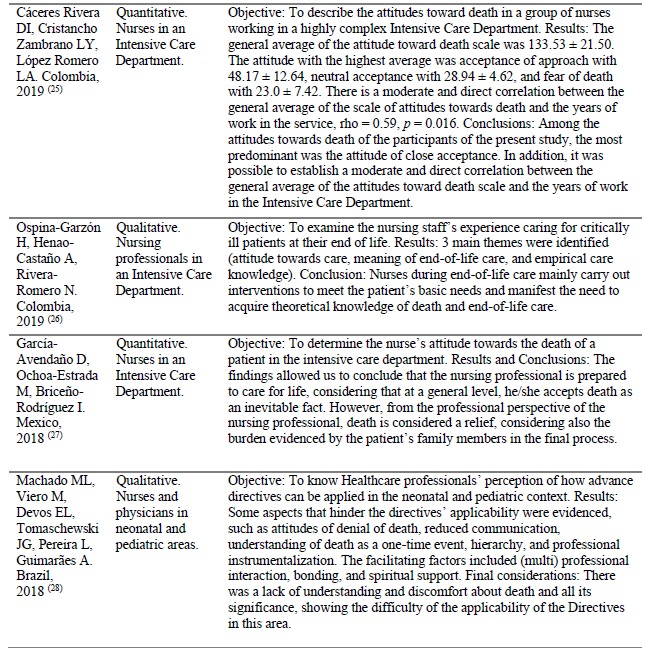
Regarding quantitative designs, descriptive designs were found in their entirety, in which the Attitudes to Death Scale (CAM-2) (n = 2, 50 %), and the Revised Profile of Attitudes to Death (PRAM) questionnaire (n = 2, 50 %) were used.
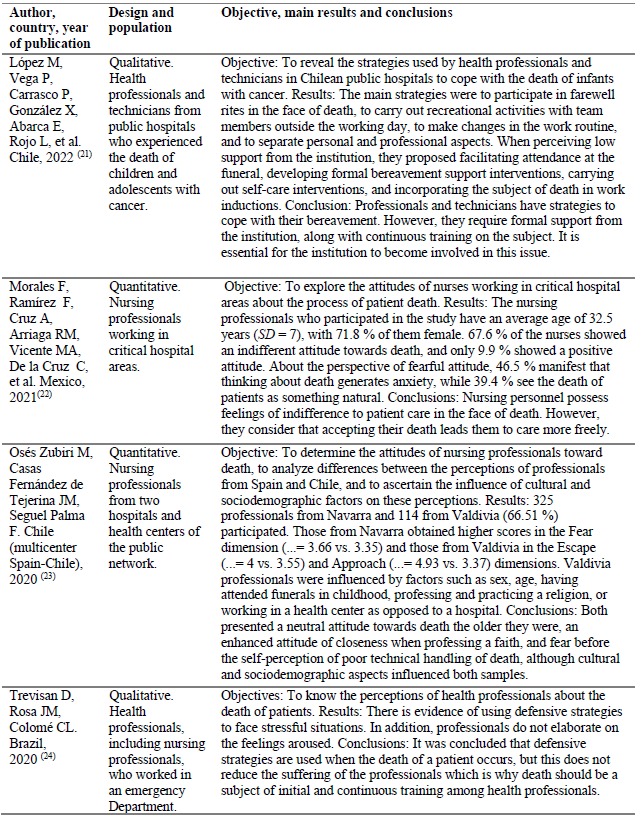
Table 33b summarizes the characteristics and results of the articles included in the review.
There was a predominance of indifference, evasive postures, and fear of death among attitudes in general, 22,25,28 but attitudes of neutrality and acceptance were also evidenced, which facilitated the approach. 23,25
Although not directly linked to attitudes, the articles underscored the significance of institutional regulations for formal interventions in addressing issues concerning death, such as bereavement and workers’ perception of care, along with the importance of a psychosocial and spiritual approach. 21,24 It is worth mentioning that all the articles were conducted within hospital settings.
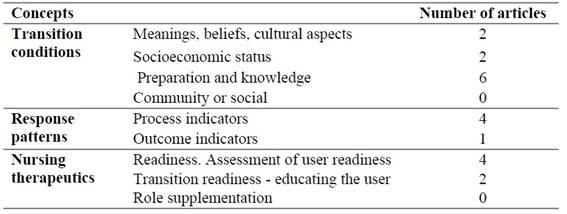
Linking the results to the Theory of Transitions, it was found that most of the articles addressed the conditions of transitions, followed by the concepts of Nursing therapeutics and response patterns (Table 4).
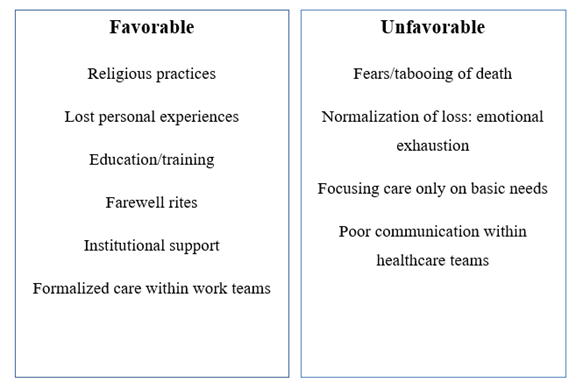
Therefore, it was possible to identify factors that favor or disfavor transitions related to death in the context of caregiving, as shown in Figure 1.
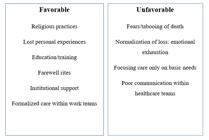
Regarding the conditions of transitions, aspects were identified that favor the attitudes of professionals regarding death in the context of care, such as participation in regular religious practices, personal experiences regarding the loss of a close family member, the incorporation of the subject as part of institutional training, in addition to its importance in initial training. Among the aspects that discourage such attitudes are personal fear of death and other stigmas related to the subject. 21,22,23,24,25,27
The research by Osés, Casas, and Seguel in 2020, 23 which is part of the selection, found that the most neutral attitudes towards death were significant in men, older professionals, those who did not have religious practices, and those who knew how to deal with end-of-life issues. In addition to technical and emotional aspects, fear of death was predominant in those professionals who had a low perception of it.
Regarding the therapeutic concept of nursing, it was found that nursing professionals have the preparation to face different aspects of the course of life, including death, 27 but require specific training for its approach. 26,27) The professional role implies demonstrating strength in this type of situation, which represents emotional exhaustion, which is not addressed,26)showing a possible normalization of this condition.
Regarding response patterns, there was evidence that the transition process related to death was facilitated by using farewell rites, formal support from the health institutions,21 communication among the group of professionals, and the generation of links between professionals and users. Explicit spiritual support as part of the care provided also contributed, 27 favoring the construction of attitudes by what is expected in this context.
Among the factors that hindered the processes, the defensive coping of the professionals in the face of the stress that death can generate was identified, as well as their lack of approach, 24) - as mentioned in the concept of nursing therapeutics-. Other factors identified were: the development of interventions focused on care that meet only the basic needs of people and not the specific ones related to the end of life, 15) as well as deficiencies in communication within the health teams. 28
Regarding the response patterns related to the results, we found evidence of the perception of relief generated by the death in the family environment, 27 reflecting a healthy transition in this context.
Discussion
Two socially relevant circumstances began to raise interest in the subject: firstly, the discussions on euthanasia and the incorporation of palliative care as a matter of rights, and secondly, the AIDS-19 pandemic, resulting in heavy deaths throughout the world, which affected the most socioeconomically vulnerable sectors of the population in particular. 29,30
Based on the findings, nursing professionals show mostly indifferent attitudes towards death, possibly related to the high exposure to this phenomenon in hospital environments,32 besides the rationalization of end-of-life processes, which accompanies the predominant biomedical vision in the healthcare field.33 Moreover, there is evidence that this attitude was mainly present in male professionals, so the gender perspective in end-of-life care should be considered,34 identifying the need to develop research to provide evidence.
Research like the one conducted by Terezinha Zenevicz et al. 35 revealed the relevance and innovations regarding end-of-life care, assuming the challenge of favoring an attitude willing to be compassionately linked to those who are moving towards death. Based on this, the idea arises of actively participating in meeting the needs beyond the biomedical, incorporating those related to the cultural, social, emotional, and spiritual needs of the dying and their families to ensure the best possible transition conditions from hospital spaces, as well as from Primary Health Care and home care services.
Other significant findings had to do with the fear and stigma surrounding the concept of death among nurses. Such a condition constitutes a limiting factor for transition conditions and is directly related to the idea of finiteness of the health professionals themselves. 36
Pais et al. 37 conclude in their research that to improve the attitude toward death, it is necessary to work on its conceptualization and reflections from undergraduate training and to receive continuous training for working with people in the end-of-life process and their environments. 37,38
Evidence has also demonstrated the need for institutional environments that promote reflections on the idea of life and death itself and that take into account the coping mechanisms of the staff, compassion fatigue, the implementation of respite times, and psycho-spiritual accompaniment; with this, we would expect an implementation of comprehensive and integrative care, from which transitions in those who exercise care are favored. 39,40
The death-related processes represent an opportunity for disciplinary development in Latin America, considering that nursing is a caring discipline and the history of its progress and positioning in health care has been marked by its contribution to well-being from different perspectives. 41
It is recognized as a limitation of this review to address only the Latin American context, which was due to the authors’ interest in knowing a more situated scientific production in coherence with the proposed objectives.
Conclusions
Research on this subject is scarce in Latin America, and having experienced close losses, training in concepts and techniques, including favorable institutional support, is the basis for contributing to a better attitude toward death.
In this review we invite you to develop research on this subject to have more evidence in the Latin American context, which facilitates its recognition and incorporation in the institutional health environment, at all levels of care, taking into account that the research found was centered in the hospital environment.
References
-
Mazzetti, C. Entre el humor y el tabú. La muerte en la trama comunicacional. Perspectivas de la Comunicación (Internet). 2021;14(2):95-125. doi: 10.4067/s0718-48672021000200095
» 10.4067/s0718-48672021000200095 -
2. Heleonora, C, Bastos, S, Dutra, G, Alende, L. A Enfermagem Diante Da Morte: Uma Revisão Narrativa De Literatura. Revista Recien (Internet). 2022;12(39):148-160. doi: 10.24276/rrecien2022.12.39.148-160
» 10.24276/rrecien2022.12.39.148-160 -
3. Peters, L, Cant, R, Payne, S, O’Connor, M, McDermott, F, Hood, K, et al. How Death Anxiety Impacts Nurses’ Caring for Patients at the End of Life: A Review of Literature. Open Nurs J. 2013;7:14-21. doi: 10.2174/1874434601307010014
» 10.2174/1874434601307010014 -
4. Strang, S, Bergh, I, Ek, K, Hammarlund, K, Prahl, C, Westin, L, et al. Swedish nursing students’ reasoning about emotionally demanding issues in caring for dying patients. Int J Palliat Nurs. 2014;20(4):194-200. doi: 10.12968/ijpn.2014.20.4.194
» 10.12968/ijpn.2014.20.4.194 -
5. Conrey, F, Smith, E. Attitudes representation: Attitudes as patterns in a distributed, connectionist representational system. Social Cognition. 2007;25(5):718-735. doi: 10.1521/soco.2007.25.5.718
» 10.1521/soco.2007.25.5.718 -
6. Maldonado, C. Death and Complexity. Rev. latinoam. bioet (Internet). 2021;21(1):113-126. doi: 10.18359/rlbi.5376
» 10.18359/rlbi.5376 -
7. Quinaglia, E. Ideario de la muerte en occidente: la bioética en una perspectiva antropológica crítica. Rev. Bioét. 2019;27(1):38-45. doi: 10.1590/1983-80422019271284
» 10.1590/1983-80422019271284 -
8. Manual del proceso manejar y entregar cadáveres y piezas anatómicas (Internet). San Salvador: Subdirección de Salud; 2022. Disponible en: https://www.transparencia.gob.sv/institutions/isss/documents/481891/download
» https://www.transparencia.gob.sv/institutions/isss/documents/481891/download -
9. Manejo seguro de cadáveres. Guía para equipos de salud (Internet). Buenos Aires: Ministerio de Salud de la Nación; 2011. Disponible en: https://bancos.salud.gob.ar/sites/default/files/2018-10/0000000097cnt-manejo_cadaveres.pdf
» https://bancos.salud.gob.ar/sites/default/files/2018-10/0000000097cnt-manejo_cadaveres.pdf -
10. Norma técnica hospitalaria para manipulación de cadáveres (Internet). Ciudad de Guatemala: Ministerio de Salud Pública y Asistencia Social; 2013. Disponible en: https://pdf.usaid.gov/pdf_docs/PA00JM5Z.pdf
» https://pdf.usaid.gov/pdf_docs/PA00JM5Z.pdf -
11. Orientación Técnica Cuidados Paliativas Universales (Internet). Chile: Ministerio de Salud; 2022. Disponible en: https://www.minsal.cl/wp-content/uploads/2023/07/Orientacion-Tecnica-Cuidados-Paliativos-Universales.pdf
» https://www.minsal.cl/wp-content/uploads/2023/07/Orientacion-Tecnica-Cuidados-Paliativos-Universales.pdf -
12. Death cafe guide (Internet). Londres: Impermanence; 2012. (citado 2020 abr 8). Disponible en: Disponible en: https://deathcafe.com/how/
» https://deathcafe.com/how/ -
13. Enfermería y partería (Internet). Organización Panamericana de la Salud; (citado 2023 sep 5). Disponible en: Disponible en: https://www.paho.org/es/temas/enfermeria
» https://www.paho.org/es/temas/enfermeria -
14. Amancio, A, Camarena, E, Fajardo, M, Del Carpio, S. Comunicación terapéutica del profesional de enfermería y donación de órganos. Apuntes Universitarios (Internet). 2021;11(3):13-28. doi: 10.17162/au.v11i3.690
» 10.17162/au.v11i3.690 -
15. Melgarejo, G, Rivas, L, Loli, R. Conceptualización y percepción de enfermería sobre el cuidado del niño. Rev Cubana Enferm (Internet). 2022;38(2):1-16. Disponible en: https://revenfermeria.sld.cu/index.php/enf/article/view/5088
» https://revenfermeria.sld.cu/index.php/enf/article/view/5088 - 16. Im Eun-Ok. Teoría de las transiciones. En: Modelos y Teorías en Enfermería. 7ª ed. Barcelona: Elsevier Mosby; 2011, p. 416-433.
-
17. Lizarondo, L, Stern, C, Carrier, J, Godfrey, C, Rieger, K, Salmond, S, et al. Mixed methods systematic reviews. En Aromataris, E, Munn, Z, editors. JBI Manual for Evidence Synthesis. JBI; 2020. doi: 10.46658/JBIMES-20-09
» 10.46658/JBIMES-20-09 -
18. Page, MJ, McKenzie, JE, Bossuyt, PM, Boutron, I, Hoffmann, TC, Mulrow, CD, et al. The PRISMA 2020 statement: an updated guideline for reporting systematic reviews. BMJ 2021;372:n71. doi:10.1136/bmj.n71
» 10.1136/bmj.n71 -
19. von Elm, E, Altman, DG, Egger, M, Pocock, SJ, Gøtzsche, PC, Vandenbroucke, JP, et al. The Strengthening the Reporting of Observational Studies in Epidemiology (STROBE) statement: guidelines for reporting observational studies. Lancet. 2007 Oct 20;370(9596):1453-1457. doi: 10.1016/S0140-6736(07)61602-X. PMID: 18064739.
» 10.1016/S0140-6736(07)61602-X. PMID: 18064739. -
20. Cano Arana, A, González Gil, T, Cabello López, JB. Plantilla para ayudarte a entender un estudio cualitativo. En CASPe. Guías CASPe de Lectura Crítica de la Literatura Médica. Alicante: CASPe; 2010, p. 3-8. Disponible en: https://redcaspe.org/plantilla_cualitativa.pdf
» https://redcaspe.org/plantilla_cualitativa.pdf -
21. López, M, Vega, P, Carrasco, P, González, X, Abarca, E, Rojo, L, et al. Estrategias del equipo de salud para afrontar la muerte de niños y adolescentes con cáncer. Rev Cubana Enfer (Internet). 2022;38(2): e4624. Disponible en: https://pesquisa.bvsalud.org/portal/resource/pt/biblio-1408335
» https://pesquisa.bvsalud.org/portal/resource/pt/biblio-1408335 -
22. Morales, F, Ramírez, F, Cruz, A, Arriaga, R, Vicente, M, De la Cruz, C, et al. Actitudes del personal de enfermería ante la muerte de sus pacientes. Rev Cuid (Internet). 2021;12(1):1-10. doi: 10.15649/cuidarte.1081
» 10.15649/cuidarte.1081 -
23. Osés, M, Casas, J, Seguel, F. Actitudes hacia la muerte de profesionales de Enfermería de España y Chile. Metas Enferm (Internet). 2020;23(10):58-64. doi: 10.35667/MetasEnf.2020.23.1003081675
» 10.35667/MetasEnf.2020.23.1003081675 -
24. Trevisan, D, Rosa, J, Colomé, C. Percepções dos profissionais da saúde sobre a morte de pacientes. Revista Subjetividades (Internet). 2020;20(1):1-13. doi: 10.5020/23590777.rs.v20i1.e9164
» 10.5020/23590777.rs.v20i1.e9164 -
25. Cáceres, D, Cristancho, L, López, L. Actitudes de las enfermeras frente a la muerte de los pacientes en una unidad de cuidados intensivos. Ciencias De La Salud (Internet). 2019;17(3):98-110. doi: 10.12804/revistas.urosario.edu.co/revsalud/a.8368
» 10.12804/revistas.urosario.edu.co/revsalud/a.8368 -
26. Ospina-Garzón, H, Henao-Castaño, A, Rivera-Romero, N. Significado de brindar cuidado al paciente crítico al final de la vida en Unidad de Cuidados Intensivos. Index Enferm (Internet). 2019;28(1-2):42-45. Disponible en: http://scielo.isciii.es/scielo.php?script=sci_arttext&pid=S1132-12962019000100009&lng=es
» http://scielo.isciii.es/scielo.php?script=sci_arttext&pid=S1132-12962019000100009&lng=es -
27. García-Avendaño, D, Ochoa-Estrada, M, Briceño-Rodríguez, I. Actitud del personal de enfermería ante la muerte de la persona en la unidad de cuidados intensivos: estudio cuantitativo. Duazary (Internet). 2018;15(3):281-893. doi: 10.21676/2389783X.2421
» 10.21676/2389783X.2421 -
28. Machado, ML, Viero, M, Devos, EL, Tomaschewski, JG, Pereira, L, Guimarães, A. Diretivas antecipadas de vontade: Percepção acerca da aplicabilidade no contexto neonatal e pediátrico. Revista de Enfermagem da UFSM (Internet). 2018;8(3):475-488. doi: 10.5902/2179769227887
» 10.5902/2179769227887 -
29. Mercadal-Sánchez, J, Ferrer Romero, E, Fradejas-García, I, Sánchez Larrosa, AI. Enfermos sin compañía, muertos sin funeral: acompañamiento paliativo en centros sociosanitarios de Barcelona durante la COVID-19. RIO (Internet). 2023;(30):79-103. doi: 10.17345/rio30.79-103
» 10.17345/rio30.79-103 -
30. Yepes-Delgado, C, Vanegas-Díaz, C, Mesa-Muñoz, C, Estrada-Bedoya, G. Miedo a la muerte y a su proceso en personal de pediatría durante la pandemia COVID-19. Salud UIS (Internet) 2023;55: e:23037. doi: 10.18273/saluduis.55.e:23037
» 10.18273/saluduis.55.e:23037 - 32. Martins, A. El final de la vida en la perspectiva de la salud global. Concilium. 2021;(393): 69-80.
- 33. Sancho Gómez, M. Morir con dignidad. Madrid: Arán Ediciones; 2005.
-
34. Pavez, A. La enfermería, realidad de ciudadanía y de género en Chile. Cienc. Enferm. (Internet). 2013;19(3):95-102. doi: 10.4067/S0717-95532013000300010
» 10.4067/S0717-95532013000300010 -
35. Zenevicz, LT, Bitencourt, JVOV, Léo, MMF, Madureira, VSF, Thofehrn, MB, Conceição, VM. Permissão de partida: um cuidado espiritual de enfermagem na finitude humana. Rev Bras Enferm (Internet). 2020;73(3):1-5. doi: 10.1590/0034-7167-2018-0622
» 10.1590/0034-7167-2018-0622 -
36. Sevilla-Casado, M, Ferré-Grau, C. Ansiedad ante la muerte en enfermeras de Atención Sociosanitaria: datos y significados. Gerokomos (Internet). 2013;24(3):109-114. doi: 10.4321/S1134-928X2013000300003
» 10.4321/S1134-928X2013000300003 -
37. Pais, N, Batista, C, Marques, A, Moreira, I. Effectiveness of a training program for nurses’ emotional management of patient death. Revista de Enfermagem Referência (Internet). 2020;(3):1-7. doi: 10.12707/RV20023
» 10.12707/RV20023 -
38. Palomar, M, Romero, M, Pérez, E, Romero, M. Educar para la vida y la muerte a los estudiantes de Enfermería: “del miedo al amor”. Enfermería: Cuidados Humanizados (Internet). 2020;9(1):65-81. doi: 10.22235/ech.v9i1.2167
» 10.22235/ech.v9i1.2167 -
39. Violim, N, Trevisan, J, Quina, M, Perfeito, R, Oliveira, A, Lourenço, M. Satisfacción, fatiga por compasión y factores asociados en las enfermeras de la atención primaria. Enferm. glob. (Internet). 2021;20(64):291-323. doi: 10.6018/eglobal.457511
» 10.6018/eglobal.457511 -
40. Pintado, S. Programas basados en mindfulness para el tratamiento de la fatiga por compasión en personal sanitario: una revisión. Ter Psicol (Internet). 2018;36(2):71-80. doi: 10.4067/S0718-48082018000200071
» 10.4067/S0718-48082018000200071 - 41. Rivas, E, editor. La historia de la Enfermería en Chile. Santiago de Chile: Ediciones Universidad de la Frontera; 2019.