Care Experience in a Hospital Emergency Unit: A Phenomenological-Hermeneutic Study
Abstract:
Introduction: Humanized care is essential in nursing, especially in emergency situations where high demand for care and limited resources can affect the user's perception. Understanding the user experience is key to identifying gaps in the relationship with nursing professionals and guiding improvements in the quality of care
Objective: To analyze the experiences of users hospitalized in an emergency unit regarding the nursing care received
Methodology: Qualitative study using Van Manen's phenomenological-hermeneutic approach. In-depth interviews were conducted with 10 participants hospitalized for more than 12 hours in a hospital emergency unit in the Maule Region, Chile
Results: Two main themes emerged: the hospitalization experience, characterized as impersonal and traumatic; and the care experience, which reveals disparate perceptions, ranging from attentive and respectful care to distant and unempathetic practices
Conclusions: The study provides a deep understanding of the elements that facilitate or hinder humanized care in hospital emergency units. The findings highlight the need to strengthen nurses' interpersonal skills and improve institutional strategies that promote attentive care, adequate time, and decent infrastructure to ensure a more humanized care experi
Keywords:
emergency nursing; humanization of care; nursing
Resumen:
Introducción: El cuidado humanizado es fundamental en enfermería, especialmente en contextos de urgencia donde la alta demanda asistencial y las limitaciones de recursos pueden afectar la percepción del usuario. Comprender la experiencia del usuario es clave para identificar brechas en la relación con el profesional de enfermería y orientar mejoras en la calidad del cuidado
Objetivo: Analizar las experiencias de usuarios hospitalizados en una unidad de emergencia respecto al cuidado de enfermería recibido
Metodología: Estudio cualitativo con enfoque fenomenológico-hermenéutico de Van Manen. Se realizaron entrevistas en profundidad a 10 participantes hospitalizados por más de 12 horas en una unidad de emergencia hospitalaria de la Región del Maule, Chile
Resultados: Emergieron dos temas principales: la experiencia de hospitalización, caracterizada como impersonal y traumática; y la experiencia del cuidado, que revela percepciones dispares, desde un cuidado cercano y respetuoso hasta prácticas distantes y poco empáticas
Conclusiones: El estudio aporta una comprensión profunda de los elementos que facilitan u obstaculizan el cuidado humanizado en las unidades de emergencia hospitalaria. Los hallazgos evidencian la necesidad de fortalecer habilidades interpersonales de los enfermeros y mejorar las estrategias institucionales que favorezcan un cuidado cercano, la garantía de tiempos adecuados y una infraestructura digna, para asegurar una experiencia de cuidado más humanizada
Palabras clave:
enfermería de urgencia; humanización de la atención; enfermería
Resumo:
Introdução: O cuidado humanizado é fundamental na enfermagem, especialmente em contextos de urgência, nos quais a alta demanda por assistência e as limitações de recursos podem afetar a percepção do usuário. Compreender a experiência do usuário é essencial para identificar lacunas no relacionamento com o profissional de enfermagem e orientar melhorias na qualidade do cuidado
Objetivo: Analisar as experiências de usuários hospitalizados em uma unidade de emergência em relação ao cuidado de enfermagem recebido
Metodologia: Estudo qualitativo com abordagem fenomenológico-hermenêutica de Van Manen. Foram realizadas entrevistas em profundidade com 10 participantes hospitalizados por mais de 12 horas em uma unidade de emergência hospitalar da Região do Maule, Chile
Resultados: Emergiram dois temas principais: a experiência de hospitalização, caracterizada como impessoal e traumática; e a experiência do cuidado, que revela percepções díspares, desde um cuidado próximo e respeitoso até práticas distantes e pouco empáticas
Conclusões: O estudo oferece uma compreensão profunda dos elementos que facilitam ou dificultam o cuidado humanizado nas unidades de emergência hospitalar. Os resultados evidenciam a necessidade de fortalecer as habilidades interpessoais dos enfermeiros e aprimorar as estratégias institucionais que favoreçam um cuidado próximo, a garantia de tempos adequados e uma infraestrutura digna, para assegurar uma experiência de cuidado mais humanizada
Palavras-chave:
enfermagem de urgência; humanização da atenção; enfermagem
Introduction
Nursing care requires a holistic approach and the consideration of the patient as a unique being in an integral manner. This care is sustained through a nurse-patient relationship that is interconnected and intersubjective, involving shared sensations between the nurse and the user.1 Watson recognizes that caring is a fundamental part of being and is the most primitive act performed by a human being. 2) And that, for this care to be effective, there must be a close interrelationship with the other. This call from the other, who in this case is the person requiring care, is the basis of the care provided by nursing professionals.
When care goes beyond the usual and simple actions of nursing and incorporates a close interrelationship with the user, accompanying them in care with feelings and emotions, it is referred to as humanized care. 3) Therefore, the nursing professional, in addition to possessing technical competencies with high quality standards in care, must also maintain sensitivity in the treatment of users who attend health centers. 4) In this sense, human care has two essential dimensions: integrality in care and person-centered care; this translates into care that is personalized and that promotes autonomy and well-being in the user. 5
Care in the context of the Hospital Emergency Unit (HEU) differs from that of other hospital services due to multiple factors that hinder humanized care and the satisfaction of community needs in the manner expected by the population.6 The Chilean Undersecretariat of Healthcare Networks,7) defines the HEU as an outpatient, transitional care unit where the patient care process is carried out, considering the clinical subprocesses of demand selection, diagnosis, and treatment, as well as the non-clinical subprocesses of administrative support. This unit must resolve all urgent and emergency care, defined as any spontaneous or referred consultation that arrives at said unit.
On the other hand, Watson defines lived experience as the subjective and relational process through which the person assigns meaning to care interactions, framed by their vulnerability, emotional needs, and health context. 2) Regarding the care experiences of users who seek care in health institutions, some studies indicate that one of the difficulties in providing this humanized care lies in the communication established between nurse and patient.8) Health processes in emergency units become complex due to high care demand, as they mainly address the needs of the older population, reducing the provision of information to users and hindering access to services. 9
Hospital emergency units in Chile face high care demand, with prolonged waiting times that affect the perception of care received. According to the Health at a Glance report (OECD, 2023), Chile has only 2 hospital beds per 1,000 inhabitants, which generates transient hospitalizations in non-equipped spaces, such as corridors. 10) In this context, it becomes essential to understand the lived experience of the user, and the phenomenological-hermeneutic approach of Van Manen allows for the exploration of the deep meaning of these experiences, favoring an interpretation from the user’s subjectivity. 11
In the Latin American context, a study in Brazil has shown the difficulties in reconciling efficiency demands with person-centered care, where aspects such as empathy and effective communication are overshadowed by workload overload and structural limitations. 12) In addition, reviews and research conducted in Mexico highlight the need to strengthen care processes that integrate the emotional dimension and interpersonal relationships in HEUs. 13,14
In Chile, recent evidence on humanized care in emergency contexts is limited. Over the past five years, national studies have addressed the perception of care in general hospitalization units, without delving into the lived experience of the user in HEUs. Therefore, it becomes necessary to generate contemporary qualitative evidence that allows for understanding how users experience care in this critical scenario, reinforcing the relevance and timeliness of the present study. In this context, the following question arises: What is the lived experience of users regarding the care received from nursing professionals during their hospitalization in an HEU?
Methodology
This study is based on the qualitative method under the phenomenological-hermeneutic approach of Van Manen, which is oriented toward the description and interpretation of the essential structures of lived experience. 11
The study was conducted in a Hospital Emergency Unit (HEU) of a hospital in the Maule region, in 2022. Regarding the participants, convenience sampling was used due to its methodological relevance, as it allowed access to individuals who had recent experiences, facilitating the collection of meaningful data on the phenomenon studied. The final sample consisted of 10 participants, with whom data saturation was achieved; this was determined when the interviews ceased to provide new and emerging information. The sample size of 10 participants was methodologically justified based on the phenomenological-hermeneutic approach of Van Manen, which prioritizes depth of narrative over the number of cases. 11) The interviews provided sufficient narrative richness, diversity of experiences, and interpretive density to characterize the experience of care in emergency settings.
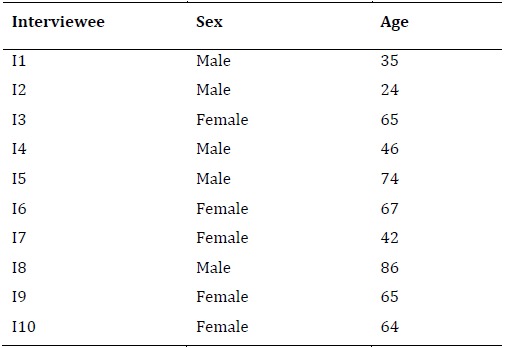
Regarding sample diversity, participants ranged in age from 24 to 86 years, with 50% female and 50% male, in addition to having different clinical conditions, which enriched the understanding of the phenomenon from multiple perspectives. This heterogeneity allowed for the exploration of varied experiences within the hospital context.
The inclusion criteria were: users over 18 years of age with a minimum hospitalization of 12 hours in an HEU, who were conscious, oriented in time and space, without cognitive impairment, capable of verbal communication, and with resolution of their acute pathology. The exclusion criteria were: users who were hospitalized through another route of entry (internal referral from another center, patient rescue via the Centralized Bed Management Unit), hospitalization for psychiatric causes, and users without medical discharge.
Participants who met the inclusion criteria were contacted on the day of their medical discharge through the hospital’s Bed Management Unit, whose nurses in charge provided an informational leaflet with an invitation to participate in the study. None of these users had been cared for or attended by the researcher responsible for this study, who has professional experience in this type of Health Unit. This is an element that could have influenced the interpretation of the data, given the development of closeness and empathy that facilitated the understanding of the phenomenon, but it also required the constant development of reflexivity to avoid bias, maintaining a critical and ethical stance throughout the entire research process.
The information was collected through an individual in-depth interview using three guiding questions, which were previously submitted to the judgment of three experts before being applied; doctors with experience in qualitative research, university teaching, and care management, ensuring the relevance and depth of the instrument. The questions included general aspects of the participants and specific aspects related to hospitalization, such as, for example: Can you tell me about your hospitalization experience? In addition, probing questions were used in order to deepen the narratives, encourage narrative spontaneity, and explore emotional and contextual aspects of the lived experience.
The interview was conducted by mutual agreement after discharge, in a place that was comfortable for the interviewee, in this case, their homes, in a comfortable, private environment free of external noise, and they were recorded in audio format to subsequently generate a faithful transcription. The interviews were conducted during December 2022 and ranged in duration from 14 to 26 minutes. Although the duration of the interviews was relatively brief, adequate narrative density was achieved due to the comfort of the environment, participant engagement, and the use of probing questions that facilitated the expression of significant experiences.
To safeguard the anonymity of the participants, the interviews were coded, without including personal data in the transcriptions. In addition, the audio files were stored in an encrypted digital folder, under the exclusive responsibility of the researcher. The information from this research will be retained for a period of five years, in accordance with institutional ethical standards.
Regarding ethical aspects, the study was evaluated by the Scientific Ethics Committee of the Universidad Católica del Maule through record No. 236/2022, and authorization was also obtained from the management of the Hospital where the research was conducted.
Prior to execution, informed consent was requested from all participants, maintaining confidentiality at all times.
Data analysis was thematic, following the four phases proposed by Van Manen, allowing for an in-depth understanding of the phenomenon through the interpretation of events and experiences, seeking the encounter of the human being with oneself and granting the possibility of analyzing the significant phenomenon that can be made conscious. 11
The analysis was operationalized as follows:
Clarification of assumptions: The researcher’s own preconceptions and assumptions regarding the phenomenon were identified, recorded, and reflected upon prior to the beginning of the analysis.
Collection of lived experience: The interviews were transcribed faithfully and initially read to capture the overall meaning of each experience.
Structural reflection: A manual coding of the texts was performed, identifying units of meaning that were grouped into themes and subthemes, seeking the essence of the lived experience.
Reflective writing: In-depth descriptions of the emerging themes were developed, integrating participant quotations and interpretive reflections that allowed for understanding the phenomenon from the perspective of personal experience.
Regarding themes and subthemes, as a way to strengthen the credibility of the analysis, analytical triangulation was carried out together with two additional researchers who have extensive experience in qualitative research. Both participated in the identification of units of meaning and in the construction of themes and subthemes. Differences in interpretation were discussed in individualized sessions, which ensured greater coherence and depth in data interpretation.
It should be noted that the analysis was conducted manually, without the use of specialized software, following the phenomenological-hermeneutic approach of Van Manen, through successive readings, inductive coding, extraction of units of meaning, and reflective construction of themes and subthemes. 11 The decision was based on the need to maintain direct and reflective immersion in the narratives, prioritizing deep reading, interpretive writing, and close contact with participants’ accounts.
The methodological design aligns coherently with the general objective of this study. The phenomenological-hermeneutic approach of Van Manen made it possible to explore the narratives, interpreting the deep meaning of the experiences without imposing prior judgments. On the other hand, the research questions were formulated to favor free and reflective narration, which facilitated access to the essential structures of the experience of care from the user’s perspective.
Methodological rigor was ensured by following the criteria of credibility, transferability, dependability, and confirmability. Credibility was strengthened through participant validation and triangulation among researchers; transferability through a detailed description of the context and participants; dependability through complete traceability of the analytic process; and confirmability through reflexivity, field notes, and auditing of interpretive decisions.
Results
According to the data collected, the sociodemographic profile of the interviewees corresponds to 50% female and 50% male, and the age range goes from 24 to 86 years of age (see Table 1).
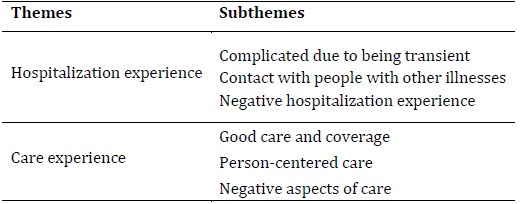
Through the narratives, two main themes were identified with their respective subthemes by empirical concept (see Table 2).
Theme 1: Hospitalization Experience
Subtheme: Complicated Due to Being Transient
The first subtheme mentions the complication generated in users due to the transitory nature of the stay, that is, the short period of stay experienced during hospitalization in HEUs. Participants feel that, because it is a transitory hospitalization, it becomes complex to experience it.
The transitory nature of emergency care is like the most complicated thing because many people arrive with different illnesses (I1, M, 35y). The change of hospitalization setting was completely abrupt for me (I2, M, 24y).
Subtheme: Contact with People with Other Illnesses
The second subtheme mentions how users experience hospitalization in an HEU while maintaining contact with people who suffer from other illnesses. Participants express how complex it is to coexist with other users, highlighting how negative and impactful it is to relate to people who are in the same place and who, in addition, have diagnoses of psychiatric pathologies. This is recorded with phrases such as:
Being next to patients as a community there is complicated, it is like the most traumatic thing one can live (I1, M, 35y). Unfortunately, I ended up next to a patient with schizophrenia (…) the medical staff took care of calming the patient, even though they were receiving blows and spitting (I2, M, 24y).
Subtheme: Negative Hospitalization Experience
The third subtheme mentions the negative hospitalization experience lived by the participants of this research during their stay in the HEU. They described what they lived as a “traumatic, impersonal, abrupt, and shocking” experience:
The most traumatic thing has been seeing what it is like to be in emergency care (I1, M, 35y).
In the same way, reference is made to the care received by older adults, with them being an external voice:
The treatment toward the older adult left me shocked (I7, F, 42y).
This unfavorable experience, according to what users report, leaves such a feeling of hostility that it brings out feelings of anxiety and restlessness about returning to their homes, recording phrases such as:
I just wanted to leave, to run away, many times I wanted to escape because I couldn’t stand it (I7, F, 42y).
In addition to what has been stated, participants also relate this bad hospitalization experience in the HEU to the physical place, with the “corridor” being a space that generates displeasure and discomfort:
In the corridor I have had a very bad experience (I6, F, 67y). Seeing the change of setting to a corridor was tough (I2, M, 24y).
In this same subtheme emphasis was placed on the environment of the place, mentioning the physical space and its furnishings. Regarding the space, users remain dissatisfied, stating that:
In emergency care you see everything and everyone is overcrowded there (I1, M, 35y). Even the furniture generates discomfort (I3, F, 65y).
Within the experiences, a specific situation arises regarding infrastructure failures:
There was a flood, the entire corridor was flooding because of some old valves that surely gave way (I6, F, 67y).
Theme 2: Care Experience
Subtheme: Good Care and Coverage
In this case, users indicate that they felt they received good care, which is closely related to feeling that the corresponding services were provided in a timely manner. Phrases such as the following are recorded:
The treatment was good and I think the care has been good as well because they did all the exams there are and could be done (I1, M, 35y). They gave me medications several times, (…) the doctor calculated how long the effect lasted and they gave me more (I5, M, 74y).
On the other hand, for participants, the comfort provided during hospitalization in the HEU was also important, which translates into concern for them. This is evidenced by phrases such as:
They came by all the time, so every time I needed something I just talked to them, so it was good (I9, F, 65y). They treated me well, with lots of little blankets (…) they all took very good care of me and I thanked them (I10, F, 64y).
Subtheme: Person-Centered Care
This subtheme refers directly to nurses. Participants refer to nursing professionals as discreet people, with good treatment, and who are concerned about doing their job properly. Examples of this are phrases such as:
They speak little, but what is necessary, they are friendly (I2, M, 24y). They are very loving (…) attentive with the medications, all the things (I3, F, 65y).
Within this subtheme, users referred to the importance of the work that nurses carry out in the HEU and highly value the composure and patience they maintain while performing their duties, considering the special conditions of the environment in which they operate. Participants refer to this as follows:
I really value the patience they have (I2, M, 24y).
Subtheme: Negative Aspects of Care
In this subtheme, first is mentioned the long waiting times to receive care. For users, waiting times are important and decisive factors when forming an opinion about their hospitalization. In this case, participants consider the wait excessive, both for medical care and for meeting their basic needs. This is reflected in phrases such as:
They process you a lot, even if you are dying outside, they don’t attend to you immediately (I3, F, 65y). The wait was the hardest (I9, F, 65y).
Finally, in this subtheme, emphasis is placed on the treatment received during hospitalization in the HEU. Some participants report having been treated in an impersonal manner, evidenced by phrases such as:
It is shocking. Very cold at first. Very impersonal (I6, F, 67y).
Participants even allude to the fact that health personnel work only for money, without taking them into account during their hospitalization:
I see that it’s money, salary, that’s what I see in them, they don’t care (I7, F, 42y).
In this sense, some users felt neglected and even felt that health personnel became annoyed by requests or expressions of their needs, often due to attention to mobile devices, which is evidenced in phrases such as:
A lot of phone use, if you tell them miss, bring me the bedpan, they don’t pay attention to anyone (I3, F, 65y).
Discussion
The results show that the lived experience of hospitalization in the HEU is experienced as an abrupt interruption of everyday life, marked by vulnerability and the search for meaningful human presence. From Van Manen’s perspective, 11) this type of experience evidences a rupture between temporality and relationality: waiting time is experienced as “lost time,” associated with uncertainty and lack of protection, while relational distancing translates into the feeling of not being recognized as a person. This experience coincides with international findings that link care pressure with restricted communication and fragmented care, (15, 16) which strains the possibility of sustaining transpersonal care in the terms proposed by Watson. 2
The participants of this research also perceived a significant lack of human resources, more than material resources, even when the infrastructure is small and they often have to be hospitalized in a corridor rather than in a closed room with a bed. In this context, some investigations conclude that increasing human and material resources improves the direct treatment provided by caregivers to patients and, therefore, is an important factor in achieving humanized user care. 16
On the other hand, Marrero points out that nursing professionals must maintain empathy and closeness with patients. 17) In addition, this same author mentions that nurses must establish a relationship that allows constant communication with the person being cared for. However, if human resources are insufficient, nursing professionals will hardly be able to build and promote care that improves and deepens treatment, sensitivity, and communication provided by nurses and the health team. 17
In this context, health personnel must ensure the availability of infrastructure, human resources, and the necessary supplies to provide quality care and meet user needs. 18
A negative aspect that affects care and generates discomfort among participants is waiting time, which was considered excessive due, according to their perception, to staff shortages, generating a technical and labor-based relationship with nurses who maintained closeness only to provide punctual care and administer treatments. This is consistent with the work of Busch et al., 16) who conclude that care pressure due to excessive workload and lack of professionals generates a negative impact on care, leading to longer waiting times and distancing in the relationship with the patient, due to the limited time available for care, prioritizing procedural aspects and the biological dimension of care, leaving the psychosocial and spiritual dimensions relegated.16) This distancing includes the absence of authentic presence, interactions focused solely on technical aspects, and limitations imposed by care pressure. These forms of separation constitute a rupture of the transpersonal encounter of humanized care described by Watson. 2
In the relationship between patients and care, participants mentioned impersonal and even aggressive treatment toward users, which coincides with other studies that recognize violence in HEUs as an attitude that has gradually become normalized, affecting the human warmth and empathy that every health professional, and particularly nursing professionals, should exercise, due to their training centered on humanization.19,20
In this context, one form of exercising violence toward users is considered to be through waiting and the alienation of the right to health, generating uncertainty and a sense of arbitrariness in care. Likewise, the alienation of the right to health refers to people who seek health care and are not recognized as subjects of rights. 20
At another point, participants value good care, good treatment, professional closeness, the provision of necessary coverage for their illness, and even maintaining adequate comfort during their stay. These details are noted by other authors, who state that sick individuals with greater care needs value the closeness of nurses, because they are the ones who provide warmth and emotional support, including containment when family members are not nearby. 21
The above is supported by other studies that describe humanized care as a need that must be identified by nursing professionals, which is also based on ethics, respect, and the desire to provide quality care to the people with whom the health team interacts. In the same way, they refer to quality of care, relating it to humanized care from an emotional perspective and emphasizing psychological health as a positive consequence of dignified treatment. 22,23
Likewise, empathy is key to generating a close bond between nurses and users, demonstrating commitment to care and the ability to identify the needs of those who require attention.24) Therefore, humanized care improves quality of care and the person’s experience, promoting empathy, effective communication, and user satisfaction. 25
Another essential aspect is compassion, which allows identification and understanding of others’ suffering, helping to improve the desire to put an end to pain, promoting the provision of care with love, understanding, empathy, and motivation. 26) This, without neglecting that the warmth and accompaniment of nurses are irreplaceable. 27
Jean Watson’s theory of transpersonal care 28 allows for deeper understanding of the reported experiences by highlighting the importance of authentic presence, empathy, and spiritual connection in the act of caring. Although the analysis focused on lived experience without imposing theoretical frameworks, Watson’s concepts enrich interpretation and allow projection of ethical and practical implications for nursing in HEUs. In relation to this point, participants in this research expressed experiencing treatment that was not very empathetic, distant, and removed from the connection that should be established between nurses and patients, leading to the feeling that their needs were not identified, much less met.
On the other hand, attention to detail, reflection, and self-knowledge are elements directly related to humanized care. 29) In this sense, among the testimonies collected for this study, there are participants who experienced a welcoming hospitalization, with needs met and close treatment from nursing professionals, as they felt concern from nurses. However, other participants did not perceive this connection, nor did they feel that they were the center of care activities, experiencing abandonment and lack of care, especially in treatment directed toward older adults and users with mental health conditions, which translates, according to Watson,28) into care that does not generate deep interest in the other, is not holistic care, and lacks a relationship of giving that allows recovery or transcendence of pain.
The findings are closely related to Watson’s Person-Centered Care theory, 2,28) addressing the transpersonal relationship and the importance of authentic professional presence. The positive experiences described by users reflect the activation of carative processes linked to sensitivity, respect, and the helping-trust relationship. Conversely, experiences of distant or cold treatment express a rupture of this encounter, consistent with what has been reported in recent research on emergency care,12,16) where care pressure limits communication and hinders humanized practices. These elements reinforce the need to strengthen relational approaches in HEUs.
In addition, the findings suggest the need to strengthen the training of nursing professionals in soft skills, empathic communication, and emotional management in emergency clinical care contexts. Likewise, it is necessary to value the physical space that limits person-centered care, promoting adequate infrastructure and care times that encourage the creation of authentic moments of care.
Regarding limitations, this study presents a small sample size which, although it allowed data saturation to be reached, limits the transferability of the findings. In addition, the duration of the interviews was relatively brief, which may have restricted the exploration of certain sensitive aspects. For this reason, to mitigate limitations, qualitative rigor strategies were applied, such as analytical triangulation, researcher reflexivity, and expert validation of the instrument.
Conclusions
Regarding the care experiences lived by the users, these were perceived as complex, as they are transient experiences and involve remaining hospitalized in an unfamiliar place, with a reduced physical space and with other people who suffer from different illnesses, where many have diagnoses of decompensated mental pathology, which affects their own care experiences.
With respect to the contextual factors that condition care, the testimonies reflect a hospital environment marked by a high workload, insufficient physical spaces, and the need to provide care in wards and even corridors. The perceptions show that structural and organizational conditions not only impact work dynamics, but also the subjective experience of patients, generating tensions between technical effectiveness and the humanization of care.
Within this same context, the marked dissatisfaction with waiting times, perceived as excessive in order to access care, is considered a form of exercising violence. This is evident from the first contact with the healthcare center and extends throughout the different stages of the process, including waiting for the performance of examinations and the administration of treatments.
Finally, regarding the perception of the care received, the experiences reported by the participants show the coexistence of practices that favor humanized care and others that create obstacles to carrying it out. This duality allows reflection on the imminent need to strengthen interpersonal skills in nursing professionals, especially in units that experience situations of high care demand such as UEHs.
Likewise, these findings demonstrate the urgency of implementing institutional strategies, both public and private, that guarantee adequate care times, an authentic relationship, and effective communication, which are essential elements for generating meaningful therapeutic and human bonds. Therefore, highlighting these aspects represents an opportunity to promote interventions aimed at humanizing care, reducing the perceived distance in the nurse-user relationship, and promoting care practices that allow a comprehensive and holistic response to the physical, emotional, and social needs of people.
In the educational field, the lived experience of users shows the need to strengthen, at undergraduate and postgraduate levels, the development of relational competencies, therapeutic communication, emotional management, and authentic presence, which should be practiced systematically in simulated scenarios and in clinical settings with reflective supervision.
From the management of UEHs, the results underline the importance of ensuring organizational conditions that facilitate the caring encounter: sufficient time for care, adequate staffing levels, dignified spaces for waiting and hospitalization, and work models that prioritize the continuity of the therapeutic bond.
Finally, in the institutional context, the experiences reported by the participants show that UEHs require structural guidelines that promote a person-centered approach, incorporating standards of humanization, indicators of relational quality, and protocols that ensure effective communication, dignified treatment, and emotional support. Integrating these measures not only strengthens the quality of care, but also improves the user experience, job satisfaction of the nursing team, and patient safety.
References
-
1. Guerrero-Ramírez R, Meneses-La Riva ME, De La Cruz-Ruiz M. Cuidado humanizado de enfermería según la teoría de Jean Watson en el servicio de medicina del Hospital Daniel Alcides Carrión. Rev Enferm Hered. 2017;9(2):133. doi: 10.20453/renh.v9i2.3017
» https://doi.org/10.20453/renh.v9i2.3017 - 2. Watson J. Unitary caring science: Philosophy and praxis of nursing. Boulder: University Press of Colorado; 2018.
-
3. Vialart Vidal N. La gestión del cuidado humanizado de enfermería en la era digital. Rev Cubana Enferm. 2019;35(4):e3059. Disponible en: https://revenfermeria.sld.cu/index.php/enf/article/view/3059
» https://revenfermeria.sld.cu/index.php/enf/article/view/3059 -
4. Monje VP, Miranda CP, Oyarzún GJ, Seguel PF, Flores GE. Percepción de cuidado humanizado de enfermería desde la perspectiva de usuarios hospitalizados. Cienc Enferm. 2018;24:5. doi: 10.4067/S0717-95532018000100205
» https://doi.org/10.4067/S0717-95532018000100205 -
5. Bermejo JC. Atención centrada en la persona. Rev Chil Endocrinol Diabetes. 2015;8(3):121-122. Disponible en: https://www.josecarlosbermejo.es/wp-content/uploads/2021/05/Atenci%C3%B3n-centrada-en-la-persona.pdf
» https://www.josecarlosbermejo.es/wp-content/uploads/2021/05/Atenci%C3%B3n-centrada-en-la-persona.pdf -
6. Landmann C, Canales S, Garay V, García P, López C, Pérez J, et al. Cuidado humanizado desde la perspectiva del enfermero de emergencia en un hospital de Quillota, Chile. Enfermería Cuidados Humanizados. 2015;3(2):12-21. doi: 10.22235/ech.v3i2.564
» https://doi.org/10.22235/ech.v3i2.564 -
7. Subsecretaría de Redes Asistenciales de Chile. Guía de diseño para establecimientos hospitalarios de mediana complejidad. Santiago: Ministerio de Salud; 2019. Disponible en: https://www.aarqhos.cl/wp-content/uploads/2020/06/Copia-de-D301.-Guia-Hospitales-Mediana-UEH-nov-2019.pdf
» https://www.aarqhos.cl/wp-content/uploads/2020/06/Copia-de-D301.-Guia-Hospitales-Mediana-UEH-nov-2019.pdf -
8. Melita AB, Jara Concha P, Moreno-Mansivais MG. Percepción de pacientes hospitalizados en unidades médico-quirúrgicas sobre el cuidado humanizado de enfermería. Enfermería Cuidados Humanizados. 2021;10(1):89-105. doi: 10.22235/ech.v10i1.2481
» https://doi.org/10.22235/ech.v10i1.2481 -
9. Centro Políticas Públicas UC. Experiencia usuaria en salud: hacia un modelo de atención que escucha a los usuarios (Internet). 2021 (citado 2024 dic 8). Disponible en: Disponible en: https://politicaspublicas.uc.cl/publicacion/experiencia-usuaria-en-salud-hacia-un-modelo-de-atencion-que-escucha-a-los-usuarios/
» https://politicaspublicas.uc.cl/publicacion/experiencia-usuaria-en-salud-hacia-un-modelo-de-atencion-que-escucha-a-los-usuarios/ -
10. Organización para la Cooperación y el Desarrollo Económicos. Health at a Glance 2023 (Internet). Paris: OECD Publishing; 2023 (citado 2025 sep 30). doi: 10.1787/7a7afb35-en
» https://doi.org/10.1787/7a7afb35-en - 11. Van Manen M. Investigación educativa y experiencia vivida: Ciencia humana para una pedagogía de la acción y de la sensibilidad. Barcelona: Idea Books; 2003.
-
12. Da Silva Trotta V. Humanização nos atendimentos de urgência e emergência. Rev Saude dos Vales (Internet). 2025 (citado 2025 jun 13);7(1):1-11. doi:10.61164/rsv.v7i1.3556
» https://doi.org/10.61164/rsv.v7i1.3556 -
13. Gardeta MR, Sancho Raimundo SE, Tundidor Martin A, Gil Torres A, Murillo Moreno R, Hernández García AI. La humanización del cuidado en los servicios de Urgencias: una perspectiva desde la Enfermería. Rev Med Ocronos. 2025;8(5):724. Disponible en: https://revistamedica.com/humanizacion-cuidado-urgencias-perspectiva-enfermeria/
» https://revistamedica.com/humanizacion-cuidado-urgencias-perspectiva-enfermeria/ -
14. Vizcaíno AJ, Vizcaíno-Marín VP, Fregoso-Jasso GS. Análisis de la satisfacción de pacientes del servicio de urgencias en un hospital público de Jalisco. Horiz sanit (Internet). 2019 (citado 2025 ago 11);18(1):27-36. doi:10.19136/hs.a18n1.2103
» https://doi.org/10.19136/hs.a18n1.2103 -
15. Huamán M, Huamán M, Munayco C. Cuidado humanizado de enfermería en pacientes en estado de agonía en el Servicio de Emergencia del Hospital de Apoyo María Auxiliadora (Tesis de especialidad). Lima, Perú: Universidad Peruana Cayetano Heredia; 2018. Disponible en: https://hdl.handle.net/20.500.12866/3948
» https://hdl.handle.net/20.500.12866/3948 -
16. Busch I, Moretti F, Travaini G, Wu A, Rimondini M. Humanization of care: Key elements identified by patients, caregivers, and healthcare providers. A systematic review. Patient. 2019;12(5):461-474. doi: 10.1007/s40271-019-00370-1
» 10.1007/s40271-019-00370-1 -
17. Marrero González CM. Análisis reflexivo sobre las vivencias de padres con niños que sufren cáncer. Cult Cuid Rev Enferm Humanid. 2022;(63). doi: 10.14198/cuid.2022.63.03
» https://doi.org/10.14198/cuid.2022.63.03 -
18. Pachas Y. La humanización en salud para promover la descentralización en los centros de salud. Dilemas Contemp Educ Política Valores. 2023;2(10). doi: 10.46377/dilemas.v2i10.3546
» https://doi.org/10.46377/dilemas.v2i10.3546 -
19. Salazar S, Suárez E, Suárez R, Valdez V, Villadiego C. La humanización en los servicios de urgencia: una revisión narrativa (Tesis de grado). Cartagena, Colombia: Universidad de Cartagena; 2021. Disponible en: https://repositorio.unicartagena.edu.co/bitstream/handle/11227/11661/Salazar%20Trujillo%2c%20Silvana%20Elvira.pdf
» https://repositorio.unicartagena.edu.co/bitstream/handle/11227/11661/Salazar%20Trujillo%2c%20Silvana%20Elvira.pdf -
20. Bellamy C, Castro R. Formas de violencia institucional en la sala de espera de urgencias en un hospital público de México. Rev Cienc Salud. 2019;17(1):120-137. doi: 10.12804/revistas.urosario.edu.co/revsalud/a.7621
» https://doi.org/10.12804/revistas.urosario.edu.co/revsalud/a.7621 -
21. Sánchez K, Santos G. Significado del cuidado humanizado para la enfermera en un servicio de emergencia en tiempos de COVID-19. Rev Cubana Enferm. 2021;37(1). Disponible en: http://www.revenfermeria.sld.cu/index.php/enf/article/view/4368/717
» http://www.revenfermeria.sld.cu/index.php/enf/article/view/4368/717 -
22. Moro L, González M. La atención humanizada en el cuidado del paciente oncológico. Cult Cuid Rev Enferm Humanid. 2022;(64). doi: 10.14198/cuid.2022.64.22
» https://doi.org/10.14198/cuid.2022.64.22 -
23. Menezes B, De Souza H, Large S. A enfermagem na assistência às mulheres em situação de perda fetal e aborto: revisão integrativa. Rev Enferm UFPE On Line. 2022;16(1). doi: 10.5205/1981-8963.2022.253023
» https://doi.org/10.5205/1981-8963.2022.253023 -
24. Mufato L, Gaíva M. Empatia de enfermeiras com recém-nascidos hospitalizados em unidades de terapia intensiva neonatal. Acta Paul Enferm. 2022;35. doi: 10.37689/acta-ape/2022ao00492
» https://doi.org/10.37689/acta-ape/2022ao00492 -
25. Pabón-Ortíz E, Mora-Cruz J, Castiblanco-Montañez R, Buitrago-Buitrago C. Estrategias para fortalecer la humanización de los servicios en salud en urgencias. Rev Cienc Cuid. 2021;18(1):94-104. doi: 10.22463/17949831.2512
» https://doi.org/10.22463/17949831.2512 -
26. Méndez Toledo JR. Beneficios, desafíos y estrategias en la implementación del cuidado humanizado de enfermería en hospitalización: revisión narrativa. Enferm Cuidados Humanizados (Internet). 2025;14(1). doi: 10.22235/ech.v14i1.4309
» https://doi.org/10.22235/ech.v14i1.4309 -
27. Caicedo-Lucas LI, Mendoza-Macías CE, Moreira-Pilligua JI, Ramos-Arce GC. Cuidado humanizado: Reto para el profesional de enfermería. Salud y Vida (Internet). 2023;7(14):17-29. doi: 10.35381/s.v.v7i14.2511
» https://doi.org/10.35381/s.v.v7i14.2511 - 28. Watson J. Nursing: Human science and human care. 2nd ed. Sudbury, MA: Jones and Bartlett; 2012.
-
29. Díaz M, Alcántara L, Aguilar D, Puertas E, Cano M. Orientaciones formativas para un cuidado humanizado en enfermería: una revisión integrativa de la literatura. Enferm Glob. 2020;19(2):640-672. doi: 10.6018/eglobal.392321
» https://doi.org/10.6018/eglobal.392321