Patient Perception of Risk Factors That Violate Human Dignity During Hospitalization: A Cross-Sectional Study in a Public Hospital in Tamaulipas, Mexico
Abstract:
Introduction: The human being who gets sick, sometimes needs to be hospitalized to establish his homeostasis. This process makes him/her vulnerable, as he/she assumes the “patient status”, which also affects psycho-affective aspects and can make him/her feel like an object due to the treatment of health professionals, which is sometimes not very empathetic. This produces negative emotions that generate health conditions and prolong recovery, which in turn increases the cost associated with days of hospitalization
Objective: To identify risk factors that violate the human dignity of hospitalized patients. Methodology: Descriptive, quantitative study. Risk factors perceived by patients were identified through the Hospitalized Patient Dignity Perception Questionnaire and the NANDA-I nursing diagnosis “Risk of compromise of human dignity 00174”
Results: Of the sample of 60 patients (16 men and 44 women), the item with the highest score was “I have been called by name” (M = 4.73; SD = 0.84) and the lowest, “I have sometimes felt like an object” (M = 1.75; SD = 1.29). Likewise, the risk factor “inadequate understanding of health information” was the most present (65 %) and “values incongruent with cultural norms” the least present (1.7 %).
Conclusion: The risk factors most perceived by patients in the health unit were related to their intimacy, integrity, understanding of information and privacy, so it is important to study this variable and intervene in it
Keywords:
dignity; nursing; nursing diagnosis; humanization of assistance
Resumen:
Introducción: El ser humano que enferma, a veces necesita ser hospitalizado para establecer su homeostasis. Este proceso lo vuelve vulnerable, ya que asume el “estatus de paciente”, que afecta también aspectos psico-afectivos y puede hacerlo sentir como un objeto debido al trato de los profesionales de salud que, en ocasiones, es poco empático. Esto produce emociones negativas que generan afecciones para la salud y prolongan la recuperación, lo que a su vez eleva el costo asociado a días de hospitalización
Objetivo: Identificar factores de riesgos que vulneren la dignidad humana de pacientes hospitalizados
Metodología: Estudio descriptivo, cuantitativo. Se identifican factores de riesgo percibidos por pacientes a través del Cuestionario de Percepción de Dignidad de Paciente Hospitalizado (CuPDPH) y del diagnóstico enfermero “Riesgo de compromiso de la dignidad humana 00174” de la NANDA-I
Resultados: De la muestra de 60 pacientes (16 hombres y 44 mujeres), el ítem con mayor puntuación fue “me han llamado por mi nombre” (M = 4.73; DE = 0.84) y el menor, “en ocasiones me he sentido como un objeto” (M = 1.75; DE = 1.29). Asimismo, el factor de riesgo “comprensión inadecuada de la información de salud” fue el más presente (65 %) y “valores incongruentes con las normas culturales” el menos presente (1.7 %)
Conclusión: Los factores de riesgo más percibidos por los pacientes en la unidad de salud fueron relacionados con su intimidad, integridad, comprensión de información y privacidad, por lo que es importante estudiar esta variable e intervenirla
Palabras clave:
dignidad; enfermería; diagnóstico de enfermería; humanización de la atención
Resumo:
Introdução: O ser humano que adoece, por vezes, necessita ser hospitalizado para restabelecer sua homeostase. Esse processo o torna vulnerável, pois ele assume o “estado de paciente”, o que também afeta os aspectos psicoafetivos e pode fazer com que se sinta como um objeto devido ao tratamento por parte dos profissionais de saúde, que, em algumas ocasiões, é pouco empático. Isso gera emoções negativas, que afetam a saúde e prolongam a recuperação, o que, por sua vez, eleva o custo associado aos dias de hospitalização
Objetivo: Identificar fatores de risco que vulneram a dignidade humana de pacientes hospitalizados
Metodologia: Estudo descritivo, quantitativo. Foram identificados fatores de risco percebidos pelos pacientes por meio do Questionário de Percepção de Dignidade do Paciente Hospitalizado (CuPDPH) e do diagnóstico de enfermagem “Risco de comprometimento da dignidade humana 00174” da NANDA-I
Resultados: Da amostra de 60 pacientes (16 homens e 44 mulheres), o item com maior pontuação foi “me chamaram pelo meu nome” (M = 4,73; DP = 0,84) e o menor foi “às vezes me senti como um objeto” (M = 1,75; DP = 1,29). Além disso, o fator de risco “compreensão inadequada das informações de saúde” foi o mais presente (65 %) e “valores incongruentes com as normas culturais” o menos presente (1,7 %)
Conclusão: Os fatores de risco mais percebidos pelos pacientes na unidade de saúde estavam relacionados à sua intimidade, integridade, compreensão das informações e privacidade, sendo, portanto, importante estudar essa variável e intervir
Palavras-chave:
dignidade; enfermagem; diagnóstico de enfermagem; humanização da atenção
Introduction
Respect for human dignity by its origin is related to the act and attitude of originating human condition, seeking coherence with the values of others. Humanizing means “opening oneself to others and welcoming diversity in a supportive and legitimate way”. In other texts, human dignity is described as the fundamental value of conduct that is unalterable. Sometime after studying human dignity from the philosophical point of view, some scholars constitute the concept of human dignity as a legal concept since it is linked to the idea of natural laws from a juridical expression. 1,2,3
Currently, human dignity is present in documents such as the Universal Declaration of Human Rights (1948) and the UNESCO Universal Declaration on Bioethics and Human Rights (2005). It is also reflected in the ethical codes of ethics of health professionals and in the quality policies, mission and vision of health care centers in public and private institutions. (3,4,5
In Mexico, human dignity is an intrinsic value that is considered the basis of fundamental rights and social peace. The Mexican Constitution establishes that all persons are equal before the law and that there can be no discrimination based on race, sex, religion, nationality, ethnic origin or any other condition that violates the dignity of the human being. Human dignity in health care in Mexico refers to the right of users to be treated in a dignified and respectful manner, both verbally and non-verbally. This right also implies that users of the country’s health services should be treated as persons, beyond their status as patients, and that their rights to privacy and intimacy should be equally respected. This is reflected in the General Health Law, the code of ethics for the professional practice of physicians in Mexico and the code of ethics for nurses in Mexico. 2,3,4,5,6,7,8
Human beings, as complex multidimensional, weak, singular and unique systems that coexist and converge in a family and social system, with beliefs and values attached to their culture, 9 are exposed to perceive acts of other people not in accordance with their system of beliefs, ethics and morals. The human being is considered a complex system from the perspective of human biology, with changing genetic characteristics in the face of exposure to the environment, adapting and evolving. However, this biological view does not provide a conceptual definition, but focuses on discovering who the human being is. Today, there is a myriad of definitions with different connotations from the disciplines that study it.
In the field of bioethics and law there are discussions on the concept of the human being, and from another worldview of the life sciences the person is understood as a unique element, as well as from the health disciplines that lead to consider the relationship between the professional and the user as one of the fundamental characteristics of human care. 9,10,11)
The nursing discipline, according to Watson, in addition to defining the human being, has used synonyms such as person or self, and conceptualizes it as a unit composed of mind, body, spirit and nature. On the other hand, Roy defines the human being as an adaptable system that takes the form of a whole with parts that act uniformly for a single purpose. Likewise, Nightingale has referred to the human being as a patient with unique particularities and has affirmed that control of the environment is a favoring factor for the recovery of health. 10,12
These conceptualizations with their unique connotations are a crucial subject of analysis to study the human being as a unique unit that has particular interaction with the surrounding environment. Sick people facing the process of hospitalization are more vulnerable to stimuli and conditions of the hospital environment, where they assume the “patient status”. This affects not only biological needs, but also psycho-affective aspects, impacts on family dynamics and self-esteem, and generates intense emotional changes that make the person more susceptible to feeling like an object. 12,13
The reality in health care practice is no different; studies describe situations where the human dignity of health system users is affected in different ways. They describe mainly the loss of respect or honor by the health system, the use of unclear language about the state of health and, on some occasions, the perception of barriers to receive health care or to carry out administrative procedures. The aforementioned generates a negative compromise in human dignity and this sometimes causes uncertainty, anxiety, depression, hopelessness and sadness. These situations are related to a slower recovery and higher costs associated with days of hospitalization. 12,13
Then, when the human being faces illness, hospitalization and the inability to perform daily activities cause in him a degree of vulnerability and, as a consequence, a greater risk of dehumanization. There is a crucial change in the environment where the person used to develop and it depends on the person how he/she adapts, that is why the concepts of human being from the nursing worldview are representative and important for the study of human dignity. (2,3,14
Currently, the act of health care is described as deficient both in professional practice and in the process of training human resources in health. This is due to the fact that most health institutions and schools maintain their work and learning structure under a biomedical model, focusing their actions, procedures and techniques, and not on the person. This generates dehumanization in the health care process, by extracting the human only to the biological, and the attention and care towards the recovery of the disease, distancing health care from its holistic vision. 15
The biomedical approach to health care is focused on reducing morbidity and mortality, which has led to a paradigm of care based on disease control. In this vision of health care, the system and the professionals have control over the patients, limiting their autonomy and, at the same time, neglecting important aspects of the quality of care, as well as comprehensiveness and user satisfaction. This approach also includes the use of unnecessary and sometimes harmful technology. 16,17
The risk of compromising human dignity in health care is high, derived from factors such as work overload, application of complex interventions, stress, fatigue and gradual loss of empathy. Although the concept of human dignity is known in the popular vocabulary, it would be imperative to really know if health professionals understand its meaning and implications in their professional practice. On the other hand, the study of the concept in health is recent and according to data also scarce. 13,18
Health, based on quality and ethics, must have as a pillar respect for the people who are the recipients of care in the different health care systems. An essential part of care is to respect the dignity of the human being as an entity with autonomy and endowed with inalienable rights regardless of gender, sexual identity, socioeconomic status, culture, religion and ethnicity. Respect for human dignity in health must remain a transversal guideline that favors change and the construction of knowledge based on dialogue between professionals, teamwork, consideration of needs, as well as the desire and interest of the different actors in the area of health care. 2,14
The first research on the subject appeared since 1960 in specialized care areas such as psychiatry, geriatrics, palliative and intensive care, among others, highlighting a greater production emanating from the nursing discipline. These studies argue that dehumanization directly affects health personnel-patient communication and decreases satisfaction with the care received. Currently, caring for human dignity in health care is a necessity requested as a right, and it is for this very reason that legal regulations should ensure good patient treatment and detect risk factors to recognize the risk of compromising human dignity. 14,19
Today, within the standardized languages for diagnosing human responses, NANDA-I investigates a label named “Risk of compromise of human dignity 00174”, defined as the perception and susceptibility to disrespect or honor that may compromise health. This is a diagnosis that explores this human response to health-illness processes. 20) The objective of this work is to identify risk factors that violate the human dignity of hospitalized patients.
Methodology
A descriptive, quantitative, cross-sectional study was carried out in a second level public hospital in the state of Tamaulipas, Mexico, between 11/01/2023 and 12/01/2023. Patients over 18 years of age, with more than 48 hours of hospitalization and conscious were included. Any patient belonging to a vulnerable group according to the Universal Declaration of Rights and the recommendations of the American Convention on Human Rights was excluded:6) patients on mechanical ventilation, in critical condition, under sedation or under the effects of any medication that alters the state of consciousness, or treatment to fall asleep.
The main variable considered was the perception of the maintenance of human dignity of the hospitalized patient, evaluated by means of the Questionnaire of Perception of Human Dignity in Hospitalized Patients (CuPDPH, for its Spanish acronym). This questionnaire is made up of 6 dimensions: intimacy, integrity, identity, information, respect and consideration, with 19 affirmative and negative statements, with five Likert-type response options (1: never to 5: always). The person expresses his/her degree of agreement with the behavior observed in the health professionals who attended him/her during hospitalization. 21
At the same time, a data form was implemented with sociodemographic variables such as gender, age, marital status, employment status and the variable to identify the risk of compromising human dignity. This was explored through operational definitions of the risk factors of the nursing diagnosis “Risk of compromise of human dignity 00174” of the NANDA-I, which were evaluated and recorded as absent or present according to the definitions of each one of them.
The sample was constituted by 60 patients, chosen through a non-probabilistic convenience sampling, selected through the described inclusion and exclusion criteria. The data were collected at the bedside, with pencil and paper instruments by the members of the research group, after training in the subject of ethics and vulnerable groups. The data were compiled in a Microsoft Excel database and analyzed using the Statistical Package for the Social Sciences (SPSS) version 25.
Descriptive analysis was performed by calculating the categorical variables through frequencies and percentages, and the quantitative variables by calculating the mean and standard deviation. Regarding ethical guidelines, the study was approved by the Bioethics Committee of the health institution where the study was carried out, with resolution number 117/2023/CEI-HGT.
Results
According to the sociodemographic data of the sample, 16 (26.7%) are men and 44 (73.3%) are women, with an average age of 44.15 years. Regarding their marital status, 26 (43.3 %) are married, 15 (25 %) live in union, 13 (21.7 %) are single, 4 (6.7 %) are widowed and 2 (3.3 %) are divorced. Finally, 51 (85 %) are inactive and 9 (15 %) are employed or have a job.
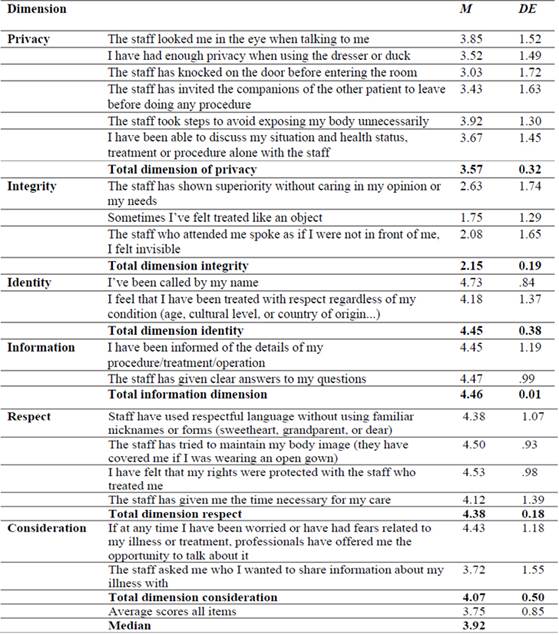
According to the CuPDPH results, the dimension with the highest mean score was “information”, with a mean of 4.46 (SD = 0.01). On the other hand, the one with the lowest score was “integrity”, obtaining a mean of 2.15 (SD = 0.19). In each item, scores were obtained in all the response options, where option number 5 (always) was the most marked. The median was 3.92 and the mean 3.75 (SD = 0.85). The item with the highest score was “I have been called by name”, with a mean of 4.73 (SD = 0.84) and is within the dimension “identity”. Meanwhile, the item with the lowest score corresponds to “at times I have felt treated as an object” (M = 1.73; SD = 1.29), within the “integrity” dimension. Table 1 shows the results related to each of the items.
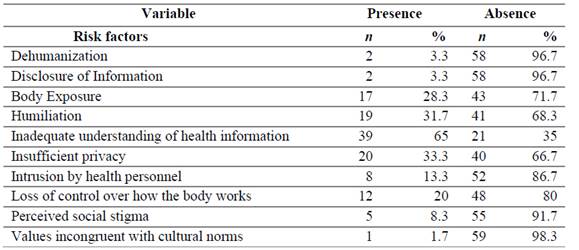
Regarding the results of the data card constructed from the risk factors and their operational concepts of the nursing diagnosis “Risk of Compromise of Human Dignity 00174” of NANDA-I, the variable that had the highest prevalence was the risk factor “inadequate understanding of health information” with 65%, and the lowest was “values incongruent with cultural norms”, with 1.7%. Table 2 collects the data related to each of the risk factors present or absent.
Prevalence of risk factors related to the Nursing Diagnosis “Risk of Compromise of Human Dignity 00174”
Discussion
The aim of this study was to identify the risk factors that predispose a person to have an opposite commitment to preserving his or her human integrity during the health care process by health professionals in a hospital. In the exploration of these variables, a total link with the type of care provided must be considered: the pandimensionality of each person facing his or her disease process, the environment, the diversity of the health professionals who have attended him or her, all of which converge in maintaining human dignity or generating actions that violate it.(4,10
According to the sociodemographic data of the patients, it was identified that the sex with the highest proportion was female (73.3 %), which is related to a higher proportion of the population at the national and state level, in addition to the fact that women seek health care to a greater extent than men, according to data from the National Institute of Statistics and Geography. 22 Regarding age, patients had a mean age of 44.15, similar to that reported by Campillo et al, 21 among other authors. 23 Regarding occupation, most of the hospitalized patients (85 %) were inactive and only a small proportion (15 %) had a job; although similar data are presented in a 2020 study, 21 the comparison of the data is limited due to the fact that in other similar investigations no questions regarding occupation have been generated.
In the present study it was found that patients perceive some actions of health professionals as risk factors to compromise their human dignity, in some dimensions such as integrity, privacy or inadequate understanding of information. These data are similar to those of the annual report of the state of Tamaulipas in 2023, which shows a satisfaction of 89.35 % through the Survey of Satisfaction, Adequate and Dignified Treatment of hospitalized patients. 24 It should be noted that some of the data collected to generate this annual report are collected by the same health professionals who work in the health institutions, which could be an important bias.
The dimension with the highest mean (4.46) was information, data similar to those of Pereira et al. 23 where the information dimension was also one of the most weighted. This is the opposite of what was found by Campillo et al., 21 where the dimensions “respect” and “identity” obtained a higher score. In relation to the “integrity” dimension, the present study showed that it was the dimension with the lowest score (M = 2.15), data similar to those of Pereira et al. 23 who report this dimension as the least weighted, and contrary to the studies of Campillo et al., 21 where it was weighted with means above 4.0.
In relation to the variable “intimacy”, in the present study we found a mean of 3.57 (SD = 0.32) and a presence of 61.6 % adding two risk factors of the questionnaire constituted by the NANDA-I risk factors related to intimacy. These data are similar to the data found by Valle et al. 20,22 represented by 48 % of disagreeing in not having enough intimacy. Regarding this same variable, the work of Ila-Garcia et al. 26 obtains a fairly high score compared to the study, ranging from 80.8 % and 88 % in relation to global privacy, auditory and visual privacy. However, the population of this study is of patients in a hemodialysis unit where, due to the type of treatment, the vascular accesses may be in different anatomical sites and to access them the body must be exposed to a greater extent; in addition, public hemodialysis rooms do not have cubicles that maintain privacy.
The variable “integrity” of the CuPDPH instrument had a mean of 2.15 (SD = 0.19) in comparison with the results of Campillo et al. 21 where a mean of 4.41 (SD = 0.18) was obtained. Along the same lines, the risk factors of nursing diagnosis that are related to the integrity perceived by CuPDPH are those of dehumanization. In the study, this phenomenon was present in only 3.3 % of the patients, data similar to those of Garza-Hernández et al. 28 where 67 % of the hospitalized patients perceived humanized care during their hospital stay. Here a different instrument was used, which is only aimed at exploring nursing care, but it was used in the population of Tamaulipas.
Regarding the variable “information”, the CuPDPH has two items (“I have been informed of the details of my procedure/treatment/operation” and “the staff has given clear answers to my questions”) with a mean of 4.46 (SD = 0.01), data similar to those of Campillo et al. 21 with a mean of 4.72 (SD = 0.54). In another study on the communication variable, where the clarity of the information provided by the nurse on care is also asked through the PCHE instrument, the result is positive since 56.7 % of the patients answered that they always understood the information. (29
However, in the present study, 65 % of the population responded that they did not adequately understand health information when this variable was explored through the NANDA-I nursing diagnosis risk factors. In relation to this variable there is no current evidence with which to relate it. Most of the studies on this subject are directed to nursing care, qualitative and literature reviews, where reference is made to the fact that patients often do not understand the medical language in relation to their treatment and evolution, which violates the human integrity of the patient receiving health care. (26, 30) It is important to evaluate the understanding of the health information provided to the hospitalized patient and to explore the wording of the items of the instruments that measure this variable, since it is strange that in the present study there are opposite results on the same subject.
The “respect” dimension obtained a mean of 4.38 (SD = 0.18), similar to the study by Campillo et al. 3 which obtained a mean of 4.68 (SD = 0.14), and also coincides with the study by Río-Mendoza et al. 31 which shows that 8.5 % of the complaints were related to respect and patient rights. In relation to the diagnosis, it is associated with the risk factors “humiliation” and “exposure of the body”, which both add up to 60 % of presence, data that contrast with the results measured through the CuPDPH.
The variable “consideration” obtained a mean of 4.07 (SD = 0.50), similar to the study by Campillo et al. 21 who obtained a mean of 3.97 (SD = 0.66). This variable has not been recorded as a risk factor for dehumanization in nursing diagnosis, so it would be appropriate to continue investigating standardized languages, which are currently an important part of the nursing care process.
Another important point that is not explored in the CuPDPH instrument is the “loss of control over the functioning of the body”, because it is not a phenomenon that is generated as a result of health care, but rather a condition derived from the pathology or treatment that violates the person by having a self-perception of loss of honor. With this it becomes evident that human dignity has more dimensions that need to be studied in depth by the disciplines that generate some type of patient care.
This work allowed to know risk factors absent in the nursing diagnosis of the NANDA-I taxonomy 2021-2023 “Risk of Compromise of human dignity 00174” that are described within one of the dimensions of the CuPDPH questionnaire which is “consideration”, where the value that health personnel show towards respect and the response of the towards their needs in a coherent way is reflected. 20,21 It is important to mention that due to the new creation of the CuPDPH instrument, with which the variable was explored, a reduced number of publications has been found and this has limited the discussion of the present study.
Conclusions
Through the CuPDPH instrument, it was possible to identify that the dimensions integrity and privacy were evaluated with low scores, which projects the lack of protocols in relation to the preservation of human dignity with respect to a conservative care of integrity and privacy. The same was observed through the nursing diagnosis “Risk of compromise of human dignity 00174”, where it was determined that inadequate understanding and privacy are elements present that violate human dignity during the health care process in the patients of the hospital studied.
In relation to the data and the literature, it was possible to recognize that hospitals currently face an important area of opportunity that reflects the quality of care, and that is the humane treatment provided to the patient during the hospitalization process. It is convenient to analyze care from a transdisciplinary perspective, since most of the studies on humane treatment are aimed at exploring the care provided by nursing professionals. However, these professionals are not the only ones who have direct contact with the patient; there are other health professionals who also generate interventions and management processes for the patient throughout his or her hospital stay. Therefore, it is recommended to explore the variable towards all those professionals who generate direct assistance with the patient. In this way, it would be possible to recognize the negative phenomena that are occurring in the treatment of the patient.
On the other hand, NANDA-I nursing diagnoses are a standardized language that describes human responses to different health situations or the risks of altering health. These responses should be detected and investigated by a nursing professional to generate individualized care plans, continue to grow the discipline’s own concepts and increase the level of evidence of the standardized languages. Especially those languages that represent human responses, to generate educational or other interventions towards the health professional mainly to make them aware of the quality of care they are providing and the repercussions they have towards health and towards the legal status of the health professional himself or even the institution where the care is provided.
References
-
1. Ovando RG de M, Bourlegat CAL, Pavon RV. Gestão hospitalar e gerenciamento legal de riscos na humanização da saúde. Braz. J. Develop. (Internet). 2023 (citado 2024 jun 03);9(05):17360-17375. doi: 10.34117/bjdv9n5-193
» https://doi.org/10.34117/bjdv9n5-193 -
2. Rivera HS, Paredes B, Sánchez SE. Seguridad del paciente hospitalizado en Essalud. cietna (Internet). 2020 (citado 2024 jun 03);7(2):85-92. doi: 10.35383/cietna.v7i2.410
» https://doi.org/10.35383/cietna.v7i2.410 -
3. Campillo B, Corbella J, Gelpi M, Martínez E, Viciana MA, Montiel J, et al. Percepción del respeto y mantenimiento de la dignidad en pacientes hospitalizados. Acta bioeth. (Internet). 2020 (citado 2024 Jun 04);26(1):61-72. doi: 10.4067/S1726-569X2020000100061
» https://doi.org/10.4067/S1726-569X2020000100061 -
4. Samayoa AN. Dignidad humana: una mirada desde un enfoque filosófico. Rev Latinoam Derechos Hum. 2021;32(1). doi: 10.15359/rldh.32-1.4
» https://doi.org/10.15359/rldh.32-1.4 -
5. Vargas MM. Sistema de salud: garantía institucional del derecho a la protección de la salud en México. Rev Latinoam Derecho Soc (Internet). 2022 (citado 2024 sep 25);(35):391-421. doi: 10.22201/iij.24487899e.2022.35.17283
» https://doi.org/10.22201/iij.24487899e.2022.35.17283 -
6. Martínez-Pérez YB, Sauceda-Villeda BJ, Moreno-Rodríguez MS. Procedural rights in vulnerable groups from national and international regulations. RPGyC (Internet). 2020 (citado 2024 ago 23);6(12):225. doi: 10.29105/pgc6.12-12
» https://doi.org/10.29105/pgc6.12-12 -
7. López R. La dignidad humana en México: su contenido esencial a partir de la jurisprudencia alemana y española. Bol Mex Derecho Comp. 2018;1(151). doi: 10.22201/iij.24484873e.2018.151.12292
» https://doi.org/10.22201/iij.24484873e.2018.151.12292 -
8. Comisión Nacional de Derechos Humanos. Derecho a la salud (Internet). México; 2018-2024 (citado 2024 sep 25). Disponible en: Disponible en: https://www.cndh.org.mx/derechos-humanos/derecho-la-salud-0
» https://www.cndh.org.mx/derechos-humanos/derecho-la-salud-0 -
9. Lafferriere JN, Lell H. Hacia una sistematización de los usos semánticos del concepto de dignidad humana en la protección internacional de derechos humanos: una revisión doctrinaria. Cuest Const Rev Mex Derecho Const. 2020;1(43):129. doi: 10.22201/iij.24484881e.2020.43.15181
» https://doi.org/10.22201/iij.24484881e.2020.43.15181 - 10. Pokorny M. Teóricas de la enfermería de importancia histórica. En Alligood-Raile M. Modelos y Teorías en Enfermería. 9 ed. Barcelona, España: Elsevier; 2018, p. 2-9.
-
11. Romero-de San Pío E, González-Alonso E, Linares-Gutiérrez MB, Romero-de San Pío MJ. Reflexiones sobre el concepto de la dignidad humana en el ámbito sanitario. Temperamentvm (Internet). 2021 (citado 2024 sep 25);17:e13038. Disponible en: Disponible en: https://ciberindex.com/c/t/e13038
» https://ciberindex.com/c/t/e13038 -
12. Silva A, Pantoja F, Millón Y, Hidalgo V, Stojanova J, Arancibia M, et al. Percepción de actores involucrados acerca del parto humanizado y la violencia obstétrica en Chile: una revisión panorámica. Medwave. 2020 (citado 2024 jun 12);20(9):e8047. doi: 10.5867/medwave.2020.09.8047
» https://doi.org/10.5867/medwave.2020.09.8047 -
13. García C. La persona como sujeto de cuidado (Internet). México: UNAM;2021 (citado 2024 ago 22). Disponible en: Disponible en: https://web.eneo.unam.mx/wp-content/uploads/2021/09/La-persona-como-sujeto-de-cuidado.pdf
» https://web.eneo.unam.mx/wp-content/uploads/2021/09/La-persona-como-sujeto-de-cuidado.pdf -
14. Gómez F, Medina O, Leguiza I, Torres G, Meza R, Candia N. Percepción de los usuarios sobre los comportamientos de cuidado humanizado en hospitales públicos de Corrientes. Notas enferm. (Internet). 2023 (citado 2024 jun 04);24(41):51-59. doi: doi: 10.59843/2618-3692.v24.n41.41466
» 10.59843/2618-3692.v24.n41.41466 -
15. Baró, S. Humanización de las prácticas de salud. Una Revisión sistemática para la prevención de la violencia en los servicios de salud. Rev. cdvs. (Internet) 2020 (citado 2024 jun 12);13(Especial). Disponible en: Disponible en: http://revistacdvs.uflo.edu.ar/index.php/CdVUFLO/article/view/274
» http://revistacdvs.uflo.edu.ar/index.php/CdVUFLO/article/view/274 -
16. Joven ZM, Guáqueta Parada SR. Percepción del paciente crítico sobre los comportamientos de cuidado humanizado de enfermería. Av. enferm. (Internet). 2019 (citado 2024 jun 04);37(1):65-74. doi: 10.15446/av.enferm.v37n1.65646
» https://doi.org/10.15446/av.enferm.v37n1.65646 -
17. Cruz Riveros C. La naturaleza del cuidado humanizado. Enfermería Cuidados Humanizados. 2020;9(1):21-32. doi: 10.22235/ech.v9i1.2146
» https://doi.org/10.22235/ech.v9i1.2146 -
18. Díaz-Rodríguez M, Alcántara L, Aguilar D, Puertas E, Cano M. Orientaciones formativas para un cuidado humanizado en enfermería: una revisión integrativa de la literatura. Enferm. glob. (Internet). 2020 (citado 2024 jun 03);19(58):640-672. doi: 10.6018/eglobal.392321
» https://doi.org/10.6018/eglobal.392321 -
19. Orellana Robalino CP. La dignidad humana como eje transversal para el ejercicio del derecho a la salud. Derecho global. 2017;2(5):139-164. doi: 10.32870/dgedj.v0i5.76
» https://doi.org/10.32870/dgedj.v0i5.76 - 20. Herdman TH, Kamitsuru S, Takáo. NANDA Internacional. Diagnósticos enfermeros: definiciones y clasificación 2015 - 2017. Barcelona: Elsevier; 2021.
-
21. Campillo B, Corbella J, Gelpi M, Martinez E, Viciana MA, Alonso M. Development and validation of the scale of perception of respect for and maintenance of the dignity of the inpatient (CuPDPH). Ethics Med Public Health (Internet). 2020 (citado 2024 jun 12);15:100553. doi: 10.1016/j.jemep.2020.100553
» https://doi.org/10.1016/j.jemep.2020.100553 -
22. Instituto Nacional de Estadística y Geografía. México en cifras (Internet). México: INEGI;2020 (citado 2024 oct 15). Disponible en: Disponible en: https://www.inegi.org.mx/app/areasgeograficas
» https://www.inegi.org.mx/app/areasgeograficas -
23. Pereira Dutra PE, Quagliato LA, Curupaná FT, Peres LZ, Pacini VL, da Silva CRM, et al. Cross-cultural adaptation of the Scale of Perception of Respect for and Maintenance of the Dignity of the Inpatient (CuPDPH) to Brazilian Portuguese and its psychometric properties. A multicenter cross-sectional study. Clinics (Sao Paulo). 2024;79:100328. doi: 10.1016/j.clinsp.2024.100328
» https://doi.org/10.1016/j.clinsp.2024.100328 -
24. Dirección General de Calidad y Educación en Salud. SESTAD Reportes. (Internet). México: Gobierno de México; 2023(citado 2024 oct 16). Disponible en: Disponible en: http://calidad.salud.gob.mx/site/calidad/SESTAD_reportes.html
» http://calidad.salud.gob.mx/site/calidad/SESTAD_reportes.html -
26. Ila-García A, Contreras-Martos GM, Ochando-García A. Intimidad percibida por los pacientes en una unidad de hemodiálisis. Enferm Nefrol (Internet). 2022 (citado 2024 jun 07);25(3):239-247. doi: 10.37551/52254-28842022024.
» https://doi.org/10.37551/52254-28842022024. -
28. Garza-Hernández R, Melendez-Méndez C, Castillo-Martínez G, González-Salinas F, Fang-Huerta M de los Á, Hidalgo HC. Surgical Patients’ Perception About Behaviors of Humanized Nursing Care. Hispanic Health Care International. (Internet). 2020 (citado 2024 jun 12);18(1):27-31. doi:10.1177/1540415319856326
» https://doi.org/10.1177/1540415319856326 -
29. Melita A, Jara Concha P, Moreno-Monsiváis MG. Percepción de pacientes hospitalizados en unidades medico quirúrgicas sobre el cuidado humanizado de enfermería. Enfermería: Cuidados Humanizados. 2021 (citado 2024 jun 12);10(1):89-105. doi: 10.22235/ech.v10i1.2481
» https://doi.org/10.22235/ech.v10i1.2481 -
30. Vega-Hurtado C. Importancia de las estrategias de comunicación entre médico. Med. IMSS. (Internet). 2020 (citado 2024 jun 12);58(2):197-201. doi: 10.24875/RMIMSS.M20000017
» https://doi.org/10.24875/RMIMSS.M20000017 -
31. Río-Mendoza J del, Becerra-Canales B, Montalvo-del Río J. Complaints from external users in a general hospital of Peru. Rev.Med.Electrón. (Internet). 2022 (citado 2024 jun 10);44(1):130-141. Disponible en: Disponible en: https://www.redalyc.org/articulo.oa?id=378277400011
» https://www.redalyc.org/articulo.oa?id=378277400011