Thinking About Arts and Poetry in Critical Qualitative Research in Latin America and Ibero-America
In this editorial, we describe the potential use of arts and poetry within qualitative research, beyond the conventional techniques and tools such as traditional interviews and focus groups. We connect artistic and poetic dispositifs with already existing sophisticated practices of critical and political arts, as well as the legacy of participatory action research in Latin America.
We propose a critical qualitative research approach incorporating the arts, differing in various aspects from Art-Based Research (ABR for its acronym in English) as developed in the Anglo-Saxon world, particularly in the United States.
We distance ourselves from viewing the arts as mere research tools that can be learned “on the fly” and argue, instead, for a continuous and assiduous engagement with arts and poetry. We particularly consider it crucial for the researcher to be aware of the current landscape of artistic and poetic debates.
Simultaneously, we emphasize the importance of critical reflection on the use of arts and poetry, especially in their application within the research process. Critical analysis is vital for evaluating art-related research projects and ensuring ethical practices. We criticize ABR for an often overly positive or even essentialist view of the arts as an automatic means to democratize research, disrupt dominant discourses, and give voice to those silenced by these discourses. 1-4 While we strongly support these aims, we caution against blind faith in the supposed transformative capacities of the arts. The arts can indeed affirm democratic rights and serve as inclusive platforms, but they can also function as spaces of exclusion. 2,5 Moreover, art lacking a critical vision can support hegemonic discourses, as evidenced by historical examples where artists, writers, and playwrights served the propaganda of fascist and nazi regimes. (6 It is also necessary to examine how the voices of silenced communities are represented and how the research findings are disseminated. 1,7-10.
Nor should we be fooled by “false democratizations”, 11 in an academic context the relationship between researcher and researched cannot be entirely democratic by default, and it is important not to lose sight of the imbalances of power. 12,13 However, through the arts, we make every effort to make hierarchies more flexible, without aiming at their complete abolition.
For these reasons, we prefer to use the concept of the artistic and poetic dispositif to reflect this critical stance. We understand the dispositif in the Foucauldian sense, 14 as a formation responding to an emerging contemporary concern. It is a network of dispersed but interconnected elements resulting from the relationship between knowledge and power. It operates in a circular movement where “agents involved participate in the procedural reproduction of the dispositif”, 15 making the dispositif crucial for subject production. 16 In the context of research, we aim for devices capable of challenging power and hegemonic discourses, particularly the triad of capitalism, patriarchy, and colonialism, positioning the devices as counter-dispositifs. 8
In this context we insist on including numerous references to artists whose works reflect a critical and political vision of the world we inhabit. We also stress the importance of referencing professional artists and poets, particularly from Latin America, as these references are often overlooked in ABR. It is essential to learn from them and their capacity to develop critical discourse to alter the status quo. We need the knowledge of critical artists and poets to build and expand our academic epistemologies. 8
In this sense, we also disagree with the casual use of the term “artist.” For us, an artist is a professional capable of sustaining a coherent discourse over time -something typically not expected from participants in a research project. In Latin America, there is a strong tradition of critical art as a form of resistance against political, social, and economic oppression. We refer, for instance, to contemporary artists and collectives such as Iconoclasistas, Archivo Caminante (both from Buenos Aires), Mujeres Creando (La Paz), Danny Reveco and Las Tesis (all from Chile). Historical examples include Tucumán Arde, CADA, the duo Las Yeguas del Apocalipsis with Pedro Lemebel in Chile, and counter-dictatorial movements like the Chilean Arpilleras, el Siluetazo in Argentina, and more recent resistances against neoliberal exploitation seen in the uprisings in Chile and Colombia. 8,17,18
In academic qualitative research, we emphasize the strong tradition of participatory action research (PAR), which originated in Latin America, specifically through Fals Borda in Colombia.19 This method is characterized by collective research and learning, aiming for the democratization of the research process at all stages: defining the topic, objectives, participants, methodology, and dissemination. It seeks critical analysis of reality with active group participation to achieve political and social transformation. The Iconoclasistas duo exemplifies the fusion of arts, design, and critical cartography with PAR. 7,8,20,21
In view of the above considerations and our distinction from ABR practices, we must reflect on the current impact of art and poetry in the Latin American context from a perspective centered on critical qualitative research. Why disseminate and develop this form of research in Latin America? We propose two lines of development to address this question and suggest practical, context-sensitive strategies for the ethical incorporation of arts and poetry in qualitative research.
A first line is to consider and incorporate the knowledge derived from art and poetry as fundamental contributions to qualitative research. We do not view art or poetry as whims or trends meant to signal avant-garde status within qualitative research. As noted by Denzin and Lincoln 22 in their periodization of qualitative research evolution, the phase known as post-experimental research marked a key reorientation during the crisis of representation, expressed in movements like deconstruction, 23 poststructuralism, 24 and critiques of how research methods were validated during an era marked by positivism. 25 Researchers turned to experimental narrative alternatives for gathering and interpreting lived experiences, involving “literary, poetic, autobiographical, conversational, critical, visual, and performative representations…”. 22 Thanks to this, the narrative turn 26 forged connections between the humanities and the human and social sciences to create collaborative narratives “open to multiple voices”. 26 We emphasize this bridge between the humanities and the social sciences, as it marks the point when qualitative research began to draw from the arts, favoring creative and unorthodox outcomes. Consequently, it is vital to highlight the insights art offers to expand the boundaries of qualitative research. One notable contribution is the semantic and interpretive openness it provides for understanding reality. Eco’s concept of the open work, 27 for instance, implies a decentralization of the interpretative power of the work by the work, expanding its meaning to the perspective of the spectator, the reader.
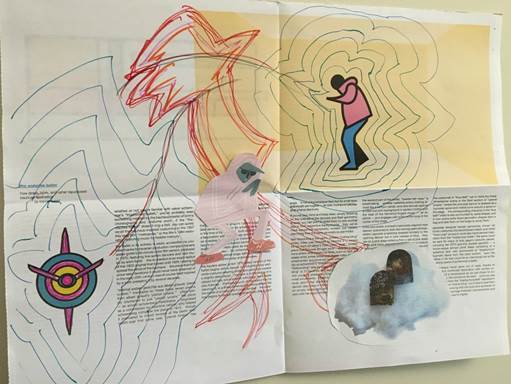
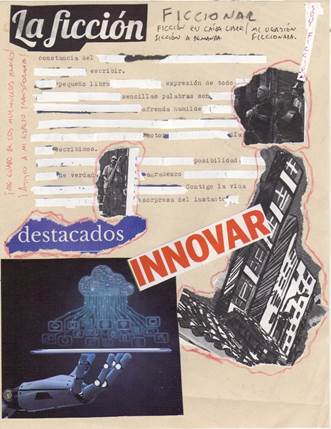
A second line of development involves using art and poetry to broaden subjectivity. We consider the possibility of understanding subjectivity as a narrative act, one that is continuously constructed, evolving, and developing. As Bruner 26 asserts, the self becomes a storyteller, shaped by various narratives that are structured according to historical, social, and cultural circumstances. Through arts-centered methodological strategies, such as poetic and artistic devices, we can promote the recovery of subjective meaning, understood as how people experience their realities. This can be expanded by art and poetry to articulate experiences, illustrating the indivisible connection between lived experience and its recounting. Thus, “the subjective configuration represents a self-organizing system in process, which generates its own alternatives along the way”. 28)F1 F2
Propulsive research, Eva Marxen, 2019. International Congress on Qualitative Research. University of Illinois Urbana Champaign, USA.
La ficción (Fiction), Luis Felipe González, 2023. Bogotá. Poetic and Narrative Creation Workshop. Universidad Santo Tomás, Colombia.
In this way, people linked to qualitative research experiences could recreate their particular experiences, mediated by art and poetry, giving subjective meaning and expanding their meanings about themselves and others. In Latin America there is a vast world of possibilities for designing research projects centered on the arts and poetry, given the valuable contribution of artists and poets who, from their creative universes, can enrich qualitative research. Likewise, in Latin America there is an important capacity to build bridges, connections and relationships between different fields of knowledge, theoretical bodies, methodologies and schools of thought in a creative and less dogmatic way than for example in Europe or the United States, where these attempts at combination are less usual, since disciplines are delimited in a more rigid way and even the subversion of fields might be sanctioned. 29
Research with the arts has expanded over the past two decades, notably in social sciences (particularly García Canclini 30 in Latin America; Buxó and de Miguel 31 in Spain) and education (Mulvihill and Swaminathan 32). Advances have also been seen in the health field (Jofré et al. 33; Marxen and González 8,7; Fonseca et al. 34 for the Ibero-American context), although this is probably the field where most resistance is encountered due to the still hegemony of positivism, quantitative research, evidence-based research. However, authors such as Gilroy 35 have shown us that evidence is always a historical, social and political construct. Despite this, there is growing use of the arts in health and mental health research across different project phases, offering tools for introspection that support reflexivity, as well as data collection benefits through symbolic, indirect, and safer communication compared to exclusively verbal methods. This allows participants to express sensitive or traumatic topics that are difficult to articulate verbally. For disseminating research findings, the arts offer broader communication methods that can reach non-academic audiences, including patients, administrators, and managers. 36,37 With the help of the arts, the aim is to bring about change in the target groups: patients, managers and healthcare professionals. Likewise, the arts serve to convey public health messages and can also help professionals to have a more empathetic understanding of their patients’ issues. Also, health and mental health research, mediated by the arts, allows for the staging of the world of human experience, which promotes the social construction of what is understood by wellness and health. We assume social construction as a “set of ideas that are in constant movement and change”. 38 In addition to this, the arts promote the relational transformation of relationships from non-generative experiences (deficit-centered) to generative experiences. According to systemic proposals, art would be considered the pretext for the evolution of social relationships, mediated by the link that binds such relationships together. 39
Undoubtedly, the way to promote the arts and poetry in qualitative research becomes a premise that should be promoted in the contexts of health and mental health through research that encourages interdisciplinary work between artists, social collectives, poets and qualitative researchers, in a permanent collaborative work, without hierarchies or pretensions on the part of researchers, as holders of knowledge; on the contrary, it is necessary to consider the conjunction of art, poetry and go towards a triad that transforms people’s daily experience. Similarly, an alternative way to disseminate research results in an artistic way should be considered, integrating the knowledge of the communities with which we work with the artistic and poetic devices built to show the impact of such research to academic and non-academic communities.
References
-
1. Gerber N, Siegesmund R. Innovations in arts-based research: ABR provocations from the 16th International Congress of Qualitative Research. Int Rev Qual Res (Internet). 2022;15(2):147-67. doi: 10.1177/19408447221090651
» https://doi.org/10.1177/19408447221090651 - 2. Leavy P. Method meets art. Arts-based research practice. 3.ª ed. New York: Guilford; 2020.
- 3. Leavy P. Introduction to arts-based research. En: Leavy P, editor. Handbook of arts-based research. New York: Guilford ; 2018. p. 3-21.
- 4. Finley S. Critical arts-based inquiry. Performances of resistance politics. En: Denzin N, Lincoln Y, editores. The Sage handbook of qualitative research. 5th ed. New York: Sage; 2017. p. 561-74.
- 5. hooks b. Art on my mind. Visual politics. New York: The New Press; 1995.
- 6. Marxen E. Transforming traditions: Walter Benjamin, art, and art therapy. En: Hougham R, Pitruzzella S, Wengrower H, editores. Traditions in transition: New articulations in the arts therapies. London: Ecarte; 2019. p. 251-71.
-
7. Marxen E, González L. Alcance de los dispositivos artísticos y poéticos en la investigación en salud y salud mental. Enfermería: Cuidados Humanizados. 2022;11(2):e2939. doi: 10.22235/ech.v11i2.2939
» https://doi.org/10.22235/ech.v11i2.2939 - 8. Marxen E, González L. Investigar con arte y poesía. Barcelona: Gedisa; 2023.
- 9. Gergen K, Gergen M. The performative movement in social science. En: Leavy P, editor. Handbook of arts-based research . New York: Guilford ; 2018. p. 54-67.
-
10. Liebenberg L. Thinking critically about photovoice: Achieving empowerment and social change. Int J Qual Methods (Internet). 2018;17:1-9. doi: 10.1177/1609406918757631
» https://doi.org/10.1177/1609406918757631 - 11. Delgado M. Cine. En: Buxó MJ, de Miguel J, editores. De la investigación audiovisual. Fotografía, cine, vídeo, televisión. Barcelona: Proyecto A Ediciones; 1999. p. 49-77.
- 12. Bourdieu P. El sentido práctico. Ciudad de México: Siglo XXI; 2008.
-
13. Eribon D. Los intelectuales de hoy. Entrevista a Pierre Bourdieu (Internet). Pierre_bourdieu BLOG; 1980/2006-2008. Disponible en: http://pierrebourdieu.blogspot.com/2006/06/los-intelectuales-de-hoyentrevista
» http://pierrebourdieu.blogspot.com/2006/06/los-intelectuales-de-hoyentrevista - 14. Foucault M. Dits et écrits, 1954-1988, vol. III: 1976-1979. Paris: Gallimard; 1994.
- 15. Curcio R, Prette M, Valentino N. Socioanálisis narrativo. Madrid: Enclave de Libros; 2017.
- 16. Agamben G. ¿Qué es un dispositivo?. Buenos Aires: Adriana Hidalgo Editora; 2014.
- 17. Plaza JM, editor. Estallido estético. Aportaciones desde la historia, la teoría, el registro y la creación artística para comprender el “estallido social”. Santiago de Chile: Fulgor; 2023.
-
18. Red conceptualismos del sur. Estallamos (Internet). 2019 Oct 23. Disponible en: https://redcsur.net/2019/10/23/estallamos/
» https://redcsur.net/2019/10/23/estallamos/ - 19. Fals Borda O. Orígenes universales y retos actuales de la IAP (Investigación Acción Participativa). Anal Polít. 1999;38:71-88.
-
20. Iconoclasistas. Nosotres (Internet). 2022. Disponible en: https://iconoclasistas.net/nosotres/
» https://iconoclasistas.net/nosotres/ - 21. Iconoclasistas. Mapeos colectivos sobre extractivismos y resistencias en Latinoamérica. En: Merlinsky G, Serafini P, compiladores. Arte y ecología política. Buenos Aires: Universidad de Buenos Aires; 2020. p. 177-92.
- 22. Denzin N, Lincoln Y. Introducción general. En: Denzin N, Lincoln Y, coordinadores. Manual de la investigación cualitativa. Vol. I: El campo de la investigación cualitativa. Barcelona: Gedisa ; 2012. p. 43-102.
- 23. Derrida J. De la gramatología. Ciudad de México: Siglo XXI ; 2005.
- 24. Barthes R. El grado cero de la escritura. Ciudad de México: Siglo XXI ; 2000.
- 25. Cisneros C. Investigación cualitativa y globalización de la academia: perspectivas desde Latinoamérica. En: Rodigou M, Paulín H, coordinadores. Coloquios de investigación cualitativa. Subjetividades y procesos sociales. Córdoba: Universidad Nacional de Córdoba; 2011. p. 15-28.
- 26. Bruner J. Actos de significado. Más allá de la revolución cognitiva. Madrid: Alianza; 1991.
- 27. Eco U. La definición del arte. Madrid: Planeta-Agostini; 1985.
-
28. González Rey F. La subjetividad en una perspectiva cultural-histórica: avanzando sobre un legado inconcluso. CS (Internet). 2013; (11):19-42. Disponible en: https://www.redalyc.org/pdf/4763/476348374001.pdf
» https://www.redalyc.org/pdf/4763/476348374001.pdf - 29. Longoni A. Oscar Masotta; vanguardia y revolución en los años sesenta. En: Longoni A, editor. Oscar Masotta. Revolución en el arte. Buenos Aires: Mansalva; 2017. p. 7-67.
- 30. García Canclini N. La sociedad sin relato. Antropología y estética de la inminencia. Buenos Aires: Katz; 2011.
- 31. Buxó MJ, de Miguel J, editores. De la investigación audiovisual. Fotografía, cine, vídeo, televisión . Barcelona: Proyecto A Ediciones ; 1999.
- 32. Mulvihill TM, Swaminathan R. Arts-based educational research and qualitative inquiry. Walking the path. New York: Routledge; 2020.
-
33. Jofré P, Flores P, Oyanedel R, Valenzuela R, Gigoux JP, Vergara R. Mindful practice y medicina narrativa para educar profesionalismo médico en pregrado. Rev Esp Educ Med (Internet). 2024;2:605251. doi: 10.6018/edumed.605251
» https://doi.org/10.6018/edumed.605251 -
34. Fonseca V, Velandia A, Rodríguez P, Laverde D. Dispositivos Creativos Colaborativos para la resignificación del abuso sexual. Psicoperspectivas (Internet). 2023;22(3):24-38. doi: 10.5027/psicoperspectivas-vol22-issue3-fulltext-2943
» https://doi.org/10.5027/psicoperspectivas-vol22-issue3-fulltext-2943 - 35. Gilroy A. Art therapy, research and evidence-based practice. New York: Sage ; 2006.
-
36. Archibald MM. Interweaving arts-based qualitative and mixed methods research: Showcasing integration and knowledge translation through material and narrative reflection. Int Rev Qual Res (Internet). 2022;15(2):168-98. doi: 10.1177/19408447221097063
» https://doi.org/10.1177/19408447221097063 - 37. Lapum J. Deepening the mystery of arts-based research in the health sciences. En: Leavy P, editor. Handbook of arts-based research . New York: Guilford ; 2018. p. 526-45.
- 38. Ayora D. De cómo una conversación se convierte en realidad. En: Ayora D, Chaveste R, Vadillo F, coordinadores. Prácticas socioconstruccionistas y colaborativas. Psicoterapia, educación y comunidad. Mérida: Ediciones Unasletras; 2011. p. 23-32.
- 39. Hernández Á. Vínculos, individuación y ecología humana. Hacia una psicología clínica compleja. Bogotá: Universidad Santo Tomás, Departamento de Comunicaciones; 2010