Original articlesRural Nursing in Latin America: Caring in Adversity in the last 10 years. Systematic Review
Abstract:
Introduction: The processes of health, illness, care and attention in rural contexts in Latin America are of great importance for Nursing, given the socioeconomic and political conditions that affect these territories and the challenges inherent to professional practice. This systematic review aims to analyze the development of Nursing in rural Latin American contexts based on scientific evidence from the last ten years
Method: A search was conducted in scientific databases (CINAHL Complete, Dialnet, DOAJ, Dynamed, Elsevier, Enfermería al Día, Health Source: Nursing/Academic Edition, JSTOR, MEDLINE, Nursing Reference Center Plus, PubMed Central, Redalyc, SciELO, ScienceDirect, Scopus and Web of Science), using MeSH and DeCS descriptors related to Rural Nursing, Community Health Nursing, Rural Health and Community Health Agents, in English, Portuguese and Spanish. The search ended in August 2023
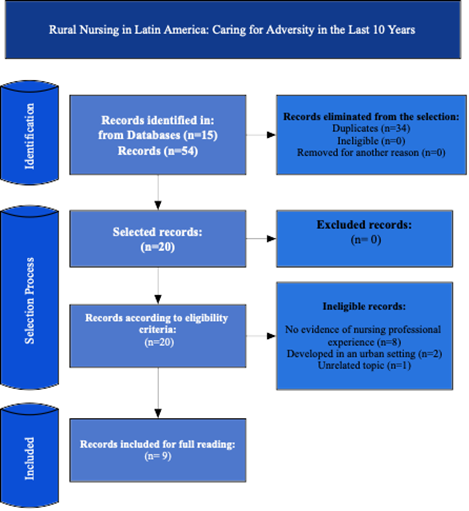
Results: 54 articles were identified, from which, after applying the PRISMA 2020 inclusion criteria, 9 studies focused on primary health care were selected. These were analyzed according to three categories: Responsibility of the Nursing Professional, Professional Intentionality (welfare vs. collective approach) and Propositional Characteristics for Rural Nursing
Conclusion: The conditions of the territory, the work dynamics and the standardization of rural and urban care reflect the commercialization of health, which represents a key professional challenge: reducing health inequalities in rural communities
Keywords:
rural nursing; primary health care; rural health; community health workers
Resumen:
Introducción: Los procesos de salud, enfermedad, atención y cuidado en contextos rurales de América Latina revisten de gran importancia para la Enfermería, dadas las condiciones socioeconómicas y políticas que afectan estos territorios y los desafíos inherentes a la práctica profesional. Esta revisión sistemática tiene como objetivo analizar el desarrollo de la Enfermería en contextos rurales latinoamericanos a partir de la evidencia científica de los últimos diez años
Método: Se realizó una búsqueda en bases de datos científicas (CINAHL Complete, Dialnet, DOAJ, Dynamed, Elsevier, Enfermería al Día, Health Source: Nursing/Academic Edition, JSTOR, MEDLINE, Nursing Reference Center Plus, PubMed Central, Redalyc, SciELO, ScienceDirect, Scopus y Web of Science), utilizando descriptores MeSH y DeCS relacionados con Enfermería Rural, Enfermería en Salud Comunitaria, Salud Rural y Agentes Comunitarios de Salud, en inglés, portugués y español. La búsqueda finalizó en agosto de 2023
Resultados: Se identificaron 54 artículos, de los cuales, tras aplicar los criterios de inclusión PRISMA 2020, se seleccionaron 9 estudios centrados en la atención primaria en salud. Estos fueron analizados según tres categorías: Responsabilidad del Profesional de Enfermería, Intencionalidad Profesional (asistencialismo vs. enfoque colectivo) y Características propositivas para una Enfermería rural.
Conclusión: Las condiciones del territorio, las dinámicas laborales y la estandarización de la atención rural con la urbana reflejan la mercantilización de la salud, lo que representa un desafío profesional clave: reducir las inequidades en salud en comunidades rurales
Palavras-chave:
enfermagem rural; atenção primária à saúde; saúde da população rural; agentes comunitários de saúde
Resumo:
Introdução: Os processos de saúde, doença, atenção e cuidado em contextos rurais da América Latina são de grande importância para a Enfermagem, dadas as condições socioeconômicas e políticas que afetam esses territórios e os desafios inerentes à prática profissional. Esta revisão sistemática tem como objetivo analisar o desenvolvimento da Enfermagem em contextos rurais latino-americanos a partir da evidência científica dos últimos dez anos
Método: Foi realizada uma busca em bases de dados científicas (CINAHL Complete, Dialnet, DOAJ, Dynamed, Elsevier, Enfermería al Día, Health Source: Nursing/Academic Edition, JSTOR, MEDLINE, Nursing Reference Center Plus, PubMed Central, Redalyc, SciELO, ScienceDirect, Scopus e Web of Science), utilizando descritores MeSH e DeCS relacionados à Enfermagem Rural, Enfermagem em Saúde Comunitária, Saúde Rural e Agentes Comunitários de Saúde, nos idiomas inglês, português e espanhol. A busca foi finalizada em agosto de 2023
Resultados: Foram identificados 54 artigos, dos quais, após aplicação dos critérios de inclusão do PRISMA 2020, foram selecionados 9 estudos centrados na atenção primária à saúde. Esses estudos foram analisados segundo três categorias: Responsabilidade do Profissional de Enfermagem, Intencionalidade Profissional (assistencialismo vs. abordagem coletiva) e Características propositivas para a Enfermagem rural
Conclusão: As condições territoriais, as dinâmicas laborais e a padronização da atenção rural com a urbana refletem a mercantilização da saúde, o que representa um desafio profissional essencial: reduzir as iniquidades em saúde nas comunidades rurais
Palavras-chave:
enfermagem rural; atenção primária à saúde; saúde da população rural; agentes comunitários de saúde
Introduction
The Organization for Economic Co-operation and Development (OECD) considers a rural territory to be an area with a population density below 150 inhabitants per km2 (in the case of Japan, it is 500 inhabitants/km2, since its average density is 300 inhabitants/km2).1,2 In Latin America and the Caribbean, rural territories have various definitions (some with more than a century of existence). This is the case in Mexico and Venezuela, which classify them as long as the population is below 2,500 inhabitants. In Colombia, rurality is defined as having less than 25,000 inhabitants and an intermediate population density (between 10 inhabitants/km2 and 100 inhabitants/km2).
Rural contexts present socioeconomic, human development and health characteristics that limit their lifestyles. Likewise, clinical epidemiology and statistics indicate higher general and infant mortality in this sector, a higher percentage of cases associated with Potential Years of Life Lost (PYLL) and considerable differences in the quality of life. 3,4) This demonstrates that the health/disease/care/prevention process differs from the urban sector.
Therefore, biomedical indicators show the challenge faced by rural areas, given the lack of state attention and the response capacity of health teams. For this reason, programs are required for the rural/agricultural/riverine population, the population belonging to indigenous peoples, the new rural areas, and families that suffer displacement to urban areas.3,4,5,6,7,8,9
In this regard, the health system in rural areas must respond to the living conditions, development and daily life of its inhabitants, as well as to the environment in which care management is provided by the nursing professional. Since it is a context with access and housing difficulties; severe climatic conditions and reduced or no access to basic services (energy, drinking water, infrastructure, communication and transportation routes).
These distinctive characteristics of the rural sector require nursing professionals able to assume these complexities, who sometimes overextend their functions, with insufficient tools and supplies. All of the above is associated with fewer labor guarantees and incentives, compared to urban areas. 3,4,5,6,7,10,11,12
The reality of the rural sector regarding health-disease-health-care processes raises the need to visualize nursing practice in these spaces. Therefore, the present systematic review is generated with the following research question: What is the nursing landscape developed in rural contexts, based on scientific evidence at the Latin American level in the last 10 years (2014-2023)? The objective is to glimpse the positioning of rural nursing, types of responsibilities-roles and professional motivation with the community (welfare/health goal or link/collective process).
Methodology
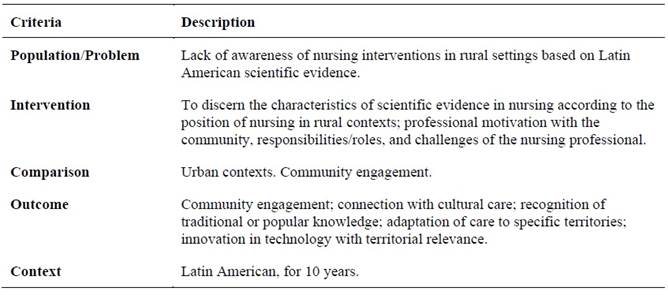
The approach of the present systematic review is based on the PICOC framework (Population/Problem, Intervention, Comparison, Outcome, Context) presented in Table 1.
Methodologically, the protocol of this review is elaborated through the declaration of the inclusion and exclusion criteria, formulation of the search strategy, collection and purification of the records. The inclusion criteria were defined as: full-text articles; with a publication period not exceeding 10 years; developed in the Latin American context and; in Spanish, Portuguese and English. Evidence developed in clinical services or in areas other than primary health care; articles that omitted the participation of the nursing professional, that do not describe characteristics of the professional role and that are carried out in contexts other than rural ones were excluded.
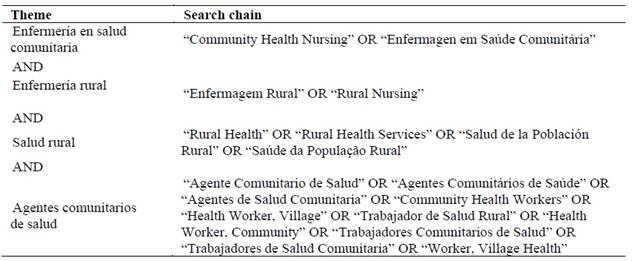
The search strategy could be applied in the EDS discovery tool of the Universidad de Los Lagos with access to the following databases: CINAHL Complete, Dialnet, DOAJ, Dynamed, Elsevier, Enfermería Al Día, Health Source: Nursing/Academic Edition; JSTOR Biological Science Archive Collection, MEDLINE, Nursing Reference Center Plus, Pubmed Central Open Access, Redalyc, SciELO, ScienceDirect, Scopus, Web of Science. All with the full test online, the last search data being August 31, 2023. The search routes were established through the DeCS and MeSH thesauri along with the Boolean AND and OR (Table 2).
The screening phase of the results was carried out based on the reading of the titles and abstracts by the researchers, and can be specified in the PRISMA 14) flowchart in Figure 1.
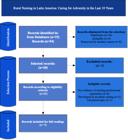
The quality criteria of the selected articles were carried out through critical reading of them. They were evaluated individually and then together by the researchers. Subsequently, summaries of each of the articles were prepared in the screening stage. Then the risk of bias was evaluated, in order to conclude with the final selection of 9 articles.
The relevant bibliometric data that were considered were: country of issue, year of publication, language, responsibility/role of the nursing profession, professional motivation (welfare or collective process).
As the screening process was carried out, coding began using the ATLAS.ti software 9.1 version. A content analysis focused on the grounded theory methodology was carried out, through open, axial and selective coding (first selecting relevant terms and then extracting a category). 15
Results
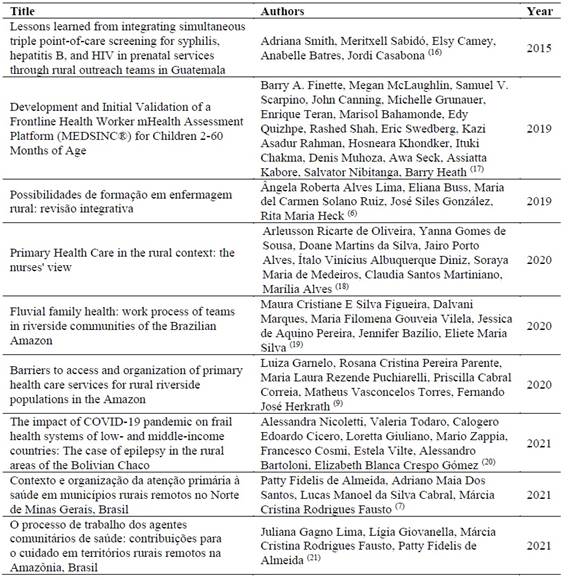
Bibliometric characteristics of the research findings enable describing, from a quantitative approach, that the articles are the result of a detailed selection of all Latin American countries and of an implementation of the inclusion and exclusion criteria and the screening stages. In the analysis stage, 66 % of the articles selected were from Brazil, followed by 11 % from each of the following countries: Bolivia, Ecuador and Guatemala. Regarding the language in which they were written, 66.6 % were in English and 33.3 % in Portuguese. The year of publication of the articles obtained the following distribution: 11.1 % published in 2015; 22.2 % in 2019; 22.2 % in 2021 and 44.4 % in 2020 (Table 3).
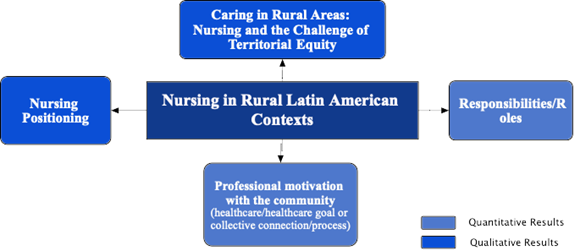
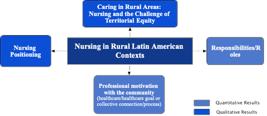
The landscape presented by Nursing in Latin American rural contexts made it possible to identify variables (quantitative type) and categories (qualitative type) from the analyzed scientific evidence (Figure 2).
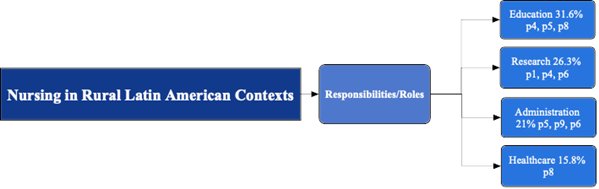
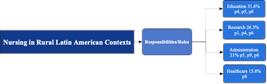
Health care services in rural areas place the nursing professional as a fundamental pillar that extends responsibilities and roles beyond those that can be developed in urban areas. The analyzed evidence indicates a distribution of nursing responsibilities/roles as follows: 31.6 % education, 26.3 % research (clarifying that these are procedural activities such as: taking samples, collecting consents, among others), 21 % administration and 15.8 % for the assistance role (Figure 3).
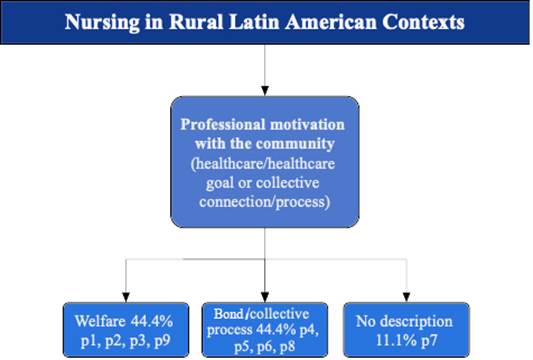
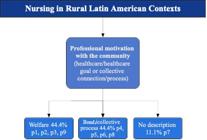
The practice of care management by the nursing professional in rural contexts is encouraged by a motivation both for assistance/health care and for establishing a bond with the community, which can be evidenced by a distribution of 44.4 % for the two options and 11.1% where the type of motivation is not described (Figure 4).
From the content analysis based on grounded theory, two main categories emerged: Caring in rural areas: Nursing and the challenge of territorial equity and Nursing positioning. The main findings in each category, as well as their representation in the evidence analyzed, are presented below.
Caring in Rural Areas: Nursing and the Challenge of Territorial Equity
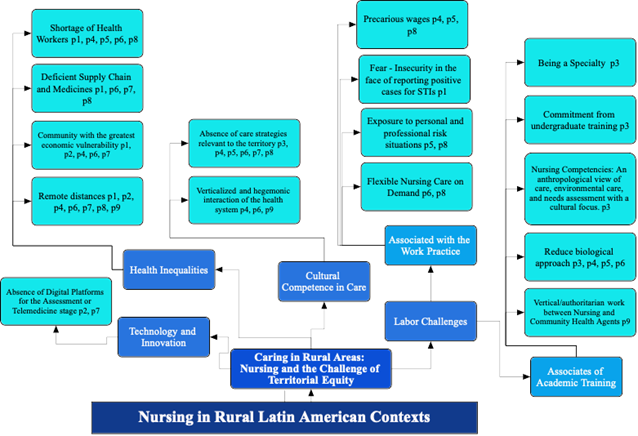
The caring scenario in rurality according to the scientific evidence analyzed presents four thematic focuses (Figure 5).
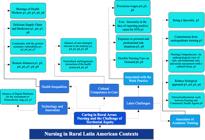
Technology and Innovation: Research suggests the absence of digital platforms for the assessment stage or the possibility of having telemedicine services in rural areas. These innovations would make it possible to narrow the opportunity gaps for the prevention of adverse events or morbimortality situations. 17,20
Health inequities: Populations residing in rural areas see their right to health as conditioned by the type of care they receive. Conditioned by living at remote distances from care facilities, stations or health posts. 7,9,16,17,18,20,21) In addition to being economically vulnerable communities, 9,16,17,18,20) insufficient supply chain and medicines that do not address their needs, as well as a shortage of health workers. 7,9,16,18,19
Cultural Competence in Care: Caring in rural areas shows that the interaction between the health professional and the people in the community is marked by a verticalized interaction, being a fundamental characteristic of a hegemonic medical model that manages to make daily life and historicity invisible. 9,18,21 This delivery of care in a unidirectional way and lacking recognition of intersubjectivity, leads to the absence of relevant care strategies within the territory. 6,7,9,18,19,20
Professional challenges: In the selected evidence analysis, the nursing professional reveals challenges associated with their professional practice and others associated with their academic training. The challenges at the work level for a nursing professional in rural contexts are reflected by: the adaptations they make to their schedules of care due to rural realities (remote distances, deficient transport, conditions of vulnerability, etc.); 7,9 they are also exposed to personal and professional risk situations, as they assume responsibilities that exceed their functions and professional preparation. 7,19
It is important to consider that these work spaces in rural areas represent a need for constant training, as in the case of situations of insecurity regarding the delivery of positive reports for sexually transmitted infections (STIs). This is referred to in the research by Adriana Smith and collaborators, 16 who identified the importance of these training instances for professionals who work in these territories and assume several responsibilities.
Finally, another of the difficulties to practice professional nursing in these spaces is the precarious salary. 7,18,19 This reinforces the idea that care is being provided on the margins of state neglect, on a map of geographic inequalities.
Now, upon analyzing the challenges associated with the academic training of nursing professionals, the evidence shows that it is necessary to reduce the biologist approach,6,9,18,19) generate competencies in areas of anthropology of care, environmental care and needs assessment with a cultural approach and even propose that it should be a specialty training. 6
Positioning of Nursing in rural Latin American contexts
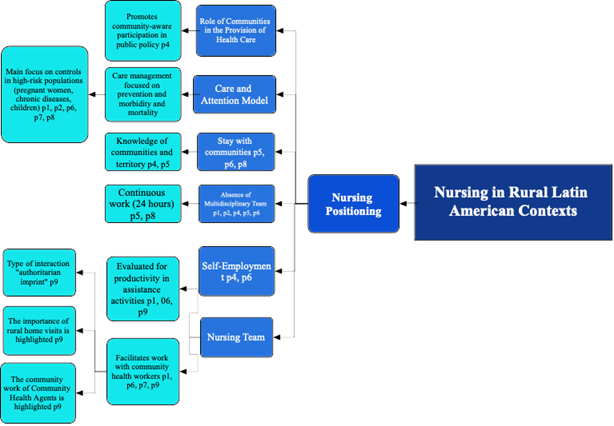
Nursing professional positioning in rural contexts, according to the analyzed evidence, can be described based on six thematic focuses (Figure 6).
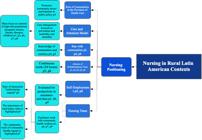
Nursing Team: The analyzed articles describe the importance of community health agents in rural contexts. In this subcategory, the nursing staff is recognized as a facilitator in the work with this group, 9,16,20,21 although their interaction is described as “authoritarian”.21 Community health workers are valued for the care activities in the community 9,16,21 and the results from home visits and community work. 21
Absence of a Multidisciplinary Team: This subcategory allows us to acknowledge the constant work of the nursing professional in rural areas in an attempt to replace the absence of a multidisciplinary team. 7,9,16,17,19
Permanence in the Communities: The nursing professional remains for extended periods of time in rural communities coming to gain adequate knowledge of the people and their territory. 7,9,18,19
Attention and Care Model: It is identified that nursing focuses its care activities on the prevention and care of chronic morbidities, especially in the population dealing with pregnant women, patients with chronic diseases and children. 7,9,16,17,20
Community Role in the Health Care Provision: The nursing professional functions as an enabling agent in the participation of communities in public policy. 18
Discussion
Despite the various health reforms implemented in countries such as Ecuador, Brazil and Peru, health as a human and social right has not been provided in an equitable manner, particularly in rural areas, which have lived in a framework of territorial and epidemiological inequality evidenced by the high prevalence and incidence of communicable and vaccine-preventable diseases, which indicates a lack of coverage and universal access to health systems. 13,17,22,23
Although there are several global health strategies implemented by the World Health Organization, such as telemedicine, it is noteworthy that these programs were configured from an urban-centric and welfarist approach, which, although it facilitates access to diagnosis and treatment for nurses and physicians, people in rural areas do not always coincide with these principles, needs and health care practices. 16,17 As Almeida 7 states, the rural space seems to be conditioned by its own territorial, economic and resource distribution and by the lack of opportunities to be accessible to health services. For example, the lack of roads, the deficiency of medicines, the scarce internet and/or virtual networks and the lack of health personnel in communities. 13,22,23
Regarding this last point, the evidence shows that the lack of health personnel in rural territories is due to the biomedical and welfarist epistemological approach, which is generated from the curricular training and health care systems, where the preference system of the new health personnel is based on high clinical specialization and the second and third level care model. Therefore, the results of this review suggest that Primary Care, community or rural, should be built as a specialty for nurses and physicians, as Madeleine Leininger points out, professional training should focus on nursing care with a cultural and territorial approach. 16,21,27,28
It is also recognized that nurses and traditional midwives are the link between community members and community health workers and the health system.18,19) Nurses have historically remained in rural territories, from a first role as visiting nurses and subsequently as rural and/or community nurses. Nevertheless, they continue not to appear as decision-makers regarding the health of these populations, making their participation invisible and reducing nursing participation to administrative and research activities of a procedural and institutional productivity type. In addition to all this, the lack of resources for health care, the scarce professional training and the precariousness of their work 16,19,21) has been a dynamic of the health institutions that has remained over time and has become more acute in adverse conditions due to socio-environmental disasters and recent situations such as COVID-19. 13,20
In this regard, studies led by Garnelo,9 Floss13) and Oliveira18) in 2020 agree that nurses in rural communities (unlike what happens in the urban or hospital sector), perform educational activities and comprehensive and intercultural care. Therefore, the nursing professional is characterized by staying for a long time in the territory, unlike other professionals, that is, they are committed to 24-hour care, develop prevention strategies, education and monitoring of cases, as well as the commitment, ethical and humanistic responsibility of nurses towards the knowledge acquisition, which gives them increased satisfaction, professional autonomy and recognition by the villagers. 19,21 In this regard, their participation should go beyond caring practice; their involvement should include participation in public policies on global and rural health, because these professionals are the ones who best know the territories and the specific needs of the people.
Nevertheless, as recognized by Lima et al. 21 and Garnelo et al., 9 nurses continue to work under a hegemonic model of care, biologicist and hierarchical by gender. This translates into the replication of structural violence, through the authoritarianism of nurses over community health workers. This affects identity, autonomy and dialogic and intercultural participation with the communities. And this is something that should be transformed from the nursing curricula with the implementation of socio-anthropological contents and rural nursing. 24
It goes without saying that the community and rural perspective of nursing has been gradually lost with the establishment of the capitalist system. Nevertheless, the authors acknowledge the need to rebuild a rural nursing that meets the population's real needs, providing multicausal, complex, comprehensive, global, continuous, equitable, gender-sensitive and quality care, as well as considering a focus on public health sustainability and political role. 9,13,18,19,25,26
Based on this review, we can argue that rural nursing is a specialization that is part of the PHC interdisciplinary team, or advanced practice nursing (nurse practitioner). The nurse practitioner should work on the practice of care in rural environments, attending people in their uniqueness and sociocultural insertion. Always seeking comprehensive, contextualized, intersectional, intercultural, gender perspective, co-participative, ecological and holistic care. In this rural reality, health surveillance actions should be present: home visits, protection and education for the health of the population, prevention and control of risks and/or diseases and participation in proposals for rural health and social justice policies.6,9,18,22
Conclusion
Rural territories are contexts that in Latin America have particularities due to the historical and cultural processes that have witnessed their transformation from the mercantilist models of health and life.
Nursing positioning in rural territories is an example of the tensions it has to face. Within the structural barriers experienced by these communities, the nursing professional is an articulating agent of care in the midst of these local and working conditions. All of the above, for the fulfillment of the activities that health institutions implement in a homogeneous way and without territorial relevance, giving priority to economic profitability over the right to life and health 19 of any living being.
At the same time, it is acknowledged that professional nursing work in rural areas is characterized by operating at the limitations of its competencies, which is the result of three structural dimensions: 1) Health system fragmentation that makes coordination between the different levels of care impossible, lack of intersectoral articulation and inequality in the distribution of resources; 2) Lack of appreciation for the practice of the profession in this territory, which is reflected in a commitment from training and the existence of a labor legislative framework that offers guarantees to those who, out of conviction and preparation, work in these localities; 3) Geographical inequity as a result of state abandonment of these communities, which conditions them to receive an androcentric/hegemonic care model that one-sidedly values scientific technical knowledge 29,30,31,32) that has been structured for the urban sectors, thereby omitting a care based on equality and social justice. 3,4,10,11,13
In conclusion, rural territories require public policies committed to their particularities that strengthen the governance of their inhabitants, local networks, and transdisciplinary and cross-sectoral work. The health sector must recover the community work and the territorially pertinent resolution of problems. Rural nursing in Latin America must transition from a professional practice in the midst of structural complexity to a management of care that retakes its ontological bases of valuing other cultures and thus promote the integral wellbeing of people, communities and the environment in a respectful, autonomous and contextual manner.
References
-
1. Soloaga I, Plassot T, Reyes M. Caracterización de los espacios rurales en México a partir de estadísticas nacionales. (Internet). 2021 (citado 2024 dic 1). Disponible en: Disponible en: https://repositorio.cepal.org/server/api/core/bitstreams/9c72184a-f1dd-4aa7-841b-cc8f5e643cde/content
» https://repositorio.cepal.org/server/api/core/bitstreams/9c72184a-f1dd-4aa7-841b-cc8f5e643cde/content -
2. Oficina de Estudios y Políticas Agrarias. Ruralidad en Chile (Internet). 2024 (citado 2024 dic 13). Disponible en: Disponible en: https://www.odepa.gob.cl/dpto-desarrollo-rural/herramientas/ruralidad-en-chile
» https://www.odepa.gob.cl/dpto-desarrollo-rural/herramientas/ruralidad-en-chile -
3. Ministerio de Agricultura de Chile. Estudio de indicadores de calidad de vida y estándares de vida de los territorios rurales de Chile: Licitación ID 688-8-LQ1. Ministerio de Agricultura de Chile; 2019. Disponible en: https://www.odepa.gob.cl/wp-content/uploads/2020/02/EstudioIndicadoresCalidadRural.pdf
» https://www.odepa.gob.cl/wp-content/uploads/2020/02/EstudioIndicadoresCalidadRural.pdf -
4. Gobierno de Chile. Estadísticas. Instituto Nacional de Estadísticas de Chile, Gobierno de Chile (Internet). 2024 (citado 2023 feb 13). Disponible en: Disponible en: http://www.ine.gob.cl/estadisticas
» http://www.ine.gob.cl/estadisticas -
5. Westgard C, Naraine R, Paucar Villacorta DM. Performance evaluation of community health workers: Case study in the Amazon of Peru. J Community Health (Internet). 2018 (citado 2023 feb 14);43(5):908-919. doi: 10.1007/s10900-018-0503-3
» https://doi.org/10.1007/s10900-018-0503-3 -
6. Alves Lima ÂR, Buss E, Solano Ruiz MC, Siles González J, Heck RM. Possibilidades de formação em enfermagem rural: revisão integrativa. Acta Paul Enferm (Internet). 2019 (citado 2023 feb 10);32(1):113-119. doi: 10.1590/1982-0194201900016
» https://doi.org/10.1590/1982-0194201900016 -
7. Almeida PF de, Santos AM dos, Silva LM da, Rodrigues MC. Contexto e organização da atenção primária à saúde em municípios rurais remotos no Norte de Minas Gerais, Brasil. Cad Saude Publica (Internet). 2021 (citado 2023 feb 25);37(11):e00255020. doi: 10.1590/0102-311X00255020
» https://doi.org/10.1590/0102-311X00255020 -
8. Hennig B. Epidemiología crítica en clave latinoamericana para una salud contrahegemónica. Centro de Investigaciones en Ciencias Sociales y Humanidades desde América Latina. Pacha (Internet). 2022;3(8):1-11. doi: 10.46652/pacha.v3i8.119
» https://doi.org/10.46652/pacha.v3i8.119 -
9. Garnelo L, Pereira RC, Rezende ML, Cabral P, Vasconcelos M, Herkrath FJ. Barriers to access and organization of primary health care services for rural riverside populations in the Amazon. Int J Equity Health (Internet). 2020;19:54. doi: 10.1186/s12939-020-01171-x
» https://doi.org/10.1186/s12939-020-01171-x -
10. Remorini C, Teves L, Pasarin L, Palermo M. Etnografía y salud rural: trayectorias de investigación en los Valles Calchaquíes, Argentina. Antropológica (Internet). 2020 (citado 2023 mar 3);38(44):267-296. doi: 10.18800/anthropologica.202001.011
» https://doi.org/10.18800/anthropologica.202001.011 -
11. Urquiza R. Foro de Salud Rural: “La salud rural en sudamérica”. Rev médica - Col Méd Paz (Internet). 2011 (citado 2023 mar 16);17(2):84-86. Disponible en: Disponible en: http://www.scielo.org.bo/scielo.php?script=sci_arttext&pid=S1726-89582011000200018
» http://www.scielo.org.bo/scielo.php?script=sci_arttext&pid=S1726-89582011000200018 -
12. Albarrán A, Ponce F. Salud rural: la gran desconocida de la atención primaria (Internet). Doble Espacio Revista de Periodismo; 2022 (citado 2023 abr 25). Disponible en: Disponible en: https://doble-espacio.uchile.cl/2022/08/01/salud-rural-la-gran-desconocida-de-la-atencion-primaria/
» https://doble-espacio.uchile.cl/2022/08/01/salud-rural-la-gran-desconocida-de-la-atencion-primaria/ -
13. Floss M, Franco CM, Malvezzi C, Silva KV, Costa B dos R, Silva VX de L, et al. A pandemia de COVID-19 em territórios rurais e remotos: perspectiva de médicas e médicos de família e comunidade sobre a atenção primária à saúde. Cad Saude Publica (Internet). 2020 (citado 2023 abr 19);36(7):e00108920. doi: 10.1590/0102-311X00108920
» https://doi.org/10.1590/0102-311X00108920 -
14. Page MJ, McKenzie JE, Bossuyt PM, Boutron I, Hoffmann TC, Mulrow CD, et al. Declaración PRISMA 2020: una guía actualizada para la publicación de revisiones sistemáticas. Rev Esp Cardiol (Internet). 2021;74(9):790-799. doi: 10.1016/j.recesp.2021.06.016
» https://doi.org/10.1016/j.recesp.2021.06.016 -
15. De La Espriella R, Gómez Restrepo C. Teoría fundamentada. Revista Colombiana de Psiquiatría (Internet). 2020;49(2):127-133. doi: 10.1016/j.rcp.2018.08.002
» https://doi.org/10.1016/j.rcp.2018.08.002 -
16. Smith A, Sabidó M, Camey E, Batres A, Casabona J. Lessons learned from integrating simultaneous triple point‐of‐care screening for syphilis, hepatitis B, and HIV in prenatal services through rural outreach teams in Guatemala. Int J Gynaecol Obstet (Internet). 2015 (citado 2023 may 12);130(S1). doi: 10.1016/j.ijgo.2015.04.009
» https://doi.org/10.1016/j.ijgo.2015.04.009 -
17. Finette BA, McLaughlin M, Scarpino SV, Canning J, Grunauer M, Teran E, et al. Development and Initial Validation of a Frontline Health Worker mHealth Assessment Platform (MEDSINC®) for Children 2-60 Months of Age. Am J Trop Med Hyg. 2019;100(6):1556-1565. doi: 10.4269/ajtmh.18-0869
» https://doi.org/10.4269/ajtmh.18-0869 -
18. Oliveira AR de, Sousa YG de, Silva DM da, Alves JP, Diniz ÍVA, Medeiros SM de, et al. Primary Health Care in the rural context: the nurses’ view. Rev Gaucha Enferm (Internet). 2020 (citado 2023 abr 26);41:e20190328. doi: 10.1590/1983-1447.2020.20190328
» https://doi.org/10.1590/1983-1447.2020.20190328 -
19. Figueira MC, Marques D, Vilela MF, Pereira JA, Bazílio J, Silva E. Fluvial family health: work process of teams in riverside communities of the Brazilian Amazon. Rural and Remote Health (Internet). 2020 (citado 2023 jul 31);20:5522. doi: 10.22605/RRH5522
» https://doi.org/10.22605/RRH5522 -
20. Nicoletti A, Todaro V, Cicero CE, Giuliano L, Zappia M, Cosmi F, et al. The impact of COVID-19 pandemic on frail health systems of low- and middle-income countries: The case of epilepsy in the rural areas of the Bolivian Chaco. Epilepsy Behav (Internet). 2021 (citado 2023 jul 13);118:107917. doi: 10.1016/j.yebeh.2021.107917
» https://doi.org/10.1016/j.yebeh.2021.107917 -
21. Lima JG, Giovanella L, Fausto MCR, Almeida PF de. O processo de trabalho dos agentes comunitários de saúde: contribuições para o cuidado em territórios rurais remotos na Amazônia, Brasil. Cadernos de Saúde Publica (Internet). 2021 (citado 2023 abr 29):37(8):e00247820. doi: 10.1590/0102-311X00247820
» https://doi.org/10.1590/0102-311X00247820 -
22. Eckhardt M, Carlfjord S, Faresjö T, Crespo-Burgos A, Forsberg BC, Falk M. Universal health coverage in marginalized populations: A qualitative evaluation of a health reform implementation in rural Ecuador. Inquiry (Internet). 2019 (citado 2023 abr 24);56:46958019880699. doi: 10.1177/0046958019880699
» https://doi.org/10.1177/0046958019880699 -
23. Quijano A. Colonialidad del poder, eurocentrismo y América Latina. En CLACSO. La colonialidad del saber: eurocentrismo y ciencias sociales. Perspectivas latinoamericanas. Buenos Aires, Argentina: CLACSO; 2000, p. 122-151. Disponible en: https://biblioteca.clacso.edu.ar/clacso/sur-sur/20100708050100/11_quijano.pdf
» https://biblioteca.clacso.edu.ar/clacso/sur-sur/20100708050100/11_quijano.pdf -
24. Rojas Torre IL, Gil Herrera RDJ. Primary Health Care strategies in five Latin American Countries. AVFT (Internet). 2023 (citado 2024 nov 30);40(7):711-719. doi: 10.5281/zenodo.5752275
» https://doi.org/10.5281/zenodo.5752275 -
25. Fernández Domínguez AO. Los Objetivos del Desarrollo Sostenible en el marco multidimensional del bienestar. Economía: Teoría y Práctica (Internet). 2022 (citado 2023 may 16);(56):175-200. doi; 10.24275/etypuam/ne/562022/fernandez
» https://doi.org/10.24275/etypuam/ne/562022/fernandez -
26. Marilaf CM, Alarcón MAM, Illesca PM. Rol del enfermero/a rural en la región de la Araucanía-Chile: Percepción de usuarios y enfermeros. Cienc Enferm (Internet). 2011 (citado 2023 may 26);17(2):111-118. doi: 10.4067/S0717-95532011000200012
» https://doi.org/10.4067/S0717-95532011000200012 - 27. Alligood MR. Nursing Theorists and Their Work. 10th edition. Elsevier; 2021.
-
28. Weber Peters C, Lange C, Lemões MAM, Vestena Zilmer JG, Schwartz E, Pereira de Llano PM. Proceso de salud-enfermedad-atención de ancianos residentes en zonas rurales: la perspectiva de una atención culturalmente congruente. Texto & Contexto - Enferm (Internet). 2021 (citado 2024 dic 8);30:e20190302. doi: 10.1590/1980-265X-TCE-2019-0302
» https://doi.org/10.1590/1980-265X-TCE-2019-0302 - 29. Gadamer HG. Verdad y método II. Salamanca, España:Ediciones Sigueme; 1993.
-
30. Gama LE. El método hermenéutico de Hans-Georg Gadamer. Escritos (Internet). 2021 (citado 2024 dic 1);29(62):17-32. doi: 10.18566/escr.v29n62.a02
» https://doi.org/10.18566/escr.v29n62.a02 -
31. Trujillo Bilbao F. Ciencia, científicos y verdad: los aportes de la hermenéutica de Hans-Georg Gadamer y de la conceptualización de Max Weber a la historia de la ciencia. Historiografías (Internet). 2022 (citado 2024 dic 4);(24):55-70. doi: 10.26754/ojs_historiografias/hrht.2022248589
» https://doi.org/10.26754/ojs_historiografias/hrht.2022248589 -
32. Ayres JR de CM. Para comprender el sentido práctico de las acciones de salud: contribuciones de la Hermenéutica Filosófica. Salud colectiva (Internet). 2008 (citado 2023 may 30);4(2):159-172. doi: 10.18294/sc.2008.339
» https://doi.org/10.18294/sc.2008.339