Perceived Quality of Nursing Care: Evaluation and Proposal for Improvement
Abstract:
Introduction: Measuring and evaluating perceived quality is a key objective in service institutions, and its application is recommended not only for the process itself but also for its relevance to continuous improvement
Objective: To evaluate the perceived quality of nursing care and present an improvement proposal in a public hospital in Coronel Oviedo, Paraguay
Methods: The study uses a mixed approach, combining quantitative, descriptive, and cross-sectional analysis with exploratory and descriptive qualitative content analysis. Sampling was non-probabilistic, based on convenience. The sample consisted of 132 patients. A survey was administered using the “Patient Perception of Nursing Care Questionnaire” as an instrument. To complement the instrument with qualitative information, additional questions were designed to obtain concise and focused responses about nursing care. Quantitative data were analyzed using the IBM® SPSS® Statistics Version 25 statistical package. A textual (qualitative) analysis was performed based on the data obtained from the open-ended questions
Results: Patients demonstrate divided perceptions: 56.8% rated care as “High” and 43.2% as “Low.”
Conclusion: This contrast highlights the need to align perspectives, identifying possible areas for improvement that reinforce trust and satisfaction
Keywords:
quality of health services; nursing care; patient satisfaction
Resumen:
Introducción: La medición y evaluación de la calidad percibida es un objetivo clave en las instituciones de servicios y se recomienda su aplicabilidad, no solo por el proceso en sí mismo, sino por su destacada pertinencia en el mejoramiento continuo
Objetivo: Evaluar la calidad percibida de la atención de enfermería para presentar una propuesta de mejora en un hospital público de Coronel Oviedo, Paraguay
Metodología: El estudio responde a un enfoque mixto, que combinó un análisis cuantitativo, descriptivo y transversal con un análisis cualitativo de contenido, de tipo exploratorio y descriptivo. El muestreo fue no probabilístico, por conveniencia. La muestra estuvo conformada por 132 pacientes. Se aplicó una encuesta, utilizando como instrumento el “Cuestionario de percepción del paciente con el cuidado de enfermería”. A fin de complementar el instrumento con información cualitativa, se agregaron preguntas diseñadas para obtener respuestas concisas y enfocadas sobre la atención de enfermería. Los datos cuantitativos fueron analizados utilizando el paquete estadístico IBM® SPSS® Statistics Versión 25. A partir de los datos obtenidos en las preguntas abiertas se realizó un análisis textual (cualitativo).
Resultados: Los pacientes mostraron una percepción dividida, con un 56.8 % que considera la atención como “Alta” y un 43.2 % como “Baja”
Conclusión: Este contraste resalta la importancia de alinear las perspectivas, identificando posibles áreas de mejora que refuercen la confianza y la satisfacción de los pacientes
Palabras clave:
calidad de los servicios de salud; atención de enfermería; satisfacción del paciente
Resumo:
Introdução: A mensuração e a avaliação da qualidade percebida são objetivos-chave nas instituições prestadoras de serviços, e recomenda-se sua aplicabilidade, não apenas pelo processo em si, mas também por sua destacada relevância na melhoria contínua
Objetivo: Avaliar a qualidade percebida do atendimento de enfermagem para apresentar uma proposta de melhoria em um hospital público de Coronel Oviedo, Paraguai
Metodologia: O estudo responde a uma abordagem mista, que combinou uma análise quantitativa, descritiva e transversal com uma análise qualitativa de conteúdo, de tipo exploratório e descritivo. A amostragem foi não probabilística, por conveniência. A amostra foi composta por 132 pacientes. Aplicou-se um questionário, utilizando como instrumento o “Questionário de percepção do paciente com o cuidado de enfermagem”. Para complementar o instrumento com informações qualitativas, agregaram-se perguntas elaboradas para obter respostas concisas e focadas no atendimento de enfermagem. Os dados quantitativos foram analisados utilizando o pacote estatístico IBM ® SPSS ® Statictics Versão 25. A partir dos dados obtidos nas perguntas abertas, realizou-se uma análise textual (qualitativa)
Resultados: Os pacientes apresentaram percepções divididas, com 56,8% considerando o atendimento como “Alta” e 43,2% como “Baixa”
Conclusão: Este contraste destaca a importância de alinhar perspectivas, identificando possíveis áreas de melhoria que reforcem a confiança e a satisfação dos pacientes
Palavras-chave:
qualidade dos serviços de saúde; atendimento de enfermagem; satisfação do paciente
Introduction
Quality of care is a priority for population well-being and health; therefore, the provision of quality services should ensure adherence to care standards and respond to users’ expectations and preferences.1 According to the World Health Organization (WHO), quality of care reflects the degree to which health professionals are committed to maximizing expected outcomes while addressing the needs of patients, families, and communities; notably, it can be measured and continuously improved. 2 In this context, health systems face substantial pressure to deliver the best possible care to the population. 3 Nursing personnel play a central role in person-centered care. They lead multidisciplinary and interdisciplinary health teams and provide care at all levels of the health system. 4 The essence of nursing is caring through knowledge, along with emotional support, effective communication, and the promotion of self-care. 5 Moreover, because nurses deliver the largest share of direct patient care, the quality of nursing care becomes a key determinant of users’ perceptions of the health system. 6 To provide quality services, nurses must possess robust knowledge and appropriately apply user-care protocols without neglecting the human dimension-particularly empathy. Each factor encountered by the user is decisive for satisfaction or dissatisfaction with the service received. 7 Consequently, quality in nursing care is a complex construct that cannot be reduced to mechanized technical aspects; it entails human caring and attentiveness to others’ pain and suffering. This empathy drives nursing practice and brings together values and scientific knowledge. 8
Patients’ perceptions of nursing care quality do not always coincide with nurses’ own perceptions, especially regarding two main dimensions of quality: technical care and interpersonal care. The former concerns the use of medical technology to benefit health and reduce risks; the latter encompasses the values, norms, expectations, and aspirations of patients. 9) Such perceptions are grounded in users’ service experiences and are consistently associated with both safety and the effectiveness of interventions. 10
This study is theoretically grounded in the contributions of Jean Watson and Hildegard Peplau. Watson posits that quality of care is linked to humanized, holistic caring that recognizes all dimensions of the person, whereas Peplau emphasizes the therapeutic nurse-patient relationship as the basis for effective care. Together, these theories provide a conceptual framework for understanding how nursing practices shape quality as perceived through users’ experiences. 11 Measuring and evaluating patients’ perceived quality is a key objective for service institutions and is recommended not only for its intrinsic value as a process but also for its critical role in continuous improvement. 12
In Paraguay, gaps persist in equitable access to quality health services, particularly in regions distant from the capital. The Regional Hospital of Coronel Oviedo, the departmental hub of Caaguazú, is a reference institution that serves a large population in the country’s central region. Despite ongoing efforts to improve service quality, there are no recent studies that systematically assess patients’ perceptions of nursing care in this center. Accordingly, this research is warranted to identify strengths and weaknesses in care and to propose feasible improvement strategies. The findings offer an up-to-date view of institutional nursing care quality and can be shared with key stakeholders-especially nursing staff-to foster awareness and to consider alternatives that enable necessary changes. The general objective of this study was to evaluate the perceived quality of nursing care and to present an improvement proposal for the public hospital of Coronel Oviedo in 2024.
Materials and Methods
This study employed a convergent parallel mixed-methods approach, integrating quantitative and qualitative data simultaneously to achieve a broader, richer understanding of the phenomenon under study. The quantitative phase used a descriptive, cross-sectional design to measure perceived quality of nursing care; the qualitative phase, exploratory and descriptive in nature, consisted of content analysis of users’ narratives to deepen insight into their experiences and perceptions. The study was conducted in the inpatient services (internal medicine, surgery/traumatology, and maternity) of the Regional Hospital “Dr. José Ángel Samudio” in Coronel Oviedo, from November to December 2024.
The target population comprised patients admitted to the aforementioned services, with a monthly average of 287 hospitalizations. The sample size calculation, using a 95 % confidence level and a 5 % margin of error, yielded a target of 164 participants. However, due to logistical constraints and the availability of patients meeting the inclusion criteria, 132 were included-80.5 % of the planned size and 46 % of the monthly population-resulting in an adjusted margin of error of 6.3 %. Non-probabilistic convenience sampling was used. Inclusion criteria were adults of both sexes with at least 24 hours of hospitalization in the specified services who provided voluntary consent. Patients with less than one day of hospitalization or who did not provide informed consent were excluded.
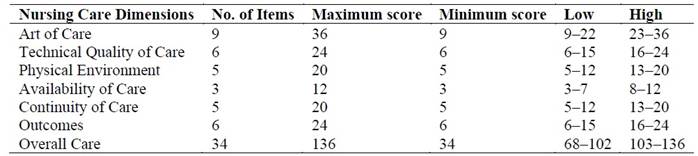
Data were collected using a survey instrument: a Nursing Care Perception Questionnaire adapted by the research team from Dávila and González. 13 The original patient opinion questionnaire on nursing care was developed by Eriksen (1988) to measure nursing care quality in a U.S. population. It comprises 34 items across six dimensions: Art of Caring (9 items, 1-9; extent of caring demonstrated by the provider), Technical Quality of Care (6 items, 10-15; providers’ technical skills and competencies, as well as the quality and modernity of equipment), Physical Environment (5 items, 16-20; the setting in which care is delivered), Availability (3 items, 21-23; service- and provider-related accessibility and the facilities available to patients), Continuity (5 items, 24-28; delivery of care by the same provider), and Outcomes (6 items, 29-34; the patient’s perception of the care they expected to receive). The response scale has four options: 1 = never, 2 = sometimes, 3 = frequently, 4 = always. The total score ranges from 34 to 136 points. To classify perceived quality based on instrument scores, two levels-high and low-were established, as shown in the accompanying Table 1.
A pilot test was conducted to validate the instrument, yielding a mean inter-item covariance of 0.1313, indicating acceptable internal consistency among responses. In addition, a scale reliability coefficient of 0.9148 was calculated, reflecting high reliability. To complement the instrument with qualitative information, three open-ended questions were added to elicit concise, focused responses regarding strengths and weaknesses in nursing care, thereby informing improvement proposals.
Quantitative data were initially processed in a spreadsheet using Microsoft® Excel® 2019 for preliminary organization. Subsequently, descriptive statistical analysis was performed with IBM® SPSS® Statistics, version 25. Absolute and relative frequencies were calculated for categorical variables, and measures of central tendency (mean) and dispersion (standard deviation) for numerical variables, as appropriate. No significant differences by subgroups (sex, age, length of stay, inpatient service) were identified or analyzed; therefore, results are presented in aggregate.
For the qualitative component, data from the open-ended questions underwent thematic content analysis following an inductive coding strategy. Responses were first grouped into broad categories, from which specific subcategories were derived to identify semantic patterns, recurrent keywords, and latent meanings. The analysis was accompanied by the selection of representative verbatim quotations that illustrate participants’ perceptions. This integration enabled data triangulation, supporting a comprehensive interpretation of the phenomenon under study.
With respect to ethical considerations, all principles articulated in the Belmont Report were observed: Respect for Persons, Beneficence, and Justice. The protocol was reviewed and approved by the Research Ethics Committee (CEI) of FENOBUNA. The requisite institutional permissions were obtained, as was informed consent from each participant. The right to self-determination was respected; participation was entirely voluntary, and anonymity was guaranteed. All participants were treated with the utmost respect and courtesy, without any form of discrimination.
Results
A total of 132 patients were surveyed. The mean age was 30 ± 10 years (range: 17-60); 62.1 % were female, 55.3 % resided in urban areas, and 84.8 % had tertiary/university education. Regarding hospitalization, the mean length of stay was 4.7 ± 2.6 days (range: 1-13). 37.1 % were admitted to Internal Medicine and 37.1 % to Maternity (the remainder to Surgery/Traumatology). In addition, 52.3 % reported prior hospitalization.
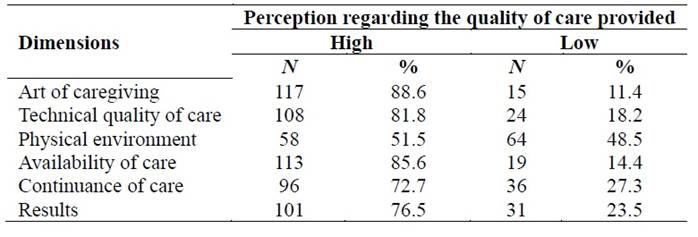
As for inpatients’ perceptions of nursing care quality, Table 1 shows the proportion rating each dimension as high: Art of Caring (88.6 %), Technical Quality of Care (81.8 %), Physical Environment (51.5 %), Availability (85.6 %), Continuity (72.7 %), and Outcomes (76.5 %). .
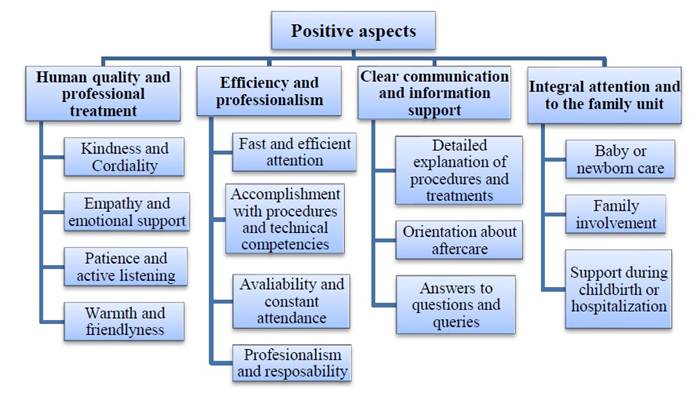
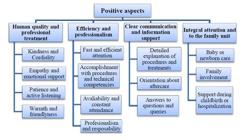
Regarding overall perception, 56.8 % of respondents reported a high perception, while 43.2 % reported a low perception. To complement the quantitative information, the instrument included questions designed to elicit focused responses on strengths and weaknesses in care. Figure 1 shows that patients highlight key positive aspects of nursing care, emphasizing warm and professional treatment, as evidenced by quotations such as: “They were always respectful and kind,” “The nurse who cared for me was warm and understanding,” and “They always greeted me with a smile.” They also value efficiency and professionalism-ensuring promptness, adherence to procedures, and constant availability: “They follow the procedures they are supposed to,” “They are always available,” and “They came when called.” Clear communication and informational support are likewise noted: “They explained all the procedures in detail,” “They made sure I understood my medications”; and, finally, comprehensive care that includes the family unit: “They were very attentive to my family,” “They treated my relatives and me well.” These elements reflect a dedication that positively shapes patients’ experience.
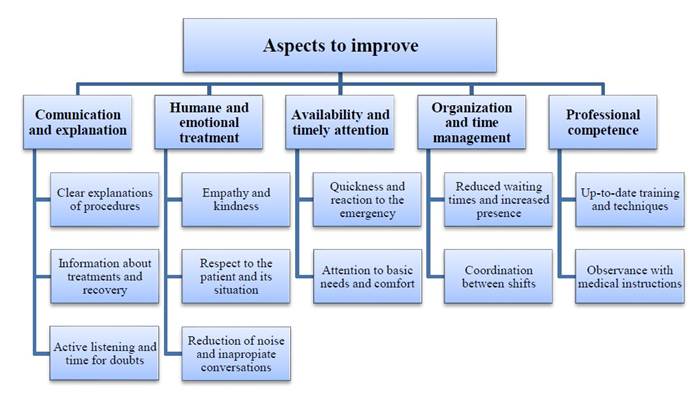
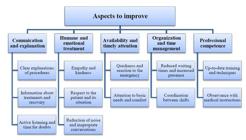
Conversely, when asked about aspects to improve in nursing care, Figure 2 shows that patients emphasize the need for greater clarity in communication regarding procedures, treatments, and post-discharge care, as well as more active listening and time to address questions, as reflected in quotations such as: “Nurses should provide more information,” “I would like them to explain the treatment,” and “I would like them to have more time to listen to my concerns.” They also stress the importance of more empathetic, kind, and respectful treatment, avoiding noise and inappropriate conversations near patients: “They should be more empathetic and kinder,” “A bit more kindness would be ideal,” and “Avoid discussing professional matters in front of patients.” Additionally, patients call for faster responses in urgent situations and better attention to basic needs: “They should be quicker when something is urgent,” “Provide more supplies to ensure comfort.” They also request more efficient time management and coordination across shifts: “Don’t make me wait so long,” “Avoid repeating the same questions.” Finally, the need for ongoing training is noted to update techniques and ensure proper adherence to medical orders: “Some use outdated techniques,” “Dressing changes were ordered every other day, but they only did it once”.
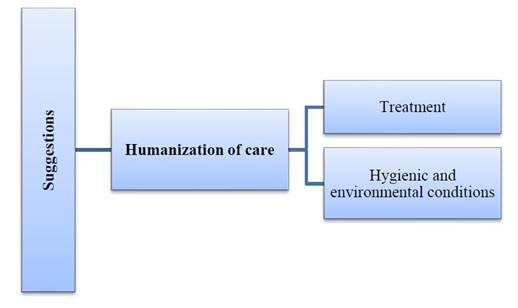
Finally, patients’ suggestions for improvement focus on the humanization of care, interpersonal treatment, and hygienic and environmental conditions. Regarding interpersonal treatment, patients call for greater empathy and kindness, more attention to older adults, and better communication-such as greeting or providing respectful and clear explanations-as reflected in quotations like: “Smile more,” “Greet at least once,” and “More attention to older people.” They also note the need to improve cleanliness by eliminating unpleasant odors and dirt in rooms, as well as ensuring additional resources such as sheets and bed dividers. In addition, they recommend reducing noise and avoiding inappropriate conversations among professionals near patients: “Clean the rooms better; there are feces and blood stains on the wall,” “More sheets and dividers for the beds, if possible,” and “From the room we could hear them gossiping.” These suggestions indicate that patients seek warmer care and a more carefully maintained environment (Figure 3).
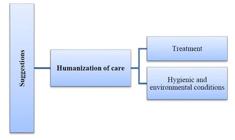
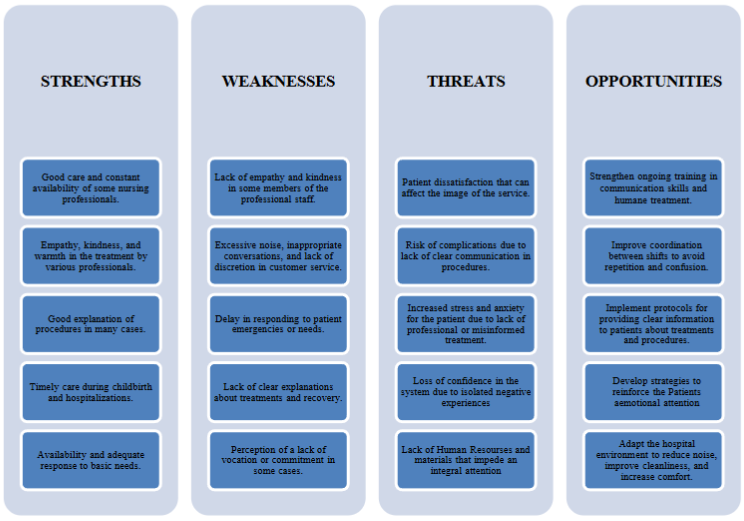
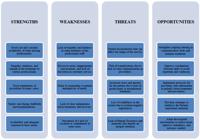
Figure 4 presents a SWOT analysis of nursing care from patients’ perspectives, highlighting that nurses are valued for their quality of care, empathy, and kindness, as well as for explaining procedures and being consistently available. However, weaknesses identified include a lack of empathy in some cases, excessive noise, and delays in responding to urgent needs. Opportunities for improvement include training in communication skills, protocols to ensure clear information, and strategies to strengthen emotionally supportive care. Threats involve patient dissatisfaction, risks arising from poor communication, and shortages of human and material resources, all of which undermine the overall quality of services.
Discussion
According to Avedis Donabedian, quality in health care is an attribute of the care delivered by institutions that can be achieved to varying degrees and is defined as attaining the greatest possible benefits from the care provided. 14 Perceived quality of care, in turn, can be understood as an equation between users’ expectations and perceptions, which together determine their level of satisfaction. 15 In this study, overall perceived quality of nursing care was divided: 56.8 % of patients rated it “high,” while 43.2 % rated it “low,” suggesting a heterogeneous assessment and revealing opportunities to strengthen care.
When these findings are contrasted with prior research, similarities emerge. For example, Rodríguez and Arévalo 11 reported that 53.3 % of patients perceived high quality of care, whereas 46.7 % perceived a medium level. Likewise, Guevara 16 found that 61.8 % of respondents considered the quality of nursing care to be good, compared with 29.1 % who rated it fair and 9.1 % poor. Similarly, Cuadros and Ruiz 14 showed that patients generally rated the care received as good or very good, with only a very small proportion evaluating it as poor or fair. However, some studies reported less encouraging results: Gutiérrez Berríos et al. 17 concluded that quality of care ranged from fair to poor, and Amed-Salazar et al. 18 reported an overall fair perception in 62 % of cases.
Analyzing the specific dimensions assessed, our results align with those reported by Dávila and Gonzales, 13 who likewise found high perceptions in “Art of Caring,” “Technical Quality,” “Availability,” “Continuity,” and “Outcomes,” with “Physical Environment” receiving the lowest scores. The qualitative data reinforce these findings. Patients positively highlighted human warmth, professional efficiency, and clear communication-consistent with studies underscoring the centrality of interpersonal skills to quality care in hospital settings, where communication and therapeutic relationship are essential to humanized care.15 At the same time, they pointed to areas for improvement such as empathy, environmental hygiene, and shift-to-shift organization, which concurs with research showing that disorganized settings or deficits in basic conditions negatively affect patient experience. The interpersonal relationship with users is fundamental, encompassing not only verbal communication but also comfort, privacy, and the overall environment provided. 14 This ambivalence suggests that, although the service has noteworthy strengths, perceived quality is not uniform; addressing these challenges could optimize the care experience.
From an educational and managerial perspective, the results reveal a need to bolster soft skills in nursing training and to strengthen organizational strategies that ensure continuity and quality across shifts. Training in effective communication, collaborative work, and the humanization of care could help improve patient experience. It is important to emphasize the relevance of aligning these findings with concrete proposals for institutional practice.
Regarding study limitations, the use of non-probabilistic convenience sampling limits the generalizability of the findings. In addition, voluntary participation may have introduced self-selection bias. Future studies should consider random sampling methods, increasing the number of participating centers, and exploring longitudinal mixed-methods designs to observe changes over time.
Conclusions
Inpatients’ perceptions of nursing care quality were largely positive, particularly in the “Art of Caring” and “Availability” dimensions, indicating a service characterized by humane treatment, accessibility, and professional attention. Nevertheless, dimensions such as “Physical Environment” and “Continuity of Care” received less favorable scores, signaling concrete opportunities for improvement. The overall perception reflects an uneven care experience in which substantial strengths coexist with structural weaknesses that affect user satisfaction. From the qualitative perspective, patients emphasized positive aspects such as empathy, professionalism, and efficiency among nursing staff, while also noting deficiencies related to response speed, interpersonal communication, environmental hygiene, and inter-shift organization. Quantitative and qualitative findings converge in identifying strengths related to warm interactions and staff availability, and weaknesses tied to structural and organizational aspects. This convergence supports practical recommendations to strengthen the performance of the nursing team at the hospital
As a result of this study, a comprehensive improvement strategy is proposed for the Coronel Oviedo Public Hospital, with actions prioritized according to the implementation timeframe.
Short-term suggestions (1-6 months)
Humanization of care:
-
- Implement workshops on communication skills, empathy, and kindness, focusing on greeting, empathy, and clarity when explaining procedures.
-
- Establish basic interaction protocols such as greeting, self-introduction, and clear explanations of procedures.
-
Optimization of hygienic and environmental conditions:
-
- Implement immediate protocols to reinforce cleanliness, improve room appearance, and eliminate unpleasant odors.
-
- Improve the availability of sheets, bed dividers, and other essential materials; complete the necessary procurement processes.
-
- Conduct weekly supervision of room hygiene and ensure adequate supplies.
-
- Reduce noise and inappropriate conversations; place signage in sensitive areas (e.g., “Quiet Zone” in patient rooms).
-
- Train and raise staff awareness about the importance of maintaining a quiet environment.
-
Organizational optimization and resources:
-
- Reorganize handover processes to ensure continuity of care. Introduce brief huddles at the start of each shift to update key patient information between outgoing and incoming teams.
Medium-term suggestions (6-18 months)
Working conditions:
-
- Assess workload and manage the hiring of additional staff.
-
- Strengthening training
-
- Establish continuing education programs in areas such as conflict management and teamwork.
-
- Develop a training calendar in online and/or in-person formats.
-
Emotional support for staff:
-
- Establish support groups or counseling sessions for the nursing team.
-
Reactivate staff well-being clinics.
-
Monitoring and evaluation:
-
- Conduct regular patient satisfaction surveys.
Long-term suggestions (18 months or more)
-
Infrastructure and technology:
-
- Undertake the necessary steps to modernize medical equipment and invest in hospital infrastructure.
-
- Renovate spaces to ensure more comfortable designs for patients (e.g., room remodels to improve ventilation and reduce odors).
-
- Manage the hiring of additional cleaning personnel to guarantee optimal standards.
-
Well-being programs:
-
- Create institutional mental health and emotional support programs for nursing staff.
-
- Review labor policies to balance workload, reduce frequent rotations, and ensure adequate rest periods.
-
- Establish permanent initiatives such as recreational spaces for staff (e.g., create a green area for outdoor activities, partnerships with gyms).
-
Implementation of technological tools:
-
- Introduce digital systems that facilitate continuity of care and internal organization; implement the Hospital Information System (HIS) in inpatient services.
-
Research and continuous improvement projects:
-
- Create committees to periodically review quality of care and identify new areas for improvement.
-
Publish an annual report with the results of interventions and patient satisfaction.
References
- 1. Flores Hernández S, Pérez Cuevas R, Dreser Mansilla A, Doubova SV, Díaz Portillo SP, Reyes Morales H. Calidad de la atención de los servicios de salud. Salud Publica Mex (Internet). 2024;66(4):570-579. doi: 10.21149/15825
- 2. Chamba M, Romero I, Condoy R, Conde A. Calidad de atención asociada al proceso enfermero según la perspectiva de pacientes y profesionales en un Hospital Obstétrico en el Ecuador. DomCien (Internet). 2022;8(3):808-824. doi: 10.23857/dc.v8i3.2840
-
3. Zambrano EY, Vera T. Percepción del usuario sobre la calidad de atención del personal de enfermería en el área de cirugía del Hospital Naval. Revista Publicando (Internet). 2020;7(25):64-72. Disponible en: https://revistapublicando.org/revista/index.php/crv/article/view/2086
» https://revistapublicando.org/revista/index.php/crv/article/view/2086 -
4. Ascama PM. Calidad de atención de enfermería en pacientes que acuden al servicio de emergencia del Hospital Regional de Ica, 2022 (Tesis de Posgrado). Perú: Universidad María Auxiliadora; 2023. Disponible en: https://repositorio.uma.edu.pe/handle/20.500.12970/1828
» https://repositorio.uma.edu.pe/handle/20.500.12970/1828 -
5. Lizárraga Quispe E. Relación de la calidad percibida del cuidado de Enfermería y Satisfacción del usuario externo, Servicio de Emergencia, Clínica Arequipa - 2018 (Tesis de Maestría). Perú: Universidad Católica de Santa María; 2022. Disponible en: https://repositorio.ucsm.edu.pe/server/api/core/bitstreams/81cf241a-6634-436c-add9-ffe7fe0772cf/content
» https://repositorio.ucsm.edu.pe/server/api/core/bitstreams/81cf241a-6634-436c-add9-ffe7fe0772cf/content - 6. Matta Zamudio LS. Calidad de cuidado de enfermería en pacientes de una sala de hospitalización ubicada en Lima Centro. Revista Cuidado y Salud Pública (Internet). 2022;2(1):30-35. doi: 10.53684/csp.v2i1.39
-
7. Pezo CF, Montalvan JA, Guerrero, Yancha CA. Satisfacción del usuario frente a la atención del personal de enfermería. Revista Dilemas Contemporáneos: Educación, Política y Valores (Internet). 2020;7(40). Disponible en: https://dilemascontemporaneoseducacionpoliticayvalores.com/index.php/dilemas/article/view/2261/2315
» https://dilemascontemporaneoseducacionpoliticayvalores.com/index.php/dilemas/article/view/2261/2315 -
8. León Román CA. Validación de instrumento para medir calidad percibida de los servicios de enfermería en el contexto hospitalario. Rev Cubana Enfermer (Internet). 2023;(39). Disponible en: http://scielo.sld.cu/scielo.php?pid=S0864-03192023000100040&script=sci_arttext&tlng=pt
» http://scielo.sld.cu/scielo.php?pid=S0864-03192023000100040&script=sci_arttext&tlng=pt -
9. Luz AY, Rivera AL. Percepción del paciente sobre la calidad de los cuidados de enfermería recibidos en el área de hospitalización (Tesis de grado). México: Universidad Autónoma Metropolitana; 2023. Disponible en: https://repositorio.xoc.uam.mx/jspui/retrieve/9f23dc5e-1419-4abe-af0c-a6fac46dd3bb/250671.pdf
» https://repositorio.xoc.uam.mx/jspui/retrieve/9f23dc5e-1419-4abe-af0c-a6fac46dd3bb/250671.pdf - 10. López Picazo JJ, Vidal Abarca I, Beteta Fernández D, López Ibáñez M. Influencia del período de alarma por la pandemia covid-19 en la calidad percibida de la atención en urgencias hospitalarias. Journal of Healthcare Quality Research (Internet). 2021;36(1):19-26. doi: 10.1016/j.jhqr.2020.10.004
- 11. Rodríguez RM, Arévalo RA. Calidad de atención de enfermería y satisfacción del paciente en el servicio de emergencia de un hospital nacional de Lima-Perú. Ciencia Latina Revista Científica Multidisciplinar (Internet). 2023;7(1):5045-5059. doi: 10.37811/cl_rcm.v7i1.4815
-
12. Ramos ME, Méndez JA, Castro KI, Flores YK. Satisfacción con la calidad de atención en pacientes en hemodiálisis de un hospital de Sonora. Rev Enferm Inst Mex Seguro (Internet). 2022;30(3):54-59. Disponible en: https://revistaenfermeria.imss.gob.mx/index.php/revista_enfermeria/article/view/1237
» https://revistaenfermeria.imss.gob.mx/index.php/revista_enfermeria/article/view/1237 -
13. Dávila S, Gonzales TG. Percepción de la calidad del cuidado de enfermería desde la perspectiva del paciente: variables asociadas (Tesis de grado). Perú: Universidad Científica del Perú; 2017. Disponible en: http://repositorio.ucp.edu.pe/handle/UCP/186
» http://repositorio.ucp.edu.pe/handle/UCP/186 -
14. Cuadros Carlesi K, Ruiz Araya PA. Percepción de la calidad de la atención otorgada a los pacientes en el servicio de Urgencia. Horizonte de Enfermería (Internet). 2023 (citado 2025 jul 28);34(3):539-560. doi: 10.7764/Horiz_Enferm.34.3.539-560
» https://doi.org/10.7764/Horiz_Enferm.34.3.539-560 -
15. Diaz Rodríguez M, Alcántara Rubio L, Aguilar Garcia D, Puertas Cristobal E, Cano Valero M. Orientaciones formativas para un cuidado humanizado en enfermería: una revisión integrativa de la literatura. Enf Global (Internet). 2020 (citado 2025 jul 28);19(2):640-672. doi: doi: 10.6018/eglobal.392321
» 10.6018/eglobal.392321 -
16. Guevara H. Calidad del cuidado de enfermería percibido por pacientes postquirúrgicos hospitalizados. Departamento de Cirugía Hospital de Policía, Lima 2019 (Tesis de Grado). Perú: Universidad César Vallejo; 2019. Disponible en: https://repositorio.ucv.edu.pe/handle/20.500.12692/38014
» https://repositorio.ucv.edu.pe/handle/20.500.12692/38014 -
17. Gutiérrez Berríos ZD, Lorenzo Gómez ML, Berríos Rivas AT. Calidad de Atención de Enfermería según el Paciente Hospitalizado. Conecta Libertad (Internet). 2019;3(1):1-11. Disponible en: https://revistaitsl.itslibertad.edu.ec/index.php/ITSL/article/view/70
» https://revistaitsl.itslibertad.edu.ec/index.php/ITSL/article/view/70 -
18. Amed Salazar EJ, Villareal Amaris G, Alvis Tous CC. Calidad del cuidado de Enfermería brindado por profesionales en una ciudad colombiana. 2019;16(2):108-19. doi: 10.22463/17949831.1615
» https://doi.org/10.22463/17949831.1615