Experience of Nurses in Chilean Primary Care. Approaches to a Master of Advanced Practice in Nursing in Primary Care
Abstract:
Introduction: The Advanced Practice Nurse (APN) is a type of professional that has been incorporated in the health systems of various countries with the aim of optimizing access, equity and efficiency in care
Objective: To unveil the perception about the advanced practice nurse professional according to primary health care nurses
Methodology: The research was conducted with a qualitative phenomenological methodology, the testimonies of eight participants who lived the experience of being a primary care nurse and talked about the feasibility of creating a Master of Advanced Practice in primary care in Chile were collected. The information was obtained through in-depth interviews, protecting confidentiality
Results: Six units of meaning emerged: 1) Development of nursing over the years; 2) Adaptation of nursing to public policies in CESFAMs; 3) Leadership in care management; 4) Personal and professional development in nursing when caring for others in primary care; 5) Need for continuous academic development; 6) Transition toward advanced practice nursing in primary care. Participants expressed motivation to pursue EPA-oriented graduate studies, including clinical, community and management content
Conclusion: The implementation of the EPA role in Chilean primary care is perceived as feasible and necessary. The study provides evidence for the design of postgraduate academic programs and supports the formulation of public policies aimed at strengthening advanced nursing competencies
Keywords:
advanced practice nursing; primary health care; health postgraduate programs
Resumen:
Introducción: La enfermería de práctica avanzada (EPA) es un tipo de profesional que ha sido incorporado en los sistemas de salud de diversos países con el objetivo de optimizar el acceso, la equidad y la eficiencia en la atención
Objetivo: Develar la percepción acerca del profesional de enfermería de práctica avanzada según enfermeros de la atención primaria de salud
Metodología: La investigación fue realizada con metodología cualitativa fenomenológica, se recogieron los testimonios de ocho participantes que vivieron la experiencia de ser enfermeros de atención primaria y hablar sobre la viabilidad de crear un Magíster de Práctica Avanzada en atención primaria en Chile. La información se obtuvo a través de entrevistas en profundidad, protegiendo la confidencialidad
Resultados: Emergieron seis unidades de significado: 1) Desarrollo de la enfermería a través de los años; 2) Adaptación de la enfermería a las políticas públicas en los CESFAM; 3) Liderazgo en la gestión del cuidado; 4) Desarrollo personal y profesional en enfermería al cuidar a otros en atención primaria; 5) Necesidad de perfeccionamiento académico continuo; 6) Transitar hacia una enfermería de práctica avanzada en atención primaria. Los participantes expresaron motivación para cursar estudios de postgrado orientados a la EPA, incluyendo contenidos clínicos, comunitarios y de gestión
Conclusión: La implementación del rol de EPA en atención primaria chilena es percibida como viable y necesaria. El estudio aporta evidencia para el diseño de programas académicos de postgrado y sustenta la formulación de políticas públicas orientadas al fortalecimiento de competencias avanzadas en enfermería
Palabras clave:
enfermería de práctica avanzada; atención primaria de salud; programas de postgrado en salud
Resumo:
Introdução: A enfermagem de prática avançada (EPA) é um tipo de profissional que tem sido incorporado nos sistemas de saúde de vários países com o objetivo de otimizar o acesso, a equidade e a eficiência no atendimento
Objetivo: Revelar a percepção sobre o profissional de enfermagem de prática avançada segundo enfermeiros da atenção primária à saúde
Metodologia: A pesquisa foi realizada com uma metodologia qualitativa fenomenológica. Foram coletados os depoimentos de oito participantes que vivenciaram a experiência de serem enfermeiros de atenção primária à saúde e se discutiu a viabilidade de criar um Mestrado de Prática Avançada na atenção primária à saúde no Chile. As informações foram obtidas por meio de entrevistas em profundidade, com garantia de confidencialidade
Resultados: Emergiram seis unidades de significado: 1) Desenvolvimento da enfermagem ao longo dos anos; 2) Adaptação da enfermagem às políticas públicas nos CESFAM; 3) Liderança na gestão do cuidado; 4) Desenvolvimento pessoal e profissional da enfermagem ao cuidar de outros na atenção primária; 5) Necessidade de aprimoramento acadêmico contínuo; 6) Caminhar em direção a uma enfermagem de prática avançada na atenção primária. Os participantes expressaram motivação para cursar estudos de pós-graduação voltados à EPA, incluindo conteúdos clínicos, comunitários e de gestão
Conclusão: A implementação do papel da EPA na atenção primária chilena é percebida como viável e necessária. O estudo fornece evidências para o desenho de programas acadêmicos de pós-graduação e fundamenta a formulação de políticas públicas voltadas ao fortalecimento de competências avançadas em enfermagem
Palavras-chave:
enfermagem de prática avançada; atenção primária à saúde; programas de pós-graduação em saúde
Introduction
According to the Pan American Health Organization (PAHO), approximately 30 % of the population in the Americas lacks access to health services for economic reasons, while 21 % faces geographical barriers that limit their care. 1 The situation is exacerbated in vulnerable populations, such as newborns and older adults, who require specialized care. The World Health Organization (WHO) estimates that by 2035 there will be a global shortage of at least 12.9 million health professionals, including doctors and nurses, posing a challenge for health systems. 2
In Chile, nursing has played an important role in the development of public health. Since 1906, professional training has evolved to become a pillar of community care and health education. In the first half of the 20th century, interventions led by nurses succeeded in reducing infant mortality from 306 deaths per 1,000 live births in 1920 to 86.6 in 1968.3 However, the role of nursing has not been limited to direct care but has also influenced the design of fundamental health policies, such as immunization programs, epidemiological surveillance, and the updating of public health strategies. 4
Given the growing aging of the Chilean population, which currently has more than 2.8 million older adults, an increase in the demand for more complex health services is projected due to the burden of chronic diseases and disabilities.5 To address these challenges, the Chilean Ministry of Health has implemented strategies aimed at reducing the prevalence of communicable and noncommunicable diseases, with goals such as increasing treatment coverage, reducing cancer mortality by 5 %, and decreasing the prevalence of disability associated with mental disorders by 10 %. 6
In this context, the training and implementation of advanced practice nurses (APNs) is a key strategy for strengthening health systems and achieving national health objectives7 Several studies have shown that incorporating APNs improves service accessibility and quality, reduces costs, and optimizes chronic disease management in primary care.(8, 9) In addition, PAHO emphasizes the need to empower nurses, allowing them to develop their full potential and positioning them at the center of global health policies, recognizing their essential role in universal health coverage and the achievement of the United Nations Sustainable Development Goals (SDGs). 10
This study seeks to contribute to the feasibility of incorporating Advanced Practice Nursing (APN) into Primary Health Care (PHC) in Chile. The need to strengthen the first level of care, together with the advancement of international models that integrate the advanced role of nurses, makes it necessary to explore the perceptions of those who already perform strategic functions in this area. The research is based on the premise that the academic and professional development of nursing must be aligned with the demands of the health system and supported by public policies.
The question that guided this work was: What is the perception of primary care nurses about the advanced practice nursing professional? Based on this question, a qualitative study was designed to analyze the representations, expectations, and experiences of these professionals regarding the implementation of the APN, with a view to informing proposals for postgraduate training and regulatory frameworks that will enable its development. The objective of the study was to reveal the perception of advanced practice nurses according to primary care nurses.
Methodology
The research was conducted using qualitative methodology following the interpretive paradigm and phenomenological design according to Helen Streubert11 based on the philosophical school of Edmund Husserl.12 Before conducting the interviews, the researchers provided a personal description of the phenomenon to differentiate their opinions from the experiences of the caregivers (braketing). 11
The sampling was by convenience, to safeguard internal validity and avoid bias. Participants were invited to take part in the study through the strict application of selection criteria. These criteria were: being a community care nurse, Chilean nationality, and at least one year of work experience. The process of searching for and inviting participants was carried out through the Chilean Society of Family and Community Nursing, with the participation of professionals from different regions of the country who were invited through a public message.
The participants were then contacted telephonically by the principal investigator, who verified the selection criteria and their willingness to participate and scheduled a meeting. The researchers did not know the participants beforehand. The interviews were conducted online via video call using the Zoom platform in a private location, after the informed consent form had been read and digitally signed. Each interview was coded with the letter “E” and assigned a number.
The data were obtained through in-depth audio-recorded interviews, beginning with the question: What is your perception of the advanced practice nurse in community care in Chile? During the interview, other questions were asked to delve deeper into the participants’ experiences in order to subsequently reveal the essence of the phenomenon, establishing active listening to the participants’ accounts and omitting value judgments or phrases that could induce a specific response. The interviews lasted between 40 and 90 minutes and were conducted by the principal investigator. The audio recordings were then transcribed verbatim. Once the transcripts were obtained, the authors separately analyzed the discourse of each testimony and then coded and triangulated the units of meaning with the support of the Atlas-Ti program. In this way, the phenomenon revealed was structured by consensus, according to Helen Streubert.11 The number of participants was determined by data saturation. This occurs when experiences are repeated in all interviews, and no new information is presented that could lead to more categories.11 The saturation criterion was achieved in the eighth interview.
Data analysis was carried out through the following steps according to author Helen Streubert: a) write a description of the phenomenon under investigation and the researcher’s assumptions (braketing), interview the participants, b) read the interview transcripts to get the general sense of the experience and discover the essences or units of meaning, c) develop formal descriptions of the phenomenon, e) return to the participants to validate the descriptions, f) consult the relevant literature, g) distribute the findings to the nursing community. 11
We sought to comply with the four criteria of methodological rigor according to Guba and Lincoln, 13 ensuring the validity and reliability of the qualitative study. These criteria include credibility, reliability, confirmability, and transferability, which were systematically applied in the research process. The credibility of the phenomenon revealed was ensured by returning the results to the participants, allowing them to validate the description and analysis of their testimonies. This process, known as member checking, is important to minimize bias in the interpretation of data and strengthen the veracity of the findings, ensuring that they represent the participants’ experience. In addition to in-depth interviews, observation was used, which allowed us to capture the richness of the phenomenon under investigation from multiple perspectives. 13 Reliability was achieved through a triangulation process, in which the researchers analyzed the testimonies independently. Subsequently, the findings were compared to reach a consensus on the coding and analysis.
The triangulation of sources and comparative analysis of the information allowed for the identification of recurring patterns and trends, reducing subjectivity in the interpretation of the results and increasing the validity of the study. 13 Confirmability was ensured through the application of an audit trail, a procedure that allows for detailed documentation of each stage of the study. This detailed record enables other researchers to trace and understand how methodological and analytical decisions were made, ensuring that the results arise directly from the information collected and analyzed. In this way, the research maintains its objectivity and allows comparison with future studies.13) Finally, the transferability of the findings was promoted with the aim of making the results useful to other authors. To achieve this, the context, participants, and conditions of the study were described in detail, making it easier for other professionals and researchers to evaluate the relevance of the findings. In addition, emphasis was placed on contextualizing the information, allowing the results to be interpreted considering the local reality and compared with other health systems with similar characteristics. (13
The research complied with the four bioethical principles plus the seven criteria of Ezequiel Emanuel, (14 with special emphasis on informed consent, interviews, and the handling of the information collected, due to its confidential nature. The study was approved by the Universidad de las Américas’ Ethics Committee.
Results
The research involved eight participants, all of whom were nurses, seven women and one man. Their ages ranged from 25 to 68, with an average age of 54, and they all had a university degree and a master’s degree. Of the total, two were retired nurses who had worked in primary care and six worked at a Family Health Center (CESFAM, for it’s Spanish acronym).
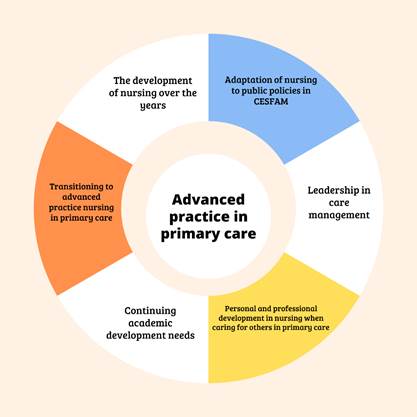
After analyzing the narratives, six units of meaning were revealed, which were organized as a dynamic process over time. The first unit was 1. Development of nursing over the years, followed by 2. Adaptation of nursing to public policies in CESFAMs, due to which nurses had to develop 3. Leadership in care management, which positioned them in a space where they experience 4. Personal and professional development in nursing by caring for others in primary care and feel the 5. Need for continuous academic improvement to 6. Transition to advanced practice nursing in primary care. F1
The development of nursing over the years
Nurses were at the forefront of changes in the profession as the epidemiological profile of the population changed, public health protocols were updated, and health programs were administered. Nurses accompanied and built the profession alongside changes in the country’s health system.
I was there for almost 39 years, more than half my life, and when I started studying, I wanted to be a primary care nurse. It wasn’t called that then; it was called public health (E7).
In addition, nursing was always involved in child health care; it was one of the pillars. So we knew what people wanted. People wanted to be fed, they wanted more comforts in their homes, they wanted to know how others had achieved this, and it was just a matter of teaching them (E5).
Adaptation of nursing to public policies in CESFAMs
In relation to public health, there have been some changes over the years, and one of the milestones was the implementation of the family health model in primary care centers, as the work of nurses changed from providing exclusive care to patients in a consultation setting to comprehensive care supporting families in their health needs, both in a consultation setting and in the field through home visits. It should be noted that before the implementation of the CESFAMs, nurses and the team provided comprehensive care in the community.
There is a difference between the 1980s and now. Before, you really worked with the family, but now you work with segments of that family, and we have them divided. On the one hand, there are cardiovascular patients, women of childbearing age go to the midwife, nurses do preventive medical examinations, the EMPA... Before, it was family-centered, but the theoretical part of the model is impressively beautiful (E5).
It was enriching because you work with a health team that is quite complementary in primary care, unlike hospitals. There is a different work environment (E6).
Now, in the CESFAMs, the whole family is cared for, and family studies are even carried out... But we need to detect problems at home, not in the clinic. At home, we can see why a diabetic patient is unwell. Nurses need more space in the community and to go and talk to schools, but this requires a lot of commitment, willingness, and resources, and there are hardly any hours available for patient care (E8).
Leadership in care management
Over the years, nurses have led public health management and played an important role in organizing community care, directing programs, teams, and activities for people in the territory. They also worked with center directors or as directors themselves.
It’s not easy to be a director, but when you’re a committed director, you can do it. I think that if you have a fairly horizontal working style that also gives your people autonomy, it’s much better, because then you can get the best out of each person (E6).
I like being in charge of programs, I like administrative work, so I’m a bit of a workaholic, I like to take the lead in something, and the childhood program has been a challenge (E7).
The nurse has territorial leadership, a broad perspective, knowledge of psychology, social work, and the medical field, solves problems, and makes sure everything works as a team (E8).
Personal and professional development in nursing while caring for others in primary care
Participants mentioned in their testimonies that they achieved personal and professional development by working in primary care. The work they have done is important for them, for their teams, and for their communities.
It has been an enriching experience. It is enriching when you make progress (E7).
Enriching, it developed my skills, my attitudes, my competencies, and I am truly satisfied. In fact, I wish I didn’t have to retire... I have experience as a field nurse and also as a nurse administrator and manager, and that enriched me personally, not only as a professional but also as a person (E6).
I felt very good, I was happy to go to work contributing to my country, I contributed a lot in the management area of the clinic, I felt the gratitude of the people, the affection and respect of the team, I contributed a lot in epidemiology, I supported the team and helped to keep the doctors’ schedules from getting too busy (E8).
Continuing academic improvement needs
Participants mentioned the importance of continuous improvement for professional development and suggested studying more administration, information technology, research, leadership, public health, and pharmacology, among other subjects. These subjects would be included in a specialized academic curriculum, as they are areas of knowledge that they use daily in their clinical practice and further study would be beneficial for their work.
I think that we as nurses should have a specialty; we should be nurses specializing in cardiovascular health in the community, know the needs of patients in the community... The administration of health centers, that we know the resources we have, how tenders are made, how projects are carried out (E1).
In terms of management, we could create more effective networks among nursing colleagues, with secondary and tertiary care, to improve user response times, update protocols, create evidence-based protocols, and make it easier to research and, obviously, manage health programs (E2).
I would like to see urgent care, pharmacology for primary health care, and perhaps better treatment of patients. I feel that these are the most necessary things (E3).
We need to move with technology. Everything is done through the computer system, so we need to advance in that area. Data management would be important, and it would be good to take courses on nursing informatics (E7).
Transitioning to advanced practice nursing in primary care
The nurses emphasized the importance of advancing and raising the profile of the profession, as they have worked directly with patients and their families in CESFAMs, homes, urban areas, and rural areas, and have carried out management and research tasks. They are motivated to continue improving their skills. They spoke about the importance of an autonomous role, developing skills that are in line with the needs of the population. For them, advanced practice nurses in the community are transformative.
I believe that we, as primary health care providers, should provide all health care in neighborhoods or communities, first to understand the needs of that population and then to be able to deliver a nursing plan or interventions according to those needs (E1).
A more present role for research, one that is not so biomedical, but rather related to nursing research in the community (E3).
Because sometimes it is based on biomedical goals, the model ends up focusing only on what is mandatory, so it does not allow you to innovate and focus on what people want from healthcare, but rather you deliver what is dictated by regulations and programs (E5).
I truly feel that primary care as a health strategy has not been used to its full potential... I imagine advanced practice nursing as an important element of transformation, of transforming the way we approach whatever we are dealing with, including the perspective of the authority, the perspective of the team, the perspective of resources, from a transdisciplinary approach (E6).
Discussion
Advanced practice nursing (APN) has emerged as a healthcare need arising from demographic and epidemiological changes in different regions of the world. Universities have played an important role in creating and delivering study programs with different specializations, and some countries have also provided legal support for the work of advanced practice nurses. In countries where APN exists, such as the United States, Japan, the Netherlands, Singapore, and Australia, nurses specialize in inpatient care, but there are initiatives to strengthen advanced practice in community care, such as in Australia and other more advanced regions such as the United Kingdom. 15
Both the International Council of Nurses (ICN) and PAHO encourage the development of APN worldwide and in Latin America, especially in community care to address pending epidemiological and demographic challenges in the population. 10 In this study, participants pointed out that nurses need to have direct contact with people in their homes to support them in their lifestyles. However, there are some limitations, such as the resources allocated and protected hours for home care, since most of the care provided by nurses in Chile is in health centers, with hours previously scheduled with patients. (15, 16) In other words, patients go to the health center, which is different from other parts of the world, where advanced practice primary care nurses are assigned territories with structured protocols for curative care and rehabilitation. (16,17
In addition, APN carries out promotion and prevention activities, especially among the elderly or vulnerable populations, and care for people who live alone, families, or groups, which leads to greater access to care, cost savings, and health empowerment for patients.16,17 They also work in coordination with other health professionals, with autonomy and their own roles within the team. 18 However, this APN model in primary care is not so far removed from the national experience. The study participants reported that before the health reform of the 2000s, nurses made rounds and home visits and provided health care in communities, with an emphasis on maternal and childcare, promotion, and prevention. In addition, they met with other professionals on the team to work in coordination and support families with one or more health problems.
This assistance in the history of nursing in Chile is known as public health activities.2,3 Although community health centers called “consultorios”, which had a biomedical approach, later shifted to a family-centered model and are now known as CESFAM, participants reported that there is currently a difference between what is written in the health model and what is actually done at the local level. Advanced practice nurses in primary care could contribute to redeveloping this concept and thereby aligning it with the community health model, given their holistic approach to working in both prevention and care during the treatment of diseases. 15
The incorporation of APN in PHC has emerged as an innovative solution, providing a multidimensional and person-centered approach that has improved the quality of life of patients and the satisfaction of health personnel. 15,16,17,18
Globally, APN in PHC has proven to be an essential resource for improving health outcomes and optimizing the efficiency of health systems. Recent studies have shown that, in various contexts, their performance is comparable or even superior to that of physicians, both in the management of clinical consultations and in the care of populations with different levels of severity. 18,19,20 In addition, the work of APN in PHC has been found to contribute to key areas such as education, management, and preventive practices, maximizing the coverage and efficiency of health services. 20,21
In Switzerland, for example, APNs working in PHC have achieved positive results in terms of interprofessional collaboration. Family doctors have experienced synergies, trust, and better care in collaboration with APNs. This teamwork model has been shown to improve the quality of care while optimizing available resources.(22, 23) Similarly, in Scotland, APNs replaced doctors in the care of minor illnesses, particularly in rural areas, which has significantly improved access and patient satisfaction. 23
International experience demonstrates the effectiveness of APNs in PHC in improving health management, as shown by several studies indicating that patients seen by APN in PHC report greater satisfaction with the care received, fewer unnecessary visits to the emergency department, and a reduction in hospital readmissions compared to those seen by physicians. These benefits are especially evident in remote areas, where they have improved access to health services. 24,25,26.
Regarding training, participants reported that they would like to learn about management, pharmacology, nursing procedures, information technology, customer service, and research. They are interested in continuing education and know that training will enable them to provide better care to patients. Management and customer service skills give them more tools to manage staff in PHC and better manage the hours assigned to professionals. Also, working directly with the Ministry of Health or central offices, where administrative decisions on health are made to be implemented in the territories. 15,16 Likewise, APNs consider pharmacology and nursing procedures to be skills for their personal and professional development. Along these lines, in the United States, APNs prescribe medications, have a legally approved list that may vary by state, and perform invasive procedures such as intubation, central venous catheter placement, and arterial line insertion, among others. 15,16 The latter are not performed frequently in PHC, but prescribing would be very useful to relieve the burden on doctors, as is the case in the Netherlands. 15,16 In addition, for the participants in this study, recognition of this improvement in hierarchy and remuneration is very important. To date, in Chile, there are no such benefits for pursuing postgraduate studies, and in this regard, nurses also indicated that they would like their employer to pay for part of their continuing education. They pointed out that it would be ideal for them to have a master’s degree in APN included in their institutional training, as in the United States, where there is hierarchical and monetary recognition according to specialization and years of study. 18,19,20
The development of an APN program and continuing education in different subjects such as management, pharmacology, and research, among others, would contribute to enhancing leadership in nursing. The participants pointed out that in their jobs they have held coordination and management positions in PHC centers, and this training would be a foundation that would enhance the performance of these positions and the profession. 24,25,26,27,28 According to the Canadian Nurses Association, the competencies that APNs should develop are professional role, management, health diagnosis, including therapeutic management, and disease promotion and prevention. (29,30,31,32
In this scenario, the postgraduate curriculum should include nursing models and a clinical conceptual framework and integrate them with innovative teaching strategies that contribute to the formation of reflective professional judgment adapted to the challenges of the workplace. 29,30,31,32 Thus, the experiences of nurses in countries where APN study programs have been implemented and a legal framework supporting their work has been established can serve as a roadmap for Chilean and Latin American nurses. 33,34,35,36,37
In accordance with the methodology of this study, qualitative research does not seek to generalize results from a sample to a universe, but rather to deepen the understanding of the experiences of a group of people in a specific context. In relation to the topic of the APN, the findings of this study show similarities with the evidence published by other authors. The information is transferable at a comparative level, 13 since the discussion of the results in comparison with previous studies allows the recurrence of the phenomenon in different international contexts to be identified. However, these results are conditioned by factors such as temporality, the development of regulatory frameworks, and financial support, showing that the process of implementing the APN in PHC has common characteristics at the global level. (12,13
In this regard, it is essential to promote research in the Latin American context to broaden understanding of the phenomenon and generate an empirical basis to support changes at the regional level. This challenge has been identified and supported by PAHO and the ICN. (10, 38) Exploring health gaps in Latin America, considering variables such as access to care, availability of treatments, demand for care, and demographic projections, would allow for a comparative analysis with the work of the APN in other countries. This approach would contribute to the development of a generalized profile of practice in the region, facilitating decision-making and evidence-based policy formulation.
Conclusion
Based on a qualitative analysis of the testimonies and a comparison with the specialized literature, elements were identified that suggest a potential evolution of the role of generalist nurses toward more specialized profiles and advanced practice in the Chilean context. The increase in population and the resulting increase in demand for care services generate new challenges for primary care. Evidence shows that APN provides support throughout the health and disease process and, above all, is effective in meeting the needs of the population, being capable of providing clinical care, management, education, and research.
The results suggest that nurses are interested in this new role and in pursuing master’s degrees in APN. Among the main challenges are the need for a legal framework to support the new clinical responsibilities inherent in this emerging role, as well as the implementation of adequate economic incentives and the strengthening of support from the health team. Given this scenario, it would be interesting to calculate the impact of incorporating nurses into the clinical setting in relation to variables such as patient readmission, recovery rates, timely referral, user perception of care, and quantification of public health expenditure.
Among the main lines of research to be developed, the evaluation of the impact of APN on primary care stands out. This could include analyzing variables such as reduced waiting times, optimized medical consultations, and greater efficiency in patient referrals. Another relevant line of research is chronic disease management. Comparative studies could be conducted on the management of conditions such as diabetes, hypertension, and cardiovascular disease, comparing the results obtained by APN professionals with those of general practitioners. It is also relevant to explore user perception and satisfaction through qualitative studies that address the acceptance of the APN model in different geographical areas. Finally, there is a need for research on the economic impact of the model. This includes cost-effective studies that quantify the potential reduction in spending on hospitalizations, medical consultations, and highly complex procedures thanks to the early intervention of APN professionals.
The consolidation of advanced practice nursing in Chile represents a strategy for strengthening the public health system by reducing gaps in care and optimizing resources. The growing interest among nurses in this new role, coupled with scientific evidence supporting its effectiveness, suggests that the next step is to formulate public policies that facilitate its implementation. This requires a joint effort between the Ministry of Health, the legislative branch, academic institutions, and international organizations to ensure the sustainable and effective integration of this model into the Chilean health system.
Limitations of the study
This study acknowledges that, as it is based on specific and subjective experiences, its findings seek a deep understanding without generalization. Convenience sampling and the virtual nature of the interviews may have limited the diversity of voices, and therefore critical reading and further research in different settings where APN is being developed are recommended.
References
-
1. Organización Panamericana de la Salud. Estrategia y plan de acción sobre acceso universal a la salud y cobertura universal de salud. OPS; 2023. Disponible en: https://www3.paho.org/hq/dmdocuments/2016/nursing-practica-avanzada-2014-spa.pdf
» https://www3.paho.org/hq/dmdocuments/2016/nursing-practica-avanzada-2014-spa.pdf -
2. Organización Mundial de la Salud. Informe sobre la situación del personal de salud en el mundo. OMS; 2024. Disponible en: https://www.who.int/es/health-topics/health-workforce#tab=tab_1
» https://www.who.int/es/health-topics/health-workforce#tab=tab_1 -
3. Núñez E, Macías L, Navarro R, De Souza S. Historia de la enfermería chilena: una revisión desde las fuentes. Cienc Enferm. 2019;25:8. doi: 10.4067/S0717-95532019000100301
» https://doi.org/10.4067/S0717-95532019000100301 -
4. Ayala RA, Thulin M. Introduction: Nurses and the politics of care. In: Ayala RA, Thulin M, editors. Nursing, policy and politics in twentieth-century Chile. Cham: Springer; 2023, p. 1-22. doi: 10.1007/978-3-030-90835-5_1
» https://doi.org/10.1007/978-3-030-90835-5_1 -
5. Ministerio de Desarrollo Social de Chile. Estadísticas de la población adulta mayor en Chile. MDS; 2024. Disponible en: https://www.desarrollosocial.cl
» https://www.desarrollosocial.cl -
6. Ministerio de Salud de Chile. Estrategia Nacional de Salud 2020-2030. MINSAL; 2024. Disponible en: https://cens.cl/wp-content/uploads/2022/03/Estrategia-Nacional-de-Salud-al-2030.pdf
» https://cens.cl/wp-content/uploads/2022/03/Estrategia-Nacional-de-Salud-al-2030.pdf -
7. Fajarini M, Setiawan A, Sung CM, Chen R, Liu D. Effects of advanced practice nurses on health-care costs, quality of care, and patient well-being: a meta-analysis of randomized controlled trials. Int J Nurs Stud. 2025;162:104953. doi: 10.1016/j.ijnurstu.2024.104953
» https://doi.org/10.1016/j.ijnurstu.2024.104953 -
8. Weise S, Steybe T, Thiel C, Frese T. Perspectives of general practitioners and practice nurses on nurse-led patient consultations and dose changes of permanent medications. Fam Pract. 2025;40(2):cmae072. doi:10.1093/fampra/cmae072
» https://doi.org/10.1093/fampra/cmae072 -
9. Nguyen VNB, Brand G, Collison L, Griffin K, Moses S, Morphet J. Registered nurse scope of practice in Australian primary healthcare settings: a retrospective longitudinal study. J Nurs Manag. 2025;(1):8882760. doi: 10.1155/jonm/8882760
» https://doi.org/10.1155/jonm/8882760 -
10. Organización Panamericana de la Salud. Fortalecimiento del rol de la enfermería en las Américas. OPS; 2025. Disponible en: https://www.paho.org
» https://www.paho.org - 11. Streubert H, Carpenter D. Qualitative research in nursing: Advancing the humanistic imperative. Philadelphia: Wolters Kluwer Health/Lippincott Williams & Wilkins; 2011.
-
12. Fuster DE. Investigación cualitativa: Método fenomenológico hermenéutico. Propósitos y Representaciones. 2019;7(1):201-229. doi: 10.20511/pyr2019.v7n1.267
» https://doi.org/10.20511/pyr2019.v7n1.267 - 13. Guba EG, Lincoln YS. Fourth generation evaluation. 1st ed. Newbury Park (CA): Sage Publications; 1989.
-
14. Emanuel E. ¿Qué hace que la investigación clínica sea ética? Siete requisitos éticos. En: Investigación en sujetos humanos: experiencia internacional. Santiago de Chile: Programa Regional de Bioética OPS/OMS; 1999, p. 33-46. Disponible en: https://vri.umayor.cl/images/Pautas-evaluacion-etica-Ezequiel-Emanuel.pdf
» https://vri.umayor.cl/images/Pautas-evaluacion-etica-Ezequiel-Emanuel.pdf -
15. Schober M. Desarrollo de la enfermería de práctica avanzada: contexto internacional. Enferm Clin. 2019;29(2):63-66. doi: 10.1016/j.enfcli.2018.08.002
» https://doi.org/10.1016/j.enfcli.2018.08.002 -
16. Valencia-Contrera MA, Valenzuela-Suazo S, Luengo-Martínez CE, Quintana-Zavala MO. Quality of life and psychosocial risks in primary care workers in an urban area. Rev Bras Med Trab. 2024;22(2):e20221031. doi: 10.47626/1679-4435-2022-1031
» https://doi.org/10.47626/1679-4435-2022-1031 -
17. Grant J, Lines L, Darbyshire P, Parry Y. How do nurse practitioners work in primary health care settings? A scoping review. Int J Nurs Stud. 2017;75:51-57. doi:10.1016/j.ijnurstu.2017.06.011
» https://doi.org/10.1016/j.ijnurstu.2017.06.011 -
18. Torrens C, Campbell P, Hoskins G, Strachan H, Wells M, Cunningham M, et al. Barriers and facilitators to the implementation of the advanced nurse practitioner role in primary care settings: a scoping review. Int J Nurs Stud. 2020;104:103443. doi:10.1016/j.ijnurstu.2019.103443
» https://doi.org/10.1016/j.ijnurstu.2019.103443 -
19. Stucky CH, Brown WJ, Stucky MG. COVID-19: an unprecedented opportunity for nurse practitioners to reform healthcare and advocate for permanent full practice authority. Nurs Forum. 202156(1):222-227. doi:10.1111/nuf.12515
» https://doi.org/10.1111/nuf.12515 -
20. Rosa WE, Fitzgerald M, Davis S, Farley JE, Khanyola J, Kwong J, et al. Leveraging nurse practitioner capacities to achieve global health for all: COVID-19 and beyond. Int Nurs Rev. 2020 Dec;67(4):554-559. doi:10.1111/inr.12632
» https://doi.org/10.1111/inr.12632 -
21. Zúñiga F, Teuscher R, Stoll H, Sailer-Schramm M, Vökt F, Kotkowski K. Advanced practice nurses’ daily practices delivering primary care to residents in long-term care facilities: a qualitative study. BMC Prim Care. 2024;25(1):203. doi: 10.1186/s12875-024-02455-9
» https://doi.org/10.1186/s12875-024-02455-9 -
22. Lauber E, Kindlimann A, Nicca D, Altermatt-von Arb R, Sgier C, Staudacher S, et al. Integration of an advanced practice nurse into a primary care practice: a qualitative analysis of experiences with changes in general practitioner professional roles in a Swiss multiprofessional primary care practice. Swiss Med Wkly. 2022;152:w30199. doi:10.4414/smw.2022.w30199
» https://doi.org/10.4414/smw.2022.w30199 -
23. Kilpatrick K, Savard I, Audet L, Costanzo G, Seedat‐Khan M, Atallah R, et al. A global perspective of advanced practice nursing research: a review of systematic reviews. PLoS One. 2024;19(7):e0305008. doi: 10.1371/journal.pone.0305008
» https://doi.org/10.1371/journal.pone.0305008 -
24. Neto JC, Pereira dos Santos OS, de Oliveira CJ, Gomes da Silva KV, de Oliveira JD, Cavalcante TF. Contributions of advanced practice nursing to primary health care: a scoping review. Aquichan. 2023;23(1):e2315 . doi: 10.5294/aqui.2023.23.1.5
» https://doi.org/10.5294/aqui.2023.23.1.5 -
25. Altermatt-von Arb R, Stoll H, Kindlimann A, Nicca D, Lauber E, Staudacher S, et al. Daily practices of advanced practice nurses within a multi-professional primary care practice in Switzerland: a qualitative analysis. BMC Prim Care. 2023;24:26. doi: 10.1186/s12875-023-01977-y
» https://doi.org/10.1186/s12875-023-01977-y -
26. To S, Freund N, Greiner A. Rural patients’ perceptions and opinions of scope of practice. Kansas J Med. 2024;17(Suppl2):71. doi: 10.17161/kjm.vol17.22709
» https://doi.org/10.17161/kjm.vol17.22709 -
27. Hako L, Turunen H, Jokiniemi K. Advanced practice nurse capabilities: A mixed methods systematic review. Scand J Caring Sci. 2023;37(1)3-19. doi: 10.1111/scs.13134
» https://doi.org/10.1111/scs.13134 -
28. Miranda Neto MV, de Almeida LY, Bonfim D, Rewa T, de Campos Oliveira MA. Implementation of advanced practice nursing in Brazilian Primary Health Care: methodological path. Rev Bras Enferm. 2022;75(5):e20210614. doi: 10.1590/0034-7167-2021-0614
» https://doi.org/10.1590/0034-7167-2021-0614 -
29. Abou Malham S, Breton M, Touati N, Maillet L, Duhoux A, Gaboury I. Changing nursing practice within primary health care innovations: the case of advanced access model. BMC Nurs. 2020;19(1):115. doi: 10.1186/S12912-020-00504-z
» https://doi.org/10.1186/S12912-020-00504-z -
30. Brownwood I, Lafortune G. Advanced practice nursing in primary care in OECD countries: Recent developments and persisting implementation challenges. OECD Health Working Papers. 2024;(165). doi: 10.1787/8e10af16-en
» https://doi.org/10.1787/8e10af16-en -
31. Cruz Riveros C, Macaya Aguirre GA, Urzúa A, Cabieses B. Barreras para la utilización de servicios de Atención Primaria de Salud en personas migrantes internacionales. Metas Enferm. 2023;26(6):57-63. doi:10.35667/metasenf.2023.26.1003082128
» https://doi.org/10.35667/metasenf.2023.26.1003082128 -
32. Laurant M, van der Biezen M, Wijers N, Watananirun K, Kontopantelis E, van Vught AJ. Nurses as substitutes for doctors in primary care. Cochrane Database Syst Rev. 2018;7(7):CD001271. doi:10.1002/14651858.CD001271.pub3
» https://doi.org/10.1002/14651858.CD001271.pub3 -
33. Wilson R, Godfrey CM, Sears K, Medves J, Ross-White A, Lambert N. Exploring conceptual and theoretical frameworks for nurse practitioner education: a scoping review protocol. JBI Database System Rev Implement Rep. 2015;13(10):146-155. doi: 10.11124/jbisrir-2015-2150
» https://doi.org/10.11124/jbisrir-2015-2150 -
34. Wilkinson J, Carryer J, Budge C. Impact of postgraduate education on advanced practice nurse activity: a national survey. Int Nurs Rev. 2018;65(3):417-424. doi:10.1111/inr.12437
» https://doi.org/10.1111/inr.12437 -
35. Lopes-Júnior LC. Advanced practice nursing and the expansion of the role of nurses in primary health care in the Americas. Sage Open Nursing. 2021;7:1-14. doi:10.1177/23779608211019491
» https://doi.org/10.1177/23779608211019491 -
36. Barrière-Arnoux C. Rôle de l’infirmière en pratique avancée en soins primaires. Soins. 2022;67(876):28-31. doi:10.1016/j.soin.2022.03.009
» https://doi.org/10.1016/j.soin.2022.03.009 -
37. Dávila JA, Harada ND, Wirtz KR, Gilman SC, Sansgiry S. Interprofessional curriculum delivery: experience of a primary care education program. Healthcare (Basel). 2024;12(9):950. doi:10.3390/healthcare12090950
» https://doi.org/10.3390/healthcare12090950 -
38. Consejo Internacional de Enfermería. Directrices de enfermería de práctica avanzada (Internet). Ginebra: CIE; 2020 (citado 2023 ene 26). Disponible en: Disponible en: https://www.icn.ch/system/files/documents/2020-04/ICN_APN%20Report_ES_WEB.pdf
» https://www.icn.ch/system/files/documents/2020-04/ICN_APN%20Report_ES_WEB.pdf