Safe Abortion and Public Policies: Impact on Women’s Health
Abstract:
Introduction: Abortion is a highly relevant topic in public health and human rights, surrounded by ethical, legal, and social debates. Although it is an essential part of reproductive health, many countries maintain restrictive legislation, perpetuating inequalities and vulnerabilities. Criminalization directly impacts women’s physical and psychological health, especially in stigmatized contexts
Objective: To analyze abortion as a family planning practice and its impact on women’s physical and psychological health, considering social, cultural, economic influences, and public policies
Methods: This is an integrative literature review conducted in the PubMed and SciELO databases. Eighteen articles published in the last ten years, in English and Portuguese, addressing abortion, reproductive health, and women’s rights were selected. The studies were analyzed based on their relevance to the investigated aspects, including the impact of legislation, social stigma, and economic vulnerability
Results: The analysis showed that the criminalization of abortion leads to clandestine procedures, increasing the risk of serious complications and maternal mortality. In contrast, in countries where abortion is decriminalized, there are fewer complications and greater access to safe care
Conclusion: Public policies that ensure safe abortion are fundamental for public health, reducing risks to women. It is essential to approach abortion as a health issue rather than a crime
Keywords:
abortion; family development planning; reproductive health; socioeconomic factors
Resumo:
Introdução: O aborto é um tema de grande relevância na saúde pública e nos direitos humanos, cercado por debates éticos, legais e sociais. Apesar de ser parte essencial da saúde reprodutiva, muitos países mantêm legislações restritivas, o que perpetua desigualdades e vulnerabilidades. A criminalização impacta diretamente a saúde física e psicológica das mulheres, especialmente em contextos de estigmatização
Objetivo: Analisar o aborto como prática de planejamento familiar e seu impacto na saúde física e psicológica das mulheres, considerando influências sociais, culturais, econômicas e as políticas públicas
Métodos: Trata-se de uma revisão integrativa da literatura, realizada nas bases PubMed e SciELO. Foram selecionados 18 artigos publicados nos últimos 10 anos, em inglês e português, que discutem aborto, saúde reprodutiva e direitos das mulheres. Os estudos selecionados foram analisados com base em sua relevância para os aspectos investigados, abrangendo desde o impacto das legislações até as consequências do estigma social e da vulnerabilidade econômica
Resultados: A análise mostrou que a criminalização do aborto leva a procedimentos clandestinos, elevando os riscos de complicações graves e mortalidade materna; já em países onde é descriminalizado, observa-se menos complicações e maior acesso a cuidados seguros
Conclusão: Conclui-se que políticas públicas que assegurem o aborto seguro são fundamentais para a saúde pública, reduzindo riscos relacionados as mulheres. Encarando o aborto como questão de saúde, não como crime
Palavras-chave:
aborto; planejamento familiar; saúde reprodutiva; fatores socioeconômicos
Resumen:
Introducción: El aborto es un tema de gran relevancia en la salud pública y los derechos humanos, rodeado de debates éticos, legales y sociales. Aunque es parte esencial de la salud reproductiva, muchos países mantienen legislaciones restrictivas que perpetúan desigualdades y vulnerabilidades. La criminalización impacta directamente en la salud física y psicológica de las mujeres, especialmente en contextos de estigmatización
Objetivo: Analizar el aborto como práctica de planificación familiar y su impacto en la salud física y psicológica de las mujeres, considerando influencias sociales, culturales, económicas y las políticas públicas
Métodos: Se trata de una revisión integrativa de la literatura, realizada en las bases de datos PubMed y SciELO. Se seleccionaron 18 artículos publicados en los últimos 10 años, en inglés y portugués, que abordan el aborto, la salud reproductiva y los derechos de las mujeres. Los estudios fueron analizados según su relevancia para los aspectos investigados, incluyendo el impacto de las legislaciones, el estigma social y la vulnerabilidad económica
Resultados: El análisis mostró que la criminalización del aborto conduce a procedimientos clandestinos, aumentando los riesgos de complicaciones graves y mortalidad materna. Por otro lado, en los países donde está despenalizado, se observan menos complicaciones y mayor acceso a cuidados seguros
Conclusión: Las políticas públicas que garantizan el aborto seguro son fundamentales para la salud pública, ya que reducen los riesgos para las mujeres. Es esencial tratar el aborto como una cuestión de salud y no como un delito
Palabras clave:
aborto; planificación familiar; salud reproductiva; factores socioeconómicos
Introduction
Unplanned pregnancy is a common reality in various regions of the world, influenced by each woman’s life history and personality. Unplanned motherhood can be oppressive and affect both the marital relationship and a woman’s professional aspirations. The context of abortion is influenced by socioeconomic, cultural, religious, emotional, and educational factors. 1
The World Health Organization (WHO) defines abortion as the termination of pregnancy before the 22nd week or when the fetus weighs less than 500 g, a criterion adopted by the organization but not universally applied. A safe abortion is one performed by trained professionals, under appropriate hygienic conditions, and with proper techniques. A legal abortion, in turn, is one permitted by current legislation under specific circumstances. In countries where abortion is criminalized, many women resort to unsafe methods, which contributes to high maternal mortality rates. 2
According to the WHO and the United Nations Population Fund (UNFPA), safe abortion, when integrated into comprehensive sexual and reproductive health policies, can be an important component of family planning, especially in cases of contraceptive failure.2,3 In the Brazilian context, abortion is legal only in cases of rape, risk to the pregnant woman’s life, or fetal anencephaly. However, criminalization does not prevent its occurrence; on the contrary, it drives the practice of clandestine abortions, which are unsafe and lack proper medical supervision, increasing the risks to women’s lives and well-being. The use of public health services to complete abortions initiated with illegally obtained medication illustrates the impact of this reality on the healthcare system. 4
The absence of effective public policies and limited access to efficient contraceptive methods worsen this scenario. In this context, abortion emerges as a response to structural gaps in reproductive healthcare and is often performed under unsafe conditions, which can lead to health complications, emotional distress, and an overload on the public health system.5
Despite the topic’s relevance, there is a noticeable lack of studies that address abortion not just from a legal or clinical standpoint, but as a public health issue directly related to the lack of family planning and to social inequality. 6,7
This study aims to analyze abortion as a practice within the context of family planning and its impact on the physical and psychological health of women, considering the social, cultural, and economic influences, as well as the public policies involved. This is an integrative literature review with the objective of gathering and discussing evidence on the effects of the absence of public policies that ensure access to safe abortion in countries where it remains criminalized.
Methods
This study is an integrative literature review with a qualitative synthesis approach. This method allows for an in-depth analysis of the investigated topic, contributing to the qualification of care practices related to the subject. The integrative review was chosen because it is a comprehensive method that permits the simultaneous analysis of studies with different methodological designs, which is essential for understanding a multifaceted phenomenon such as abortion in the context of public policy and reproductive health. The review adhered to six stages: formulating the guiding question, literature search or sampling, data collection, critical analysis of the included studies, discussion of the results, and presentation of the integrative review. 8
To construct the guiding question, the PICo acronym-representing Population, Intervention, and Context-was used as a framework for formulating an effective question to guide the review. 9 In this study, P refers to women of reproductive age, I refers to policies and practices related to abortion in the context of reproductive health, and Co refers to women who face gender, economic, and social hardships. This resulted in the following guiding question: How do policies and practices related to abortion as a family planning strategy affect the physical and emotional health of women, considering gender, economic, and social inequalities, and their access to safe and legal abortion?
The objective of this study is to analyze the physical and psychological impacts of abortion within the context of public health policies and family planning, based on an integrative literature review.
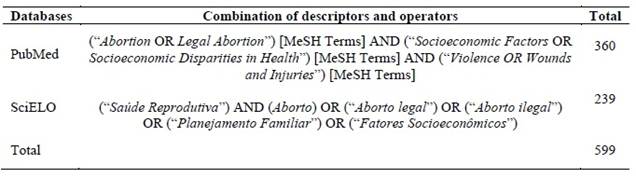
The study was conducted from February to November 2024, with a bibliographic search in the following databases: Medical Literature Analysis and Retrieval System Online (MEDLINE) via PubMed and the Scientific Electronic Library Online (SciELO). The search utilized Health Sciences Descriptors - DeCS (in Portuguese and English), Text Words (Tw), and the Boolean operators “AND” and “OR”, as detailed in Table 1.
To select the studies, the following inclusion criteria were applied: original or review studies, available in full-text and free of charge, published in the last 10 years, and in English or Portuguese. Therefore, articles that did not meet these criteria or were not related to the research question were excluded.
The titles and abstracts of the identified articles were organized in a Microsoft Excel spreadsheet (Office 365 version), and duplicates were removed. The screening of these articles was performed independently by the two authors, who read the titles and abstracts to identify the most relevant ones.
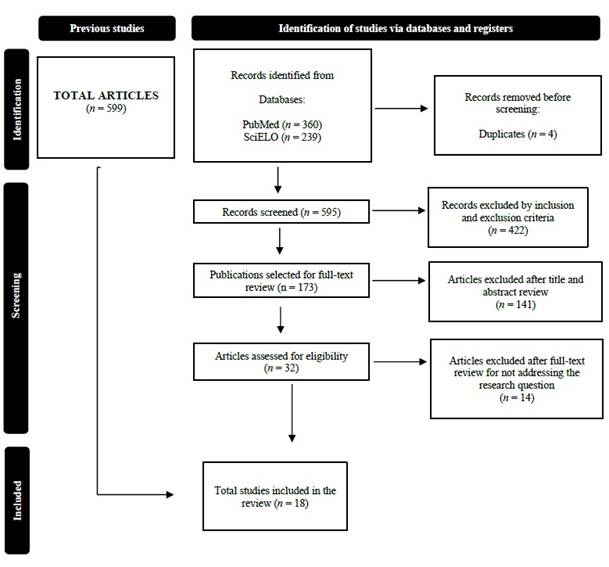
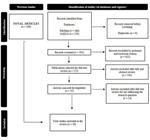
The search strategy resulted in a total of 599 citations. After removing 4 duplicate articles and applying the inclusion criteria, 136 studies remained for the preliminary reading of their titles and abstracts. Of these, 32 articles were selected for full-text reading. Ultimately, 577 studies were excluded for not addressing the guiding question, leaving 18 to form the final sample.
The method for searching and summarizing the studies was based on the Preferred Reporting Items for Systematic Reviews and Meta-Analyses (PRISMA 2020) flowchart guidelines, as illustrated in Figure 1.
Results
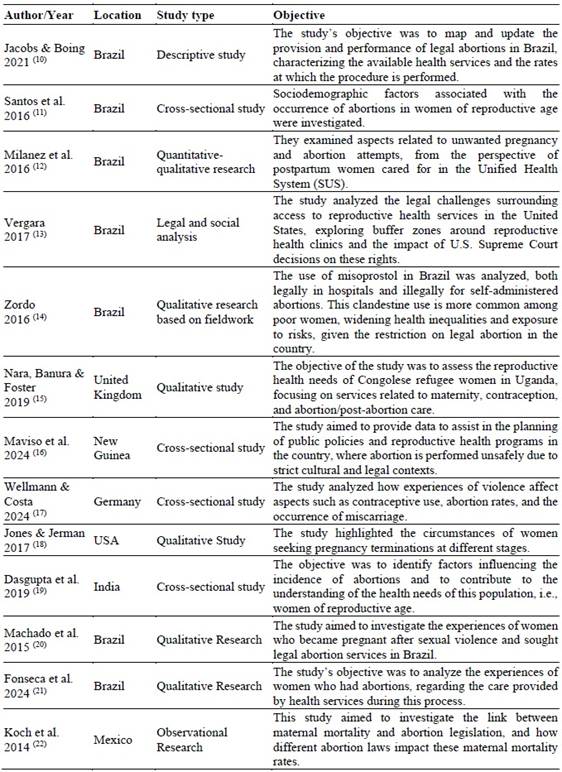
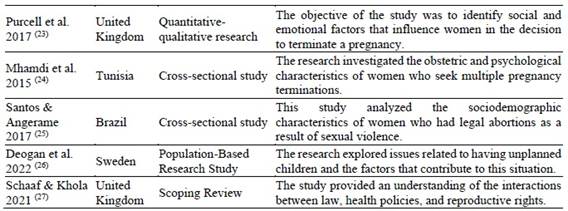
The selected studies were identified and characterized according to the criteria described in Table 2, which considers aspects such as the year of publication, the type of methodological approach, and the context of each study. This systematization allowed for a more precise analysis, highlighting common elements and relevant variations among the included studies.
Table 2. showed a predominance of research conducted in Latin America, especially in Brazil and Mexico, reflecting the regional relevance of the debate on abortion in contexts of social inequality. Most of the studies used a qualitative approach and highlighted barriers to abortion access among women in situations of social vulnerability.
In the quantitative breakdown, 39 % of the studies were from Brazil, focusing on unsafe abortion and its relationship with socioeconomic and cultural factors. 10-16 The United States accounted for 11 %, with an emphasis on the impact of public policies and access to safe methods, although limited by social barriers. 17,18 Mexico represented 6 %, highlighting the effects of restrictive legislation. 19 The remaining 44 % corresponded to research from Europe and Asia, which compared more accessible regulatory policies and their outcomes. 20,21,22,23,24,25,26,27
Sociocultural factors proved to be decisive in the decision to terminate a pregnancy, with social stigma being one of the main barriers faced. In contexts where abortion is treated as a taboo, the psychological consequences are more pronounced, often associated with anxiety, depression, and feelings of guilt. 13,14
The integrative review confirmed that the criminalization of abortion, which is in effect in a large part of developing countries including Brazil, has led to serious consequences for women’s health, especially for those in conditions of socioeconomic vulnerability. The lack of access to effective contraceptive methods and adequate sexual education has increased the incidence of unwanted pregnancies, leading many women to resort to unsafe and clandestine procedures. 25
The findings reinforced that abortion should be treated as a central public health issue. When framed exclusively as a criminal problem, access to safe procedures is restricted, with a direct impact on the physical and mental health of women. Evidence indicates that decriminalization, combined with robust policies for sexual education and family planning, is essential to reduce gender inequalities, expand access to reproductive health, and offer more humanized care. 18
In countries where abortion has been integrated into public health policies, a significant reduction in complication rates and maternal mortality has been observed. 23,24 This result stems from the ability to perform the procedure in safe conditions, with adequate medical support and without the stigma associated with illegality. 25 In these contexts, decriminalization has promoted improvements in health indicators and strengthened women’s autonomy, allowing them to exercise greater control over their reproductive decisions and life plans. 24,25,26
Discussion
After reviewing the key findings of each study used in this research, several relevant aspects emerged that have guided the analysis of this review. Therefore, the discussion will be organized into three thematic axes: Legislation and Public Policies related to abortion; Social, Cultural, and Economic Factors that influence the decision to terminate a pregnancy; and the Physical and Psychological Impacts of Abortion, also considering how legal frameworks condition these effects. These aspects are analyzed based on the gathered evidence, highlighting their implications for public health and reproductive rights.
Legislation and Public Policies
The diversity of legal contexts directly influences the access to and safety of abortion. In countries where the procedure is criminalized, women face considerable challenges in undergoing it safely, often being driven to resort to unsafe methods. Criminalization not only limits access to abortion but also exacerbates social inequalities, primarily affecting women in situations of socioeconomic vulnerability. 11,24
In contrast, in countries like Canada and the Netherlands, where public policies integrate abortion into family planning practices, a significant improvement in reproductive health indicators is observed. The decriminalization of abortion does not lead to an increase in the practice, but rather to a reduction in the maternal complications and deaths associated with unsafe procedures, ensuring safe and legally supported care. 25,26
Furthermore, the implementation of decriminalization policies is associated with an improvement in public health conditions, resulting in less pressure on the healthcare system. Studies indicate that countries with liberal policies, by ensuring safe abortion, observe a decrease in maternal morbidity, proving that safe access significantly reduces the risks of serious complications for women. 13
Social, Cultural, and Economic Factors
The decision to terminate a pregnancy is widely influenced by social, cultural, and economic factors that shape women’s reproductive experiences. Social stigma is especially strong in conservative societies where abortion is seen as a taboo, leading to negative consequences for the mental health of women who opt for the procedure. This social judgment forces many women to resort to clandestine abortions. 20,25
Economic conditions also directly impact the decision to have an abortion. In contexts of poverty, access to contraceptive methods is limited, which contributes to the occurrence of unplanned pregnancies. For women in situations of financial vulnerability, abortion becomes an unavoidable alternative, given the high cost of raising and supporting a child. 12
The support network, or its absence, plays a crucial role in decisions about abortion. The lack of family and social support intensifies the emotional impact, increasing the risk of anxiety and guilt. 15,19 Conversely, when women receive support, their experience with abortion is more positive, reinforcing the importance of a support network in the decision-making process. 17
Cultural factors also exert a decisive influence. In religious communities, abortion is highly stigmatized, causing many women to avoid seeking safe and legal methods. Religious culture, therefore, reinforces the barriers to safe abortion, placing women at greater risk.12,14
Social inequalities further aggravate the difficulties faced by women in contexts of abortion restriction. Women from lower socioeconomic classes face disproportionate challenges, especially due to a lack of resources to access health services, which accentuates disparities in the reproductive experience and compromises the autonomy of low-income women. 16
Physical and Psychological Repercussions
The effects of abortion on the physical and psychological health of women vary substantially depending on the legal context in which it occurs. In countries where the procedure is safe and regulated, physical complications are minimal and comparable to other medical procedures. 13 However, in contexts of criminalization, clandestine abortions increase the risk of infections, permanent sequelae, and maternal mortality. 11
In addition to physical harm, legal conditions also influence the psychological effects. In environments where institutional and social support is available, a reduction in adverse emotional impacts is observed. The existence of support networks and the absence of stigma help women navigate the process in a less traumatic way. 15 In contrast, the absence of support in restrictive contexts increases vulnerability to mental health disorders, such as depression and anxiety, amplifying the suffering associated with the experience. 22
The physical impacts of abortion vary substantially between safe and unsafe procedures. In contexts where abortion is legalized and safe, complications are minimal and comparable to other medical procedures. On the other hand, in scenarios where abortion is clandestine, the risk of infections and serious complications increases, affecting women’s physical health. 17,27
Conclusion
It is concluded that there is an urgent need to rethink legal and political approaches to abortion. Furthermore, it is essential to strengthen investment in multidisciplinary research to generate data that can inform effective public policies aimed at reducing clandestine abortions. The integration of safe pregnancy termination practices into family planning strategies represents a significant step forward in promoting public health and protecting women’s reproductive rights. Treating abortion as a health issue, rather than a criminal one, strengthens healthcare systems by reducing maternal morbidity and mortality, while also promoting the dignity and autonomy of women. Therefore, progressive and inclusive public policies are essential to ensure a comprehensive and humanized approach, guaranteeing that all women have the right to make decisions about their own bodies in a safe, informed, and supported manner.
References
- 1. Silva ATM da, Sousa GD de, Lohmann CM, Ferreira Filho ES, Pinheiro WDS, Soares Júnior JM, et al. Vulnerability in adolescence: a case report of attempted abortion and sexual violence. J Hum Growth Dev. 2017;27(1):117-123. doi: 10.7322/jhgd.127686
-
2. World Health Organization. Abortion care guideline (Internet). WHO; 2022. Disponível em: https://www.who.int/publications/i/item/9789240039483
» https://www.who.int/publications/i/item/9789240039483 -
3. United Nations Population Fund. My Body is My Own: Claiming the Right to Autonomy and Self-Determination. State of World Population Report 2021. New York: UNFPA; 2021. Disponível em: https://www.unfpa.org/sowp-2021
» https://www.unfpa.org/sowp-2021 -
4. Coletiva C e S. Mesmo em queda, o aborto ainda é um problema de saúde pública no Brasil SciELO em Perspectiva | Press Releases (Internet). 2023. Disponível em: https://pressreleases.scielo.org/blog/2023/07/06/mesmo-em-queda-o-aborto-ainda-e-um-problema-de-saude-publica-no-brasil/
» https://pressreleases.scielo.org/blog/2023/07/06/mesmo-em-queda-o-aborto-ainda-e-um-problema-de-saude-publica-no-brasil/ -
5. Diniz D, Castro R. O comércio de medicamentos de gênero na mídia impressa brasileira: misoprostol e mulheres. Cadernos de Saúde Pública. 2011;27(1):94-102. doi: 10.1590/S0102-311X2011000100010
» https://doi.org/10.1590/S0102-311X2011000100010 -
6. Grimes DA. Unsafe abortion: the preventable pandemic. The Lancet (Internet). 2006;368(9550):1908-1919. doi: 10.1016/S0140-6736(06)69481-6
» https://doi.org/10.1016/S0140-6736(06)69481-6 -
7. Sedgh G, Singh S, Shah IH, Åhman E, Henshaw SK, Bankole A. Induced abortion: incidence and trends worldwide from 1995 to 2008. The Lancet. 2012;379(9816):625-632. doi: 10.1016/S0140-6736(11)61786-8
» https://doi.org/10.1016/S0140-6736(11)61786-8 -
8. Souza MT de, Silva MD da, Carvalho R de. Revisão integrativa: o que é e como fazer. Einstein (São Paulo). 2010;8(1):102-106. doi: 10.1590/s1679-45082010rw1134
» https://doi.org/10.1590/s1679-45082010rw1134 -
9. Mitchell RD, O’Reilly GM, Phillips GA, Sale T, Roy N. Developing a research question: A research primer for low- and middle-income countries. African Journal of Emergency Medicine. 2020;10(2):S109-S114. doi: 10.1016/j.afjem.2020.05.004
» 10.1016/j.afjem.2020.05.004 -
10. Jacobs MG, Boing AC. O que os dados nacionais indicam sobre a oferta e a realização de aborto previsto em lei no Brasil em 2019? Cadernos de Saúde Pública. 2021;37(12):e00085321. doi: 10.1590/0102-311X00085321
» https://doi.org/10.1590/0102-311X00085321 -
11. Santos A, Coelho E, Gusmão M, Silva D, Marques P, Almeida M. Factors Associated with Abortion in Women of Reproductive Age. Rev Bras Ginecol Obstet. 2016;38(6):273-279. doi: 10.1055/s-0036-1584940
» https://doi.org/10.1055/s-0036-1584940 -
12. Milanez N, Oliveira AE, Barroso ADV, Martinelli KG, Esposti CDD, Santos Neto ET dos. Gravidez Indesejada e Tentativa de Aborto: práticas e contextos. Sexualidad, Salud y Sociedad (Rio de Janeiro) (Internet). 2016;(22):129-146. doi: 10.1590/1984-6487.sess.2016.22.06.a
» 10.1590/1984-6487.sess.2016.22.06.a -
13. Vergara K. Reproductive Healthcare Services and the U.S. Supreme Court: beyond Roe v. Wade and “Abortion Clinics.” Revista de Investigações Constitucionais. 2017Feb16;4(1):43-68. doi: 10.5380/rinc.v4i1.47660
» https://doi.org/10.5380/rinc.v4i1.47660 -
14. Zordo SD. The biomedicalisation of illegal abortion: the double life of misoprostol in Brazil. História, Ciências, Saúde-Manguinhos. 2016;23(1):19-36. doi: 10.1590/S0104-59702016000100003
» https://doi.org/10.1590/S0104-59702016000100003 -
15. Nara R, Banura A, Foster AM. Exploring Congolese refugees’ experiences with abortion care in Uganda: a multi-methods qualitative study. Sexual and Reproductive Health Matters. 2019;27(1):1681091. doi: 10.1080/26410397.2019.1681091
» https://doi.org/10.1080/26410397.2019.1681091 -
16. Maviso M, Zebedee Aines P, Potjepat G, Geregl N, Mola G, Bolnga JW. Prevalence of pregnancy termination and associated factors among married women in Papua New Guinea: A nationally representative cross-sectional survey. PLoS One. 2024;19(9):e0309913. doi: 10.1371/journal.pone.0309913
» https://doi.org/10.1371/journal.pone.0309913 -
17. Wellmann AM, Costa D. Sexual and reproductive health outcomes of women who experienced violence in Germany: Analysis of the German health interview and examination survey for adults (DEGS1). PLoS One. 2024;19(8):e0305992. doi: 10.1371/journal.pone.0305992
» https://doi.org/10.1371/journal.pone.0305992 -
18. Jones RK, Jerman J. Characteristics and Circumstances of U.S. Women Who Obtain Very Early and Second-Trimester Abortions. Foster AM, editor. PLOS One. 2017;12(1):e0169969. doi: 10.1371/journal.pone.0169969
» https://doi.org/10.1371/journal.pone.0169969 -
19. Dasgupta P, Biswas R, Dilip Kumar Das, Jayanta Kumar Roy. Occurrence and predictors of abortion among women of the reproductive age group in a block of Darjeeling District, West Bengal, India. Indian Journal of Public Health. 2019;63(4):298-304. doi: 10.4103/ijph.IJPH_316_18
» https://doi.org/10.4103/ijph.IJPH_316_18 -
20. Machado CL, Fernandes AM dos S, Osis MJD, Makuch MY. Gravidez após violência sexual: vivências de mulheres em busca da interrupção legal. Cadernos de Saúde Pública. 2015;31(2):345-353. doi: 10.1590/0102-311X00051714
» https://doi.org/10.1590/0102-311X00051714 -
21. Jamile Guerra Fonseca, de E, Silva L, Silva, Railene Pires Evangelista, Célia A. Intersecção entre dificuldades de acesso e violência obstétrica em itinerários abortivos. Ciência & Saúde Coletiva. 2024;29(9):e04552023. doi: 10.1590/1413-81232024299.04552023
» 10.1590/1413-81232024299.04552023 -
22. Koch E, Chireau M, Pliego F, Stanford J, Haddad S, Calhoun B, et al. Abortion legislation, maternal healthcare, fertility, female literacy, sanitation, violence against women and maternal deaths: a natural experiment in 32 Mexican states. BMJ Open (Internet). 2015;5(2):e006013. doi: 10.1136/bmjopen-2014-006013
» https://doi.org/10.1136/bmjopen-2014-006013 -
23. Purcell C, Riddell J, Brown A, Cameron S, Melville C, Flett G, et al. Women’s experiences of more than one termination of pregnancy within two years: a mixed-methods study. BJOG. 2017;124(13):1983-1992. doi: 10.1111/1471-0528.14940
» https://doi.org/10.1111/1471-0528.14940 -
24. Mhamdi SE, Salah AB, Bouanene I, Imen Hlaiem, Saloua Hadhri, Wahiba Maatouk, et al. Obstetric and psychological characteristics of women seeking multiple abortions in the region of Monastir (Tunisia): results of a cross-sectional design. BMC Women s Health. 2015;15:40. doi: 10.1186/s12905-015-0198-x
» https://doi.org/10.1186/s12905-015-0198-x -
25. Danielle, Yela DA. Sociodemographic characteristics of women in a public hospital in Campinas who underwent legal abortion due to sexual violence: cross-sectional study. Sao Paulo Medical Journal. 2017;135(4):363-368. doi: 10.1590/1516-3180.2017.0048150317
» https://doi.org/10.1590/1516-3180.2017.0048150317 -
26. Deogan C, Abrahamsson K, Mannheimer L, Björkenstam C. Having a child without wanting to? Estimates and contributing factors from a population-based survey in Sweden. Scandinavian Journal of Public Health. 2020;50(2):215-222. doi: 10.1177/1403494820965762
» https://doi.org/10.1177/1403494820965762 -
27. Schaaf M, Khosla R. Necessary but not sufficient: a scoping review of legal accountability for sexual and reproductive health in low-income and middle-income countries. BMJ Global Health. 2021;6:e006033. doi: 10.1136/bmjgh-2021-006033
» https://doi.org/10.1136/bmjgh-2021-006033