Nursing Care in Primary Healthcare in Prenatal Care: An Integrative Review
Abstract:
Introduction: Antenatal care is a crucial component of maternal and child health care, and one of the key players in this care in primary care is the nursing staff
Objective: To understand, through scientific evidence, what prenatal care is like performed by nurses in primary health care in Brazil
Methodology: Integrative literature review using the PICo (Population, Interest and Context) strategy to answer the question: how do nurses work in prenatal care in primary care in Brazil? The search was carried out on the CAPES Portal between July and August 2023. Data analysis, using the Bardin method, included 25 publications between 2017 and 2023
Results: The final sample of 25 articles of studies conducted in Brazil were grouped into thematic categories of analysis and indicate a performance: in multiple spaces, guided by protocols of the Ministry of Health; with reception and connection; difficulties/lack of preparation in sensitive issues; lack of knowledge of the network; and based on biomedical care
Conclusions: The role of nurses in prenatal care requires welcoming and building bonds, comprehensive care to women respecting their beliefs and particularities, and promoting a sensitive and comprehensive care practice. However, weaknesses of the service are pointed out, especially in situations of vulnerability. The nursing professional acts in prenatal care based on scientific evidence, biomedical care and with relative professional autonomy
Keywords:
nursing; primary health care; prenatal care
Resumo:
Introdução: O pré-natal é um componente crucial da assistência à saúde materna-infantil, e uma das personagens nesse cuidado na atenção básica são os enfermeiros
Objetivo: Compreender, por meio de evidências científicas, como é o acompanhamento pré-natal realizado por enfermeiros na atenção primária à saúde no Brasil
Metodologia: Revisão integrativa de literatura utilizando a estratégia PICo (População, Interesse e Contexto) para responder à pergunta: como a enfermeira atua no pré-natal na atenção básica no Brasil? A busca foi realizada no portal da CAPES entre julho e agosto de 2023. A análise dos dados, pelo método de Bardin, incluiu 25 publicações entre 2017 e 2023
Resultados: A amostra final de 25 artigos de estudos realizados no Brasil foi agrupada em categorias de análise temática e apontam uma atuação: em múltiplos espaços, pautadas em protocolos do Ministério da Saúde; com acolhimento e vinculação; dificuldades/despreparo em temas sensíveis; desconhecimento da rede; e, embasadas no cuidado biomédico
Conclusões: A atuação dos enfermeiros no cuidado pré-natal requer acolhimento e construção de vínculos, uma atenção holística à mulher, respeitando suas crenças e particularidades, fomentando uma prática de cuidado sensível e integral. Entretanto, fragilidades no atendimento são apontadas, principalmente em situações de vulnerabilidade. O profissional de enfermagem atua na assistência pré-natal com base em evidências científicas, no cuidado biomédico e com relativa autonomia profissional
Palavras-chave:
enfermagem; atenção primária à saúde; cuidado pré-natal
Resumen:
Introducción: Los cuidados prenatales son un componente crucial de la atención sanitaria maternoinfantil, y uno de los protagonistas de esta asistencia en la atención primaria es el personal de enfermería
Objetivo: Comprender, a través de evidencias científicas, cómo es el acompañamiento prenatal realizado por enfermeros en la atención primaria de salud en Brasil
Metodología: Revisión integrativa de la literatura utilizando la estrategia PICo (población, interés y contexto) para responder a la pregunta: ¿cómo la enfermería prenatal brinda cuidados básicos en Brasil? La búsqueda se realizó en el portal CAPES entre julio y agosto de 2023. Se analizaron los datos mediante el método de Bardin, incluyendo 25 publicaciones entre 2017 y 2023
Resultados: La muestra final de 25 artículos de estudios realizados en Brasil se agrupó en categorías temáticas de análisis e indican una actuación: en múltiples espacios, guiada por protocolos del Ministerio de Salud; con recepción y conexión; dificultades/falta de preparación en temas delicados; falta de conocimiento de la red; y basada en la atención biomédica
Conclusiones: El rol de la enfermería en la atención prenatal requiere acogida y construcción de vínculos, atención integral a la mujer respetando sus creencias y particularidades, y promoviendo una práctica de cuidado sensible e integral. Sin embargo, se señalan debilidades del servicio, especialmente en situaciones de vulnerabilidad. El profesional de enfermería actúa en la atención prenatal con base en la evidencia científica, en la atención biomédica y con relativa autonomía profesional
Palabras clave:
enfermería; atención primaria de salud; atención prenatal
Introduction
The care of nurses in Primary Health Care (PHC) in prenatal care is a crucial component of maternal and child health care. Covers the follow-up and care in the gestational period, identifying and treating possible complications early. In addition to the clinical actions, it also provides an environment conducive to educational practices, which promotes reduction of possible negative outcomes, ensuring a healthy pregnancy and safe delivery. 1
From the perspective of Ayres (2004), in a therapeutic meeting, as a prenatal consultation, a relationship of care can be established, provided that it actively seeks to relate the technical aspect to the humanistic aspects of health care. 2 Thus, nursing care is conceived as an "intentional phenomenon, essential to life, that occurs in the encounter of human beings who interact and are directed to the needs of the individual, the family and the community". 3
Primary Health Care (PHC) plays an important role in the care of women during pregnancy, as it is the gateway to the Unified Health System (UHS). For this reason, the pregnant woman should seek the Basic Health Unit (BHU) to start prenatal care as soon as possible, because it provides integrated, continuous and equitable welcoming their needs and involving educational and preventive activities developed by health professionals. 1,4
For prenatal care in the AB, the nurse is legally supported by Decree n. 94.406/87 and Law 7.498/86 to perform nursing consultations, obstetric evaluations, request for examination and prescription of medicines. They have been involved in the implementation of prenatal care, considering the potential that involves this care, but also recognizing the existence of many weaknesses that interfere with the quality of care. 5,6
Furthermore, it enables the establishment of a bond between the nurse and the pregnant woman, which allows confidence and security in the care of these. This perception is evidenced in studies that show that pregnant women are satisfied with the consultations performed by nurses, referring to the reception and listening to the differential in this care.7
In Brazil, there are programs and materials established by the Ministry of Health (MH) with the purpose of improving access, coverage and quality of care, such as the Humanization Program in Prenatal and Birth (PHPN in Portuguese) instituted in 2000 and the Network Stork in 2011. Among the materials, we highlight the PHC Notebooks for low-risk prenatal care launched in 2012. The country has made an international commitment to adhere to the United Nations Millennium Development Goals for reducing maternal and neonatal mortality. Thus, it seeks to follow the parameters of the World Health Organization (WHO) that establishes that the optimal number of prenatal consultations is equal or greater than six, being held monthly until the 28th week, fortnightly between 28 and 36 weeks, and weekly thereafter. According to the MH, consultations can be performed by a doctor and/or nurse. 4
There is a recommendation from the Brazilian government, in which it is essential to conduct quality consultations, diagnostic tests, vaccinations, routine examinations and supply of necessary supplements, and that all information is recorded in the Register of the Pregnant Woman and in information systems, in order to facilitate at the time of delivery to ensure quality care. 8
Given the significant importance of adequate prenatal care to optimally ensure maternal and neonatal well-being, it is essential to deepen knowledge about how prenatal care has been carried out in primary care by nurses, since, from this, it is possible to obtain relevant information based on the literature that reflect aspects - whether positive or negative - that interfere with the quality of care provided, causing new reflections.
In this perspective, it was established as an objective: To understand, through scientific evidence, how is the prenatal follow-up performed by nurses in primary health care in Brazil.
Methodology
This is an integrative literature review, which aimed to gather, synthesize and analyze the available scientific evidence that relate to the theme, 9) carried out in six stages 10 mentioned below:
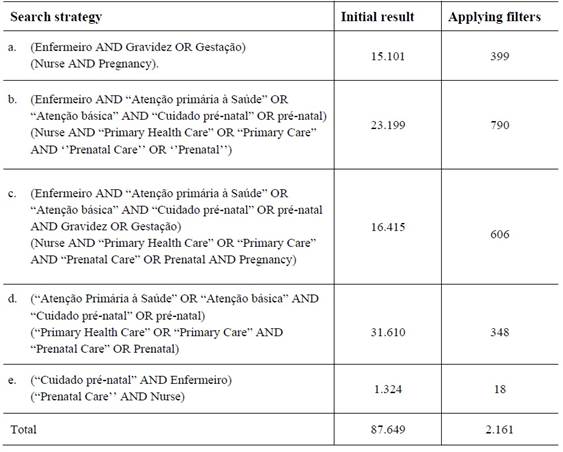
Step 1. Elaboration of the theme, delimitation of the research question and objective; Step 2. Definition of the search strategy, databases and establishment of inclusion and exclusion criteria; Step 3. Literature search and database formation; Step 4. Categorization of the research using the PICo strategy that corresponds to the acronym Population, Interest and Context; the elaboration of the research question started from DeCS (Health Sciences Descriptors), which made it possible to delimit the descriptors in Portuguese and their equivalents in English through MeSH (Medical Subject Headings)11, according to Table 1, culminating in the following research question: How do nurses provide prenatal care within the context of primary health care in Brazil?
From this, through the CAPES Journal Portal that was created to enable access to updated and quality scientific production, by providing textual and referential databases in all areas of knowledge of national and international journals, Step 4 of data extraction was completed; starting with step 5 composed by the analysis, interpretation and discussion of results; and finally, step 6 of the synthesis and review presentation. (9
It was adopted as inclusion criteria: national and/or international articles; articles published in Portuguese and/or English and/or Spanish; articles published in the last 7 years, specifically between 2017 and 2023, until the month of July. 2017 was established as the initial year, because the National Policy on Primary Care in Brazil had been sanctioned. 12 As the exclusion criteria were: articles unavailable in full; review studies, reflection, report of experience, abstracts, theses and dissertations; and studies that did not address the care provided by the nurse, inserted in the PHC services.
In this sense, the descriptors were combined with the use of the Boolean operator "AND" and "OR" and generated the search strategies that were used in the Portal of journals of CAPES. The search strategy was applied on July 21 and August 9, 2023 by five examiners, independently, with the same amount of initial publications being found. After applying the filters: language (Portuguese, English, Spanish), time frame (2017-2023) and available in full, the data comprised the initial results (Table 1).
The articles found were analyzed and chosen by evaluating their titles that should contain some of the selected descriptors. They were then imported into the Rayyan Web (http://rayyan.qcri.org), where the second evaluation step took place. The Rayyan enables evaluation of studies with the blind assistant reviewer, which favors reliability in the selection of information and methodological accuracy. 13) In this stage, which corresponded to the analysis of the adequacy of the publications to the inclusion criteria, the first and second author carried out, independently and blindly, the screening step, by reading the titles and subsequently the abstracts, while the third author did the same, but being responsible for resolving the previous disagreements.
For the data extraction phase, which was carried out by five authors, the included studies were filed and organized in a spreadsheet using the Microsoft Excel editor, version 2016, with the following data: country, database, method, central ideas and level of evidence about nursing care.
Then, it was proceeded with the analysis of the extracted data, based on the inductive method, because it allows to reach conclusions of broader content when using particular data, verified from observational processes, to infer a general truth. The content analysis method of Bardin through three steps (pre-analysis, exploration of the material, treatment of the results and interpretation) allowed the categorization and interpretation of the data. 14 Finally, the final writing of this review was based on the recommendations of the PRISM 2020 checklist and the PRISMA 2020 checklist for summary. 15
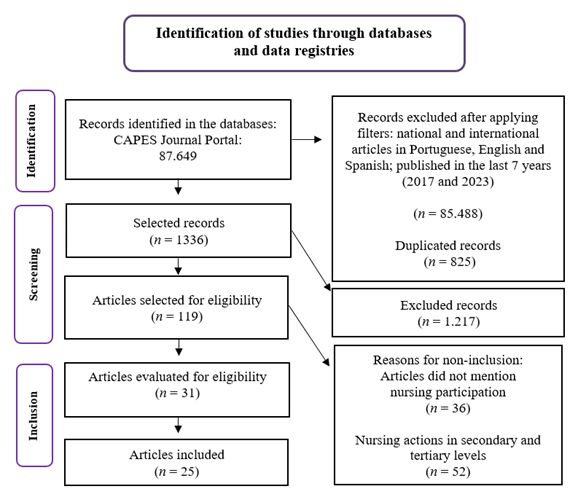
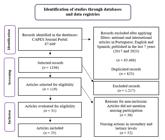
Figure 1 describes the route taken for identification, screening, eligibility and inclusion of studies according to the bases consulted. Were identified 87,649 publications, with the application of the inclusion criteria, these being: national and international articles in Portuguese, English and Spanish; published in the last seven years (2017 and 2023) were identified 2,161 publications, after eliminating the duplicates remained 1,336 publications, 119 after reading the titles, 31 after reading the abstracts and that met the eligibility criteria, but after reading in full 25 made up the sample. The articles not included totaled 88 publications, of these 36 publications were not included in the research because they did not mention the participation of the nurse and 52 publications do not speak of actions of the nurse aimed at PHC.
The selected studies were classified, following the referential proposed by the authors that evaluates the level of evidence of each study and allows the researcher to analyze different types of methods. Level 1 has been established, which involves meta-analysis of multiple randomized controlled clinical trials; Level 2 brings the individual studies with experimental design; Level 3 presents the quasi-experimental studies; Level 4 the descriptive (non-experimental) studies or with a qualitative approach; Level 5 brings the case or experience reports; and, Level 6 contains articles with evidence based on expert opinions.16
Given the methodology used, restricted to the use of published data, there was no need for submission to the Research Ethics Committee. However, the ethical and legal aspects were preserved, and the study did not involve participants at any time.
Results
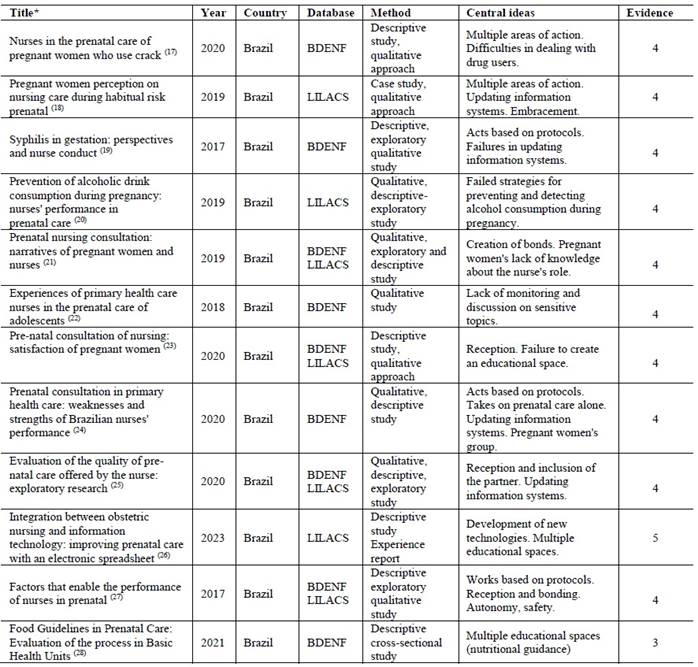
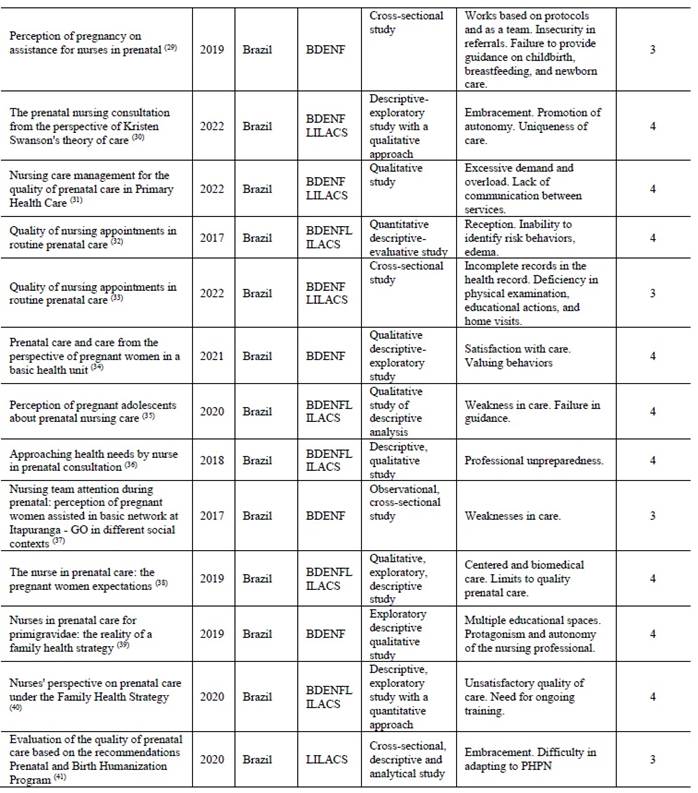
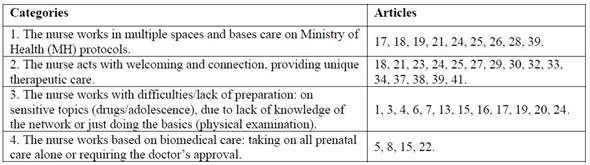
The available evidence (1,336) on antenatal care for women performed by nurses in the AB resulted from the final sample of 25 articles that are presented in the synoptic table (Table 2) .. The final sample was divided into four categories for analysis and discussion of the findings, the detail of the articles indicated in each category is described in Table 3.
In this sense, despite the inclusion criteria of articles published in three languages and in international journals, it can be identified that the 25 articles included in this review were published in national journals, linked to higher education institutions, what symbolizes the importance of them for the production of scientific knowledge about the subject.
Regarding the year of publication, 2019 and 2020 presented the highest concentration of published articles, that is, seven articles were published in 2020 and six in 2019, in 2023 there was only one article published. In turn, the Northeast was recognized as one of the Brazilian regions with the highest number of publications (8), followed by the Southeast region (6), South Region (4), Midwest (3), and the North region (1) was the one with the least published articles on the subject.
In the synthesis stage, having performed the complete reading and registration of the publications, they were classified according to the levels of evidence. This evidence-based approach focuses on classification systems, usually organized in a hierarchical way, depending on the research design, that is, the methodology adopted in the study. 16 Thus, it was possible to identify that five articles are in level three of evidence as being quasi-experimental studies, 19 in level four of evidence as being non-experimental/qualitative descriptive studies, and one with level five of evidence, being from case study.
Discussion
Based on the main results presented by the authors of the selected articles, four categories of thematic analysis were confirmed and discussed in order to meet the objective proposed for this study.
Category 1. The nurse works in multiple spaces and bases care on MH protocols
The nurse’s assistance in prenatal care of PHC in Brazil is usually developed in a single space, that is, within the BHU. However, if we limit the space of UBS as unique, we are also limiting prenatal care. In nine selected studies 17-19,21,24-26,28,39 it was highlighted that it is possible the performance of the nurse in multiple spaces being: health education, home visits and active searches, Interactive groups with pregnant women and family members and the development of new technologies for prenatal care.
Regarding the education spaces, the nine articles cited point out that the nurse performs guidance and seeks to resolve doubts of pregnant women in this period of great changes in their lives, guidelines that allow the development of a safe pregnancy.
As for the more specific guidelines, among the studies stand out pregnant women who use crack 17 and pregnant women with a diagnosis of syphilis 19, in which it is reported that there is a support from the nurse as the dependent patients, encouraging thein the guidelines, diagnosis and treatment for syphilis. It is understood that the role of nursing is crucial in attending pregnant women in this scenario, because the nurse plays a key role in promoting the well-being of mother and child, and preventing transmission to the baby. 42
One of the strategies used cited in the selected articles, 17,18,24 was the creation of interactive groups, as a space outside the facilitator’s office to resolve doubts and deal with issues in general by favoring the exchange of knowledge and ensuring greater empowerment of pregnant women in the face of situations experienced during pregnancy and postpartum. The existence and implementation of these groups in PHC is extremely relevant to prepare the pregnant woman and her relatives for the pregnancy-puerperal period and care for the newborn, which strengthens the family’s bond with the nurse and the health unit. 43
During the consultations, it is the nurse’s responsibility to register them in various information systems that end up taking a good part of the consultations, and there may be failures to access them. In one of the articles included in the research, it depicts the creation of an electronic spreadsheet that optimized its prenatal care, because during its use was noticeable significant time savings (20 minutes per consultation), which generated a greater willingness to answer questions of pregnant women. 26 In addition to the facilitation during decision-making and appropriate conduct, since all information from previous consultations was organized systematically.
The multiple spaces of action found in the articles described, are in line with what is registered in Note 32 of Primary Care. In it we observe how the monitoring and development of a safe pregnancy should be carried out. For example, the approach of educational and preventive activities is recommended, which can be developed through interactive groups with the pregnant woman and family or in each consultation. In this protocol of the Ministry of Health (MH) also mentions that there must be early identification of all pregnant women in the community and their periodic and continuous monitoring, recording all information about the quantity of pregnant women and the development of each query in the information systems. 4
This information becomes important for a space of action that was mentioned, the search active, because the unit having this control of how many pregnant women have and if they are attending the continuous consultations, it becomes easier to observe the faults and go after them in their homes that is another space of action. 4
On the other hand, there are still realities that do not have adherence/existence of action in these multiple spaces going in disagreement with the protocols of MS, as an example we find in four articles of a failure in the creation of an educational space, whose purpose is to bring knowledge and information about pregnancy, childbirth and puerperium, thus compromising the quality of prenatal care. 22,23,29,31
In a study conducted in Canada, it shows the reality of rural populations, which often face significant barriers to access health care, including geographic and financial issues. The lack of transportation, long distances and costs associated with travel are critical obstacles that undermine equity in access to prenatal care. The solutions proposed to improve prenatal care in these areas were mobile health clinics and telemedicine, similar to the extramural activities developed in the research found in this category. 44
Category 2. The nurse acts with welcoming and connection, providing unique therapeutic care
The nurse performance through the reception and construction of links stand out in 15 of the selected studies 18,21,23-25,27,29,30,32-34,37-39,41 in a remarkable way. Because there is an evident appreciation of the actions of reception and listening promoted by the nurse, emphasizing the relevance of the individualized approach in care for the development of a healthy prenatal. This implies, as they emphasize, to devote a holistic attention to women, respecting their beliefs and particularities, and thus fostering a sensitive and integral care practice. 18,33
The consultation with the nurse in prenatal care is a crucial moment for establishing bonds. In these contexts, pregnant women experience a positive evaluation, characterized by respect and the construction of interpersonal relationships marked by interaction, bond, trust, listening and therapeutic relations between nurses and pregnant women. 21 The perception of pregnant women is unanimous in considering the consultation with the nurse as relevant as that carried out by the medical team, and all said they feel welcome and at ease. 45
In this perspective, researchers showed that the improvement in the performance of the nurse during the prenatal follow-up, through the establishment of links with pregnant women, favors the continuity of prenatal care. In this context, the consolidation of the link in the prenatal consultation occurs most effectively when nurses show respect for each woman’s intrinsic beliefs and values. 45
A selected article also highlighted that during the consultation, women reported feeling more comfortable with the nurse, claiming to have received greater attention, improved understanding, and feel more welcomed and valued. The reports indicate that the attention offered during the consultation plays a significant role in the positive perception of pregnant women, highlighting the importance of feeling valued. It is crucial to note that, according to the participants, nurses play a key role in the humanization and transformation of the delivery and birth care model in our country. 29
In a survey conducted in Peru, the participants considered the nurse’s reception as an important aspect, providing them with security and the opportunity to clarify all doubts, since they showed constant willingness to listen and meet the needs of pregnant women. 46
In this category, emphasis was placed on the effectiveness of certain actions performed by nurses during care that aimed to provide safety and establish a significant link with the patient. These practices not only provide tranquility, but also promote autonomy in the care of pregnancy, resulting in a quality prenatal care, as the woman receives comprehensive and enlightening information. 46
In a study that measured the quality of prenatal care, nurses were observed receiving patients courteously, applying qualified listening, using appropriate language and ensuring privacy, with full respect for confidentiality. In addition, they performed a satisfactory anamnesis, with accurate calculations of the gestational age and probable date of delivery, duly reviewed and recorded. 32
The reception is a fundamental strategy to establish effective links with pregnant women. This method involves the warm welcome of the pregnant woman, using a welcoming posture, calling her by name and providing an active listening. 27 In addition, the study emphasizes openness to clarify doubts and understand the desires of pregnant women, these actions being crucial to reorganize the work approach. The main orientation is directed to provide comfort and safety to pregnant women, thus promoting an environment conducive to effective prenatal care.
The reception was highlighted in the attention during consultations, the approach of problems in pregnancy, the investigation of current complaints, guidance on vaccination and readiness to clarify doubts were notable aspects. The use of clear language, consultation time and professional competence appear as positive contributions. 44
Category 3. The nurse works with difficulties/lack of preparation: on sensitive topics (drugs/adolescence), due to lack of knowledge of the network or just doing the basics (physical examination)
Some difficulties and unpreparedness in the performance of the nurse in prenatal care were evidenced in 12 studies. 17,19,20,22,23,29,31-33,35,36,40) Among the selected studies, 17,20,22,36 highlight social stigmas and lack of adequate training, because many professionals have difficulty when they encounter situations of social vulnerability. In addition, when the nurse has contact with audiences that need approaches outside of physical-obstetric, they have difficulty in having a holistic look at the conditions and experiences of patients, such as the cases of pregnant adolescents, drug users and alcohol. Addressing these issues in an open and comprehensive manner, using protocols and strategies, is essential to provide effective support to patients, promoting health and preventing future problems. 47
The weaknesses in the care of pregnant women were pointed out, especially those who are in situations of vulnerability, such as when they are carriers of some disability, because besides facing sociocultural prejudice and difficulties in communication, the performance of the nurse was characterized as limited, and that the training of these professionals is essential to improve the quality of care for all the prenatal public. 41
As for the difficulties/unpreparedness in referring high-risk pregnant women, articles 19,29,32,40 point out that nurses do not know how to drive and where to drive or even do not refer them to perform necessary tests. This aspect is relevant since referral to other services allows access to specialized care and can often save the life of the mother-baby binomial, so it is the nurse’s obligation to understand how the health network works. 48
Thus, in five articles 23,29,31,32,35, one of the most evident points regarding professional unpreparedness in prenatal care was the lack of information on reproductive planning, preconception evaluation, delivery, pregnancy, breastfeeding and care for the newborn, and the non-identification of risk behaviors for STI and guidance regarding protection, even not guidance on performing rapid tests and importance of performing prenatal care.
Another extremely important point presented in articles 32,33) was the lack of physical examinations. Many nurses performed obstetric examinations and cardiofetal auscultation, however, did not perform the screening for edema, breast and gynecological examination, rapid tests, even when the pregnant woman had symptoms of respiratory discomfort.
The gaps in prenatal care, either by lack of guidance or by the absence of physical examination, are evident in national and international studies, in which he pointed out that women are more informed about the process of parturition by means of communication than in the consultation with the nurse. And that despite scoring good marks in the research on the guidance provided, when asked about pain relief methods, true contractions, right time to go to the maternity hospital, rights at the time of delivery most did not know. In addition, deficiencies were identified in the knowledge and practice of prenatal care among pregnant women. For this reason, it is suggested that the lack of information, guidance and inadequate prenatal care practices are associated with adverse maternal and neonatal health outcomes. 49,50
It is worth noting that knowledge is interconnected with the female empowerment and autonomy of her pregnancy, once the woman knows her rights and knows the processes that await her she feels safer to choose her way of delivery and talk about behaviors, and the nurse has a key role to disseminate this knowledge. 49
Category 4. A The nurse works based on biomedical care: taking on all prenatal care alone or with the need for a doctor's approval
Four studies were included in this category. 21,24,31,38 The biomedical model impacts the organization of the health work process and, consequently, restricts the technical autonomy of the nurse. In this care model, the doctor is the professional who has the highest degree of autonomy, acting as a central actor, limiting and conditioning the professional autonomy of the nurse by the demands of medical work.
In the PHC, collective work in health provides different degrees of autonomy and does not exclude the fact that nurses also decide and define behaviors to perform their work, especially in internal routines, assuming control over the technical component of their work and the appropriation of a knowledge to execute the process of managerial work. 51
Related to this, in the studies selected in the surveys carried out in municipalities of the Southern region of Brazil in the Family Health Strategy (FHS) 24,31, they pointed out that there is a low number of professionals in the teams, especially doctors and a high number of visits. For this reason, the nurse assumes the demands of prenatal alone, resulting in overwork and an excessive amount of assignments that are mostly not duties of the nurse, which should ideally be distributed among the professionals of the multiprofessional team. As a consequence of the insufficient number of professionals involved in prenatal care, the quality of care provided to pregnant women is low. 52
The nurse has many attributions that extrapolate the direct service to the user, which may be a consequence of the demands generated by institutions and social division of labor, being necessary to identify the competence of each team member, so that the limits are not exceeded, being indispensable the definition of roles, given that the various responsibilities require different skills, because the service involves individual and collective approaches, highlighting the importance of sharing tasks with a multiprofessional team so that there is no work overload or that does not affect the quality care. 53
Furthermore, pregnant women and nurses have contrary ideas about the responsibilities of the nurse in prenatal care. The pregnant women suggest that nurses should make an appointment for the doctor and return to the nursing appointment, when they do not do so they are the target of criticism. Another aspect of divergence is that when pregnant women do not have all their demands resolved by the nurse, due to legal issues of professional competence or specificities, such as prescribing antibiotics and performing some procedures, referral to a doctor by the nurse is seen as limited knowledge or incompetence. 21
In this category, only one study carried out in Rio de Janeiro (Brazil) 31 deals with teamwork and highlights that pregnant women felt more at ease in consulting with the nurse than with the doctor, because they were better welcomed and valued, highlighting the attention received, since, with the doctor the conduct is different, demonstrating coldness and not focusing on the human being as a whole, conforming to the biomedical model, contrary to the ideal model for a quality prenatal. 38
Contrasting the satisfaction of pregnant women with the nurse’s consultation, a study from Fortaleza-Ceará (Brazil) showed dissatisfaction with the nursing consultation in the absence of reference and counter-reference and when there is lack of information. These women consider that quality prenatal care is one with the presence of technological resources, where professionals develop an integral and welcoming care. 54
Study limitations
One point to highlight was the instability of the CAPES Journal Portal during article searches, because it did not load on a certain page and this required a delay in collection. In the selection phase, some articles did not imply in their abstracts which health professional was researched and therefore were excluded.
Conclusion
Through the literature available and selected, the performance of the nurse in prenatal care is based on scientific evidence, biomedical care and with relative professional autonomy. However, challenges persist, such as difficulties in the management of sensitive issues and limitations in the approach beyond physical examination, compromising the comprehensiveness of care.
Thus, it is essential that the professional training strengthens the autonomy of the nurse, ensuring that she fully exercises her role according to the guidelines of the Ministry of Health. In addition, new research should be encouraged to update and expand the evidence in the field.
References
-
1. Paiz JC, Ziegelmann PK, Martins ACM, Giugliani ERJ, Giugliani C. Fatores associados à satisfação das mulheres com a atenção pré-natal em Porto Alegre, Rio Grande do Sul, Brasil. Ciênc Saúde Coletiva (Internet). 2021;26(8):3041-51. doi: 10.1590/1413-81232021268.15302020
» https://doi.org/10.1590/1413-81232021268.15302020 -
2. Ayres JRCM. Cuidado e reconstrução das práticas de saúde. Interface (Botucatu). 2004;8(14):73-92. doi: 10.1590/S1414-32832004000100005
» https://doi.org/10.1590/S1414-32832004000100005 -
3. Vale EG, Pagliuca LMF. Construção de um conceito de cuidado de enfermagem: contribuição para o ensino de graduação. Rev Bras Enferm. 2011;64(1):106-13. doi: 10.1590/S0034-71672011000100016
» https://doi.org/10.1590/S0034-71672011000100016 -
4. Brasil. Ministério da Saúde. Cadernos de Atenção Básica: Atenção ao pré-natal de baixo risco (Internet). 2012. Disponível em: https://bvsms.saude.gov.br/bvs/publicacoes/cadernos_atencao_basica_32_prenatal.pdf
» https://bvsms.saude.gov.br/bvs/publicacoes/cadernos_atencao_basica_32_prenatal.pdf -
5. Brasil. Decreto n. 94.406, de 8 de junho de 1987. Regulamenta a Lei nº 7.498, de 25 de junho de 1986, que dispõe sobre o exercício da enfermagem, e dá outras providências (Internet). Brasília; 1986 (citado 2024 abr 17). Disponivel em: Disponivel em: https://www2.camara.leg.br/legin/fed/decret/1980-1987/decreto-94406-8-junho-1987-444430-publicacaooriginal-1-pe.html
» https://www2.camara.leg.br/legin/fed/decret/1980-1987/decreto-94406-8-junho-1987-444430-publicacaooriginal-1-pe.html -
6. Brasil. Lei n. 7.498, de 25 de junho de 1986. Dispõe sobre a regulamentação do exercício da enfermagem, e dá outras providências (Internet). Brasília; 1986 (citado 2024 abr 17). Disponível em: Disponível em: https://www.planalto.gov.br/ccivil_03/leis/l7498.htm
» https://www.planalto.gov.br/ccivil_03/leis/l7498.htm -
7. Gonçalves ITJP, Souza KV, Amaral MA, Oliveira ARS, Ferreira WFC. Prática do acolhimento na assistência pré-natal: limites, potencialidades e contribuições da enfermagem. Rev Rene. 2017;14(3):620-9. Disponível em: http://www.periodicos.ufc.br/rene/article/view/3503
» http://www.periodicos.ufc.br/rene/article/view/3503 -
8. Leal M do C, Esteves-Pereira AP, Viellas EF, Domingues RMSM, Gama SGN da. Prenatal care in the Brazilian public health services. Rev Saude Publica (Internet). 2020; 54:8. doi: 10.11606/s1518-8787.2020054001458
» https://doi.org/10.11606/s1518-8787.2020054001458 -
9. Dantas HLL, Costa CRB, Costa LMC, Lúcio IML, Comasseto I. Como elaborar uma revisão integrativa: sistematização do método científico. Rev Recien. 2022;12(37):334-45. doi: 10.24276/rrecien2022.12.37.334-345
» https://doi.org/10.24276/rrecien2022.12.37.334-345 -
10. Institute TJB. Joanna Briggs Institute Reviewers’ Manual: 2014 Edition. (Internet). Adelaide: Joanna Briggs Institute; 2014 (citado 2025 jan 20). Disponível em: Disponível em: http://joannabriggs.org/assets/docs/sumari/ReviewersManual-2014.pdf
» http://joannabriggs.org/assets/docs/sumari/ReviewersManual-2014.pdf -
11. Stern C, Jordan Z, McArthur A. Developing the review question and inclusion criteria. Am J Nurs. 2014;114(4):53-6. doi: 10.1097/01.NAJ.0000445689.67800.86
» https://doi.org/10.1097/01.NAJ.0000445689.67800.86 -
12. Brasil. Ministério da Saúde. Portaria n° 2.436, de 21 de setembro de 2017. Aprova a Política Nacional de Atenção Básica, estabelecendo a revisão de diretrizes para a organização da Atenção Básica, no âmbito do Sistema Único de Saúde (SUS). Diário Oficial da União (Internet). 2017 (citado 2024 abr 16);Seção 1:68. Disponível em: Disponível em: https://bvsms.saude.gov.br/bvs/saudelegis/gm/2017/prt2436_22_09_2017.html
» https://bvsms.saude.gov.br/bvs/saudelegis/gm/2017/prt2436_22_09_2017.html -
13. Ouzzani M, Hammady H, Fedorowicz Z, Elmagarmid A. Rayyan: a web and mobile app for systematic reviews. Syst Rev. 2016;5:210. doi: 10.1186/s13643-016-0384-4
» https://doi.org/10.1186/s13643-016-0384-4 -
14. Valle PRD, Ferreira JL. Análise de conteúdo na perspectiva de Bardin: contribuições e limitações para a pesquisa qualitativa em educação (Internet). SciELO Preprints. 2024 (citado 2025 jan 15). doi: 10.1590/SciELOPreprints.7697
» https://doi.org/10.1590/SciELOPreprints.7697 -
15. Page MJ, McKenzie JE, Bossuyt PM, Boutron I, Hoffmann TC, Mulrow CD, et al. A declaração PRISMA 2020: diretriz atualizada para relatar revisões sistemáticas. Rev Panam Salud Publica (Internet). 2022 (citado 2025 jan 15);46:e112. doi:10.26633/RPSP.2022.112
» https://doi.org/10.26633/RPSP.2022.112 -
16. Galvão CM. Níveis de evidência. Acta paul enferm (Internet). 2006;19(2):5. doi: 10.1590/S0103-21002006000200001
» https://doi.org/10.1590/S0103-21002006000200001 -
17. Rizzo ER, Messias CM, Valente GSC, Basílio MD, Santos ME, Ferreira SR. O enfermeiro frente ao pré-natal das gestantes usuárias de crack. Enferm Brasil. 2020;19(2):136-47. doi: 10.33233/eb.v19i2.3225
» https://doi.org/10.33233/eb.v19i2.3225 -
18. Dias BR, Oliveira VA da C. Percepção de gestantes sobre a assistência de enfermagem realizada durante o pré-natal de risco habitual. R Enferm Cent O Min (Internet). 2019 (citado 2025 jan 23);9:e3264. doi: 10.19175/recom.v9i0.3264
» https://doi.org/10.19175/recom.v9i0.3264 -
19. Nunes JT, Marinho ACV, Davim RMB, Silva GG de O, Félix RS, Martino MMF de. Sífilis na gestação: perspectivas e condutas do enfermeiro. Rev Enferm UFPE Online (Internet). 2017 (citado 2025 jan 23);11(12):4875-84. doi: 10.5205/1981-8963-v11i12a23573p4875-4884-2017
» https://doi.org/10.5205/1981-8963-v11i12a23573p4875-4884-2017 -
20. Caires TLG, Santos RS, Ribeiro LCC. Prevenção do consumo de bebida alcoólica durante a gestação: atuação de enfermeiras no pré-natal. Rev Enferm Cent Oeste Min. 2019;9:e2938. doi:10.19175/recom.v9i0.2938
» https://doi.org/10.19175/recom.v9i0.2938 -
21. Gomes CB de A, Dias R da S, Silva WGB, Pacheco MAB, Sousa FGM de, Loyola CMD. Prenatal nursing consultation: narratives of pregnant women and nurses. Texto Contexto Enferm. 2019;28:e20170544. doi: 10.1590/1980-265X-TCE-2017-0544
» https://doi.org/10.1590/1980-265X-TCE-2017-0544 -
22. Parenti PW, Silva LCFP da, Sola EPS, Venâncio KCPM, Ferreira FM, Camargo J da CS de. Experiências de enfermeiras da atenção primária à saúde no atendimento pré-natal de adolescentes. Rev Fam Ciclos Vida Saúde Contexto Soc (Internet). 2018 (citado 2025 jan 23);6(1):72-8. doi: 10.18554/refacs.v6i1.2796
» https://doi.org/10.18554/refacs.v6i1.2796 -
23. Chaves IS, Rodrigues IDCV, Freitas CKAC, Barreiro MSC. Pre-natal consultation of nursing: satisfaction of pregnant women. Rev Fun Care Online. 2020;12:814-9. doi: 10.9789/2175-5361.rpcfo.v12.7555
» https://doi.org/10.9789/2175-5361.rpcfo.v12.7555 -
24. Sehnem GD, Saldanha LS, Arboit J, Ribeiro AC, Paula FM, Morais F. Consulta de pré-natal na atenção primária à saúde: fragilidades e potencialidades da intervenção de enfermeiros brasileiros. Rev Enf Ref (Internet). 2020 (citado 2025 jan 24);1(1):e19050. doi: 10.12707/RIV19050
» https://doi.org/10.12707/RIV19050 -
25. Souza RA, Santos MS, Messias CM, Silva HCDA, Rosas AMMTF, Silva MRB. Avaliação de qualidade da assistência pré-natal prestada pelo enfermeiro: pesquisa exploratória. Online Braz J Nurs (Internet). 2020 (citado 2025 jan 23);19(3). doi: 10.17665/1676-4285.20206377
» https://doi.org/10.17665/1676-4285.20206377 -
26. Gomes BKG, Abreu MA, Lino MKR, Silva EP, Lima LC, Lopes KG de D, et al. Integração entre enfermagem obstétrica e tecnologia da informação: aprimorando a assistência pré-natal com uma planilha eletrônica. Rev Foco (Internet). 2023 (citado 2025 jan 24);16(6):e2403. doi: 10.54751/revistafoco.v16n6-159
» https://doi.org/10.54751/revistafoco.v16n6-159 -
27. Bortoli CFC, Bisognin P, Wilhelm LA, Prates LA, Sehnem GD, Ressel LB. Factors that enable the performance of nurses in prenatal. Rev Fun Care Online. 2017;9(4):978-83. doi: 10.9789/2175-5361.2017.v9i4.978-983
» https://doi.org/10.9789/2175-5361.2017.v9i4.978-983 -
28. Serafim ALC, Marques AA, Cândido DB, Marques RM. Orientações alimentares na assistência pré-natal: avaliação do processo em unidades básicas de saúde. R Assoc Bras Nutr (Internet). 2021 (citado 2025 jan 23);12(2):133-45. Disponível em: Disponível em: https://www.rasbran.com.br/rasbran/article/view/1528
» https://www.rasbran.com.br/rasbran/article/view/1528 -
29. Pereira IP, Giotto AC. Percepção das gestantes em relação ao atendimento pré-natal de baixo risco realizado pelo enfermeiro. Rev Inic Cient Ext. 2019;2(1):250-7. doi: 10.33448/rsd-v10i10.18785
» https://doi.org/10.33448/rsd-v10i10.18785 -
30. Paes RLC, Rodrigues DP, Alves VH, Silva SÉD, Cunha CLF, Carneiro MS, et al. A consulta de enfermagem no pré-natal sob a ótica da teoria do cuidado de Kristen Swanson. Cogitare Enferm (Internet). 2022;27:e82601. doi: 10.5380/ce.v27i0.82601
» https://doi.org/10.5380/ce.v27i0.82601 -
31. Amorim TS, Backes MTS, Carvalho KM, Santos EKA, Dorosz PAE, Backes DS. Gestão do cuidado de enfermagem para a qualidade da assistência pré-natal na atenção primária à saúde. Esc Anna Nery (Internet). 2022;26:e20210300. doi: 10.1590/2177-9465-EAN-2021-0300
» https://doi.org/10.1590/2177-9465-EAN-2021-0300 -
32. Oliveira IG, Castro LL, Massena AM, Santos LVF, Sousa LB, Anjos SJSB. Qualidade da consulta de enfermagem na assistência ao pré-natal de risco habitual. Rev Eletrônica Enferm. 2017;19:a28. doi: 10.5216/ree.v19.40374
» https://doi.org/10.5216/ree.v19.40374 -
33. Santos PS, Terra FS, Felipe AOB, Calheiros CAP, Costa ACB, Freitas PS. Assistência pré-natal pelo enfermeiro na atenção primária à saúde: visão da usuária. Enferm Foco. 2022;13:e202229. doi: 10.21675/2357-707X.2022.v13.e-202229
» https://doi.org/10.21675/2357-707X.2022.v13.e-202229 -
34. Batista CR, Santos FS, De Oliveira FJF, Santos LFS, Pascoal LM, Costa ACP de J, et al. Assistência pré-natal e acolhimento sob a ótica de gestantes na atenção primária à saúde: estudo qualitativo. Rev Enferm Atual In Derme. 2021;95(34):e-021074. Disponível em: https://revistaenfermagematual.com.br/index.php/revista/article/view/1027
» https://revistaenfermagematual.com.br/index.php/revista/article/view/1027 -
35. Carvalho SS, Oliveira LF. Percepção de adolescentes gestantes sobre a assistência de enfermagem ao pré-natal. Enferm Foco. 2020;11(3). doi: 10.21675/2357-707X.2020.v11.n3.2868
» https://doi.org/10.21675/2357-707X.2020.v11.n3.2868 -
36. Miranda EF, Ana S, Nei E. Abordagem de necessidades de saúde pelo enfermeiro na consulta pré-natal. Rev Pesqui (Univ Fed Estado Rio J, Online) (Internet). 2018;10(2):524-33. doi: 10.9789/2175-5361.2018.v10i2.524-533
» https://doi.org/10.9789/2175-5361.2018.v10i2.524-533 -
37. Rocha AC, Andrade GS. Atenção da equipe de enfermagem durante o pré-natal: percepção das gestantes atendidas na rede básica de itapuranga - go em diferentes contextos sociais. Rev Enferm Contemp. 2017;6(1):30-41. doi: 10.17267/2317-3378rec.v6i1.1153
» https://doi.org/10.17267/2317-3378rec.v6i1.1153 -
38. Assunção CS, Rizzo ER, dos santos ME, de Carvalho JB, Basílio MD, Messias CM. The Nurse in Prenatal Care: The Pregnant Women Expectations / O Enfermeiro no Pré-Natal: Expectativas de Gestantes. Rev. Pesqui. (Univ. Fed. Estado Rio J., Online) (Internet). 2020;11(3):576-81. doi: 10.9789/2175-5361.2019.v11i3.576-581
» https://doi.org/10.9789/2175-5361.2019.v11i3.576-581 -
39. Weschenfelder DT, Reolon-Costa A, Ceolin S. O enfermeiro na assistência do pré-natal de primigestas: a realidade de uma estratégia de saúde da família. Rev Enferm Contemp. 2019;8(1):7-16. doi: 10.17267/2317-3378rec.v8i1.1626
» https://doi.org/10.17267/2317-3378rec.v8i1.1626 -
40. Carla L, Maria S, Daniella P, Cavalcante E, Lúcia M, Cristina E. Perspectiva dos enfermeiros sobre a assistência pré-natal no âmbito da Estratégia Saúde da Família. Rev Enferm UFSM (Internet). 2020;10:e44. doi: 10.5902/2179769238444
» https://doi.org/10.5902/2179769238444 -
41. Mendes RB, Santos JM de J, Prado DS, Gurgel RQ, Bezerra FD, Gurgel RQ. Avaliação da qualidade do pré-natal a partir das recomendações do Programa de Humanização no Pré-natal e Nascimento. Ciênc Saúde Coletiva. 2020;25(3). doi: 10.1590/1413-81232020253.13182018
» https://doi.org/10.1590/1413-81232020253.13182018 -
42. Silva CMP da, Cunha GGG da, Passos SG de. Gestantes diagnosticadas com sífilis e os cuidados da Enfermagem. Rev JRG (Internet). 2023 (citado 2025 jan 25);6(13):1546-59. doi: 10.55892/jrg.v6i13.745
» https://doi.org/10.55892/jrg.v6i13.745 -
43. Santos EAM, Lima LV de, Cavalcante JR do C, Amaral MS. A relevância do grupo de gestantes na Atenção Primária à Saúde: uma revisão da literatura. REAEnf (Internet). 2022 (citado 2025 jan 25);17:e9837. doi: 10.25248/reaenf.e9837.2022
» https://doi.org/10.25248/reaenf.e9837.2022 -
44. Kneller M, Pituskin E, Tegg NL, Norris CM. Rural prenatal care by nurse practitioners: A narrative review. Women’s Health Reports (Internet). 2023;4(1):262-70. doi: 10.1089/whr.2023.0011
» https://doi.org/10.1089/whr.2023.0011 -
45. Silva AABD, Andrade C. O papel do enfermeiro na assistência pré-natal, na educação e na promoção da saúde. Pesqui, Soc e Desenvolv. 2020;10:e9989109477. doi: 10.33448/rsd-v9i10.9477
» https://doi.org/10.33448/rsd-v9i10.9477 -
46. Enríquez Canto Y. Desigualdades en la cobertura y en la calidad de la atención prenatal en Perú, 2009-2019. Rev Panam de Salud Pública (Internet). 2022;46:e47. doi: 10.26633/RPSP.2022.47
» https://doi.org/10.26633/RPSP.2022.47 -
47. Ferraz Dos Santos AC, Feria Vador RM, Cunha FV, e Silva ADA. Abordagem do Enfermeiro na Gravidez na Adolescência. Braz. J. Hea. Rev. (Internet). 2020 (citado 2025 jan 25);3(6):17438-56. doi: 10.34119/bjhrv3n6-161
» https://doi.org/10.34119/bjhrv3n6-161 -
48. Rodrigues DB, Backes MTS, Delziovo CR, Santos EKA dos, Damiani P da R, Vieira VM. Complexity of high-risk pregnancy care in the health care network. Rev Gaúcha Enferm (Internet). 2022;43:e20210155. doi: 10.1590/1983-1447.2022.20210155.en
» https://doi.org/10.1590/1983-1447.2022.20210155.en -
49. Silva SR, Luz JLF, Floriani DTGC, Rosa T. Lacunas no conhecimento das gestantes: falhas na assistência pré-natal e o papel do enfermeiro. Contemp - Rev de Ética e Filos Polít. 2023;3(1):299-329. doi: 10.56083/RCV3N1-019
» https://doi.org/10.56083/RCV3N1-019 -
50. Khan MMF, Mumtaz MT, Uzair M, Khan NA, Khalid MD, Khan MA. Nurturing New Life: Examining Pregnant Women’s Knowledge and Perception of Prenatal Care and Breastfeeding. Pak J Med Health Sci (Internet). 2023 (citado 2024 sep 4);17(05):287. doi: 10.53350/pjmhs2023175287
» https://doi.org/10.53350/pjmhs2023175287 - 51. Melo CMM, Florentino TC, Mascarenhas NB, Macedo KS, Silva MC, Mascarenhas SN. Autonomia profissional da enfermeira: algumas reflexões. Esc Anna Nery . 2016;20(4):e20160085. doi: 10.5935/1414-8145.20160085
-
52. Dias EG, Santos MCB, Sousa PH de, Campos LM, Caldeira MB. A consulta de enfermagem no pré-natal por equipes de Saúde da Família em uma cidade mineira. Espac. Saude (Internet). 2023 (citado 2025 jan 25);24. doi: 10.22421/1517-7130/es.2023v24.e962
» https://doi.org/10.22421/1517-7130/es.2023v24.e962 -
53. Soares CES, Biagolini REM, Bertolozzi MR. Atribuições do enfermeiro na unidade básica de saúde: percepções e expectativas dos auxiliares de enfermagem. Rev da Esc de Enferm da USP. 2013;47(4):915-21. doi: 10.1590/S0080-623420130000400020
» https://doi.org/10.1590/S0080-623420130000400020 -
54. Guerreiro EM, Rodrigues DP, Silveira, MAM, Ferreira, NB. O cuidado pré-natal na atenção básica de saúde sob o olhar de gestantes e enfermeiros. Rev. Min. Enferm. 2012;16(3):315-23. doi: 10.35699/reme.v16i3.50297
» https://doi.org/10.35699/reme.v16i3.50297