The Covered Face of Stereotypes: Benevolent Sexism in the Reproduction of Social Inequalities
Abstract:
This study aimed to replicate the Stereotype Content Model instrument in a Brazilian sample of 245 individuals, mapping the stereotypes produced by participants from southern Brazil and adding the gender variable to the social groups evoked. The instrument compares the dimensions of Warmth and Competence, which correspond to the sympathy or competitiveness that social groups elicit. The results showed that the differences were more frequently in favor of male groups. Female social groups were only seen as more competent and warmer than their male counterparts in the case of Unemployed, Poor, and Black Women. From the perspective of racism and gender, we discuss that stereotypes also uphold sexist norms, sometimes benevolent and sometimes hostile, as a way of transmitting traditional ideologies, encouraging the maintenance of social positions that are beneficial to the unequal social system.
Keywords:
stereotypes; sexism; intergroup relations; gender; prejudice.
Resumo:
O presente estudo buscou replicar em uma amostra brasileira de 245 indivíduos o instrumento Modelo do Conteúdo dos Estereótipos, mapeando os estereótipos produzidos em uma amostra de brasileiros do sul do país e acrescentando a variável gênero para os grupos sociais evocados. O instrumento prevê a comparação das dimensões Sociabilidade e Competência, as quais correspondem à simpatia ou à competitividade que os grupos sociais despertam. Os resultados demonstraram que as diferenças se deram mais frequentemente no favorecimento aos grupos masculinos. Os grupos sociais femininos apenas foram vistos como mais competentes e mais sociáveis que seus correspondentes masculinos no caso de Mulheres Desempregadas, Pobres e Negras. Discutimos, sob a ótica do racismo e do gênero, que os estereótipos também conservam normas sexistas, ora benevolentes ora hostis, como uma forma de transmissão de ideologias tradicionais, estimulando a manutenção de posições sociais que são úteis ao sistema social desigual.
Palavras-chave:
estereótipos; sexismo; relações intergrupais; gênero; preconceito
Resumen:
Este estudio tuvo como objetivo replicar el instrumento Modelo del Contenido de los Estereotipos en una muestra brasileña de 245 personas, mapeando los estereotipos producidos en una muestra de brasileños del sur del país y agregando la variable género a los grupos sociales evocados. El instrumento prevé la comparación de las dimensiones Sociabilidad y Competencia, que corresponden a la simpatía o competitividad que los grupos sociales despiertan. Los resultados mostraron que las diferencias se dieron con más frecuencia en favor de los grupos masculinos. Los grupos sociales femeninos solo fueron vistos como más competentes y sociables que sus contrapartes masculinas en el caso de Mujeres Desempleadas, Pobres y Negras. Desde la perspectiva del racismo y género, discutimos que los estereotipos también conservan normas sexistas, algunas veces benevolentes y otras hostiles, como una forma de transmisión de ideologías tradicionales, estimulando el mantenimiento de posiciones sociales que son útiles al sistema social desigual.
Palabras clave:
estereotipos; sexismo; relaciones intergrupales; género; prejuicio
Multiple theories seek to explain and operationalize the concept of a stereotype. They mainly differ on the emphasis placed on the function exerted by the categorization of the stereotyped images. The studies about stereotypes began with Walter Lippmann (1922), who postulates that stereotypes tell us “about the world before we see it. We imagine most things before we experience them” (p. 91). He believes stereotypes contain the core of our personal tradition and act as strongholds for our positions in society, adding: “no wonder, then, that any disturbance of the stereotypes seems like an attack on the foundations of the universe” (p. 96). Lippmann presents the idea that stereotypes precede one’s relation to the world, working as a fixed repertoire of impressions which mold perception even before something is directly experienced. Thus, besides saving time in daily life, stereotypes serve as a defense of the position one occupies in society. It also preserves us from the awkward effort of trying to see the world in a whole and continuous way, of facing it in all its complexity and variability.
Allport (1954) also examined the function of stereotypes and understood the stereotype as a means of mental economy, defining it as the product of a rigid and unavoidable cognitive process. In the foundation of this idea lies the belief that such phenomenon is individual, as it helps in social interactions. Hence ways of understanding the world are created through the observation of a specific feature; this feature marks a known type and the rest of the image is formed by preconceived schemes. Allport’s ideas paved the way for a field later called social cognition studies, which sees stereotypes as socially shared beliefs that direct mental resources and guide coding and the retrieval of information from memory. In accordance, stereotypes emerge and develop from a basic cognitive need to simplify social environments through group categorization (Thiele, 2022).
Multiple authors regard stereotypes as subjective processes in which an individual perceives, understands, and justifies an existing structure or situation with the intention of maintaining it (Jost & Banaji, 2020; Liaquat & Jost, 2023; Rubin et al., 2023). They argue that such categorizations are not simple and serve to underpin ideological forces and social control; these, however, do not protect the interests of the individual or group. According to this perspective, such justification is in service of the preservation of a larger social structure, even if it implies psychological and material harm to disadvantaged individuals and groups. The background of these processes, therefore, gains greater relevance.
Through this perspective, the function of stereotypes would also be linked to the preservation of the statu quo and, for this reason, the maintenance of unequal social systems, as defended by Tajfel (1984) and later elaborated upon by Yzerbyt et al. (1997). This is the function presented in the theory of Social Dominance (Ho et al., 2012), which demonstrates that values are maintained by subjects who occupy a dominant position, but also by those who are subaltern, even if this is not rationalized. The theory of Social Dominance seeks to, in the form of social value, integrate psychological and sociological theories about the processes involving prejudice and discrimination. As such, it has its foundation on the idea that society is organized from a perspective of social hierarchies and, therefore, consists of a small system of dominant and hegemonic groups at the top, with subordinate groups below, in a social pyramid, revealing hierarchical systems with a high degree of stability (Kleppesto et al., 2024). Hegemonic groups can be formed based on social or political value, or on superior or more positive access to resources to the detriment of other groups (Giger et al., 2015).
Emphasizing the relationships arising from individuals’ self-perception of belonging to groups, Tajfel and Turner (1979) propose the Social Identity theory. Its fundamental idea is as follows: based on the competition for resources, the rivalry between groups tends to intensify morale, cohesion, and cooperation within groups (among similar individuals). In this perspective, stereotypes serve to accentuate the similarities of the ingroup (group of belonging) and highlight intergroup differences (outgroups) as natural, thus reflecting the reality of the relationship between groups. The behavioral variable arises from the premise that the more intense the intergroup conflict, the greater the likelihood that individuals identified with opposing groups will behave in service of their group affiliations (Tajfel & Turner, 1979). Similarly, there would be a tendency for individuals to perceive members of outgroups in a homogeneous way, unlike their perception of their ingroup peers, who would be seen as having greater heterogeneity. This results in those perceived as belonging to outgroups being the target of more stereotypical perceptions compared to individuals from the ingroup (Böhm et al., 2020).
The present study is based on the assertion that, although stereotypes are a form of “mental economy” as claimed by Allport and authors of social cognition, they serve to preserve unequal social relations, socially dominant groups, and conflicts of interest, as stated by authors of Social Identity theory. As Tajfel and Turner (1979) have stated, whenever social stratification is based on a social division of scarce resources-such as power, prestige, or wealth-ethnocentrism will be the basis of the relationship between more or less favored groups. And with this, stereotypes end up being a way of justifying prejudiced expressions (Böhm et al., 2020).
Based on the logic of belonging and the relationship between groups, Fiske et al. (2002) suggest that the observer wants to know the other’s intention, whether positive or negative, and subsequently their capacity to compete for resources in society. From this, they developed the Stereotype Content Model (SCM). This model aims to map the content of stereotyped perceptions of social groups, and uses two evaluative dimensions: Warmth and Competence (Fiske et al., 2002; Fiske & North, 2015; Nicolas et al., 2022; Operario & Fiske, 2001; Schofield et al., 2022).
According to SCM, Warmth (W) relates to the observed subject’s perceived intention and the group in which they are placed by the observer. Meanwhile, Competence (C) corresponds to the degree of action capability the observed subject seems to have. In social interactions, SCM also exposes how very complimentary perceptions in one of the dimensions are not necessarily positive, as they may imply a decrease in the other dimension. That is, a group may prompt sympathy (higher W value), but disrespect (lower C value), or the other way around; they might be perceived as cold (lower W value), but seen as worthy of respect (higher C value) (Canton et al., 2023; Nicolas et al., 2022; Schofield et al., 2022).
The social groups more frequently perceived as part of the first quadrant (W > C) are, for example, housewives, elderly people, or persons with disabilities. As for the second quadrant (C > W), they’re often “non-traditional” women (who have jobs outside the home and/or are feminists), as well as people of Asian or Jewish ancestry (Fiske et al., 2002; Fiske & North, 2015). In subgroups involving the category of women, group perceptions derived from envy are observed, such as the perception that women from non-traditional female groups (such as career women, feminists, lesbians, or athletes) are unpleasant, rude, and dominant, as well as distinct perceptions, directed at housewives, for example, who are seen as agreeable, dependent, and affectionate (Canton et al., 2023; Fiske et al., 2002). These data correspond to the authors’ research with the population of the US, the country in which the instrument was created (Fiske & North, 2015; Nicolas et al., 2022).
Although the literature on stereotypes contains disagreements, the models could be seen as complementary. That is, even though the social categorization of stereotypes is inevitable and fulfills an adaptive function by allowing people to organize the social world, debate about the fundamental dimensions that structure their content is indispensable. Therefore, the SCM can function as an instrument that encompasses different theoretical perspectives. As argued by the authors of Social Identity, stereotypes are images that reproduce a series of ideologies implicit in social relations, as well as being a form of denunciation of the competitive relationship of all subjects who interact socially (Cuddy et al. 2009; Fiske et al., 2002). In our understanding, the SCM can be an excellent tool not only to highlight such relationships, but also to bring to light the implicitly negative content of laudatory perceptions, thus overcoming the barrier of social desirability in stereotype research.
For the present study, it is of note that as the model was created originally in the English language some linguistic nuances, mainly related to gender, could be lost. This is because the Portuguese language has a series of gendered contents, with no neutral gender, and many words that do not allow variations in the feminine gender, reducing many words, including in number inflection, to the masculine gender. This absence is problematized by gender studies, whose frequent use of “x”, “@” or even the letter “e” in place of the article that indicates gender serves to highlight the masculine character of the language and the absence of forms that inclusively name the plural that encompasses feminine and masculine elements (Nodari, 2021).
Therefore, in addition to applying a version of the SCM instrument to a sample of Brazilians, the objective of this study was also to adapt it in order to avoid reproducing the sexist nature of the masculine plural in Portuguese. This option allowed for the preservation of gender specificities-feminine and masculine-in the social groups evaluated, enabling comparison between gendered results. Thus, the aim was to map not only intergroup aspects for social groups of belonging, but also comparative mapping, considering gender within these social groups.
Some studies, such as Amorim et al. (2024) and Conceição (2020), also sought to apply the SCM, but without including the initial stage of openly identifying social groups, as foreseen in the model. These studies, as well as that of Couto and Koller (2012), used the instrument with social groups defined by the authors themselves in advance and independently, without a stage in which participants could express their own perceptions about which social groups exist in their context. The recognition that the complete use of the model was still a gap in the literature, at least until the period in which this research was conducted, reinforced the relevance of the present investigation. We were also interested in understanding which social groups are most frequently evoked by the sample, rather than directing the study.
Furthermore, the choice to use gender-specific linguistic variation in the application of the instrument was based on the recognition of the role of language in the construction of stereotypes. Language is a social, historical, and variable construct depending on its context. Similarly, it is in the production of discourse that subjects perceive the realities that surround them-and the linguistic factor has a direct influence in this regard. In this respect, it becomes relevant to recognize the political dimension of language, which can create, fix, and perpetuate violence insofar as the words used define the places of identities (Kilomba, 2019; Silva & de Oliveira Nunes, 2022).
Considering how important stereotypes are for the understanding the propagation of moralisms and ideologies in society, as well as for studies on prejudice, and acknowledging how relevant the comparative aspect between the perceptions of groups of men and women is, the present study aims to examine in what ways the subjects perceive the existence and differences of groups in society, testing the model’s applicability for a sample of southern Brazilians.
Method
This study is part of a broader research project, originating from a doctoral investigation, whose general objective was to replicate the study by Fiske and North (2015) using the SCM instrument, considering the linguistic variations of Portuguese related to gender. The research, exploratory and descriptive in nature, was developed in two complementary stages. The execution of this research received due approval from the Research Ethics Committee of the Pontifícia Universidade Católica do Rio Grande do Sul (PUCRS), under code 40091820.1.0000.5336 and opinion number 4.486.250.
Stage 1 - Exploratory Study (Qualitative Study)
In the initial exploratory and qualitative phase, we sought to identify the social groups perceived as existing by the sample of participants. Thirty-six people, selected by convenience, participated by responding online in April 2021 to a question adapted from the original study by Fiske and North (2015), previously translated and validated in preliminary studies: “Brazilian society can be categorized into different social groups, considering types of profession, age, race/ethnicity, religion, gender, etc. Based on your perception, list some of these groups. If possible, we would like you to list at least 5 that you perceive to exist. But try to intuitively list all that come to mind!”. The responses were analyzed qualitatively, resulting in the most frequent identification of the following social groups: feminists, Indigenous people, trans people, leftists, homosexuals, teachers, women, elderly people, military personnel, judges, Asian people, doctors, Jewish people, wealthy people, unemployed people, poor people, Black people, and fat people.
Stage 2 - Main Study (Application of the SCM)
Based on these results, the instrument used in the main quantitative stage was developed. The emerging social groups were included in the SCM questionnaire in both female and male versions, in order to encompass the gender variations of the Portuguese language. Subsequently, the questionnaire was applied to a new sample of participants, constituting the final stage of the research, the results of which are presented and discussed in this article.
Participants
In order to achieve the proposed objectives, an invitation was extended to the general population, with the only inclusion criteria being: 18 years of age or older, being literate, and expressing due consent through the online signing of the Informed Consent Form (ICF), available on the questionnaire’s homepage. 245 individuals participated in this stage, answering the questionnaire through an online platform, based on the sample sizes of the studies by Fiske et al. (2002) and Cuddy et al. (2009). Participants ranged in age from 18 to 85 years, with a mean age of 37.20 years. They were, for the most part, people who identified as female (67.3 %), heterosexual (84.5 %), single (54.3 %), without children (72.22 %), from economic class B, which corresponds to family income between 10 and 20 minimum wages (30.6 %), and can be defined as upper middle class, and mostly residents of Porto Alegre/RS (76.7 %). Regarding education, most participants had postgraduate degrees (43.3 %), and self-identified as white (94.3 %).
Instruments and Proceedings
Participants were asked to classify the aforementioned groups on two pre-tested trait lists, one reflecting attributes associated with Warmth (W) and the other with Competence (C). These trait lists are proposed by the original SCM studies (Fiske et al., 2002; Fiske & North, 2015) and consist of 12 items assessing Warmth and Competence on a rating scale ranging from 1, not at all, to 5, extremely. The items are arranged in rows and the groups in columns, with respondents entering the number 1 to 5 in each. As done by Fiske et al. (2002) and Fiske and North (2015), participants were asked to complete the questionnaire according to what they imagine to be the way Brazilian society perceives the aforementioned groups, in an attempt to reduce the social desirability factor. This was previously tested and validated for the Portuguese language by Couto and Koller (2012). Some questions from the questionnaire can be exemplified as follows: “From the perspective of society, how confident (in themselves) are (...)?” / “From the perspective of society, how friendly are (...)?” / “From the perspective of society, how capable are (...)?” / “From the perspective of society, how trustworthy are (...)?”.
The attributes associated with Competence are: capable, trustworthy, intelligent, competent, skillful, and efficient. Those associated with Warmth are: confident, friendly, affectionate, well-intentioned, benevolent, and sincere.
Data Analysis
Descriptive statistics, means, and standard deviations were performed for the Warmth and Competence dimensions for all groups overall and by gender. Additionally, a k-means cluster analysis was conducted with five groups, as in the previous study. Finally, independent t-tests (comparing W and C) and paired t-tests (by gender) were performed, considering Cohen’s d as the effect size and p ≤ 0.05 as significant.
Results
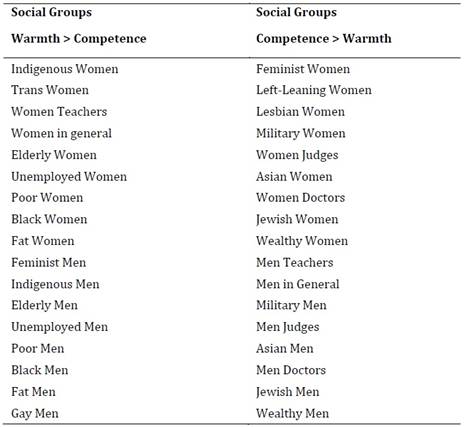
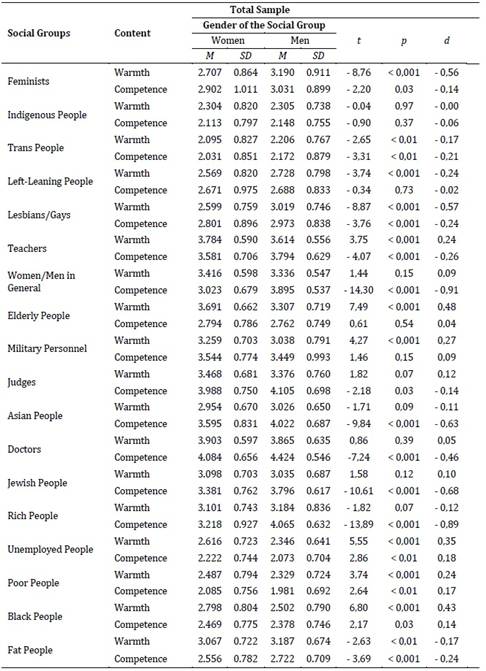
Table 1 presents a comparison of the expectations of W and C attributed to each social group, considering the female and male versions of the groups presented in the questionnaire, based on the overall sample. Table 2 shows the resulting mean values. When comparing the gender of the social group, significant differences in mean values were identified in almost all social groups in the questionnaire. The only group that did not show significant differences in value for both dimensions was Indigenous men and women, which can be explained by the lack of representation of Indigenous people in various social spaces, which may generate a certain distancing from this social group, since most of the sample consisted of self-declared white people. The groups that did not show a difference in value for W were: Indigenous people, men/women in general, judges, Asian people, doctors, Jewish people, and wealthy people. Those that did not show a difference in value for dimension C were: Indigenous people, left-leaning people, elderly people, and military personnel.
In other social groups in which the difference was significant, women were perceived as warmer (W) than men in the following groups: teachers, elderly people, military personnel, unemployed people, poor people, and Black people. They were only perceived as more competent (C) than men when in the social groups unemployed, poor, and Black. In all other categories where a significant difference was identified, the average scores assigned were higher for men.
Comparison of expectations of Warmth (W) and Competence (C) for the questionnaire’s male and female groups
Discussion
The results demonstrate that, even when social groups are assigned equivalent values when the W and C dimensions are compared, there are differences in value for almost all social groups in the gendered comparison. Interestingly, even when there is agreement regarding the ambivalent position of the W and C dimensions, the differences are still more frequently in favor of male groups. When this was not the case, aspects related to the maintenance of sexist conservatism may serve as a basis for understanding the data. First, it is considered that female groups were only seen as both more competent (C) and more sociable (S) than men in the case of unemployed people, poor people, and Black people. Only teachers, elderly, military, unemployed, poor, and Black women were seen as warmer (W).
Research conducted in different Brazilian contexts also points to a marked difference in the social valuation of certain professions between men and women; therefore, the results observed in the sample, although predominantly from Porto Alegre, are consistent with this trend (Formiga et al., 2002). The results reflect the idea that women are only recognized as more competent than men in situations where the category of profession is not present. This already seems to corroborate the premise that stereotypes serve unequal and conservative moral ideologies.
Furthermore, through the most valued female groups in both dimensions, an image may emerge, ranging between the housewife and, possibly, the housemaid. This occurs as belonging to these three groups (the unemployed, the poor and the black people) as women might represent alignment with traditional expectations of women, especially Black women: someone without formal employment, who tends to the home and its chores, and is responsible for the maintenance of the family’s emotional bonds. This contrasts strongly with the idea of unemployed men, who may be seen as not fulfilling their role as a provider. Moreover, women who are both Black and poor might represent a specific-and violent-profile, an ideological expectation of what one would “find” in the intersection of such groups: the housemaid. These women are the object of more sympathy than their male counterparts because of the role they are socially expected to perform: in Brazil, housemaids are mostly poor Black women (Rodrigues, 2023). This social position is imbued with affective ambiguities that reproduce a stratified system of gender, class, and race. This system, while serving a broad process of reproducing inequality, is simultaneously endowed with affectivity. Therefore, the fact that these women receive higher scores in W and C than men does not necessarily mean that they are seen as more valuable. This is because it is the maintenance of their social position, useful to the unequal social system, that is at stake. In the name of supposed benevolence towards housewives and/or unemployed and Black women, there is a need to keep them stable in this position, since their subjugation to the social system is what sustains the evident inequality.
The fact that Black women scored higher on the W and C dimensions than Black men can also be explained by another line of reasoning. From various perspectives, classic authors who delve into the issues of race and gender, such as Lélia Gonzalez (2020) and Florestan Fernandes (1965), discuss the existence of a stereotype associated with Black women, which can denote a certain naturalized passivity, being affectionate, dedicated, and involved in domestic chores, characterized by the myth of the Black mother. However, there is also the myth of the “mulato”, which positions Black women as sexual objects, endowed with exacerbated eroticism. Two antagonistic, distinct images, but both at the service of White people (the majority of the sample) and their families (Reis, 2019). Thus, the higher value of Warmth and Competence for Black women compared to men may also be associated with the extreme level of objectification that Black women suffer, according to which they “are at the service” of something or someone. This phenomenon is widely verified and discussed in studies of Black feminism and intersectionality (Kilomba, 2019; Pires, 2021).
As aforementioned, the conservative nature of the supposed value placed upon these groups of women is undeniable. As such, it is possible to recognize a sexist quality linked to the supposedly laudatory manifestations. This is the premise of ambivalent sexism, which can be presented in two main forms: hostile and benevolent. While the first would be a clear expression of prejudice and rejection towards women, the second would present itself through positive demonstrations that are apparently not prejudiced towards them (Formiga et al., 2002). In other words, the results demonstrate a supposed “appreciation” of certain “types’ of women, while at the same time reinforcing their social role based on characteristics of dependence, fragility, and sensitivity.
In the SCM, ambivalence is explained using the terms envy and paternalistic. Envy stereotypes correspond to groups perceived as highly competent but simultaneously unsympathetic, while paternalistic stereotypes are directed towards groups that, by not representing competition, evoke sympathy. We could infer that when making comparisons about gender, paternalistic stereotypes could be expressions of benevolent sexism, just as envy stereotypes can express hostile sexism. Besides being exemplified by the previously mentioned groups (unemployed, poor, and Black women), the comparison between the social groups of teachers and the elderly can also be demonstrated.
In both cases, the female groups received higher W scores. Male teachers were identified as more competent, while the elderly group showed no differences for C. This demonstrates that the people in these groups, when female, would evoke the paternalistic stereotype. This is because elderly women tend to be seen as frail, incapable, and in need of care (Locatelli & Cavedon, 2014).
Regarding the group of teachers, we rely on the study by Dametto and Esquinsani (2015), which shows that during the expansion of schooling in Brazil there was a strengthening of the narrative that the “natural gift” of women as mothers would be a positive trait for female presence in teaching, contributing to a process of “feminization” of the teaching profession, but with the aim of making the teaching workforce “cheaper”. The exaltation of qualities such as dedication, altruism, and sacrifice (characteristics socially related to the female universe, mainly maternal) gained strength and value, causing teaching to be associated with motherhood, resembling domestic care. This feminization process would also explain the remuneration deficit observed in early childhood education and in elementary school, a characteristic that persists to this day (Dametto & Esquinsani, 2015). Furthermore, there is a belief that expert opinion on a subject, from a scientific or academic point of view, comes from the male professor, who represents the image of academic, university excellence, while female teaching is attributed to maternal and less valued elements, such as teachers of early grades, not endowed with “theoretical authority” (Dametto & Esquinsani, 2015, p. 152).
As for the other male groups perceived as warmer and more competent than female groups, we have feminist men, trans men, gay men, and fat men. It is interesting to consider that these are groups that do not explicitly list a work-related trait, and yet, similarly, are more valued when masculine. It is assumed that, behind a strong culture of oppression that associates the value of women with the objectified quality of their bodies or conformity to aesthetic standards and heteronormative logic, groups that deviate from these expectations associated with the ideal feminine end up being more devalued, such as trans women, lesbian women, and fat women. Trans and lesbian women do not elicit sympathy within a heteronormative logic because they do not submit to it (Fonseca et al., 2022), just as fat women do not correspond to the hegemonic aesthetic ideal (Arruda & Miklos, 2020). It seems that, when men, people in these groups carry a lower burden of social aversion.
It is possible that trans, lesbian, and fat women are also devalued because they do nothing to guarantee and reinforce the status quo. On the contrary, one may think that, as women, freedom to live out their own gender and sexuality outside of conventional standards may lead to devaluation, as they represent resistance. This may also explain the group of feminist women. These women arouse less sympathy than the corresponding male group, perhaps also because women involved in civic and political engagement are further removed from the stereotype of traditional subservience. They are non-traditional women, as argued by Fiske et al. (2002), who are seen as more threatening to the status quo and hegemonic social norms-seen, moreover, as women who wish to occupy “male spaces”.
The male categories favored only in dimension C were teachers, men in general, judges, Asian men, doctors, Jewish men, and the wealthy. Regarding the men in general group, it is interesting to note that this group was seen as more competent, but women in general were not perceived as warmer. This also demonstrates a sexist element, but outside the logic of paternalism, since they were not favored in any of the dimensions. Perhaps the category “in general” allows for multiple interpretations, but the idea that men are more competent than women, in general, seems to serve to reinforce traditional cultural logics. It is also worth emphasizing that the vast majority of participants in this study are self-declared White people, which raises questions about which definition of “in general” was used when completing the questionnaire. Given the still very present colonial logic and the lack of reflection on whiteness and its narcissistic pact (Bento, 2022), it is possible that the definition of men or women “in general” reflects stereotypes associated with White people, with non-whites being seen as separate categories.
Another aspect that can be observed is that the social groups with high social value, such as doctors, judges, and the wealthy, received higher Competence ratings when men were involved. Although women were also allocated the same way by the participants with respect to position (more competent, less warm), they are ranked lower in terms of value than the male groups. In other words, the female groups in these categories are recognized as having a degree of Competence, but still in a subordinate way to their male counterparts, reinforcing the sexist nature of the data.
Conclusion
The present paper aimed to understand how a sample of southern Brazilians perceive the existence and differences of groups within society, testing the applicability of the Stereotype Content Model (SCM) to a Brazilian sample. Considerations regarding linguistic variations in Portuguese related to gender were taken into account and demonstrated that the gender variable exerted a significant influence on the attribution of the Warmth and Competence dimensions, reinforcing the importance of gender classification of groups in the application of the instrument.
The results identified a strong sexist bias insofar as, regardless of the subgroup, men had a higher attribution value when compared to women, mainly in relation to the Competence dimension. This situation was particularly present when the group category stated the variable profession; that is, with the exception of the professional category teacher, in all others, the groups of men were seen as more competent than the women. The explanation for the women’s group being described as more competent in the teaching category may be related to the fact that teaching, especially in basic and elementary education, is seen from the perspective of exalting qualities such as dedication, altruism, and sacrifice, characteristics socially related to the female universe, mainly maternal, and undervalued in the labor market.
The fact that only the categories of unemployed, poor, and Black women were perceived as more competent than their corresponding male group also demonstrates the sexist bias of the results. The idea of the traditional woman-unemployed, housewife, and responsible for childcare and housework, also represented by domestic workers-seems to permeate the data. However, although these results may be seen as positive at first glance, increasing the “value” of these women in relation to their corresponding male groups, it is crucial to recognize that this is not the case. The stereotypes associated with housewives and housemaids as being more docile, fragile, and sensitive reinforce less valued social positions, useful for maintaining social inequalities, and define an identity in terms of their dependence or co-dependence.
The reproduction of this ambivalent sexism-represented by the not necessarily explicit manifestation of prejudice-contributes to the maintenance of inequalities between men and women, which translates into wage differences and overload caused by the double or triple work shift combined with the primary responsibility of caring for others. Furthermore, it illustrates how subjective barriers still seem to exist for different groups of women to access social spaces-causing those who are part of spaces not traditionally expected to encounter more obstacles in guaranteeing equal rights in different contexts. The positive affect derived from perceptions of benevolent and paternalistic sexist stereotypes offers nothing to help women in projects of personal and social change. On the contrary, they serve to subject women to less valued positions, but necessary for the maintenance of social order, pressuring them into traditional roles-conservative, sexist, and moralistic.
The results of this study corroborate these assertions. There are differences between groups of women who threaten the status quo, such as feminists, career women, lesbians, and trans women, and are therefore viewed with distrust and animosity, and those who conform to the expectations of the patriarchal system, such as housewives. It was possible to identify that the social barriers encountered by different groups of women are distinct, and when combined with other intersectional markers, these differences become even more explicit, as is the case with Black women. Although starting from different extremes, both positions reinforce the stereotype of the subjugation of Black women to White women.
References
- Allport, G. W. (1954). The nature of prejudice Addison-Wesley.
-
Amorim, A. K. F., Conceição, A. C., Pereira, C. R., & Do Bú, E. A. (2024). O papel legitimador do conteúdo estereotípico para a diferença salarial entre homens e mulheres. Revista de Psicologia Da IMED, 16(1), 3-21. https://doi.org/10.18256/2175-5027.2024.v16i1.5170
» https://doi.org/10.18256/2175-5027.2024.v16i1.5170 -
Arruda, A. S., & Miklos, J. (2020). O peso e a mídia: estereótipos da gordofobia. LÍBERO, 23(46), 111-126. https://seer.casperlibero.edu.br/index.php/libero/article/view/1116
» https://seer.casperlibero.edu.br/index.php/libero/article/view/1116 - Bento, C. (2022). O pacto da branquitude Companhia das Letras.
-
Böhm, R., Rusch, H., & Baron, J. (2020). The psychology of intergroup conflict: A review of theories and measures. Journal of Economic Behavior & Organization, 178, 947-962. https://doi.org/10.1016/j.jebo.2018.01.020
» https://doi.org/10.1016/j.jebo.2018.01.020 -
Canton, E., Hedley, D., & Spoor, J. R. (2023). The stereotype content model and disabilities. The Journal of Social Psychology, 163(4), 480-500. https://doi.org/10.1080/00224545.2021.2017253
» https://doi.org/10.1080/00224545.2021.2017253 -
Conceição, A. C. (2020). O papel do conteúdo dos estereótipos na discriminação de gênero. Em M. E. O. Lima, D. X. D. França, & R. M. Ko. Freitag (Orgs.), Processos psicossociais de exclusão social (pp. 89-100). Editora Blucher. https://doi.org/10.5151/9786555060393-04
» https://doi.org/10.5151/9786555060393-04 -
Couto, M. C. P. de P., & Koller, S. H. (2012). Warmth and competence: stereotypes of the elderly among young adults and older persons in Brazil. International Perspectives in Psychology: Research, Practice, Consultation, 1(1), 52-62. https://doi.org/10.1037/a0027118
» https://doi.org/10.1037/a0027118 -
Cuddy, A., Fiske, S., Kwan, V., Glick, P., Demoulin, S., Leyens, J., & Ziegler, R. (2009). Stereotype content model across cultures: Towards universal similarities and some differences. British Journal of Social Psychology, 48(1), 1-33. https://doi.org/10.1348/014466608X314935
» https://doi.org/10.1348/014466608X314935 -
Dametto, J., & Esquinsani, R. S. S. (2015). Mãe, mulher... professora! Questões de gênero e trabalho docente na agenda educacional contemporânea. Acta Scientiarum. Human and Social Sciences, 37(2), 149-155. https://doi.org/10.4025/actascihumansoc.v37i2.27127
» https://doi.org/10.4025/actascihumansoc.v37i2.27127 -
Fiske, S., Cuddy, A., Glick, P., & Xu, J. (2002). A model of (often mixed) stereotype content: Competence and warmth respectively follow from perceived status and competition. Journal of Personality and Social Psychology, 82(6), 878-902. https://doi.org/10.1037/0022-3514.82.6.878
» https://doi.org/10.1037/0022-3514.82.6.878 -
Fiske, S., & North, M. (2015). Measures of stereotyping and prejudice: Barometers of bias. Em G. J. Boyle, D. H. Saklofske, & G. Matthews (Eds.), Measures of personality and social psychological constructs (pp. 120-138). Academic Press. https://doi.org/10.1016/B978-0-12-386915-9.00024-3
» https://doi.org/10.1016/B978-0-12-386915-9.00024-3 - Fernandes, F. (1965). A Integração do Negro na Sociedade de Classes (6th ed.). Editora Contracorrente.
-
Fonseca, L. K. da S., de Araújo, L. F., Salgado, A. G. A. T., Gomes, H. V., de Jesus, L. A., & Alves, M. E. da S. (2022). Representações sociais a respeito da velhice LGBT sob a ótica de mulheres lésbicas brasileiras. Salud & Sociedad, 12, e3508. https://doi.org/10.22199/issn.0718-7475-3508
» https://doi.org/10.22199/issn.0718-7475-3508 -
Formiga, N., Golveia, V., & Santos, M. N. (2002). Inventário de sexismo ambivalente: Sua adaptação e relação com o gênero. Psicologia em Estudo, 7(1), 25-34. https://doi.org/10.1590/S1413-73722002000100013
» https://doi.org/10.1590/S1413-73722002000100013 -
Giger, J. C., Orgambídez-Ramos, A., Gonçalves, G., Santos, J., & Gomes, A. (2015). Evidências métricas da adaptação da escala de dominância social numa amostra portuguesa. Avaliação Psicológica, 14(1), 143-151. https://doi.org/10.15689/ap.2015.1401.16
» https://doi.org/10.15689/ap.2015.1401.16 - Gonzalez, L. (2020). Por um feminismo afro-latino-americano: Ensaios, intervenções e diálogos Zahar.
- Kilomba, G. (2019). Memórias da plantação: Episódios de racismo cotidiano Cobogó.
-
Kleppesto, T. H., Czajkowski, N. O., Sheehy‐Skeffington, J., Vassend, O., Roysamb, E., Eftedal, N. H., Kunst, J. R., Ystrom, E., & Thomsen, L. (2024). The genetic underpinnings of right‐wing authoritarianism and social dominance orientation explain political attitudes beyond Big Five personality. Journal of Personality, 92(6), 1744-1758. https://doi.org/10.1111/jopy.12921
» https://doi.org/10.1111/jopy.12921 -
Liaquat, U., & Jost, J. T. (2023). Expectations about system justification predict the ideological gap in attitudes towards immigrants. Scientific Reports, 13, 11309. https://doi.org/10.1038/s41598-023-38347-8
» https://doi.org/10.1038/s41598-023-38347-8 - Lippmann, W. (1922). Public opinion The Free Press.
-
Locatelli, P. A. P. C., & Cavedon, N. R. (2014). Representações sociais e a captação de pessoas para trabalhar com idosos. RACE: Revista de Administração, Contabilidade e Economia, 13(1), 9-34. https://periodicos.unoesc.edu.br/race/article/view/2619
» https://periodicos.unoesc.edu.br/race/article/view/2619 -
Ho, A., Sidanius, J., Pratto, F., Levin, S., Thomsen, L., Kteily, N., & Sheehy-Skeffington, J. (2012). Social dominance orientation: Revisiting the structure and function of a variable predicting social and political attitudes. Personality and Social Psychology Bulletin, 38(12), 1610-1627. https://doi.org/10.1037/e514892012-001
» https://doi.org/10.1037/e514892012-001 - Jost, J. T., & Banaji, M. R. (2020). The role of stereotyping in system-justification and the production of false consciousness. Em J. T. Jost (Ed.), A Theory of System Justification (pp. 70-95). Oxford University Press.
-
Nicolas, G., Bai, X., & Fiske, S. T. (2022). A spontaneous stereotype content model: Taxonomy, properties, and prediction. Journal of Personality and Social Psychology, 123(6), 1243-1263. https://doi.org/10.1037/pspa0000312
» https://doi.org/10.1037/pspa0000312 -
Nodari, S. (2021). Nomes e pronomes na Língua Portuguesa: a questão sexista no idioma e na academia. Revista Estudos Feministas, 29, e74197. https://doi.org/10.1590/1806-9584-2021v29n374197
» https://doi.org/10.1590/1806-9584-2021v29n374197 -
Operario, D., & Fiske, S. T. (2001). Effects of trait dominance on powerholders' judgments of subordinates. Social Cognition, 19(2), 161-180. https://doi.org/10.1521/soco.19.2.161.20704
» https://doi.org/10.1521/soco.19.2.161.20704 - Pires, E. (2021). A blogosfera materna é branca: Trabalho, feminismos, raça e classe na blogosfera materna brasileira. Revista Ártemis: Estudos de Gênero, Feminismo e Sexualidades, 31(1).
-
Reis, M. (2019). O pacto narcísico da casa-grande: A representação das mulheres negras a partir de Lélia Gonzalez e Gilberto Freyre. Humanidades em Diálogo, 9, 93-101. https://doi.org/10.11606/issn.1982-7547.hd.2019.154274
» https://doi.org/10.11606/issn.1982-7547.hd.2019.154274 -
Rodrigues, R. A. (2023). The Invisible Workforce: Domestic Workers and Labor Rights in Brazil (Tese de Doutorado, American University). ProQuest Dissertations & Theses. https://search.proquest.com/openview/3e4cc1c98cf3fbe7f2d7f2ae4e033f83/1?pq-origsite=gscholar
» https://search.proquest.com/openview/3e4cc1c98cf3fbe7f2d7f2ae4e033f83/1?pq-origsite=gscholar -
Rubin, M., Owuamalam, C. K., Spears, R., & Caricati, L. (2023). Social identity explanations of system justification: Misconceptions, criticisms, and clarifications. European Review of Social Psychology, 34(1), 268-297. https://doi.org/10.1080/10463283.2023.2184578
» https://doi.org/10.1080/10463283.2023.2184578 -
Silva, L. L., & de Oliveira Nunes, E. S. (2022). Reflexões sobre língua (gem) neutra no português brasileiro. Crátilo, 15(1), 113-133. https://revistas.unipam.edu.br/index.php/cratilo/article/view/3767
» https://revistas.unipam.edu.br/index.php/cratilo/article/view/3767 -
Schofield, T. P., Suomi, A., & Butterworth, P. (2022). Is the stereotype of welfare recipients associated with type of welfare state regime? A cross‐national meta‐regression of the stereotype content model. Journal of Applied Social Psychology, 52(4), 201-209. https://doi.org/10.1111/jasp.12843
» https://doi.org/10.1111/jasp.12843 - Tajfel, H. (1984). Intergroup relations, social myths and social justice in social psychology. Em H. Tajfel (Ed.), The social dimension (Vol. 2, pp. 695-715). Cambridge University Press.
-
Tajfel, H., & Turner, J. C. (1979). An integrative theory of intergroup conflict. Em W. G. Austin, & S. Worchel (Eds.), Organizational identity: A reader (pp. 56-65). Books/Cole. https://doi.org/10.1093/oso/9780199269464.003.0005
» https://doi.org/10.1093/oso/9780199269464.003.0005 -
Thiele, M. (2022). Categories, stereotypes, images, and intersectionality. New Perspectives on Imagology, 30, 277-297. https://doi.org/10.1163/9789004513150_015
» https://doi.org/10.1163/9789004513150_015 - Yzerbyt, V., Rocher, S., & Schadron, G. (1997). Stereotypes as explanations: A subjective essencialistic view of group perception. Em R. Spears, P. J. Oakes, N. Ellemers, & S. A. Haslam (Eds.), The social psychology of stereotyping and group life (pp. 21-50). Blackwell.