Approach-Avoidance Temperament Questionnaire (ATQ): Psychometric Properties of the First Spanish Version in Young Peruvian Adults
Abstract:
Approach and avoidance tendencies allow for an understanding of personality and psychopathology. The present study describes the psychometric properties of the first Spanish version of the Approach-Avoidance Temperament Questionnaire (ATQ). Method: An instrumental design was used to analyze the internal structure and obtain evidence of reliability, as well as validity through its relationship with other variables. A total of 359 young Peruvian adults (M = 21.57, SD = 2.46) participated, the majority of whom were females (57.1 %). Results: The findings indicate an adequate fit for a correlated two-factor structure, consistent with both temperaments. The ATQ demonstrated high internal consistency in both dimensions. Avoidance temperament was positively associated with traumatic experiences and childhood emotion invalidation, while approach temperament was negatively related to paternal invalidation. Conclusion: The Spanish version of the ATQ constitutes a promising tool for personality research in Latin American contexts
Keywords:
approach temperament; avoidance temperament; personality; motivated behavior; Spanish validation
Resumen:
Las tendencias de aproximación y evitación permiten la comprensión de la personalidad y la psicopatología. El presente estudio describe las propiedades psicométricas de la primera versión en español del Approach-Avoidance Temperament Questionnaire (Cuestionario del Temperamento de Aproximación-Evitación; ATQ). Se empleó un diseño instrumental para analizar la estructura interna y obtener evidencias de confiabilidad, así como de validez mediante la relación con otras variables. Participaron 359 adultos jóvenes peruanos (M = 21.57, DE = 2.46), siendo en su mayoría mujeres (57.1 %). Los hallazgos indican que existe un ajuste adecuado para una estructura de dos factores correlacionados, congruentes con ambos temperamentos. El ATQ evidenció alta consistencia interna en ambas dimensiones. El temperamento de evitación se asoció positivamente con experiencias traumáticas e invalidación emocional infantil, mientras que el de aproximación se relacionó negativamente con la invalidación paterna. Se concluye que la versión española del ATQ constituye una herramienta prometedora para la investigación de la personalidad en contextos latinoamericanos.
Palabras clave:
temperamento de aproximación; temperamento de evitación; personalidad; comportamiento motivado; validación en español
Resumo:
As tendências de aproximação e evitação permitem a compreensão da personalidade e da psicopatologia. O presente estudo descreve as propriedades psicométricas da primeira versão em espanhol do Approach-Avoidance Temperament Questionnaire (Questionário de Temperamento de Aproximação-Evitação; ATQ). Método: Foi utilizado um desenho instrumental para analisar a estrutura interna e obter evidências de confiabilidade, bem como de validade por meio da relação com outras variáveis. Participaram 359 adultos jovens peruanos (M = 21,57; DP = 2,46), em sua maioria mulheres (57,1 %). Resultados: Os achados indicam ajuste adequado para uma estrutura de dois fatores correlacionados, congruentes com ambos os temperamentos. O ATQ apresentou alta consistência interna em ambas as dimensões. O temperamento de evitação associou-se positivamente a experiências traumáticas e à invalidação emocional infantil, enquanto o temperamento de aproximação relacionou-se negativamente à invalidação paterna. Conclusão: A versão espanhola do ATQ constitui uma ferramenta promissora para a investigação da personalidade em contextos latino-americanos.
Palavras-chave:
temperamento de aproximação; temperamento de evitação; personalidade; comportamento motivado; validação em espanhol
Human beings represent one of the most recent lineages in evolutionary history, which has been possible due to their outstanding capacity to adapt to the environment (Dobzhansky, 1973). From this biological perspective emerges a term called temperament, which, over the years, has been extensively investigated with the aim of understanding human behavior (Cornellà, 2010). Its conceptualization refers to individual differences arising from a biological (hereditary) basis that characterize individuals, becoming evident through their response style to diverse stimuli (Braungart et al., 1992; Campbell, 2009; Thomas & Chess, 1977). These temperamental characteristics not only affect the organism's reactivity but can also influence its mode of functional regulation at the cognitive, behavioral, and emotional levels (Rothbart et al., 2000). It is important to highlight that temperament manifests early (in childhood) and possesses relative stability throughout the life cycle (Bornstein et al., 2019; Buss & Plomin, 1984; Clark, 2005; Kopala-Sibley et al., 2018; Rothbart, 2011), although it is not exempt from changes, since interaction with the environment (including culture, see Mead, 1935) influences its development and externalization (Belsky et al., 1991; Kagan & Snidman, 2004; Rothbart, 2011; Rothbart & Bates, 1998). It should be clarified that although these models address childhood temperament, these primary biological dispositions become ontogenetically structured into more complex adult personality architectures (Ponikiewska et al., 2026).
The scientific community has consolidated a line of research aimed at examining the degree of influence of genetics and the environment on personality formation. An interesting meta-analysis revealed that 40 % of the individual differences expressed in personality had a genetic origin, while 60 % were a product of the environment (Vukasović & Bratko, 2015). Furthermore, another meta-analysis found that, although genetic and environmental influences contribute to the phenotypic stability of personality, the effect of contextual mechanisms predominates during adulthood (Briley & Tucker-Drob, 2014). On the other hand, Sánchez-Roige et al. (2018) emphasize that genetic research is the path to comprehensively understanding personality and psychopathology, while Volk and Puchalski (2025) highlight the application of evolutionary theory in the study of personality, positioning this convergence as a robust explanatory framework for its clinical and normative patterns. In general terms, the discussion regarding the structuring and formation of personality remains current (John & Robins, 2021), which drives the development and validation of psychometric instruments that allow for its understanding.
Within the framework of this structuring in adulthood, Elliot and Thrash (2002) examined the three main contemporary approaches that study personality: affective dispositions (Watson & Clark, 1993), traits (Costa & McCrae, 1992; Eysenck & Eysenck, 1985), and motivational systems (Gray, 1987; Lang, 1995), and determined that their central constructs were related, despite differing in the conceptualization of each one. Consequently, they established approach and avoidance temperament as two latent factors that would explain the shared variance among such constructs (Elliot & Thrash, 2010). To illustrate the higher-order level of both temperaments, the approach temperament is characterized by positive emotionality, extraversion, and high sensitivity of the Behavioral Activation System (BAS), whereas the avoidance temperament is characterized by negative emotionality, neuroticism, and high sensitivity of the Behavioral Inhibition System (BIS). Under these premises, approach temperament is defined as a general neurobiological sensitivity to rewarding stimuli (e.g., prizes) that involves an activation in the organism (affective and receptive) and a behavioral inclination to experience them (Elliot & Thrash, 2010). On the other hand, the avoidance temperament presents a similar functioning, with the only modifications being that the sensitivity is toward aversive stimuli (e.g., punishments) and involves a behavioral propensity to avoid them (Elliot & Thrash, 2002). Both mechanisms are considered responsible for the organism's adaptability to the environment throughout the evolutionary process (Gray & McNaughton, 2000), given that they represent the elementary responses of behavioral functionality, such as proximity to favorable stimuli and distance from harmful ones (Tooby & Cosmides, 1990).
In this regard, Elliot and Thrash (2010) designed the Approach-Avoidance Temperament Questionnaire (ATQ) with the purpose of directly measuring both constructs. Regarding the validity evidence based on the internal structure, through Confirmatory Factor Analysis (CFA), the two-correlated factor model yielded a good fit (χ2 (53) = 84.84, p < .01, CFI = .93, TLI = .91, RMSEA = .06), in addition to reliability evidence through internal consistency coefficients, by averaging the Cronbach's alpha (α) of the six studies conducted by the authors (Approach = .81, Avoidance = .84). Likewise, this test has been adapted and validated for the Dutch culture (Bipp et al., 2017), where the same multifactorial solution was confirmed (CFI = .94, TLI = .92, RMSEA = .06) with adequate internal consistency coefficient ranges for both dimensions (α: Approach = .71-.80, Avoidance = .73-.81). Similarly, the Italian version (Monni & Scalas, 2019) obtained excellent fit indices for the same model (CFI = .96, TLI = .95, RMSEA = .04) and demonstrated adequate evidence of internal consistency (α Approach = .74, α Avoidance = .82). The most recent adaptation of the instrument has been developed in Germany (Paelecke & Weiß, 2025), reporting acceptable fit indices for the two-factor solution: CFI (robust) = .94, RMSEA (robust) = .07, SRMR (robust) = .06; along with good internal consistency (ω: Approach = .86, Avoidance = .90).
However, the use of the ATQ is not limited only to the community population, since it has demonstrated solid psychometric properties in a psychiatric sample, specifically in individuals with anxiety and depressive disorders, which increases its importance and utility for clinical research (Rassaby et al., 2025). It should be noted that this analytical framework is not recent, since the experimental study on the implication of approach and avoidance tendencies in psychopathology has been ongoing since the beginning of the present century, increasing sharply during the course of the past decade (Loijen et al., 2020). This line of research is highly relevant for the understanding of mental disorders, given that it is in line with the Research Domain Criteria (RDoC; Cuthbert & Kozak, 2013; Insel et al., 2010).
The RDoC project is a reference framework whose main objective is to promote the study of mental disorders through the integration and deepening of the dimensions of behavioral functioning and neural systems, promoting dimensionality (Cuthbert, 2022). Under this approach, the translational perspective it adopts, which is considered one of its fundamental pillars, positions positive valence (approach) and negative valence (avoidance) systems as domains responsible for neurobehavioral functioning (for a detailed review of the seven pillars, see Morris et al., 2022).
Therefore, the design of therapeutic interventions can be optimized by integrating approach and avoidance tendencies as a clinical frame of reference. Supporting this premise, the systematic review by Loijen et al. (2020) identified differentiated behavioral bias profiles according to the clinical picture: in addictive disorders, an approach bias towards substances predominates; depression is characterized by a sustained reduction in approach to appetitive stimuli; and anxiety disorders exhibit an avoidance bias towards aversive stimuli. Furthermore, the literature underscores the clinical value of both systems in affective disorders, pointing to avoidance tendencies as priority targets for treatment (Struijs et al., 2018) and to interventions on positive valence as a way to foster social connection (Gross et al., 2025). Beyond affective disorders, these constructs have demonstrated explanatory utility regarding urgent public health problems. Specifically, Daneshvar et al. (2025) provided evidence that positive and negative valence systems mediate the relationship between perseverative cognitions and suicidal vulnerability in university students, a finding that converges with documented evidence on alterations in positive valence as a substrate for self-injurious thoughts and behaviors (Bettis et al., 2022). These advances shape a promising research agenda, as they invite further investigation into the role of approach and avoidance tendencies in suicidal behavior, fostering the development of more comprehensive explanatory models and more precise clinical interventions (Blacutt et al., 2025).
In parallel to these clinical implications, approach and avoidance mechanisms involve motivational processes corresponding to the specific valence assigned to stimuli (Elliot & Covington, 2001). In other words, both energize behavior (motivation) and direct it toward appetitive experimentation or punishment suppression (for a deeper review, see Elliot, 2006, 2008). For this reason, it is consistent to state that both temperaments are related to certain behavioral manifestations and modulating environmental factors.
Raine et al. (2006) conceptualize instrumental or proactive aggression as aggressive externalizations whose execution is established based on the achievement of personal benefits. In other words, this type of aggression does not arise as a response to the appearance of stressful stimuli (e.g., threats), but rather as a means (a manipulative strategy) that the person intentionally uses to obtain rewards (Dodge & Coie, 1987). Furthermore, Glenn and Raine (2009) argue that proactive aggression predominates in individuals with high levels of psychopathic traits, where its functioning is mainly oriented towards achieving a desired goal, with the harm inflicted on others being an instrumental consequence and not the end in itself. As observed, proactive aggression could be theoretically related to the approach mechanism, given that it shares the pursuit and enjoyment of personal gratification.
On the other hand, a relationship could be conceptualized between temperamental components and environments based on systematic criticism and rejection (invalidating environments). Various theoretical models, such as the biosocial theory (Linehan, 1993), have been proposed for the analysis of emotion dysregulation (i.e., generalized difficulties in effectively managing emotions and associated behaviors). Boggiano and Gagliesi (2020) point out that emotion dysregulation is generated as a consequence of transactional processes between biological factors (e.g., temperament) and contextual factors (e.g., invalidating environments) in the individual's life. Likewise, another variable consistent with this relationship would be childhood trauma, since there is evidence that suffering from it (e.g., emotional abuse) is related to a behavioral response of withdrawal, that is, a prioritization of avoiding harm (De Carvalho et al., 2015). In this sense, considering that temperament is not exempt from changes (Kagan & Snidman, 2004; Rothbart, 2011), experiences of childhood and adolescent emotion invalidation and childhood trauma may have significantly influenced its development, associating with an avoidant temperament.
In light of the exhaustive review on the subject, it is identified that the Spanish adaptation of the ATQ assumes great relevance today, both for its theoretical and psychometric support (Monni et al., 2020; Monni & Scalas, 2024) and for its implications for clinical research (Blacutt et al., 2025; Loijen et al., 2020; Morris et al., 2022; Rassaby et al., 2025). Therefore, the need for a cultural adaptation of the construct to the Latin American context is highlighted, considering that the sociocultural environment plays a fundamental role (e.g., the influence of cultural values) in shaping motivational tendencies (Heim et al., 2021). Taking these aspects into account, the aim of the present research was to determine the psychometric properties of the first Spanish version of the Approach-Avoidance Temperament Questionnaire (ATQ) in a sample of young Peruvian adults. Specifically, the study seeks to identify validity evidence linked to content, internal structure, and relationships with other variables, in addition to obtaining internal consistency coefficients to determine reliability evidence.
Method
Research Type and Design
The present study is a proposal with a quantitative approach, in addition to considering an instrumental design (Ato et al., 2013), since the main aim is to obtain a series of psychometric properties associated with both validity evidence (linked to content, internal structure, and relationships with other variables) and reliability evidence (internal consistency coefficients). Therefore, current standards for the adaptation and construction of psychological instruments were followed (American Educational Research Association (AERA) et al., 2014; International Test Commission (ITC), 2017).
Participants
Using non-probability sampling, a total of 359 young adults participated, of which 205 (57.1 %) were females, 147 (40.9%) were males, and 7 (1.9 %) identified in the "other" category. Ages ranged between 18 and 30 years (M = 21.57, SD = 2.46). Regarding educational level, the vast majority reported currently pursuing technical or university studies (n = 266, 74.1 %), followed by individuals who had completed secondary studies (n = 32, 8.9 %), 5 (1.4 %) had postgraduate studies, and the remainder (n= 56, 15.6 %) were equally distributed among those who had complete or incomplete higher technical or university education.
The main inclusion criteria considered were having Peruvian nationality, being a young adult (i.e., being between 18 and 30 years old), currently residing in Lima (the capital of Peru), and having completed secondary education, due to the requirements presented in some of the tests. The sample size met the recommended minimum requirements, considering the upper limit of 300 (Tabachnick & Fidell, 2019) and at least 10 participants per item (Hair et al., 2019).
Measures
Sociodemographic record. A questionnaire was applied to obtain information on sociodemographic data such as gender, age, educational level, and marital status.
Approach-Avoidance Temperament Questionnaire (ATQ; Elliot & Thrash, 2010). This questionnaire has 12 items evaluated using a Likert scale ranging from 1 (Strongly disagree) to 7 (Strongly agree). It consists of two correlated dimensions called approach and avoidance temperament. The authors conducted a series of six studies for its proposal, obtaining validity evidence linked to the internal structure, as well as adequate internal consistency coefficients for each dimension by averaging all studies (α: Approach = .81, Avoidance = .84).
Reactive/Proactive Questionnaire (RPQ; Raine et al., 2006). This is a questionnaire that evaluates two types of aggression (reactive and proactive) through 23 items rated on a three-point response scale (0 = Never, 1 = Sometimes, 2 = Often). The instrument was validated for the Spanish-speaking population by Andreu et al. (2009). In its Peruvian version (Rojas et al., 2020), the fit indices were adequate for the correlated two-dimension solution (χ2 (229) = 2074.1, p < .001, CFI = .982, TLI = .980, RMSEA = .053, SRMR = .058). Similarly, the internal consistency coefficients were acceptable for both reactive (α = .826; ω = .828) and proactive (α = .852; ω = .863) aggression. For the present study, only the proactive dimension (i.e., premeditated aggression for instrumental purposes) was used, which consists of 12 items (e.g., “I have used physical force to get others to do what I want" (“He usado la fuerza física para conseguir que otros hagan lo que quiero”)).
CaMir-R Attachment Questionnaire (Balluerka et al., 2011). This is a questionnaire that measures attachment representations; it consists of 32 items distributed across seven dimensions, which are answered using response options ranging from 1 (Strongly disagree) to 5 (Strongly agree). The authors performed a principal component analysis to determine such structure, in addition to obtaining relatively acceptable internal consistency coefficients for all factors (α = .54-.85). For the present study, only the childhood trauma dimension was used (i.e., having experienced lack of availability, violence, and/or threats from attachment figures during childhood), which is composed of five items (e.g., “When I was a child I had to face violence from one of my loved ones” (“Cuando yo era niño(a) tuve que enfrentarme a la violencia de uno de mis seres queridos”) ).
Invalidation Childhood Environmental Scale - brief version (ICES; Okumura-Clark et al., 2024). The original proposal was developed by Mountford et al. (2007) and evaluates the retrospective analysis of perceived emotion validation and invalidation from both parents during childhood and adolescence (0 to 18 years), and is administered to adults through 28 items with a Likert scale ranging from 1 (Never) to 5 (All the time). In its reduced proposal for the Peruvian context (Okumura-Clark et al., 2024), it consists of nine items for each parent, identifying two dimensions associated with validation (four items) and invalidation (five items) behaviors regarding the child's emotions. Validity evidence linked to the internal structure was obtained through CFA for both the father scale (χ2 (26) = 43.4, p < .01, CFI = 1.00, TLI = .99, RMSEA = .05, SRMR = .04) and the mother scale (χ2 (26) = 45.7, p < .01, CFI = 1.00, TLI = .99, RMSEA = .05, SRMR = .03). In addition, acceptable internal consistency coefficients were identified for both parents (ω = .86-.92). For the present study, only the invalidation dimension (i.e., parents who frequently punish and/or ignore the child for expressing their needs or emotions) of both the mother and the father was applied (e.g., "If I was satisfied because I had done well in school, my mom would say things to me like: 'Well, it's not that big of a deal'.” (“Si yo estaba satisfecho/a porque me había ido bien en el colegio, mi mamá me decía cosas como: «Bueno, tampoco es para tanto»)).
Procedures
In order to linguistically adjust the ATQ instrument, the translation of the items and instructions from the source language (English) to Spanish was performed, considering that the ATQ is free to use for research purposes. The translation and cultural adaptation team consisted of professionals specialized in psychometric research and assessment, as well as clinical and forensic psychology. This initial version of the instructions and items was rigorously reviewed and discussed to identify possible linguistic and cultural discrepancies with respect to the original version.
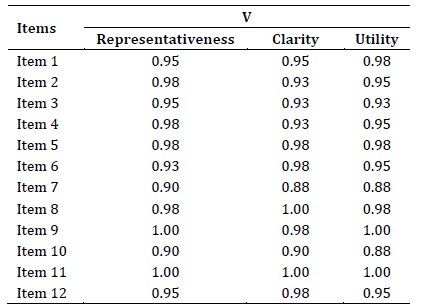
Subsequently, the initial version was subjected to a bilingual review by a panel of eight professionals in clinical and forensic psychology (researchers in these areas), experts in the analysis of human behavior and personality, who simultaneously received the Spanish translation and the original English text, allowing them to directly compare both versions. The representativeness of the items in relation to the two temperaments and the clarity of their wording were evaluated (Sireci & Faulkner-Bond, 2014). In addition, the utility criterion that each item exhibits and a section for receiving qualitative observations were added. Finally, the scores were analyzed through Aiken's V coefficient (Aiken, 1985), taking into account a minimum cutoff point of .80 (Davis, 1992), which, along with the comments made by the expert panel, was considered for the formulation of the final version of the instrument.
Regarding data collection, a Google Form was created, starting with an informed consent. Subsequently, the ATQ, RPQ, CaMir-R, ICES questionnaires, and the sociodemographic questionnaire were administered. The document was distributed in university spaces and through various social networks (Facebook, Instagram, WhatsApp, and LinkedIn) during the first semester of 2025 (April to August). The ethical principles for research involving human subjects were met (Nijhawan et al., 2013); the informed consent indicated the research objective and the principles of autonomy, meaning that participation was voluntary and there would be no consequences if participants decided to withdraw. Likewise, the high degree of privacy (anonymity) regarding the use of their data was emphasized in order to reduce social desirability bias when completing the form. The present research was approved by the Research and Ethics Committee of the Faculty of Psychology of the University of Lima (Approval No. 013-CIE-FPSI-ULIMA-2024).
Data Analysis
Statistical analyses were conducted using the R programming software (version 4.5.0; R Core Team, 2024). First, a descriptive analysis of the data obtained for each ATQ item was performed, examining the response frequencies, percentages, and descriptive statistics of central tendency (arithmetic mean), dispersion (standard deviation), and shape (skewness and kurtosis indices).
Regarding the validity evidence linked to the internal structure, a CFA was applied using the Weighted Least Squares with Adjusted Means and Variances (WLSMV) estimator. This estimation method was chosen due to the ordinal nature of the ATQ items (Brown, 2015), which recommends the use of polychoric correlation matrices (Li, 2016; Suh, 2015). The fit of the original model (Elliot & Thrash, 2010) was estimated considering the Tucker-Lewis Index (TLI), Comparative Fit Index (CFI), Root Mean Square Error of Approximation (RMSEA), and Standardized Root Mean Square Residual (SRMR). The interpretation of model fit considered the following criteria as adequate (TLI ≥ .90, CFI ≥ .90, RMSEA ≤ .08, SRMR ≤ .08) and excellent (TLI ≥ .95, CFI ≥ .95, RMSEA ≤ .05, SRMR ≤ .06) categorizations, in accordance with foundational (Hu & Bentler, 1999) and updated literature (Keith, 2019; Kline, 2016). Additionally, factor loadings were expected to be adequate, that is, greater than .40 (Brown, 2015). The Average Variance Extracted (AVE) used a reference threshold of exceeding .50 for each factor, as this would indicate good convergent validity, whereas an AVE greater than the squared correlation between factors is indicative of discriminant validity (Hair et al., 2019). Furthermore, to evaluate the instrument's internal consistency, Cronbach's alpha coefficient (Cronbach, 1951) and the Omega coefficient (McDonald, 1999) were estimated considering current methodological guidelines (Green & Yang, 2009), where values from .70 onwards are acceptable, although estimates above .80 would be adequate (Raykov & Hancock, 2005; Viladrich et al., 2017). Additionally, a unidimensional model of the ATQ was estimated as a reference, so that the fit between both models could be compared.
On the other hand, for the validity evidence linked to relationships with other variables, the psychometric properties of all scales, including the ATQ, were first obtained. This is because the sample was reduced to 328 participants upon considering the requirements of the ICES instrument (having been raised by both parents). Following this, descriptive statistics were calculated through Factor Scoring based on the previously conducted CFA for each questionnaire, following the recommendations of McNeish and Wolf (2020). Regarding the correlations, Spearman's rank correlation coefficient (Spearman, 1904) was used, due to the recommendation for its use with ordinal variables or non-normal distributions (Field, 2013). The scores obtained for the approach temperament (ATQ) were correlated with those for proactive aggression (RPQ) to evaluate convergent validity, and with those for childhood emotion invalidation (ICES) and childhood trauma (CaMir-R) for divergent validity. A similar procedure was applied to the scores obtained for the avoidance temperament (ATQ), with the associations designated in the inverse manner to those proposed for the approach temperament. As a final step, the determination of association levels and effect sizes was carried out in accordance with the guidelines posited by Cohen (1992), whose criteria establish that values below .10 reflect practical insignificance; from .10 to .30, weak association; between .30 and .50, moderate association; and above .50, strong association.
Results
Content-Related Validity Evidence
The multidisciplinary team of eight expert judges participated in the review of all items, considering the evaluation criteria of representativeness, clarity, and utility. Aiken’s V coefficients (Table 1) satisfactorily met the minimum cutoff point of .80 (Davis, 1992) for all criteria. Likewise, modifications were made based on the observations provided by the judges, and this final version was used for data collection.
Descriptive Analysis of Items
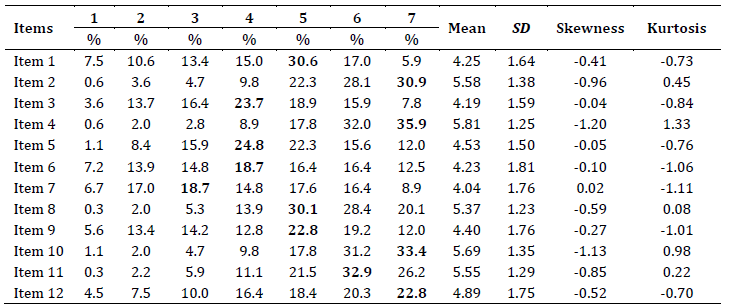
Table 2 displays the descriptive statistics of the scores for all items in the questionnaire. The skewness and kurtosis analysis showed that the obtained values are within the range considered acceptable (± 2; George & Mallery, 2010; Kline, 2016). Furthermore, in general, the frequencies of participation for each response option were as follows: first, 140 (3.3 %); second, 345 (8.0 %); third, 455 (10.6 %); fourth, 645 (15.0 %); fifth, 921 (21.4 %); sixth, 982 (22.8 %); and seventh, 820 (19.0 %). It is observed that the highest distribution of responses is mainly concentrated in the higher categories (fifth to seventh).
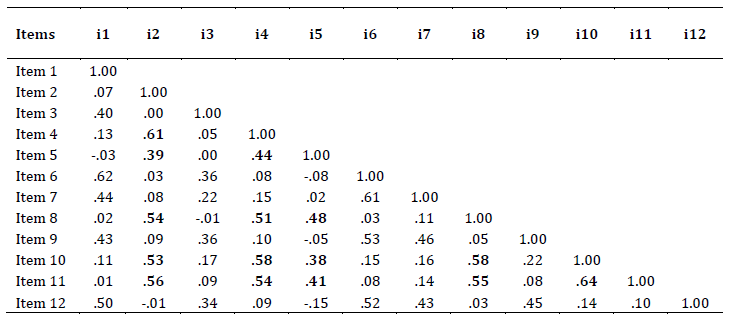
On the other hand, the polychoric correlation matrix (Table 3) showed that all items belonging to the approach dimension were positively interrelated (.38 ≤ r ≤ .64). The same result was obtained for those of avoidance (.22 ≤ r ≤ .62).
Internal Structure and Reliability Validity Evidence
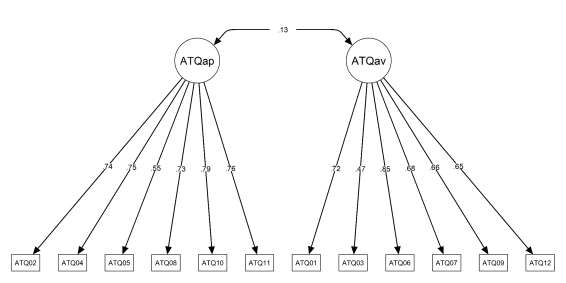
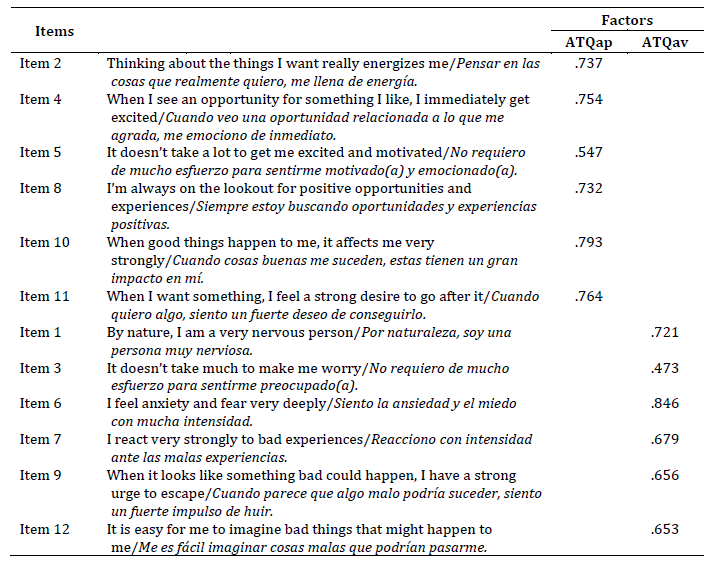
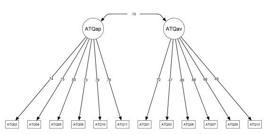
Table 4 presents the results of the factorial structure analyzed based on two proposed models through CFA. As expected, the unidimensional proposal obtained a poor fit across all indices (CFI = .552, TLI = .452, RMSEA = .260, SRMR = .207). Conversely, the original model of two correlated factors (Elliot & Thrash, 2010) presented mostly excellent fit indices (CFI = .971, TLI = .963, SRMR = .054), while the RMSEA (.067) showed an adequate value (Keith, 2019). Internal consistency was good for both approach temperament (α = .839; ω = .842) and avoidance temperament (α = .816; ω = .822). The correlation between factors, though low, was statistically significant (r = .134, p < .05). Likewise, the factor loadings of all items were adequate (Table 5), ranging from moderate to high (λ = .473-.846). The multifactorial model is presented in Figure 1. Regarding AVE, results showed heterogeneous values, ranging from .46 (avoidance temperament) to .53 (approach temperament), denoting limitations regarding convergent validity for the avoidance factor. However, the squared correlation between factors was .018, significantly lower than the obtained AVE values, thus providing evidence of discriminant validity (Hair et al., 2019).
Validity Evidence Linked to Relationships with Other Variables
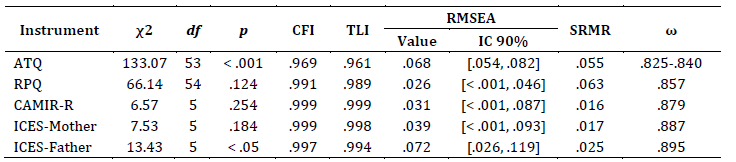
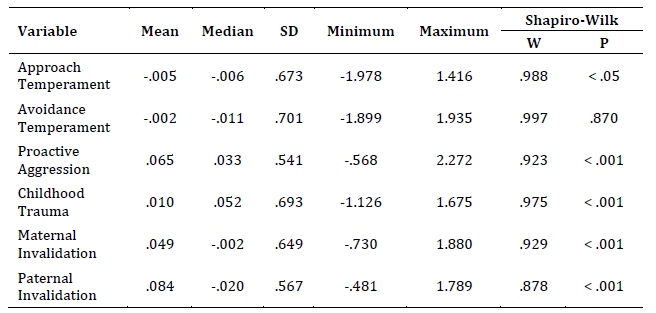
For this specific analysis, a sample of 328 participants was considered, as the ICES test requires having had a two-parent upbringing, a condition not met by the total sample. Psychometric properties for the complementary scales and the ATQ were obtained (Table 6), identifying internal structure validity evidence through CFA with mostly excellent fit indices (Kline, 2016). Regarding reliability evidence, adequate internal consistency coefficients were obtained for all scales, as they were greater than .80 (Viladrich et al., 2017). It is identified that all measurement tools function satisfactorily. Subsequently, descriptive statistics for each variable (Table 7) were computed from factor scores derived from the previously fitted models, following the recommendations of McNeish and Wolf (2020).
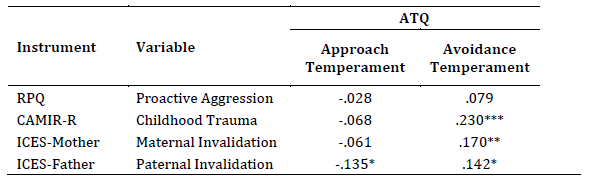
Using the factor scores of each variable, the relationship between ATQ dimensions and complementary variables was determined through Spearman’s correlation coefficient (Table 8). Avoidance temperament presented direct, statistically significant associations with childhood trauma (rs = .230, p < .001), maternal invalidation (rs = .170, p < .01) and paternal invalidation (rs = .142, p< .05), identifying convergent validity evidence. In the case of approach temperament, an inverse relationship with paternal invalidation was found (rs = -.135, p < .05), obtaining divergent validity evidence. However, no relationship was established with proactive aggression. All identified correlations presented a small effect size (Cohen, 1992).
Discussion
Temperament is a highly studied variable in the psychological field due to its implications in various spheres of an individual's life, being associated with both contextual factors and early parenting (Kagan & Snidman, 2004; Rothbart, 2011) as well as behavioral manifestations at the psychopathological level (Loijen et al., 2020). Due to its great relevance, the present study aimed to determine the psychometric properties of the first Spanish version of the ATQ in a sample of young Peruvian adults.
First, content validity evidence was obtained through a bilingual review by eight expert judges in both clinical and forensic fields (Sireci & Faulkner-Bond, 2014). Aiken's V coefficients were statistically significant for the evaluation domains of representativeness, clarity, and utility, as scores above .80 were obtained. The cultural adaptation of the ATQ followed a rigorous process, such that qualitative modifications were made based on the comments provided by the experts.
Through CFA, it was confirmed that the original two-factor correlated model of both temperaments (Elliot & Thrash, 2010) presented mostly excellent fit indices, with the exception of the RMSEA, which was within the adequate range (Keith, 2019; Kline, 2016). These results suggest that the multifactorial structure fits the data well, aligning with those obtained in the other versions of the ATQ (Bipp et al., 2017; Elliot & Thrash, 2010; Monni & Scalas, 2019; Paelecke & Weiß, 2025). It should be noted that the AVE analysis identified good discriminant validity between factors (consistent with the theoretical approach; Elliot & Thrash, 2010), although there were limitations regarding convergent validity in the avoidance temperament subscale (AVE = .46). Despite this, the factor loadings were adequate as they were greater than .40 for all items in their corresponding dimension (Brown, 2015), such that the overall evidence supports convergent validity (Hair et al., 2019). Regarding reliability, adequate internal consistency coefficients were determined for both ATQ dimensions, as these estimates were greater than .80 (Raykov & Hancock, 2005). This allows for the interpretation that the scores derived from the instrument present highly acceptable levels of precision for both research and psychological evaluation contexts (Kline, 2016).
Subsequent to obtaining psychometric evidence for the complementary measurement scales in this study, associations between other constructs and approach and avoidance temperaments were identified. Through correlational analyses, convergent validity evidence was established for avoidance temperament with complex parenting experiences from both parents and childhood-adolescent trauma, as well as divergent validity evidence in the inverse association between approach temperament and paternal invalidation. Although the identified correlations presented small effect sizes (rs = .14-.23), these are consistent with what is expected in research on individual differences in personality, where typical associations tend to fall within modest ranges (Gignac & Szodorai, 2016), so their value lies more in their directional coherence with the theoretical framework than solely in their magnitude (Funder & Ozer, 2019). In this sense, evidence suggests that systematic experiences of rejection, criticism, and mistreatment during childhood promote the manifestation of avoidant repertoires in response to high-intensity emotions (De Carvalho et al., 2015; Linehan, 1993), findings that complement those of Boggiano and Gagliesi (2020), suggesting that invalidating environments primarily foster avoidant patterns rather than approach behaviors and emotional openness. Furthermore, it is interesting that only paternal invalidation was associated with both temperaments. A possible explanatory path for this finding is found in the meta-analysis by Zheng et al. (2026), which underscores that the paternal figure exerts a differentiated and multifaceted influence on children's socioemotional competence, given that the early father-child bond constitutes a fundamental pillar of long-term affective and relational development. For this reason, systematic paternal invalidation could represent a disruption in this dynamic, amplifying the impact on the individual's temperamental configuration; that is, it would affect both their sensitivity toward aversive stimuli and their disposition toward appetitive experiences. Future research could further investigate this line of inquiry, specifically in South American contexts, given that the study by Zheng et al. (2026) did not include this population.
Contrary to expectations, proactive aggression was not associated with approach temperament. This finding is supported by the available empirical evidence and opens considerable theoretical questions. First, the relationship between proactive aggression and approach and avoidance tendencies is, in itself, empirically scarce and inconsistent. Van Bockstaele (2024), in a study specifically designed to examine this relationship, found no evidence that approach tendencies predicted proactive aggression in children, concluding that further research is required to clarify the role of these tendencies in aggression. In contrast, Pederson et al. (2018) did find support for this association in American university students. However, it should be noted that in said research, appetitive sensitivity was operationalized exclusively through reactivity to the BAS system, a construct that differs at the latent order level from approach temperament (Elliot & Thrash, 2010). Second, the executive elaboration of proactive aggression is not reducible to a motivational tendency of approach toward rewards. This type of aggression is characterized by being planned, calculated, and emotionally cold (Glenn & Raine, 2009; Raine et al., 2006); that is, the individual prepares the attack independently of immediate motivation, such that the delays between intention and execution can extend from hours to years (Meloy, 2025). Likewise, neuropsychological evidence indicates that deficits in executive functioning poorly explain the variance of proactive aggression (Choy et al., 2025), suggesting that its execution is predominantly determined by factors that transcend the temperamental level captured by the ATQ, such as strategic planning and deliberate cognitive control. Third, the literature points out that instrumental aggression is more closely linked to psychopathic traits (Glenn & Raine, 2009; Thomson et al., 2025) than to general appetitive sensitivity, which constitutes an indication that the relationship between approach tendencies and proactive aggression might not be direct but mediated by these traits. Along this line, Sica et al. (2026) longitudinally demonstrated that the BAS predicted the three dimensions of the triarchic model of psychopathy: Boldness, Disinhibition, and Meanness (Patrick et al., 2009), a finding that is consistent with the neurobiological evidence positioning the mesolimbic dopaminergic system (substrate of the BAS) as a central, albeit non-linear, element in the etiology of psychopathic traits (Fowles, 2024). To the best of our knowledge, empirical applications of approach and avoidance temperaments have not been developed to explain the development of psychopathic personality nor the behavioral manifestations that characterize it, which establishes a future research agenda of considerable clinical and forensic relevance.
On the other hand, the adaptation of the ATQ into Spanish has far-reaching implications. The proposal by Elliot and Thrash (2010) has substantially contributed to the study of approach and avoidance tendencies in the explanation of various behaviors, particularly those linked to psychopathology, constituting a line of research of increasing relevance for clinical psychology (Monni & Scalas, 2024). However, scientific production in the Spanish language is notably scarce compared to that documented in other languages, which limits the development of this field in Latin American contexts. In this sense, it is anticipated that this first Spanish version will constitute a fundamental resource to boost research on these constructs in the region.
The recent validation of the ATQ in a clinical sample (Rassaby et al., 2025) reinforces its utility for identifying psychopathological vulnerabilities and detecting risk profiles in the Spanish-speaking population that guide the differentiated selection of therapeutic strategies (Loijen et al., 2020; Monni & Scalas, 2024). For example, in patients with elevated avoidance temperament, interventions aimed at gradual exposure to aversive stimuli are particularly relevant (Racz et al., 2024), while reduced approach temperament signals the utility of behavioral activation strategies aimed at increasing contact with appetitive stimuli (Forbes, 2020; Struijs et al., 2018). The clinical applicability of the ATQ also extends to emerging psychopathological domains such as behavioral addictions (Li et al., 2024), broadening its potential use beyond traditional affective disorders.
Additionally, its utility transcends the clinical sphere, reaching other fields of psychology. In the educational setting, analyzing attentional bias and test anxiety (Putwain et al., 2020); in forensics, examining patterns of social response in individuals with psychopathic traits (von Borries et al., 2012); and in the organizational context, exploring employees' responses to the innovation climate (Wang et al., 2026) and the role of motivational tendencies in interacting with clients (Lee et al., 2025). Consequently, given the demonstrated relevance of approach and avoidance tendencies in the study of adaptive goal-directed behavior (Chen et al., 2025), the Spanish version of the ATQ constitutes a cross-domain resource of considerable scope that spans clinical, educational, forensic, and organizational domains, positioning it as a broad-spectrum measurement tool for contemporary psychological research and practice.
Nonetheless, the present study has a series of important limitations to consider. Non-probability sampling prevents the results from being generalizable to the Peruvian population as a whole, reducing the external validity of the findings (Andrade, 2021). This is a widely recognized challenge in psychological research with student samples, since they may systematically differ from the general population in personality variables (Hanel & Vione, 2016). Furthermore, the sample size did not allow for a measurement invariance analysis, given that, when segmenting the sample by subgroups, the number of participants did not reach the minimums required to guarantee stability when estimating the multiple thresholds demanded by the rigorous modeling of ordinal items (Wu & Estabrook, 2016). The evaluation of measurement invariance constitutes an important methodological step in future research, since determining whether both temperaments function equivalently across population subgroups (e.g., by gender or age) is an indispensable prerequisite for the valid comparison of scores between groups and for the generalization of findings (Putnick & Bornstein, 2016). On the other hand, the characteristics of the sample could have influenced the results, as the participants were young people (18 to 30 years old), which does not necessarily reflect the age distribution of the Peruvian population. These limitations are acknowledged in the present study with the aim of promoting future research proposals that consider probability samples, which are more representative and heterogeneous, in order to evaluate the psychometric functioning of the ATQ in diverse Latin American contexts, since variations in responses to the items could arise due to cultural influence (Chen, 2007).
Finally, it can be concluded that the Spanish version of the ATQ is a test that meets current psychometric standards regarding psychological measurement tools (AERA et al., 2014; ITC, 2017), by identifying validity evidence (content, internal structure, relationship with other variables) and reliability evidence (internal consistency). Its availability in Spanish provides a platform for the development of translational research that articulates temperamental assessment, psychopathological explanation, and differentiated intervention in Latin American contexts, contributing to expanding the empirical base on approach and avoidance temperaments in Spanish-speaking populations.
References
-
Aiken, L. (1985). Three coefficients for analyzing the reliability and validity of ratings. Educational and Psychological Measurement, 45(1), 131-142. https://doi.org/10.1177/0013164485451012
» https://doi.org/10.1177/0013164485451012 -
American Educational Research Association, American Psychological Association & National Council of Measurement in Education. (2014). Standards for educational and psychological testing https://www.apa.org/science/programs/testing/standards
» https://www.apa.org/science/programs/testing/standards -
Andrade, C. (2021). The inconvenient truth about convenience and purposive samples. Indian Journal of Psychological Medicine, 43(1), 86-88. https://doi.org/10.1177/0253717620977000
» https://doi.org/10.1177/0253717620977000 -
Andreu, J. M., Peña, M. E., & Ramírez, J. M. (2009). Cuestionario de agresión reactiva y proactiva: un instrumento de medida de la agresión en adolescentes. Revista de Psicopatología y Psicología Clínica, 14(1), 37-49. https://doi.org/10.5944/rppc.vol.14.num.1.2009.4065
» https://doi.org/10.5944/rppc.vol.14.num.1.2009.4065 -
Ato, M., López, J. J., & Benavente, A. (2013). Un sistema de clasificación de los diseños de investigación en psicología. Anales de Psicología, 29(3), 1038-1059. https://doi.org/10.6018/analesps.29.3.178511
» https://doi.org/10.6018/analesps.29.3.178511 - Balluerka, N., Lacasa, F., Gorostiaga, A., Muela, A., & Pierrehumbert, B. (2011). Versión reducida del cuestionario CaMir (CaMir-R) para la evaluación del apego. Psicothema, 23(3), 486-494.
-
Belsky, J., Fish, M., & Isabella, R. A. (1991). Continuity and discontinuity in infant negative and positive emotionality: The influence of attachment and out-of-home caregiving. Developmental Psychology, 27(3), 421-431. https://doi.org/10.1037/0012-1649.27.3.421
» https://doi.org/10.1037/0012-1649.27.3.421 -
Bettis, A. H., Benningfield, M. M., Dao, A., Dickey, L., Pegg, S., Venanzi, L., & Kujawa, A. (2022). Self-injurious thoughts and behaviors and alterations in positive valence systems: A systematic review of the literature. Journal of Psychiatric Research, 156, 579-593. https://doi.org/10.1016/j.jpsychires.2022.10.033
» https://doi.org/10.1016/j.jpsychires.2022.10.033 -
Bipp, T., Kleingeld, A., & Van Dam, K. (2017). Approach and avoidance temperament: An examination of its construct and predictive validity at work. European Journal of Psychological Assessment, 33(3), 196-206. https://doi.org/10.1027/1015-5759/a000285
» https://doi.org/10.1027/1015-5759/a000285 -
Blacutt, M., O'Loughlin, C. M., & Ammerman, B. A. (2025). Bias toward escape responding during reinforcement learning among those with suicidal ideation. Journal of Psychiatric Research, 181, 586-595. https://doi.org/10.1016/j.jpsychires.2024.12.020
» https://doi.org/10.1016/j.jpsychires.2024.12.020 - Boggiano, J. P., & Gagliesi, P. (2020). Terapia dialéctico conductual. Introducción al tratamiento de consultantes con desregulación emocional Tres Olas.
-
Bornstein, M. H., Hahn, C. S., Sputnik, D. L., & Pearson, R. (2019). Stability of child temperament: Multiple moderation by child and mother characteristics. British Journal of Developmental Psychology, 37(1), 51-67. https://doi.org/10.1111/bjdp.12253
» https://doi.org/10.1111/bjdp.12253 -
Braungart, J. M., Plomin, R., DeFries, J. C., & Fulker, D. W. (1992). Genetic influence on tester-rated infant temperament as assessed by Bayley's Infant Behavior Record: Nonadoptive and adoptive siblings and twins. Developmental Psychology, 28(1), 40-47. https://doi.org/10.1037/0012-1649.28.1.40
» https://doi.org/10.1037/0012-1649.28.1.40 -
Briley, D. A., & Tucker-Drob, E. M. (2014). Genetic and environmental continuity in personality development: A meta-analysis. Psychological Bulletin, 140(5), 1303-1331. https://doi.org/10.1037/a0037091
» https://doi.org/10.1037/a0037091 - Brown, T. A. (2015). Confirmatory Factor Analysis for Applied Research (2a ed.). The Guilford Press.
- Buss, A., & Plomin, R. (1984). Temperament: Early developing personality traits Lawrence Erlbaum Associates.
- Campbell, R. J. (2009). Psychiatric dictionary (9a ed.). Oxford University Press.
-
Chen, F. F. (2007). Sensitivity of goodness of fit indexes to lack of measurement invariance. Structural Equation Modeling: A Multidisciplinary Journal, 14(3), 464-504. https://doi.org/10.1080/10705510701301834
» https://doi.org/10.1080/10705510701301834 -
Chen, M., Reutter, M., Pauli, P., Gamer, M., & Pittig, A. (2025). Overcoming automatic behavioral tendencies in approach-avoidance conflict decisions. Psychophysiology, 62(7), e70101. https://doi.org/10.1111/psyp.70101
» https://doi.org/10.1111/psyp.70101 -
Choy, O., Tan, G., & van Dongen, J. D. M. (2025). Executive functions and aggression in “hot” and “cold” contexts: Two meta-analyses. Aggression and Violent Behavior, 80, 102024. https://doi.org/10.1016/j.avb.2024.102024
» https://doi.org/10.1016/j.avb.2024.102024 -
Clark, L. A. (2005). Temperament as a unifying basis for personality and psychopathology. Journal of Abnormal Psychology, 114(4), 505-521. https://doi.org/10.1037/0021-843X.114.4.505
» https://doi.org/10.1037/0021-843X.114.4.505 -
Cohen, J. (1992). A power primer. Psychological Bulletin, 112(1), 155-159. https://doi.org/10.1037/0033-2909.112.1.155
» https://doi.org/10.1037/0033-2909.112.1.155 -
Cornellà, J. (2010). ¿Qué es el temperamento? Anales de Pediatría Continuada, 8(5), 231-236. https://doi.org/10.1016/S1696-2818(10)70041-X
» https://doi.org/10.1016/S1696-2818(10)70041-X - Costa, P. T., Jr., & McCrae, R. R. (1992). Revised NEO Personality Inventory (NEO-PI-R) and NEO Five-Factor Inventory (NEO-FFI): Professional manual Psychological Assessment Resources.
-
Cronbach, L. J. (1951). Coefficient alpha and the internal structure of tests. Psychometrika, 16(3), 297-334. https://doi.org/10.1007/BF02310555
» https://doi.org/10.1007/BF02310555 -
Cuthbert, B. N. (2022). Research Domain Criteria (RDoC): Progress and potential. Current Directions in Psychological Science, 31(2), 107-114. https://doi.org/10.1177/09637214211051363
» https://doi.org/10.1177/09637214211051363 -
Cuthbert, B. N., & Kozak, M. J. (2013). Constructing constructs for psychopathology: The NIMH research domain criteria. Journal of Abnormal Psychology, 122(3), 928-937. https://doi.org/10.1037/a0034028
» https://doi.org/10.1037/a0034028 -
Daneshvar, S., Mohammadi-Bytamar, J., Dehbozorgi, S., Pourmohammad, P., Zeraatpisheh, Z., & Jobson, L. (2025). Perseverative cognitions, negative valence systems, positive valence systems, social disconnection, and suicide: Testing a mediator model among university students. BMC Psychology, 13, 215. https://doi.org/10.1186/s40359-025-02550-1
» https://doi.org/10.1186/s40359-025-02550-1 -
Davis, L. L. (1992). Instrument review: Getting the most from a panel of experts. Applied Nursing Research, 5(4), 194-197. https://doi.org/10.1016/S0897-1897(05)80008-4
» https://doi.org/10.1016/S0897-1897(05)80008-4 -
De Carvalho, H. W., Pereira, R., Frozi, J., Bisol, L. W., Ottoni, G. L., & Lara, D. R. (2015). Childhood trauma is associated with maladaptive personality traits. Child Abuse and Neglect, 44, 18-25. https://doi.org/10.1016/j.chiabu.2014.10.013
» https://doi.org/10.1016/j.chiabu.2014.10.013 -
Dobzhansky, T. (1973). Nothing in biology makes sense except in the light of evolution. The American Biology Teacher, 35(3), 125-129. https://doi.org/10.2307/4444260
» https://doi.org/10.2307/4444260 -
Dodge, K. A., & Coie, J. D. (1987). Social-information-processing factors in reactive and proactive aggression in children's peer groups. Journal of Personality and Social Psychology, 53(6), 1146-1158. https://doi.org/10.1037/0022-3514.53.6.1146
» https://doi.org/10.1037/0022-3514.53.6.1146 -
Elliot, A. J. (2006). The hierarchical model of approach-avoidance motivation. Motivation and Emotion, 30, 111-116. https://doi.org/10.1007/s11031-006-9028-7
» https://doi.org/10.1007/s11031-006-9028-7 - Elliot, A. J. (Ed.). (2008). Handbook of approach and avoidance motivation Psychology Press.
-
Elliot, A. J., & Covington, M. V. (2001). Approach and avoidance motivation. Educational Psychology Review, 13(2), 73-92. https://doi.org/10.1023/A:1009009018235
» https://doi.org/10.1023/A:1009009018235 -
Elliot, A. J., & Thrash, T. M. (2002). Approach-avoidance motivation in personality: Approach and avoidance temperaments and goals. Journal of Personality and Social Psychology, 82(5), 804-818. https://doi.org/10.1037//0022-3514.82.5.804
» https://doi.org/10.1037//0022-3514.82.5.804 -
Elliot, A. J., & Thrash, T. M. (2010). Approach and avoidance temperament as basic dimensions of personality. Journal of Personality, 78(3), 865-906. https://doi.org/10.1111/j.1467-6494.2010.00636.x
» https://doi.org/10.1111/j.1467-6494.2010.00636.x - Eysenck, H. J., & Eysenck, M. W. (1985). Personality and individual differences: A natural science approach Plenum Press.
- Field, A. (2013). Discovering statistics using IBM SPSS statistics (4a ed.). Sage.
-
Forbes, C. N. (2020). New directions in behavioral activation: Using findings from basic science and translational neuroscience to inform the exploration of potential mechanisms of change. Clinical Psychology Review, 79, 101860. https://doi.org/10.1016/j.cpr.2020.101860
» https://doi.org/10.1016/j.cpr.2020.101860 -
Fowles, D. C. (2024). Arousal, Gray’s theory of anxiety, and the etiology of psychopathy. Biological Psychology, 188, 108772. https://doi.org/10.1016/j.biopsycho.2024.108772
» https://doi.org/10.1016/j.biopsycho.2024.108772 -
Funder, D. C., & Ozer, D. J. (2019). Evaluating effect size in psychological research: Sense and nonsense. Advances in Methods and Practices in Psychological Science, 2(2), 156-168. https://doi.org/10.1177/2515245919847202
» https://doi.org/10.1177/2515245919847202 - George, D., & Mallery, M. (2010). SPSS for windows step by step: A simple guide and reference Pearson.
-
Gignac, G. E., & Szodorai, E. T. (2016). Effect size guidelines for individual differences researchers. Personality and Individual Differences, 102, 74-78. https://doi.org/10.1016/j.paid.2016.06.069
» https://doi.org/10.1016/j.paid.2016.06.069 -
Glenn, A. L., & Raine, A. (2009). Psychopathy and instrumental aggression: Evolutionary, neurobiological, and legal perspectives. International Journal of Law and Psychiatry, 32(4), 253-258. https://doi.org/10.1016/j.ijlp.2009.04.002
» https://doi.org/10.1016/j.ijlp.2009.04.002 - Gray, J. A. (1987). The psychology of fear and stress (2a ed.). Cambridge University Press.
- Gray, J. A., & McNaughton, N. (2000). The neuropsychology of anxiety: An enquiry into the functions of the Septo-Hippocampal System Oxford University Press.
-
Green, S. B., & Yang, Y. (2009). Reliability of summed item scores using structural equation modeling: An alternative to coefficient alpha. Psychometrika, 74(1), 155-167. https://doi.org/10.1007/S11336-008-9099-3
» https://doi.org/10.1007/S11336-008-9099-3 -
Gross, A. M., Rassaby, M., Hoffman, S. N., Depp, C. A., Moore, R. C., & Taylor, C. T. (2025). Driven by rewards or punishments? Understanding real world social functioning in anxiety and depressive disorders. Journal of Mood & Anxiety Disorders, 9, 100097. https://doi.org/10.1016/j.xjmad.2024.100097
» https://doi.org/10.1016/j.xjmad.2024.100097 - Hair, J. F., Black, W. C., Babin, B. J., & Anderson, R. E. (2019). Multivariate data analysis (8a ed.). Cengage Learning.
-
Hanel, P. H. P., & Vione, K. C. (2016). Do student samples provide an accurate estimate of the general public? PLoS ONE, 11(12), e0168354. https://doi.org/10.1371/journal.pone.0168354
» https://doi.org/10.1371/journal.pone.0168354 -
Heim, E., Mewes, R., Abi Ramia, J., Glaesmer, H., Hall, B., Harper Shehadeh, M., Ünlü, B., Kananian, S., Kohrt, B. A., Lechner-Meichsner, F., Lotzin, A., Moro, M. R., Radjack, R., Salamanca-Sanabria, A., Singla, D. R., Starck, A., Sturm, G., Tol, W., Weise, C., & Knaevelsrud, C. (2021). Reporting Cultural Adaptation in Psychological Trials - The RECAPT criteria. Clinical Psychology in Europe, 3, 6351. https://doi.org/10.32872/cpe.6351
» https://doi.org/10.32872/cpe.6351 -
Hu, L., & Bentler, P. M. (1999). Cutoff criteria for fit indexes in covariance structure analysis: Conventional criteria versus new alternatives. Structural Equation Modeling, 6(1), 1-55. https://doi.org/10.1080/10705519909540118
» https://doi.org/10.1080/10705519909540118 -
Insel, T., Cuthbert, B., Garvey, M., Heinssen, R., Pine, D.S., Quinn, K., Sanislow, C., & Wang, P. (2010). Research domain criteria (RDoC): toward a new classification framework for research on mental disorders. The American Journal of Psychiatry, 167(7), 748-751. https://doi.org/10.1176/appi.ajp.2010.09091379
» https://doi.org/10.1176/appi.ajp.2010.09091379 -
International Test Commission. (2017). The ITC guidelines for translating and adapting tests (2a ed.). https://www.intestcom.org
» https://www.intestcom.org - John, O. P., & Robins, R. W. (Eds.). (2021). Handbook of personality: Theory and research (4a ed.). The Guilford Press.
- Kagan, J., & Snidman, N. (2004). The long shadow of temperament The Belknap Press of Harvard University Press.
- Keith, T. Z. (2019). Multiple regression and beyond. An introduction to multiple regression and structural equation modeling (3a ed.). Routledge.
- Kline, R. B. (2016). Principles and practice of structural equation modeling (4a ed.). The Guilford Press.
-
Kopala-Sibley, D. C., Olino, T., Durbin, E., Dyson, M. W., & Klein, D. N. (2018). The stability of temperament from early childhood to early adolescence: A multi-method, multi-informant examination. European Journal of Personality , 32(2), 128-145. https://doi.org/10.1002/per.2151
» https://doi.org/10.1002/per.2151 -
Lang, P. J. (1995). The emotion probe: Studies of motivation and attention. American Psychologist, 50(5), 372-385. https://doi.org/10.1037/0003-066X.50.5.372
» https://doi.org/10.1037/0003-066X.50.5.372 -
Lee, R., Klotz, A., McClean, S., Ilies, R., & Zhang, J. H. (2025). On the receiving end of customer creativity: Insights from approach-avoidance and interpersonal complementarity perspectives. Journal of Management, 51(7), 2809-2851. https://doi.org/10.1177/01492063241247499
» https://doi.org/10.1177/01492063241247499 -
Li, C., Pan, T., He, J., Zheng, Y., Fan, L., & Meng, Y. (2024). Approach bias in individuals with Internet gaming disorder: Evidence from an event-related potential-based approach-avoid task. International Journal of Psychophysiology , 202, 112376. https://doi.org/10.1016/j.ijpsycho.2024.112376
» https://doi.org/10.1016/j.ijpsycho.2024.112376 -
Li, C.-H. (2016). Confirmatory factor analysis with ordinal data: Comparing robust maximum likelihood and diagonally weighted least squares. Behavior Research Methods, 48(3), 936-949. https://doi.org/10.3758/s13428-015-0619-7
» https://doi.org/10.3758/s13428-015-0619-7 - Linehan, M. M. (1993). Cognitive-behavioral treatment of borderline personality disorder The Guilford Press.
-
Loijen, A., Vrijsen, J. N., Egger, J. I. M., Becker, E. S., & Rinck, M. (2020). Biased approach-avoidance tendencies in psychopathology: A systematic review of their assessment and modification. Clinical Psychology Review, 77, 101825. https://doi.org/10.1016/j.cpr.2020.101825
» https://doi.org/10.1016/j.cpr.2020.101825 - McDonald, R. P. (1999). Test theory: A unified treatment Lawrence Erlbaum Associates.
-
McNeish, D., & Wolf, M. G. (2020). Thinking twice about sum scores. Behavior Research Methods, 52, 2287-2305. https://doi.org/10.3758/s13428-020-01398-0
» https://doi.org/10.3758/s13428-020-01398-0 - Mead, M. (1935). Sex and temperament in three primitive societies Morrow.
-
Meloy, J. R. (2025). Affective and predatory violence: from evolutionary adaptation to psychiatric morbidity. Frontiers in Psychiatry, 16, 1690508. https://doi.org/10.3389/fpsyt.2025.1690508
» https://doi.org/10.3389/fpsyt.2025.1690508 -
Monni, A., & Scalas, L. F. (2019). Italian validation of the Approach-Avoidance Temperament Questionnaire. BPA-Applied Psychology Bulletin, 67(284), 20-30. https://doi.org/10.26387/bpa.284.3
» https://doi.org/10.26387/bpa.284.3 -
Monni, A., & Scalas, L. F. (2024). Approach-avoidance assessment: Comparison and validity of the measures related to three theories. Psychological Studies, 69(2), 145-157. https://doi.org/10.1007/s12646-024-00786-2
» https://doi.org/10.1007/s12646-024-00786-2 -
Monni, A., Olivier, E., Morin, A. J. S., Olivetti, M., Mulvihill, K., & Scalas, L. F. (2020). Approach and avoidance in Gray's, Higgins', and Elliot's perspectives: A theoretical comparison and integration of approach-avoidance in motivated behavior. Personality and Individual Differences, 166, 110163. https://doi.org/10.1016/j.paid.2020.110163
» https://doi.org/10.1016/j.paid.2020.110163 -
Morris, S. E., Sanislow, C. A., Pacheco, J., Vaidyanathan, U., Gordon, J. A., & Cuthbert, B. N. (2022). Revisiting the seven pillars of RDoC. BMC Medicine, 20, 220. https://doi.org/10.1186/s12916-022-02414-0
» https://doi.org/10.1186/s12916-022-02414-0 -
Mountford, V., Corstorphine, E., Tomlinson, S., & Waller, G. (2007). Development of a measure to assess invalidating childhood environments in the eating disorders. Eating Behaviors, 8(1), 48-58. https://doi.org/10.1016/j.eat-beh.2006.01.003
» https://doi.org/10.1016/j.eat-beh.2006.01.003 -
Nijhawan, L. P., Janodia, M. D., Muddukrishna, B. S., Bhat, K. M., Bairy, K. L., Udupa, N., & Musmade, P. B. (2013). Informed consent: Issues and challenges. Journal of Advanced Pharmaceutical Technology & Research, 4(3), 134-140. https://doi.org/10.4103/2231-4040.116779
» https://doi.org/10.4103/2231-4040.116779 -
Okumura-Clark, A., Blancas-Guillen, J., Ccoyllo-Gonzalez, L., & Valencia, P. D. (2024). Psychometric properties comparison among diverse versions of the invalidation childhood environmental scale (ICES) in Peruvian adults. Interacciones, 10, 424. https://doi.org/10.24016/2024.v10.424
» https://doi.org/10.24016/2024.v10.424 -
Paelecke, M., & Weiß, M. (2025). German validation of the Approach-Avoidance Temperament Questionnaire. European Journal of Psychological Assessment . https://doi.org/10.1027/1015-5759/a000909
» https://doi.org/10.1027/1015-5759/a000909 -
Patrick, C. J., Fowles, D. C., & Krueger, R. F. (2009). Triarchic conceptualization of psychopathy: Developmental origins of disinhibition, boldness, and meanness. Development and Psychopathology, 21(3), 913-938. https://doi.org/10.1017/S0954579409000492
» https://doi.org/10.1017/S0954579409000492 -
Pederson, C. A., Fite, P. J., & Bortolato, M. (2018). The role of functions of aggression in associations between behavioral inhibition and activation and mental health outcomes. Journal of Aggression, Maltreatment & Trauma, 27(8), 811-830. https://doi.org/10.1080/10926771.2017.1370053
» https://doi.org/10.1080/10926771.2017.1370053 -
Ponikiewska, K., Strus, W., & Cieciuch, J. (2026). The 45 degrees difference between the personality Big Two and the temperamental Big Two. Personality and Individual Differences, 259, 113839. https://doi.org/10.1016/j.paid.2026.113839
» https://doi.org/10.1016/j.paid.2026.113839 -
Putnick, D. L., & Bornstein, M. H. (2016). Measurement invariance conventions and reporting: The state of the art and future directions for psychological research. Developmental Review, 41, 71-90. https://doi.org/10.1016/j.dr.2016.06.004
» https://doi.org/10.1016/j.dr.2016.06.004 -
Putwain, D. W., Symes, W., Coxon, E., & Gallard, D. (2020). Attention bias in test anxiety: The impact of a test-threat congruent situation, presentation time, and approach-avoidance temperament. Educational Psychology, 40(6), 713-734. https://doi.org/10.1080/01443410.2020.1740653
» https://doi.org/10.1080/01443410.2020.1740653 -
R Core Team. (2024). R: A language and environment for statistical computing R Foundation for Statistical Computing. https://www.R-project.org/
» https://www.R-project.org/ -
Racz, J. I., Bialocerkowski, A., Calteaux, I., & Farrell, L. J. (2024). Determinants of exposure therapy implementation in clinical practice for the treatment of anxiety, OCD, and PTSD: A systematic review. Clinical Child and Family Psychology Review, 27, 317-341. https://doi.org/10.1007/s10567-024-00478-3
» https://doi.org/10.1007/s10567-024-00478-3 -
Raine, A., Dodge, K., Loeber, R., Gatzke-Kopp, L., Lynam, D., Reynolds, C., Stouthamer-Loeber, M., & Liu, J. (2006). The reactive-proactive aggression questionnaire: Differential correlates of reactive and proactive aggression in adolescent boys. Aggressive Behavior, 32(2), 159-171. https://doi.org/10.1002/ab.20115
» https://doi.org/10.1002/ab.20115 -
Rassaby, M., Rogers, J. M., & Taylor, C. T. (2025). Validation of the Approach-Avoidance Temperament Questionnaire in individuals with anxiety and depression. Journal of Personality Assessment, 107(1), 114-126. https://doi.org/10.1080/00223891.2024.2350466
» https://doi.org/10.1080/00223891.2024.2350466 -
Raykov, T., & Hancock, G. R. (2005). Examining change in maximal reliability for multiple-component measuring instruments. British Journal of Mathematical and Statistical Psychology, 58(1), 65-82. https://doi.org/10.1348/000711005X38753
» https://doi.org/10.1348/000711005X38753 -
Rojas, M. E., Arias, W. L., Rivera, R., Geldres, J. A., Starke, M. A., & Apaza, E. N. (2020). Propiedades psicométricas de los cuestionarios Reactive/Proactive Questionnaire (RPQ) y How I Think Questionnaire (HIT) en estudiantes peruanos. Revista de Psicopatología y Psicología Clínica, 25(1), 59-68. https://doi.org/10.5944/rppc.24426
» https://doi.org/10.5944/rppc.24426 - Rothbart, M. K. (2011). Becoming who we are: Temperament and personality in development The Guilford Press.
- Rothbart, M. K., & Bates, J. E. (1998). Temperament. En W. Damon (Series Ed.) & N. Eisenberg (Vol. Ed.), Handbook of child psychology: Vol. 3. Social, emotional, and personality development (5a ed., pp. 105-176). Wiley.
-
Rothbart, M. K., Ahadi, S. A., & Evans, D. E. (2000). Temperament and personality: Origins and outcomes. Journal of Personality and Social Psychology, 78(1), 122-135. https://doi.org/10.1037//0022-3514.78.1.122
» https://doi.org/10.1037//0022-3514.78.1.122 -
Sánchez-Roige, S., Gray, J. C., MacKillop, J., Chen, C.-H., & Palmer, A. A. (2018). The genetics of human personality. Genes, Brain and Behavior, 17(3), 12439. https://doi.org/10.1111/gbb.12439
» https://doi.org/10.1111/gbb.12439 -
Sica, C., Caudek, C., Bottesi, G., Colpizzi, I., Malerba, A., Iannattone, S., & Patrick, C. J. (2026). Reciprocal longitudinal relations between reinforcement sensitivity constructs and triarchic psychopathy traits in Italian adolescents: A Bayesian random intercept cross-lagged panel model. Personality and Individual Differences, 249, 113523. https://doi.org/10.1016/j.paid.2025.113523
» https://doi.org/10.1016/j.paid.2025.113523 -
Sireci, S., & Faulkner-Bond, M. (2014). Validity evidence based on test content. Psicothema, 26(1), 100-107. https://doi.org/10.7334/psicothema2013.256
» https://doi.org/10.7334/psicothema2013.256 -
Spearman, C. (1904). The proof and measurement of association between two things. The American Journal of Psychology, 15(1), 72-101. https://doi.org/10.2307/1412159
» https://doi.org/10.2307/1412159 -
Struijs, S. Y., Lamers, F., Rinck, M., Roelofs, K., Spinhoven, P., & Penninx, B. W. J. H. (2018). The predictive value of approach and avoidance tendencies on the onset and course of depression and anxiety disorders. Depression and Anxiety, 35(6), 551-559. https://doi.org/10.1002/da.22760
» https://doi.org/10.1002/da.22760 -
Suh, Y. (2015). The performance of maximum likelihood and weighted least square mean and variance adjusted estimators in testing differential item functioning with nonnormal trait distributions. Structural Equation Modeling : A Multidisciplinary Journal, 22(4), 568-580. https://doi.org/10.1080/10705511.2014.937669
» https://doi.org/10.1080/10705511.2014.937669 - Tabachnick, B. G., & Fidell, L. S. (2019). Using multivariate statistics (7a ed.). Pearson.
- Thomas, A., & Chess, S. (1977). Temperament and development Brunner/Mazel.
-
Thomson, N. D., Kjaervik, S. L., Neumann, C. S., & Hare, R. D. (2025). The role of psychopathy in subtypes of aggression and gun violence. Journal of Psychopathology and Behavioral Assessment, 47, 69. https://doi.org/10.1007/s10862-025-10247-3
» https://doi.org/10.1007/s10862-025-10247-3 -
Tooby, J., & Cosmides, L. (1990). The past explains the present: Emotional adaptations and the structure of ancestral environment. Ethology and Sociobiology, 11(4-5), 375-424. https://doi.org/10.1016/0162-3095(90)90017-Z
» https://doi.org/10.1016/0162-3095(90)90017-Z -
van Bockstaele, B. (2024). Approach-avoidance tendencies in proactive and reactive aggression. Aggressive Behavior, 50(4), e22162. https://doi.org/10.1002/ab.22162
» https://doi.org/10.1002/ab.22162 -
Viladrich, C., Angulo-Brunet, A., & Doval, E. (2017). Un viaje alrededor de alfa y omega para estimar la fiabilidad de consistencia interna. Annals of Psychology, 33(3), 755-782. https://doi.org/10.6018/analesps.33.3.268401
» https://doi.org/10.6018/analesps.33.3.268401 -
Volk, A. A., & Puchalski, A. (2025). Evolutionary theory and personality. Current Opinion in Psychology, 65, 102069. https://doi.org/10.1016/j.copsyc.2025.102069
» https://doi.org/10.1016/j.copsyc.2025.102069 -
von Borries, A. K. L., Volman, I., de Bruijn, E. R. A., Bulten, B. H., Verkes, R. J., & Roelofs, K. (2012). Psychopaths lack the automatic avoidance of social threat: Relation to instrumental aggression. Psychiatry Research, 200(2-3), 761-766. https://doi.org/10.1016/j.psychres.2012.06.026
» https://doi.org/10.1016/j.psychres.2012.06.026 -
Vukasović, T., & Bratko, D. (2015). Heritability of personality: A meta-analysis of behavior genetic studies. Psychological Bulletin, 141(4), 769-785. https://doi.org/10.1037/bul0000017
» https://doi.org/10.1037/bul0000017 -
Wang, H., Zhang, L., & Cheng, M. (2026). Resource depletion or resource gain? The impact of AI technology application on employees’ taking charge behavior. Current Psychology, 45, 538. https://doi.org/10.1007/s12144-026-09168-5
» https://doi.org/10.1007/s12144-026-09168-5 - Watson, D., & Clark, L. A. (1993). Behavioral disinhibition versus constraint: A dispositional perspective. En D. Wegner & J. Pennebaker (Eds.), Handbook of mental control (pp. 506-527). Prentice Hall.
-
Zheng, Q., Cai, L., Huang, P., Huang, W., & Ni, Y. (2026). Father’s involvement is critical in social-emotional development in early childhood: A meta-analysis. Early Childhood Research Quarterly, 74, 26-34. https://doi.org/10.1016/j.ecresq.2025.08.001
» https://doi.org/10.1016/j.ecresq.2025.08.001