Relationships between dysfunctional perfectionism and school stress in primary school students in Posadas (Argentina)
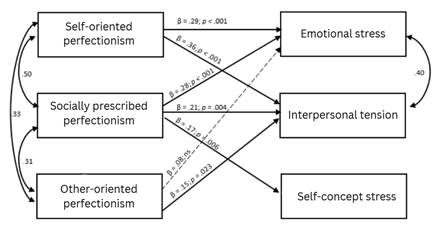
Although it is known that maladaptive perfectionism leads to negative consequences in academic life, so far, no scientific work has been found that studies school stress in relation to the three dimensions of multidimensional perfectionism (i. e., self-directed, socially prescribed, and other-oriented). The aim of this paper was to analyze the predictive role of dysfunctional perfectionism in school stress in primary school students and to assess the differential contribution of each of its dimensions. A quantitative, cross-sectional, and correlational study was conducted with n= 226 students from primary schools in the city of Posadas, Argentina. The results suggest that perfectionism predicts school stress by 31.9 %, especially in the self-directed and socially prescribed dimensions. In multivariate regression analysis, self-oriented perfectionism contributed to emotional stress and interpersonal tension, socially prescribed perfectionism predicted all three dimensions of school stress, while other-oriented perfectionism only predicted interpersonal tension. These results are in line with the underlying theoretical model and provide relevant information to deepen the understanding of the dynamics of children's perfectionism at the primary school level.
Keywords:
perfectionism; school stress; primary education; middle childhood
 Thumbnail