Family conflict and parental engagement: perceptions of teenage children
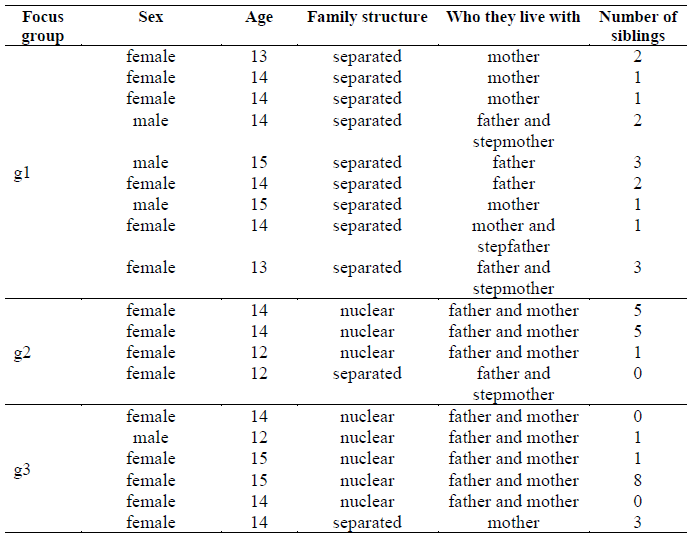
Family conflicts and low parental involvement can have repercussions on children's development. For this reason, the aim of this study was to investigate teenage members of nuclear and separated families' perceptions of parental involvement and family conflicts, as well as their possible repercussions on internalizing and externalizing symptoms. This is a qualitative study carried out in three public schools, through focus groups and involving nineteen adolescents who also answered a sociodemographic questionnaire and the Youth Self-Report. Descriptive statistical analysis showed that part of the sample had clinical symptoms. The conversations in the focus groups were subjected to content analysis and gave rise to the following categories: family conflicts, parental involvement, internalizing symptoms, and externalizing symptoms. The results made it possible to understand how family interrelationships are perceived by children and impact their way of thinking, feeling, and acting, suggesting the need for spaces to welcome and listen to young people.
Keywords:
parent-child relationships; adolescence; family conflict; psychological symptoms.