Meaning of Life and Perceived Quality of Life in Metropolitan Area of Buenos Aires Adults
Abstract:
Meaning of life is a construct that has shown positive associations with quality of life of people at different life stages. The objective of this study was to identify categories of meanings related to the meaning of life and analyze their association with quality of life in adults in Buenos Aires Metropolitan Area. 223 adults between 18 and 87 years old participated (M = 44; SD = 19), 54 % women. Four categories of meanings of meaning in life were detected: 1) search for positive emotions/happiness, 2) connections with significant others, 3) goals and projects, and 4) altruism/prosociality. Quality of life was measured using the Quality of Life Inventory (QOLI). Results show that people who give meaning to their lives by prioritizing relationships with others have a higher quality of life compared to those who prioritize the pursuit of emotions, goals, and projects. Although meaning in life is positively associated with quality of life in adults, meaning in relationships with others would seem to contribute more to a high quality of life.
Keywords:
quality of life; meaning of life; psychological assessment; adults
Resumen:
El sentido de vida es un constructo que ha mostrado asociaciones positivas con la calidad de vida de las personas en diferentes etapas vitales. El objetivo de este estudio fue identificar categorías de significados relacionados al sentido de vida y analizar su asociación con la calidad de vida en adultos del Área Metropolitana de Buenos Aires. Participaron 223 adultos entre 18 y 87 años (M = 44; DE = 19), 54 % mujeres. Se detectaron cuatro categorías de significados del sentido de vida: 1) búsqueda de emociones positivas/felicidad, 2) vínculos con otros significativos, 3) metas y proyectos y 4) altruismo/prosocialidad. La calidad de vida fue medida mediante el Inventario de Calidad de Vida (ICV). Se encontró que las personas que dan sentido a su vida privilegiando los vínculos con los otros tienen una mayor calidad de vida en comparación con los que priorizan la búsqueda de emociones, y las metas y proyectos. Si bien el sentido de vida se asocia positivamente a la calidad de vida de los adultos, hallar sentido en las relaciones con otros parecería contribuir en mayor medida a una elevada calidad de vida.
Palabras clave:
calidad de vida; sentido de vida; evaluación psicológica; adultos
Resumo:
O sentido de vida é um construto que tem apresentado associações positivas com a qualidade de vida das pessoas em diferentes etapas vitais. O objetivo deste estudo foi identificar categorias de significados relacionadas ao sentido de vida e analisar sua associação com a qualidade de vida em adultos da região metropolitana de Buenos Aires. Participaram 223 adultos entre 18 e 87 anos (M = 44; DP = 19), 54 % mulheres. Foram detectadas quatro categorias de significados do sentido de vida: 1) busca por emoções positivas/felicidade, 2) vínculos com outras pessoas significativas, 3) metas e projetos e 4) altruísmo/ pró-socialidade. A qualidade de vida foi medida por meio do Inventário de Qualidade de Vida (IQV). Verificou-se que as pessoas que dão sentido à sua vida privilegiando os vínculos com os outros têm maior qualidade de vida em comparação com aquelas que priorizam a busca de emoções e as metas e projetos. Embora o sentido de vida se associe positivamente à qualidade de vida nos adultos, encontrar significado nas relações com os outros parece contribuir em maior medida para uma elevada qualidade de vida.
Palavras-chave:
qualidade de vida; sentido de vida; avaliação psicológica; adultos
The World Health Organization (WHO, 2021) proposes, within the 2030 Sustainable Development Agenda, the goal of achieving well-being societies. Health is considered a state of complete physical, mental, and social well-being. Well-being is also defined from a holistic perspective as the condition in which persons can realize their own abilities and cope with stressors. In this framework, the concepts of meaning of life (MOL) and perceived quality of life (PQL) gain relevance as determinants of well-being and, therefore, of health.
MOL understands the uniqueness of the experience of existence, inherent to humankind itself (Frankl, 1946). This means that each person's motivation lies in understanding the meaning of the world, seeking the reason and the purpose of living. Logotherapy postulates that the source of meaning lies in creative values (what a person can give), experiential values (each person's experiences), and attitudinal values (how each person copes with adverse situations) (Frankl, 1946).
Since its formalization, MOL has been defined in various ways. The salutogenic perspective proposed the term "sense of coherence" (Mittelmark et al., 2022), understanding it as the orientation that leads to evaluating circumstances as significant, predictable, and manageable. Also, considering the notion of psychological well-being, Ryff (2018) conceptualized "life purpose" as one of its dimensions. This includes the need to set goals, orient oneself toward the future, and grant continuity to existence through beliefs about the personal value of life (Ribeiro et al., 2020; Ryff, 2018).
Another important approach to MOL develops the distinction between the dimensions of presence and search for meaning. The presence of meaning refers to perceiving one's own life as meaningful, while the search for meaning implies that the persons continue to explore what gives value to their existence (Steger, 2017). From this perspective, a study conducted in Latin America by Avellar de Aquino et al. (2017) reports that, in adulthood, the presence of the meaning dimension predominates. In this sense, as age groups increase, the search for meaning tends to decrease, while its presence increases.
In the most recent models, it is conceptualized as a network of connections and interpretations that allow us to understand experience in order to set out plans, direct effort towards them, and feel that life has importance and significance (George & Park, 2016; Martela & Steger, 2016). MOL is considered to have three dimensions: understanding/coherence (perceiving coherence and integration in life), purpose (directing oneself towards personal goals), and importance/meaning (feeling an inherent value in life itself) (King & Hicks, 2021).
Considering this variety of models, there is a lack of agreement on defining and operationalizing MOL. However, in recent years, there has been a tendency to attribute crucial importance to it in mental health, considering it as a protective factor against adversity. Those who find meaning in their existence will strive to move forward (Ribeiro et al., 2020). Studies concerning this topic include the negative link between MOL and disorders such as anxiety and depression (Osorio Castaño et al., 2022), negative automatic thoughts (Valarezo-Salazar et al., 2023), burnout (Restrepo Siegert et al., 2023), and depressive symptoms (Dewitte et al., 2019). MOL has also been linked to lower levels of stress and repetitive negative thoughts (Ostafin & Proulx, 2020). In this perspective Chan Chi (2021) found in Mexico that the majority of the sample with psychological discomfort presented uncertainty and existential emptiness.
Regarding the research designs that predominate in the study of MOL, qualitative designs are worth highlighting, as they facilitate the detection of the meanings associated with this construct through the perceptions of the participants themselves. From this approach, it has become important in recent years to understand, for example, what kind of representations people have when they perceive their MOL, considering different ages, social and cultural groups, among others. For example, it has been found that older adults base their MOL on daily satisfactions (Molina Codecido, 2021). Furthermore, empirical evidence indicates that relationships with family play an important role in this age group. Less investigated, but equally important, other variables such as health, goals, transcendence, freedom, happiness, and social participation are exposed (Condis Viltres et al., 2021; Dewitte et al., 2019; Molina Codecido, 2021; Razo-González et al., 2021). Among those who point to a lack of meaning, they recognize that it is related to a lack of goals and keeping a routine life (Condis Viltres et al., 2021). Similarly, a study conducted with university students showed that participants referred to relationships as the source that gave them meaning. This group also mentioned the academic field as the privileged place where they find meaning in their existence through professional projects (Zapata et al., 2020).
Another field of study about MOL that has received significant interest in recent years has been its relationship with various measures of well-being. From this perspective, the relationship between MOL and QOL has gained particular relevance. QOL is a multidimensional construct that even though it has been studied in various fields, still it does not have a single definition or agreed-upon assessment criteria (Ramírez-Coronel et al., 2021).
Four major conceptual models of QOL have been identified as developed in recent decades. The first, from an objective perspective, considers a person's measurable living conditions, such as physical health, income level, social relationships, occupation, housing conditions, among others. The second emphasizes the subjective aspects of QOL, in terms of overall life satisfaction. The third emphasizes the combination of objective and subjective components, defining QOL as the quality of a person's living conditions, along with the satisfaction they experience. Finally, the fourth model combines both living conditions and personal satisfaction, weighted by a scale of personal values, aspirations, and expectations (Ramírez-Coronel et al., 2021).
Currently, QOL is considered from an ecological perspective, which allows us to understand it in its multidimensionality, integrating the different areas involved, both from the material and psychosocial environments (Mikulic et al., 2020). QOL is defined by Mikulic (2001) as the subjective assessment made by an individual of the degree to which their desires, goals, and needs are fulfilled. Objective domains comprise culturally relevant measures of social and material well-being, while subjective domains refer to satisfaction with different vital dimensions, weighted by their importance for the individual. Each domain or area therefore reflects a factor, personal or contextual, relevant to explaining a person's functioning in their natural environment. The dimensions that are valued in the QOL are the environment in which the person develops life cycle, support networks, the personal growth or fulfillment that gives satisfaction with life and the need to transcend as inherent to the human nature (Mikulic et al. 2020; Ramírez-Coronel et al., 2021).
QOL has been widely studied in relation to health and well-being in different age groups. For example, the study conducted in Chile by Guzmán Muñoz et al. (2021) found that the most valued QOL areas were physical health, followed by social relationships in a sample of young adults. However, they later compared these results with the assessment during the COVID-19 pandemic and observed a decrease in QOL levels, especially in the areas of vitality, social function, emotional role, and health. In a similar study, Veramendi Villavicencios et al. (2020) found higher scores in Peru in the domains of self-determination, followed by interpersonal relationships, personal development, material and emotional well-being, and physical well-being. In the Argentinian context, a precedent is the study by Mikulic et al. (2020), conducted with a sample of general adult population. The QOL areas in which participants reported the greatest satisfaction were values, solidarity, love, children, and housing. Those that showed the lowest levels of satisfaction were income, work, recreation and community.
Among older adults, previous studies show that they place greater importance on physical and psychological health, followed by their environment and, finally, their social relationships (Terraza et al., 2020). Contrasting studies show that relationships are vitally important for QOL, as older adults with partners report higher levels of QOL than those who are single (Mesa Trujillo et al., 2020). Meanwhile, research conducted in Cuba found that older adults perceived a low QOL due to the presence of states of displeasure or unfavorable relationships with their families (Corugedo Rodríguez et al., 2014).
In studies linking MOL and QOL, Osamika and Asagba (2019) found that the pursuit of MOL is positively related to the social relationships area of QOL. They propose that people who experience adversity, such as an illness, by valuing life as meaningless due to the loss of health, focus on finding meaning in their existence through something or someone external. They also found that MOL is positively related to QOL as a whole, especially with the health dimension. Furthermore, another study showed that MOL is positively and significantly related to the psychological well-being dimension of QOL, and negatively related to mental illnesses such as depression, while it does not contribute to the physical well-being dimension (Almeida et al., 2020).
In this perspective, MOL has been found to be a predictor of QOL. A study conducted in Switzerland that analyzed both variables in patients with chronic pain and the general population found that MOL explained 22% of the variance in QOL (Bernard et al., 2024). Thus, they linked the predominance of existential dimensions of QOL with the high presence of MOL in both groups. Specifically, social interactions were the most frequently mentioned in both groups. However, as the second most important dimension, the patient sample mentioned spirituality, while the general population mentioned work (Bernard et al., 2024).
QOL is understood to refer to a person's subjective assessment of the level of satisfaction in particular areas of life considered important (Mikulic & Muiños, 2005). In turn, MOL is the meaning that each person attributes to existence (Frankl, 1946). Therefore, it is believed that including the notion of MOL can allow for a deeper understanding of the unique experience of QOL (Razo-González et al., 2014). While both variables consider both internal and external factors, MOL goes a step further and postulates that existence has value even in the face of adversity, such as illness or lack of goods, among others (Razo-González et al., 2014). Thus, it is understood that people not only need means to live, but also a reason to exist.
Considering the close relationship between MOL and QOL, and their importance as determinants of well-being, this study proposes to analyze both constructs in a sample of adults from the Buenos Aires Metropolitan Area (AMBA). Although research on MOL and QOL has advanced significantly in recent years, the joint study of both constructs, in general, and in Latin American populations in particular, has proven to be scarce (Razo-González et al., 2014). Furthermore, while the qualitative approach has demonstrated a growing interest in research on MOL, the background information that informs the perception that participants themselves present when defining this variable is limited.
The present study aimed to identify the categories of meanings associated with MOL and assess perceived QOL in a sample of adults from the AMBA region. It also analyzed the existence of significant differences in perceived QOL based on the MOL categories identified.
Method
Research design
A descriptive correlational study was conducted with a qualitative-quantitative design, considering that this methodology allows to integrate metric and qualitative data, favoring a greater understanding of the object of the study (Hernández-Sampieri & Mendoza Torres, 2018). From a temporal perspective, the study is cross-sectional, so the subsequent description and interrelation of the variables correspond to a single point in time.
Specifically, the mixed-method design adopted a sequential analysis strategy, in which qualitative and quantitative data were collected simultaneously and initially analyzed independently. Data were then integrated to analyze differences in perceived QOL according to the general MOL categories identified in the previous step, which were included as categorical variables in the statistical analysis.
Participants
A non-probability purposive sample was selected based on accessibility and relevance criteria. This selection strategy was primarily based on the study's objectives, which required exploring personal meanings and experiences regarding MOL and QOL in adults. This strategy allowed a sample of 223 adults from the AMBA region who voluntarily provided information on the study variables. Participants ranged in age from 18 to 85 years, with a mean age of 44 and a standard deviation of 19. The sample was distributed 54% female and the rest male. Regarding educational level, the majority had an incomplete higher education level than tertiary education (72.6%). A smaller proportion reported complete secondary education (15.8%), incomplete secondary education (6.6%), complete primary education (3.5%), and incomplete primary education (1.5%).
Instruments
Sociodemographic questionnaire and questions about meaning in life. A specific questionnaire was developed that included variables such as age, nationality, gender, education, place of residence, marital status, employment status, and support network. Two questions specifically designed to assess the meaning of life were included. These were: "What does the concept of meaning of life mean to you?" and "What is your meaning of life?" This type of open-ended questioning provides detailed information about participants' experiences and perceptions (Hernández-Sampieri & Mendoza Torres, 2018).
Perceived Quality of Life Inventory (PQLI) (Mikulic, 2001). This test was designed to measure QOL by assessing life satisfaction and dissatisfaction in 18 domains, including: Health, Self-esteem, Values, Religion, Finances, Work, Recreation, Study, Creativity, Solidarity, Love, Friends, Children, Relatives, Home, Neighborhood, Community, and Environment (Mikulic, 2001). Subjects evaluate each of these life areas in terms of its importance to overall happiness and in terms of satisfaction with each area. Satisfaction scores are weighted by the importance assigned to each area. The inventory has favorable evidence regarding its psychometric properties (Mikulic & Muiños, 2005; Mikulic, 2007; Mikulic et al., 2020). Validity is reflected, on the one hand, in construct validity, evidenced through various confirmatory factor analyses. On the other hand, in convergent validity, based on the discovery of positive and significant correlations with other measures of quality of life and well-being. Likewise, optimal internal consistency and test-retest reliability indices have been reported. Internal consistency, assessed using Cronbach's alpha coefficient, was .85, while the temporal stability of the scores, assessed through test-retest, yielded a coefficient of .82 (p < .001) (Mikulic & Muiños, 2005).
Procedures
Both the Sociodemographic Questionnaire and the Perceived Quality of Life Inventory were administered by the authors in paper-and-pencil format to the participants described above. The response time was approximately 30 minutes. Before responding, participants completed an informed consent form explaining the research objectives, guarantees of confidentiality and anonymity, the voluntary and uncompensated nature of participation, and the possibility of withdrawing at any time.
Various strategies were also implemented to ensure the study's internal validity. First, to ensure the validity and reliability of the results, a Perceived Quality of Life Inventory (PQOL) was used, which has demonstrated optimal psychometric properties, as previously described. In the MOL assessment, emerging general categories were identified through a comprehensive qualitative analysis involving systematic coding and inter-rater agreement. Furthermore, during the administration of the instruments, a context free from potential environmental bias was ensured, and the instructions were delivered in the same way to all participants.
This study and all its procedures followed the Declaration of Helsinki (World Medical Association, 2013), which establishes the fundamental principles and ethics for research involving human subjects. The research protocol was also approved by the Ethics Committee of the Faculty of Psychology at the University of Buenos Aires.
Data analysis
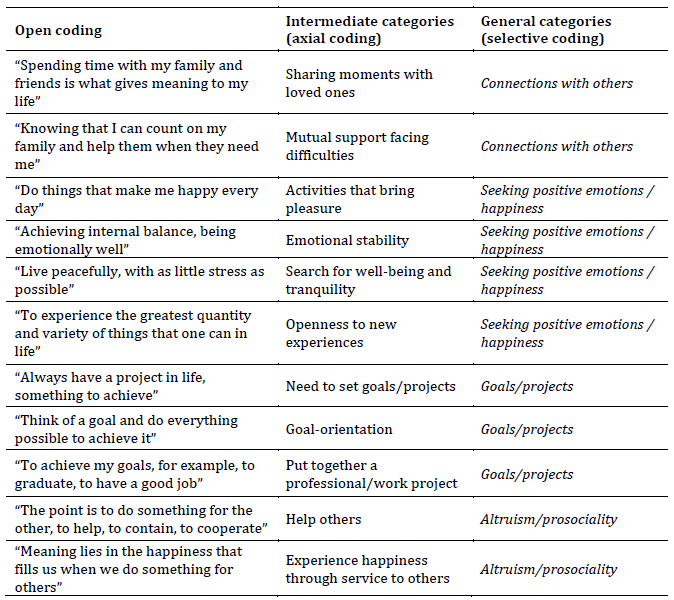
Based on the responses obtained from the open-ended questions included in the Sociodemographic Questionnaire, a qualitative analysis was conducted using the Grounded Theory methodology (Hernández-Sampieri & Mendoza Torres, 2018). First, open coding was performed, detecting specific categories by comparing the responses obtained. The data were constantly and repeatedly compared, seeking to find similarities and differences between the responses that would contribute to the identification of categories. Then, axial coding was carried out, establishing relationships between the categories obtained in the open coding, thus obtaining more general concepts. This level of categorization is achieved in the analysis by grouping the most specific categories, highlighting the relationships between them and their impact on the most general category. Finally, the selective coding stage arrived at the emerging general categories that represent the main meanings associated with MOL.
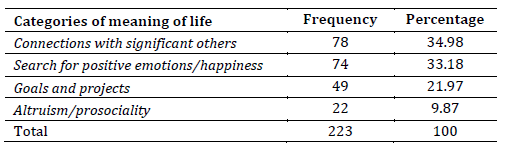
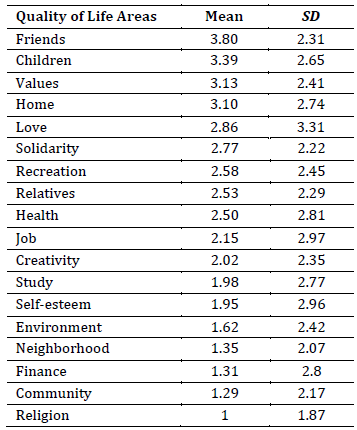
SPSS version 25 was used for quantitative data. Frequency analyses were performed on the MOL categories identified through the prior qualitative analysis. For the analysis of perceived QOL, means and deviations were obtained for each of the QOL areas included in the Perceived Quality of Life Inventory.
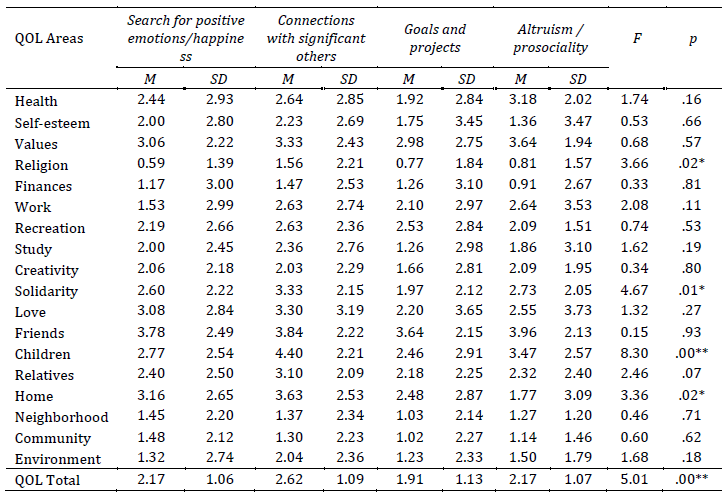
To assess the distribution of the perceived QOL variable, the skewness and kurtosis indices were considered, and the Shapiro-Wilk test was used to evaluate whether the data followed a normal distribution. Skewness and kurtosis values were obtained within the acceptable range (-1 and +1) in accordance with the recommendations of George and Mallery (2010). Furthermore, the results of the Shapiro-Wilk test (W = 0.99, p = .18) indicated that there was insufficient evidence to reject the null hypothesis that the data followed a normal distribution. Accordingly, the ANOVA statistical test was used to analyze the existence of significant differences in QOL according to the MOL categories detected.
Results
Meanings associated with the meaning of life
As previously explained, the qualitative analysis of the responses included an initial stage of open coding, which involved the identification of units of meaning, followed by axial coding, in which intermediate categories were established. Finally, through the selective coding process, four general categories of MOL were identified, which are described below:
Connections with significant others: This category includes responses that associate MOL with relationships with significant others, especially time spent with family, children, grandchildren, and friends. Emphasis is placed on sharing pleasant moments with them, as well as support during difficult times.
Seeking positive emotions/happiness: This category includes responses that link MOL with engaging in activities that provide pleasure and enjoyment; experiencing emotional stability; seeking well-being and tranquility; and openness to new experiences.
Goals and Projects: This category encompasses the purpose dimension, which is evident in responses linked to the need to set goals, goal-orientation, and the importance of achieving them as a central axis of MOL.
Altruism/Prosociality: This category contains responses that link MOL with the development of behaviors that seek to help and benefit others. Responses include living to brighten the lives of others, helping others, being supportive, and experiencing happiness through service to most vulnerable people.
Table 1 presents some representative examples of each of the above mentioned stages of the qualitative analysis process carried out, through which it is explained how the central categories that support the study were arrived at.
Table 2 presents the absolute frequencies and percentage distributions obtained for each of the identified general categories. As shown in Table 2, Connections with significant others was the most frequent category, followed by Seeking positive emotions/ happiness.
Importance of satisfaction assigned to the areas of quality of life
Based on the second objective of the study, satisfaction was analyzed, weighted by the importance assigned to each of the QOL domains perceived by the participants. Table 3 shows the mean values and standard deviations obtained for each domain of the Perceived Quality of Life Inventory.
Regarding the description of the sample's QOL, the areas with the highest scores in terms of importance-weighted satisfaction were: Friends, followed by Children, Values, and Home. The areas with the lowest levels of satisfaction were Neighborhood, Finance, Community, and finally, Religion (Table 3). These domains negatively impact the participants' overall quality of life.
Differences in perceived QOL according to categories of meanings associated with MOL
Based on the third objective of the study, the existence of significant differences in perceived QOL was analyzed according to the categories of MOL meanings indicated. As observed in Table 4, significant differences were found in the total perceived QOL in favor of participants in the category of Connections with Significant Others, compared to those in the category of Seeking Positive Emotions/Happiness, and Goals and Projects (F(3, 83.3) = 5.01, p < .001).
In particular, participants in the category of Connections with Significant Others perceive significantly greater satisfaction in the areas of their CV corresponding to Religion, Solidarity, Children, and Home.
Discussion
The objective of this research was to analyze MOL and QOL in a sample of adults from the AMBA.
Based on the results obtained, it is highlighted that four central categories were found as sources of MOL, namely: search for positive emotions/happiness, connections with significant others, goals and projects, and altruism/prosociality. Similar dimensions were found by Condis Viltres et al. (2021), Dewitte et al. (2019), Molina Codecido (2021), Razo-González et al. (2021), and Zapata et al. (2020). Therefore, it is considered that the sample of the present study demonstrated having reasons to value their existence. This is consistent with previous research such as those mentioned, even though in other studies the existential void predominated (Chan Chi, 2021).
Regarding the description of the categories associated with MOL, it was found that the majority of adults in the AMBA valued their sense of existence based on their connections with significant others and the pursuit of positive emotions such as happiness. These findings agree with previous studies, which support that social relationships, especially with family, play a predominant role in MOL, both in young people and older adults (Condis Viltres et al., 2021; Razo-González et al., 2021; Zapata et al., 2020). It also shows consistency with the results reported in various studies that point to well-being and satisfaction obtained from daily experiences as determinants of MOL (Molina Codecido, 2021).
In agreement with Frankl's theory (1946), the study participants' life values would be expressed through the attainment of experience values and, secondarily, through creative values. According to the author, experience values encompass those significant experiences, emotions, and feelings that people receive from their interaction with their environment and other human beings. In this category, we find the meanings identified by the participants: connections and happiness/thrill-seeking. Creative values, on the other hand, involve the dimension of life planning and the personal commitment to its realization. This aspect was also but less highlighted by the participants, when they identified the importance of having goals and objectives as an inherent aspect of life values.
The results of the qualitative analysis are also consistent with theoretical positions that recognize a distinction between meaning and purpose in life (George & Park, 2016; Steger, 2017). Meaning is associated with the significance of life, the evaluation we place on it in terms of importance and satisfaction with experiences. Purpose, on the other hand, refers to the dimension of goals and objectives.
Regarding the assessment of QOL in adults in the AMBA (Buenos Aires Metropolitan Area), the results of this study show that the areas of greatest perceived satisfaction are those related to interpersonal relationships, especially relationships with friends and children. The least relevant in contributing to overall quality of life were areas associated with external factors such as the environment, neighborhood, community, and religion. These findings agree with previous studies, which demonstrate that maintaining positive relationships contributes to a high level of QOL (Corugedo Rodríguez et al., 2014; Guzmán Muñoz et al., 2021; Mesa Trujillo et al., 2020). It also corresponds to studies that found that more objective areas of QOL, such as material well-being, are overlooked (Mikulic et al., 2020; Terraza et al., 2020; Veramendi Villavicencios et al., 2020).
Likewise, we aimed to analyze the existence of significant differences in QOL according to categories of meanings associated with MOL. Significant differences in QOL were found in favor of participants in the category of connections with significant others, compared to those in the category of seeking positive emotions/happiness, goals and projects, and altruism/prosociality. In particular, participants in the category of connections with significant others perceived greater QOL in the areas of home, children, solidarity, and religion. These findings support previous research, which suggests that MOL is more frequently associated with bonding areas of QOL (Bernard et al., 2024; Osamika & Asagba, 2019).
According to these results, finding meaning in relationships with others, especially in close relationships such as coexisting family and children, would seem to contribute more to a high QOL than finding it in individual purposes and goals. These contributions agree with previous research, which places MOL positively related to QOL (Almeida et al., 2020; Bernard et al., 2024; Osamika & Asagba, 2019). Furthermore, they agree with what various authors have theorized about the protective role that MOL plays in giving meaning to existence and thus contributing to a higher QOL (Frankl, 1946; King & Hicks, 2021; Martela & Steger, 2016; Mittelmark et al., 2022; Ribeiro et al., 2020; Ryff, 2018).
Considering the study's contributions, while this descriptive research provides interesting findings, it has some limitations. First, the study is cross-sectional, so it does not allow for analyzing whether the results are maintained or vary over time. Furthermore, the data collected show that most participants report having incomplete higher education, which limits the generalizability of the results. Therefore, in future research, a more representative sample of the general population of the AMBA should be considered as well as the influence of other contextual variables (e.g., employment, support network, marital status). Another potentially relevant aspect is to analyze whether MOL varies according to the age of the participants, as well as their relationship with QOL areas.
Finally, considering the type of sample used, as it is a non-probability and purposive sample, it is not possible to generalize these results to the entire adult population of the AMBA. This characteristic limits the scope of inferences and the external validity of the findings.
Despite the above mentioned limitations, this study constitutes a pioneering contribution to the field by linking two highly important concepts: MOL and perceived QOL. An interesting contribution has been the MOL categories identified based on the study participants' self-assessment, an aspect that provides valuable information for the construction of a MOL assessment instrument. Despite the existence of various MOL instruments, few have been developed in the Latin American context. In fact, no test specifically designed for the Spanish-speaking population has yet been developed.
Based on the above conclusions, we support that there is a positive relationship between MOL and perceived QOL among adults in the AMBA. Mainly, based on the importance assigned to social relationships, detected in the analysis of both variables, it is possible to affirm that people not only value material means with which to live, but also value their support networks as fundamental pillars.
The results obtained in this study provide relevant empirical evidence for the design of interventions that seek to promote variables such as meaning of life, thus contributing to a better quality of life.
References
-
Almeida, V. M., Carvalho, C., & Pereira, M. G. (2020). The contribution of purpose in life to psychological morbidity and quality of life in chronic pain patients. Psychology, Health & Medicine, 25(2), 160-170. https://doi.org/10.1080/13548506.2019.1665189
» https://doi.org/10.1080/13548506.2019.1665189 -
Avellar de Aquino, T. A., Gouveia, V. V., Gomes, E. S., & Silva, L. B. D. (2017). La percepción de sentido de la vida en el ciclo vital: Una perspectiva temporal. Avances en Psicología Latinoamericana, 35(2), 375-390. https://doi.org/10.12804/revistas.urosario.edu.co/apl/a.3728
» https://doi.org/10.12804/revistas.urosario.edu.co/apl/a.3728 -
Bernard, M., Berchtold, A., Strasser, F., Gamondi, C., & Borasio, G. D. (2024). Meaning in life and quality of life: Palliative care patients versus the general population. BMJ Supportive & Palliative Care, 14, e2537-e2545. https://doi.org/10.1136/bmjspcare-2020-002211
» https://doi.org/10.1136/bmjspcare-2020-002211 -
Chan Chi, G. I. (2021). Sentido de vida: Una herramienta en la formación de estudiantes universitarios en el sureste de México. RIDE. Revista Iberoamericana para la Investigación y el Desarrollo Educativo, 11(22), 1-18. https://doi.org/10.23913/ride.v11i22.937
» https://doi.org/10.23913/ride.v11i22.937 - Condis Viltres, E. I., Arrabal Guzmán, M. de los Á., & Rodríguez González, D. R. (2021). Sentido de vida en personas adultas mayores semi institucionalizadas. Humanidades Médicas, 21(3), 829-846.
- Corugedo Rodríguez, M. D. C., García González, D., González Arias, V. I., Crespo Lechuga, G. A., González García, G., & Calderín Hernández, M. (2014). Calidad de vida en adultos mayores del hogar de ancianos del municipio Cruces. Revista Cubana de Medicina General Integral, 30(2).
-
Dewitte, L., Vandenbulcke, M., & Dezutter, J. (2019). Meaning in life matters for older adults with Alzheimer’s disease in residential care: Associations with life satisfaction and depressive symptoms. International Psychogeriatrics, 31(5), 681-689. https://doi.org/10.1017/S1041610218002338
» https://doi.org/10.1017/S1041610218002338 - Frankl, V. E. (1946). El hombre en busca de sentido (3a ed.). Herder.
- George, D., & Mallery, P. (2010). SPSS for Windows step by step: A simple guide and reference (10a ed.). Pearson.
-
George, L. S., & Park, C. L. (2016). Meaning in life as comprehension, purpose, and mattering: Toward integration and new research questions. Review of General Psychology, 20(3), 205-220. https://doi.org/10.1037/gpr0000077
» https://doi.org/10.1037/gpr0000077 - Guzmán Muñoz, E., Cisternas, Y., Lira Cea, C., Vásquez Yáñez, J., & Castillo Retamal, M. (2021). Impacto de un contexto de pandemia sobre la calidad de vida de adultos jóvenes. Revista Cubana de Medicina Militar, 50(2).
- Hernández-Sampieri, R., & Mendoza Torres, C. P. (2018). Metodología de la investigación: Las rutas cuantitativa, cualitativa y mixta McGraw Hill.
-
King, L., & Hicks, J. A. (2021). The science of meaning in life. Annual Review of Psychology, 72, 561-584. https://doi.org/10.1146/annurev-psych-072420-122921
» https://doi.org/10.1146/annurev-psych-072420-122921 -
Martela, F., & Steger, M. F. (2016). The three meanings of meaning in life: Distinguishing coherence, purpose, and significance. The Journal of Positive Psychology, 11(5), 531-545. https://doi.org/10.1080/17439760.2015.1137623
» https://doi.org/10.1080/17439760.2015.1137623 - Mesa Trujillo, D., Valdés Abreu, B. M., Espinosa Ferro, Y., Verona Izquierdo, A. I. & García Mesa, I. (2020). Estrategia de intervención para mejorar la calidad de vida del adulto mayor. Revista Cubana de Medicina General Integral, 36(4), 1-10.
- Mikulic, I. M. (2001). Calidad de vida en contexto urbano y rural desde el enfoque de la psicología comunitaria. Anuario de Investigaciones, Facultad de Psicología, Universidad de Buenos Aires, 9, 127-135.
- Mikulic, I. M. (2007). Calidad de Vida: Aportes del Inventario de Calidad de Vida percibida y del Inventario de Respuestas de Afrontamiento a la Evaluación Psicológica Departamento de Publicaciones, Facultad de Psicología, Universidad de Buenos Aires.
- Mikulic, I. M., & Muiños, R. (2005). La construcción y uso de instrumentos de evaluación en la investigación e intervención psicológica: El Inventario de Calidad de Vida percibida (ICV). Anuario de Investigaciones, 12, 193-202.
-
Mikulic, I. M., Crespi, M., & Caballero, R. (2020). Calidad de vida percibida, emociones, creencias y satisfacción con los servicios públicos en situación de pandemia por COVID-19 (Informe de investigación). Observatorio de Psicología Social Aplicada, Universidad de Buenos Aires. https://www.psi.uba.ar/opsa/
» https://www.psi.uba.ar/opsa/ -
Mittelmark, M. B., Bauer, G. F., Vaandrager, L., Pelikan, J. M., Sagy, S., Eriksson, M., Lindström, B., & Meier Magistretti, C. (Eds.). (2022). The Handbook of Salutogenesis (2a ed.). Springer. https://doi.org/10.1007/978-3-030-79515-3
» https://doi.org/10.1007/978-3-030-79515-3 -
Molina Codecido, C. (2021). Sentido de vida en adultos mayores institucionalizados desde el enfoque humanista-existencial. Actualidades en Psicología, 35(131), 19-33. https://doi.org/10.15517/ap.v35i131.42292
» https://doi.org/10.15517/ap.v35i131.42292 -
Organización Mundial de la Salud. (2021). Health promotion glossary of terms 2021 https://iris.who.int/bitstream/handle/10665/350161/9789240038349-eng.pdf?se quence=1
» https://iris.who.int/bitstream/handle/10665/350161/9789240038349-eng.pdf?se quence=1 -
Osamika, B. E., & Asagba, R. B. (2019). Quality of life, health perception and meaning in life among selected people living with HIV/AIDS in a hospital in South Western Nigeria. International Journal of Social Sciences Perspectives, 5(1), 1-8. https://doi.org/10.33094/7.2017.2019.51.1.8
» https://doi.org/10.33094/7.2017.2019.51.1.8 -
Osorio Castaño, C. A., Ortiz Garzón, E., Avendaño Prieto, B. L., & Hernández Pozo, M. D. R. (2022). Sentido de vida y su asociación con la ansiedad y la depresión en jóvenes. Interdisciplinaria Revista de Psicología y Ciencias Afines, 39(2), 237-250. https://doi.org/10.16888/interd.2022.39.2.22
» https://doi.org/10.16888/interd.2022.39.2.22 -
Ostafin, B. D., & Proulx, T. (2020). Meaning in life and resilience to stressors. Anxiety, Stress and Coping, 33(6), 603-622. https://doi.org/10.1080/10615806.2020.1800655
» https://doi.org/10.1080/10615806.2020.1800655 -
Ramírez-Coronel, A. A., Malo-Larrea, A., Martínez-Suarez, P. C., Montánchez-Torres, M. L., Torracchi-Carrasco, E., & González-León, F. M. (2021). Origen, evolución e investigaciones sobre la calidad de vida: Revisión sistemática. Archivos Venezolanos de Farmacología y Terapéutica, 39(8), 1035-1042. https://doi.org/10.5281/zenodo.4543649
» https://doi.org/10.5281/zenodo.4543649 - Razo‑González, A. M., Díaz‑Castillo, R., Morales‑Rossell, R., & Cerda‑Barceló, R. (2014). Metaanálisis del concepto de calidad de vida en América Latina: Una nueva propuesta, sentido de vida. Revista CONAMED, 19(4), 149-156.
- Razo-González, Á. M., Flores-Monroy, C. A., & Martínez-Mondragón, M. E. (2021). Sentido de vida y trayectorias vitales en personas adultas mayores desde el enfoque de género. Integra2. Revista Electrónica de Educación Especial y Familia, 12(2), 37-50.
-
Restrepo Siegert, A. M., Restrepo Soto, M. M., Palacio, C., Vargas, J. J., Parra, S. L., Mesa, C., & Krikorian, A. (2023). Calidad de vida profesional de quienes laboran en cuidados paliativos y su relación con el autocuidado, la atención plena y el sentido de vida. Psicooncología, 20(2), 357-372. https://doi.org/10.5209/psic.88671
» https://doi.org/10.5209/psic.88671 -
Ribeiro, C. C., Yassuda, M. S., & Neri, A. L. (2020). Propósito de vida em adultos e idosos: Revisão integrativa. Ciência & Saúde Coletiva, 25, 2127-2142. https://doi.org/10.1590/1413-81232020256.20602018
» https://doi.org/10.1590/1413-81232020256.20602018 -
Ryff, C. D. (2018). Well-being with soul: Science in pursuit of human potential. Perspectives on Psychological Science, 13(2), 242-248. https://doi.org/10.1177/1745691617699836
» https://doi.org/10.1177/1745691617699836 - Steger, M. F. (2017). Meaning in life and wellbeing. En M. Slade, L. Oades & A. Jarden (Eds.), Wellbeing, recovery and mental health (pp.75-85). Cambridge University Press.
- Terraza, A. M., Azzolino, J. M., Giménez, C., Rodríguez, F., Otaño, D., & Martínez, P. (2020). Calidad de vida en adultos mayores, un análisis de sus dimensiones. PsiUC. Revista de Psicología, 6(6), 1-12.
-
Valarezo-Salazar, D. L., Vélez-Freire, K. N., Placencio-Loayza, M. R. (2023). Sentido de vida en adultos con subempleo y su relación con pensamientos automáticos. Revista Espacios, 44(5), 53-68. https://doi.org/10.48082/espacios-a23v44n04p05
» https://doi.org/10.48082/espacios-a23v44n04p05 - Veramendi Villavicencios, N. G., Portocarero Merino, E., & Espinoza Ramos, F. E. (2020). Estilos de vida y calidad de vida en estudiantes universitarios en tiempo de Covid-19. Revista Universidad y Sociedad, 12(6), 246-251.
-
World Medical Association (2013). Declaration of Helsinki. Ethical Principles for Medical Research Involving Human Subjects. Journal of American Medical Association (JAMA), 310(20), 2191-2194. https://doi.org/10.1001/jama.2013.281053
» https://doi.org/10.1001/jama.2013.281053 - Zapata, S. I., Restrepo Tobón, M. V., & Durán Palacio, N. M. (2020). Sentidos de vida, autodeterminación y diversidad funcional. Intersticios: Revista Sociológica de Pensamiento Crítico, 14(2), 383-399.