Parental Insecure Attachment Styles and Clinical Psychological Symptoms in Adolescent Children: The Mediating Role of Coparenting
Abstract:
Building social relationships is a central task in adult development. According to Attachment Theory, this foundation is formed in early interactions with caregivers. Anxious and avoidant adult attachment styles can impair the quality of coparenting, generating conflict and negatively impacting the family environment. As these factors are associated with the development of emotional and behavioral symptoms in adolescents, this study investigated the relationship between parental attachment styles and adolescents’ clinical psychological symptoms, analyzing the mediating role of coparenting. This is a quantitative, explanatory, and cross-sectional study conducted with 217 caregivers of adolescents aged 12 to 16 years, selected by convenience. Participants completed validated instruments on attachment styles, coparenting, and children’s symptoms. Data were analyzed using structural equation modeling. Results indicated associations between adult attachment, coparenting, and adolescents’ psychological symptoms, with coparenting acting as a partial mediator in this relationship. The model showed good fit indices and revealed a strong impact of avoidant attachment and coparenting support. This study highlights the relevance of coparenting and underscores the need for preventive interventions focused on promoting emotional health in families.
Keywords:
attachment style; coparenting; psychological symptoms; adolescence; structural equation modeling
Resumo:
Construir relacionamentos sociais é uma tarefa central no desenvolvimento adulto. Segundo a Teoria do Apego, essa base é formada nas interações precoces com cuidadores. Os estilos de apego ansioso e evitativo em adultos podem prejudicar a qualidade da coparentalidade, gerando conflitos e impactando negativamente o ambiente familiar. Como esses fatores se associam ao desenvolvimento de sintomas emocionais e comportamentais em adolescentes, este estudo investigou a relação entre estilos de apego dos pais e sintomas psicológicos clínicos dos filhos, analisando o papel mediador da coparentalidade. Trata-se de uma pesquisa quantitativa, explicativa e transversal, realizada com 217 responsáveis por adolescentes de 12 a 16 anos selecionados por conveniência. Os participantes responderam a instrumentos validados sobre estilos de apego, coparentalidade e sintomas dos filhos. A análise foi conduzida por modelagem de equações estruturais. Os resultados indicaram associações entre apego adulto, coparentalidade e sintomas psicológicos dos adolescentes, com destaque para a mediação parcial da coparentalidade nessa relação. O modelo apresentou bons índices de ajuste e revelou forte impacto da evitação no apego e do suporte coparental. O estudo destaca a relevância da coparentalidade e aponta para a necessidade de intervenções preventivas voltadas à saúde emocional familiar.
Palavras-chave:
estilo de apego; coparentalidade; sintomas psicológicos; adolescência; modelagem de equações estruturais
Resumen:
Establecer relaciones sociales es una tarea central en el desarrollo adulto. Según la teoría del apego, esta base se forma en las interacciones tempranas con los cuidadores. Los estilos de apego ansioso y evitativo en adultos pueden perjudicar la calidad de la coparentalidad, al generar conflictos e impactar negativamente en el ambiente familiar. Dado que estos factores se asocian con el desarrollo de síntomas emocionales y conductuales en adolescentes, este estudio investigó la relación entre los estilos de apego de los padres y los síntomas psicológicos clínicos de los hijos, analizando el papel mediador de la coparentalidad. Se trata de un estudio cuantitativo, explicativo y transversal, realizado con 217 responsables de adolescentes de 12 a 16 años, seleccionados por conveniencia. Los participantes respondieron a instrumentos validados sobre estilos de apego, coparentalidad y síntomas de los hijos. El análisis se realizó mediante modelado de ecuaciones estructurales. Los resultados indicaron asociaciones entre apego adulto, coparentalidad y síntomas psicológicos de los adolescentes, se destaca la mediación parcial de la coparentalidad en esta relación. El modelo mostró buenos índices de ajuste y un fuerte impacto del apego evitativo y el apoyo coparental. El estudio destaca la relevancia de la coparentalidad y la necesidad de intervenciones preventivas orientadas a la salud emocional familiar.
Palabras clave:
apego adulto; coparentalidad; síntomas psicológicos; adolescencia; modelado de ecuaciones estructurales
Building and maintaining interpersonal relationships constitutes one of the central tasks of human development throughout adulthood. This social competence begins to develop from the earliest interactions established during childhood. According to Attachment Theory (Bowlby, 1973), early relational experiences contribute to personality development and influence personal choices, expectations, and behavioral responses throughout life (Fraley & Shaver, 2021). Adult attachment in romantic relationships began to be widely investigated following the work of Cindy Hazan and Phillip Shaver (1987), and Kim Bartholomew and Leonard Horowitz (1991), who proposed that affective relationships vary according to attachment patterns developed during early experiences with caregivers.
From these early relational experiences, internal working models develop that guide expectations, behaviors, and forms of emotional regulation in relationships throughout life. These patterns are generally organized into attachment styles classified as secure attachment and insecure attachment, with the latter subdivided into avoidant attachment and anxious attachment. Avoidant attachment refers to discomfort with emotional closeness and interdependence, favoring distancing behaviors and self-sufficiency. In contrast, anxious attachment is characterized by fear of rejection and abandonment, associated with insecurity regarding one’s own worth and the stability of relationships. In general, individuals with avoidant or anxious attachment styles tend to report lower marital satisfaction and a greater frequency of relational conflicts and ruptures. Conversely, individuals with lower levels in these dimensions tend to present more secure attachment patterns and more satisfying affective relationships (Collins & Read, 1990; Costa & Mosmann, 2020).
Based on this perspective, different studies began to investigate the association between parental attachment styles and children’s emotional and behavioral adjustment (Bifulco et al., 2009; Cowan et al., 2009). A systematic review with meta-analysis conducted by Kim et al. (2021), which synthesized 1,091 studies on anxious and avoidant attachment, identified that insecure parental attachment patterns were associated with anxiety in children, greater interpersonal difficulties, lower levels of psychological autonomy promoted by parents, and negative self-perceptions. Similarly, a study conducted in Mexico (Fuentes-Balderrama et al., 2023) identified associations between insecure parental attachment and emotional and behavioral problems in children. The findings indicated that maternal attachment was associated with children’s internalizing behaviors and indirectly associated with externalizing behaviors. In addition, paternal avoidant attachment was associated with internalizing symptoms in children.
Adolescence corresponds to a developmental period marked by intense emotional, cognitive, social, and relational transformations. It is a stage of increased vulnerability to the emergence of internalizing and externalizing symptoms, in addition to important changes in family dynamics and in relationships between caregivers and children. Recent studies have also highlighted the impact of contemporary factors, such as increased use of digital technologies (Orben & Blakemore, 2023) and post-pandemic stressors (Racine et al., 2021), on adolescent mental health, reinforcing the importance of investigations focused on this stage of the life cycle (Orben, 2020; Sawyer et al., 2018).
Based on the understanding that attachment developed throughout childhood may be related to behaviors and forms of interaction in adulthood, it is understood that the way parents educate and coordinate the care of their children is also influenced by attachment patterns experienced throughout life. This relational process can be understood through the concept of coparenting (Feinberg, 2003; Margolin et al., 2001).
Coparenting can be understood as the mutual and joint involvement of two adult caregivers in the tasks of raising and caring for a child or adolescent (Feinberg, 2003). It may occur in different family configurations, including nuclear, divorced, heterosexual, and same-sex families, as well as in contexts in which caregivers are not necessarily a couple or the biological parents of the child (Marsanic & Kusmic, 2013).
Feinberg (2003) proposes that coparenting is composed of the dimensions of agreement/disagreement, support/competition, division of labor, and joint management of family relationships. These dimensions involve aspects related to parental values and practices, support or hostility between caregivers, the division of parental responsibilities, and the manner in which the dyad manages family interactions and communication.
In articulation with attachment styles, studies have demonstrated that secure attachment is associated with greater coparental cooperation, whereas high levels of anxious and avoidant attachment are related to higher levels of coparental conflict and disagreement (Talbot et al., 2009; Young et al., 2017). Attachment is also identified as an important correlate of coparenting quality, especially when high levels of avoidant attachment are considered (Noftle & Shaver, 2006). Parents with high levels of anxious and avoidant attachment tend to experience greater difficulties in maintaining a cohesive and harmonious coparental environment, as well as more conflict in the coparental relationship (Iwanski et al., 2023; McRae et al., 2021; Young et al., 2017).
Coparenting has also been associated with children’s emotional and behavioral problems (Feinberg, 2003; Laxman et al., 2013; Margolin et al., 2001; Stright & Bales, 2003; Zvara et al., 2019). In this sense, studies have identified relationships between negative dimensions of coparenting and the development of internalizing and externalizing symptoms in children and adolescents (Benini et al., 2025; Machado & Mosmann, 2020; Mosmann et al., 2017; Pan et al., 2025). A meta-analysis conducted by Zhao et al. (2022), involving 93 studies and 41,207 participants from different countries, identified significant associations between coparental behaviors and internalizing and externalizing symptoms in children and adolescents, reinforcing the relevance of coparenting as an important relational context associated with children’s and adolescents’ emotional and behavioral adjustment. Externalizing symptoms refer to aggressive behaviors, impulsivity, frequent involvement in conflicts, and difficulties following rules. Internalizing symptoms include manifestations such as anxiety, depressive symptoms, and somatic complaints (Machado & Mosmann, 2020). Although the literature frequently emphasizes internalizing and externalizing symptoms as indicators of child adjustment, positive socioemotional competencies, such as prosocial behavior, also constitute relevant dimensions of psychological functioning and may be influenced by the quality of family and coparental relationships (Benini et al., 2025; Pan et al., 2025).
Although international studies have investigated associations among attachment, coparenting, and child and adolescent adjustment (Feinberg, 2003; Margolin et al., 2001; McHale & Lindahl, 2011; Riina et al., 2020), studies integrating parental attachment styles, coparenting, and psychological symptoms in adolescent children remain limited, especially in the Brazilian context. In Brazil, studies have primarily focused on the associations between coparenting and the emotional and behavioral adjustment of children and adolescents (Benini et al., 2025; Machado & Mosmann, 2020; Mosmann et al., 2017), with less exploration of how parents’ relational characteristics, such as attachment styles, may indirectly influence children’s psychological symptoms through coparental dynamics. Considering these gaps, the present study aimed to analyze the relationship between parental attachment styles and clinical psychological symptoms in adolescent children, examining the mediating role of coparenting.
Method
The present study was quantitative, explanatory, and cross-sectional (Gil, 2019).
Participants
The minimum number of respondents required for the study was calculated and established at 200 participants to enable the use of Structural Equation Modeling, according to the parameters proposed by Hair et al. (2009). The present study included 217 Brazilian participants selected through convenience sampling (Gil, 2019). As an inclusion criterion, participants were required to share the care of an adolescent aged 12 to 16 years with another adult, exercising functions related to coparenting. Coparenting was primarily exercised with romantic partners, including married, cohabiting, separated, and divorced couples who shared responsibilities related to adolescent care.
The sample was predominantly composed of female participants (89.3%), followed by male participants (10.7%), with a mean age of 44.84 years (SD = 7.38). Most participants resided in the state of Rio Grande do Sul (90.3%), although respondents from Santa Catarina, Paraná, Minas Gerais, Goiás, Rio de Janeiro, and Espírito Santo were also represented. Regarding educational level, most participants had completed graduate education (36.7%), followed by completed high school (17.2%), incomplete undergraduate education (15.8%), completed undergraduate education (14.9%), incomplete high school (6%), technical education (4.7%), and complete or incomplete elementary education (2.3%).
Regarding the adolescents, the mean age was 12.65 years. Concerning gender, 39.3% were identified as female, 30.8% as male, and 1% as other. Some participants did not respond to this variable, which is why percentages do not total 100%. Regarding race/ethnicity, most adolescents were identified as White (60.5%), followed by mixed-race (7.3%) and Black (2.4%), with missing data also observed for this variable.
Instruments
Sociodemographic Questionnaire. Developed by the researchers for the present study, the questionnaire consisted of 28 questions related to gender, educational level, age, marital status, religion, place of residence, previous treatments, number of children, socioeconomic status, among others. Four questions were specifically intended to identify the gender, age, and race/ethnicity of the adolescent selected for the study. This questionnaire assisted in characterizing the study sample.
Attachment Style Assessment. The Brazilian version of the ECR-R-Brazil (Experience in Close Relationships; Wei et al., 2007; Brazilian version by Natividade & Shiramizu, 2015) was used. The scale consists of 10 items related to emotions and feelings present in romantic and/or sexual relationships. Five items refer to attachment-related anxiety and five refer to attachment-related avoidance. Items are rated on a scale ranging from 1 (strongly disagree) to 7 (strongly agree). An example item is: “It helps a lot to be able to count on my partner in times of need.” The instrument demonstrated adequate internal consistency (Cronbach’s alpha = .72). During confirmatory factor analysis, two items presenting multicollinearity were excluded to ensure better model fit. The exclusion of these items improved model quality by reducing redundancies and statistical instability. Confirmatory factor analysis indicated good model fit, with indices within recommended parameters (CMIN/DF = 2.02; GFI = .95; CFI = .92; TLI = .89), confirming the adequacy of the theoretical structure of the scale.
Coparenting Assessment. The CRS (Coparenting Relationship Scale; Feinberg et al., 2012), in its Brazilian version (Escala de Relação Coparental; Carvalho et al., 2018), was used. The instrument consists of 35 items divided into seven subscales: Coparental Agreement, Coparental Closeness, Exposure to Conflict, Coparental Support, Coparental Competition, Coparental Approval, and Division of Labor. Items use a frequency scale ranging from 0 (“not true of us”) to 6 (“very true of us”). An example item is: “I believe my partner is a good father / I believe my partner is a good mother.” The instrument demonstrated satisfactory internal consistency, with Cronbach’s alpha ranging from .60 to .88 across subscales. In the present study, the Division of Labor factor showed low or non-significant factor loadings and was excluded to improve model fit. Similar findings were reported in studies by Lee et al. (2020) and Costa and Figueiredo (2019). These authors suggested that the “division of labor” dimension may not be universally applicable or measurable across different cultural contexts, leading researchers to adapt the scale to better fit the populations under investigation. Confirmatory factor analysis indicated acceptable model fit for social sciences research, with CMIN/DF = 2.72, CFI = .82, TLI = .80, and RMSEA = .089.
Assessment of Psychological Symptoms in Adolescents (Strengths and Difficulties Questionnaire, SDQ; Goodman, 1997). The SDQ assesses the socioemotional functioning of children and adolescents aged 2 to 17 years and includes three versions: parent-report, teacher-report, and self-report (for individuals aged 11 years and older). The Brazilian version was translated and validated by Fleitlich et al. (2000). In the present study, the parent-report version was used, consisting of 25 items distributed across five scales: conduct problems, emotional symptoms, hyperactivity, peer relationship problems, and prosocial behavior. The first four scales assess emotional and behavioral difficulties and may be grouped into internalizing and externalizing dimensions. Higher scores indicate greater levels of difficulties. The prosocial behavior scale assesses competencies related to positive social interactions, empathy, and helping behaviors, with higher scores indicating a greater prosocial repertoire. Although this subscale does not represent internalizing or externalizing symptoms, it was included in the present study to allow for a broader assessment of child socioemotional adjustment, considering not only reductions in difficulties but also possible changes in positive social competencies associated with the family and coparental context. The total difficulties score is calculated by summing the four difficulties scales, excluding prosocial behavior, and may range from 0 to 40. The overall score may be considered valid when at least 12 of the 20 relevant items are completed. Studies using the Brazilian version have reported Cronbach’s alpha coefficients close to .80, indicating good internal consistency (Saur & Loureiro, 2012).
Data collection procedures
Participants were selected through convenience sampling, seeking to achieve a snowball effect through the dissemination of the study on social media platforms (Instagram, Facebook, e-mail, and WhatsApp), as well as through recruitment in school and work settings. Data collection occurred in two formats: online, using the Google Forms platform, and in person. In the online format, participants had access to the Informed Consent Form prior to completing the instruments and were able to contact the research team in case of questions or discomfort related to participation. In the in-person format, the instruments were delivered to participants in schools in the state of Rio Grande do Sul and were subsequently completed at home and returned to the researchers at a later time. In this modality, participants also received instructions regarding the objectives of the study, completion of the instruments, and ways to contact the research team in case of questions. In both modalities, voluntary participation, confidentiality of information, and the right to withdraw from the study at any time were assured.
Data analysis
Data analysis was conducted using the statistical software Statistical Package for the Social Sciences 22.0 (IBM SPSS), considering a significance level of 5% (p < .05). The psychometric properties of the instruments used (reliability and validity) were examined, and all instruments demonstrated satisfactory reliability and validity. In addition, parametric assumptions (dependent variable, independent variable, sample size, and normality) were assessed. Adequate levels of normality were identified for the study variables.
Expected Maximization was used to estimate missing data. Data were identified as missing completely at random through Little’s MCAR Test (Little, 1988). For descriptive analyses, means and standard deviations were calculated to provide information regarding each study variable. Pearson correlation analyses were also conducted to identify the levels of association among the study variables.
Structural Equation Modeling was performed using the SPSS Analysis of Moment Structures 22.0 extension (IBM SPSS Amos). The predictive value of parental attachment and coparenting on psychological symptoms in adolescent children was examined. Simultaneously, the mediating role of coparenting in the relationship between adult attachment and psychological symptoms in adolescent children was evaluated. Estimation was performed using the Maximum Likelihood method. The following model fit indices were adopted: chi-square/degrees of freedom ratio (χ²/df), with values below 5 indicating good fit; Root Mean Square Error of Approximation (RMSEA), with values lower than .10 indicating good fit; and Comparative Fit Index (CFI), with values greater than .90 indicating good fit (Hair et al., 2009).
Ethical considerations
The study followed the guidelines and regulatory standards for research involving human participants, in accordance with Resolution No. 510/2016 of the Brazilian National Health Council (Brazil, 2016). The study was submitted to and approved on March 18, 2021, by the Research Ethics Committee of the Universidade do Vale do Rio dos Sinos (CEP-Unisinos) (CAAE: 43697020.0.0000.5344).
Results
Descriptive analyses and Pearson correlations
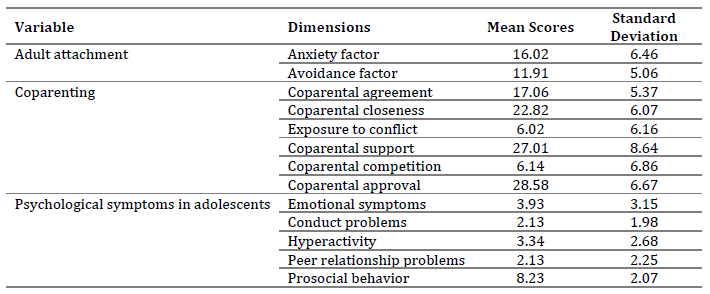
Descriptive analyses were conducted for the attachment, coparenting, and psychological symptoms variables in adolescent children, as well as for their respective dimensions, considering the mean scores of the subscales and standard deviations. Table 1 presents the descriptive results of the investigated variables.
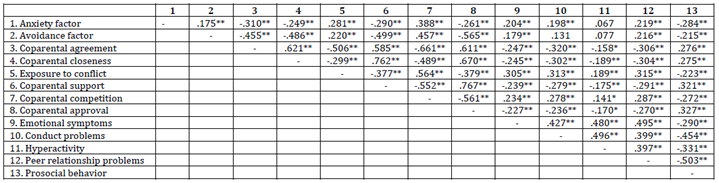
As presented in Table 1, higher scores were observed in the positive dimensions of coparenting, particularly coparental support and coparental approval. Regarding adolescents’ psychological symptoms, higher scores were observed for emotional symptoms and hyperactivity. Pearson’s correlation analysis was selected because an approximately normal distribution of the data was identified through the Kolmogorov-Smirnov test. Table 2 presents the correlation matrix among the investigated variables.
Pearson correlation analyses indicated significant associations among coparenting dimensions, adult attachment, and adolescents’ psychological symptoms. Positive dimensions of coparenting, such as coparental support and coparental approval, were associated with lower levels of psychological symptoms, whereas negative dimensions, such as coparental competition and exposure to conflict, showed positive associations with emotional and behavioral difficulties.
Structural equation modeling
Structural equation modeling was conducted to examine the mediating role of coparenting in the relationship between adult attachment and psychological symptoms in adolescent children. Model fit quality was evaluated using different statistical indices.
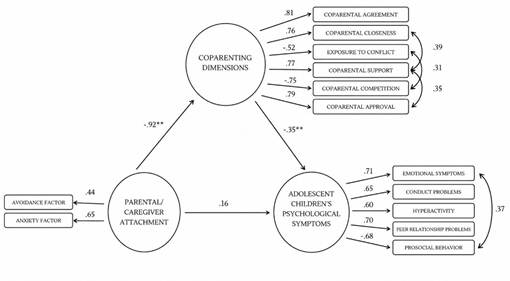
The results revealed a chi-square (χ²) value of 104.311 (df = 58, p < .001), indicating moderate fit. The Comparative Fit Index (CFI) reached .961, whereas the Tucker-Lewis Index (TLI) was .948. The Root Mean Square Error of Approximation (RMSEA) presented a value of .061, with a 90 % confidence interval ranging from .042 to .079, suggesting acceptable model fit.
Among the factors that most strongly explained the latent variables, the avoidance factor showed the greatest contribution to the adult attachment latent variable, with a standardized factor loading of .649. Regarding coparenting, the dimensions with the highest factor loadings were coparental agreement (.812), coparental approval (.794), and coparental support (.769). Concerning adolescents’ psychological symptoms, the factors with the highest loadings were emotional symptoms (.708) and peer relationship problems (.697), indicating their greater contribution to psychological symptoms in adolescent children.
The analysis of standardized factor loadings showed that all indicators presented values above .50. Coparenting was included as an additional predictor of adolescents’ psychological symptoms, beyond adult attachment. As a result, the direct influence of adult attachment on psychological symptoms was substantially reduced (Hair et al., 2009). The evaluation of indirect associations demonstrated that the relationship between adult attachment and adolescents’ psychological symptoms was partially mediated by coparenting (β = -.35), reinforcing the relevance of this factor in parent-child dynamics. The analysis of total effects showed that the overall effect of adult attachment on adolescents’ psychological symptoms was β = .485.
The analysis of direct associations indicated a significant and negative impact of adult attachment on coparenting (β = -.920, p < .001). In addition, coparenting showed a moderate and negative association with adolescents’ psychological symptoms (β = -.350, p < .001). However, the direct relationship between adult attachment and psychological symptoms was weak and non-significant (β = .162), suggesting that this association occurs predominantly through indirect pathways. Figure 1 presents the final structural model obtained.
Discussion
The evaluation of the composition of the latent variables in the interaction model, considering the mean scores and correlation indices, suggests a sample predominantly composed of participants with avoidant attachment. This predominance contributed to the construction of the parental attachment latent variable. Avoidant attachment has been associated with lower marital adjustment, relating to lower levels of dyadic cooperation and higher levels of coparental conflict (Costa & Mosmann, 2020; Young et al., 2017). Evidence has also demonstrated that mothers with lower levels of avoidant attachment tend to report greater trust in the adolescent’s father and fewer conflicts in coparental relationships (Sheftall et al., 2020).
In contrast, the coparenting variable was predominantly composed of positive dimensions. Particularly noteworthy was the magnitude of the negative association between the parental attachment latent variable and coparenting, indicating that higher levels of avoidant attachment were associated with poorer coparenting quality. This finding has also been identified in previous studies, such as those conducted by Chen et al. (2017), Kolak and Volling (2007), Young et al. (2017), and Zemp et al. (2017), which suggest that parents with secure attachment tend to present better coparental relationships. In the present study, this association occurred through a negative pathway: the higher the levels of avoidant attachment, the lower the levels of coparental support and coparental closeness.
The negative association between coparenting and psychological symptoms observed in the present study suggests that lower levels of coparenting quality were related to higher levels of clinical symptoms in adolescents. These findings are consistent with previous evidence from the international literature. Zhao et al. (2022), in a meta-analysis involving 93 studies and 41,207 participants from different countries, identified significant associations between coparental behaviors and internalizing and externalizing problems in children and adolescents. The findings of the present study expand this evidence by demonstrating that such associations may also be observed in Brazilian families with adolescents.
Among the main findings of this study was the partial mediation of coparenting in the relationship between anxious and avoidant attachment and children’s psychological symptoms. When coparenting was included as a mediating variable, a reduction in the direct association between parental attachment and children’s psychological symptoms was observed, indicating partial mediation of this relationship (Hair et al., 2009). Coparenting intervention studies have also identified relevant associations between improvements in the coparental relationship and children’s emotional well-being (Euzebio & Mosmann, 2023; Jones et al., 2021; Tomfohr-Madsen et al., 2020), as well as parental well-being (Jones et al., 2021; Nunes et al., 2021). These findings contribute to the understanding of psychological symptoms in adolescents by highlighting the role of the coparental relationship in the interaction between parental attachment and children’s mental health.
Considering adolescence specifically, this developmental stage is marked by intense emotional, cognitive, and relational transformations, characterized by greater autonomy-seeking, reorganization of family bonds, and increased vulnerability to internalizing and externalizing symptoms (Papalia & Martorell, 2021; Sawyer et al., 2018). In this context, difficulties in the quality of coparental relationships may more strongly impact adolescents’ emotional adjustment, especially in light of the developmental changes inherent to this stage of the life cycle.
When one member of the couple presents an avoidant attachment style, developed from early experiences with caregivers, this pattern may negatively affect coparenting, especially through reduced support and intensified competition between caregivers. This dynamic is related to the tendency toward self-sufficiency, characteristic of individuals with avoidant attachment (Young et al., 2017), marked by avoidance of dependence and preference for dealing with emotional situations alone, including within intimate relationships. Such a tendency may contribute to difficulties in both offering and seeking support in shared parenting tasks.
Furthermore, the presence of a caregiver with this attachment style may weaken important dimensions of coparenting, such as mutual support, emotional stability, and the construction of a secure relational environment. Emotional unavailability and distant behavior may hinder cooperation between caregivers, generating frustration and insecurity, particularly when the other caregiver presents an anxious attachment style characterized by a greater need for emotional security. As a consequence, coparental conflict and competition tend to increase (Simpson, 1990; Zhang, 2024), which may also affect children by hindering the development of prosocial skills and the appropriate expression of emotional needs.
It is important to consider that the study was conducted during the COVID-19 pandemic, a period marked by increased levels of stress in the general population (Freisthler et al., 2021), which may have influenced the findings obtained. In addition, the sample presented higher educational levels than those observed in the general population, which requires caution in interpreting the results and limits their generalizability to other sociodemographic contexts. Although structural equation modeling allows for the testing of relationships between variables based on theoretical models, the cross-sectional design of the study does not permit causal inferences. Therefore, the findings should be interpreted as associations consistent with the proposed theoretical model.
In summary, the findings demonstrate the relevance of interactions between caregivers and children, as well as attachment style and the quality of the coparental relationship, for understanding clinical psychological symptoms in adolescents. These findings reinforce results identified in relational studies conducted in the Brazilian context (Euzebio & Mosmann, 2023; Machado & Mosmann, 2020; Mosmann et al., 2018).
Final considerations
This study aimed to investigate the relationship between adult attachment style, the presence of clinical symptoms in adolescent children, and the mediating role of coparenting. The findings indicate that, in understanding clinical psychological symptoms in adolescents, interactions between caregivers and children, as well as attachment style and the quality of the coparental relationship, play a relevant role. The results suggest a mediating role of coparenting in the relationship between avoidant and anxious attachment styles in caregivers and clinical psychological symptoms in adolescent children. This finding adds an important relational variable to the literature that should be considered when evaluating the interaction between parental attachment and children’s psychological symptoms.
In this sense, the quality of coparental relationships within families may be understood as an important factor for health systems. It represents a relational variable that influences whether adolescents present symptomatic or non-symptomatic outcomes and therefore deserves greater attention. Thus, preventive interventions targeting coparental interactions may contribute to the development of more functional and psychologically healthy family relationships, even in the presence of avoidant attachment patterns among caregivers.
Some limitations of the present study should be acknowledged, as previously discussed. In addition, regarding methodology, the cross-sectional design represents a snapshot of a specific moment in time. Therefore, longitudinal studies could contribute by testing temporal relationships among the evaluated constructs and the chronological ordering of variables. Future studies should consider these aspects.
References
-
Bartholomew, K., & Horowitz, L. M. (1991). Attachment styles among young adults: a test of a four-category model. Journal of Personality and Social Psychology, 61(2), 226-244. https://doi.org/10.1037/0022-3514.61.2.226
» https://doi.org/10.1037/0022-3514.61.2.226 -
Benini, L. E., Euzebio, L. D. C., & Mosmann, C. P. (2025). Personality, co-parenting, and psychological symptoms in adolescent children. Paidéia (Ribeirão Preto
),
35, e3509. https://doi.org/10.1590/1982-4327e3509
» https://doi.org/10.1590/1982-4327e3509 -
Bifulco, A., Moran, P., Jacobs, C., & Bunn, A. (2009). Problem partners and parenting exploring linkages with maternal insecure attachment style and adolescent offspring internalizing disorder. Attachment & Human Development, 11(1), 69-85. https://doi.org/10.1080/14616730802500826
» https://doi.org/10.1080/14616730802500826 - Bowlby, J. (1973). Attachment and loss: Vol. II. Separation: anxiety and anger Basic Books.
- Brasil. Conselho Nacional de Saúde. (2016). Resolução nº 510, de 7 de abril de 2016: Dispõe sobre as normas aplicáveis a pesquisas em Ciências Humanas e Sociais Diário Oficial da União.
-
Carvalho, T. R., Barham, E. J., Souza, C. D., Böing, E., Crepaldi, M. A., & Vieira, M. L. (2018). Cross-cultural adaptation of an instrument to assess coparenting: Coparenting Relationship Scale. Psico-usf, 23(2), 215-227. https://doi.org/10.1590/1413-82712018230203
» https://doi.org/10.1590/1413-82712018230203 -
Chen, H. H., Liang, Y. C., Gapp, S. C., Newland, L. A., Giger, J. T., & Lin, C. Y. (2017). Direct and indirect links between the couple relationship and child school outcomes. The Journal of Experimental Education, 85(4), 658-673. https://doi.org/10.1080/00220973.2017.1279115
» https://doi.org/10.1080/00220973.2017.1279115 -
Collins, N. L., & Read, S. J. (1990). Adult attachment, working models, and relationship quality in dating couples. Journal of Personality and Social Psychology, 58(4), 644-663. https://doi.org/10.1037/0022-3514.58.4.644
» https://doi.org/10.1037/0022-3514.58.4.644 -
Costa, C. B., & Mosmann, C. P. (2020). Aspects of the marital relationship that characterize secure and insecure attachment in men and women. Estudos de Psicologia (Campinas), 37, e190045. https://doi.org/10.1590/1982-0275202037e190045
» https://doi.org/10.1590/1982-0275202037e190045 -
Costa, P. A., & Figueiredo, I. Q. G. (2019). Adaptação das versões completa e breve da Escala de Relação Coparental (ERC) em uma amostra comunitária de pais e mães portugueses. Revista Psicologia, 33(1), 236-248. https://doi.org/10.17575/rpsicol.v33i1.1598
» https://doi.org/10.17575/rpsicol.v33i1.1598 -
Cowan, P. A., Cowan, C. P., & Mehta, N. (2009). Adult attachment, couple attachment, and children's adaptation to school: An integrated attachment template and family risk model. Attachment & Human Development, 11(1), 29-46. https://doi.org/10.1080/14616730802500222
» https://doi.org/10.1080/14616730802500222 - Euzebio, L., & Mosmann, C. (2023). A coparentalidade como mediadora entre a desregulação emocional de mães e a percepção da regulação emocional de seus filhos adolescentes. Ciências Psicológicas, 17(1), e-2583. https://doi.org/10.22235/cp.v17i1.2583
-
Feinberg, M. E. (2003). The internal structure and ecological context of coparenting: A framework for research and intervention. Parenting, 3(2), 95-131. https://doi.org/10.1207/S15327922PAR0302_01
» https://doi.org/10.1207/S15327922PAR0302_01 -
Feinberg, M. E., Brown, L. D., & Kan, M. L. (2012). A multi-domain self-report measure of coparenting. Parenting, Science and Practice, 12(1), 1-21. https://doi.org/10.1080/15295192.2012.638870
» https://doi.org/10.1080/15295192.2012.638870 - Fleitlich, B., Cortázar, P. G., & Goodman, R. (2000). Questionário de Capacidades e Dificuldades (SDQ). Revista de Psiquiatria da Infância e Adolescência, 8(44), 44-50.
- Fraley, R. C., & Shaver, P. R. (2021). Attachment theory and its place in contemporary personality theory and research. Em O. P. John & R. W. Robins (Eds.), Handbook of personality: Theory and research (pp. 642-666). The Guilford Press.
-
Freisthler, B., Gruenewald, P. J., Tebben, E., Shockley McCarthy, K., & Price Wolf, J. (2021). Understanding at-the-moment stress for parents during COVID-19 stay-at-home restrictions. Social Science & Medicine, 279, 114025. https://doi.org/10.1016/j.socscimed.2021.114025
» https://doi.org/10.1016/j.socscimed.2021.114025 -
Fuentes-Balderrama, J., Turnbull-Plaza, B., & Ojeda-García, A. (2023). Insecure attachment to parents as a contributor to internalizing and externalizing problem behaviors in Mexican preadolescents. Trends in Psychology, 31(1), 105-122. https://doi.org/10.1007/s43076-021-00125-8
» https://doi.org/10.1007/s43076-021-00125-8 - Gil, A. C. (2019). Métodos e Técnicas de Pesquisa Social (7ª ed.). Grupo GEN.
-
Goodman, R. (1997). The Strengths and Difficulties Questionnaire: a research note. Journal of Child Psychology and Psychiatry, 38(5), 581-586. https://doi.org/10.1111/j.1469-7610.1997.tb01545.x
» https://doi.org/10.1111/j.1469-7610.1997.tb01545.x - Hair, J. F., Black, W. C., Babin, B. J., Anderson, R. E. & Tatham, R. L. (2009). Análise multivariada de dados Grupo A.
-
Hazan, C., & Shaver, P. (1987). Romantic love conceptualized as an attachment process. Journal of Personality and Social Psychology, 52(3), 511-524. https://doi.org/10.1037/0022-3514.52.3.511
» https://doi.org/10.1037/0022-3514.52.3.511 -
Iwanski, A., Lichtenstein, L., Forster, F., Stadelmann, C., Bodenmann, G., & Zimmermann, P. (2023). A family systems perspective on attachment security and dependency to mother and father in preschool: Differential and reciprocal effects on children’s emotional and behavioral problems. International Journal of Environmental Research and Public Health, 20(3), 1837. https://doi.org/10.3390/ijerph20031837
» https://doi.org/10.3390/ijerph20031837 -
Jones, E. J., Feinberg, M. E., Graham-Engeland, J., Jones, D. E., & Schreier, H. (2021). A perinatal coparenting intervention: Effects on parent cardiometabolic risk and self-reported health. PsyArXiv. https://doi.org/10.31234/osf.io/4hfsg
» https://doi.org/10.31234/osf.io/4hfsg -
Kim, S., Baek, M., & Park, S. (2021). Association of parent-child experiences with insecure attachment in adulthood: A systematic review and meta‐analysis. Journal of Family Theory & Review, 13(1), 58-76.https://doi.org/10.1111/jftr.12402
» https://doi.org/10.1111/jftr.12402 -
Kolak, A. M., & Volling, B. L. (2007). Parental expressiveness as a moderator of coparenting and marital relationship quality. Family Relations, 56(5), 467-478. https://doi.org/10.1111/j.1741-3729.2007.00474.x
» https://doi.org/10.1111/j.1741-3729.2007.00474.x -
Laxman D. J., Jessee A., Mangelsdorf S. C., Rossmiller-Giesing W., Brown G. L. & Schoppe-Sullivan S. J. (2013). Stability and antecedents of coparenting quality: the role of parent personality and child temperament. Infant Behavior and Development, 36(2), 210-222. https://doi.org/10.1016/j.infbeh.2013.01.001
» https://doi.org/10.1016/j.infbeh.2013.01.001 -
Lee, J.-K., Feinberg, M. E., & Wells, M. B. (2020). The Swedish Brief Coparenting Relationship Scale: Psychometrics and concurrent validity among primiparous and multiparous fathers. Scandinavian Journal of Psychology, 61(5), 679-690. https://doi.org/10.1111/sjop.12645
» https://doi.org/10.1111/sjop.12645 -
Little, R. J. A. (1988). A Test of Missing Completely at Random for Multivariate Data with Missing Values. Journal of the American Statistical Association, 83(404), 1198-1202. https://doi.org/10.1080/01621459.1988.10478722
» https://doi.org/10.1080/01621459.1988.10478722 -
Machado, M. R., & Mosmann, C. P. (2020). Coparental conflict and triangulation, emotion regulation, and externalizing problems in adolescents: Direct and indirect relationships. Paidéia (Ribeirão Preto), 30(19). https://doi.org/10.1590/1982-4327e3004
» https://doi.org/10.1590/1982-4327e3004 -
Margolin, G., Gordis, E. B., & John, R. S. (2001). Coparenting: a link between marital conflict and parenting in two-parent families. Journal of Family Psychology, 15(1), 3-21. https://doi.org/10.1037/0893- 3200.15.1.3
» https://doi.org/10.1037/0893- 3200.15.1.3 - Marsanic, B. V., & Kusmic, E. (2013). Coparenting within the family system: Review of literature. Collegium Antropologicum, 37(4), 1379-1384.
- McHale, J. P., & Lindahl, K. M. (Eds.). (2011). Coparenting: A conceptual and clinical examination of family systems American Psychological Association.
-
McRae, C. S., Overall, N. C., Henderson, A. M. E., Low, R. S. T., & Cross, E. J. (2021). Conflict-coparenting spillover: The role of actors’ and partners’ attachment insecurity and gender. Journal of Family Psychology, 35(7), 942-953. https://doi.org/10.1037/fam0000884
» https://doi.org/10.1037/fam0000884 -
Mosmann, C. P., Costa, C. B. da, Einsfeld, P., Silva, A. G. M. da, & Koch, C. (2017). Conjugalidade, parentalidade e coparentalidade: Associações com sintomas externalizantes e internalizantes em crianças e adolescentes. Estudos de Psicologia (Campinas), 34(4), 487-498.https://doi.org/10.1590/1982-02752017000400005
» https://doi.org/10.1590/1982-02752017000400005 -
Mosmann, C., Costa, C. B., Silva, A. G. B., & Luz, S. K. (2018). Filhos com sintomas psicológicos clínicos: papel discriminante da conjugalidade, coparentalidade e parentalidade. Temas em Psicologia, 26(1), 429-442. https://doi.org/10.9788/tp2018.1-17pt
» https://doi.org/10.9788/tp2018.1-17pt -
Natividade, J. C., & Shiramizu, V. K. M. (2015). Uma medida de apego: versão brasileira da Experiences in Close Relationship Scale - Reduzida (ECR-R-Brasil). Psicologia USP, 26(3), 484-494. https://doi.org/10.1590/0103-656420140086
» https://doi.org/10.1590/0103-656420140086 -
Noftle, E. E., & Shaver, P. R. (2006). Attachment dimensions and the big five personality traits: Associations and comparative ability to predict relationship quality. Journal of Research in Personality, 40(2), 179-208. https://doi.org/10.1016/j.jrp.2004.11.003
» https://doi.org/10.1016/j.jrp.2004.11.003 -
Nunes, C., Roten, Y., El Ghaziri, N., Favez, N., & Darwiche, J. (2021). Co‐parenting programs: A systematic review and meta‐analysis. Family Relations, 70, 759-776. https://doi.org/10.1111/fare.12438
» https://doi.org/10.1111/fare.12438 -
Orben, A. (2020). Teenagers, screens and social media: A narrative review of reviews and key studies. Social Psychiatry and Psychiatric Epidemiology, 55(4), 407-414. https://doi.org/10.1007/s00127-019-01825-4
» https://doi.org/10.1007/s00127-019-01825-4 -
Orben, A., & Blakemore, S. J. (2023). How social media affects teen mental health: A missing link. Nature, 614(7948), 410-412. https://doi.org/10.1038/d41586-023-00402-9
» https://doi.org/10.1038/d41586-023-00402-9 -
Pan, B., Wang, Y., Zhang, J., Wang, J., Xiao, B., & Li, Y. (2025). Parental co-parenting quality, children’s emotion regulation abilities, and prosocial behavior. BMC Psychology, 13(1), 635. https://doi.org/10.1186/s40359-025-02947-y
» https://doi.org/10.1186/s40359-025-02947-y - Papalia, D. E., & Martorell, G. (2021). Desenvolvimento humano (14ª ed.). AMGH.
-
Racine, N., McArthur, B. A., Cooke, J. E., Eirich, R., Zhu, J., & Madigan, S. (2021). Global prevalence of depressive and anxiety symptoms in children and adolescents during COVID-19: A meta-analysis. JAMA Pediatrics, 175(11), 1142-1150. https://doi.org/10.1001/jamapediatrics.2021.2482
» https://doi.org/10.1001/jamapediatrics.2021.2482 - Riina, E. M., McHale, J. P., & King, V. (2020). Bidirectional associations between coparenting and parental adjustment across time. Family Process, 59(4), 1668-1684.
-
Saur, A. M., & Loureiro, S. R. (2012). Qualidades psicométricas do Questionário de Capacidades e Dificuldades: Revisão da literatura. Estudos de Psicologia (Campinas
),
29(4), 619-629. https://doi.org/10.1590/S0103-166X2012000400016
» https://doi.org/10.1590/S0103-166X2012000400016 -
Sawyer, S. M., Azzopardi, P. S., Wickremarathne, D., & Patton, G. C. (2018). The age of adolescence. The Lancet Child & Adolescent Health, 2(3), 223-228. https://doi.org/10.1016/S2352-4642(18)30022-1
» https://doi.org/10.1016/S2352-4642(18)30022-1 -
Sheftall, A., Schoppe-Sullivan, S., & Futris, T. (2010). Adolescent mothers’ perceptions of the coparenting relationship with their child’s father: a function of attachment security and trust. Journal of Family Issues, 31(7), 884-905. https://doi.org/10.1177/0192513X09359892
» https://doi.org/10.1177/0192513X09359892 -
Simpson, J. (1990). Influence of attachment styles on romantic relationships. Journal of Personality and Social Psychology, 59(5), 971-980. https://doi.org/10.1037/0022-3514.59.5.971
» https://doi.org/10.1037/0022-3514.59.5.971 -
Stright, A. D., & Bales, S. S. (2003). Coparenting quality: Contributions of child and parent characteristics. Family Relations, 52(3), 232-240. https://doi.org/10.1111/j.1741-3729.2003.00232.x
» https://doi.org/10.1111/j.1741-3729.2003.00232.x -
Talbot, J. A., Baker, J. K., & McHale, J. P. (2009). Sharing the love: Prebirth adult attachment status and coparenting adjustment during early infancy. Parenting: Science and Practice, 9(1-2), 56-77. https://doi.org/10.1080/15295190802656760
» https://doi.org/10.1080/15295190802656760 -
Tomfohr-Madsen, L. M., Giesbrecht, G., Madsen, J. W., MacKinnon, A., Le, Y., & Doss, B. (2020). Improved child mental health following brief relationship enhancement and co-parenting interventions during the transition to parenthood. International Journal of Environmental Research and Public Health, 17(3), 766. https://doi.org/doi:10.3390/ijerph17030766
» https://doi.org/doi:10.3390/ijerph17030766 -
Wei, M., Russell, D. W., Mallinckrodt, B., & Vogel, D. L. (2007). The Experiences in Close Relationship Scale (ECR)-short form: Reliability, validity, and factor structure. Journal of Personality Assessment, 88(2), 187-204. https://doi.org/10.1080/00223890701268041
» https://doi.org/10.1080/00223890701268041 -
Young, M., Riggs, S., & Kaminski, P. (2017). Role of marital adjustment in associations between romantic attachment and coparenting. Family Relations: An Interdisciplinary Journal of Applied Family Studies, 66(2), 331-345. https://doi.org/10.1111/fare.12245
» https://doi.org/10.1111/fare.12245 -
Zemp, M., Milek, A., Cummings, E. M., & Bodenmann, G. (2017). Longitudinal interrelations between dyadic coping and coparenting conflict in couples. Journal of Child and Family Studies, 26(8), 2276-2290. https://doi.org/10.1007/s10826-017-0742-4
» https://doi.org/10.1007/s10826-017-0742-4 -
Zhang, J. (2024). The long-term effects of avoidant and anxious attachment styles in infancy on personality development and future relationships. Lecture Notes in Education Psychology and Public Media, 42(1), 253-257. https://doi.org/10.54254/2753-7048/42/20240641
» https://doi.org/10.54254/2753-7048/42/20240641 -
Zhao, F., Wu, H., Li, Y., Zhang, H., & Hou, J. (2022). The association between coparenting behavior and internalizing/externalizing problems of children and adolescents: A meta-analysis. International Journal of Environmental Research and Public Health, 19(16), 10346. https://doi.org/10.3390/ijerph191610346
» https://doi.org/10.3390/ijerph191610346 -
Zvara, B. J., Altenburger, L. E., Lang, S. N., & Schoppe-Sullivan, S. J. (2019). The role of coparenting in the association between parental neuroticism and harsh intrusive parenting. Journal of Family Psychology, 33(8), 945-953. https://doi.org/10.1037/fam0000555
» https://doi.org/10.1037/fam0000555