Predictive ability of cognitive flexibility and planning in early mathematical competencies
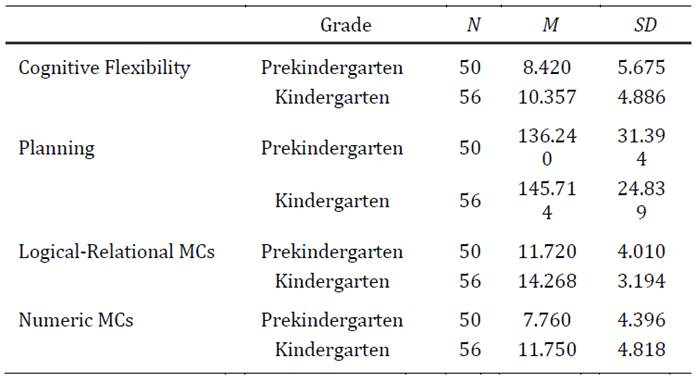
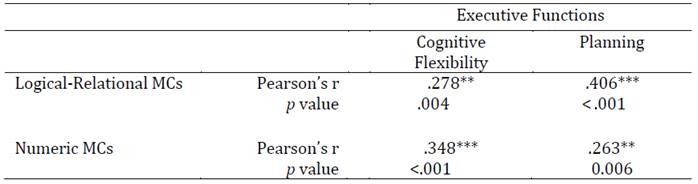
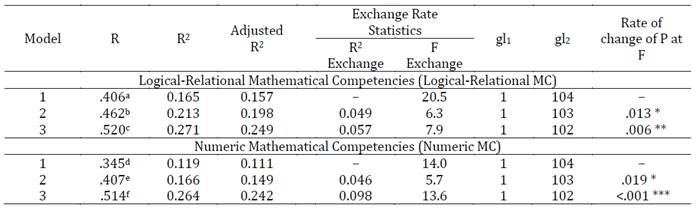
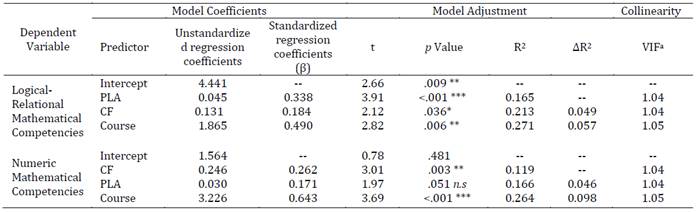
It has been shown that early mathematical competencies play an important role in the learning of this discipline and that both cognitive flexibility and planning favor this process. However, most research has related executive functions to general mathematical outcomes, without taking into account that this discipline includes several components that vary in their cognitive complexity. Therefore, the aim of this research was to evaluate the predictive capacity of cognitive flexibility and planning in the logical-relational and numerical mathematical competencies of 106 children in early childhood education in Chilean schools, who were evaluated with two executive tasks and a test of early mathematical competencies. Correlations and multiple linear regression models were used for data analysis. The results showed that cognitive flexibility was a significant predictor of both logical-relational and numerical mathematical competencies, while planning was only a significant predictor of numerical competencies. These results confirm the importance of cognitive flexibility and planning in the development of early mathematical competencies, which could lead to specific interventions on these executive functions and thus favor the learning of mathematics in early education.
Keywords:
executive functions; cognitive flexibility; early math skills; early childhood education