Working memory and spatial representation in mapuche and non-mapuche schoolchildren from La Araucanía
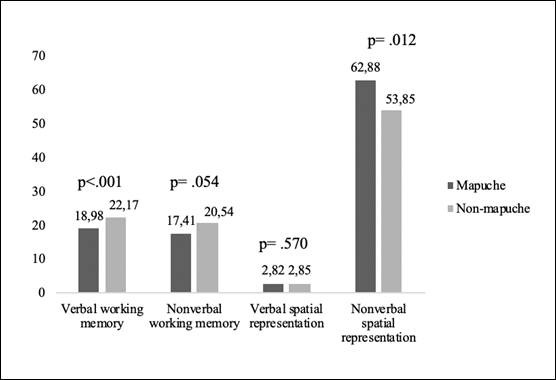
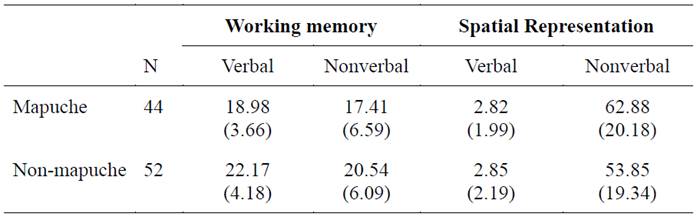
The objective of this study was to determine if there are differences in performance in working memory and spatial representation in rural Mapuche children and non-Mapuche urban children, from the Araucanía region, Chile. 96 students between 8 and 12 years old participated (M = 10.33; SD = 1.02) who answered tasks of working memory and spatial representation in verbal and non-verbal format. A multivariate analysis of covariance (MANCOVA) was performed, controlling for the effect of age and gender. The results show that Mapuche participants scored lower than their non-Mapuche peers in verbal working memory and marginally significant differences were found in non-verbal working memory. In the verbal spatial representation, no differences will be obtained in the groups and in the non-verbal spatial representation Mapuche children obtained a significantly higher performance than their non-Mapuche peers. Non-Mapuche children perform better on verbal tasks, while Mapuche children perform similarly or higher on non-verbal tasks. The relevance of ecological validity from the situated cognition paradigm is discussed.
Keywords:
working memory; spatial representation; mapuche; non mapuche; rural; urban
 Thumbnail