Cognitive Flexibility and Stress at Work in Brazilian Higher Education Professors
Abstract:
This study investigated the predictive role of Cognitive Flexibility (CF) in Job Stress (JS) in a sample of 203 Brazilian higher education faculty members. A socio-professional questionnaire, the Cognitive Flexibility Scale-Brazil (CFS-B), and the Job Stress Scale (JSS) were applied. Data collection was conducted individually and online, aiming for sample heterogeneity, composed of 52.2 % women, 56.7 % residents of the southern region of the country, 61.6 % in management positions, and 52.2 % working in private institutions. Descriptive, correlation, and regression analyses were conducted. Most participants reported high demand (59.6 %), high control/autonomy (63.5 %), and high support (52.7 %) at work, and indicated a high level of CF (52 %). Weak and positive correlations were found between CF and the evaluated dimensions of JS. The greater the autonomy and social support, and the lower the work demands, the lower the levels of stress experienced. CF presented a small predictive value for JS; nevertheless, it may be protective in the dimensions of social support and control, although it was also related to higher levels of assumed work demands. Organizational Psychology interventions that develop CF may mitigate risk factors associated with the development of work-related illnesses.
Keywords:
cognitive flexibility; occupational stress; work psychology; higher education; teachers
Resumo:
Este estudo investigou o papel preditor da Flexibilidade Cognitiva (FC) no Estresse no Trabalho (ET) em uma amostra de 203 docentes do ensino superior brasileiro. Foi aplicado um questionário socioprofissional, a Cognitive Flexibility Scale-Brasil (CFS-B) e a Job Stress Scale (JSS). A coleta ocorreu de forma individual e online, buscando heterogeneidade da amostra, composta por 52,2 % de mulheres, 56,7 % residentes na região sul do país, 61,6 % com cargos de gestão e 52,2 % atuantes em instituições privadas. Foram realizadas análises descritivas, de correlação e regressão. A maioria dos participantes da pesquisa percebeu alta demanda (59,6 %), alto controle/autonomia (63,5 %) e alto apoio (52,7 %) no trabalho e indicou alto nível de FC (52 %). Verificou-se correlações fracas e positivas entre FC e as dimensões avaliadas do ET. Quanto maior a autonomia e apoio social, e menores demandas no trabalho, menores níveis de estresse são experienciados. A FC apresentou pequeno valor preditivo para o ET, apesar disso, pode ser protetiva nas dimensões de apoio social e controle, embora mostrou-se relacionada à níveis maiores de demandas assumidas no trabalho. Intervenções em Psicologia Organizacional que desenvolvam FC podem mitigar fatores de risco associados ao desenvolvimento de adoecimentos no trabalho.
Palavras-chave:
flexibilidade cognitiva; estresse ocupacional; psicologia do trabalho; ensino superior; docentes
Resumen:
Este estudio investigó el papel predictivo de la flexibilidad cognitiva (FC) sobre el estrés laboral (EL) en una muestra de 203 profesores brasileños de enseñanza superior. Se aplicó un cuestionario socioprofesional, la Escala de Flexibilidad Cognitiva-Brasil (CFS-B) y la Escala de Estrés Laboral (JSS, por su sigla en inglés). El cuestionario se recogió de forma individual y en línea, buscando la heterogeneidad de la muestra, compuesta por 52.2 % de mujeres, 56.7 % residentes en el sur del país, 61.6 % en cargos directivos y 52.2 % que trabajan en instituciones privadas. Se realizaron análisis descriptivos, de correlación y de regresión. La mayoría de los participantes percibió una alta demanda (59.6 %), alto control/autonomía (63.5 %) y alto apoyo (52.7 %) en el trabajo e indicaron un alto nivel de FC (52 %). Se encontraron correlaciones débiles y positivas entre la FC y las dimensiones del EL evaluadas. Cuanto mayores eran la autonomía y el apoyo social, y menores las exigencias en el trabajo, menores eran los niveles de estrés experimentados. La FC mostró poco valor predictivo para el EL; aunque puede ser protectora en las dimensiones de apoyo social y control, si bien se relacionó con mayores niveles de exigencias asumidas en el trabajo. Las intervenciones de psicología del trabajo que desarrollan FC pueden mitigar los factores de riesgo asociados al desarrollo de enfermedades laborales.
Palabras clave:
flexibilidad cognitiva; estrés laboral; psicología del trabajo; educación superior; profesores
The beginning of the 21st century has been marked by an increase in work-related health issues, especially those associated with behavioral and mental disorders (International Labour Organization (ILO), 2016). These pathologies are primarily the result of psychosocial risk factors present in the workplace, including the content, workload, pace, and excessive working hours, the organizational culture, and/or inadequate or violent interpersonal relationships, as well as a lack of autonomy and control over one’s own professional activity (Tolfo et al., 2023).
The increase in illnesses resulting from factors present in the work environment takes on particular importance in the context of higher education professors. Among the main contributors are rising institutional demands (Pinheiro et al., 2023), heightened pressure for academic productivity, limited control over working conditions, and the increasing precariousness of academic work (Campos et al., 2020; Pinho et al., 2023). In addition, career insecurity, the ways in which faculty cope with stressful situations, and the normalization of chronic stress in academic settings also stand out (Nicholls et al., 2022), elements that, although linked to individual experience, can also contribute to the deterioration of these professionals’ mental health.
In this sense, workers' health can be understood as the result of the interaction among organizational, environmental, and psychosocial factors, and its promotion depends on investing in protective factors and reducing risk factors (ILO, 2016; Reis et al., 2010; Rodrigues et al., 2020; Vazquez et al., 2018). One possible definition of psychosocial risk factors refers to aspects present in the social and psychological context of work that have the potential to positively or negatively influence individuals through their interaction with the environment. Alternatively, it can be understood as the interaction between working conditions, environmental characteristics, and the worker’s capacities, needs, and personal circumstances, whose perceptions and experiences can impact their health and performance (Tolfo et al., 2023). In this research, the second definition was adopted.
When an element of the work environment contributes to health promotion and the prevention of illness, it is considered a psychosocial protective factor (Vazquez et al., 2018), conversely, when it has the potential to harm a worker’s physical or psychological health, it is classified as a psychosocial risk factor (Rodrigues et al., 2020). The outcomes of this interaction are varied and depend on the individual in question, their emotional competencies and psychological needs, as well as the nature of their interaction with the organization, the organizational context, and the broader society in which they are embedded (Reis et al., 2010; Rodrigues et al., 2020; Tolfo et al., 2023).
Among the most widely studied psychosocial risks is Job Stress (JS) (Athayde & Souza, 2019; Tolfo et al., 2023), defined as a pattern of responses (emotional, cognitive, behavioral, and physiological) that an individual exhibits in reaction to the various stressors they are exposed to daily in the workplace (Prado, 2016). In this sense, JS, or occupational stress, can be understood as resulting from a work environment characterized by the presence of risk factors and the absence of adequate health promotion policies and practices (Alves et al., 2013; Athayde & Souza, 2019; Karasek, 1979; Prado, 2016). However, JS can itself act as a psychosocial risk factor for the development of chronic illnesses, including cardiovascular and musculoskeletal conditions, as well as mental health disorders such as Burnout Syndrome (Alves et al., 2013; Fernández-Sánchez et al., 2018; Prado, 2016)
JS among higher education faculty has been the subject of study from multiple perspectives. Research shows that high levels of stress in this population are associated with increased family conflict, the development of burnout syndrome (Zhao et al., 2022), symptoms of anxiety and depression (Yousaf, 2025), as well as difficulties in maintaining a balance between personal and professional life (Malik et al., 2024). At the same time, investigations have focused on identifying protective psychosocial factors that may mitigate the effects of stress, such as social support (Yousaf, 2025), job satisfaction, and even the reinterpretation of stress as an effort aimed at achieving better performance, which can generate positive feelings (Iriarte Rédin & Erro-Garcés, 2020).
One way to conceptualize JS is through the Demand-Control Model developed by Karasek (1979). This model defines JS as a consequence of the imbalance between psychological demands and the level of control the worker has over their own work. Psychological demands refer to everything that is mentally required to perform work activities - such as time pressure, required levels of concentration, interruptions to activities, and the need to wait for tasks to be completed by other workers (Karasek, 1979; Reis et al., 2010; Vazquez et al., 2018). The concept of control is understood as the worker’s assessment of how much autonomy and how many resources they have within the organizational environment to make decisions about their work, as well as how much influence they have over the creation and modification of organizational policies and practices that affect them (Karasek, 1979; Reis et al., 2010).
Four quadrants emerge from this model, based on the levels of psychological demands and control/autonomy perceived by the individual in the workplace. Low demands and low autonomy result in the “passive” quadrant, which reflects a tedious, monotonous, and stress-inducing job, as it requires little effort to complete. At the opposite end is the “active” quadrant, where both demands and control are high; however, this does not necessarily guarantee mental health, as the work still requires significant time and effort. High demands combined with low control define the “high-strain” quadrant, considered the most harmful to mental health because it requires intense daily effort and offers little room for creativity or originality. In contrast, high control/autonomy and low psychological demands characterize the “low-strain” quadrant, which poses the least risk to workers’ mental health (Karasek, 1979).
In 1986, the social support factor was added to the model by Jeffrey V. Johnson. It is defined as the social and psychological climate of the work environment, encompassing both emotional and instrumental support (Reis et al., 2010). This element is considered essential for promoting health, and its absence may contribute to the development of pathological conditions in workers (Vazquez et al., 2018). As a result, the model came to be known as the Demand-Control-Support model (Karasek, 1979; Reis et al., 2010).
With the expansion of the demand-control model to include the social support factor, the importance of considering both contextual and personal resources available to individuals has been highlighted. This reinforces the need to understand not only external stressors but also internal resources that may mediate or moderate the impact of JS. For example, self-efficacy (Liu et al., 2023) and individual personality traits (Munusamy et al., 2024) can, even in the presence of risk factors, exert a protective effect against the development of work-related mental disorders. This perspective broadens the understanding of JS by incorporating individual elements into the equation, opening the way for research into psychological competencies that facilitate adaptation to adverse conditions.
Among the individual protective factors is Cognitive Flexibility (CF), cited as a rising competency in the digital organizational era (Yu et al., 2019), and one that can be trained (Archer et al., 2024; Buitenweg et al., 2017; Harel et al., 2023; Keith et al., 2015). This study adopts the definition of CF proposed by Martin and Rubin (1995), which includes three components: (1) awareness that there are behavioral alternatives in any given situation, (2) willingness to be flexible, and (3) self-efficacy in being flexible. A review of the literature on CF indicates that its potential relationship with job stress (JS) remains underexplored. Existing studies have investigated CF as an independent variable, associating it with factors in the treatment of post-traumatic stress disorder in war veterans (Keith et al., 2015), and as a protective factor against stress in educators (Harel et al., 2023). However, studies that consider CF as a dependent variable are less common (Fernández-Sánchez et al., 2018).
In this context, the present study was designed to investigate the predictive role of CF in JS among Brazilian higher education professors. It also aimed to explore the relationships between CF and JS in relation to sociodemographic characteristics such as gender, educational level, and administrative category of the higher education institution (HEI), as well as socioprofessional factors such as the teaching level at which professors work and whether they hold management positions.
Method
Participants
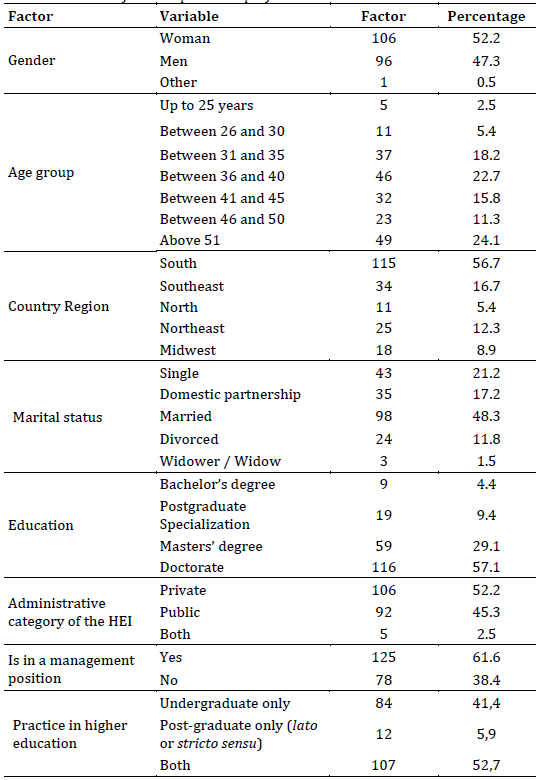
This quantitative, descriptive, and correlational study included 203 professors affiliated with various HEIs in Brazil, as detailed in Table 1. The sample was collected through convenience sampling, based on the researchers' proximity to participants and the interest and availability of those invited, using the snowball technique. Inclusion criteria were: professors working in public or private Brazilian HEIs; with at least one year of experience in higher education; and a minimum teaching workload of 20 hours per week. Exclusion criteria included professors who were on vacation or any type of leave during the data collection period, as well as incomplete questionnaires.
Instruments
Socioprofessional questionnaire contains questions about personal, social and professional aspects of the professors
Cognitive Flexibility Scale (CFS) (Martin & Rubin, 1995; adapted to the Brazilian context by Tomedi et al., 2023) consists of 12 items answered on a 6-point Likert scale (in which 1 = highly disagree and 6 = highly agree) it is a unidimensional scale with reliability of α = .78 (example item: “I can convey an idea in more than one way”).
Job Stress Scale (Alves et al., 2004) consists of 17 items answered in a 4-point Likert scale (in which 1 = never or almost never and 4 = frequently), assessing three dimensions linked to JS, derived from the Demand-Control theory, initially conceptualized by Karasek (1979): (1) Psychological demand (5 items, α = .72, example item: “Does your job require too great a work effort?”), (2) control/autonomy (6 items, α = .63, example item: “Do you have the possibility to decide for yourself how to carry out your work?”), subdivided into skill discretion (α = .56) and decision authority (α = .67), and (3) support (6 items, α = .86, example item: “My co-workers are there for me”), variable introduced by Johnson et al. (1988).
Data collection procedure and ethical concerns
Initial contact with participants was made individually and online (via e-mail and social media) through the researchers’ network. After agreeing to participate, respondents were asked to share the study with their contacts who met the inclusion criteria. Due to the low initial response rate, direct contact was made with academic coordinators of HEIs across different regions of Brazil and with unions via e-mail, WhatsApp, and social media platforms (Facebook and Instagram), requesting dissemination of the study among faculty members or union associates. Additionally, invitation posts were published in Facebook groups related to faculty job openings and official HEI groups.
The project was reviewed and approved by the Research Ethics Committee of the Meridional Faculty under approval number 40501820.9.0000.5319. Furthermore, all requirements of the National Health Council (Conselho Nacional de Saúde (CNS)), and resolutions 466/2012 and 510/2016 were followed. Participants were provided with a link to the research instruments via an online Google Forms questionnaire, where they were directed to the scales only after agreeing to the Informed Consent Form (ICF), which was available on the first page of the online form, and after confirming they met the inclusion and exclusion criteria.
Data analysis procedure
Data were analyzed using descriptive and inferential statistics in SPSS version 23.0. Before conducting the analyses, assumptions were checked. The Shapiro-Wilk test indicated that the Cognitive Flexibility variable was not normally distributed (W(203) = 0.97, p = .001). Therefore, non-parametric tests were used. Spearman correlation, Kruskal-Wallis test, Chi-square test, and linear regression were performed. The interpretation of effect size for correlation coefficients was ± 0.10 for small effect, ± 0.30 for moderate effect, and ± 0.50 for large effect (Cohen, 1988). Results were considered statistically significant when p ≤ .05. Since the CFS does not yet have established cutoff points for the Brazilian population, the sample mean was calculated to classify participants as having high or low CF, following the scale authors’ guidelines (Martin & Anderson, 1998; Martin & Rubin, 1995). Accordingly, scores ≥ 58 were classified as high cognitive flexibility, and scores ≤ 57 as low.
For the analysis of JS according to the demand-control-support model, the sample’s mean scores for demands (15.8) and control (20.7) were identified and used as cutoff points between quadrants. Scores above the mean were considered high demand (≥ 16 points) and high control (≥ 21 points), while scores below the mean were classified as low demand (≤ 15 points) and low control (≤ 20 points). The same procedure was applied to the social support dimension (M = 19.6; high support ≥ 20 points; low support ≤ 19 points). To categorize participants into the quadrants, those with demand and control scores above the mean were placed in the “active” quadrant; those with demand above the mean but control below the mean were classified in the “high-strain” quadrant. Participants with both demand and control scores below the sample mean were classified in the “passive” quadrant, while those with low demand but control above the mean were assigned to the “low-strain” quadrant.
Results
Regarding CF, the sample had a mean score of (M = 57.54), with approximately 52 % (n = 106) of the sample classified as having high levels of CF based on the adopted parameters. The descriptive results of CF and the dimensions of JS are presented in Table 2.
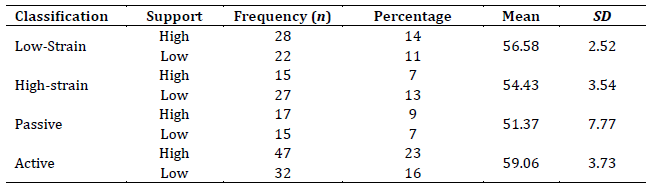
The descriptive analysis of JS using the JSS indicated that most participants reported high psychological demand (59.6 %, n = 121), high perceived control/autonomy (63.5 %, n = 129), and high support (52.7 %, n = 107). Additionally, 39 % of participants were classified within the active quadrant (n = 79; M = 59.06, SD = 3.73) (Table 3). The Kruskal-Wallis test revealed significant differences in levels of CF among the quadrants in the model (H(3) = 9.742; p = .021).
Table 4 presents the results of the Spearman correlations conducted between CF and the dimensions of JS. Scores on the CFS showed a weak but positive correlation with all dimensions of JS, indicating that higher levels of CF were associated with higher levels of perceived control/autonomy, psychological demands, and social support in the workplace.
Comparisons between means indicated that individuals located in the active quadrant presented significantly higher levels of CF compared to those in the passive (p = .008), low-strain (p = .034), and high-strain (p = .047) quadrants. No significant differences were found among the remaining groups.
Regarding sociodemographic characteristics, no differences in CF were observed by gender; however, women reported experiencing higher psychological demands (X 2 = 5.997; p = .050) and higher levels of control (X 2 = 7.260; p = .027). Among educational levels, graduates showed a higher prevalence of low demand (X 2 = 10.430; p = .012), while individuals with doctoral degrees were more frequently associated with high control (X 2 = 11.242; p = .010). No differences were found across educational levels regarding support or CF. As for professional variables, a higher prevalence of high control was observed among professors in public HEIs (X 2 = 9.757; p = .008). Faculty members holding management positions showed a higher frequency of high CF (X 2 = 6.358; p = .012), as well as a greater prevalence of high control (X 2 = 3.876; p = .049). When analyzing levels of teaching, faculty members who taught at both undergraduate and graduate levels demonstrated a greater prevalence of high CF (X 2 = 15.671; p ≤ .001).
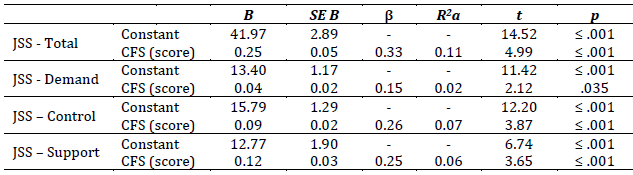
Finally, a linear regression analysis was conducted to examine the predictive value of cognitive flexibility for job stress (see Table 5). The model obtained for the total JSS score was considered moderate (F(1.201) = 24.86, R = 0.332), with cognitive flexibility (CFS) explaining approximately 11 % of the variance. The models for the JSS dimensions -Demand (F(1.201) = 4.50, R = 0.148), Control (F(1.201) = 14.96, R = 0.263), and Support (F(1.201) = 13.32, R = 0.249)- were considered to have small effect sizes, and the greatest explained variance was found for the control dimension (7 %), followed by support (6 %) and demand (2 %).
Discussion
This study investigated the predictive role of CF in JS among faculty members in HEIs. Regarding CF, the sample presented a mean score (M = 57.54), similar to that found by Martin and Anderson (1998) in a study conducted with university students (M = 57). A study with adults over the age of 60 (Johnco et al., 2014) also reported similar mean scores (M = 58.13). Although these averages are close, caution is required in their interpretation, as it is not possible, based on this dataset, to make generalizations about the measure or the construct. Nevertheless, these results allow for exploratory considerations regarding the scale’s performance across different populations, such as the stability of responses.
In the collected sample, there was a predominance of faculty members with high CF. The literature indicates that, beyond its benefits for workers' well-being (Fernández-Sánchez et al., 2018; Yağan & Kaya, 2022; Yu et al., 2019), CF may play an important role in facilitating interpersonal relationships (Schwenke et al., 2020), as cognitive rigidity can be a barrier to socialization processes (Tariq & Adil, 2020). These findings are even more relevant when considering that a harmonious relationship between faculty and students is fundamental to the well-being of both groups, and conversely, work overload and intensification can result in suffering and occupational illness (Iriarte Redín & Erro-Garcés, 2020; Nicholls et al., 2022; Vivian et al., 2020). Considering CF as a competency (Yu et al., 2019) and one that can be trained (Archer et al., 2024; Buitenweg et al., 2017; Harel et al., 2023), it is plausible that a higher likelihood of selecting cognitively flexible individuals for academic (and management) positions results in a greater prevalence of such traits in the sample.
Regarding JS, the findings related to high levels of demand are consistent with previous studies that highlight excessive pressure for productivity (Campos et al., 2020; Pinho et al., 2023) and work overload-particularly in terms of the quantity and quality of scientific production and student supervision (Hungulo, 2019; Vivian et al., 2020). These demands are especially pronounced when responsibilities extend beyond teaching duties (Koetz et al., 2013). The high level of control reported may be explained by the nature of faculty work, which is often tied to compliance with institutional regulations and the fulfillment of HEI requirements. These obligations can limit opportunities for creativity (Li et al., 2018), despite an increasing trend of diminishing faculty autonomy in academic decision-making (Monteiro et al., 2022). As for the support factor, responses were relatively evenly distributed, with a slight majority perceiving high levels of support (52.7 %, n = 107). This finding contrasts with the literature, which often identifies strained collegial relationships as a major contributor to high levels of JS among faculty (Nicholls et al., 2022; Vivian et al., 2020).
A positive correlation was observed between CF and the dimensions of JS, suggesting that higher levels of perceived demands, autonomy, and support are associated with higher levels of CF. Evidence in the literature indicates that organizational strategies-such as employee empowerment, the assignment of complex tasks, the provision of continuous feedback, and the encouragement of creativity in the workplace-can foster the development of CF (Li et al., 2018). This may offer a possible explanation for the observed association between higher job demands and elevated levels of CF. However, in another study that investigated the relationship between burnout and CF, the authors reported a positive correlation between burnout and CF (Fernández-Sánchez et al., 2018), which contrasts with the commonly held view that exhaustion tends to impair cognitive functioning. An important consideration is that Burnout Syndrome-one of the potential consequences of chronic exposure to JS (Fernández-Sánchez et al., 2018; Prado, 2016)-can negatively impact professional performance, including a reduced capacity to apply CF (Lemonaki et al., 2021). Therefore, although a positive correlation was found in the present study and is echoed in some findings in the literature, it is essential to consider that prolonged exposure to stressors may lead to the emergence of other difficulties over time.
Specifically, the relationship between CF and social support has been explored in other studies. One study found a positive correlation between cognitive rigidity and certain temperaments, suggesting that higher levels of CF may be associated with better social adjustment (Tariq & Adil, 2020). Another study observed that a positive perception of social support can moderate the negative effects of JS in highly demanding jobs (Birolim et al., 2019). Additionally, a study involving 60 participants also found a positive association between CF and social interactions (Schwenke et al., 2020).
Once a link between demand and CF was established, it is pertinent to explore the various characteristics that may influence this relationship. Proactivity, for example, is recognized as a protective factor for professors (Pyhältö et al., 2021), although it often requires engagement in a greater number of activities. Moreover, CF has been found to correlate with creative capacity (Li et al., 2018), which may also influence the level of activity in the workplace. Added to this is the role of stimulation in the development of CF (Buitenweg et al., 2017; Li et al., 2018). Therefore, frequent engagement with tasks that demand advanced problem-solving skills may contribute to a higher self-perception of one’s CF.
The weak but positive association between control and CF suggests that lower levels of CF may interfere with one’s perception of control at work. A study conducted with professors in Israel found that lower levels of CF were associated with a greater presence of maladaptive coping strategies in response to stress (Harel et al., 2023). Coping strategies refer to the ways in which individuals respond to stressful situations (Pyhältö et al., 2021; Sousa et al., 2009). It is plausible to argue that professors with lower CF may struggle to identify behavioral alternatives, as this ability is intrinsically linked to mental flexibility (Martin & Anderson, 1998; Martin & Rubin, 1995). As a result, they may feel less capable of managing the situations to which they are exposed (Keith et al., 2015). Conversely, individuals with more developed CF are likely to possess a broader repertoire of perceived alternatives, which may contribute to a stronger sense of control in the face of work-related demands.
Most of the professors were classified within the active quadrant of the model, meaning they perceived both high psychological demands and high control over their work, a combination that suggests a certain level of balance (Alves et al., 2004). Notably, individuals in the active quadrant demonstrated higher levels of CF compared to those in other quadrants. It is possible that individuals in this group, in addition to having greater autonomy to manage their tasks (high control), are also stimulated by the demands of their work (high demand), which may contribute to the development of CF through continuous learning and adaptation, as previously discussed (Buitenweg et al., 2017; Li et al., 2018). This dynamic could help explain the significant differences observed between the quadrants. Individuals in other quadrants may not experience the same balance, either due to a lack of autonomy to apply CF (as in the high-strain and passive quadrants), or insufficient demands to stimulate its use (as in the passive and low-strain quadrants).
The quadrant representing the most adaptive condition and the lowest risk for the development of health problems is the low-strain quadrant (Alves et al., 2004; Karasek, 1979), in which only 28.57 % of participants in this study were classified. However, having high autonomy at work, in isolation, is not a predictor of mental health, as faculty members still reported elevated stress levels due to the high psychological demands involved (Alves et al., 2004). Moreover, the analyses between CF and the JS quadrants of the Karasek model indicated that individuals in the active and low-strain quadrants obtained higher scores on the CSF-B compared to those in the passive quadrant, reinforcing the idea that higher CF may be related to lower JS (Tomedi et al., 2023) and may play a protective role in coping with stressful situations (Harel et al., 2023).
The literature reports comparisons between socio-professional groups and JS, such as differences between genders, administrative categories in HEIs, undergraduate versus graduate teaching assignments, workloads, and length of employment. When comparing genders, studies have shown that female faculty report higher levels of JS (Areias & Guimarães, 2004; Iriarte Redín & Erro-Garcés, 2020; ILO, 2016; Stefano et al., 2013) and are more vulnerable to the negative impacts of stress, including physical and mental illness, than their male counterparts (Areias & Guimarães, 2004; Pinho et al., 2023). These findings are consistent with the results of the present study. Such outcomes may also be partly explained by social expectations placed disproportionately on women-for example, the expectation to provide more support to students-along with additional barriers related to race and ethnicity, reflected in unequal access to opportunities (Nicholls et al., 2022). These factors may influence the perception of JS.
It was found that doctorate degree professors showed a higher frequency of high control, although no significant differences were found for other factors. This finding is supported by a study in which nearly 70 % of specialists showed lower scores in the social domain of a quality of life assessment when compared to master’s and doctoral degree holders, which may be explained by the greater workload stability often enjoyed by those with graduate-level qualifications (Koetz et al., 2013). Simultaneously, faculty members still pursuing undergraduate degrees demonstrated lower demand levels, possibly due to a lighter workload compared to those with doctorates.
Among teachers in public institutions, a higher prevalence of high control was observed compared to their counterparts in private institutions. In several countries, including Brazil, there has been a reduction in teachers’ ability to influence institutional decisions (Cong-Lem, 2024; Monteiro et al., 2022). However, the job stability provided by public institutions-often cited as a primary motivation for entering the public sector (Monteiro et al., 2022)-may contribute to maintaining a sense of freedom and autonomy in work-related aspects, as public roles tend to be less influenced by market fluctuations and organizational strategies (Sousa et al., 2009). It is also important to note that the freedom for expression and innovation often associated with faculty members in private higher education has been increasingly questioned in recent years (Oliveira, 2020).
CF is associated with higher performance in tasks that require decision-making (Fernández-Sánchez et al., 2018), and it also plays an important role in establishing interpersonal relationships (Schwenke et al., 2020; Yağan & Kaya, 2022). It was found that individuals in management positions presented higher levels of CF, which may be related to these considerations. People in management roles may be more likely to assume such positions due to their performance in tasks that require the application of CF, which could explain the prevalence of higher scores among these participants. In addition, as previously mentioned, it is expected that some learning occurs in the course of carrying out work-related tasks, which aligns with the finding that faculty members who teach at multiple levels (undergraduate and graduate) showed a higher prevalence of high CF-suggesting that exposure to tasks of varying complexity contributes to the development of CF.
This highlights the importance of institutions remaining attentive to the high proportion of faculty members experiencing elevated levels of stress and who may require interventions. After all, work environments play a key role in reducing such stress. Coping can be one of the resources individuals use to deal with JS, which presupposes the use of behavioral and/or cognitive strategies that enable workers to adjust their behaviors and cognitive functions (Prado, 2016; Pyhältö et al., 2021; Sousa et al., 2009) so that, through interaction with environmental stressors, their functioning is not negatively affected (Prado, 2016). For example, evasive coping strategies-such as distracting oneself from stressful stimuli-may be used when workload is high (Iriarte Redín & Erro-Garcés, 2020). In this study, CF is understood not only as a cognitive function (Reis et al., 2010) but also as a competence (Harel et al., 2023; Yu et al., 2019), and its development may serve as a coping strategy, becoming a protective factor against JS.
CF demonstrated a small predictive power when considering individual dimensions but explained 11 % of the variance in the total score of the JSS. Thus, individuals with higher CF tend to perceive higher levels of control, demands, and social support in the work context, which reinforces the role of CF in the tendency to identify a greater number of problem-solving alternatives, engage in more activities-which may result in a higher perception of stress-and possibly facilitate the establishment of interpersonal relationships (Schwenke et al., 2020). Moreover, it is important not to overlook the potential learning effect of CF stemming from the stimulation imposed by work demands (Buitenweg et al., 2017; Li et al., 2018). Another relevant aspect concerns the CFS as a tool, which can be influenced by factors such as depressed mood and anxiety; specifically, the more anxious or negative the mood, the lower the CF scores (Johnco et al., 2014). This possibility must be taken into account when interpreting the data obtained, since emotional factors may affect CFS results-particularly considering the high levels of stress observed in the sample of the present study.
Based on this study, HEIs may develop actions to reduce psychosocial risk factors or to promote protective factors through interventions focused on stress management and the development of strategies to cope with stressors (Archer et al., 2024; Halat et al., 2024; Sousa et al., 2009). Examples include the establishment of clear and achievable goals, improvements in the quantity and quality of training and development programs, and greater investment in workplace quality-of-life initiatives (Prado, 2016). At the same time, it is emphasized that such interventions should be customized to the institution’s context (Halat et al., 2024). Other protective factors-aligned with the main causes of JS among faculty and with the findings of this study-include increasing salaries, reducing working hours, improving the distribution of tasks across roles, enhancing communication systems, and encouraging greater participation in institutional policy and planning, as these actions would allow faculty members to face fewer psychological demands and have greater control and autonomy over their work (Hungulo, 2019; Prado, 2016).
Conclusions
The results obtained allowed for the observation of how different dimensions of JS-control/autonomy, demand, and support-according to the adopted model, relate to CF. Regression analysis suggests that CF plays a predictive role in overall job stress scores. Although the effect is small, it should be considered in light of the mental health of higher education faculty. In this sense, the findings are relevant as they propose an integration between cognitive functions-specifically CF-and the theoretical model of stress, offering practical applications. The dissemination of this knowledge may provide a foundation for the development of new theoretical frameworks and tools aimed at improving professors’ quality of life and well-being.
It is important to acknowledge some limitations of the present study. There was a high concentration of participants residing in the state of Rio Grande do Sul, which, combined with the absence of a sample size calculation, may limit the generalizability of the findings. Another aspect to consider is the use of self-report measures, which are subject to potential response biases that were not addressed in the presented results. For future research, it is recommended to include participants with varying levels of education, specifying their fields of training and professional practice, as well as examining other occupational groups that may be vulnerable to workplace stress-such as banking, healthcare, and security professionals, as this study focused exclusively on higher education faculty.
The results also lead to practical conclusions. Emphasis is placed on the importance of reducing psychological demands and strengthening autonomy over the work-related activities of faculty members, with the aim of reaching the low-strain quadrant-which would provide healthier working conditions. It is also concluded that CF may serve a protective role in the dimensions of social support and control. Therefore, implementing training and activities that foster the development of this competency within the context of higher education may serve as a viable strategy for mitigating risk factors associated with work-related illnesses, particularly in relation to occupational stress.
References
-
Alves, M. G. M., Chor, D., Faersteinc, E., de S Lopes, C., & Werneck, G. L. (2004). Versão resumida da “job stress scale”: adaptação para o português. Revista de Saúde Pública, 38(2), 164-171. https://doi.org/10.3233/WOR-2012-0549-2963
» https://doi.org/10.3233/WOR-2012-0549-2963 -
Archer, R., Lewis, R., Yarker, J., Zernerova, L., & Flaxman, P. E. (2024). Increasing workforce psychological flexibility through organization-wide training: Influence on stress resilience, job burnout, and performance. Journal of Contextual Behavioral Science,
33 https://doi.org/10.1016/j.jcbs.2024.100799
» https://doi.org/10.1016/j.jcbs.2024.100799 -
Areias, M. E. Q., & Guimarães, L. A. M. (2004). Gênero e estresse em trabalhadores de uma universidade pública do estado de São Paulo. Psicologia em Estudo, 9(2), 255-262. https://doi.org/10.1590/S1413-73722004000200011
» https://doi.org/10.1590/S1413-73722004000200011 - Athayde, M., & Souza, W. F. de. (2019). Saúde do trabalhador. Em P. F. Bendassolli & J. E. Borges-Andrade (Eds.), Dicionário de psicologia do trabalho e das organizações (pp. 597-605). Artesã.
-
Birolim, M. M., Mesas, A. E., González, A. D., Santos, H. G. D., Haddad, M. D. C. F. L., & Andrade, S. M. D. (2019). Trabalho de alta exigência entre professores: associações com fatores ocupacionais conforme o apoio social. Ciência & Saúde Coletiva, 24(4), 1255-1264. https://doi.org/10.1590/1413-81232018244.08542017
» https://doi.org/10.1590/1413-81232018244.08542017 -
Buitenweg, J. I. V., van de Ven, R. M., Prinssen, S., Murre, J. M. J., & Ridderinkhof, K. R. (2017). Cognitive Flexibility Training: A Large-Scale Multimodal Adaptive Active-Control Intervention Study in Healthy Older Adults. Frontiers in Human Neuroscience, 11 https://doi.org/10.3389/fnhum.2017.00529
» https://doi.org/10.3389/fnhum.2017.00529 -
Campos, T. C., Véras, R. M., & Araújo, T. M. de. (2020). Trabalho docente em universidades públicas brasileiras e adoecimento mental: Uma revisão bibliográfica. Revista Docência do Ensino Superior, 10, e015193, 1-19. https://doi.org/10.35699/2237-5864.2020.15193
» https://doi.org/10.35699/2237-5864.2020.15193 -
Cohen, J. (1988). Statistical power analysis for the behavioral sciences Lawrence Erlbaum. https://doi.org/10.4324/9780203771587
» https://doi.org/10.4324/9780203771587 -
Cong-Lem, N. (2024). Teacher agency for change and development in higher education: A scoping literature review. International Journal of Educational Reform, 0(0). https://doi.org/10.1177/10567879231224744
» https://doi.org/10.1177/10567879231224744 -
Fernández-Sánchez, J. C., Pérez-Mármol, J. M., Santos-Ruiz, A. M., Pérez-García, M., & Peralta-Ramírez, M. I. (2018). Burnout y funciones ejecutivas em personal sanitário de Cuidados Paliativos: influencia del desgaste professional sobre la toma de decisiones. Anales del Sistema Sanitario de Navarra, 41(2), 171-180. https://doi.org/10.23938/assn.0308
» https://doi.org/10.23938/assn.0308 -
Halat, D. H., Sami, W., Soltani, A., & Malki, A. (2024). Mental health interventions affecting university faculty: a systematic review and meta-analysis. BMC Public Health, 24 https://doi.org/10.1186/s12889-024-20402-2
» https://doi.org/10.1186/s12889-024-20402-2 -
Harel, O., Hemi, A., & Levy-Gigi, E. (2023). The role of cognitive flexibility in moderating the effect of school-related stress exposure. Scientific Reports, 13(1), 5241. https://doi.org/10.1038/s41598-023-31743-0
» https://doi.org/10.1038/s41598-023-31743-0 -
Iriarte Redín, C., & Erro-Garcés, A. (2020). Stress in teaching professionals across Europe. International Journal of Educational Research, 103 https://doi.org/10.1016/j.ijer.2020.101623
» https://doi.org/10.1016/j.ijer.2020.101623 -
Johnco, C., Wuthrich, V. M., & Rapee, R. M. (2014). Reliability and validity of two self-report measures of cognitive flexibility. Psychological Assessment, 26(4), 1381-1387. https://doi.org/10.1037/a0038009
» https://doi.org/10.1037/a0038009 -
Johnson, J. V., & Hall, E. M. (1988). Job strain, work place social support, and cardiovascular disease: a cross-sectional study of a random sample of the Swedish working population. American Journal of Public Health, 78(10), 1336-1342. https://doi.org/10.2105/ajph.78.10.1336
» https://doi.org/10.2105/ajph.78.10.1336 -
Karasek, R. A. (1979). Job demands, job decision latitude, and mental strain: Implications for job redesign. Administrative Science Quarterly, 24(2), 285-308. https://doi.org/10.2307/2392498
» https://doi.org/10.2307/2392498 -
Keith, J., Velezmoro, R., & O’Brien, C. (2015). Correlates of cognitive flexibility in veterans seeking treatment for posttraumatic stress disorder. The Journal of Nervous and Mental Disease, 203(4), 287-293. https://doi.org/10.1097/nmd.0000000000000280
» https://doi.org/10.1097/nmd.0000000000000280 -
Koetz, L., Rempel, C., & Périco, E. (2013). Qualidade de vida de professores de Instituições de Ensino Superior Comunitárias do Rio Grande do Sul. Ciência & Saúde Coletiva, 18(4), 1019-1028. https://doi.org/10.1590/S1413-81232013000400015
» https://doi.org/10.1590/S1413-81232013000400015 -
Lemonaki, R., Xanthopoulou, D., Bardos, A. N., Karademas, E. C., & Simos, P. G. (2021). Burnout and job performance: a two-wave study on the mediating role of employee cognitive functioning. European Journal of Work and Organizational Psychology, 30(5), 692-704. https://doi.org/10.1080/1359432x.2021.18
» https://doi.org/10.1080/1359432x.2021.18 -
Li, H., Li, F., & Chen, T. (2018). A motivational-cognitive model of creativity and the role of autonomy. Journal of Business Research, 92, 179-188. https://doi.org/10.1016/j.jbusres.2018.07.025
» https://doi.org/10.1016/j.jbusres.2018.07.025 -
Liu, Y., Yi, S., & Siwatu, K. O. (2023). Mediating roles of college teaching self-efficacy in job stress and job satisfaction among Chinese university teachers. Frontiers in Education, 7. https://doi.org/10.3389/feduc.2022.1073454
» https://doi.org/10.3389/feduc.2022.1073454 -
Malik, A., Javaid, F., & Gardezi, S. B. B. (2024). Impact of job stress on mental health and work-life balance: Cross-sectional study. Journal of Professional & Applied Psychology, 5(4), 640-652. https://doi.org/10.52053/jpap.v5i4.322
» https://doi.org/10.52053/jpap.v5i4.322 -
Martin, M. M., & Anderson, C. M. (1998). The cognitive flexibility scale: Three validity studies. Communication Reports, 11(1), 1-9. https://doi.org/10.1080/08934219809367680
» https://doi.org/10.1080/08934219809367680 -
Martin, M. M., & Rubin, R. B. (1995). A new measure of cognitive flexibility. Psychological Reports, 76(2), 623-626. https://doi.org/10.2466/pr0.1995.76.2.623
» https://doi.org/10.2466/pr0.1995.76.2.623 -
Monteiro, A. N. P., Vaz, B. R. G., & Mota, R. S. de. (2022). Desvalorização profissional dos professores. Revista Latino-Americana de Estudos Científicos, 3(13). https://doi.org/10.55470/relaec.37379
» https://doi.org/10.55470/relaec.37379 -
Munusamy, S., Ramasamy, S., & Sukir, N. I. (2024). A systematic review on mental health and its associated factors among educators in Malaysia. BMC Public Health, 24 https://doi.org/10.1186/s12889-024-19855-2
» https://doi.org/10.1186/s12889-024-19855-2 -
Nicholls, H., Nicholls, M., Tekin, S., Lamb, D., & Billings, J. (2022). The impact of working in academia on researchers’ mental health and well-being: A systematic review and qualitative meta-synthesis. PLOS ONE, 17(5). https://doi.org/10.1371/journal.pone.0268890
» https://doi.org/10.1371/journal.pone.0268890 -
Oliveira, D. A. (2020). Políticas conservadoras no contexto escolar e autonomia docente. Práxis Educativa (Brasil), 15, 1-18. https://doi.org/10.5212/PraxEduc.v.15.15335.069
» https://doi.org/10.5212/PraxEduc.v.15.15335.069 -
Organização Internacional do Trabalho. (2016). Workplace Stress: A Collective Challenge https://www.ilo.org/safework/info/publications/WCMS_466547/lang--en/index.htm
» https://www.ilo.org/safework/info/publications/WCMS_466547/lang--en/index.htm -
Pinheiro, F. P. H. A., Santana, A. R., Melo, L. A. de, Rodrigues, C. S. D., Camelo, E., Cunha, E. S., Aguiar, H. M. T., & Alves, J. J. P. (2023). Trabalho docente no contexto da expansão universitária. Estudos e Pesquisas em Psicologia, 23(1), 92-114. https://doi.org/10.12957/epp.2023.75303
» https://doi.org/10.12957/epp.2023.75303 -
Pinho, P. de S., Freitas, A. M. C., Patrão, A. L., & Aquino, E. M. L. (2023). Estresse ocupacional, saúde mental e gênero entre docentes do ensino superior: revisão integrativa. Saúde E Sociedade, 32(4). https://doi.org/10.1590/S0104-12902023210604pt
» https://doi.org/10.1590/S0104-12902023210604pt -
Prado, C. E. P. (2016). Estresse ocupacional: causas e consequências. Revista Brasileira de Medicina do Trabalho, 14(3), 285-289. https://doi.org/10.5327/Z1679-443520163515
» https://doi.org/10.5327/Z1679-443520163515 -
Pyhältö, K., Pietarinen, J., Haverinen, K., Tikkanen, L., & Soini, T. (2021). Teacher burnout profiles and proactive strategies. European Journal of Psychology of Education, 36(1), 219-242. https://doi.org/10.1007/s10212-020-00465-6
» https://doi.org/10.1007/s10212-020-00465-6 -
Reis, A. L. P. P. D., Fernandes, S. R. P., & Gomes, A. F. (2010). Estresse e fatores psicossociais. Psicologia: ciência e profissão, 30(4), 712-725. https://doi.org/10.1590/S1414-98932010000400004
» https://doi.org/10.1590/S1414-98932010000400004 -
Rodrigues, C. M. L., Faiad, C., & Facas, E. P. (2020). Fatores de risco e riscos psicossociais no trabalho: definição e implicações. Psicologia: Teoria e Pesquisa, 36, 1-9. https://doi.org/10.1590/0102.3772e36nspe19
» https://doi.org/10.1590/0102.3772e36nspe19 -
Schwenke, D., Goregliad Fjaellingsdal, T., Bleichner, M. G., Grage, T., & Scherbaum, S. (2020). An approach to social flexibility: Congruency effects during spontaneous word-by-word interaction. PLOS ONE, 15(6), e0235083. https://doi.org/10.1371/journal.pone.0235083
» https://doi.org/10.1371/journal.pone.0235083 -
Sousa, I. F., Mendonça, H., Zanini, D. S., & Nazareno, E. (2009). Estresse ocupacional, coping e burnout. Revista EVS-Revista de Ciências Ambientais e Saúde, 36(1), 57-74. https://doi.org/10.18224/est.v36i1.1018
» https://doi.org/10.18224/est.v36i1.1018 -
Stefano, S. R., Bonanato, F. M., & Raifur, L. (2013). Estresse em funcionários de uma instituição de ensino superior: Diferenças entre gênero. Revista Economia e Gestão, 13(31), 73-92. https://doi.org/10.5752/p.1984-6606.2013v13n31p73
» https://doi.org/10.5752/p.1984-6606.2013v13n31p73 -
Tariq, S., & Adil, A. (2020). Rigidity as mediator between temperaments and social adjustment: A comparative study of teachers of madaris and schools of Pakistan. Archive for the Psychology of Religion, 42(2), 194-210. https://doi.org/10.1177/0084672420921956
» https://doi.org/10.1177/0084672420921956 -
Tolfo, S. R., Monteiro, J. K., Heloani, J. R. M. (2023). Processos psicossociais e saúde no trabalho: Perspectivas teóricas, instrumentos e gerenciamento. Revista de Psicologia da IMED (RPI), 15(2), 76-94. https://doi.org/10.18256/2175-5027.2023.v15i2.4941
» https://doi.org/10.18256/2175-5027.2023.v15i2.4941 - Tomedi, J. M., Oliveira, C. R., & Gonçalves, J. (2023). Tradução e adaptação transcultural da Cognitive Flexibility Scale para o português brasileiro (Manuscrito não publicado).
-
Vazquez, A. C. S., Pianezolla, M., & Hutz, C. S. (2018). Assessment of psychosocial factors at work: A systematic review. Estudos de Psicologia (Campinas), 35(1). https://doi.org/10.1590/1982-02752018000100002
» https://doi.org/10.1590/1982-02752018000100002 -
Vivian, C., Trindade, L. D. L., & Vendruscolo, C. (2020). Prazer e sofrimento docente: estudo na pós-graduação stricto sensu. Revista Psicologia Organizações e Trabalho, 20(3), 1064-1071. http://doi.org/10.17652/rpot/2020.3.18949
» http://doi.org/10.17652/rpot/2020.3.18949 -
Yağan, F., & Kaya, Z. (2025). The relationship between psychological resilience and job stress in academicians: The mediating role of cognitive flexibility. Current Psychology, 44(7), 5609-5626. https://doi.org/10.1007/s12144-025-07599-0
» https://doi.org/10.1007/s12144-025-07599-0 -
Yousaf, H. Q., Naseer, M., Ahmed, M., & Rehman, S. (2025). Navigating job demands: The relationship of psychological well-being, anxiety, depression, and social support in university teachers’ job performance. Current Psychology, 44(7), 5609-5626. https://doi.org/10.1007/s12144-025-07599-0
» https://doi.org/10.1007/s12144-025-07599-0 -
Yu, C., Beckmann, J. F., & Birney, D. P. (2019). Cognitive flexibility as a meta-competency. Estudios de Psicología, 40(3), 563-584. https://doi.org/10.1080/02109395.2019.1656463
» https://doi.org/10.1080/02109395.2019.1656463 -
Zhao, W., Liao, X., Li, Q., Jiang, W., & Ding, W. (2022). The relationship between teacher job stress and burnout: A moderated mediation model. Frontiers in Psychology, 12 https://doi.org/10.3389/fpsyg.2021.784243
» https://doi.org/10.3389/fpsyg.2021.784243